

Taxes
What Is a Capital Allowance in the UK? Accountant Explains

Table of Contents
- The Tax Relief Most UK Businesses Do Not Claim Fully
- What Are Capital Allowances?
- What Qualifies for Capital Allowances?
- All UK Capital Allowances: Complete 2026 Rates and Conditions
- The 2026 WDA Rate Reduction: What It Means for Your Business
- How Capital Allowances Are Calculated: Worked Examples
- Example 1: Annual Investment Allowance (AIA) -- Most Common Situation
- Example 2: Writing Down Allowance (WDA) -- Pool Balance in 2026/27
- Example 3: Full Expensing (Limited Company, AIA Already Exhausted)
- Capital Allowances on Business Cars: CO2 Rates for 2026
- How to Claim Capital Allowances: The Practical Process
- Conclusion
- Frequently Asked Questions (FAQ)
The Tax Relief Most UK Businesses Do Not Claim Fully
When a business buys a laptop, a piece of machinery, a commercial van, or a new piece of office equipment, accounting rules require the cost is spread across the asset's useful life as depreciation -- not deducted immediately as a business expense. But HMRC does not allow accounting depreciation as a tax deduction. Instead, it provides a separate, more structured system of tax relief for capital asset purchases: capital allowances. TapTax: 'Capital allowances are the tax relief you claim instead of deducting the cost of long-lasting business assets, such as equipment, machinery, vehicles, computers and certain fixtures, as ordinary running expenses. Because accounting depreciation is not allowable for tax, HMRC lets you deduct the cost of these capital items from your taxable profit through capital allowances instead.'For many UK businesses, capital allowances represent one of the largest and most accessible sources of legitimate tax reduction available. The Annual Investment Allowance (AIA) alone allows 100% of qualifying asset costs up to £1 million to be deducted from taxable profits in the year of purchase -- meaning a business spending £200,000 on qualifying plant and machinery can reduce its taxable profit by £200,000 in that year, producing an immediate Corporation Tax saving of £50,000 at the 25% rate. ProTax (May 29, 2026): 'Get these right, and you can reduce your Corporation Tax bill significantly in years when you invest in your business. Get them wrong, and you leave money on the table.'
2026 is a significant year for capital allowances. Two major changes have taken effect: the Writing Down Allowance on the main pool reduced from 18% to 14% from April 2026, announced in the Autumn 2025 Budget; and a new 40% First Year Allowance was introduced from 1 January 2026, available to all business types including sole traders and businesses with leased assets. This guide explains every UK capital allowance in plain language, including who qualifies, the 2026 rate changes, worked examples, business vehicle rules, and the practical steps for claiming.
What Are Capital Allowances?
Capital allowances are the HMRC-approved mechanism for businesses to claim tax relief on the purchase of capital assets -- items with lasting value used in the business over more than one accounting period. UKCalculator (May 2026): 'Capital allowances are the UK tax system's mechanism for allowing businesses to deduct the cost of capital assets against their taxable profits. Unlike regular business expenses (rent, wages, software subscriptions), capital assets -- machinery, vehicles, IT equipment -- cannot be written off in a single year through accounting depreciation for tax purposes. Instead, HMRC provides a separate system of tax deductions known as capital allowances.'The key distinction is between revenue expenditure and capital expenditure. Revenue expenditure is the day-to-day cost of running the business -- rent, wages, insurance, utilities, marketing -- and is generally deductible from taxable profits as incurred. Capital expenditure is the cost of acquiring or improving assets used in the business over multiple years: machinery, equipment, vehicles, IT hardware, commercial buildings. Capital expenditure cannot be deducted as a regular expense; instead it is claimed through capital allowances. ProTax (May 2026): 'Capital allowances are the mechanism HMRC uses to give businesses tax relief on capital expenditure, which is the cost of buying assets like equipment, machinery, vehicles, and IT. Rather than deducting depreciation from your accounting profit, you claim capital allowances on your Corporation Tax return at HMRC statutory rates.'
Capital allowances are available to: sole traders (claimed on Self Assessment to reduce taxable income); partnerships (reducing taxable profits and each partner's Income Tax); and limited companies (claimed on the Corporation Tax return to reduce Corporation Tax). UKCalculator: 'Capital allowances are available to sole traders, partnerships, and limited companies alike.'
UK capital allowances 2026 -- key figures: AIA: £1m at 100%. Main pool WDA: 14% from April 2026 (down from 18%). New 40% FYA from January 2026. Full Expensing: 100%, no cap (limited companies, new assets). — ProTax (May 29, 2026): 'Two significant changes apply to capital allowances in 2026: main pool WDA reduced from 18% to 14% from 1 April 2026; new 40% FYA introduced from 1 January 2026.' UKCalculator (May 2026): 'AIA limit £1,000,000 -- made permanent in Spring Budget 2023.' Accountancy Partnership: '40% FYA can be used by unincorporated businesses, and for assets used for leasing.' Saffery (January 2026): 'WDA reduces from 18% to 14% from April 2026.'
What Qualifies for Capital Allowances?
The range of qualifying assets is broader than many business owners realise. The central category is plant and machinery -- a broad term in UK tax law extending well beyond factory equipment:- Plant and machinery: The core qualifying category. Includes: manufacturing machinery and equipment; computers, servers, and IT hardware; office furniture and equipment; tools; commercial refrigerators, ovens, and catering equipment; security systems and CCTV; agricultural machinery; construction equipment. Covers most tangible assets a business uses to operate, provided they are used in the business and not held for sale.
- Commercial vehicles: Vans, lorries, trucks, and other commercial vehicles qualify for AIA and WDA. Cars are excluded from AIA and Full Expensing and have their own CO2-based rules.
- Integral features of buildings: Eight specific items built into or forming part of a commercial building qualify as special rate expenditure: lifts and escalators; heating and cooling systems; air conditioning; hot and cold water systems; electrical and lighting systems; external solar shading. Accountancy Partnership: 'Integral features of a building, including lifts and escalators, heating and cooling systems, air conditioning, hot and cold-water systems, electrical and lighting systems.' These enter the special rate pool at 6% WDA (or AIA up to £1m).
- Long-life assets: Assets with an expected useful economic life of 25 years or more. Includes: large industrial turbines; some heavy manufacturing machinery; certain pipelines and power generation equipment. These enter the special rate pool at 6% WDA (or AIA up to £1m limit).
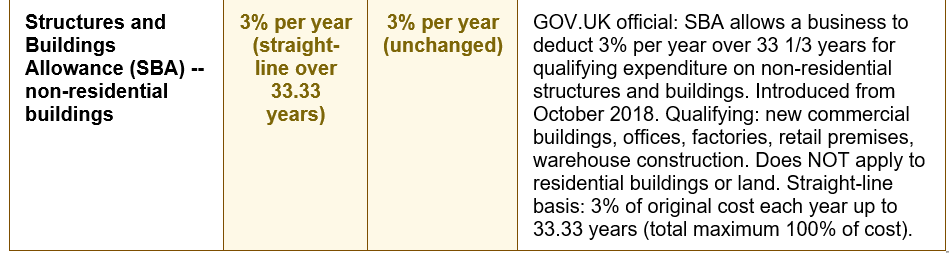
- Non-residential structures and buildings (SBA): GOV.UK: 'Structures and Buildings Allowances allow a business to deduct 3% per year over 33 1/3 years for qualifying expenditure on non-residential structures and buildings.' Covers new commercial buildings, factories, warehouses, offices, retail premises. Does NOT cover land (never qualifies for any capital allowance) or residential buildings.
- Assets that do NOT qualify: Land; residential properties; assets not used for business purposes. Cars have their own specific CO2-based rules. Assets used partly privately must be apportioned -- only the business-use proportion qualifies.
All UK Capital Allowances: Complete 2026 Rates and Conditions
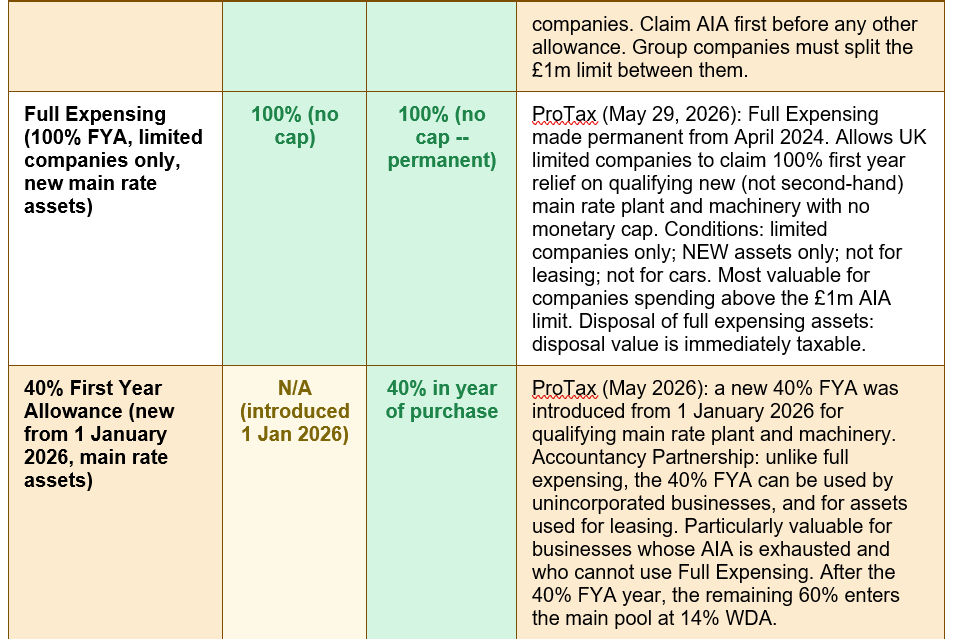
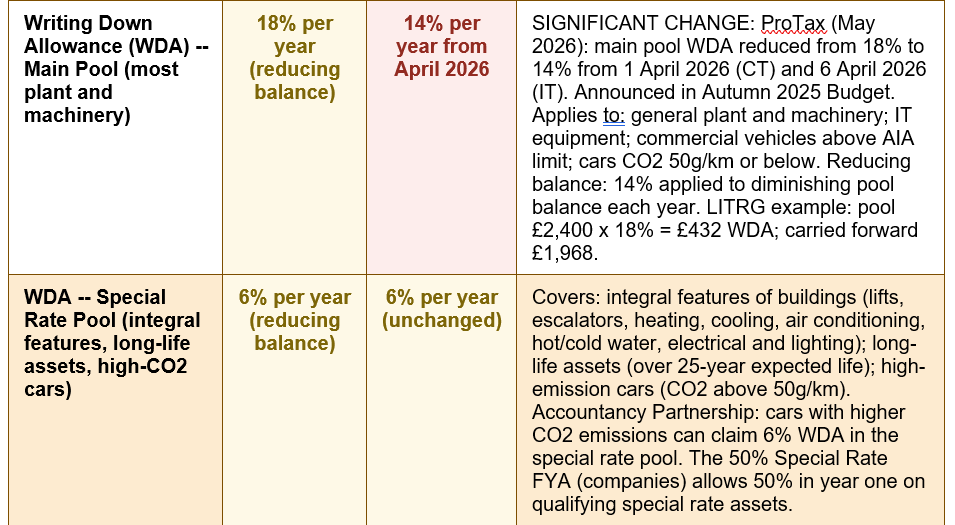
The following table maps every major UK capital allowance type with 2025/26 and 2026/27 rates side by side, including the key 2026 changes: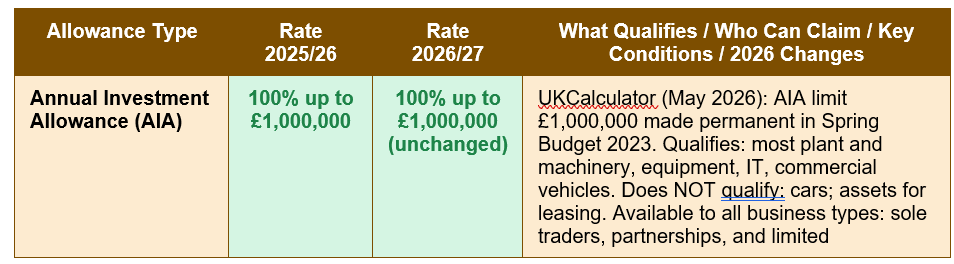
The 2026 WDA Rate Reduction: What It Means for Your Business
The most impactful change to capital allowances in 2026 is the reduction in the main pool WDA from 18% to 14%, effective from 1 April 2026 for Corporation Tax and 6 April 2026 for Income Tax. Saffery (January 2026): 'Within the 2025 Autumn Budget the chancellor announced that the rate of WDA for main pool plant and machinery will reduce from 18% to 14% from April 2026.' DepreciationsCalculator (March 2026): 'Main rate WDA change (18% to 14%) takes effect 1 April 2026 for Corporation Tax and 6 April 2026 for Income Tax.'The WDA rate reduction affects businesses with assets in the main pool that exceed the AIA limit, or assets that cannot benefit from Full Expensing or the 40% FYA. A £100,000 main pool balance generates £18,000 of WDA in 2025/26 but only £14,000 in 2026/27 -- a reduction of £4,000 in relief per year, worth £1,000 in Corporation Tax at the 25% rate. LITRG provides the worked example: main pool balance £2,400, WDA for 2025/26 = £2,400 x 18% = £432. Written down value carried forward: £1,968.
For most businesses making regular capital investment, the WDA rate change is mitigated by the AIA (still 100% on qualifying purchases up to £1m) and by Full Expensing and the 40% FYA. The WDA primarily affects expenditure already partly written down in previous years sitting as a carried-forward pool balance. ProTax (May 2026): the introduction of the 40% FYA alongside the WDA reduction gives businesses a meaningful first-year relief option even when AIA is exhausted.
The relationship between AIA, Full Expensing, and the 40% FYA: Three allowances provide first-year relief on qualifying assets, each applying to different circumstances. The AIA (100%, £1m cap, all business types, new and second-hand) is always claimed first and is most flexible. Full Expensing (100%, no cap, limited companies only, new assets only, no leasing) is used for expenditure above the £1m AIA limit by companies. The new 40% FYA (40%, all business types from January 2026, new assets, leasing assets eligible) fills the gap for sole traders and partnerships spending above the AIA limit, and for leasing assets where Full Expensing is unavailable. ProTax (May 2026): 'A new 40% First Year Allowance was introduced from 1 January 2026 for qualifying main rate plant and machinery.' After the 40% FYA year, the remaining 60% enters the main pool and is written down at 14% WDA per year.
How Capital Allowances Are Calculated: Worked Examples
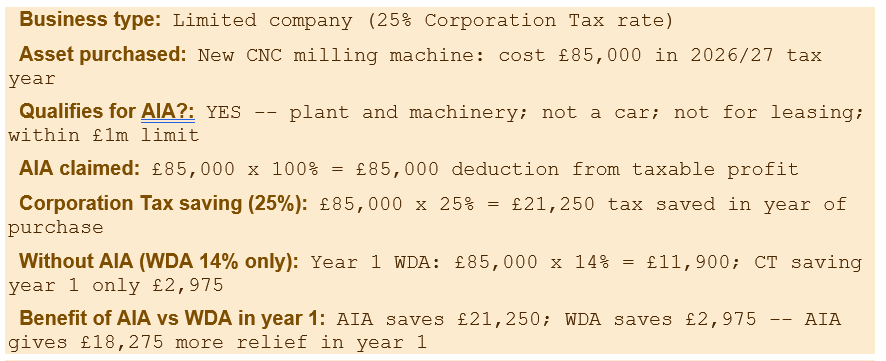
Example 1: Annual Investment Allowance (AIA) -- Most Common Situation
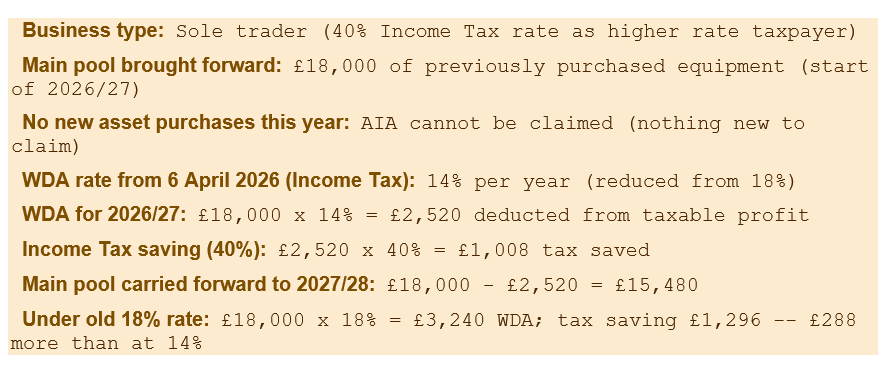
Example 2: Writing Down Allowance (WDA) -- Pool Balance in 2026/27
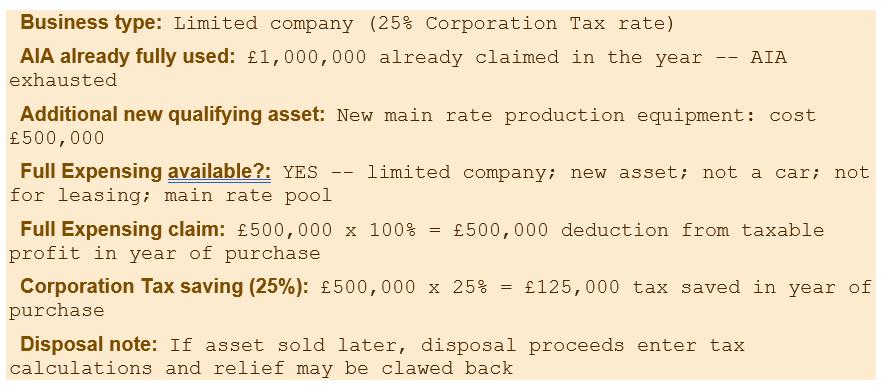
Example 3: Full Expensing (Limited Company, AIA Already Exhausted)
Capital Allowances on Business Cars: CO2 Rates for 2026
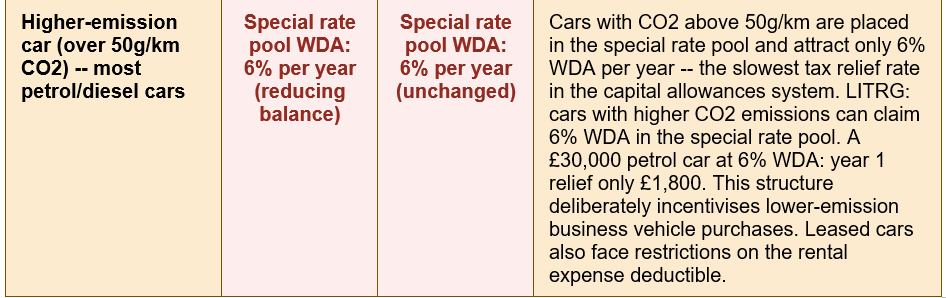
Cars are the most commonly misunderstood asset category in the capital allowances system. TapTax: 'Cars are a special case. They count as plant and machinery, but they are deliberately excluded from the Annual Investment Allowance and are almost always relieved through the Writing Down Allowance instead, at a rate that depends on their CO2 emissions.' No AIA, Full Expensing, or 40% FYA applies to cars: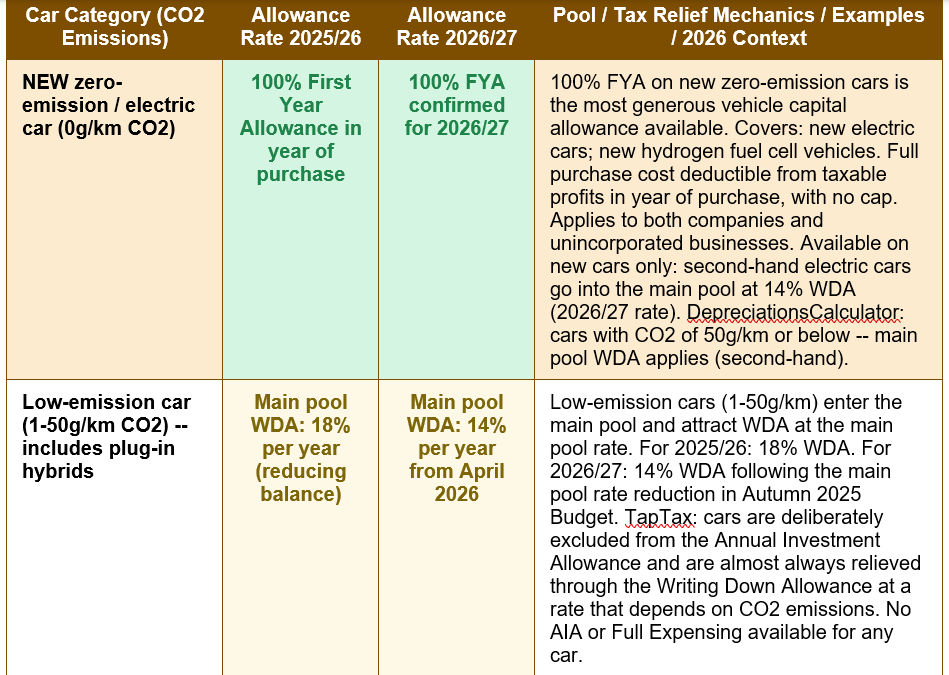
How to Claim Capital Allowances: The Practical Process
Capital allowances are claimed as part of the annual tax return. The process differs by business type:- Limited companies -- Corporation Tax return (CT600): Capital allowances are claimed in the supplementary capital allowances pages of the CT600. The claim lists qualifying asset additions during the accounting period, identifies the allowance type (AIA, Full Expensing, 40% FYA, WDA), calculates the deductions, and reduces the profit chargeable to Corporation Tax. The CT600 and supporting computations must be filed online within 12 months of the accounting period end.
- Sole traders and partnerships -- Self Assessment return (SA100): TapTax: 'You can claim capital allowances as part of your tax return -- just remember to tick the option to claim so that these pages are available.' Capital allowances reduce taxable self-employment income on the Self Assessment return. The annual deadline is 31 January (online) or 31 October (paper) following the end of the 5 April tax year.
- Keep detailed records: Every claim requires supporting documentation: invoices showing purchase date, supplier, asset description, and cost; records of business use (particularly for mixed-use assets); and the date the asset was first brought into use in the business. Asset registers (maintained spreadsheets or accounting software asset modules) are the standard approach for businesses with multiple capital assets.
- Pooling and disposal: Assets are tracked within pools (main pool, special rate pool) on a reducing balance basis. When an asset is sold or scrapped, the disposal proceeds are deducted from the relevant pool. If disposal proceeds exceed the pool balance, a balancing charge arises (additional taxable income). If the pool balance exceeds disposal proceeds on cessation of trade, a balancing allowance may be available.
CAPITAL ALLOWANCES DECISION GUIDE -- 2026: STEP 1: Is the expenditure on a qualifying asset? Not land, not residential property, not non-business assets. YES: proceed. STEP 2: Is it a car? YES: check CO2 emissions. 0g/km new = 100% FYA. 1-50g/km = main pool 14% WDA. Over 50g/km = special rate pool 6% WDA. NO: continue. STEP 3: Eligible for AIA? Most plant and machinery -- not cars, not leased assets. YES: claim AIA first up to £1m limit for 100% deduction in year of purchase. STEP 4: Expenditure above £1m AIA limit? Limited company buying new asset: claim Full Expensing (100%, no cap). Sole trader/partnership/leasing asset: claim 40% FYA (from 1 January 2026). Remaining pool balance: 14% WDA per year (from April 2026). STEP 5: Integral building features or long-life assets? Use AIA (£1m cap) first. Remaining: special rate pool 6% WDA or 50% SR FYA (companies). STEP 6: Non-residential building or structure (not land)? SBA: 3% straight-line per year over 33.33 years. ALWAYS: consult an accountant before significant capital expenditure -- the right allowance choice in the right year can save thousands in tax.
FIVE CAPITAL ALLOWANCE MISTAKES THAT COST UK BUSINESSES MONEY: (1) NOT CLAIMING AIA ON ALL QUALIFYING ASSETS. Many businesses claim WDA on assets that qualify for AIA, losing the timing benefit of 100% first-year relief. Always check if the asset qualifies for AIA before defaulting to WDA. (2) ASSUMING CARS QUALIFY FOR AIA. TapTax: cars are deliberately excluded from the Annual Investment Allowance. Trying to claim AIA on a company car is a common error -- CO2 emissions determine the allowance, and no AIA or Full Expensing is available on any car regardless of emissions. (3) IGNORING THE WDA RATE CHANGE FROM APRIL 2026. ProTax (May 2026): main pool WDA reduced from 18% to 14%. Tax planning models based on 18% WDA will overestimate future relief on pool balances. Update financial models to reflect 14% from the applicable date. (4) NOT CLAIMING CAPITAL ALLOWANCES ON INTEGRAL BUILDING FEATURES. Lifts, heating systems, air conditioning, electrical systems, and lighting in commercial buildings all qualify for capital allowances -- many businesses overlook these, claiming only the SBA on the overall building cost. Integral features can be claimed under AIA for faster relief. (5) MIXING PERSONAL AND BUSINESS ASSET COSTS. Assets used partly for private purposes -- particularly company cars used for commuting -- must have capital allowances reduced to the business-use proportion. Over-claiming on mixed-use assets is a common HMRC enquiry trigger.
Conclusion
Capital allowances are one of the most significant sources of legitimate tax relief available to UK businesses investing in their operations. The Annual Investment Allowance at 100% on up to £1 million of qualifying plant and machinery expenditure provides immediate, complete tax relief in the year of purchase for the vast majority of UK business investment decisions. Full Expensing extends this 100% relief without a monetary cap for limited companies buying new main rate assets. The new 40% First Year Allowance, introduced from 1 January 2026, extends accelerated first-year relief to all business types and leasing assets. And the Structures and Buildings Allowance provides 3% annual relief on qualifying commercial building expenditure over 33.33 years.2026 brings two significant changes every UK business should understand: the main pool WDA rate reduction from 18% to 14% from April 2026 (announced in the Autumn 2025 Budget), and the introduction of the 40% FYA from 1 January 2026. Together, these changes make maximising claims under the AIA and Full Expensing (for companies) or the 40% FYA (for unincorporated businesses) in the year of purchase even more important, as the ongoing WDA rate on pool balances has reduced. ProTax (May 2026) captures the essential message: 'Get these right, and you can reduce your Corporation Tax bill significantly in years when you invest in your business. Get them wrong, and you leave money on the table.'
Always verify current rates at GOV.UK and consult a qualified accountant for advice specific to your business type, accounting period, and investment decisions. The tax savings available from correctly structured capital allowance claims are often substantial -- and the cost of getting them wrong, in left-on-the-table tax relief, can be equally significant.
Frequently Asked Questions (FAQ)
What is a capital allowance in the UK?A capital allowance is a UK tax relief allowing businesses to deduct the cost of qualifying capital assets from taxable profits, instead of accounting depreciation (which HMRC does not accept as a tax deduction). TapTax: 'Capital allowances are the tax relief you claim instead of deducting the cost of long-lasting business assets, such as equipment, machinery, vehicles, computers and certain fixtures, as ordinary running expenses. Because accounting depreciation is not allowable for tax, HMRC lets you deduct the cost of these capital items from your taxable profit through capital allowances instead.' The system applies to all business types: sole traders, partnerships, and limited companies. Main types in 2026: Annual Investment Allowance (100% up to £1m); Full Expensing (100%, no cap, limited companies buying new assets); the new 40% First Year Allowance (from January 2026, all business types); Writing Down Allowances on the main pool (14% from April 2026) and special rate pool (6%); and the Structures and Buildings Allowance (3% per year for non-residential buildings).
What is the Annual Investment Allowance (AIA) for 2026?
The AIA provides 100% tax relief on qualifying plant and machinery expenditure in the year of purchase, up to £1 million. UKCalculator (May 2026): 'This allows businesses to deduct 100% of qualifying plant and machinery costs (up to £1 million) from taxable profits in the year of purchase. The limit was set at £1 million from January 2019 and made permanent in Spring Budget 2023.' Available to sole traders, partnerships, and limited companies. The £1m limit applies per business and must be split between group companies. Qualifying: most plant and machinery, IT equipment, commercial vehicles. Excluded: cars (CO2-based WDA instead); assets primarily for leasing. Always claim AIA first, before WDA or other allowances, as it provides the most immediate relief.
What is the Writing Down Allowance rate in 2026?
The WDA is the annual percentage deduction applied to the pool balance of qualifying assets not fully relieved through AIA, Full Expensing, or FYAs. It operates on a reducing balance basis. ProTax (May 29, 2026): 'Main pool WDA reduced from 18% to 14% from 1 April 2026 for Corporation Tax and 6 April 2026 for Income Tax.' Rates for 2026: main pool (most plant, machinery, IT, commercial vehicles, low-emission cars): 14% per year from April 2026 (down from 18%). Special rate pool (integral building features, long-life assets, higher-emission cars CO2 above 50g/km): 6% per year (unchanged). LITRG worked example: main pool balance £2,400 x 18% WDA (2025/26) = £432 deduction; written down value carried forward £1,968. At 14% (2026/27): £2,400 x 14% = £336 deduction. The WDA rate change was announced in the Autumn 2025 Budget.
What is Full Expensing and who can claim it?
Full Expensing is a 100% First Year Allowance for UK limited companies on qualifying new main rate plant and machinery, with no monetary cap. ProTax (May 29, 2026): 'Full Expensing was made permanent from April 2024 and allows UK limited companies to claim 100% first year relief on qualifying new (not second-hand) main rate plant and machinery with no monetary cap. This is the most generous capital allowance available to companies spending above the £1 million AIA limit.' Conditions: limited companies only (not sole traders or partnerships); NEW assets only (not second-hand); not cars; not assets for leasing; not special rate assets. GOV.UK: 'Full expensing is a 100% first-year allowance which allows companies to claim a deduction from taxable profits equal to 100% of their qualifying expenditure in the year incurred.' Disposal rule: Saffery (January 2026): 'Where an asset on which full expensing has been claimed is disposed of, the disposal value is immediately taxable.' Take advice before disposing of full expensing assets.
Can sole traders claim capital allowances?
Yes -- capital allowances are fully available to sole traders and self-employed individuals, reducing taxable self-employment income and therefore Income Tax liability. UKCalculator (May 2026): 'Capital allowances are available to sole traders, partnerships, and limited companies alike.' Main allowances for sole traders in 2026: AIA (100% up to £1m -- same limit as limited companies); the new 40% First Year Allowance from 1 January 2026 (Accountancy Partnership confirms available to unincorporated businesses, filling the gap for spending above AIA limit that Full Expensing covers for companies only); Writing Down Allowances on the main pool (14% from 6 April 2026) and special rate pool (6%); SBA (3% per year on qualifying commercial building expenditure). Full Expensing is NOT available to sole traders -- this is the key difference from limited companies. TapTax: 'You can claim capital allowances as part of your tax return -- just remember to tick the option to claim so that these pages are available.' Capital allowances are claimed on the Self Assessment return, reducing taxable profit on the self-employment pages.

0 Comments Comments