

Savings
What Is a Save As You Earn (SAYE) Scheme? UK Guide

SAYE lets you save up to £500 a month from net pay for three or five years, then buy shares in your employer at a discount of up to 20% — with no Income Tax, no National Insurance, and the option to shelter gains in an ISA. Around 1.5 million UK employees are currently enrolled. Here’s how it works.

The defining appeal of SAYE is its combination of upside participation and downside protection. If the share price rises during the saving period, the employee can buy shares at the lower locked-in price and immediately benefit from the gain. If the share price falls below the option price, the employee simply takes their savings back in cash, with no loss and no obligation to buy the shares. In a well-designed scheme with a meaningful discount, the financial case for joining is compelling: the worst outcome is a risk-free savings account with a government-set bonus; the best outcome is a significant gain on shares acquired at below-market value, free of Income Tax and National Insurance.
Around 1.5 million UK employees are currently enrolled in SAYE schemes, collectively saving approximately £1.7 billion (UKCalculator.com, March 2026). The total value of SAYE options granted in the tax year ending 2024 was £2.09 billion (JP Morgan Workplace Solutions, December 2025). Despite this scale, participation in SAYE is concentrated among employees of large companies — primarily FTSE 350 businesses — and awareness of the scheme’s full tax advantages remains limited even among those enrolled.
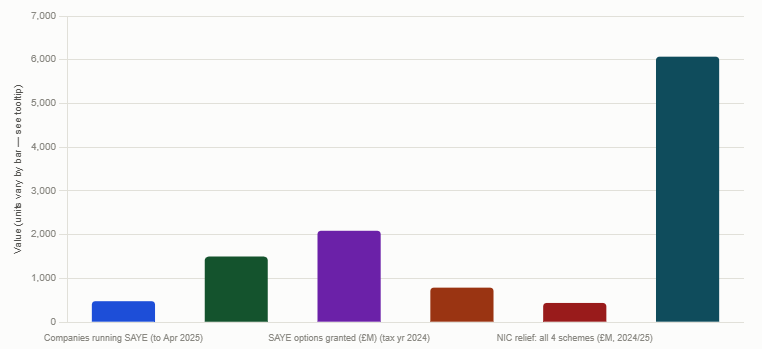
Around 1.5 million UK employees are enrolled in SAYE in 2024/25, saving ~£1.7 billion collectively. 480 companies operated SAYE schemes to 5 April 2025 (HMRC statistics). Total SAYE options granted: £2.09 billion in tax year ending 2024. Average value per SAYE option granted: £6,070 (HMRC data, 2024). Income Tax and NIC relief from all four HMRC-approved schemes in 2024/25: £1.23 billion combined (£790M IT + £440M NIC, RSM UK July 2026).
The critical feature that makes SAYE attractive: the option price is set at the start and does not change, regardless of what happens to the share price during the saving period. If the shares are worth £1.00 at the invitation date and the option price is set at £0.80 (a 20 percent discount), the employee has the right to buy the shares at £0.80 per share at maturity — even if the market price is then £1.50. The gain (£0.70 per share) is not subject to Income Tax or National Insurance.
How the market value is determined for option pricing purposes:
The 20% discount means SAYE gives you a guaranteed head start of up to 20% on shares before the price has moved at all. Even in a flat market, exercising a SAYE option with the maximum discount generates an immediate 25% return on the option price (£0.80 option price vs £1.00 market value = 25% gain calculated as (£1.00 − £0.80) / £0.80).
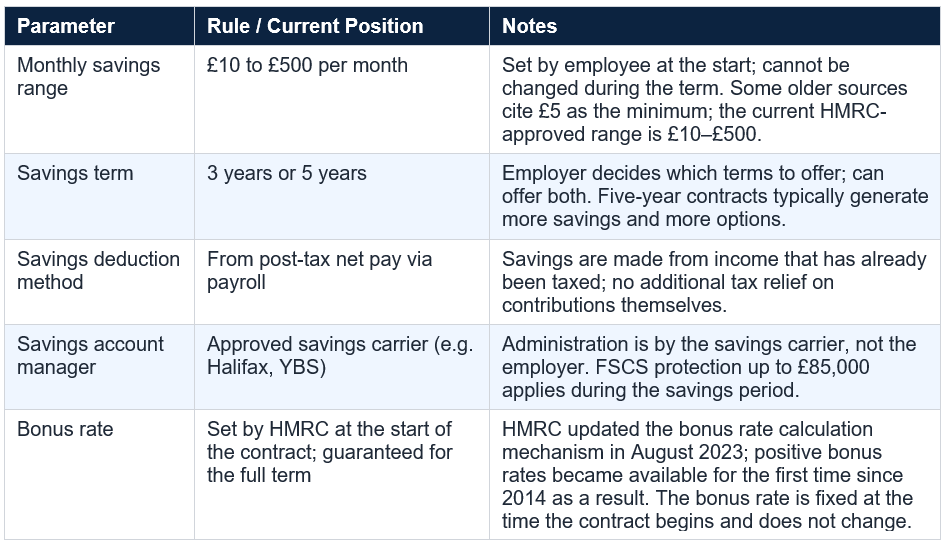

The bonus rate is a fixed sum paid at the end of the contract in addition to the accumulated savings, set by HM Treasury and expressed as an equivalent of a fixed interest rate. Before the 2023 mechanism change, the bonus rate had been 0 percent (i.e. no bonus at all) since 2014 due to the low interest rate environment. The restoration of positive bonus rates since August 2023 makes the savings element of SAYE more attractive as a standalone proposition, even setting aside the share option.
SAYE's Income Tax and NIC exemption at exercise is a rare piece of generosity in the UK tax system. Most employment income — salary, bonus, benefits in kind — is subject to Income Tax and NIC. SAYE exercise income is explicitly carved out of both. For a higher-rate taxpayer who also pays NIC at 2% above the Upper Earnings Limit, a £10,000 gain at SAYE exercise would otherwise attract approximately £4,200 in combined IT and NIC. Inside SAYE, that liability is zero.
The key CGT mechanics for SAYE shares:
The ISA transfer mechanism:
If your SAYE matures and you decide to exercise, act within the 90-day ISA transfer window immediately. Contact your ISA provider or your employer's designated SAYE administrator to arrange the transfer. Don't sell the shares first — if you sell outside the ISA, the gain is realised and potentially subject to CGT. Transfer the shares in specie into the ISA and then decide whether to hold or sell within the ISA wrapper.
To make this concrete: an employee saves £300 per month for three years under a five-year SAYE with an option price of £2.50 per share. After three years, the share price has fallen to £1.80. The option is ‘underwater’ — the option price is above the market price. There is no advantage to exercising. The employee takes their accumulated savings of £10,800 (36 × £300) plus any applicable bonus back in cash. They have lost nothing (assuming inflation-adjusted returns — the cash value is returned in full). The downside risk is essentially the opportunity cost: three years of savings earning only the SAYE bonus rate, rather than being deployed elsewhere.
The one scenario where an employee can lose money in a SAYE scheme: early withdrawal and reinvestment elsewhere at a loss. But by the nature of the scheme — saved from payroll, held by an independent savings carrier — the principal is never at risk from the scheme itself.
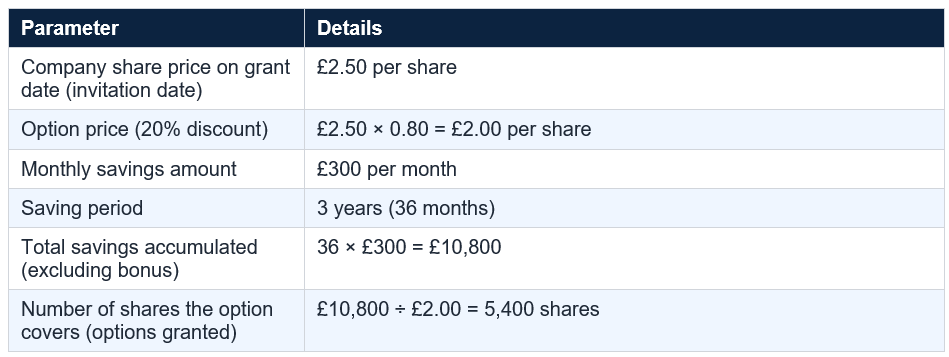
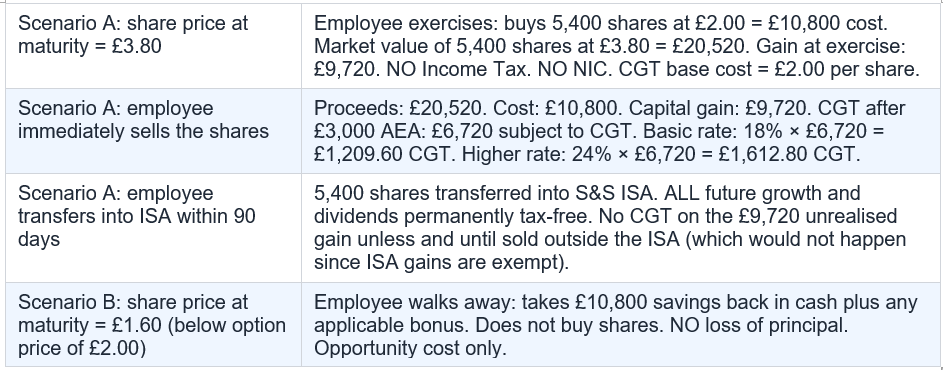
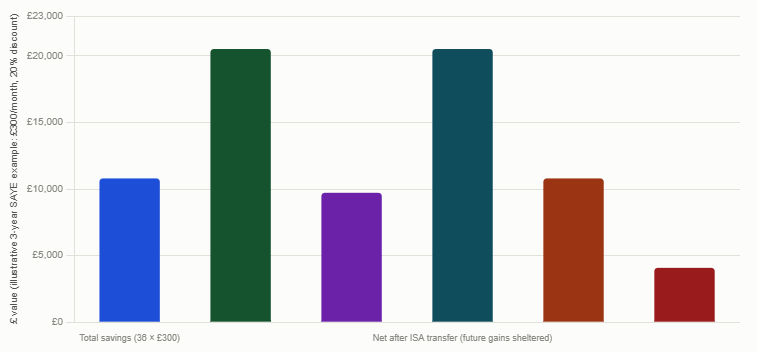
The worked example illustrates the asymmetric nature of SAYE: in the upside scenario, the employee gains £9,720 (a 90% return on the £10,800 saved) entirely free of Income Tax and NIC. Even if CGT is payable on eventual sale, the effective return remains exceptional. In the downside scenario, the employee receives their savings back in full with no penalty.
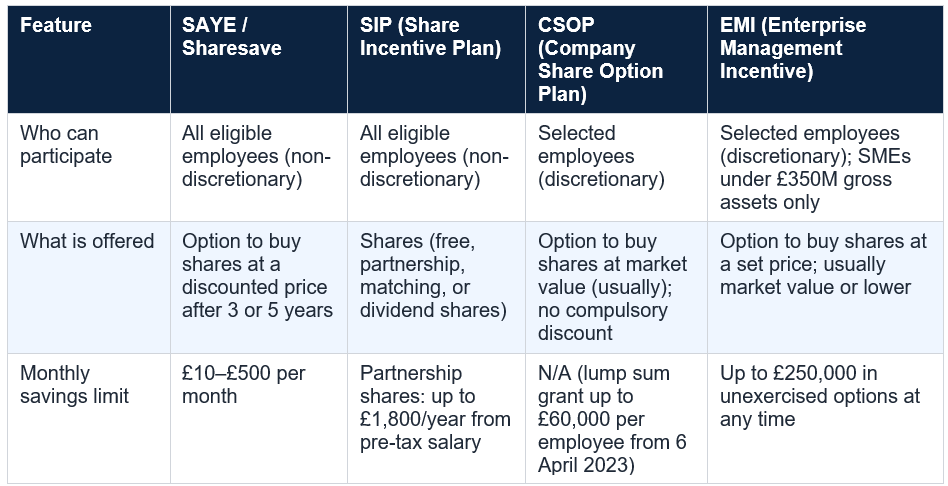
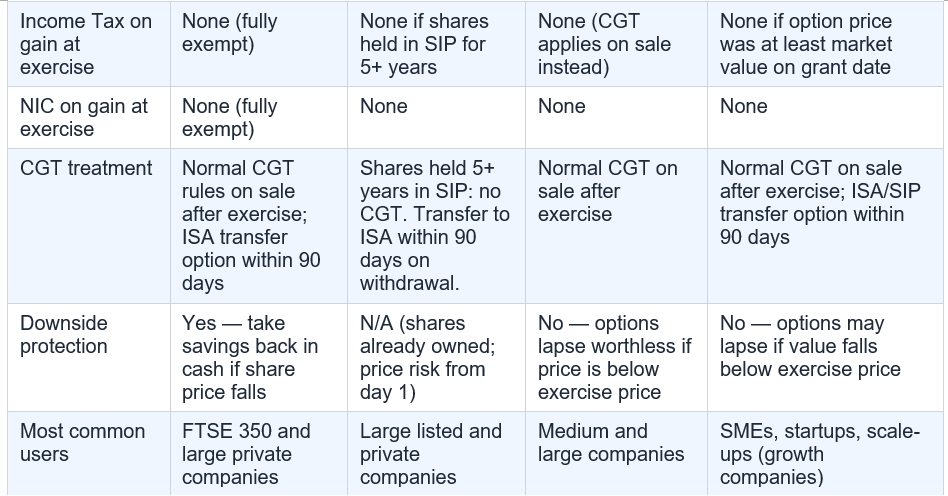
SAYE’s distinctive combination of the fixed discount, the downside protection, and the all-employee availability makes it the most employee-friendly of the four schemes. EMI offers higher individual gains for selected key employees in smaller companies, but does not carry SAYE’s downside protection or non-discretionary availability.
The two most common reasons employees do not join SAYE when their employer offers it are lack of awareness of the tax advantages and concern about locking up savings. The first is addressed by reading a guide like this one. The second is addressed by the downside protection: the worst outcome in SAYE is not a loss, but the return of the savings in cash. For employees who can comfortably commit £10 to £500 per month to a three- or five-year savings contract without touching that money, joining SAYE is almost always the financially correct decision.
The challenge with the SAYE landscape in 2025–26 is not that the scheme is unattractive — it remains extremely attractive — but that the number of companies offering it has fallen and the CGT Annual Exempt Amount has been reduced from £12,300 in 2022/23 to £3,000 in 2024/25 onwards, meaning that employees with larger gains will now pay some CGT on eventual share sales that would previously have been covered by the exemption. The ISA transfer window remains the most effective response: exercising and transferring immediately into a Stocks and Shares ISA within 90 days eliminates all future CGT, regardless of the size of the eventual gain.
A SAYE scheme, also known as Sharesave or a Savings-Related Share Option Scheme, is an HMRC-approved all-employee benefit that allows UK employees to save a fixed monthly amount for three or five years and then use those savings to buy shares in their employer at a price fixed (often at a discount of up to 20%) at the start of the scheme. If the share price rises above the fixed option price, the employee can profit by exercising the option (buying the shares cheaply) with no Income Tax or National Insurance due on the discount. If the share price falls, the employee simply takes their savings back in cash with no loss. SAYE is governed by Schedule 3 of the Income Tax (Earnings and Pensions) Act 2003 and must be approved by HMRC. Approximately 1.5 million UK employees are currently enrolled in SAYE schemes (UKCalculator.com, March 2026).
How much can I save in a SAYE scheme?
SAYE contributions must be between £10 and £500 per month (some older sources cite £5 as the minimum; the current HMRC-approved range is £10–£500 per JP Morgan Workplace Solutions and UKCalculator.com). The amount is set when you join and cannot be changed during the contract term. If you participate in more than one SAYE scheme simultaneously (for example, a 3-year and a 5-year scheme running concurrently), your total monthly savings across all SAYE contracts cannot exceed £500. Contributions are made from your post-tax net pay via payroll deduction and held by an approved savings carrier.
Do I pay tax on SAYE gains?
At the point of exercise (when you use your savings to buy shares at the option price): no Income Tax, no National Insurance. The entire gain from buying shares below their market value is exempt. This applies to gains of any size. When you sell the shares after exercise: Capital Gains Tax may apply. The CGT base cost is the option price (what you paid), not the market value at the time you exercised. CGT rates in 2025/26 and 2026/27 are 18% (basic rate taxpayers) and 24% (higher or additional rate taxpayers). The CGT Annual Exempt Amount is £3,000 — the first £3,000 of net capital gains per year is free of CGT. If you transfer the shares into a Stocks and Shares ISA within 90 days of exercise, all future gains and dividends inside the ISA are permanently tax-free.
What happens if the share price falls below the option price?
If the company's share price falls below the option price at maturity, the employee has no obligation to buy the shares. They simply take their accumulated savings plus any applicable SAYE bonus back in cash, with no loss of principal. This downside protection is one of SAYE's most important features and distinguishes it from other investment decisions. The only cost of not exercising is the opportunity cost — the monthly savings generated only the SAYE bonus rate return rather than any investment return. There is no penalty for choosing not to exercise, and there is no tax on the return of savings (which were already taxed when you earned them).
Can I put SAYE shares into an ISA?
Yes. When a SAYE option matures and you exercise it to acquire shares, you can transfer those shares into a Stocks and Shares ISA within 90 days of exercise without the transfer counting against your annual ISA subscription allowance (£20,000 in 2026/27). The shares are transferred at their market value at the date of transfer; no CGT is triggered by the transfer itself. Once inside the ISA, all future gains in the value of the shares and all dividends are permanently exempt from CGT and Income Tax. This is the most tax-efficient way to handle a large SAYE gain: exercise, transfer to ISA within 90 days, and the future growth is entirely sheltered regardless of how large it becomes.
Is SAYE worth joining if I'm offered it?
For most employees, yes. The key reasons: (1) The maximum 20% discount means you start with an immediate advantage — even if the share price doesn't move, exercising the option generates a 25% return on the option price. (2) The gain at exercise is free of Income Tax and National Insurance, regardless of size. (3) If the share price falls below the option price, you simply take your savings back in cash — no loss of principal. (4) You can transfer shares into an ISA within 90 days, sheltering all future gains permanently. The main reasons not to join: if you cannot commit the monthly savings without financial difficulty; if your employer's share price outlook is very poor; or if you have more pressing financial priorities (e.g. expensive debt). For most employees who can comfortably afford the monthly savings, SAYE is almost always worth joining.
Table of Contents
- What SAYE Is and Why It Matters
- How SAYE Works: The Core Mechanics
- The 20% Discount Explained: How the Option Price Is Set
- The Savings Contract: Terms, Contributions, and Bonus Rates
- The Tax Advantages of SAYE: Income Tax, NICs, and the Discount
- Capital Gains Tax on SAYE: What You Need to Know
- The ISA Transfer Window: Sheltering Gains Permanently
- What Happens at Maturity: Your Three Options
- What Happens If the Share Price Falls? The Downside Protection
- What Happens If You Leave Your Employer During the Term?
- Is SAYE Worth Joining? A Worked Example
- SAYE vs Other Employee Share Schemes: How It Compares
- The HMRC Statistics: How Many People Use SAYE in 2025–26?
- Conclusion: SAYE Is One of the Best Employee Benefits Available
- Frequently Asked Questions
SAYE Worked Example: 3 Years At £300/ Month
UK SAYE Scheme Statistics 2024/25
What SAYE Is and Why It Matters
Save As You Earn — also known as Sharesave or the Savings-Related Share Option Scheme — is one of the most financially valuable employee benefits available in the United Kingdom, and one of the least understood. It is an HMRC-approved scheme introduced under the Finance Act 1980 and now governed by Schedule 3 of the Income Tax (Earnings and Pensions) Act 2003. It allows employees to save a fixed amount from their post-tax salary each month for three or five years, and then use those accumulated savings to buy shares in their employer at a price that was locked in at the start of the scheme — typically at a discount of up to 20 percent below the share price at the time the invitation was made.The defining appeal of SAYE is its combination of upside participation and downside protection. If the share price rises during the saving period, the employee can buy shares at the lower locked-in price and immediately benefit from the gain. If the share price falls below the option price, the employee simply takes their savings back in cash, with no loss and no obligation to buy the shares. In a well-designed scheme with a meaningful discount, the financial case for joining is compelling: the worst outcome is a risk-free savings account with a government-set bonus; the best outcome is a significant gain on shares acquired at below-market value, free of Income Tax and National Insurance.
Around 1.5 million UK employees are currently enrolled in SAYE schemes, collectively saving approximately £1.7 billion (UKCalculator.com, March 2026). The total value of SAYE options granted in the tax year ending 2024 was £2.09 billion (JP Morgan Workplace Solutions, December 2025). Despite this scale, participation in SAYE is concentrated among employees of large companies — primarily FTSE 350 businesses — and awareness of the scheme’s full tax advantages remains limited even among those enrolled.
Around 1.5 million UK employees are enrolled in SAYE in 2024/25, saving ~£1.7 billion collectively. 480 companies operated SAYE schemes to 5 April 2025 (HMRC statistics). Total SAYE options granted: £2.09 billion in tax year ending 2024. Average value per SAYE option granted: £6,070 (HMRC data, 2024). Income Tax and NIC relief from all four HMRC-approved schemes in 2024/25: £1.23 billion combined (£790M IT + £440M NIC, RSM UK July 2026).
How SAYE Works: The Core Mechanics
SAYE operates in two connected phases: a savings phase and an option exercise phase. Understanding both is essential for getting the most from the scheme.Phase 1: The Savings Contract
When the company launches an invitation to join the SAYE scheme, employees who choose to participate enter into a savings contract. They agree to save a fixed monthly amount — from £10 to £500 per month — for either three or five years. The savings are deducted from net pay (after Income Tax and NIC have already been taken) via payroll. The money is held in an account managed by an approved savings carrier (such as Halifax or Yorkshire Building Society), not by the employer. The Financial Services Compensation Scheme (FSCS) protects the savings up to £85,000 per person while they are held in the savings account before exercise.Phase 2: The Share Option
At the same time as the savings contract begins, the employee is granted a share option. This gives them the right — but not the obligation — to buy a specified number of shares in their employer at a price fixed at the start (the ‘option price’ or ‘exercise price’). The number of shares the option covers is calculated by dividing the projected total savings at maturity (including any applicable bonus) by the option price. At maturity, the employee can choose to exercise the option (buy the shares), take their savings back in cash, or in some cases roll over into a new scheme.The critical feature that makes SAYE attractive: the option price is set at the start and does not change, regardless of what happens to the share price during the saving period. If the shares are worth £1.00 at the invitation date and the option price is set at £0.80 (a 20 percent discount), the employee has the right to buy the shares at £0.80 per share at maturity — even if the market price is then £1.50. The gain (£0.70 per share) is not subject to Income Tax or National Insurance.
The 20% Discount Explained: How the Option Price Is Set
The option price is one of the most important features of SAYE and is set by the employer at the time the invitation is issued. HMRC rules allow the option price to be set at up to a 20 percent discount to the market value of the shares on the grant date (the invitation date). The discount is not mandatory — some employers offer less than 20 percent — but the maximum permitted discount is 20 percent.How the market value is determined for option pricing purposes:
- For shares listed on a UK stock exchange (such as the London Stock Exchange or AIM), the market value is typically the closing price of the shares on the business day before the invitation date, or an average of prices over a defined period.
- For unlisted (private) companies, the market value must be agreed in advance with HMRC’s Shares and Assets Valuation team.
- The option price, once set, is fixed for the entire duration of the savings contract — three or five years. It does not adjust for subsequent share price movements, bonus shares, or rights issues (though the terms of the scheme must specify how the option price is adjusted in these events).
The 20% discount means SAYE gives you a guaranteed head start of up to 20% on shares before the price has moved at all. Even in a flat market, exercising a SAYE option with the maximum discount generates an immediate 25% return on the option price (£0.80 option price vs £1.00 market value = 25% gain calculated as (£1.00 − £0.80) / £0.80).
The Savings Contract: Terms, Contributions, and Bonus Rates
The savings contract is the formal agreement between the employee and the approved savings carrier. The key parameters:The bonus rate is a fixed sum paid at the end of the contract in addition to the accumulated savings, set by HM Treasury and expressed as an equivalent of a fixed interest rate. Before the 2023 mechanism change, the bonus rate had been 0 percent (i.e. no bonus at all) since 2014 due to the low interest rate environment. The restoration of positive bonus rates since August 2023 makes the savings element of SAYE more attractive as a standalone proposition, even setting aside the share option.
The Tax Advantages of SAYE: Income Tax, NICs, and the Discount
SAYE’s most distinctive feature is the combination of tax reliefs it provides at the point of exercise. These are available to all participants, regardless of income level, and are not subject to any cap:- No Income Tax on the discount: when an employee exercises their SAYE option — that is, uses their savings to buy the shares at the option price — any gain arising from buying the shares at below-market value is completely exempt from Income Tax. This is the case even where the market value of the shares is substantially above the option price. The Optio Incentives overview (July 2025) confirms: ‘the discount, bonus, and interest are free of Income Tax and NICs.’
- No Income Tax on the SAYE bonus: the bonus paid by the savings carrier at the end of the term (where applicable) is also completely free of Income Tax.
- No National Insurance on the discount or bonus: neither the employee nor the employer pays National Insurance contributions on the gain at exercise or the bonus. This is a significant saving, particularly for higher earners, where the combined employee and employer NIC saving on a substantial gain can be considerable.
- No requirement to report the discount as employment income on a Self Assessment return: because SAYE exercise is specifically exempt from employment income tax, the gain at exercise does not need to be declared as income.
SAYE's Income Tax and NIC exemption at exercise is a rare piece of generosity in the UK tax system. Most employment income — salary, bonus, benefits in kind — is subject to Income Tax and NIC. SAYE exercise income is explicitly carved out of both. For a higher-rate taxpayer who also pays NIC at 2% above the Upper Earnings Limit, a £10,000 gain at SAYE exercise would otherwise attract approximately £4,200 in combined IT and NIC. Inside SAYE, that liability is zero.
Capital Gains Tax on SAYE: What You Need to Know
While the gain at exercise (the discount) is free of Income Tax and NIC, any subsequent increase in the value of the shares after exercise — between the date of purchase and the date of eventual sale — is subject to Capital Gains Tax (CGT) in the normal way.The key CGT mechanics for SAYE shares:
- Cost basis: the base cost for CGT purposes is the option price — the price the employee actually paid for the shares. It is not the market value at the time of exercise. This means the CGT gain is calculated as: market value at sale minus option price, multiplied by the number of shares sold.
- CGT rates in 2025/26 and 2026/27: 18 percent for basic-rate taxpayers on gains from shares; 24 percent for higher-rate and additional-rate taxpayers (rates changed from 10 and 20 percent respectively in the Autumn Budget October 2024).
- CGT Annual Exempt Amount: £3,000 in 2025/26 and 2026/27. The first £3,000 of net capital gains per tax year is free of CGT. SAYE gains below £3,000 (net of other gains and losses) attract no CGT.
- Calculating the gain example: Employee bought shares at the option price of £0.80. At sale, shares are worth £1.50. Gain per share: £0.70. On 1,000 shares: £700 gain. Well within the £3,000 AEA — no CGT. On 10,000 shares: £7,000 gain. Exceeds the AEA by £4,000. Basic-rate taxpayer pays 18% on £4,000 = £720 CGT.
The ISA Transfer Window: Sheltering Gains Permanently
The most powerful — and most commonly overlooked — feature of SAYE maturity is the ability to transfer shares purchased at exercise directly into a Stocks and Shares ISA within 90 days, without the transfer counting against the annual ISA subscription allowance (£20,000 in 2026/27).The ISA transfer mechanism:
- Within 90 days of exercising the SAYE option and acquiring the shares, the employee can transfer those shares into a Stocks and Shares ISA without it being treated as a new ISA subscription.
- The shares are transferred at their market value at the time of transfer. No CGT is triggered by the transfer itself.
- Once inside the ISA, all future growth in the value of the shares — and all dividends paid on them — are permanently free of CGT and Income Tax, indefinitely.
- The transfer into the ISA does not affect the employee’s normal £20,000 annual ISA allowance. They can still contribute up to £20,000 in the same tax year from other sources.
If your SAYE matures and you decide to exercise, act within the 90-day ISA transfer window immediately. Contact your ISA provider or your employer's designated SAYE administrator to arrange the transfer. Don't sell the shares first — if you sell outside the ISA, the gain is realised and potentially subject to CGT. Transfer the shares in specie into the ISA and then decide whether to hold or sell within the ISA wrapper.
What Happens at Maturity: Your Three Options
When the SAYE savings contract ends — at the three-year or five-year point — the employee has a choice about what to do with their accumulated savings. The three options are:- Option 1 — Exercise: use the accumulated savings to buy shares at the option price. This is the financially optimal choice when the current market price of the shares is above the option price. The employee immediately owns shares at a cost below their market value, with no Income Tax or NIC due on the discount. They can then sell the shares immediately, transfer them into an ISA, or hold them.
- Option 2 — Take the cash: simply take the accumulated savings plus any bonus back in cash and walk away. This is the correct choice if the share price has fallen below the option price — there is no point paying £0.80 per share when the shares are currently worth £0.60. The employee receives all their savings back with no loss. There is no tax on the return of the savings themselves (they were saved from post-tax income). There may be a small tax liability on any interest or bonus if it exceeds the Personal Savings Allowance, though HMRC has confirmed the SAYE bonus is tax-free.
- Option 3 — Roll over: in some circumstances — for example, where an employer is acquired and the acquiring company offers SAYE participants the option to roll their savings into a new SAYE scheme at the acquiror — it is possible to continue rather than exercising or taking the cash. The rules around rollover are specific to the circumstances; the employer and savings carrier will advise.
What Happens If the Share Price Falls? The Downside Protection
SAYE’s single most distinctive feature — the one that makes it genuinely unlike most investment decisions — is the downside protection it provides. If the company’s share price falls below the option price at maturity, the employee is not obligated to buy the shares. They simply take their savings back in cash.To make this concrete: an employee saves £300 per month for three years under a five-year SAYE with an option price of £2.50 per share. After three years, the share price has fallen to £1.80. The option is ‘underwater’ — the option price is above the market price. There is no advantage to exercising. The employee takes their accumulated savings of £10,800 (36 × £300) plus any applicable bonus back in cash. They have lost nothing (assuming inflation-adjusted returns — the cash value is returned in full). The downside risk is essentially the opportunity cost: three years of savings earning only the SAYE bonus rate, rather than being deployed elsewhere.
The one scenario where an employee can lose money in a SAYE scheme: early withdrawal and reinvestment elsewhere at a loss. But by the nature of the scheme — saved from payroll, held by an independent savings carrier — the principal is never at risk from the scheme itself.
What Happens If You Leave Your Employer During the Term?
What happens to a SAYE scheme when an employee leaves their employer depends on the reason for leaving and the specific scheme rules. The general HMRC framework:- • Leaving for most reasons within three years of grant: the options lapse and cannot be exercised. The employee receives their accumulated savings back in cash (with the SAYE bonus if the savings carrier rules provide for it at that point). No shares can be purchased.
- • Leaving after three years from grant (on a five-year scheme): the employee may be able to exercise the options within six months of leaving, using the accumulated savings to that point. Check the specific scheme rules.
- • Leaving due to certain ‘good leaver’ reasons: employees who leave due to death, injury, disability, redundancy, or retirement, or because the business is sold or transferred, are typically classified as ‘good leavers’ and may be entitled to exercise their options or receive their savings with interest at any point.
- • Transfer on acquisition: where the employer is acquired by another company, employees are often given the opportunity to exchange their existing SAYE options for new options in the acquiring company, subject to conditions.
- • Company maternity/paternity/adoption leave: periods of statutory leave are typically treated as continuous employment for SAYE purposes; contributions can be suspended during leave and resumed on return.
11. Is SAYE Worth Joining? A Worked Example
The financial case for SAYE is strongest when the maximum discount is offered and the share price rises during the saving period. The following example illustrates both the upside scenario and the downside scenario:The worked example illustrates the asymmetric nature of SAYE: in the upside scenario, the employee gains £9,720 (a 90% return on the £10,800 saved) entirely free of Income Tax and NIC. Even if CGT is payable on eventual sale, the effective return remains exceptional. In the downside scenario, the employee receives their savings back in full with no penalty.
SAYE vs Other Employee Share Schemes: How It Compares
SAYE is one of four HMRC-approved tax-advantaged employee share schemes in the UK. Understanding how it compares to the others helps employees and employers evaluate which is most appropriate:SAYE’s distinctive combination of the fixed discount, the downside protection, and the all-employee availability makes it the most employee-friendly of the four schemes. EMI offers higher individual gains for selected key employees in smaller companies, but does not carry SAYE’s downside protection or non-discretionary availability.
The HMRC Statistics: How Many People Use SAYE in 2025–26?
HMRC publishes annual statistics on tax-advantaged employee share schemes covering the four approved schemes (SAYE, SIP, CSOP, and EMI). The most recent data available covers the tax year ending 5 April 2025, published in July 2026:- 480 UK companies operated SAYE schemes in the tax year to 5 April 2025 (down from 540 in the year to 5 April 2022 — an 11.1 percent decline over the four years to 2025) (Vestd, July 2026, citing HMRC July 2026 statistics; RSM UK, July 2026).
- The fall in the number of SAYE-operating companies reflects a broader trend in which larger established employers are the primary users, while SMEs and growth companies increasingly favour EMI (now 90 percent of all companies running a tax-advantaged scheme) (Vestd, July 2026).
- Despite fewer companies operating SAYE, participation remains high among those that do. Around 1.5 million employees participated in 2024/25, saving approximately £1.7 billion collectively (UKCalculator.com, March 2026).
- The total value of SAYE options granted in the tax year ending 2024 was £2.09 billion, up from £1.97 billion the previous year (JP Morgan Workplace Solutions, December 2025).
- Average value per SAYE option granted: £6,070 per employee in 2024 (Founder Catalyst, April 2026, citing HMRC statistics).
- In the tax year to 2025, employees across all four HMRC-approved share schemes received combined Income Tax relief of £790 million and NIC relief of £440 million (£1.23 billion total) (RSM UK, July 2026).
Conclusion
Save As You Earn is, for the employees of the companies that offer it, one of the most financially rewarding benefits in the UK employment market. The combination of a guaranteed discount of up to 20 percent on company shares, complete exemption from Income Tax and National Insurance at the point of exercise, a government-set savings bonus, downside protection that returns the full savings if the share price falls, and the ability to transfer gains into a Stocks and Shares ISA within 90 days creates a risk-reward profile that is essentially unmatched by any other widely available employee benefit.The two most common reasons employees do not join SAYE when their employer offers it are lack of awareness of the tax advantages and concern about locking up savings. The first is addressed by reading a guide like this one. The second is addressed by the downside protection: the worst outcome in SAYE is not a loss, but the return of the savings in cash. For employees who can comfortably commit £10 to £500 per month to a three- or five-year savings contract without touching that money, joining SAYE is almost always the financially correct decision.
The challenge with the SAYE landscape in 2025–26 is not that the scheme is unattractive — it remains extremely attractive — but that the number of companies offering it has fallen and the CGT Annual Exempt Amount has been reduced from £12,300 in 2022/23 to £3,000 in 2024/25 onwards, meaning that employees with larger gains will now pay some CGT on eventual share sales that would previously have been covered by the exemption. The ISA transfer window remains the most effective response: exercising and transferring immediately into a Stocks and Shares ISA within 90 days eliminates all future CGT, regardless of the size of the eventual gain.
Frequently Asked Questions
What is a SAYE (Save As You Earn) scheme?A SAYE scheme, also known as Sharesave or a Savings-Related Share Option Scheme, is an HMRC-approved all-employee benefit that allows UK employees to save a fixed monthly amount for three or five years and then use those savings to buy shares in their employer at a price fixed (often at a discount of up to 20%) at the start of the scheme. If the share price rises above the fixed option price, the employee can profit by exercising the option (buying the shares cheaply) with no Income Tax or National Insurance due on the discount. If the share price falls, the employee simply takes their savings back in cash with no loss. SAYE is governed by Schedule 3 of the Income Tax (Earnings and Pensions) Act 2003 and must be approved by HMRC. Approximately 1.5 million UK employees are currently enrolled in SAYE schemes (UKCalculator.com, March 2026).
How much can I save in a SAYE scheme?
SAYE contributions must be between £10 and £500 per month (some older sources cite £5 as the minimum; the current HMRC-approved range is £10–£500 per JP Morgan Workplace Solutions and UKCalculator.com). The amount is set when you join and cannot be changed during the contract term. If you participate in more than one SAYE scheme simultaneously (for example, a 3-year and a 5-year scheme running concurrently), your total monthly savings across all SAYE contracts cannot exceed £500. Contributions are made from your post-tax net pay via payroll deduction and held by an approved savings carrier.
Do I pay tax on SAYE gains?
At the point of exercise (when you use your savings to buy shares at the option price): no Income Tax, no National Insurance. The entire gain from buying shares below their market value is exempt. This applies to gains of any size. When you sell the shares after exercise: Capital Gains Tax may apply. The CGT base cost is the option price (what you paid), not the market value at the time you exercised. CGT rates in 2025/26 and 2026/27 are 18% (basic rate taxpayers) and 24% (higher or additional rate taxpayers). The CGT Annual Exempt Amount is £3,000 — the first £3,000 of net capital gains per year is free of CGT. If you transfer the shares into a Stocks and Shares ISA within 90 days of exercise, all future gains and dividends inside the ISA are permanently tax-free.
What happens if the share price falls below the option price?
If the company's share price falls below the option price at maturity, the employee has no obligation to buy the shares. They simply take their accumulated savings plus any applicable SAYE bonus back in cash, with no loss of principal. This downside protection is one of SAYE's most important features and distinguishes it from other investment decisions. The only cost of not exercising is the opportunity cost — the monthly savings generated only the SAYE bonus rate return rather than any investment return. There is no penalty for choosing not to exercise, and there is no tax on the return of savings (which were already taxed when you earned them).
Can I put SAYE shares into an ISA?
Yes. When a SAYE option matures and you exercise it to acquire shares, you can transfer those shares into a Stocks and Shares ISA within 90 days of exercise without the transfer counting against your annual ISA subscription allowance (£20,000 in 2026/27). The shares are transferred at their market value at the date of transfer; no CGT is triggered by the transfer itself. Once inside the ISA, all future gains in the value of the shares and all dividends are permanently exempt from CGT and Income Tax. This is the most tax-efficient way to handle a large SAYE gain: exercise, transfer to ISA within 90 days, and the future growth is entirely sheltered regardless of how large it becomes.
Is SAYE worth joining if I'm offered it?
For most employees, yes. The key reasons: (1) The maximum 20% discount means you start with an immediate advantage — even if the share price doesn't move, exercising the option generates a 25% return on the option price. (2) The gain at exercise is free of Income Tax and National Insurance, regardless of size. (3) If the share price falls below the option price, you simply take your savings back in cash — no loss of principal. (4) You can transfer shares into an ISA within 90 days, sheltering all future gains permanently. The main reasons not to join: if you cannot commit the monthly savings without financial difficulty; if your employer's share price outlook is very poor; or if you have more pressing financial priorities (e.g. expensive debt). For most employees who can comfortably afford the monthly savings, SAYE is almost always worth joining.
0 Comments
Be the first to share your thoughts on this article.