

Investing
What Is a Treasury Bill (T-Bill)? Accountant Explains


Table of Contents
- The Safest Investment in the World
- What Is a Treasury Bill?
- How Do Treasury Bills Work? The Discount Mechanics
- A Real T-Bill Auction: Worked Example from May 2024
- US T-Bill Maturities: The Six Standard Durations in 2026
- How to Buy T-Bills: Competitive vs Non-Competitive Bidding
- Non-Competitive Bidding (Recommended for Most Retail Investors)
- Competitive Bidding (Used by Institutional Investors)
- T-Bills vs T-Notes vs T-Bonds vs UK Gilts: Complete Comparison
- T-Bill Tax Treatment: UK and US Investors
- United States: Federal vs State Tax
- United Kingdom: ISA Shelter and Direct Gilt Access
- Risks and Limitations of Treasury Bills
- Conclusion
- Frequently Asked Questions (FAQ)
The Safest Investment in the World
When investors, central banks, corporations, and governments around the world need the absolute certainty of getting their money back — with a guaranteed return and zero default risk — they turn to one instrument above all others: the Treasury bill. A T-bill is not glamorous. It generates no dramatic returns. Its maturity is measured in weeks, not years. But in a world of investment risk, complexity, and uncertainty, the Treasury bill occupies a unique position: it is the one instrument against which all others are measured, the one security backed by the full faith and credit of the world's largest economy, and the one investment that has never once failed to pay back its investors in full.Britannica's May 2026 analysis confirms the T-bill's dominance in the US government debt market: 'In 2025, T-bills accounted for roughly 75% to 80% of total Treasury issuance.' This means that in terms of total volume, Treasury bills represent by far the most commonly issued form of US government debt — not Treasury bonds, not notes, but short-term bills with maturities of four weeks to one year. Commercial banks, money market funds, sovereign wealth funds, and individual investors alike use them as the foundation of the safest end of any portfolio. As of July 15, 2026, US Treasury rates remained elevated relative to the near-zero rates of 2020-2021, with shorter-term instruments offering meaningful yields to patient investors.
This guide explains Treasury bills completely: the precise definition and mechanics of how the discount pricing works, the six standard US maturities and their 2026 yield profiles, the real auction example from NerdWallet showing exactly how a $1,000 T-bill investment works in practice, the competitive versus non-competitive bidding process, how T-bills differ from Treasury notes and bonds, the UK equivalent (DMO bills and gilts), the tax treatment in both countries, the three ways to buy T-bills in 2026, and the specific investor scenarios where T-bills make the most sense as a component of a financial plan.
What Is a Treasury Bill?
A Treasury bill (T-bill) is a short-term debt security issued by the US Department of the Treasury with a maturity ranging from four weeks to 52 weeks (one year). It is backed by the full faith and credit of the United States government — the same guarantee that underpins all US government debt and which has never once been dishonoured in the instrument's history since its first issue during World War I. Britannica (May 2026) defines it: 'A Treasury bill is a short-term Treasury debt security backed by the full faith and credit of the U.S. government. In terms of total (notional) value, T-bills are the most widely issued type of Treasury security.'The defining mechanical characteristic that distinguishes T-bills from all other Treasury securities is that they are sold at a discount to their face value and pay no periodic interest (no coupon). Instead of receiving regular interest payments like a bond, the investor receives the full face value at maturity — and the profit is the difference between the discounted purchase price and that face value. CFI's guide explains it with a clear example: 'A one-year Treasury bill with a par value of $1,000,000 may be sold for $950,000. The US Government promises to pay the investor the full par value of $1,000,000 at its specified maturity date.' The $50,000 difference is the investor's return — all received at maturity rather than distributed throughout the holding period.
This discount pricing is not a quirk of the instrument — it is its defining feature. Because T-bills pay no coupon, their entire return is built into the price at which they are issued. The lower the issue price relative to face value, the higher the effective yield to the investor. When interest rates are high, T-bills are issued at a deeper discount (lower price) relative to face value, giving a higher return. When rates are low, the discount narrows and returns fall. TBillCalculator captures the current environment: 'In 2023-2024, T-bill rates hit 4.5-5.5%, the highest in decades. As of 2026, they have come down but remain competitive with savings accounts and CDs.'
T-bills in 2025-2026 — scale and significance: T-bills = 75-80% of all US Treasury issuance in 2025. First introduced in World War I. Minimum purchase: $100. Current US 10-year rate: 4.58% (July 15, 2026). — Britannica (May 26, 2026): 'T-bills accounted for roughly 75% to 80% of total Treasury issuance in 2025. T-bills were first introduced during World War I as an emergency source of federal revenue. Today, they are widely used by commercial banks and other investors (including in margin accounts) as a way to earn a return on excess funds.' Forbes Advisor (July 15, 2026): current US Treasury rates — 2-year at 4.18%; 5-year at 4.31%; 10-year at 4.58%. Minimum T-bill purchase: $100 (issued electronically). Maximum at single auction: $5 million
How Do Treasury Bills Work? The Discount Mechanics
The mechanics of a Treasury bill are simple enough to explain in a single paragraph but profound enough in their implications to underpin the entire global risk-free rate framework. You lend the US government money today by buying a T-bill at a price below its face value. The government promises to repay you the full face value at maturity. The difference between what you paid and what you receive is your entire return — received in one lump sum at maturity, with no interim payments.Forbes Advisor (July 15, 2026) summarises the mechanics: 'T-bills are sold at a discount, which the US Treasury determines at auction, and pay interest at maturity. The interest is the difference between the face value and the purchase price. T-bills are issued electronically, and the minimum purchase is $100.' The process flows through four clear steps:
- 1. The auction: T-bills are not sold at a fixed price — they are auctioned. The US Treasury holds weekly auctions (or monthly for the 52-week bill) where investors bid on the yield they are willing to accept. The Treasury then sets the auction clearing rate based on the bids received. Non-competitive bidders accept whatever rate the auction produces; competitive bidders specify a minimum yield they will accept.
- 2. The issue and purchase: After the auction, successful bidders pay the discounted price for their T-bills. This discounted price is calculated from the auction discount rate and the bill's maturity. The bill is issued electronically in the investor's account — there are no paper certificates.
- 3. The holding period: During the holding period, nothing happens. There are no interest payments, no dividends, no statements requiring action. The T-bill sits in the investor's TreasuryDirect account or brokerage account. It can be sold in the secondary market before maturity if liquidity is needed, though the sale price will reflect current market rates.
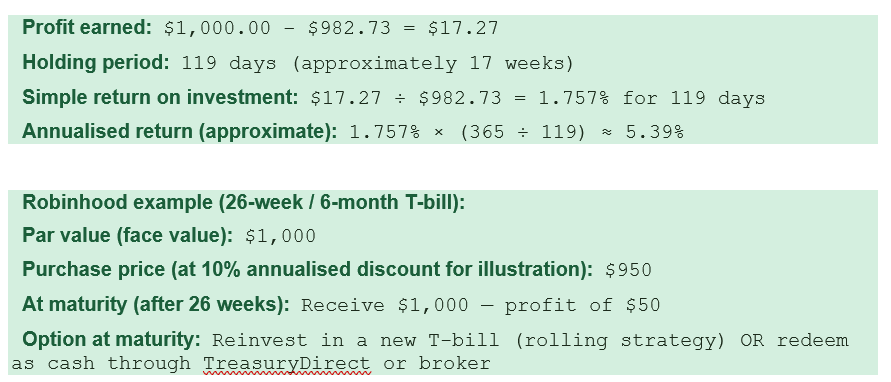
- 4. Maturity and payment: On the maturity date, the Treasury automatically pays the full face value to the investor's account. No action is required. The $17.27 earned on a $1,000 investment simply appears as $1,000 in the account where $982.73 was originally debited.
A Real T-Bill Auction: Worked Example from May 2024
NerdWallet's guide uses a real historical auction to illustrate exactly how the discount mechanics work in practice. This example is based on an actual TreasuryDirect auction: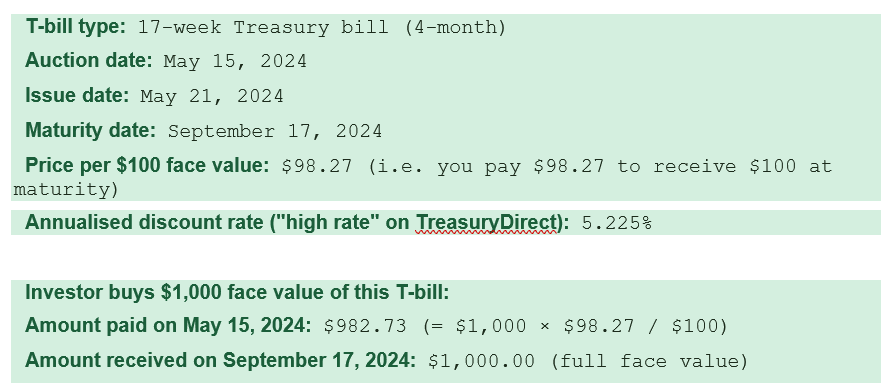
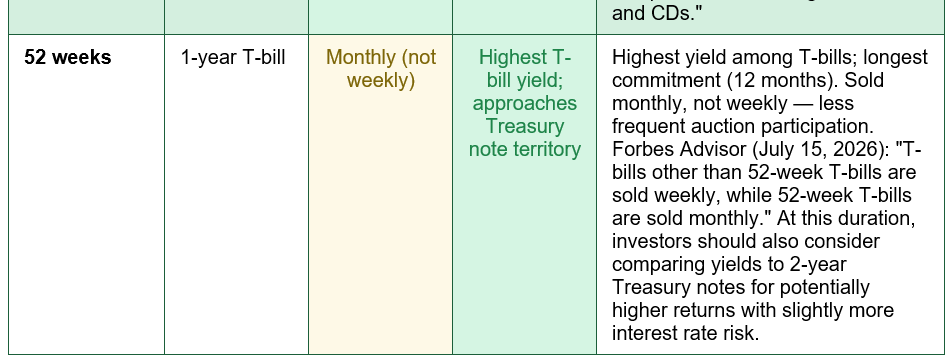
US T-Bill Maturities: The Six Standard Durations in 2026
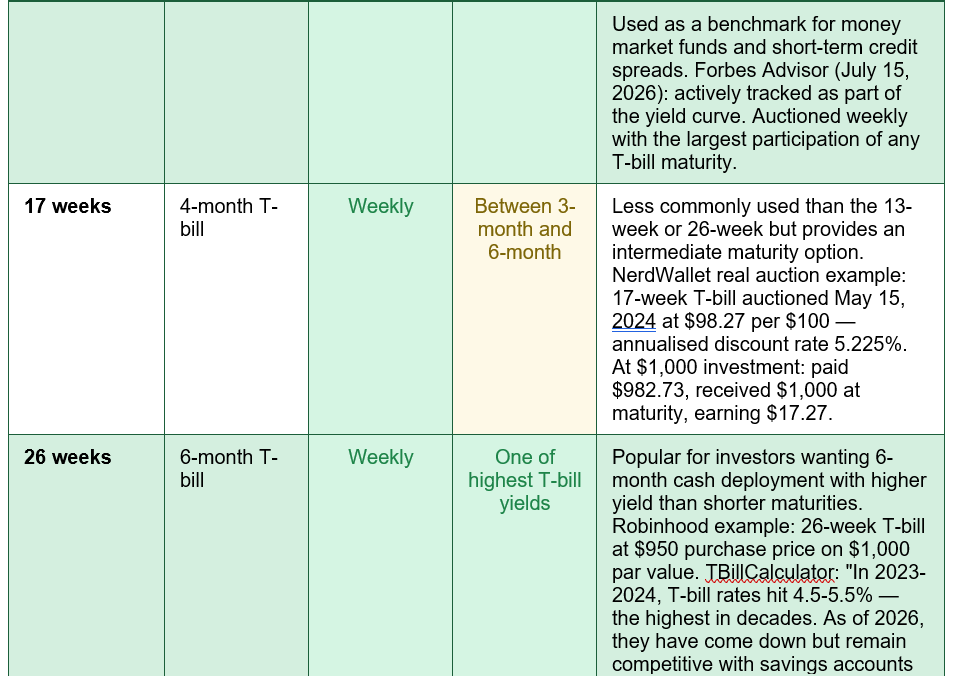
The US Treasury offers six standard T-bill maturities, each with different auction schedules and yield profiles. Choosing the right duration depends on when you need your money back, the current interest rate environment, and your reinvestment strategy: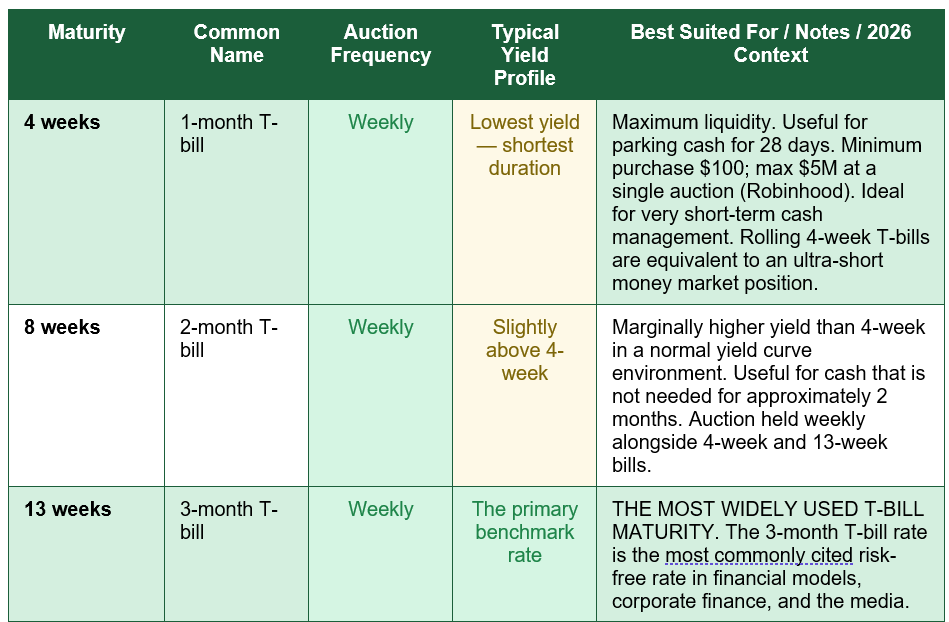
How to Buy T-Bills: Competitive vs Non-Competitive Bidding
There are two ways to participate in a T-bill auction, and understanding both helps investors choose the approach that best matches their needs:Non-Competitive Bidding (Recommended for Most Retail Investors)
In a non-competitive bid, the investor agrees in advance to accept whatever discount rate the auction produces. CFI: 'In a non-competitive bid, the investor agrees to accept the discount rate determined at auction. The yield that an investor receives is equal to the average auction price for T-bills sold at auction. Individual investors prefer this method since they are guaranteed to receive the full amount of the bill at the expiry of the maturity period.' Non-competitive bids are guaranteed to be filled — you will receive the T-bills you have requested at the average auction price, regardless of how competitive the auction turns out to be. This is the standard approach for retail investors using TreasuryDirect.gov or a brokerage.Competitive Bidding (Used by Institutional Investors)
In a competitive bid, the investor specifies the minimum yield (maximum price) they are willing to accept. CFI: 'In a competitive bidding auction, investors buy T-Bills at a specific discount rate that they are willing to accept. Every submitted bid states the lowest rate or discount margin that the bidder/investor is willing to accept. Bids accepting the lowest discount rate are accepted first.' The risk: if the investor's specified rate is not competitive with other bids in the auction, they may receive fewer T-bills than requested, or none at all. Competitive bidding is the domain of banks, primary dealers, hedge funds, and institutional investors — not typically retail participants.The three ways to buy T-bills in 2026: (1) TreasuryDirect.gov — the US Treasury's official direct purchase portal. Buy T-bills at auction with no fees, no broker, and no intermediary. Minimum $100. Maximum $10 million per non-competitive bid. The account is free to open and linked directly to a bank account. Settlement is automatic. Ideal for investors who want to hold T-bills to maturity and reinvest in a rolling strategy. (2) Through a broker or investment platform — Fidelity, Schwab, Vanguard, Interactive Brokers, and most major brokerages allow T-bill purchases on the secondary market or at auction. The advantage: T-bills appear alongside other investments in one account, simplifying portfolio management. Potential disadvantage: some brokers charge small commissions. (3) Through money market funds investing in T-bills — for investors who want T-bill-equivalent yields with daily liquidity and no auction timing, Treasury money market funds (such as Vanguard Treasury Money Market Fund or Fidelity Government Money Market Fund) hold primarily T-bills and offer same-day or next-day liquidity. The trade-off: a small ongoing fund expense ratio (typically 0.10-0.25% annually).
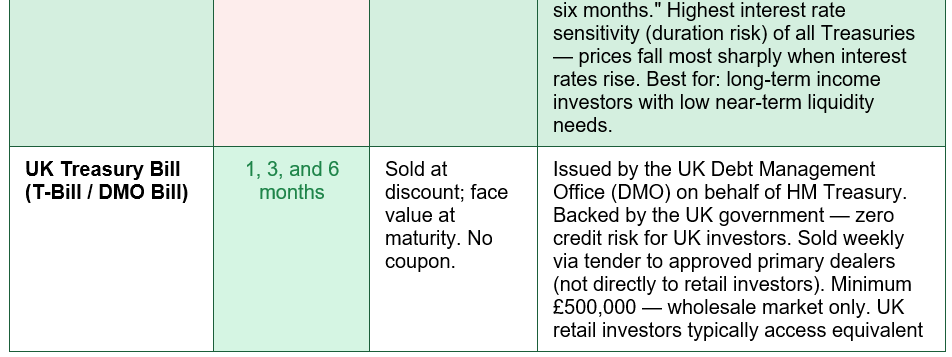
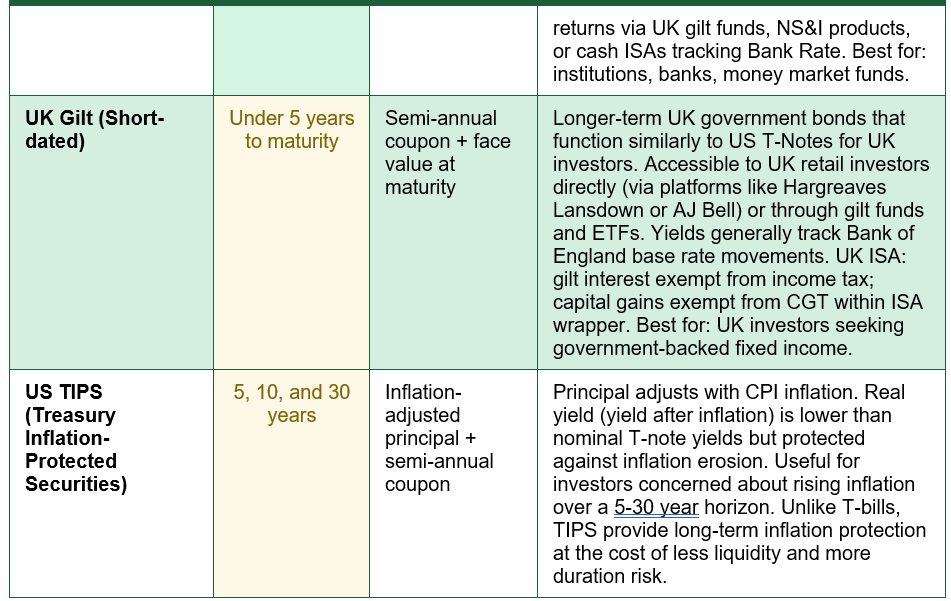
T-Bills vs T-Notes vs T-Bonds vs UK Gilts: Complete Comparison
T-bills are one of several US government securities. Understanding how they compare to other Treasuries — and to UK government equivalents — helps investors choose the right instrument for their specific needs: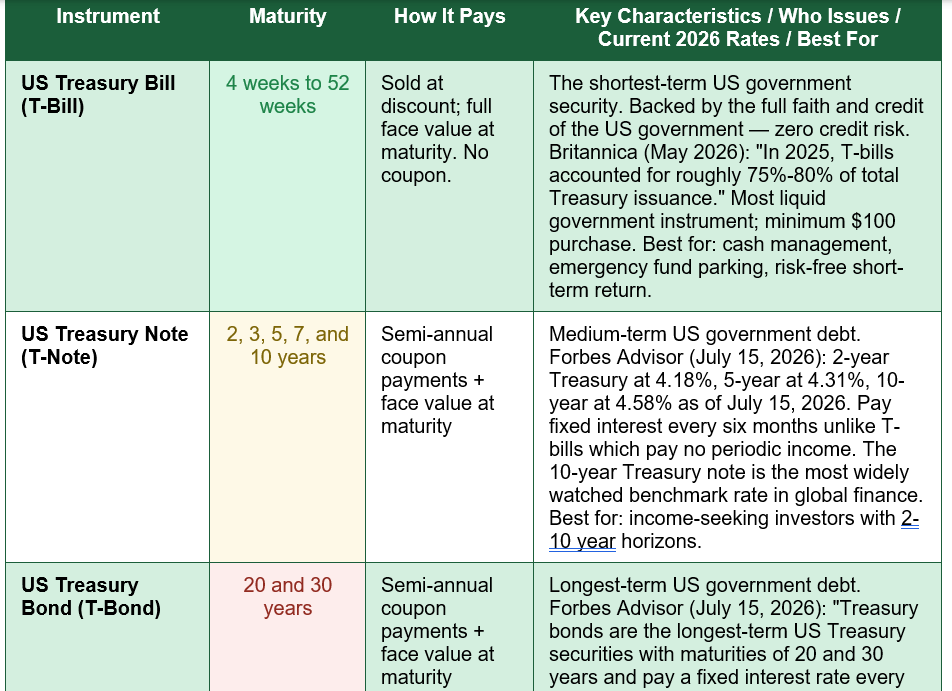
T-Bill Tax Treatment: UK and US Investors
United States: Federal vs State Tax
T-bill income in the US has a specific and highly advantageous tax treatment: it is exempt from state and local income taxes. T-bill interest (the discount gain) is subject to federal income tax, but specifically exempted from all 50 states' income taxes. This exemption is codified in law and applies regardless of the investor's state of residence. For investors in high-tax states (California, New York, New Jersey, Oregon), this state tax exemption can meaningfully increase the after-tax return relative to equivalent-yielding savings accounts or corporate bonds that are fully taxable at the state level.For example: an investor in New York with a combined federal and state marginal tax rate of 37% federal + 12% state = effectively 49% marginal tax on ordinary income. T-bill income taxed only at the federal level (37%) means approximately 12 percentage points of tax saved relative to a savings account paying the same gross yield. The after-tax yield on T-bills is correspondingly higher for state-tax-exempt investors. The discount gain (the difference between purchase price and face value) is taxed as ordinary income in the year the T-bill matures — not as capital gains — and must be reported on the federal tax return for that year.
United Kingdom: ISA Shelter and Direct Gilt Access
UK retail investors cannot directly purchase UK Treasury bills — these are wholesale instruments with a minimum transaction of £500,000, available only to approved primary dealers through the UK Debt Management Office. The UK equivalent for retail investors is the short-dated gilt — a UK government bond (issued by the DMO on behalf of HM Treasury) with a maturity of less than five years, accessible via most UK investment platforms including Hargreaves Lansdown, AJ Bell, and Interactive Brokers UK.UK investors can also access US T-bills through UK-regulated brokers, though currency risk (GBP/USD) applies unless currency-hedged instruments are used. Within a UK Stocks and Shares ISA, gilt income is exempt from income tax and gilt capital gains are exempt from CGT — making the ISA the optimal wrapper for UK investors holding government bonds. Outside an ISA, gilt interest is subject to UK income tax at the investor's marginal rate (20%, 40%, or 45%). NS&I (National Savings and Investments) products, including Premium Bonds and fixed-rate savings bonds, provide UK government-backed alternatives at retail-accessible minimum amounts.
WHO SHOULD CONSIDER T-BILLS IN 2026 — A PRACTICAL SUITABILITY GUIDE: T-bills are most appropriate for: (1) EMERGENCY FUND COMPONENT — investors who have their 3-6 month emergency fund in cash and want to earn a competitive yield on the portion beyond the immediate buffer. Rolling 4-week or 13-week T-bills earn more than most savings accounts with only a few days' lag in accessibility. (2) SHORT-TERM GOAL SAVING — investors saving for a goal 3-12 months away (holiday, car, deposit) who want guaranteed return of principal. T-bills are the ideal vehicle: no credit risk, returns set at purchase, and maturity aligned to the goal date. (3) CASH WAITING TO BE DEPLOYED — investors who have sold other investments and are waiting for the right opportunity to reinvest can earn a meaningful return on the waiting capital through T-bills rather than leaving it in a zero-yield current account. (4) RISK-AVERSE INVESTORS seeking certainty — retired investors or those near retirement who cannot tolerate any risk of capital loss. T-bills provide an absolute guarantee of return of principal (if held to maturity) that no equity, property, or corporate bond investment can match. NOT ideal for: long-term wealth building (equities have historically outperformed T-bills significantly over 10+ year periods); investors who need daily instant access (there is a settlement delay of a few days on maturity proceeds).
Risks and Limitations of Treasury Bills
Treasury bills are the closest thing to a 'risk-free' investment that exists in the financial markets — but 'closest thing' is not the same as 'no risk at all.' Several important limitations apply:- Reinvestment risk: When a T-bill matures, the investor must decide what to do with the proceeds. If interest rates have fallen since the original purchase, the new T-bill will offer a lower yield — and the investor is forced to accept a lower return going forward. An investor who locked in 5.2% on a 26-week T-bill in mid-2024 may find that the same 26-week bill now yields only 3.5-4% in 2026. This reinvestment risk is particularly relevant for investors relying on T-bill income as a regular income source.
- Inflation risk: T-bills guarantee the nominal return of principal — but if inflation exceeds the T-bill yield, the real (inflation-adjusted) return is negative. An investor earning 4% on a T-bill while inflation runs at 5% is losing 1% of purchasing power per year. This is why TIPS (Treasury Inflation-Protected Securities) exist for investors who want inflation protection alongside government credit quality.
- Opportunity cost: Over long periods, equities have historically outperformed T-bills by a substantial margin. Investors who hold large proportions of their long-term portfolio in T-bills sacrifice the equity risk premium — the additional return that equity investors earn for accepting volatility. T-bills are appropriate for short-term capital and risk-free positions within a portfolio, not as a substitute for equity investment in long-term wealth-building.
- Secondary market price risk (if sold before maturity): If an investor needs to sell a T-bill before it matures, the sale price depends on prevailing interest rates at the time of sale. If rates have risen since purchase, the T-bill will sell at a lower price than its purchase price — a loss. Only investors who hold to maturity are guaranteed to receive the full face value. T-bills are inherently short-term instruments and this risk is minimal relative to bonds with longer maturities, but it exists.
THE OPPORTUNITY COST REALITY — T-BILLS VS LONG-TERM EQUITY RETURNS: Treasury bills are often described as the 'risk-free rate' in financial theory — the baseline return available with zero default risk. Over short periods (1-3 years), T-bills are an excellent choice for capital that cannot be put at risk. Over long periods, however, the historical return gap between T-bills and equities is dramatic. The S&P 500 has historically returned approximately 10% per year over long periods (NerdWallet, Motley Fool). T-bills, even at their current elevated yields of approximately 4-5% in 2026, have historically averaged around 2-3% annually over the past century. Over 30 years, the compound difference between 3% (T-bill average) and 10% (S&P 500 historical) produces vastly different outcomes: £10,000 at 3% for 30 years = £24,273. £10,000 at 10% for 30 years = £174,494. T-bills are the right choice for capital you cannot afford to lose in the short term. Equities are the right choice for capital you can commit to the long run. The mistake is using T-bills as a long-term substitute for equity investment — a choice that reliably generates lower wealth over decades.
Conclusion
A Treasury bill is the US government's short-term borrowing instrument — a security sold at a discount to face value, paying the investor the full face value at maturity between four weeks and 52 weeks later, backed by the full faith and credit of the United States. Britannica confirms their dominance: T-bills represented 75-80% of all US Treasury issuance in 2025 — the single most commonly issued type of government security, used by commercial banks, money market funds, corporations, and individual investors worldwide as the benchmark for risk-free short-term returns.The mechanics are straightforward: buy at a discount, receive face value at maturity, earn the difference as your return. The NerdWallet real auction example demonstrates this concretely: $982.73 paid for a 17-week T-bill in May 2024 returned $1,000 at maturity — $17.27 earned with absolute certainty and no credit risk. The minimum purchase of $100 and the availability of TreasuryDirect.gov make T-bills accessible to virtually every US investor directly without any broker intermediary or fee.
In 2026, with T-bill rates remaining elevated relative to the near-zero era of 2020-2021 — though moderated from the 5%+ peaks of 2023-2024 — T-bills offer competitive returns for short-term capital alongside their foundational characteristic of zero credit risk. They are the right instrument for cash that must be safe, must be returned in full, and must be available within a year. They are not the right instrument for capital that can be patiently invested over a decade or more — where equities have historically delivered the substantially higher returns that long-term wealth accumulation requires. Understanding this distinction — and applying T-bills appropriately as a component of a well-structured financial plan — is the practical conclusion of everything this guide covers.
0 Comments
Be the first to share your thoughts on this article.