

Business
What Is a Vendor / Supplier? Complete Business Guide

Table of Contents
- The People and Businesses Behind Every Product You Use
- What Is a Vendor?
- What Is a Supplier?
- Vendor vs Supplier vs Contractor: The Complete 2026 Comparison
- The Five Types of Vendor: A Complete 2026 Classification
- The Three Types of Supplier
- The Supply Chain Journey: From Raw Material to End Consumer
- Vendor and Supplier Management: How to Do It Right in 2026
- Managing Supplier Relationships
- Managing Vendor Relationships
- Conclusion
- Frequently Asked Questions (FAQ)
The People and Businesses Behind Every Product You Use
Behind every product on a supermarket shelf, every piece of software running on a business computer, every component in a manufactured good, and every service a business uses to operate, there is a vendor or supplier relationship. These relationships are so fundamental to modern commerce that they are often taken for granted -- until they break down. The 14.5% of US small businesses that reported domestic supplier delays in July 2023 (US Census Bureau, cited by Ramp.com April 2026) discovered how directly their operations depended on people and companies they had never met and may never have thought about in detail.The terms vendor and supplier are among the most widely used in business -- and among the most widely confused. Shopify's 2026 guide defines a vendor as 'an entity -- either an individual or a business -- that provides goods or services to companies or consumers for profit. Vendors are everyone from manufacturers to specialised suppliers and third-party resellers who distribute products throughout the supply chain.' Ramp.com (April 2026) clarifies the supplier: 'A supplier is a business or individual that provides raw materials, components, or semi-finished goods used in production. Suppliers operate upstream in the supply chain, selling in large volumes to manufacturers or distributors that transform those inputs into finished products.'
This guide explains both definitions completely: what vendors and suppliers are, how they differ from each other and from contractors, the five main types of vendor, the three types of supplier, how the supply chain positions them relative to each other, the practical considerations for businesses choosing between vendors and suppliers, how to manage these relationships effectively, and the real-world examples that make the distinctions concrete. Whether you are a business owner building your procurement framework, a student learning supply chain fundamentals, or a professional encountering these terms in a new context, this guide gives you the complete 2026 picture.
What Is a Vendor?
A vendor is a business or individual that sells finished goods or services directly to customers -- whether those customers are individual consumers, other businesses, or organisations. Auditive (August 2025): 'A vendor is a business or individual that sells goods or services directly to customers or other businesses. Their role is crucial in the supply chain, acting as the final link that ensures products reach their intended market. Unlike suppliers who provide raw materials or distributors who handle logistics, vendors typically engage in direct transactions with end users. This includes managing sales, delivery, and sometimes post-sale support.'The defining characteristics of a vendor are three: they sell finished products or fully rendered services (not raw materials); they interact directly with the end buyer; and they typically manage the customer relationship including sales, delivery, and aftersales. Tradogram (2026): 'Vendors sell finished goods or services directly to consumers or businesses, while suppliers provide raw materials or goods for manufacturing purposes.' Shopify (2026) adds the scope: 'Vendors do more than supply products. They can be manufacturers, wholesalers, or service providers, each with different levels of involvement, based on their role in the supply chain.'
Importantly, a business can be a vendor even if it also manufactures its products. Apple is both a manufacturer and a vendor -- it manufactures iPhones and sells them directly to consumers through Apple Stores and its website. Foxconn, by contrast, is a manufacturer but not a vendor in the traditional sense -- it manufactures iPhones for Apple but does not sell them to end consumers. The distinction turns not on whether the entity makes the product but on whether it sells the finished product to the end buyer.
What Is a Supplier?
A supplier is a business or individual that provides raw materials, components, or semi-finished goods to other businesses that use those inputs in their own production processes. Ramp.com (April 2026): 'A supplier is a business or individual that provides raw materials, components, or semi-finished goods used in production. Suppliers operate upstream in the supply chain, selling in large volumes to manufacturers or distributors that transform those inputs into finished products.' Ramp.com provides two concrete examples: 'a textile supplier provides fabric to clothing manufacturers; an electronics supplier delivers chips to smartphone companies.'Indeed UK (November 2025) characterises the supplier by scale and business model: 'A supplier is a large-scale organisation that makes its profit through bulk making and selling a product, or similar products, to different businesses.' This captures the operational model of most suppliers: large production volumes, B2B-only relationships, long-term supply agreements, and standardised products (raw materials or components) rather than differentiated finished goods. The relationship between a supplier and its business customers is typically more interdependent and longer-term than a typical vendor-customer relationship -- switching a key raw material supplier carries significant operational risk.
RIB Software (July 2025) adds the quality dimension: 'Unlike vendors, suppliers operate exclusively on a B2B basis; in other words, they primarily offer goods or services to businesses as opposed to end customers. What they do directly affects the quality, cost, and efficiency of the final product.' This is the reason supplier selection is so critical in manufacturing, construction, and any production-intensive industry: the quality of the final product is constrained by the quality of its inputs. A smartphone is only as good as the chips, glass, and battery cells provided by its suppliers.
Vendor and supplier relationships -- 2026 data: 14.5% of US small businesses reported domestic supplier delays (July 2023, US Census Bureau). 850+ TPRM programmes benchmarked by Auditive in 2026. — Ramp.com (April 3, 2026): 'According to the U.S. Census Bureau, 14.5% of small businesses reported domestic supplier delays in July 2023 -- a reminder that understanding who you are working with matters when building a resilient supply chain.' Auditive (August 2025): '2026 benchmarks across 850+ TPRM (Third-Party Risk Management) programs' -- reflecting the scale of enterprise vendor management. Shopify (2026): 'Categorising vendors helps you realise which are critical to your retail operation and which are easy to replace if things go south.'
Vendor vs Supplier vs Contractor: The Complete 2026 Comparison
The three terms are frequently used interchangeably in business conversation -- but they represent meaningfully different roles in the supply chain and commercial relationship. The following table maps every key dimension: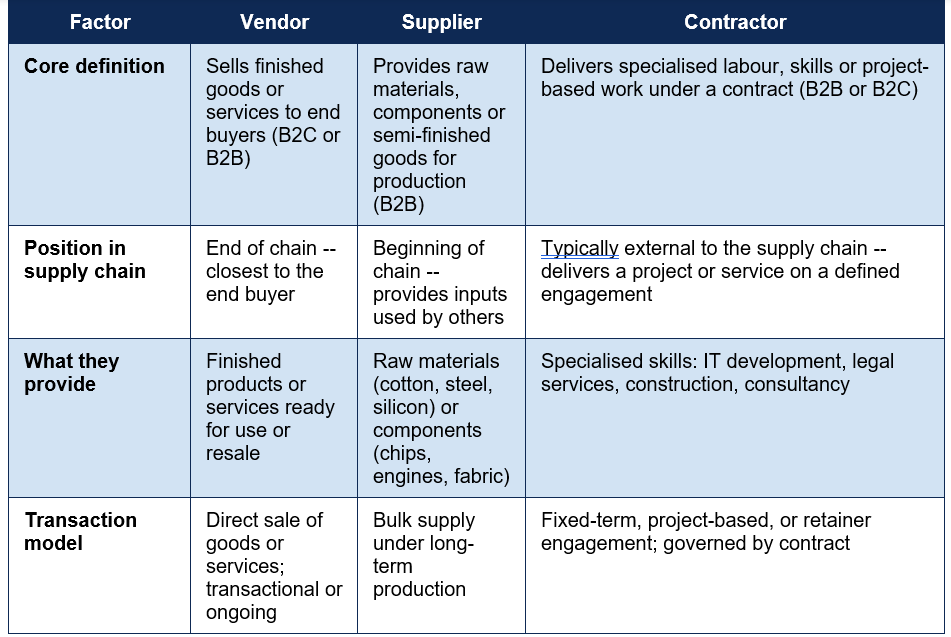
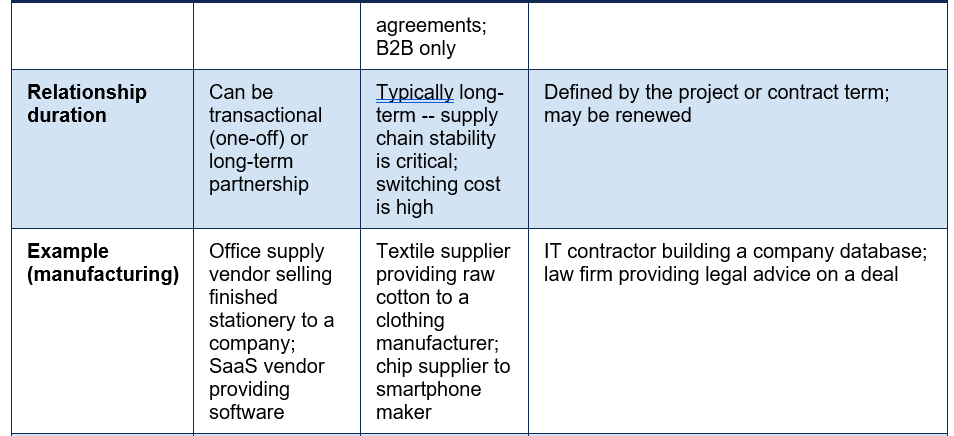
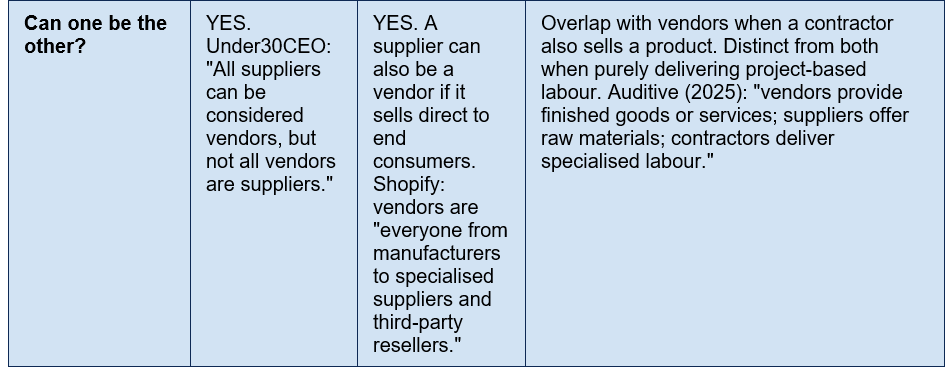
The supply chain position matters for procurement strategy: Ramp.com (April 2026): 'The core difference in vendor vs supplier relationships comes down to supply chain position, what they provide, and how you structure the relationship. That distinction directly affects your costs, operational risk, and negotiating power.' A supplier disruption affects your ability to produce anything; a vendor disruption affects your ability to source a finished product you could source elsewhere. Supplier relationships therefore require greater resilience planning, longer contracts, and more strategic management than most vendor relationships. Shopify (2026): 'Categorising vendors helps you realise which are critical to your retail operation and which are easy to replace if things go south. In sophisticated retail environments, this involves category management, in which products are treated as mini-business units to maximise profitability.'
The Five Types of Vendor: A Complete 2026 Classification
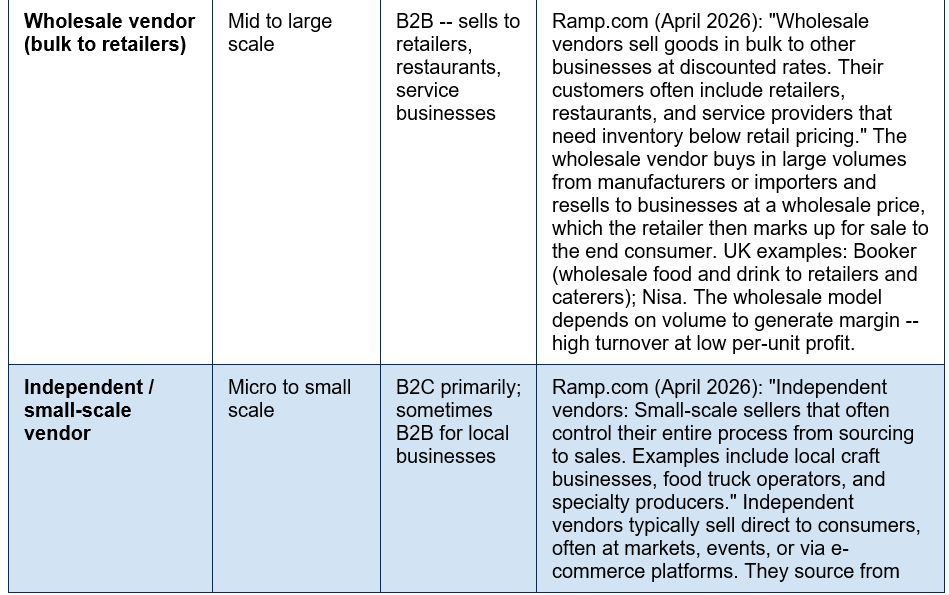
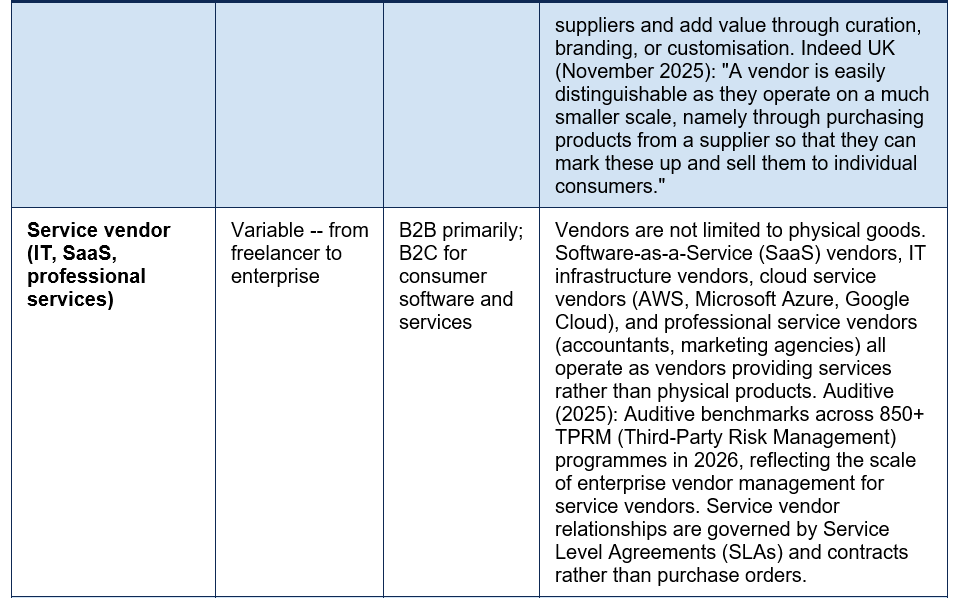
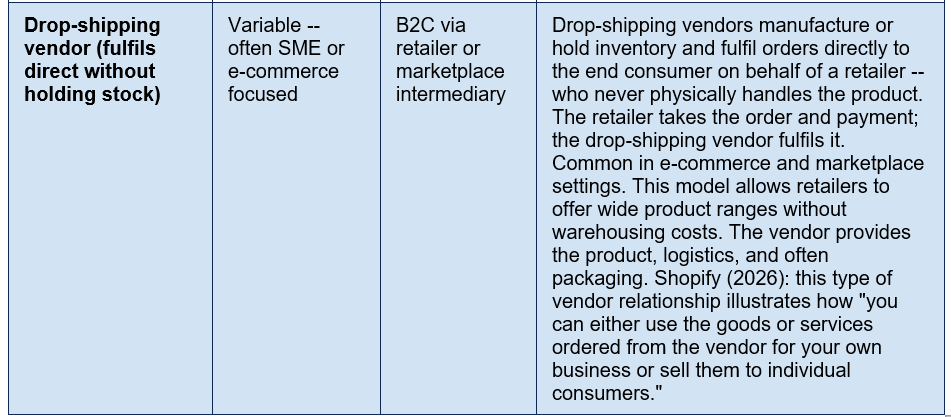
Vendors are not a monolithic category. Shopify (2026) identifies that vendors 'can be manufacturers, wholesalers, or service providers, each with different levels of involvement, based on their role.' The following table maps the five main vendor types with their scale, customer type, and operating model: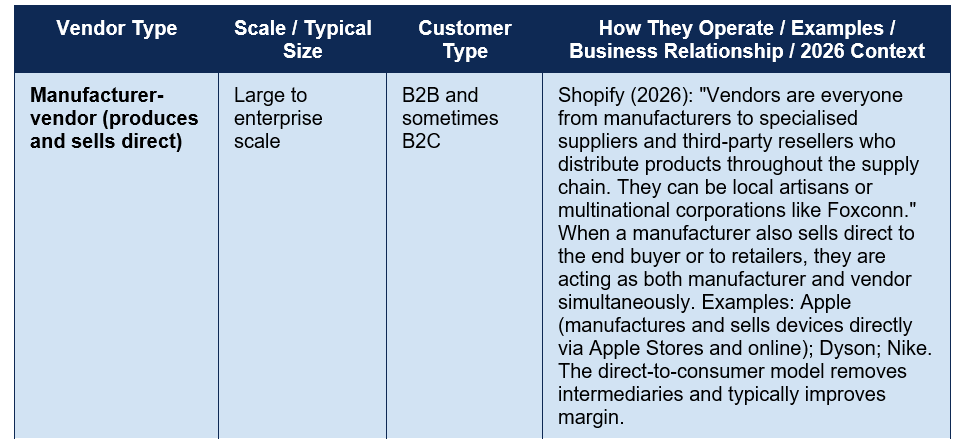
The Three Types of Supplier
Suppliers also fall into distinct categories based on what they provide and how far upstream in the supply chain they operate:- Raw material suppliers: Provide the most basic inputs -- natural resources and unprocessed materials that form the physical basis of manufactured products. Examples include: steel mills supplying steel sheet to automotive manufacturers; cotton growers and spinning mills supplying raw cotton and yarn to textile manufacturers; silicon wafer producers supplying semiconductor-grade silicon to chip manufacturers; timber suppliers to furniture manufacturers and construction. Ramp.com (April 2026): 'A textile supplier provides fabric to clothing manufacturers, and an electronics supplier delivers chips to smartphone companies.' These relationships are typically the most strategic and have the longest contract terms, as switching a raw material supplier requires significant operational reconfiguration.
- Component and sub-assembly suppliers: Provide manufactured components or sub-assemblies rather than raw materials -- items that are themselves the product of a production process, intended to be incorporated into a more complex finished product. Examples: a chip manufacturer supplying processed semiconductor chips to a device maker (Intel or TSMC to Apple or Samsung); a brake system supplier to an automotive manufacturer; a glass panel supplier to a smartphone manufacturer. Component suppliers sit between raw material suppliers and final manufacturers in the supply chain. They add significant processing value to the raw material before passing the component upstream.
- Service suppliers (B2B): Provide professional or commercial services to other businesses as inputs to their operations. Examples: logistics and shipping companies; energy utilities supplying commercial electricity and gas to manufacturers; cleaning and facilities management companies; payroll processing services; IT infrastructure providers (cloud hosting, data centre colocation). RIB Software (July 2025): 'Unlike vendors, suppliers operate exclusively on a B2B basis; in other words, they primarily offer goods or services to businesses as opposed to end customers.' Service suppliers sit outside the physical supply chain but are equally critical to operations.
The Supply Chain Journey: From Raw Material to End Consumer
Understanding where vendors and suppliers fit requires understanding the supply chain as a whole. The following example traces a single product from raw material origin to end consumer to show how suppliers and vendors each play their role: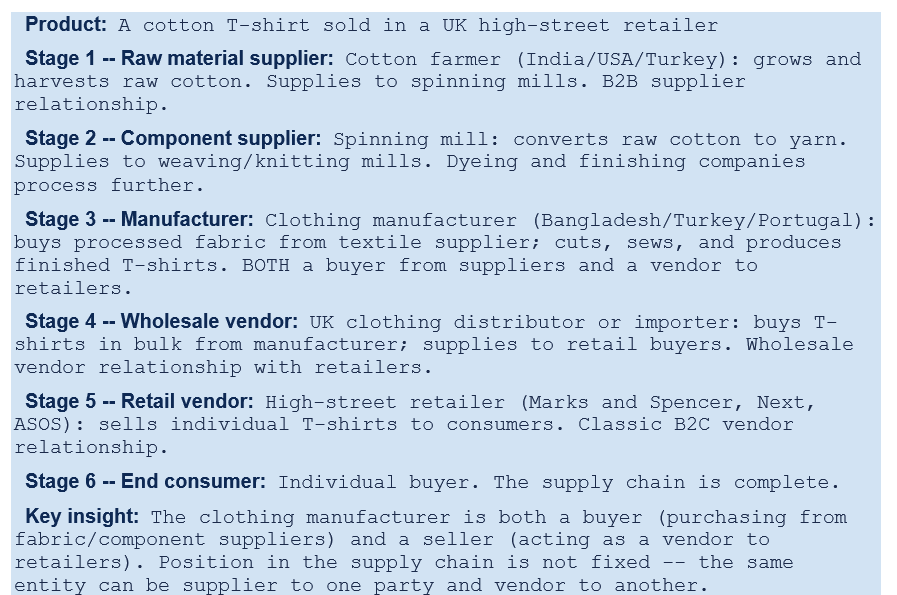
Vendor and Supplier Management: How to Do It Right in 2026
Effective vendor and supplier management is one of the most operationally significant skills in business. The distinction between vendor and supplier is not just academic -- it shapes how relationships should be structured, how risks should be assessed, and how performance should be monitored. Auditive (August 2025): 'Despite being such a core element of day-to-day operations, the term vendor is often misunderstood. These distinctions matter, especially when you are negotiating contracts, building relationships, or trying to improve procurement efficiency.'Managing Supplier Relationships
Supplier relationships require strategic, long-term management because supplier disruptions affect the ability to produce. Ramp.com (April 2026): '14.5% of small businesses reported domestic supplier delays in July 2023 -- understanding who you are working with matters when building a resilient supply chain.' Best practices for supplier management in 2026:- Diversify critical suppliers: Single-source supplier relationships create concentration risk. Where possible, qualify at least two suppliers for each critical raw material or component. The 2020-2023 global supply chain disruptions -- semiconductor shortages, shipping container crises -- demonstrated the vulnerability of single-source dependencies.
- Use long-term supply agreements: Suppliers plan production capacity based on committed orders. Long-term supply agreements (typically 12-36 months) provide both parties with planning certainty and often secure better pricing through volume commitments.
- Audit supplier quality regularly: RIB Software: 'What they do directly affects the quality, cost, and efficiency of the final product.' Quality audit programmes, factory visits, and certification requirements (ISO 9001, for example) provide confidence in consistent input quality.
- Build in supply chain resilience: Maintain safety stock of critical inputs; pre-qualify alternative suppliers; include force majeure and substitution provisions in supply contracts. The pandemic-era disruptions showed that businesses with resilient supply strategies recovered faster than those with purely lean, single-source approaches.
Managing Vendor Relationships
Vendor relationships vary significantly in strategic importance. Shopify (2026): 'Categorising vendors helps you realise which are critical to your retail operation and which are easy to replace if things go south. In sophisticated retail environments, this involves category management, in which products are treated as mini-business units to maximise profitability.'- Segment vendors by criticality: Not all vendors are equally important. Tier 1 (strategic): vendors providing unique products or services critical to operations -- losing them would significantly damage the business. Tier 2 (preferred): reliable vendors with good value but some alternatives. Tier 3 (transactional): commodity vendors where switching is easy and alternatives are plentiful. Management intensity should match tier: strategic vendors deserve relationship investment; transactional vendors need only contract and price management.
- Use Service Level Agreements (SLAs) for service vendors: For IT, SaaS, professional service, and logistics vendors, SLAs define the performance standards the vendor is contractually required to meet -- uptime, delivery windows, response times, quality metrics. SLAs give the business a basis for performance measurement and, where necessary, contractual remedies.
- Conduct Third-Party Risk Management (TPRM) for critical vendors: Auditive (2025): benchmarks across 850+ TPRM programmes in 2026. TPRM assesses the financial, operational, security, and compliance risks posed by vendor relationships. For IT and data vendors, cybersecurity and data protection assessments are now standard. Regulators in financial services, healthcare, and government supply chains mandate TPRM as a condition of operation.
THE VENDOR/SUPPLIER SELECTION CHECKLIST -- 2026: FOR ANY NEW VENDOR OR SUPPLIER: (1) VERIFY LEGITIMACY: Check Companies House (UK) or SEC/State filings (US); confirm trading history; check for CCJs/judgments or bankruptcy history. (2) ASSESS FINANCIAL STABILITY: Request or review latest accounts; a vendor or supplier that goes into administration mid-contract creates operational disruption. (3) CHECK REFERENCES: Speak to other customers; ask specifically about on-time delivery, quality consistency, and how disputes were handled. (4) EVALUATE PRODUCT/SERVICE FIT: Can they meet your volume, specification, and delivery requirements? Do they hold relevant certifications (ISO, CE marking, food safety standards)? (5) NEGOTIATE AND DOCUMENT: All vendor and supplier relationships should be governed by a written contract. Key terms: price, payment terms, delivery, quality standards, warranties, liability limits, dispute resolution, and termination rights. (6) SEGMENT BY CRITICALITY: Not every vendor deserves the same management intensity. Identify which relationships are strategic (hard to replace) vs transactional (easy to replace) and manage accordingly. (7) PLAN FOR DISRUPTION: Who is the alternative vendor/supplier if this relationship fails? Maintaining at least one qualified alternative for critical inputs is basic supply chain resilience.
THE FOUR VENDOR/SUPPLIER MISTAKES THAT DAMAGE BUSINESSES: (1) SINGLE-SOURCE DEPENDENCY ON A CRITICAL SUPPLIER. Ramp.com (April 2026): '14.5% of small businesses reported domestic supplier delays in July 2023.' A single-source dependency means a supplier problem becomes your problem immediately with no backup. Always pre-qualify alternatives for any input critical to your production or delivery capability. (2) NO WRITTEN CONTRACT. A vendor or supplier relationship without a written contract leaves both parties exposed. Verbal agreements on price, delivery, quality, and liability are unenforceable in most circumstances. Even a simple purchase order with clear terms is better than nothing. (3) PAYING VENDOR/SUPPLIER INVOICES WITHOUT RECONCILIATION. Always reconcile invoices against agreed prices and quantities before payment. Billing errors -- intentional or accidental -- are common, especially in high-volume vendor relationships. A formal invoice approval and payment process is essential for financial control. (4) TREATING ALL VENDORS AS EQUAL PRIORITY. Shopify (2026): 'Categorising vendors helps you realise which are critical to your retail operation and which are easy to replace.' Spending disproportionate management time on low-criticality transactional vendors while undermanaging strategic vendor relationships is a common procurement error. Segment your vendors and allocate management attention accordingly.
Conclusion
A vendor sells finished goods or services to end buyers. A supplier provides raw materials, components, or semi-finished inputs to businesses that use them in production. These definitions sound simple -- and at their core, they are. But the practical implications of the distinction run deep through supply chain strategy, procurement management, contract structure, risk assessment, and commercial relationships.Ramp.com (April 2026) captures the business-critical nature of the distinction: 'The core difference in vendor vs supplier relationships comes down to supply chain position, what they provide, and how you structure the relationship. That distinction directly affects your costs, operational risk, and negotiating power.' A business that understands which of its external relationships are vendor relationships and which are supplier relationships can structure appropriate contracts, allocate appropriate management resources, plan appropriate supply chain resilience, and build appropriate risk mitigation for each.
In 2026, the scope of vendor and supplier relationships has expanded significantly beyond physical goods to include SaaS platforms, cloud infrastructure, cybersecurity services, professional advisers, and logistics providers -- all of which require the same rigorous vendor management disciplines that physical goods procurement has applied for decades. The Auditive benchmark of 850+ TPRM programmes confirms that enterprise vendor management has become a standalone discipline. Whether a business is managing a single critical raw material supplier or a portfolio of 200 software vendors, the foundational principles are the same: know who you are dealing with, document the relationship in writing, segment by criticality, monitor performance, and plan for disruption.

0 Comments Comments