

Finance
What Is APR? An Accountant’s Complete Guide

The average US credit card APR is 20.94%. Americans carry $1.263 trillion in credit card debt. The average UK credit card APR just hit 35.9% — a 14-percentage-point rise in a decade. Most people have seen the letters ‘APR’ on every loan offer, mortgage document, and credit card statement they’ve ever received. Very few can explain what the number actually means and why it matters more than almost any other figure in personal finance. An accountant can. Here is the complete explanation.

The consequences of not understanding APR are measurable. The average US credit card APR in Q2 2026 was 20.94% for all accounts and 22.15% for accounts actually carrying a balance (Federal Reserve G.19; LendingTree, August 2026). Americans carry $1.263 trillion in credit card debt. The average US household owes $11,507 in credit card balances. The average UK credit card APR reached 35.9% in May 2026 — 14 percentage points higher than a decade ago (Moneyfacts; Which?, May 2026). A $5,000 credit card balance at 21.47% APR, paying only the minimum, takes over 15 years to eliminate and costs more than $6,000 in interest on top of the original balance (The Global Statistics, May 2026).
These outcomes are not inevitable. They are the direct result of how APR works when it is not understood and not managed. This guide explains APR in full — the definition, the calculation, the types, the real monthly cost, and the five practical strategies that reduce what you actually pay. The explanation comes from an accountant’s perspective: precise, quantitative, and focused on the numbers that matter.
Average US credit card APR (Q2 2026): 20.94% all accounts; 22.15% accounts accruing interest (Federal Reserve G.19; LendingTree). US credit card debt Q2 2026: $1.263 trillion (NY Fed). Average household debt: $11,507 (WalletHub Q1 2026). UK average credit card APR (May 2026): 35.9% — up 14pp in a decade (Moneyfacts; Which?). A $5,000 balance at 21.47% APR on minimum payments: 15+ years, $6,000+ interest cost.
The key word is ‘annual.’ APR converts the full cost of borrowing into a yearly figure regardless of the actual loan term, making it possible to compare a 3-month loan and a 30-year mortgage on the same scale. Without this standardisation, a lender offering a ‘3% monthly rate’ would be charging more than a lender offering a ‘24% annual rate’ — a comparison that is impossible without converting both to the same time period.
APR was designed as a consumer protection tool. In the United States, the Truth in Lending Act (TILA), enforced by the Consumer Financial Protection Bureau (CFPB), requires lenders to disclose the APR on all consumer credit products before a borrower signs. In the United Kingdom, the Consumer Credit Act requires disclosure of the Representative APR before advertising or offering credit. In the European Union, the Consumer Credit Directive establishes similar requirements. The intent in all jurisdictions is the same: give consumers a single, comparable number that reflects the true cost of a loan.
Accountant’s insight: APR is a legal requirement, not a marketing choice. Every time you see it on a credit product, a regulator mandated its presence to protect you. The number exists specifically because lenders, given the choice, would prefer to advertise the lowest-looking component of the borrowing cost (the interest rate alone, before fees) rather than the full cost of the product. Understanding APR is, in part, understanding what the law is trying to tell you about what you are actually paying.
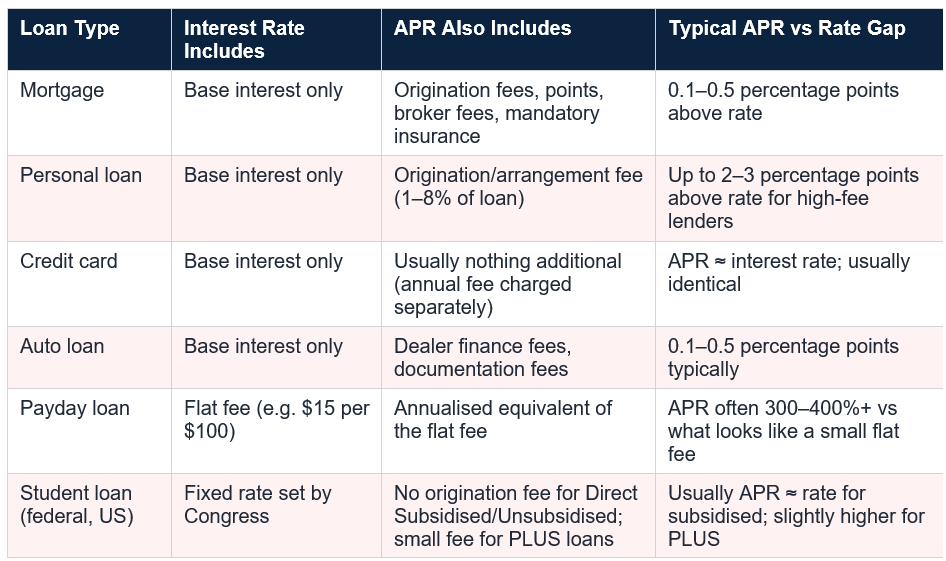
The interest rate is the percentage of the outstanding balance that the lender charges for the use of the money. It does not include any fees. The APR is the interest rate plus mandatory fees, both expressed as a combined annualised cost.
Example: Mortgage illustration: A 30-year fixed mortgage with a 6.75% interest rate and $4,500 in origination fees and closing costs on a $300,000 loan has an APR higher than 6.75% — because those fees are folded into the APR calculation, effectively raising the annual cost of the loan. The interest rate (6.75%) is what you pay on the principal. The APR (perhaps 6.95%) is what the loan actually costs you per year, including those fees. When comparing two mortgages with the same 6.75% interest rate but different fees, the APR comparison reveals which one is actually cheaper over the full term.
The difference between APR and interest rate matters most for:
• Mortgages: origination fees, discount points, broker fees, and mandatory insurance can create a significant gap between the advertised interest rate and the APR.
• Personal loans: arrangement fees or origination fees (typically 1–8% of the loan amount) are included in the APR calculation.
• Payday loans: a ‘flat’ fee of $15 per $100 borrowed for a 2-week loan looks modest until converted to an APR — which reveals a rate of approximately 391% annually.
• Credit cards: for most credit cards, there are no annual fee components in the APR calculation itself (the annual fee is charged separately). The credit card APR is effectively the same as the nominal interest rate. This is one of the few cases where APR and interest rate are identical.
In practice, this is an internal rate of return (IRR) calculation — the same calculation used in corporate finance to evaluate investment returns. The APR is the IRR of the loan’s cash flows from the lender’s perspective (or equivalently, the IRR of the cash flows from the borrower’s perspective with reversed sign convention).
Example: Simple illustration: You borrow $10,000 for 1 year. You receive $9,800 (the lender deducts a $200 origination fee upfront). You repay $10,800 at the end of the year ($10,000 principal + $800 interest). The nominal interest rate is 8% ($800 / $10,000). But you only received $9,800, so the APR is $800 / $9,800 = approximately 8.16%. The small gap reflects the fee's effect on the true cost: you paid $800 in interest on $9,800 actually received, not on $10,000 nominally borrowed. This is the core insight of APR: it asks what you actually received and what you actually paid, not what the stated principal was.
For credit cards, the calculation is simplified because there is typically no upfront fee included in the APR. The credit card APR is the nominal annual interest rate, stated as a simple annual percentage. The Daily Periodic Rate (DPR) is then calculated as APR ÷ 365 and applied to the average daily balance in each billing cycle to determine the monthly finance charge.
APR is a simple annual rate: it does not account for the effect of intra-year compounding. EAR is the actual annualised return or cost after compounding is taken into account. For a savings account or investment, EAR is what you actually earn. For a borrowing product, EAR is what you actually pay.
The relationship between APR and EAR:
Example: Formula: EAR = (1 + APR/n)^n − 1, where n = number of compounding periods per year. For a credit card with 21% APR compounded daily (n = 365): EAR = (1 + 0.21/365)^365 − 1 = (1.000575)^365 − 1 ≈ 23.36%. For the same 21% APR compounded monthly (n = 12): EAR = (1 + 0.21/12)^12 − 1 = (1.0175)^12 − 1 ≈ 23.14%. The practical result: a credit card with a stated APR of 21% actually costs approximately 23.1–23.4% per year in effective terms, depending on the compounding frequency. This gap grows as the APR increases — at 30% APR daily compounding, the EAR is approximately 34.97%.
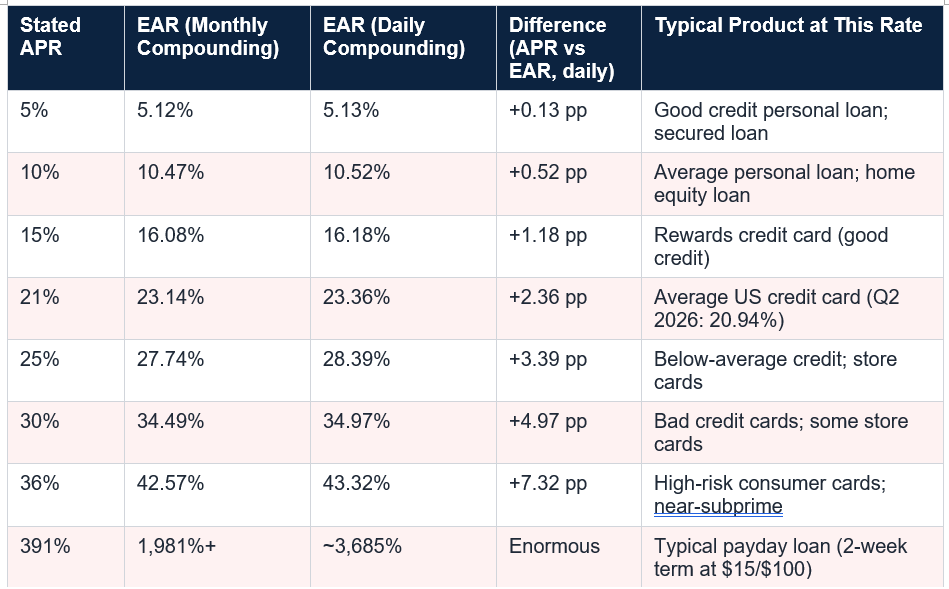
Accountant’s insight: The EAR is what borrowers and investors should use when comparing the true cost of credit or the true return on savings. APR is the legally required disclosure and the basis for comparison, but EAR is the honest answer to 'what does this actually cost me per year?' The gap between the two is small at low rates (0.1–0.5 pp at 5–10% APR) but meaningful at high rates (3–7 pp at 21–30% APR) and enormous at payday loan rates. For savings accounts and P2P products quoting an APR, the EAR tells you what you will actually earn with compounding.
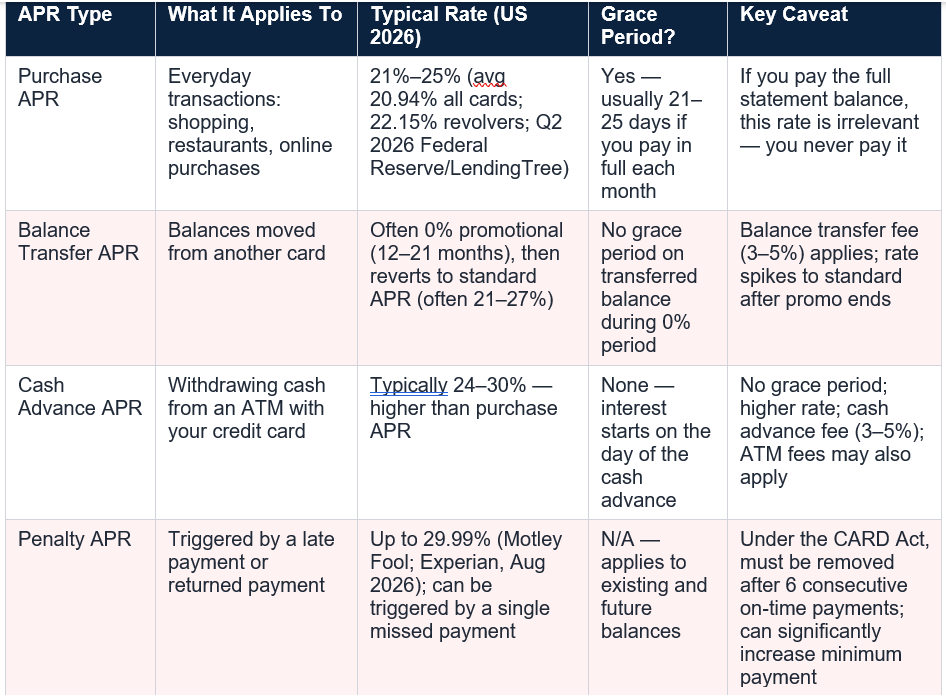
Many cardholders focus only on the purchase APR when comparing cards and are caught off guard by the cash advance APR (often 5–10 percentage points higher, with no grace period) and the penalty APR (which can jump to 29.99% after one missed payment and applies to all existing balances, not just new transactions). Reading the Schumer box — the standardised APR disclosure table that US card issuers must include in every card application — before applying reveals all four rates before you are committed.
The Daily Periodic Rate is simple to calculate:
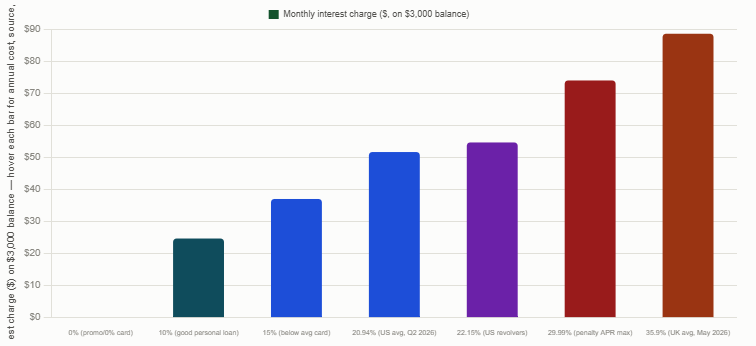
Example: DPR = APR ÷ 365. For a card with a 21% APR: DPR = 21% ÷ 365 = 0.05753% per day. Each day, the card issuer multiplies this rate by the outstanding balance that day (the average daily balance across the billing cycle is typically used). Over a 30-day billing cycle on a $3,000 balance: Daily interest = $3,000 × 0.0005753 = $1.73 per day. Monthly charge = $1.73 × 30 days = $51.78. Annualised: $51.78 × 12 = $621.36, which is approximately 20.7% of $3,000 — close to the 21% APR (the small discrepancy reflects the simplified average daily balance assumption in this illustration). If that same $3,000 balance were at the average UK credit card APR of 35.9%: DPR = 35.9% ÷ 365 = 0.09836% per day. Monthly charge = $3,000 × 0.0009836 × 30 = $88.52 per month. Annualised: $1,062.24 per year, or 35.4% of $3,000 — reflecting the 35.9% stated APR on the actual balance.
The monthly cost at different APR levels on a constant $3,000 balance:
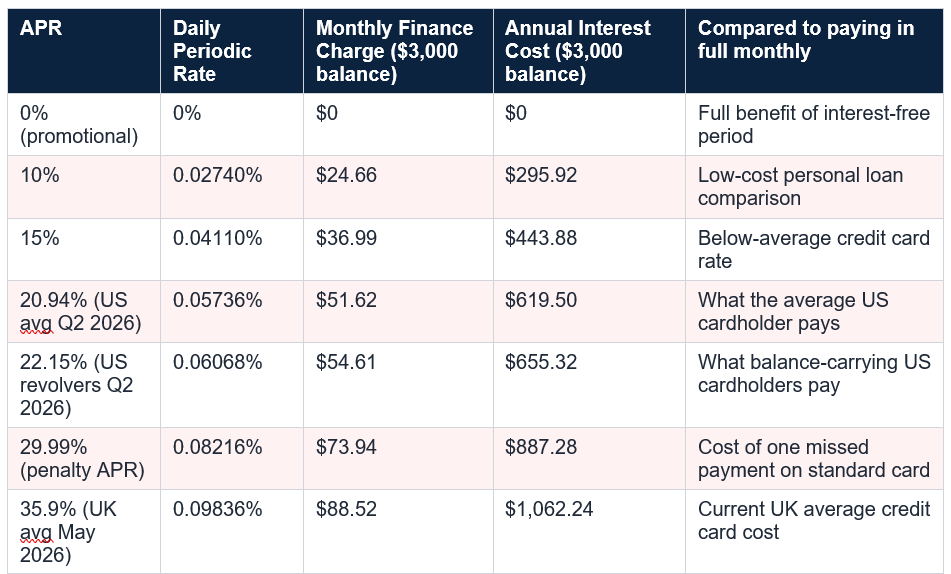
Accountant’s insight: The monthly finance charge is money you pay for the privilege of keeping a balance. It is not reducing your debt — it is the fee for using borrowed money for one more month. At 20.94% APR on a $3,000 balance, you pay $51.62 per month in interest before a single cent reduces the principal. Over a year, that is $619.50 in interest — money that could instead be redirected to principal, investment, or savings. This is why the accountant's first rule about credit card debt is: the interest rate, not the balance, determines the urgency.
Example: The minimum payment trap (illustrative calculation at 21.47% APR): Starting balance: $5,000. Minimum payment: 2% of balance or $25, whichever is greater. At this payment pace: Time to pay off: over 15 years (approximately 183 months). Total interest paid: more than $6,000 on the original $5,000 balance — meaning you pay back more than $11,000 in total for $5,000 borrowed. (The Global Statistics, May 2026.) Now compare paying $200 per month fixed (above the minimum): Time to pay off: approximately 29 months. Total interest paid: approximately $752. Interest savings over minimum payments: approximately $5,248. The difference between the minimum payment strategy and the $200/month strategy is over five thousand dollars. This is what APR does when it compounds across many small payments over many years.
Under the CARD Act of 2009, credit card issuers in the United States are required to disclose on each monthly statement: (1) how long it will take to pay off the current balance if only the minimum payment is made; (2) the total amount paid, including interest, if only the minimum payment is made; and (3) the monthly payment required to pay off the balance in 36 months. These disclosures exist specifically to make the minimum payment trap visible rather than hidden.
The minimum payment disclosure on your statement is one of the most important numbers on the entire page. It reveals the true cost of the comfort of paying the minimum. If the '36-month payoff' payment shown on your statement is dramatically higher than what you're currently paying, and you carry a balance month to month, that gap is costing you money every single billing cycle.
United States (2026):
US avg credit card APR (Q2 2026): 20.94% all accounts; 22.15% revolvers; 23.80% new offers (Federal Reserve G.19; LendingTree). US credit card debt Q2 2026: $1.263 trillion. UK avg credit card APR (May 2026): 35.9% (+14pp over decade; Moneyfacts). US total credit card accounts: 648 million. Avg US household card debt: $11,507. Avg interest/fees paid per US person per year: $396.30 (WalletHub 2025).
In the US, the dominant scoring model is the FICO Score (range 300–850). The relationship between FICO score and credit card APR is roughly:
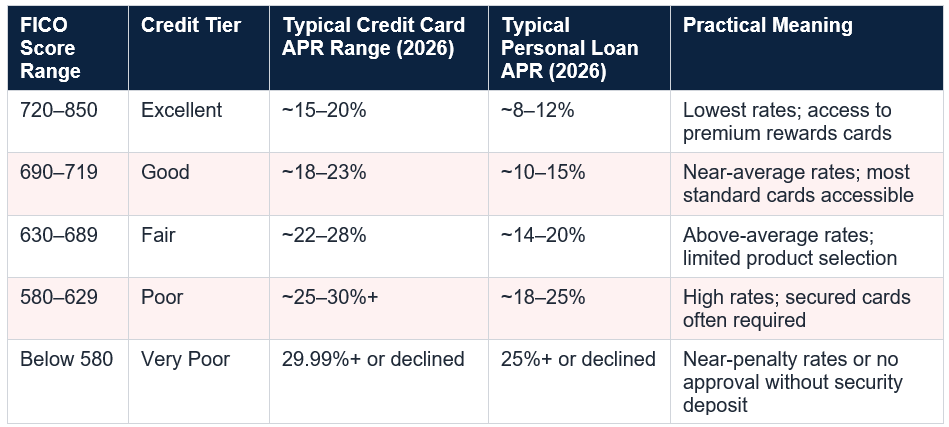
The practical implication: a 100-point improvement in credit score can reduce a credit card APR by 5–10 percentage points. On a $5,000 balance, the difference between a 20% APR and a 28% APR is approximately $400 in annual interest. The difference between a 15% and a 28% personal loan on $20,000 over 5 years is approximately $8,000 in total interest paid. Improving a credit score is, in accounting terms, the highest-return action available to most borrowers — it has a measurable, calculable, and compounding financial benefit with every use of credit thereafter.
What APR tells you: the annualised cost of borrowing, including mandatory fees, on a comparable basis. It allows like-for-like comparison between offers from different lenders for the same type of product.
What APR does NOT tell you:
The accountant’s perspective on APR is simple: it is a cost of capital, and every pound or dollar of interest paid to a lender is a pound or dollar not building wealth, not compounding in an investment account, and not available for any other use. Minimising it — through paying in full, improving credit scores, using 0% promotional periods strategically, and consolidating at lower rates — is one of the highest-return financial actions available to any household.
Understanding APR is the beginning. Using that understanding to change how you borrow, what products you choose, and how aggressively you repay is the outcome that changes financial trajectories.
APR stands for Annual Percentage Rate. In the simplest possible terms: it is the annual cost of borrowing money, expressed as a percentage, that includes both the interest charged and any mandatory fees associated with the loan. If you borrow $10,000 at a 20% APR, the loan costs you approximately $2,000 per year in interest and fees (before taking into account the effect of compounding and repayments reducing the balance). APR is legally required to be disclosed on all consumer credit products in the US (under the Truth in Lending Act) and the UK (under the Consumer Credit Act), specifically so that borrowers can compare the true cost of different products on the same scale.
What is the difference between APR and interest rate?
The interest rate is the basic charge for borrowing money, expressed as a percentage of the outstanding balance. It does not include fees. APR includes the interest rate plus most mandatory fees (origination fees, broker fees, points, mandatory insurance), all combined and expressed as a single annualised percentage. For most credit cards, the APR and the interest rate are identical because there are no fees included in the APR calculation. For mortgages and personal loans with origination fees, the APR will always be higher than the interest rate. When comparing two products, always compare APR to APR, not the interest rate of one to the APR of another.
Is APR charged monthly or annually?
APR is stated annually but typically applied on a daily or monthly basis. Most credit card issuers use a Daily Periodic Rate (APR ÷ 365) applied to the average daily balance each billing cycle, producing a monthly interest charge. You do not pay the full APR in one lump sum at the end of the year — the annual cost is divided and charged each month (or each day) based on the outstanding balance. This means that as you pay down a balance, the monthly interest charge falls, because the rate is applied to a smaller balance.
What is a good APR?
'Good' is relative to the product type and the current interest rate environment. In 2026, with US average credit card APRs at 20.94% (Federal Reserve) and UK averages at 35.9% (Moneyfacts), 'good' for a credit card is anything significantly below the average — typically 15% or below for borrowers with excellent credit. For personal loans, a good APR in 2026 is in the 8–14% range for qualified borrowers. For mortgages, 'good' varies by term and down payment but broadly means below the national average for comparable products. The most important benchmark is not an absolute number but your specific comparison set: what rate can you get at your credit score, and how does that compare across lenders for the same product?
Why is UK APR higher than US APR?
The UK average credit card APR (35.9% as of May 2026, Moneyfacts) appears significantly higher than the US average (around 20–22%, Federal Reserve) for several structural reasons: the UK Representative APR includes fees in the calculation methodology that may not be included in the US APR calculation; UK credit card products typically have no grace period for interest-free borrowing on the same scale as US cards; UK lenders historically apply higher margins above the base rate; and the specific cards sampled in Moneyfacts surveys include many products aimed at less creditworthy borrowers where rates are highest. The structural difference also reflects competitive market dynamics and regulatory frameworks that differ between the two countries. Both trends are, however, upward in 2026.
Can I negotiate my APR?
Yes, and it works more often than most people expect. A straightforward phone call to your credit card issuer requesting a rate reduction — citing a clean payment history and competing offers — results in a rate reduction for a meaningful proportion of customers who ask. For existing loans with a fixed APR, renegotiation is less common, but refinancing into a new loan at a better rate is always an option if your credit profile has improved since the original loan was taken out. The most powerful APR negotiation happens before you take out a loan: comparing multiple offers across different lenders, particularly for mortgages and personal loans, typically produces meaningfully different APR offers for the same credit profile.
Table of Contents
- The Three Letters on Every Loan That Most People Misunderstand
- What APR Stands For — and What It Actually Measures
- APR vs Interest Rate: The Crucial Distinction
- How APR Is Calculated: The Accountant’s Breakdown
- APR vs EAR: Why the Number You See Isn’t Always the Number You Pay
- The Four Types of APR on a Credit Card
- How APR Becomes a Real Monthly Cost: The Daily Periodic Rate
- What Happens When You Only Pay the Minimum?
- The Current APR Landscape: US and UK Rates in 2026
- How Your Credit Score Determines Your APR
- How to Compare APR Across Different Loan Products
- What APR Does and Doesn’t Tell You
- Five Ways to Reduce the APR You Actually Pay
- Conclusion: The Most Important Number in Your Financial Life
- Frequently Asked Questions
What APR Actually Costs: Real Monthly Charges on a £/$3,000 Balance
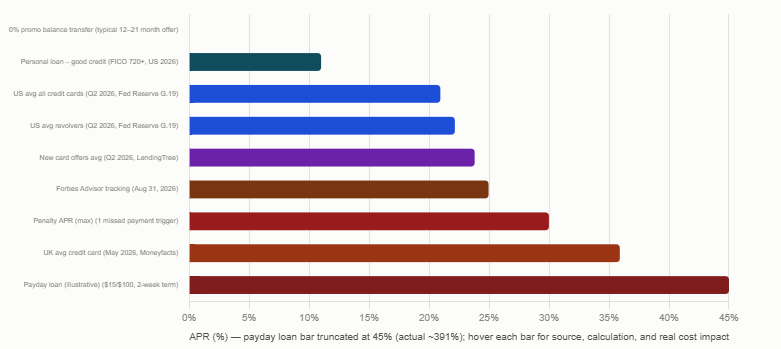
APR Rates Landscape 2026: US & UK Product Comparison
The Three Letters on Every Loan That Most People Misunderstand
APR appears on every credit card statement, every mortgage offer, every car loan document, every personal loan agreement, and every buy-now-pay-later advertisement in the English-speaking world. It is, by regulation, the single standardised number that lenders must disclose to allow consumers to compare the cost of borrowing across different products and providers. It is also, consistently, one of the least understood numbers in personal finance.The consequences of not understanding APR are measurable. The average US credit card APR in Q2 2026 was 20.94% for all accounts and 22.15% for accounts actually carrying a balance (Federal Reserve G.19; LendingTree, August 2026). Americans carry $1.263 trillion in credit card debt. The average US household owes $11,507 in credit card balances. The average UK credit card APR reached 35.9% in May 2026 — 14 percentage points higher than a decade ago (Moneyfacts; Which?, May 2026). A $5,000 credit card balance at 21.47% APR, paying only the minimum, takes over 15 years to eliminate and costs more than $6,000 in interest on top of the original balance (The Global Statistics, May 2026).
These outcomes are not inevitable. They are the direct result of how APR works when it is not understood and not managed. This guide explains APR in full — the definition, the calculation, the types, the real monthly cost, and the five practical strategies that reduce what you actually pay. The explanation comes from an accountant’s perspective: precise, quantitative, and focused on the numbers that matter.
Average US credit card APR (Q2 2026): 20.94% all accounts; 22.15% accounts accruing interest (Federal Reserve G.19; LendingTree). US credit card debt Q2 2026: $1.263 trillion (NY Fed). Average household debt: $11,507 (WalletHub Q1 2026). UK average credit card APR (May 2026): 35.9% — up 14pp in a decade (Moneyfacts; Which?). A $5,000 balance at 21.47% APR on minimum payments: 15+ years, $6,000+ interest cost.
What APR Stands For — and What It Actually Measures
APR stands for Annual Percentage Rate. It is the total annualised cost of borrowing, expressed as a percentage of the amount borrowed, incorporating not just the nominal interest rate but also most mandatory fees and charges associated with the credit product.The key word is ‘annual.’ APR converts the full cost of borrowing into a yearly figure regardless of the actual loan term, making it possible to compare a 3-month loan and a 30-year mortgage on the same scale. Without this standardisation, a lender offering a ‘3% monthly rate’ would be charging more than a lender offering a ‘24% annual rate’ — a comparison that is impossible without converting both to the same time period.
APR was designed as a consumer protection tool. In the United States, the Truth in Lending Act (TILA), enforced by the Consumer Financial Protection Bureau (CFPB), requires lenders to disclose the APR on all consumer credit products before a borrower signs. In the United Kingdom, the Consumer Credit Act requires disclosure of the Representative APR before advertising or offering credit. In the European Union, the Consumer Credit Directive establishes similar requirements. The intent in all jurisdictions is the same: give consumers a single, comparable number that reflects the true cost of a loan.
Accountant’s insight: APR is a legal requirement, not a marketing choice. Every time you see it on a credit product, a regulator mandated its presence to protect you. The number exists specifically because lenders, given the choice, would prefer to advertise the lowest-looking component of the borrowing cost (the interest rate alone, before fees) rather than the full cost of the product. Understanding APR is, in part, understanding what the law is trying to tell you about what you are actually paying.
APR vs Interest Rate: The Crucial Distinction
The single most important conceptual distinction in understanding APR is the difference between the APR and the interest rate (also called the nominal rate or the note rate). These two numbers describe different things, and confusing them is the most common and most costly misunderstanding in consumer borrowing.The interest rate is the percentage of the outstanding balance that the lender charges for the use of the money. It does not include any fees. The APR is the interest rate plus mandatory fees, both expressed as a combined annualised cost.
Example: Mortgage illustration: A 30-year fixed mortgage with a 6.75% interest rate and $4,500 in origination fees and closing costs on a $300,000 loan has an APR higher than 6.75% — because those fees are folded into the APR calculation, effectively raising the annual cost of the loan. The interest rate (6.75%) is what you pay on the principal. The APR (perhaps 6.95%) is what the loan actually costs you per year, including those fees. When comparing two mortgages with the same 6.75% interest rate but different fees, the APR comparison reveals which one is actually cheaper over the full term.
The difference between APR and interest rate matters most for:
• Mortgages: origination fees, discount points, broker fees, and mandatory insurance can create a significant gap between the advertised interest rate and the APR.
• Personal loans: arrangement fees or origination fees (typically 1–8% of the loan amount) are included in the APR calculation.
• Payday loans: a ‘flat’ fee of $15 per $100 borrowed for a 2-week loan looks modest until converted to an APR — which reveals a rate of approximately 391% annually.
• Credit cards: for most credit cards, there are no annual fee components in the APR calculation itself (the annual fee is charged separately). The credit card APR is effectively the same as the nominal interest rate. This is one of the few cases where APR and interest rate are identical.
How APR Is Calculated: The Accountant’s Breakdown
The official formula for APR is defined by regulatory bodies (CFPB in the US, FCA in the UK) and is designed to express the true annualised cost of borrowing. At its most conceptual level, the calculation works by:- Step 1: Identify all payments the borrower must make under the credit agreement: principal repayments, interest payments, and any mandatory fees.
- Step 2: Identify the amount actually received by the borrower (the principal, after any fees deducted upfront).
- Step 3: Solve for the interest rate at which the present value of all future payments equals the amount received today. This rate is the APR.
In practice, this is an internal rate of return (IRR) calculation — the same calculation used in corporate finance to evaluate investment returns. The APR is the IRR of the loan’s cash flows from the lender’s perspective (or equivalently, the IRR of the cash flows from the borrower’s perspective with reversed sign convention).
Example: Simple illustration: You borrow $10,000 for 1 year. You receive $9,800 (the lender deducts a $200 origination fee upfront). You repay $10,800 at the end of the year ($10,000 principal + $800 interest). The nominal interest rate is 8% ($800 / $10,000). But you only received $9,800, so the APR is $800 / $9,800 = approximately 8.16%. The small gap reflects the fee's effect on the true cost: you paid $800 in interest on $9,800 actually received, not on $10,000 nominally borrowed. This is the core insight of APR: it asks what you actually received and what you actually paid, not what the stated principal was.
For credit cards, the calculation is simplified because there is typically no upfront fee included in the APR. The credit card APR is the nominal annual interest rate, stated as a simple annual percentage. The Daily Periodic Rate (DPR) is then calculated as APR ÷ 365 and applied to the average daily balance in each billing cycle to determine the monthly finance charge.
APR vs EAR: Why the Number You See Isn’t Always the Number You Pay
For accounts that compound interest more frequently than once per year — which includes virtually all credit cards — the Annual Percentage Rate is not the same as the Effective Annual Rate (EAR), also called the Annual Equivalent Rate (AER) in the UK.APR is a simple annual rate: it does not account for the effect of intra-year compounding. EAR is the actual annualised return or cost after compounding is taken into account. For a savings account or investment, EAR is what you actually earn. For a borrowing product, EAR is what you actually pay.
The relationship between APR and EAR:
Example: Formula: EAR = (1 + APR/n)^n − 1, where n = number of compounding periods per year. For a credit card with 21% APR compounded daily (n = 365): EAR = (1 + 0.21/365)^365 − 1 = (1.000575)^365 − 1 ≈ 23.36%. For the same 21% APR compounded monthly (n = 12): EAR = (1 + 0.21/12)^12 − 1 = (1.0175)^12 − 1 ≈ 23.14%. The practical result: a credit card with a stated APR of 21% actually costs approximately 23.1–23.4% per year in effective terms, depending on the compounding frequency. This gap grows as the APR increases — at 30% APR daily compounding, the EAR is approximately 34.97%.
Accountant’s insight: The EAR is what borrowers and investors should use when comparing the true cost of credit or the true return on savings. APR is the legally required disclosure and the basis for comparison, but EAR is the honest answer to 'what does this actually cost me per year?' The gap between the two is small at low rates (0.1–0.5 pp at 5–10% APR) but meaningful at high rates (3–7 pp at 21–30% APR) and enormous at payday loan rates. For savings accounts and P2P products quoting an APR, the EAR tells you what you will actually earn with compounding.
The Four Types of APR on a Credit Card
Most people know that credit cards have an APR. Fewer know that a single credit card typically carries four different APRs for four different transaction types, and that some of these rates are significantly higher than the advertised purchase APR:Many cardholders focus only on the purchase APR when comparing cards and are caught off guard by the cash advance APR (often 5–10 percentage points higher, with no grace period) and the penalty APR (which can jump to 29.99% after one missed payment and applies to all existing balances, not just new transactions). Reading the Schumer box — the standardised APR disclosure table that US card issuers must include in every card application — before applying reveals all four rates before you are committed.
How APR Becomes a Real Monthly Cost: The Daily Periodic Rate
Understanding how a stated annual APR translates into a real monthly charge on your credit card statement requires understanding the Daily Periodic Rate (DPR), which is how most credit card issuers actually calculate interest.The Daily Periodic Rate is simple to calculate:
Example: DPR = APR ÷ 365. For a card with a 21% APR: DPR = 21% ÷ 365 = 0.05753% per day. Each day, the card issuer multiplies this rate by the outstanding balance that day (the average daily balance across the billing cycle is typically used). Over a 30-day billing cycle on a $3,000 balance: Daily interest = $3,000 × 0.0005753 = $1.73 per day. Monthly charge = $1.73 × 30 days = $51.78. Annualised: $51.78 × 12 = $621.36, which is approximately 20.7% of $3,000 — close to the 21% APR (the small discrepancy reflects the simplified average daily balance assumption in this illustration). If that same $3,000 balance were at the average UK credit card APR of 35.9%: DPR = 35.9% ÷ 365 = 0.09836% per day. Monthly charge = $3,000 × 0.0009836 × 30 = $88.52 per month. Annualised: $1,062.24 per year, or 35.4% of $3,000 — reflecting the 35.9% stated APR on the actual balance.
The monthly cost at different APR levels on a constant $3,000 balance:
Accountant’s insight: The monthly finance charge is money you pay for the privilege of keeping a balance. It is not reducing your debt — it is the fee for using borrowed money for one more month. At 20.94% APR on a $3,000 balance, you pay $51.62 per month in interest before a single cent reduces the principal. Over a year, that is $619.50 in interest — money that could instead be redirected to principal, investment, or savings. This is why the accountant's first rule about credit card debt is: the interest rate, not the balance, determines the urgency.
What Happens When You Only Pay the Minimum?
The minimum payment on a credit card is typically calculated as either a flat amount (often $25–35) or a percentage of the outstanding balance (often 1–2%), whichever is greater. The minimum payment is deliberately set low — it keeps the account in good standing and avoids a penalty APR, but it barely reduces the principal and maximises the long-term interest cost to the borrower.Example: The minimum payment trap (illustrative calculation at 21.47% APR): Starting balance: $5,000. Minimum payment: 2% of balance or $25, whichever is greater. At this payment pace: Time to pay off: over 15 years (approximately 183 months). Total interest paid: more than $6,000 on the original $5,000 balance — meaning you pay back more than $11,000 in total for $5,000 borrowed. (The Global Statistics, May 2026.) Now compare paying $200 per month fixed (above the minimum): Time to pay off: approximately 29 months. Total interest paid: approximately $752. Interest savings over minimum payments: approximately $5,248. The difference between the minimum payment strategy and the $200/month strategy is over five thousand dollars. This is what APR does when it compounds across many small payments over many years.
Under the CARD Act of 2009, credit card issuers in the United States are required to disclose on each monthly statement: (1) how long it will take to pay off the current balance if only the minimum payment is made; (2) the total amount paid, including interest, if only the minimum payment is made; and (3) the monthly payment required to pay off the balance in 36 months. These disclosures exist specifically to make the minimum payment trap visible rather than hidden.
The minimum payment disclosure on your statement is one of the most important numbers on the entire page. It reveals the true cost of the comfort of paying the minimum. If the '36-month payoff' payment shown on your statement is dramatically higher than what you're currently paying, and you carry a balance month to month, that gap is costing you money every single billing cycle.
The Current APR Landscape: US and UK Rates in 2026
Understanding where APR rates currently stand provides the context for evaluating any individual rate you are offered. The data in 2026 shows rates at historically elevated levels in both the US and UK, though with recent signs of moderation in the US as the Federal Reserve has begun cutting rates.United States (2026):
- Average APR for all credit card accounts (Q2 2026): 20.94%, up from 16.28% in 2020 — a 28% increase in six years (Federal Reserve G.19; LendingTree; Motley Fool).
- Average APR for accounts accruing interest (Q2 2026): 22.15% (Federal Reserve G.19; LendingTree).
- Average new credit card offer APR (Q2 2026): 23.80% (LendingTree).
- Forbes Advisor tracking: approximately 24.96% as of August 31, 2026.
- Record high: 21.76% in August 2024 (Motley Fool). Current rates have retreated slightly from this peak.
- APR range: 7.90% to 34.48% depending on card type and creditworthiness (Experian, August 2026).
- Federal mechanism: credit card APRs are typically set as Prime Rate (Fed Funds Rate + 3%) plus a margin. When the Fed cut rates in 2024–2025, card APRs began a gradual decline from peak levels.
- Average credit card APR (May 2026): 35.9% — up approximately 14 percentage points over the past decade (Moneyfacts; Which?, May 2026).
- Outstanding UK credit card debt: £79.5 billion as of February 2026 (The Money Charity; Which?).
- Average UK household credit card debt: approximately £2,735 (Which?, May 2026).
US avg credit card APR (Q2 2026): 20.94% all accounts; 22.15% revolvers; 23.80% new offers (Federal Reserve G.19; LendingTree). US credit card debt Q2 2026: $1.263 trillion. UK avg credit card APR (May 2026): 35.9% (+14pp over decade; Moneyfacts). US total credit card accounts: 648 million. Avg US household card debt: $11,507. Avg interest/fees paid per US person per year: $396.30 (WalletHub 2025).
How Your Credit Score Determines Your APR
The APR you are quoted on any credit product is not fixed. It is personalised to your risk profile as assessed by the lender, using primarily your credit score and credit history. Understanding this relationship is one of the most practically valuable aspects of APR literacy.In the US, the dominant scoring model is the FICO Score (range 300–850). The relationship between FICO score and credit card APR is roughly:
The practical implication: a 100-point improvement in credit score can reduce a credit card APR by 5–10 percentage points. On a $5,000 balance, the difference between a 20% APR and a 28% APR is approximately $400 in annual interest. The difference between a 15% and a 28% personal loan on $20,000 over 5 years is approximately $8,000 in total interest paid. Improving a credit score is, in accounting terms, the highest-return action available to most borrowers — it has a measurable, calculable, and compounding financial benefit with every use of credit thereafter.
How to Compare APR Across Different Loan Products
APR allows comparison across different products on the same scale, but using it correctly for comparison requires understanding its limitations:- Compare APR within the same product category: comparing a mortgage APR to a credit card APR is not directly meaningful because the products have different terms, structures, and compounding frequencies. Compare mortgage to mortgage, personal loan to personal loan.
- Adjust for loan term: a short-term loan may show a lower APR but cost more in total interest if its structure front-loads fees. Always calculate the total cost in pounds or dollars paid, not just the APR, for large purchases.
- Check whether the APR is fixed or variable: a credit card APR is almost always variable (tied to the Prime Rate or base rate). A personal loan APR may be fixed or variable. A fixed APR is more predictable; a variable APR can increase unexpectedly.
- Understand what is included: the APR calculation does not always include all costs. In the US, it excludes third-party fees (e.g. title insurance on a mortgage), late payment fees, and optional costs. In the UK, the Representative APR is what at least 51% of successful applicants receive — many applicants receive a higher rate than the Representative APR advertised.
- 0% APR is not free: a 0% APR promotional offer on a balance transfer or purchase still involves a balance transfer fee (usually 3–5%) and reverts to the standard APR when the promotional period ends. The 0% period is free borrowing — the transfer fee is the upfront cost of accessing it.
What APR Does and Doesn’t Tell You
APR is the most important standardised number in consumer finance. It is not the only number that matters, and knowing its limitations prevents costly errors in evaluation.What APR tells you: the annualised cost of borrowing, including mandatory fees, on a comparable basis. It allows like-for-like comparison between offers from different lenders for the same type of product.
What APR does NOT tell you:
- The total cost in money: APR is a rate, not a pound or dollar amount. To know the total interest paid over the life of a loan, you need to multiply the APR by the outstanding balance over time and sum the result. Two loans with the same APR but different terms will have very different total interest costs.
- The compounding effect (EAR): as explained in Section 5, the APR understates the effective annual cost for products that compound more frequently than annually. EAR is the true cost after compounding.
- Fees excluded from the calculation: in some jurisdictions and products, certain fees are not included in the APR disclosure. Optional insurance, late fees, and some third-party charges may fall outside the APR.
- How variable rate risk affects the long-term cost: a variable APR quoted today may be significantly different in 12 or 24 months if interest rates move. A fixed APR eliminates this risk; a variable APR does not.
Five Ways to Reduce the APR You Actually Pay
From an accountant’s perspective, the most effective response to a high-APR environment is not complaint — it is specific, quantifiable action. These five strategies have measurable outcomes:- Pay the full statement balance every month: the single most effective APR strategy. If you pay the full balance by the due date each month, the purchase APR is completely irrelevant — you pay zero interest regardless of the rate. The grace period (typically 21–25 days in the US) means you have borrowed at 0% for up to 25 days on every purchase. The credit card APR only costs you money when you carry a balance.
- Improve your credit score before applying for credit: as shown in Section 10, a higher credit score directly produces a lower APR offer. Specific credit score improvements include: reducing credit utilisation below 30% (the ratio of balances to limits); paying on time for 12+ consecutive months; disputing errors on your credit report; avoiding new credit applications in the 6 months before a major loan. The APR reduction from a credit score improvement is permanent and applies to every future credit product.
- Use a 0% balance transfer card for existing high-APR debt: balance transfer cards offer 0% APR for 12–21 months (typical range in 2026). Transferring a $5,000 balance from a 21% APR card to a 0% card for 18 months saves approximately $1,575 in interest (½ of $3,150 — the annual interest at 21%), minus the balance transfer fee (typically 3–5% = $150–$250). Net saving: approximately $1,325–1,425. The caveat: you must pay down the balance during the 0% period; if it reverts to the standard rate with a remaining balance, the saving is reduced or eliminated.
- Negotiate a lower rate with your existing card issuer: a straightforward phone call requesting a rate reduction is often successful, particularly for customers with a history of on-time payments. Issuers regularly grant rate reductions of 3–6 percentage points to customers who ask and have good payment history. On a $3,000 balance, a 5-point reduction (from 22% to 17%) saves $150 per year in interest — from a single phone call.
- Consolidate high-APR debt with a lower-APR personal loan: if your credit score qualifies you for a personal loan at 8–14% APR (The Global Statistics, May 2026), using it to pay off credit card debt at 20–25% APR locks in a lower rate and a fixed payoff timeline. The net saving over 3–5 years can reach thousands of dollars depending on the balance. Discipline is required: the paid-off credit cards must not be re-charged.
Conclusion
APR is not just a number on a document. It is the precise, legal, regulated answer to the question: what is borrowing money actually costing me? An average US credit card APR of 20.94% means that a $10,000 balance, untouched, costs $2,094 per year in interest alone. A UK average of 35.9% means that the same balance costs £3,590 per year. Over 15 years of minimum payments on $5,000 of credit card debt, the total cost exceeds $11,000. These are not abstract possibilities — they are the documented outcomes for millions of borrowers who carry balances without understanding what APR is doing to them.The accountant’s perspective on APR is simple: it is a cost of capital, and every pound or dollar of interest paid to a lender is a pound or dollar not building wealth, not compounding in an investment account, and not available for any other use. Minimising it — through paying in full, improving credit scores, using 0% promotional periods strategically, and consolidating at lower rates — is one of the highest-return financial actions available to any household.
Understanding APR is the beginning. Using that understanding to change how you borrow, what products you choose, and how aggressively you repay is the outcome that changes financial trajectories.
Frequently Asked Questions
What is APR in simple terms?APR stands for Annual Percentage Rate. In the simplest possible terms: it is the annual cost of borrowing money, expressed as a percentage, that includes both the interest charged and any mandatory fees associated with the loan. If you borrow $10,000 at a 20% APR, the loan costs you approximately $2,000 per year in interest and fees (before taking into account the effect of compounding and repayments reducing the balance). APR is legally required to be disclosed on all consumer credit products in the US (under the Truth in Lending Act) and the UK (under the Consumer Credit Act), specifically so that borrowers can compare the true cost of different products on the same scale.
What is the difference between APR and interest rate?
The interest rate is the basic charge for borrowing money, expressed as a percentage of the outstanding balance. It does not include fees. APR includes the interest rate plus most mandatory fees (origination fees, broker fees, points, mandatory insurance), all combined and expressed as a single annualised percentage. For most credit cards, the APR and the interest rate are identical because there are no fees included in the APR calculation. For mortgages and personal loans with origination fees, the APR will always be higher than the interest rate. When comparing two products, always compare APR to APR, not the interest rate of one to the APR of another.
Is APR charged monthly or annually?
APR is stated annually but typically applied on a daily or monthly basis. Most credit card issuers use a Daily Periodic Rate (APR ÷ 365) applied to the average daily balance each billing cycle, producing a monthly interest charge. You do not pay the full APR in one lump sum at the end of the year — the annual cost is divided and charged each month (or each day) based on the outstanding balance. This means that as you pay down a balance, the monthly interest charge falls, because the rate is applied to a smaller balance.
What is a good APR?
'Good' is relative to the product type and the current interest rate environment. In 2026, with US average credit card APRs at 20.94% (Federal Reserve) and UK averages at 35.9% (Moneyfacts), 'good' for a credit card is anything significantly below the average — typically 15% or below for borrowers with excellent credit. For personal loans, a good APR in 2026 is in the 8–14% range for qualified borrowers. For mortgages, 'good' varies by term and down payment but broadly means below the national average for comparable products. The most important benchmark is not an absolute number but your specific comparison set: what rate can you get at your credit score, and how does that compare across lenders for the same product?
Why is UK APR higher than US APR?
The UK average credit card APR (35.9% as of May 2026, Moneyfacts) appears significantly higher than the US average (around 20–22%, Federal Reserve) for several structural reasons: the UK Representative APR includes fees in the calculation methodology that may not be included in the US APR calculation; UK credit card products typically have no grace period for interest-free borrowing on the same scale as US cards; UK lenders historically apply higher margins above the base rate; and the specific cards sampled in Moneyfacts surveys include many products aimed at less creditworthy borrowers where rates are highest. The structural difference also reflects competitive market dynamics and regulatory frameworks that differ between the two countries. Both trends are, however, upward in 2026.
Can I negotiate my APR?
Yes, and it works more often than most people expect. A straightforward phone call to your credit card issuer requesting a rate reduction — citing a clean payment history and competing offers — results in a rate reduction for a meaningful proportion of customers who ask. For existing loans with a fixed APR, renegotiation is less common, but refinancing into a new loan at a better rate is always an option if your credit profile has improved since the original loan was taken out. The most powerful APR negotiation happens before you take out a loan: comparing multiple offers across different lenders, particularly for mortgages and personal loans, typically produces meaningfully different APR offers for the same credit profile.
0 Comments
Be the first to share your thoughts on this article.