
Finance
What is Consumer Rights: The Complete UK Guide

Table of Contents
- The Legal Framework: What Laws Protect You in 2026
- Your Rights at a Glance: The Complete Timeline
- Faulty Goods: What the Law Says and What You Can Demand
- The Three Standards Every Purchase Must Meet
- The 30-Day Short-Term Right to Reject
- After 30 Days: Repair, Replacement, and Price Reduction
- Online and Distance Purchases: Your Additional Rights
- Digital Content and Services: Rights That Many Consumers Miss
- Digital Content
- Services
- Myths vs Facts: What Traders Tell You and What the Law Actually Says
- What Is New in 2026: Changes to Consumer Rights
- Stronger CMA Enforcement Powers (Active from April 2025)
- Drip Pricing Now More Clearly Prohibited
- Subscription Contract Protections (Expected Autumn 2026)
- Enforcing Your Rights: The Step-by-Step Process
- Conclusion
- Frequently Asked Questions (FAQ)
- External References & Further Reading

Most people know they have consumer rights. Far fewer can name what they actually are, when they apply, and — most crucially — what to say to a trader who tells them something that is not legally accurate. 'All sales are final.' 'We can only offer an exchange.' 'You need a receipt.' 'It's been more than 30 days so there's nothing we can do.' These are among the most common things consumers are told when they try to return faulty goods or cancel a service — and most of them are either misleading or outright false under UK law.
The Consumer Rights Act 2015 is the primary piece of legislation governing what you are entitled to when something goes wrong with a purchase in the United Kingdom. Updated and consolidated from earlier laws, it sets out clear statutory rights covering physical goods, digital content, and services — rights that are automatic, cannot be removed by any trader's terms and conditions, and apply regardless of whether you shopped in-store, online, by phone, or at the door. Running alongside it, the Consumer Contracts (Information, Cancellation and Additional Charges) Regulations 2013 gives you a 14-day cooling-off period for any purchase made remotely. And from 2025-2026, the Digital Markets, Competition and Consumers Act 2024 has expanded the Competition and Markets Authority's enforcement powers significantly, giving regulators the ability to fine businesses up to 10% of their global turnover for consumer law breaches.
This guide covers everything you need to know about your consumer rights in 2026: what the law says about faulty goods, how the time limits work and why they matter, what 'satisfactory quality' and 'as described' actually mean, your rights for online purchases, digital content, and services, the new subscription contract rules arriving in Autumn 2026, the myths traders perpetuate and the facts that counter them, and the step-by-step escalation path when a trader refuses to honour your rights.
The Legal Framework: What Laws Protect You in 2026
UK consumer protection in 2026 rests on a clear hierarchy of legislation that has been significantly strengthened in the past two years:- The Consumer Rights Act 2015 (CRA): The primary statute governing purchases of goods, digital content, and services. It consolidated the Sale of Goods Act 1979, the Supply of Goods and Services Act 1982, and the Unfair Terms in Consumer Contracts Regulations 1999 into a single, modernised framework. The CRA sets out the three core standards goods must meet, the remedies available to consumers when they are not met, and the rules on unfair contract terms.
- The Consumer Contracts (Information, Cancellation and Additional Charges) Regulations 2013: Gives consumers a statutory 14-day cooling-off period for any purchase made 'at a distance' — online, by phone, or by mail order — during which they can cancel for any reason and receive a full refund.
- The Digital Markets, Competition and Consumers Act 2024 (DMCC), in force from April 2025: Restates the prohibition on unfair trading practices, explicitly bans drip pricing (showing artificially low prices then adding unavoidable charges), and gives the CMA direct enforcement powers without needing to take businesses to court first. Fines can reach 10% of a company's global annual turnover — a significant deterrent that has already prompted undertakings from major retailers including ASOS, Boohoo, and Asda in relation to misleading green claims and pricing practices.
- New subscription contract rules (expected Autumn 2026): Under the DMCC Act's provisions for subscription contracts, businesses will be required to provide reminders before automatic renewals, ensure cancellation is 'straightforward' (including online cancellation for online subscriptions), and send an 'end of contract' notice confirming cancellation. These provisions give consumers the right to cancel without penalty if a trader breaches the new requirements.
New CMA enforcement powers from 2025: Fines up to 10% of global annual turnover — the Digital Markets, Competition and Consumers Act 2024 gave the Competition and Markets Authority direct powers to investigate and fine businesses for consumer law breaches — replacing a court-based system that was slower and less effective. The CMA has already used these powers against major retailers (DMCC Act 2024 / Law Bid, February 2026).
Your Rights at a Glance: The Complete Timeline
Consumer rights are time-dependent, which is why understanding the timeline is as important as understanding what the rights are. The table below maps your entitlements to the timeframe in which they apply: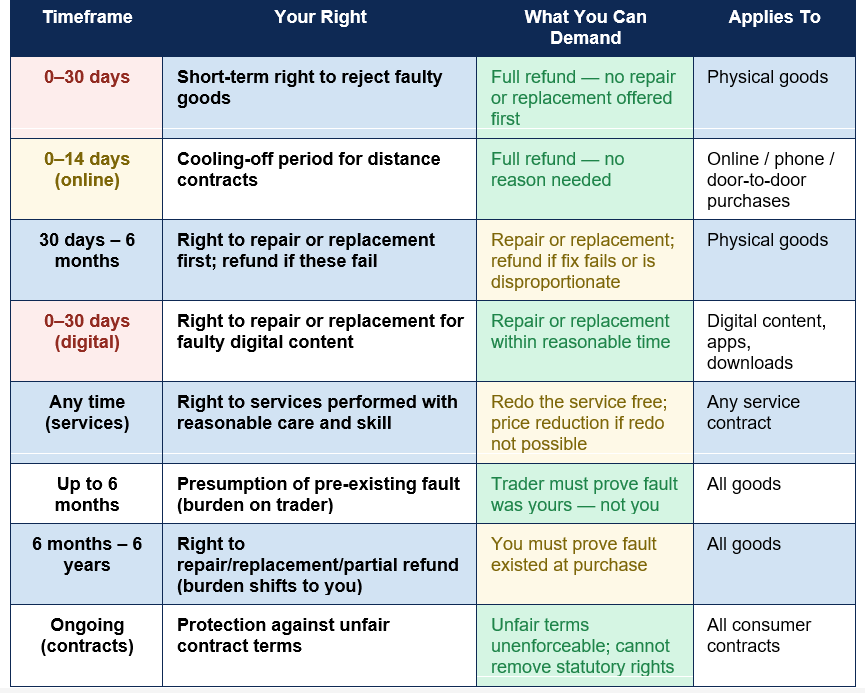
Faulty Goods: What the Law Says and What You Can Demand
The Consumer Rights Act establishes that when you buy goods, they must meet three statutory standards. Failure to meet any of these standards gives you a legal right to a remedy:The Three Standards Every Purchase Must Meet
- Satisfactory quality: Goods must be of a standard that a reasonable person would regard as satisfactory, taking into account the price paid, the description, and any other relevant circumstances. This covers appearance, finish, safety, freedom from minor defects, durability, and fitness for purpose generally. A television that breaks after two months is not of satisfactory quality. A shirt that falls apart after two washes is not of satisfactory quality.
- Fit for purpose: Goods must be fit for their general purpose and for any specific purpose you made known to the seller before buying. If you asked a shop assistant whether a pair of boots was suitable for hill walking, and they confirmed they were, and the boots proved unsuitable, they are not fit for purpose.
- As described: Goods must match any description given — whether written on the label, shown on a website, stated verbally at the point of sale, or shown in a catalogue or advertisement. If an item was described as 'waterproof' and is not, it fails this standard regardless of whether it is otherwise of good quality.
The 30-Day Short-Term Right to Reject
The most powerful time-limited right in UK consumer law is the short-term right to reject. Within 30 days of purchase, if goods fail to meet any of the three standards above, you can reject them and demand a full refund — not a repair, not a replacement, not a store credit. A full cash refund. The trader cannot insist on attempting a repair or replacement instead as a condition of the refund within this 30-day window.The 30-day clock starts from the date of delivery (for goods delivered) or purchase (for goods collected). For digital content, the equivalent right is to a repair or replacement within a reasonable time, with a refund available if those remedies fail — the digital content right is slightly different from the physical goods right but equally strong.
One of the most important practical points: if you discover a fault within 30 days, act promptly. Do not use the product for weeks after discovering the fault and then try to invoke the 30-day right — a tribunal or court might reasonably conclude that continued use after discovering the fault amounts to acceptance of the goods. Report the fault to the trader as soon as you find it, in writing where possible, to preserve your entitlement.
What 'faulty' actually means in practice: The law covers more than obvious manufacturing defects. If your brand-new washing machine works technically but vibrates excessively and is far noisier than any washing machine would reasonably be expected to be, it may be of unsatisfactory quality. If your laptop's battery life is advertised as 12 hours but runs for only four in normal use, it may fail the 'as described' standard. The question is always whether a reasonable person would consider the goods satisfactory given the price paid and the description given — a test that is deliberately broad and consumer-friendly.
After 30 Days: Repair, Replacement, and Price Reduction
Between 30 days and six months from purchase, your right to a full refund is replaced by a right to a repair or replacement first. The trader can choose which remedy to offer, provided their choice is not disproportionately more expensive than the alternative. If the repair fails, takes an unreasonably long time, causes significant inconvenience, or is unavailable, you can then request a refund — though the trader may make a deduction for the use you have had of the goods.The critical legal advantage in this period: within the first six months of purchase, it is presumed that any fault that emerges was present when you bought the goods. The burden of proof is on the trader to demonstrate that the fault was caused by something you did — not on you to prove the fault existed at purchase. This presumption reverses after six months, at which point you must provide evidence that the fault was pre-existing. This is why the six-month marker is one of the most important dates in UK consumer law.
Online and Distance Purchases: Your Additional Rights
When you buy at a distance — online, by telephone, or by mail order — you have a 14-day cooling-off period that gives you the right to cancel and receive a full refund for any reason whatsoever. You do not need to have a reason. The goods do not need to be faulty. You simply exercise your right to cancel within 14 days of receiving the goods, notify the trader, and return them. The trader must provide a refund within 14 days of receiving the goods back or your proof of return.Several important details about the cooling-off right that traders frequently misstate:
- The trader must pay return postage if the goods are faulty: You are generally expected to pay for return postage under the cooling-off right for change-of-mind returns — unless the trader's terms state otherwise. However, if you are returning goods because they are faulty, the trader must cover the return costs.
- The cooling-off period is 14 calendar days: It starts from the day after you receive the goods — not from when you ordered them. A 'working day' calculation does not apply; it is 14 calendar days including weekends.
- Some purchases are excluded from the cooling-off period: Custom-made items made to your specification, perishable goods, sealed hygiene products that have been opened, and digital content you have already begun downloading or streaming (with your agreement) are among the categories excluded. Check the full list at Citizens Advice or MoneyHelper if you are uncertain.
- After the cooling-off period, statutory rights still apply: Missing the 14-day cooling-off window does not extinguish your statutory rights under the Consumer Rights Act. If goods subsequently prove faulty, your rights to a remedy remain in force for up to six years.
Digital Content and Services: Rights That Many Consumers Miss
Digital Content
The Consumer Rights Act 2015 was the first UK legislation to set statutory standards for digital content — apps, downloaded films, e-books, games, software, music, and streaming subscriptions. Digital content must meet the same three standards as physical goods: satisfactory quality, fit for purpose, and as described. When it does not, you are entitled to a repair or replacement within a reasonable time, and if that fails, to a price reduction or refund.A significant protection specific to digital content: if faulty digital content damages your device or other digital content (for example, a corrupted app that damages files on your computer), the trader is liable for that consequential damage and you can claim the cost of repair or replacement of the affected device or content. This right is rarely publicised and even more rarely claimed.
Services
When you pay for a service — a haircut, a repair, a building job, a design project, a cleaning service — the service must be performed with 'reasonable care and skill,' in a reasonable time (if no specific time was agreed), and at a reasonable price (if no specific price was agreed). If the service fails to meet these standards:- You have the right to demand the service be repeated or completed properly at no extra charge.
- If repeating the service is not possible or practical, you are entitled to a price reduction appropriate to the shortfall in quality.
- If the service provider caused damage while performing the service — a plumber who floods your bathroom, a decorator who damages your floor — you are entitled to compensation for that damage.
Traders cannot legally remove your statutory rights: Any term in a contract attempting to do so is automatically void and unenforceable — Section 31 of the Consumer Rights Act 2015 explicitly prevents traders from excluding or limiting liability for failing to meet the three statutory standards for goods — any 'no refunds' sign or contractual clause attempting to do so has no legal effect whatsoever (Consumer Rights Act 2015, s.31).
Myths vs Facts: What Traders Tell You and What the Law Actually Says
The following table directly addresses the most common misleading statements consumers encounter when trying to exercise their rights: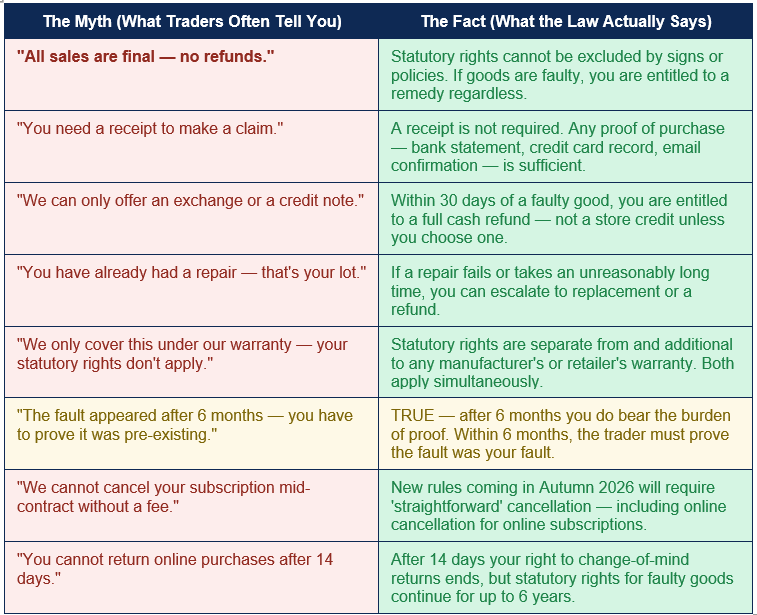
The single most important phrase to know: When a trader tells you something that contradicts your statutory rights, cite the Consumer Rights Act 2015 by name. Say: 'I am invoking my statutory rights under the Consumer Rights Act 2015. The goods are faulty and I am exercising my short-term right to reject within 30 days and requesting a full refund.' Naming the specific legislation shifts the dynamic of the conversation significantly — it demonstrates you know your rights and makes clear to the trader that the conversation is now a legal matter rather than a discretionary goodwill decision on their part.
What Is New in 2026: Changes to Consumer Rights
Several significant developments in UK consumer protection have occurred or are imminent in 2026 that consumers should be aware of:Stronger CMA Enforcement Powers (Active from April 2025)
The DMCC Act 2024 gave the CMA the ability to investigate and penalise consumer law breaches directly, without needing to take businesses to court. This has already produced action against major UK retailers. CMA enforcement under these new powers is ongoing in 2026, with the law firm analysis from Law Bid confirming that fines of up to 10% of global turnover are now possible, and that 'regulators can act faster and more robustly when businesses mislead shoppers or break the rules.' The practical benefit for consumers is an enforcement landscape in which systemic, widespread unfair trading practices are more likely to be acted upon promptly.Drip Pricing Now More Clearly Prohibited
Drip pricing — the practice of advertising a low headline price and then adding unavoidable fees (booking fees, service charges, processing charges) during the payment process — is now more explicitly prohibited under the DMCC Act's implementation. Several sectors known for this practice, including ticketing, hotels, and airlines, have faced increased scrutiny. Consumers who believe a final price was materially higher than the advertised price due to unavoidable add-on charges can report this to the CMA or to their local Trading Standards office.Subscription Contract Protections (Expected Autumn 2026)
The DMCC Act contains specific provisions governing subscription contracts that are expected to come into force in Autumn 2026. Businesses offering subscriptions will be required to: send a reminder notice before automatic renewals occur; ensure that cancellation is 'straightforward' and does not require 'any steps that are not reasonably necessary'; provide an online cancellation option for contracts entered into online; and send an 'end of contract' notice confirming cancellation. Consumers will have the right to cancel without penalty if a trader breaches any of these requirements.Enforcing Your Rights: The Step-by-Step Process
Knowing your rights is only useful if you know how to enforce them. The following process applies when a trader is not responding appropriately to a rights claim:- Raise the issue in writing with the trader: Put your complaint in writing — email is ideal. Reference the Consumer Rights Act 2015 specifically, state the fault or breach clearly, and state what remedy you are requesting and by when you expect a response. Written complaints create a record, set a clear timeline, and demonstrate seriousness. Keep a copy of everything.
- Give the trader a reasonable deadline: A response of 14 days is a standard reasonable timeframe. If the trader does not respond or refuses your request, state in a follow-up that you will escalate to the appropriate body if no resolution is reached within a further specified period.
- Use Alternative Dispute Resolution (ADR): Many sectors have an ombudsman or ADR scheme whose decisions are binding on the trader. The Financial Ombudsman covers financial services; the Retail Ombudsman and various sector-specific ombudsmen cover other areas. Check whether the trader is a member of an ADR scheme — they are required to tell you in their complaints procedure.
- Report to Trading Standards or the CMA: For systemic unfair practices — misleading pricing, fake reviews, illegal contract terms, unfair subscription traps — report to your local Trading Standards authority through Citizens Advice Consumer Service (0808 223 1133) or directly to the CMA for large-scale or digital market issues.
- Consider the Small Claims Court: For claims up to £10,000 in England and Wales, the Small Claims Court is a straightforward, relatively inexpensive process. Filing a claim forces the trader to take the matter seriously, and many traders settle before the hearing to avoid the cost and reputational risk. You do not need a solicitor for small claims — the gov.uk online Money Claim service (MCOL) allows you to file electronically.
Conclusion
Your consumer rights in the United Kingdom in 2026 are comprehensive, automatic, and — critically — cannot be removed by any trader's terms and conditions, signs, or policies. The Consumer Rights Act 2015 gives you 30 days to reject faulty goods and receive a full refund, up to six months of presumed fault liability resting with the trader, rights to repair and replacement thereafter, and ongoing protection against unfair contract terms across the full six-year limitation period. The Consumer Contracts Regulations give you 14 days to cancel any online or distance purchase for any reason. And the DMCC Act 2024 has equipped regulators with enforcement powers that are being actively used against businesses that mislead or exploit consumers.The gap between the rights most UK consumers believe they have and the rights they actually have is significant — and it runs consistently in consumers' favour. The 30-day full refund right is stronger than most people realise. The six-month burden-of-proof reversal is almost unknown. The digital content damage claim is rarely used. The subscription cancellation rights coming in Autumn 2026 will be transformative for the millions of consumers stuck in rolling contracts they struggle to leave. And the drip pricing crackdown under the DMCC Act is already changing how major retailers present their prices.
The most effective thing you can do as a consumer right now is read this guide, note the timeframes that matter most (30 days for full rejection, 14 days for online cooling-off, six months for burden of proof), and remember the name of the legislation that protects you: the Consumer Rights Act 2015. When a trader tells you something that contradicts these rights, name the Act. Most traders either do not know the law as well as they should, or are hoping you do not. Knowing your rights — and being willing to say so out loud — is the most powerful consumer tool available.
Frequently Asked Questions (FAQ)
Can a shop legally refuse a refund if goods are faulty?
No. If goods are faulty — failing to meet the standards of satisfactory quality, fitness for purpose, or 'as described' under the Consumer Rights Act 2015 — the trader is legally obligated to provide a remedy. Within 30 days of purchase, that remedy is a full refund on demand. After 30 days, the trader can attempt a repair or replacement first, but cannot simply refuse to help. Any 'no refunds' sign or policy that claims to override these statutory rights has no legal effect. If a trader refuses to honour your statutory rights, you can escalate through Citizens Advice, Trading Standards, or ultimately the Small Claims Court.Do I need a receipt to claim a refund for faulty goods?
No. A receipt is not a legal requirement for making a consumer rights claim. Any proof of purchase is sufficient — a bank or credit card statement, a confirmation email, an order reference number, or even a witness who can confirm you bought the item. Traders who tell you that you need a receipt and can do nothing without one are misleading you. Keep any proof of purchase you have, but do not accept a refusal on the grounds of not having the original till receipt.What is the 14-day cooling-off period and does it apply to everything I buy online?
The 14-day cooling-off period applies to most purchases made online, by telephone, or by mail order under the Consumer Contracts Regulations 2013. During this period you can cancel for any reason and receive a full refund. It starts from the day after you receive the goods. Exceptions include custom-made items personalised to your specification, perishable goods, sealed hygiene products that have been opened, and digital content you have already started downloading with your consent. After the 14-day period, your statutory rights under the Consumer Rights Act for faulty goods remain fully in force.What is the 'six-month rule' and why does it matter?
Within the first six months of purchasing goods, UK law presumes that any fault that emerges was present at the time of purchase. This means the trader — not you — must prove that the fault was caused by something you did (misuse, accidental damage, normal wear and tear). After six months, this burden reverses: you must provide evidence that the fault was pre-existing rather than something that developed through your use. This makes the first six months the strongest period for any consumer claim about a product that develops a fault, and it is why acting promptly when problems emerge is important.What can I do if a trader ignores my consumer rights complaint?
If a trader refuses to address a legitimate consumer rights complaint, escalate systematically. First, put your complaint in writing referencing the Consumer Rights Act 2015 specifically. If there is no response within a reasonable period (14 days is standard), contact the Citizens Advice Consumer Service on 0808 223 1133, which can advise on your options and refer cases to Trading Standards. For financial services disputes, the Financial Ombudsman Service is free and binding. For other sectors, check whether the trader belongs to an ADR scheme with an ombudsman. As a last resort, file in the Small Claims Court via MCOL — claims up to £10,000 do not require a solicitor and the filing process is available online.
External References & Further Reading
The following authoritative sources were used in researching this article and are recommended for further reading:1. Legislation.gov.uk — Consumer Rights Act 2015 (Full Text, Updated to July 2026)
https://www.legislation.gov.uk/ukpga/2015/15/contents
2. Citizens Advice — Consumer Rights: Your Rights When Buying Goods
https://www.citizensadvice.org.uk/consumer/changed-your-mind-about-something-youve-bought/if-you-want-to-cancel/
3. MoneyHelper — Your Consumer Rights Explained
https://www.moneyhelper.org.uk/en/everyday-money/consumer-rights
4. GOV.UK — Consumer Rights Act 2015: Overview
https://www.gov.uk/government/publications/consumer-rights-act-2015/consumer-rights-act-2015
5. UKLegalGuides.com — Your Rights as a Consumer (England & Wales 2026)
https://www.uklegalguides.com/your-rights-as-a-consumer/
6. Competition and Markets Authority (CMA) — Consumer Law Enforcement
https://www.gov.uk/government/organisations/competition-and-markets-authority
7. Law Bid — UK Consumer Protection: What's Changing in 2026 (February 2026)
https://blog.lawbid.co.uk/untitluk-consumer-protection-whats-changing-in-2026-and-why-it-matters-to-youed-4/
8. Gov.uk — Small Claims Court: Make a Money Claim Online (MCOL)
https://www.moneyclaim.gov.uk/web/mcol/welcome
0 Comments
Be the first to share your thoughts on this article.