
Investing
What Is Debt Restructuring? Accountants' Guide

Table of Contents
- When Existing Debt Terms No Longer Work
- What Is Debt Restructuring? The Core Definition
- The Three Levels of Debt Restructuring: Personal, SME, and Corporate
- Level 1: Personal Debt Restructuring
- Level 2: SME Debt Restructuring
- Level 3: Corporate Debt Restructuring
- Personal Debt Restructuring Options: UK vs US 2026 Comparison
- Corporate and SME Debt Restructuring: The UK Options in 2026
- How Debt Restructuring Works: The Mechanics Step by Step
- Debt Restructuring Pros and Cons: The Balanced Assessment
- The Genuine Benefits
- The Real Risks
- When Should You Consider Debt Restructuring?
- Conclusion
- Frequently Asked Questions (FAQ)
When Existing Debt Terms No Longer Work
Debt -- whether personal credit card balances, a business loan, or a corporate bond -- is a contractual obligation with specific terms: a defined principal, an interest rate, and a repayment schedule. In normal financial conditions, those terms are met. But financial conditions are rarely static. Interest rates change. Incomes fall. Business revenues decline. Economic shocks arrive without warning. When the terms of existing debt become unmanageable under changed circumstances, the question is no longer whether to act -- it is how.Debt restructuring is the process of modifying those existing terms -- the interest rate, the repayment schedule, the principal amount, or all three -- to create a repayment structure that the borrower can actually sustain. JG Wentworth (May 2025): 'Debt restructuring is the process of modifying the terms of existing debt obligations to make them more manageable for the borrower. For individuals, this typically means working with creditors to alter payment schedules, interest rates, or even the total amount owed to create a more sustainable financial situation. The fundamental goal of debt restructuring is to provide financial relief while allowing the borrower to meet their obligations and the lender to recover as much of the debt as possible.' The final phrase is the key to why restructuring works as a bilateral tool: lenders who restructure get less than the original terms but often more than they would through default and enforcement.
This guide covers debt restructuring at every level in 2026: the personal level (individuals restructuring consumer debts through hardship plans, DMPs, IVAs, or bankruptcy); the small business level (SMEs restructuring commercial loans, vendor agreements, and equipment finance); and the corporate level (large companies restructuring complex multi-creditor capital structures through standstill agreements, CVAs, Schemes of Arrangement, and Part 26A Restructuring Plans). The guide covers both UK and US frameworks, with current data from Summit Law (April 2026), FBX Capital (July 2026), National Debt Relief (May 2026), Global Law Experts (May 2026), and other 2026 sources.
What Is Debt Restructuring? The Core Definition
Debt restructuring is the process of negotiating new terms for existing debt with the current lender or creditor -- modifying aspects of the loan or obligation to make repayment more manageable without necessarily taking out new debt. Experian (December 2025): 'Debt restructuring is the process of negotiating new terms with your creditors to make your debt more manageable. When you restructure debt, you work directly with lenders to modify aspects of your existing loans, such as lowering your interest rate, extending your repayment period or reducing the total amount owed.'The modifications that debt restructuring can include are: a reduction in the interest rate (producing lower monthly costs and reduced total repayment); an extension of the repayment term (lower monthly payments, though potentially higher total interest); a temporary payment holiday or reduced payment period; partial debt forgiveness (a reduction in the principal owed -- more common in corporate restructuring and formal insolvency procedures); or a combination of all of the above. National Debt Relief (May 2026): 'Debt restructuring is a process that adjusts the terms of existing loans to make repayment more manageable. Whether it applies to personal debt, business debt or corporate obligations, the goal is typically to prevent default and create a sustainable repayment path.'
The critical distinction between debt restructuring and debt consolidation is one that Experian (December 2025) draws clearly: 'Unlike taking out a new loan, debt restructuring involves modifying your existing agreements with your current lenders.' Debt consolidation creates a new loan to pay off existing debts; debt restructuring changes the terms of those existing debts with the same lenders. In practice, some personal debt situations involve elements of both -- but the conceptual distinction matters because the legal and practical process is entirely different. Restructuring involves negotiation with existing creditors; consolidation involves applying for new credit from a new or existing lender.
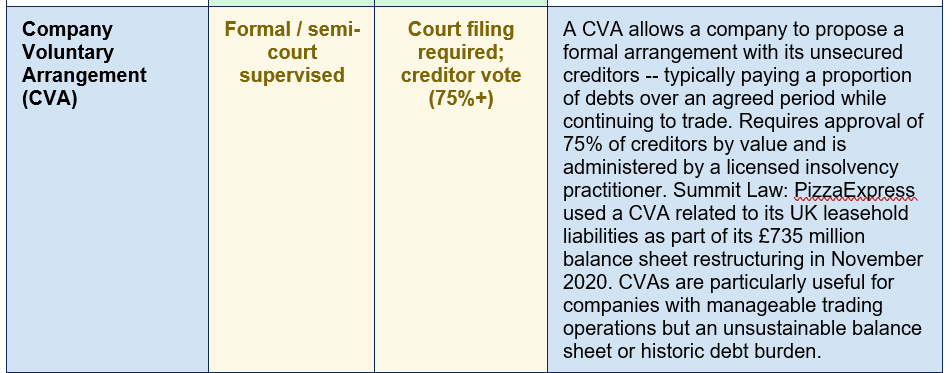
Debt restructuring in 2026 -- scale and context: PizzaExpress: £735m restructuring 2020. Challenger banks: 60% of UK SME lending 2025. FCA 2026/27 new supervisory priorities for liability management. — Summit Law (April 22, 2026): 'PizzaExpress completed a £735 million balance sheet restructuring in November 2020 including implementation of a CVA related to its UK leasehold liabilities. In January 2025, the fast food chain was bought in a pre-pack deal, preserving more than 3,000 jobs and 139 restaurants.' FBX Capital (3 weeks ago, July 2026): 'The British Business Bank 2025 report found that challenger and specialist banks accounted for 60% of gross SME bank lending in 2025 -- that breadth is what makes a restructuring that felt impossible a year ago worth revisiting today.' Global Law Experts (May 11, 2026): 'The FCA 2026/27 work programme, published in April 2026, introduces supervisory priorities that directly affect how liability management exercises and creditor workouts are designed, disclosed and executed.'
The Three Levels of Debt Restructuring: Personal, SME, and Corporate
Debt restructuring operates at three distinct levels, each with its own process, tools, legal framework, and typical outcomes. Understanding which level applies to your situation is the first step of any restructuring decision:Level 1: Personal Debt Restructuring
National Debt Relief (May 2026): 'Personal debt restructuring often involves credit cards, personal loans, medical debt or mortgages. It may include hardship programs, modified payment plans or consolidation agreements.' At the personal level, restructuring ranges from informal arrangements directly with a single creditor (the most accessible and least formal route) through to formal insolvency procedures (IVA or bankruptcy in the UK; Chapter 13 or Chapter 7 in the US) at the most regulated end. The appropriate tool depends on the severity of the financial difficulty, the number of creditors involved, the total debt level, and whether the situation is temporary or structural.JG Wentworth (May 2025) identifies the optimal timing: 'The ideal time to pursue debt restructuring is before accounts become severely delinquent. Being proactive rather than reactive increases your negotiating power and available options.' This is consistently confirmed by debt advisers: creditors who have not yet defaulted the account are more willing to negotiate favourable restructuring terms than those attempting to recover a severely overdue balance from an account already in default.
Level 2: SME Debt Restructuring
For small and medium-sized enterprises (SMEs), debt restructuring typically involves negotiating with commercial lenders (banks, alternative finance providers, trade creditors) to modify business loan terms, extend commercial credit facilities, or restructure equipment financing. FBX Capital (July 2026): 'Corporate debt restructuring is the process of reorganising a company's existing debt -- its facilities, terms, pricing, security, maturities or the lenders behind them -- so that the debt fits the business as it is now. For most mid-market companies, it is a consensual refinancing exercise, not insolvency. Act early at the first sign of covenant pressure or a facility that will not stretch for the best options.'The expanded UK SME lending market significantly improves restructuring options compared to even two years ago. FBX Capital: 'The British Business Bank 2025 Small Business Finance Markets report found that challenger and specialist banks accounted for 60% of gross SME bank lending in 2025, with challenger banks and non-bank lenders together providing more than two-thirds of all SME lending. That breadth is what makes a restructuring that felt impossible a year ago worth revisiting today.' More lenders means more competition for business, which translates to more willingness to negotiate on terms.
Level 3: Corporate Debt Restructuring
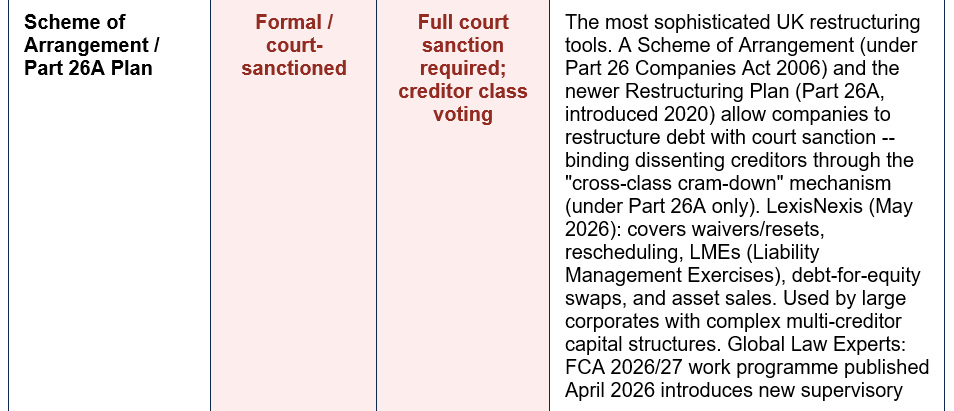
Corporate debt restructuring involves large companies reorganising complex capital structures -- multiple creditors, different seniority levels of debt, bond and loan markets, and often cross-border considerations. At this level, restructuring ranges from informal liability management exercises (LMEs) to court-sanctioned processes under the Companies Act 2006 Part 26A Restructuring Plan or administration. Global Law Experts (May 2026): 'The FCA 2026/27 work programme, published in April 2026, introduces supervisory priorities that directly affect how liability management exercises and creditor workouts are designed, disclosed and executed. The headline change is the regulator's focus on targeted support as a category of regulated activity, combined with a sector-wide push for greater resilience in consumer and wholesale markets.'Personal Debt Restructuring Options: UK vs US 2026 Comparison
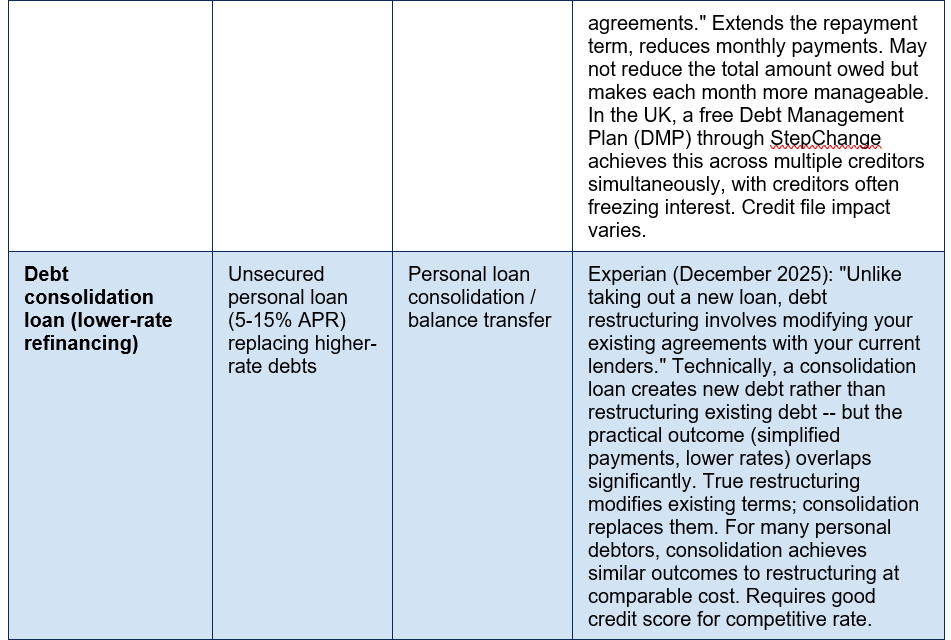
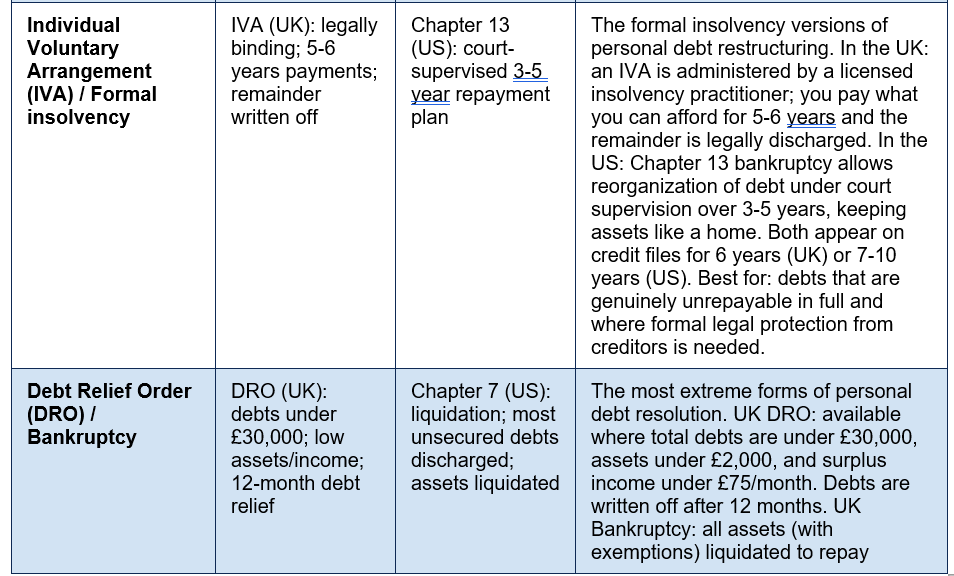
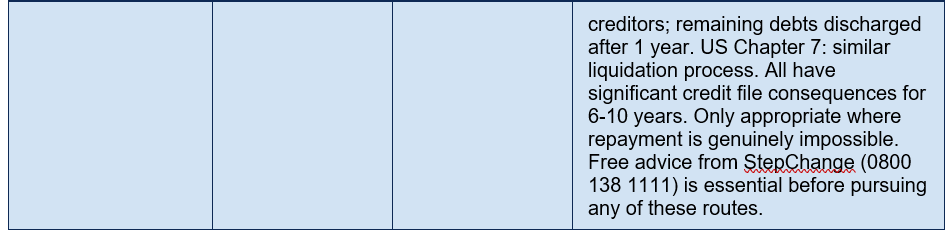
For individuals, the right debt restructuring tool depends on the severity of the financial difficulty and the number of creditors involved. The following table maps every major personal debt restructuring option across both the UK and US: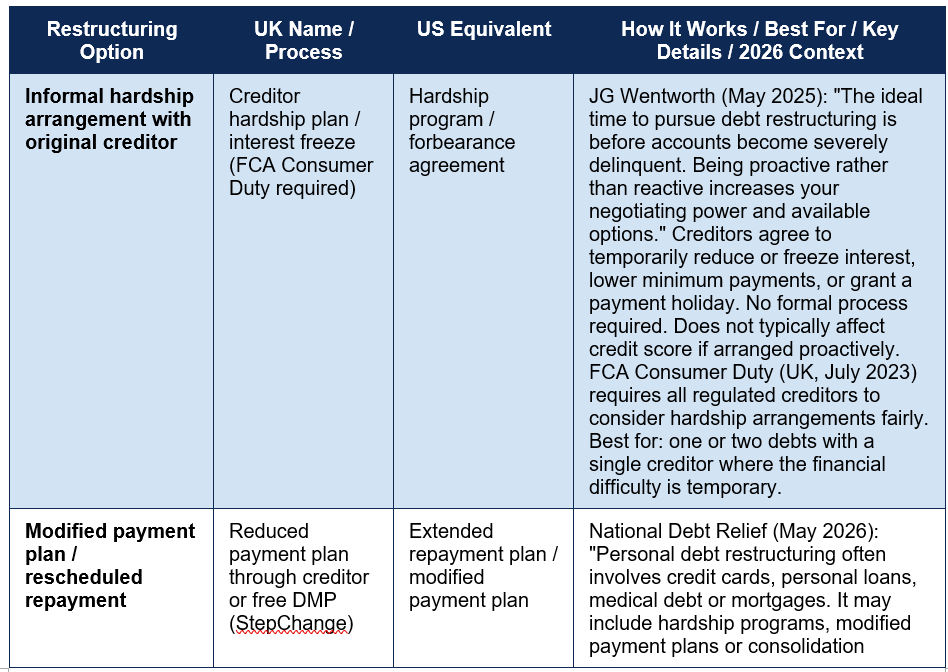
Corporate and SME Debt Restructuring: The UK Options in 2026
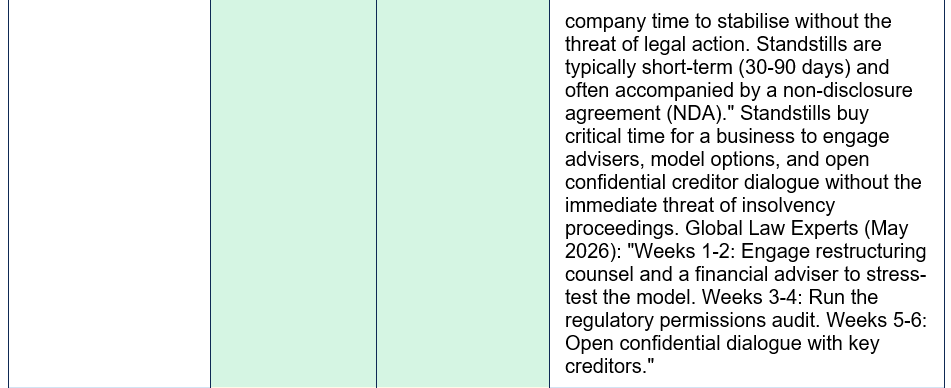
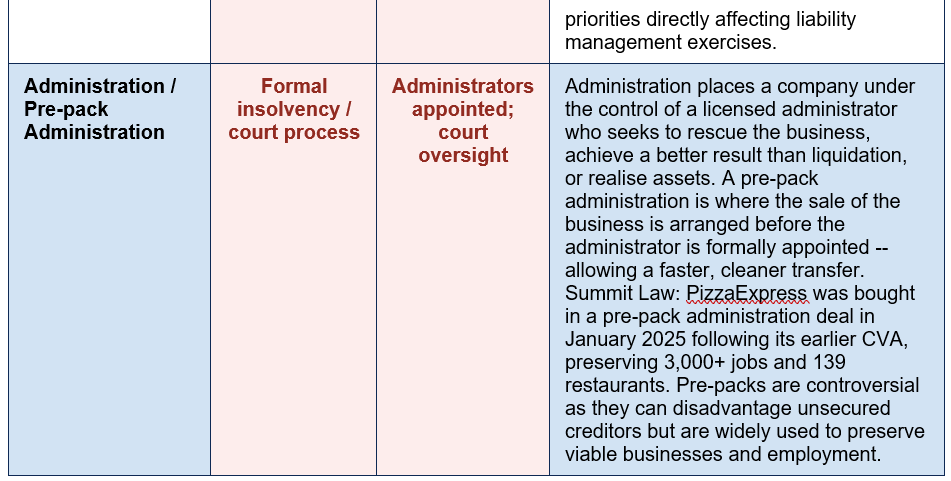
For businesses, the restructuring options range from informal, relationship-preserving refinancing at one end to court-supervised formal insolvency at the other. The appropriate route depends on the severity of financial distress, the number and type of creditors, and whether the business is fundamentally viable. The following table maps the UK corporate restructuring spectrum: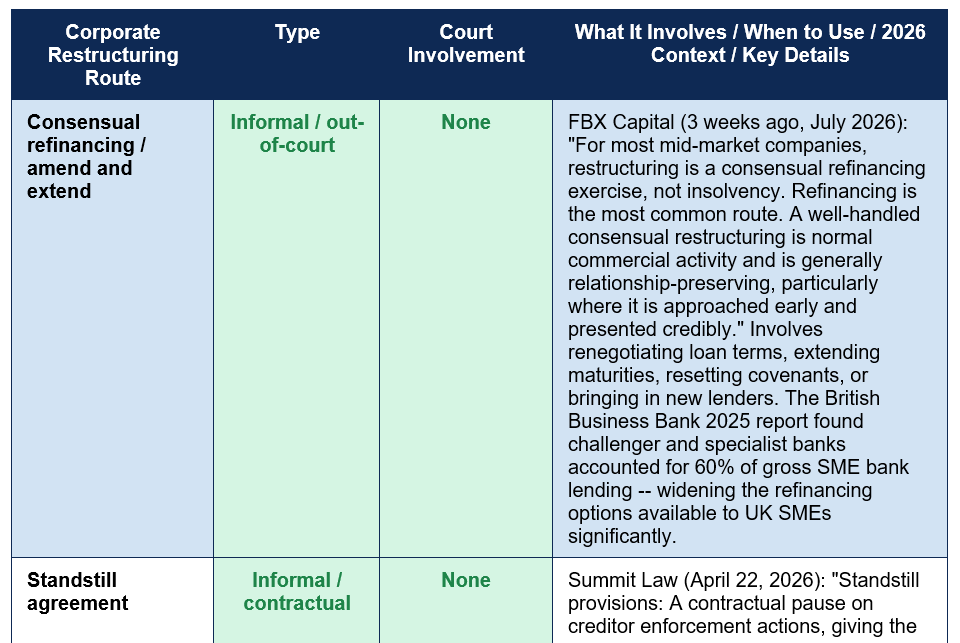
How Debt Restructuring Works: The Mechanics Step by Step
While the specific process varies by restructuring type and whether it is personal or corporate, the underlying mechanics share a common structure:- Step 1 -- Assess the full financial position: Before any creditor conversation, establish a complete picture of all debts (balances, rates, terms, security), all assets, all income and expenditure, and the gap between what is currently required and what is sustainable. Global Law Experts (May 2026): 'Weeks 1-2: Engage restructuring counsel and a financial adviser to stress-test the model and map the creditor universe.' For personal debt: this is the debt audit. For corporate debt: this is the full financial model with sensitivity analysis.
- Step 2 -- Identify the restructuring objective: Is the goal to reduce monthly payments (term extension)? Reduce total cost (rate reduction)? Get breathing space (payment holiday)? Reduce the total amount owed (partial forgiveness)? The objective determines which tool is appropriate and which creditors need to be engaged. For personal debtors: a free debt adviser at StepChange or Citizens Advice will help identify the correct objective. For corporate borrowers: a restructuring adviser performs this role.
- Step 3 -- Identify and prioritise creditors: Not all creditors are equal in a restructuring. Secured creditors (those holding security over assets) have priority over unsecured creditors in any enforcement scenario. Understanding the creditor hierarchy is essential to knowing which creditors must be engaged first and which have most leverage. Summit Law: 'Security arrangements: New or enhanced security over company assets, such as charges over property, stock, or receivables, or personal guarantees from directors.'
- Step 4 -- Open dialogue proactively: FBX Capital (July 2026): 'The greater risk to relationships and standing usually comes from leaving a strained structure unaddressed until a lender has to intervene.' Contact key creditors before default, not after. Frame the conversation as partnership -- the goal is a solution that works for both sides. Global Law Experts: 'Weeks 5-6: Open confidential dialogue with key creditors, armed with the model, a proposed term sheet and a clear fallback position.'
- Step 5 -- Agree and document revised terms: Every restructuring agreement must be documented in writing with legal precision. Experian: 'Understanding the new terms, total repayment costs and available alternatives can help borrowers make informed decisions.' For simple personal hardship arrangements: a letter from the creditor confirming the revised payment terms is sufficient. For formal restructuring (CVA, scheme of arrangement, or IVA): a legally binding document prepared by the relevant qualified professional is required.
- Step 6 -- Monitor compliance and manage the path forward: A restructured debt is a new contractual obligation. Missing payments on a restructured arrangement can trigger default clauses that return the full original balance to immediate demand. Summit Law: 'Financial covenants: Performance-based commitments by the company, such as maintaining a minimum EBITDA threshold or keeping leverage and liquidity ratios within agreed limits.' Review the restructuring terms regularly and communicate any anticipated difficulties before they materialise.
Debt Restructuring Pros and Cons: The Balanced Assessment
The Genuine Benefits
- Prevents default and its consequences: National Debt Relief (May 2026): 'The goal is typically to prevent default and create a sustainable repayment path.' Restructuring before default preserves the credit relationship, avoids formal proceedings, and in the corporate context protects the business from the reputational and operational damage of administration or liquidation.
- Reduces the immediate financial burden: Summit Law (April 2026): 'Improved cash flow: Reducing immediate financial obligations through renegotiated terms and conditions, including lower interest rates, extended repayment timelines, and partial debt forgiveness.' For individuals: lower monthly payments create the breathing space to stabilise finances. For businesses: improved cash flow enables continued operation and investment.
- Maintains lender relationships: FBX Capital (July 2026): 'A well-handled consensual restructuring is normal commercial activity and is generally relationship-preserving, particularly where it is approached early and presented credibly.' Lenders who restructure cooperatively typically continue to work with the borrower; lenders who are forced into enforcement typically do not.
- More flexible than formal insolvency: Summit Law: 'Avoiding insolvency proceedings: Preventing the reputational and operational impacts of bankruptcy or administration.' Consensual restructuring preserves more options and avoids the stigma, legal costs, and operational restrictions of formal insolvency routes.
The Real Risks
- Extended terms increase total interest cost: A restructured loan that extends a 5-year term to 10 years at the same rate pays significantly more in total interest. National Debt Relief (May 2026): 'While restructuring debt can offer relief, it also carries long-term implications. Understanding the new terms, total repayment costs and available alternatives can help borrowers make informed decisions.' Always calculate total repayment cost, not just monthly payment, before agreeing to restructuring terms.
- Credit file impact: Formal restructuring arrangements (IVA, CVA, DRO) appear on credit files and reduce access to future credit for 6-10 years. Even informal arrangements may be noted if they result in changed payment terms being reported to credit agencies. This is a significant but often manageable trade-off -- a restructuring that makes current debt sustainable is typically preferable to default, which has worse credit consequences.
- Restructuring can be misused to delay inevitable insolvency: Summit Law: 'Director duties under the Insolvency Act 1986 and wrongful-trading thresholds.' For corporate directors: restructuring must be pursued in good faith with genuine prospects of viability. Using restructuring to delay inevitable insolvency while continuing to incur debts can expose directors to wrongful trading liability.
The key distinction: debt restructuring vs debt consolidation vs debt settlement. These three terms are frequently confused. Debt restructuring: modifying the terms of existing debts with existing lenders -- no new borrowing, same creditors, changed terms. Debt consolidation: taking out new credit (a personal loan, a balance transfer card) to replace multiple existing debts -- new lender relationship, existing debts paid off, new single debt created. Debt settlement: negotiating to pay less than the full amount owed in exchange for the debt being treated as discharged -- often involves a lump-sum payment at a discount (30-60% of outstanding balance). A comprehensive debt strategy may involve all three: restructuring some debts informally, consolidating others, and settling old debts where a discount is available. National Debt Relief (May 2026): 'Understanding the new terms, total repayment costs and available alternatives can help borrowers make informed decisions.'
When Should You Consider Debt Restructuring?
The optimal moment to consider debt restructuring is before a crisis, not during one. JG Wentworth: 'The ideal time to pursue debt restructuring is before accounts become severely delinquent. Being proactive rather than reactive increases your negotiating power and available options.' The following signals indicate that restructuring should be explored immediately: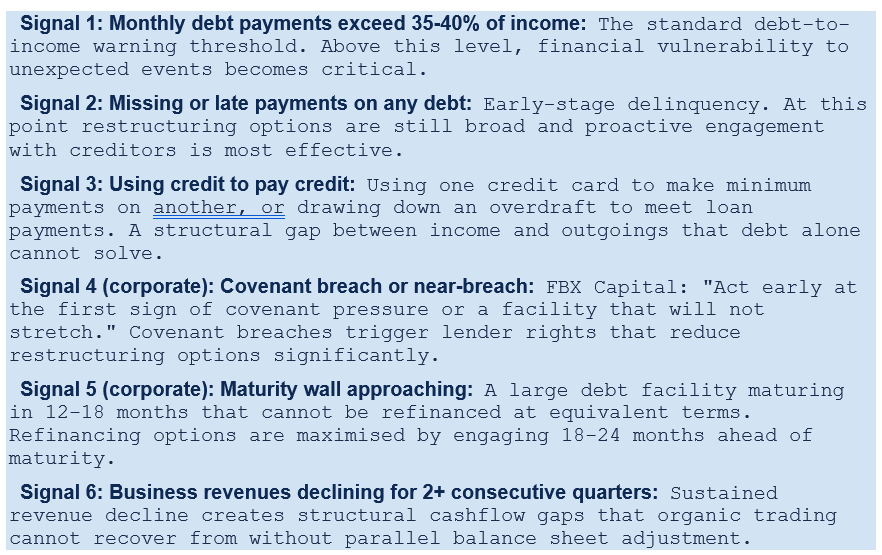
THE DEBT RESTRUCTURING DECISION CHECKLIST -- UK 2026: FOR PERSONAL DEBT: (1) Is the difficulty temporary (illness, job loss, rate rise) or structural (permanent income reduction)? Temporary: seek short-term hardship arrangement with creditor. Structural: consider DMP, IVA, or formal insolvency. (2) How many creditors are involved? One or two: negotiate directly. Three or more: free DMP through StepChange (0800 138 1111) negotiates with all simultaneously. (3) Is total debt over £30,000 with no realistic prospect of repayment in full? UK: IVA may be appropriate. Under £30,000 with low income and assets: DRO. US: Chapter 13 for repayment plan; Chapter 7 for liquidation of debts. (4) Are any debts statute-barred (over 6 years UK / 3-6 years US)? Do not engage until checked with National Debtline 0808 808 4000. FOR CORPORATE DEBT: (5) Is the business fundamentally viable (positive EBITDA before debt service)? If yes: consensual restructuring/refinancing is the appropriate route. If no: formal insolvency options. (6) How many creditors? One or two: direct renegotiation. Multiple: coordinate approach essential. (7) Are there imminent enforcement triggers (covenant breach, maturity, missed payment)? Engage restructuring adviser immediately -- standstill buys time. (8) Have directors considered wrongful trading risks? Insolvency Act 1986 duties apply. Seek legal advice.
PERSONAL DEBT RESTRUCTURING WARNINGS -- THREE CRITICAL POINTS: (1) FORMAL RESTRUCTURING SOLUTIONS HAVE LONG CREDIT FILE CONSEQUENCES. An IVA (UK) or Chapter 13 (US) appears on your credit file for 6 years (UK) or 7 years (US). This restricts access to mortgage lending, competitive loan rates, and some employment categories for that period. This is often the right trade-off -- but it must be understood and consented to with full information before entering. (2) ALWAYS USE FREE ADVICE BEFORE FORMAL RESTRUCTURING. Commercial debt settlement and restructuring companies charge 15-25% of the debt amount for services identical to those provided free by StepChange (UK: 0800 138 1111), Citizens Advice (UK: 0800 144 8848), and NFCC counsellors (US: 1-800-388-2227). Never pay for debt restructuring advice when free regulated equivalents exist. (3) RESTRUCTURING DOES NOT ERASE THE DEBT. Except where explicit debt forgiveness or discharge is part of the formal solution (IVA, DRO, bankruptcy), restructuring changes the terms of repayment -- not the obligation to repay the principal. Total interest paid may increase under extended terms even at lower rates. Always calculate the total cost of the restructured arrangement, not just the monthly payment.
Conclusion
Debt restructuring is one of the most versatile and widely used financial tools available to both individuals and businesses -- from a personal credit card hardship arrangement agreed in a single phone call to a multi-creditor corporate reorganisation under a court-sanctioned Part 26A Restructuring Plan. At every level, the underlying logic is the same: modifying the terms of existing debt so that repayment becomes sustainable, preventing default, preserving the relationship with creditors, and creating a workable path to financial stability.The 2026 environment is one where restructuring options have both expanded and become more complex. For UK SMEs, the British Business Bank's finding that challenger and specialist banks account for 60% of gross SME lending creates more refinancing options than existed even two years ago. For UK corporates, the FCA's 2026/27 work programme -- published April 2026 -- introduces new supervisory priorities that directly affect how liability management exercises are designed and executed. For individuals, the FCA's Consumer Duty (effective July 2023) requires all regulated creditors to consider hardship arrangements fairly, providing a stronger regulatory foundation for proactive restructuring conversations.
The consistent message from every source in this guide is timing: act early. JG Wentworth: 'The ideal time to pursue debt restructuring is before accounts become severely delinquent.' FBX Capital: 'The greater risk to relationships usually comes from leaving a strained structure unaddressed until a lender has to intervene.' For individuals, proactive engagement with creditors before the first missed payment produces the best available terms. For businesses, addressing covenant pressure 18-24 months before a maturity wall produces far more options than engaging when the wall has already arrived. Debt restructuring works best as a tool of financial management, not financial crisis -- and the distinction between those two situations is almost always a matter of timing.

0 Comments Comments