

Finance
What Is PIP? Personal Independence Payment Guide

Table of Contents
- The Benefit Millions Need But Many Don't Know They Can Claim
- What Is PIP? The Core Definition
- Who Is Eligible for PIP in 2026?
- PIP Rates 2026/27: What You Could Receive (From 6 April 2026)
- The 12 PIP Assessment Activities Explained
- How PIP Assessments Work in 2026
- The PIP2 Form: The Foundation of Your Claim
- The Assessment Itself
- Supporting Evidence
- PIP Changes 2026: What Has Changed and What Has Been Dropped
- How to Apply for PIP: The Step-by-Step Process
- Challenging a PIP Decision: Mandatory Reconsideration and Appeal
- Stage 1: Mandatory Reconsideration
- Stage 2: Appeal to the First-Tier Tribunal
- Conclusion
- Frequently Asked Questions (FAQ)
The Benefit Millions Need But Many Don't Know They Can Claim
Personal Independence Payment -- PIP -- is one of the most significant financial support payments available to disabled people and those with long-term health conditions in the United Kingdom. Yet it is also one of the most widely misunderstood, with significant numbers of eligible people either not claiming at all, or claiming and receiving less than they are entitled to.GOV.UK Official Statistics (June 16, 2026): as at 30 April 2026 there were 4 million claimants entitled to PIP in England and Wales -- up 2% from January 2026. Yet the DWP's own Fraud and Error in the Benefit System report showed that 11% of claimants are currently under-claiming PIP. That means hundreds of thousands of people are receiving less than the system says they should receive. And those are only the people who are already claiming. Many more people who are eligible have not claimed at all.
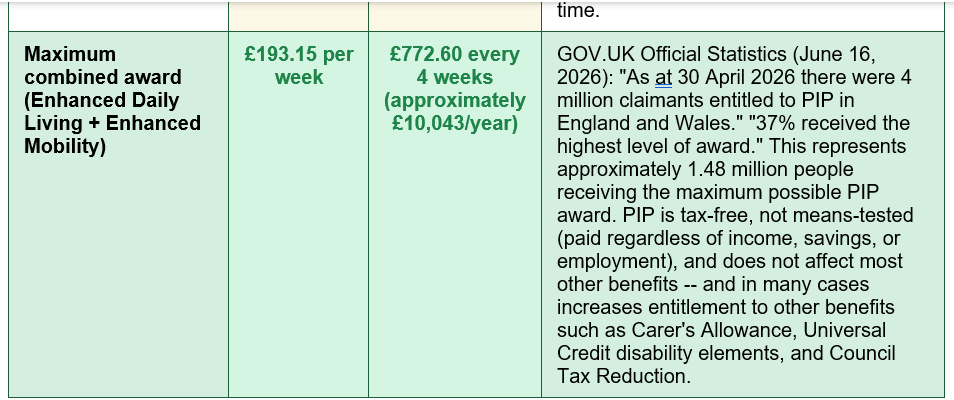
This guide explains what PIP is, what it pays, who qualifies, how the 12 assessment activities work, what the 2026 changes mean for current and future claimants, and exactly what to do whether you are considering a first claim, challenging a refusal, or worried about what the government's welfare reform plans mean for your current award. From 6 April 2026, PIP rates increased by 3.8% in line with the September 2025 CPI figure (Luis Paiva, May 4, 2026). The maximum combined award is now £193.15 per week -- approximately £10,043 per year -- paid tax-free and with no means test. If you or someone you know lives with a disability or long-term health condition, this is the guide to read before deciding whether to apply.
What Is PIP? The Core Definition
Personal Independence Payment (PIP) is a UK welfare benefit provided by the Department for Work and Pensions (DWP) to help with the extra costs of living with a long-term disability or health condition. It replaced Disability Living Allowance (DLA) for working-age adults from 2013 and has been the primary disability benefit for people aged 16 to State Pension Age in England and Wales since then. Scotland now operates an equivalent benefit called Adult Disability Payment (ADP), administered by Social Security Scotland, which completed the transition from PIP by June 2025.PIP is fundamentally different from most welfare benefits in several important ways. It is not means-tested: your income, savings, employment status, and partner's income are irrelevant to eligibility. You can claim PIP whether you are employed full-time, self-employed, on Universal Credit, a carer, a pensioner within the qualifying age range, or not working at all. It is not taxable -- it does not count as income for tax purposes. And it is not limited to physical conditions: mental health conditions, cognitive and developmental conditions, sensory impairments, and fluctuating conditions can all qualify if they affect daily living or mobility in the ways the benefit is designed to address.
PIP is divided into two components -- Daily Living and Mobility -- and each component has two award levels (Standard and Enhanced). This means there are four possible combinations: Daily Living only (standard or enhanced), Mobility only (standard or enhanced), or both components at either rate. The rates from 6 April 2026 range from £30.30 per week (Standard Mobility only) to £193.15 per week (Enhanced Daily Living plus Enhanced Mobility combined).
PIP in 2026 -- the numbers: 4 million claimants in England and Wales. 37% receive highest award. 11% under-claiming. 2 in 3 tribunal appeals succeed. — GOV.UK (June 16, 2026): 'As at 30 April 2026 there were 4 million claimants entitled to PIP in England and Wales, a 2% increase on January 2026. 37% received the highest level of award.' PIPexpert (1 week ago -- most current): 'Roughly two in three PIP appeals that reach a tribunal succeed.' HomeCare.co.uk (April 28, 2026): '11% of claimants are under-claiming PIP. Over 50% of applications rejected between 2019 and 2024.' Luis Paiva (May 4, 2026): 'From 6 April 2026, PIP ranges from £30.30 to £194.60 per week. All rates increased by 3.8% from April.'
Who Is Eligible for PIP in 2026?
PIP eligibility is based on the impact of your health condition or disability on your daily life -- not on your diagnosis. This is one of the most commonly misunderstood aspects of PIP and one of the most frequent reasons for under-claiming: people believe they will not qualify because their condition is not 'serious enough' or because they have not been formally diagnosed with a qualifying condition. Neither of these is a correct basis for assuming ineligibility.HomeCare.co.uk (April 28, 2026): 'PIP is available to people with a wide range of health conditions, which can make it difficult to determine if you might be eligible.' The eligibility criteria require that: you are aged 16 or over and have not yet reached State Pension Age; you have a mental or physical disability or health condition that makes daily living or getting around difficult; you have had these difficulties for at least 3 months; and you expect these difficulties to continue for at least another 9 months (or you have a terminal illness, in which case the 9-month forward-looking test does not apply). The most important point: the test is whether your condition affects how you carry out activities -- not what your condition is called.
HomeCare.co.uk: 'The top 5 medical conditions that qualified for PIP as of April 2026 are' -- and the data consistently shows that psychiatric disorders (covering mental illness) make up almost 40% of all PIP awards. Musculoskeletal conditions (covering arthritis, back pain, and related conditions) are another major category. The full range includes neurological conditions, sensory impairments, cardiovascular conditions, respiratory conditions, cancer, autoimmune conditions, and many others. If your health condition or disability affects your ability to carry out any of the 12 assessment activities described in this guide, you may be eligible regardless of your specific diagnosis.
PIP Rates 2026/27: What You Could Receive (From 6 April 2026)
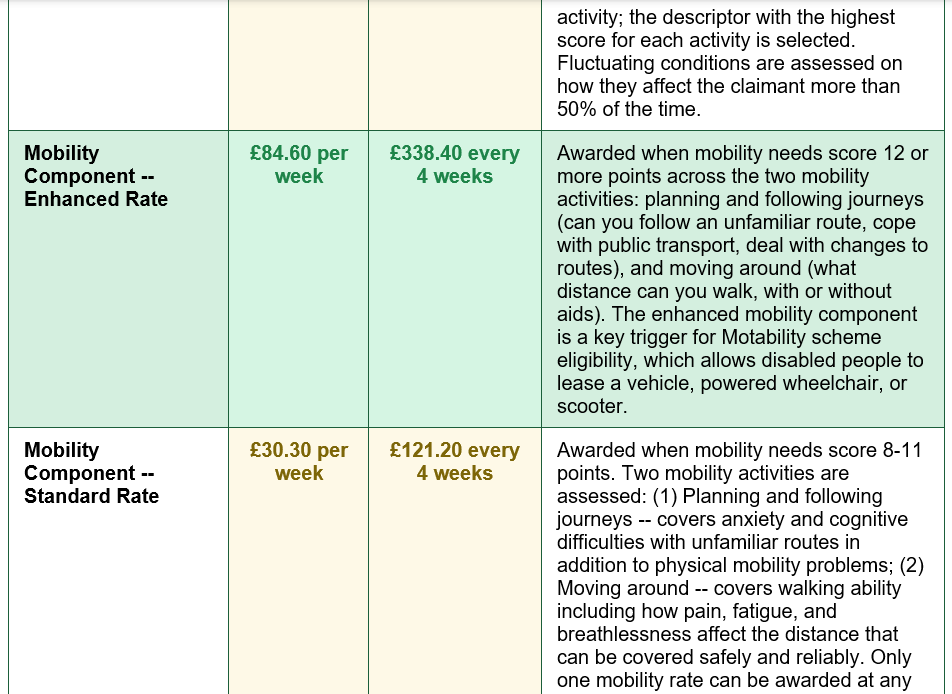
All PIP rates rose by 3.8% on 6 April 2026 in line with the September 2025 CPI figure. The following table sets out the current rates and what each component covers: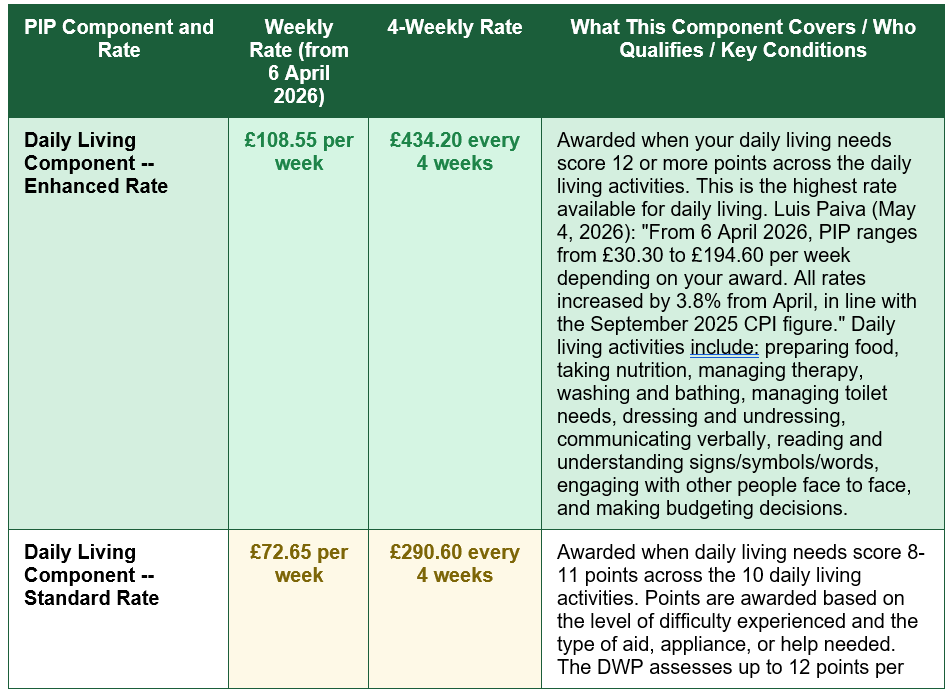
The 12 PIP Assessment Activities Explained
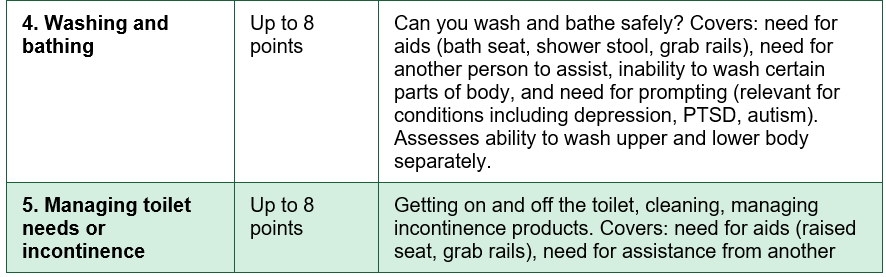
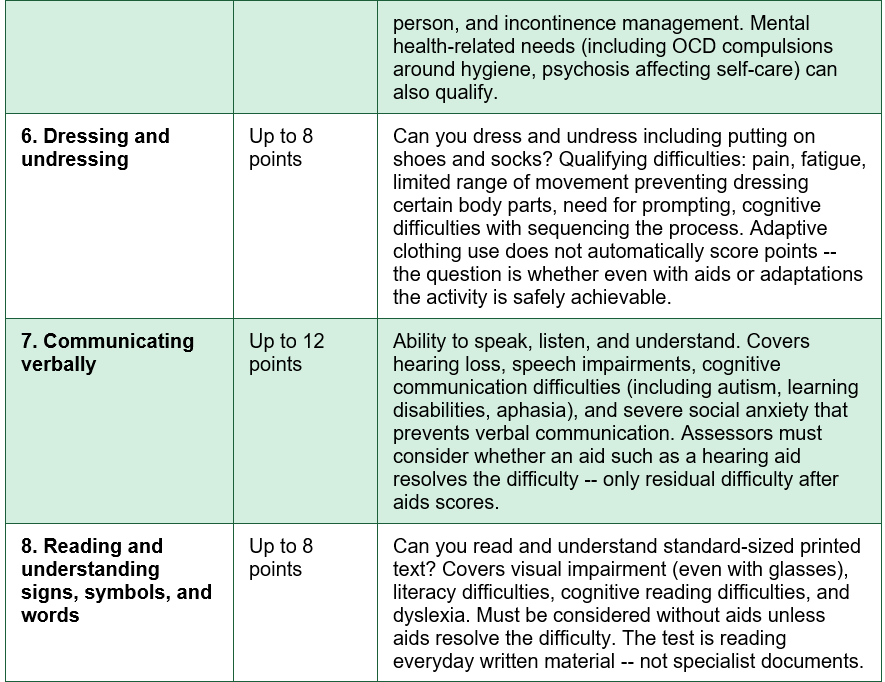
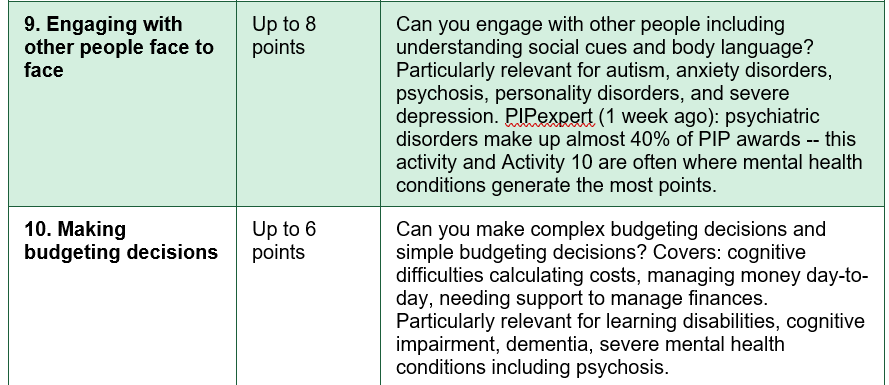
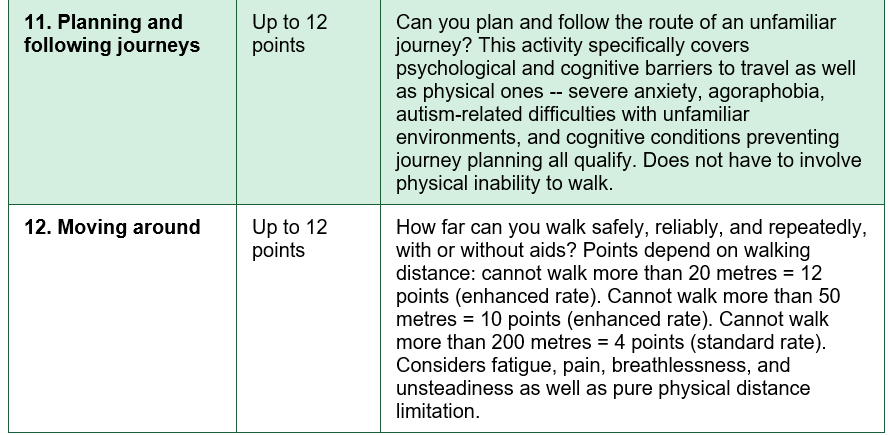
PIP is awarded on the basis of a points-based assessment across 12 activities -- 10 Daily Living activities and 2 Mobility activities. For each activity, the DWP assessment considers what help, aids, or supervision you need to complete the activity, and awards points based on the highest-scoring descriptor that applies to you. To qualify for the Standard rate of a component you need at least 8 points; for the Enhanced rate you need at least 12 points. The following table explains all 12 activities: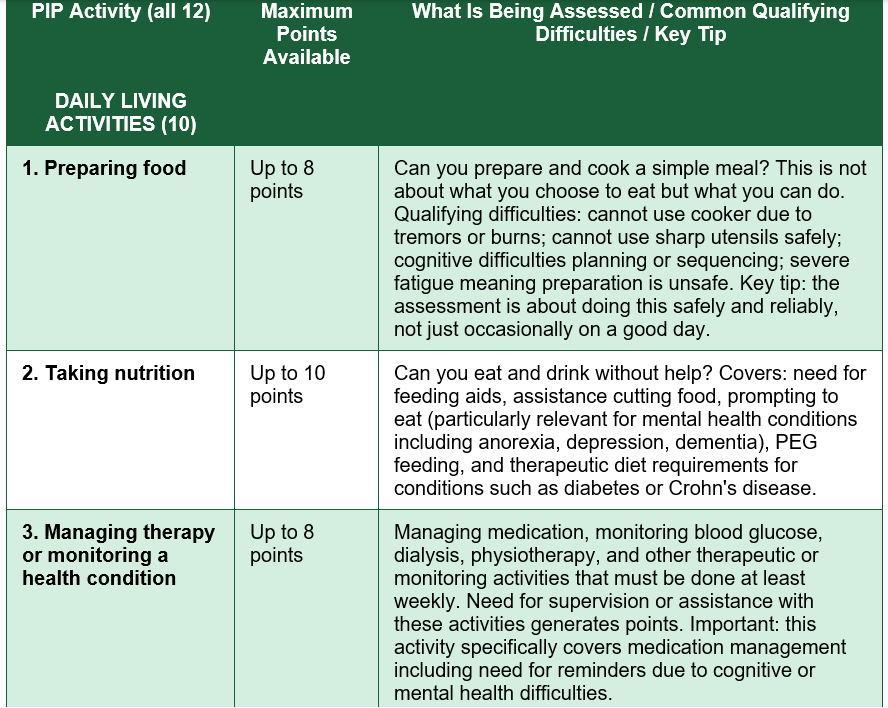
How PIP Assessments Work in 2026
The PIP assessment process involves submitting a detailed written form (the PIP2 'How your disability affects you' form) and usually attending a face-to-face or telephone assessment with a health professional appointed by the DWP. Understanding how the process works is essential to presenting your claim effectively.The PIP2 Form: The Foundation of Your Claim
The PIP2 form ('How your disability affects you') is a detailed questionnaire that asks about each of the 12 assessment activities described in this guide. The form is the primary document on which the DWP assesses your claim -- and the most common reason for a lower-than-expected award or a refusal is an incomplete or insufficiently detailed PIP2 form. The critical principle for completing the PIP2 form: describe your worst days, not your average days or your best days. The DWP assesses your ability to carry out activities 'reliably' -- which means safely, to an acceptable standard, and repeatedly. If completing an activity causes significant pain or fatigue, takes longer than a reasonable time (usually taken to be twice the normal time), or requires the help of another person or an aid, those factors should be explicitly described in your answer. Do not assume the assessor will infer difficulties from your diagnosis -- describe in specific, concrete terms what help you need and why.The Assessment Itself
HomeCare.co.uk (April 28, 2026): 'Over 50% of applications were rejected between 2019 and 2024, meaning fewer than half of applications were awarded.' Many of these rejections reflect a gap between what the claimant described in their form and what the assessor records. Key points for the assessment: you can have someone with you (a friend, family member, or support worker); you can request a face-to-face assessment rather than a telephone assessment, or vice versa, and providing a reason; the assessment is not primarily a medical examination -- it is a functional assessment of how you carry out the 12 activities; and you should describe your worst days and the genuine extent of difficulty, not attempt to demonstrate that you are capable of more than your condition typically allows. Keep a copy of everything you submit with your claim.Supporting Evidence
Supporting evidence from healthcare professionals, carers, and third parties significantly strengthens a PIP claim. Useful supporting evidence includes: letters from GPs, consultants, or specialist nurses describing your condition and its functional impact; occupational therapy reports; physiotherapy letters; care plans or hospital discharge summaries; letters from care workers, social workers, or support workers; and letters from family members or carers describing the help they provide. The DWP can request evidence directly from healthcare professionals, but this can take time -- providing evidence with your claim or promptly after the assessment speeds up the process.PIP Changes 2026: What Has Changed and What Has Been Dropped
2026 has been a year of significant proposed and actual changes to PIP, driven by the government's welfare reform agenda. Understanding what has changed and what has been delayed or withdrawn is essential for current and prospective claimants.- The 3.8% rate increase from 6 April 2026: All PIP rates increased by 3.8% from 6 April 2026 in line with the September 2025 Consumer Price Index (CPI) figure. This is the regular annual uprating that applies to most disability and welfare benefits. Luis Paiva (May 4, 2026): 'From 6 April 2026, PIP ranges from £30.30 to £194.60 per week depending on your award. All rates increased by 3.8% from April, in line with the September 2025 CPI figure.'
- The four-point rule -- proposed but now delayed: The government's March 2025 green paper on welfare reform included a proposal known as the 'four-point rule': a new eligibility requirement that new PIP claimants would need to score at least four points in a single daily living activity (rather than eight points spread across multiple activities) to qualify for the daily living component. This change was estimated to affect around one million people and save £4.8 billion by 2029/30. However, following significant opposition from disability organisations, charities, and within Parliament, Luis Paiva (May 4, 2026): 'Following a series of concessions, the government dropped its plan to tighten PIP eligibility rules. No changes will be made to PIP until the Timms Review is complete.' The four-point rule has been abandoned for new claimants for now.
- The Timms Review: The government announced an independent review of PIP, led by Sir Stephen Timms, to examine how the benefit works and what changes should be made to it. Luis Paiva (May 4, 2026): 'The Timms Review -- which will determine the long-term future of how PIP works -- is expected to report in autumn 2026.' The review's outcome will shape PIP policy for the medium term. Claimants and prospective claimants should be aware that further changes may follow the review's recommendations, though any changes will require parliamentary approval and lead-in time.
- Reduced frequency of award reviews: The DWP confirmed new review frequency rules that reduce how often claimants face reassessment. HomeCare.co.uk (April 28, 2026): 'The DWP says this change is due to the fact that around 60% of current reviews result in no change to a claimant's award.' Reducing unnecessary reassessments is a response to evidence that the majority of reviews confirm existing awards. Claimants still have the responsibility to report changes in their condition to the DWP rather than waiting for a review.
PIP and other benefits: what else PIP can unlock. Receiving PIP can trigger entitlement to additional support through several other benefits and schemes: (1) Carer's Allowance: if you receive either component of PIP at any rate, someone who spends at least 35 hours per week caring for you may be entitled to claim Carer's Allowance. This can also unlock Carer Premium additions in means-tested benefits. (2) Universal Credit disability elements: receiving PIP at any rate may entitle you to the disabled child addition or the limited capability for work-related activity element of Universal Credit, depending on your circumstances. (3) Council Tax Reduction: many local authorities automatically apply a discount or exemption for PIP recipients -- check with your local council. (4) Motability scheme: the Enhanced Rate Mobility Component (£84.60/week) qualifies you for the Motability scheme, which allows you to exchange your mobility component to lease a car, powered wheelchair, or scooter. (5) Free vehicle tax (road tax): if you receive the Enhanced Rate Mobility Component, your vehicle is exempt from vehicle excise duty. (6) Blue Badge: receiving the Enhanced Rate Mobility Component (moving around activity) automatically qualifies you for a Blue Badge. Standard Rate Mobility may also qualify in some circumstances. (7) Disabled Persons Railcard and other travel concessions. Always check what other support PIP entitlement unlocks as part of your overall benefits entitlement review.
How to Apply for PIP: The Step-by-Step Process
- 5. Step 1 -- Call the PIP new claims line: DWP PIP new claims: 0800 917 2222 (Monday to Friday, 8am to 6pm). You will be asked for basic personal information and some initial questions about your condition. If eligible to apply, you will be sent a PIP2 form ('How your disability affects you'). You have one month to return the completed form. Note: calling this number does not commit you to a claim and does not affect any existing benefits.
- 6. Step 2 -- Complete the PIP2 form carefully and fully: Take the full month allowed. Describe each activity in detail, focusing on your worst days, the help you need, any aids or appliances you use, and how pain, fatigue, or other symptoms affect your ability. Do not leave activities blank or answer 'yes I can do this' without explaining any associated difficulty -- an unqualified 'yes' scores zero points for that activity. PIPexpert (1 week ago): 11% of claimants under-claim, often because the PIP2 form does not capture the full extent of difficulty. Get free help with the form from Citizens Advice, a disability charity, or a welfare rights adviser before submitting.
- 7. Step 3 -- Gather and submit supporting evidence: Collect letters or reports from healthcare professionals, care workers, therapists, or carers that describe your functional limitations rather than just your diagnosis. A letter that says 'patient has arthritis' is less useful than one that describes 'patient is unable to stand for more than 10 minutes without severe pain, requires assistance with dressing due to limited range of movement, and uses a walking frame for distances over 20 metres.'
- 8. Step 4 -- Attend or prepare for the assessment: The assessment (face-to-face, telephone, or paper-based for some conditions) is conducted by a healthcare professional working for an assessment provider contracted by the DWP. You can take someone with you for support. Describe how your condition affects you on your worst days. Do not underplay difficulties or demonstrate capabilities beyond your normal level.
- 9. Step 5 -- Receive the decision and check it carefully: HomeCare.co.uk (April 28, 2026): 'Over 50% of applications were rejected between 2019 and 2024.' PIPexpert: 'About 37% receive the highest level of award.' If you disagree with the decision -- whether a refusal or a lower award than expected -- you have the right to challenge it. Do not assume the first decision is final.
Challenging a PIP Decision: Mandatory Reconsideration and Appeal
PIPexpert (1 week ago): 'Roughly two in three PIP appeals that reach a tribunal succeed.' This is one of the most important statistics in the entire PIP system: two thirds of independent tribunal hearings result in the claimant winning. Yet many people accept an unfair refusal or reduced award without challenging it. The challenge process has two stages:Stage 1: Mandatory Reconsideration
Before you can appeal to a tribunal, you must request a Mandatory Reconsideration (MR) from the DWP. This is an internal review of the decision by a different DWP decision maker. You must request an MR within one month of the date on the decision letter (extensions of time can be requested). To request an MR: call the PIP enquiry line or write to the DWP PIP centre on your decision letter; ask for a Mandatory Reconsideration; explain which activities you believe have been incorrectly assessed and why; and include any additional supporting evidence. The success rate at MR stage is lower than at tribunal -- but it is required before you can proceed to appeal.Stage 2: Appeal to the First-Tier Tribunal
If the Mandatory Reconsideration does not change the decision, you can appeal to the independent First-Tier Tribunal (Social Entitlement Chamber). Appeals must be submitted within one month of the MR decision. PIPexpert (1 week ago): 'Roughly two in three PIP appeals that reach a tribunal succeed.' Representation significantly increases success rates: Citizens Advice, disability charities (Scope, RNIB, MS Society, Mind), and welfare rights advisers can help prepare and present your case. The tribunal is independent of the DWP. Free representation is available through many advice organisations. Do not give up because the DWP's initial or reconsidered decision went against you -- the tribunal is a genuinely independent forum where the evidence is assessed afresh.PIP APPLICATION CHECKLIST -- DO THESE BEFORE SUBMITTING YOUR CLAIM: BEFORE SUBMITTING THE PIP2 FORM: (1) Get free help completing the form -- Citizens Advice 0800 144 8848, Turn2us, or your local welfare rights service will help ensure the form captures the full extent of your difficulty. The form is complex and under-description is the primary reason for under-awards. (2) Describe your WORST days, not your average days. The test is whether you can perform each activity safely, reliably, and repeatedly. If you can only do something some of the time, or only with significant pain or fatigue, describe this explicitly. (3) Do NOT leave activities blank or write only "yes I can do this." Even if you can perform an activity, if it takes longer than normal, causes significant pain or fatigue, requires help, or is unsafe, describe these difficulties. (4) Gather supporting evidence before or promptly after submission: GP letters, specialist letters, occupational therapy reports, care plans, letters from carers or family members describing the support they provide. (5) Keep a copy of everything you send. (6) Note the date you posted the form -- you have a record of compliance with the deadline. AFTER A REFUSAL OR LOWER AWARD: (7) Request a Mandatory Reconsideration within one month of the decision letter. (8) If MR fails, appeal to the First-Tier Tribunal. PIPexpert (1 week ago): 2 in 3 PIP tribunal appeals succeed. Do not give up. FREE HELP: Citizens Advice 0800 144 8848 | MoneyHelper 0800 138 7777 | Disability Rights UK | Turn2us (turn2us.org.uk) | Scope (0808 800 3333).
FIVE COMMON PIP MISTAKES THAT COST CLAIMANTS MONEY: (1) DESCRIBING YOUR BEST DAYS INSTEAD OF YOUR WORST. PIP assesses how your condition affects you reliably -- which means consistently, safely, and to an acceptable standard. If a flare-up means you cannot cook or dress yourself for 3-4 days out of every 7, describe that reality. Minimising your difficulties out of modesty or a desire to demonstrate capability typically results in a lower score than your condition actually warrants. (2) NOT CLAIMING BECAUSE YOUR CONDITION IS 'NOT BAD ENOUGH' OR 'INVISIBLE.' PIPexpert: roughly 11% of claimants are under-claiming. Many more eligible people never claim. PIP covers mental health conditions, fluctuating conditions, cognitive conditions, and chronic pain -- none of which are 'visible' in the way stereotypical disability is. The test is functional impact, not appearance. (3) MISSING THE DEADLINE TO CHALLENGE A WRONG DECISION. You have one month from the date on the decision letter to request a Mandatory Reconsideration. Missing this deadline means you would need to start the claim again. If you disagree with the decision, act immediately. (4) NOT GETTING HELP WITH THE PIP2 FORM. The PIP2 form is long, detailed, and structured around activities that do not map intuitively onto how most people think about their condition. Professional welfare rights advisers complete significantly more successful claims than self-represented applicants. Citizens Advice is free and widely available. (5) ASSUMING A REFUSAL IS FINAL. HomeCare.co.uk: over 50% of applications are rejected at initial decision. PIPexpert: 2 in 3 tribunal appeals succeed. The first decision is not final -- and the tribunal is genuinely independent of the DWP. The gap between the initial rejection rate and the tribunal success rate reflects the fact that many correct claims are rejected at first assessment and reversed only when challenged.
Conclusion
Personal Independence Payment is a tax-free, non-means-tested financial support payment for disabled people and those with long-term health conditions in the UK. As at 30 April 2026, 4 million people in England and Wales are entitled to it -- but 11% of those claimants are under-claiming, and many more eligible people have never applied. The rates from 6 April 2026 range from £30.30 to £193.15 per week, with the maximum combined award worth approximately £10,043 per year.The 2026 policy landscape has been shaped by the government's dropped four-point eligibility change and the ongoing Timms Review, expected to report in autumn 2026. The rates have increased by 3.8% in line with inflation. The right to challenge decisions remains intact -- and the tribunal success rate of approximately two in three appeals reflects the genuine independence of that process.
The most important message from the data: do not assume you are not eligible without checking. Do not assume a refusal is final. And do not complete the PIP2 form alone without free professional support from Citizens Advice, a disability charity, or a welfare rights adviser. PIPexpert (1 week ago): roughly two in three PIP appeals that reach a tribunal succeed. The system is challenging to navigate -- but the support is available, the entitlement is there, and the money is significant. This guide is the starting point. Free help is one phone call away.
Frequently Asked Questions (FAQ)
What is the difference between PIP and DLA?Personal Independence Payment (PIP) replaced Disability Living Allowance (DLA) for working-age adults (those aged 16 to State Pension Age) in Great Britain, beginning the transition in 2013 and completing it progressively since. DLA still exists for children under 16, and some adults over State Pension Age who were already on DLA before a certain date may have been transferred to or remain on DLA. The key structural differences are: DLA had three rates of care component and two rates of mobility component, giving more flexibility but also more complexity; PIP has two components (Daily Living and Mobility) each with Standard and Enhanced rates; PIP is assessed using the 12 functional activities described in this guide, whereas DLA was assessed partly on the basis of care and attention needs rather than functional activities; PIP assessments are more regularly reviewed than DLA was; and PIP includes a more structured application and assessment process including the PIP2 form and a functional assessment. The rates for DLA and PIP are broadly comparable but not identical. If you are currently on DLA as a working-age adult, you should have been contacted by the DWP about transferring to PIP -- if you have not been, contact the DWP enquiry line.
Can I claim PIP if I am working?
Yes -- PIP is not means-tested and is not affected by whether you work or what you earn. The benefit is designed to help with the extra costs of living with a disability or long-term health condition, and those extra costs exist whether you are in employment or not. Many PIP claimants are in full-time or part-time employment. Your employment status, income, savings, and partner's income are all irrelevant to PIP eligibility. You also do not need to be receiving any other benefit to claim PIP. The PIP assessment is based entirely on how your health condition or disability affects your ability to carry out the 12 daily living and mobility activities -- not on your employment status. GOV.UK Official Statistics (June 16, 2026): of the 4 million PIP claimants in England and Wales as at 30 April 2026, 3.3 million (83%) were of Working Age. This group includes both those in and out of employment. If your condition makes daily activities difficult or mobility challenging, you may be eligible regardless of whether you are working.
How long does it take to get a PIP decision?
Processing times for PIP claims have varied significantly in recent years and continue to do so. As a general guide: after calling the new claims line and completing the PIP2 form, you will usually be contacted for an assessment appointment or asked to provide more information. GOV.UK statistics record clearance times from registration to initial decision. The DWP's target is to process most claims within 20 weeks of registration, though actual times vary. GOV.UK Official Statistics (June 16, 2026) noted that 'the latest quarter's registrations are up by 15% for new claims' compared to the previous year -- increased demand may affect processing times. You can check the current waiting times by calling the PIP enquiry line (0800 121 4433) or by contacting Citizens Advice. During the wait, you can request a paper-based assessment if you have difficulty attending a face-to-face assessment due to your condition. Your award, if approved, is backdated to the date of your initial telephone call -- not to the date of the assessment or decision. This means it is always worth calling as soon as you believe you might be eligible, even if you need time to gather supporting evidence or complete the form.
What happens if my condition changes after I am awarded PIP?
You are required to tell the DWP if your condition changes significantly -- either worsening or improving -- after you have been awarded PIP. This is a legal obligation. Failure to report a significant improvement that would reduce your award is treated as benefit fraud. Reporting a worsening is optional in the sense that the DWP will review at the next scheduled review, but reporting promptly if your condition worsens can result in an increase in your award sooner rather than waiting for the next review. To report a change: call the PIP enquiry line on 0800 121 4433. A 'change of circumstances' will trigger a review, which may result in the same award being maintained, an increase, a decrease, or a stoppage. HomeCare.co.uk (April 28, 2026): 'The DWP says this change is due to the fact that around 60% of current reviews result in no change to a claimant's award.' This means most reviews confirm existing awards rather than reducing them. Reduced review frequency (a 2026 change) means that fewer mandatory periodic reviews are required. If you are worried about your review, Citizens Advice or a welfare rights adviser can help you prepare.
What is the Timms Review and will it affect my PIP?
The Timms Review is an independent review of PIP commissioned by the government and led by Sir Stephen Timms, a former DWP minister. Luis Paiva (May 4, 2026): 'The Timms Review -- which will determine the long-term future of how PIP works -- is expected to report in autumn 2026.' The review was established following significant controversy over the government's original welfare reform proposals, including the now-abandoned four-point rule. The review is examining: how PIP eligibility is assessed; whether the current activities and descriptors adequately reflect the extra costs faced by disabled people; whether the assessment process is fair and accessible; and what reforms, if any, should be made to the structure of the benefit. For current PIP claimants: the Timms Review will not change your current award. Any changes recommended by the review would require: government acceptance of the recommendations; legislation if the changes affect the primary legal basis of PIP; a consultation period; and an implementation timeline. Current claimants' awards would be protected through any transition period, as was the case when PIP was introduced to replace DLA. For new claimants or those considering applying: the current eligibility rules and rates apply until any post-Timms changes take effect. The four-point rule is not currently in force. Apply under the current rules now if you believe you are eligible -- do not wait to see what the Timms Review recommends.

0 Comments Comments