
Savings
Where's the Best Place to Store $5k Right Now? Smart Options

Smart ways to keep cash flowing, grow your savings and avoid the traps that quietly cost you money. Top savings about 4.35%-4.40% APY; national average 0.37%-0.38%; 1-year CD about 4.5%-4.6%; 1-year Treasury about 4.28%; FDIC limit $250,000; inflation 3.7% (September).
If you have $5,000 sitting in a checking account, you are probably leaving money on the table. The FDIC's national average savings rate was 0.37% in September, while top high-yield accounts are paying around 4.35% to 4.40%. On $5,000, my calculation says that is roughly $19 a year versus about $218. The best place for the money depends on when you need it. For cash you may need quickly, a high-yield savings account usually makes the most sense, as Fortune puts it. For money you will not touch for six months to a year, CDs and Treasury bills can pay a little more or offer tax advantages. This guide walks through each option, the traps that catch savers out, and a few simple ways to split $5,000. It is built for ordinary savers who want a safe, boring place for cash, not a way to chase returns.
Key takeaway: Match the account to the timeline. Emergency cash goes in an insured, flexible high-yield account. Money with a known date can go in a CD or T-bill. Read the fine print on any rate that looks too good.
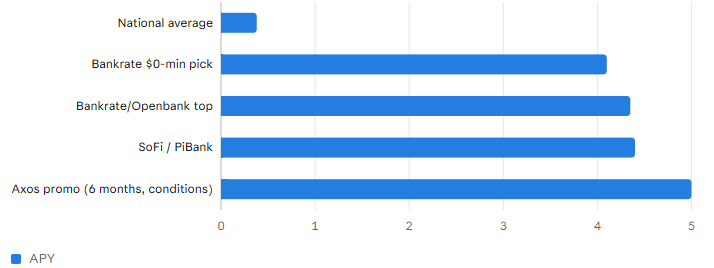
NerdWallet's headline says "up to 5%", but that rate is from Axos Bank and applies for six months and only with a linked checking account and certain deposit requirements. That is a promotional rate, not the standard rate, and I would not plan around it. The big attraction of an HYSA is flexibility. You can usually withdraw or transfer your money, and it earns interest the whole time. The big drawback is that the rate is variable, so it can fall when the Fed or the bank changes course. Switchwize also warns that rates are variable and some top rates apply only to new customers, need monthly deposits or change with your balance.
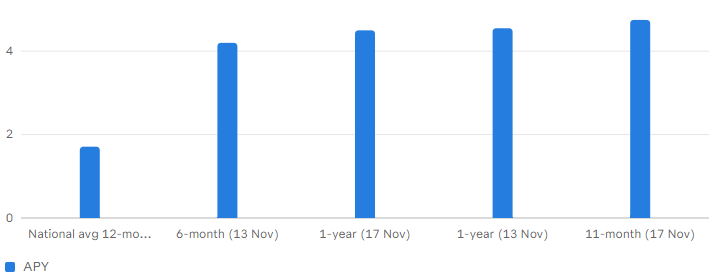
Compare that with the national average. The Points Party reported a national average 12-month CD rate of 1.71% in August, and 24/7 Wall St gave 1.65% for June. So competitive CDs pay roughly two and a half times the average, and the gap is the reason shopping around is worthwhile. The trade-off is access. If you need the cash early, you will likely pay a penalty, and rates on a new CD may be better or worse than your locked rate if the Fed moves again. For that reason, a CD suits money with a known end date.
Treasuries can be bought through TreasuryDirect or a brokerage account. That adds a small learning curve, which is one reason many people stay with a bank CD. But for savers in states with high income taxes, it is worth knowing the option exists.
Now the places to avoid for cash you want to grow. Leaving it in a traditional checking account is the obvious one. MoneyLion says some traditional accounts still pay 0.01% APY, a fraction of the 0.38% national average. At that rate, $5,000 would earn about 50 cents a year (my calculation). If your main bank offers a savings account that pays close to the national average, you are being paid roughly a tenth of what top accounts offer. Moving is free and takes a few days, and it is the single biggest improvement most savers can make.
The fourth is the outlier. A CD paying 9% sounds irresistible, but it is local and for new members only. And the fifth is the sponsored ranking. Bankrate says its lists include sponsored offers, so remember that a "best" list is not an unbiased survey. Finally, there is the quiet trap of doing nothing. Rates move, and an account that was competitive in the spring may have slipped. A quick check twice a year is enough.
MoneyLion notes the $250,000 limit has held steady since 2008, and that spreading money across separately chartered banks extends coverage. That is not relevant to $5,000, but it is good to know if your savings grow. Check the legal name of the bank, not just the brand. Some apps are not banks themselves and hold money at partner banks, so look for "Member FDIC" and the name of the actual bank. That one step avoids most of the nasty surprises.
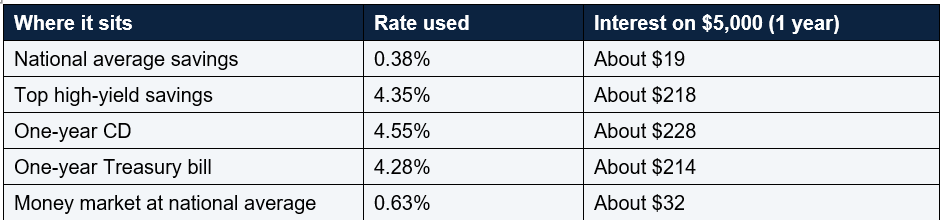
The difference between average and top is about $199 a year on $5,000. It is not life-changing, but it costs nothing but a little time. The difference among the top options is small, only about $14 between the highest and lowest in the table, so do not over-engineer the choice. Pick something safe and flexible, and move on.
Taxes also take a bite. In general, bank interest is taxable income, while Treasury interest is exempt from state and local tax, as noted above. The exact amount you keep depends on your tax bracket and state, which I cannot know. If you earn a lot of interest, a tax professional can help.
Remember that if you already carry credit card debt, paying it down will almost certainly beat any savings rate. Debt on a card usually costs far more than a savings account can pay. Build a small cushion first, then pay down high-interest balances, and save the rest.
For money you may need soon, a high-yield savings account, with top rates around 4.35% to 4.40%. For money you will not need for several months, a CD or Treasury bill is an alternative.
How much interest will $5,000 earn in a high-yield savings account?
At 4.35%, about $218 over a year by my calculation, compared with about $19 at the 0.38% national average.
Are CDs better than savings accounts?
CDs may pay slightly more and lock in a rate, such as 4.55% on one-year terms, but you may pay a penalty for early withdrawal. A savings account offers flexibility with a variable rate.
Are Treasury bills safe, and are they taxed?
They are backed by the US government, though not FDIC insured, and the interest is exempt from state and local income taxes. Federal tax still applies.
Is my $5,000 insured?
Yes, if it is in an FDIC-insured bank or NCUA-insured credit union, up to $250,000 per depositor, per institution, per ownership category.
Table of Contents
- Start with the job your $5,000 has to do
- High-yield savings: the default home
- Certificates of deposit: locking in a rate
- Treasury bills: the tax-friendly option
- Money market accounts and where not to park cash
- Savings traps to avoid
- Safety: what FDIC insurance covers
- What $5,000 can actually earn
- Inflation and taxes: the quiet subtraction
- Three simple ways to split $5,000
- How to move your money without mistakes
- Questions to ask before you choose
- Conclusion
- FAQ
Savings account rates, November 2026 (APY %)
% APY by Sources: Yahoo Finance, Bankrate, Switchwize, NerdWallet, 2-12 Nov 2026
CD rates vs the national average (APY %)
% APY by Sources: The Points Party; Bankrate, Nov 2026
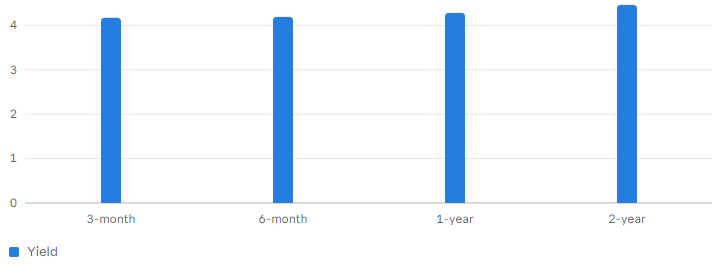
Treasury par yields, 5 November 2026 (%)
% yield by Source: DepositAccounts, citing US Treasury, 5 Nov 2026If you have $5,000 sitting in a checking account, you are probably leaving money on the table. The FDIC's national average savings rate was 0.37% in September, while top high-yield accounts are paying around 4.35% to 4.40%. On $5,000, my calculation says that is roughly $19 a year versus about $218. The best place for the money depends on when you need it. For cash you may need quickly, a high-yield savings account usually makes the most sense, as Fortune puts it. For money you will not touch for six months to a year, CDs and Treasury bills can pay a little more or offer tax advantages. This guide walks through each option, the traps that catch savers out, and a few simple ways to split $5,000. It is built for ordinary savers who want a safe, boring place for cash, not a way to chase returns.
Key takeaway: Match the account to the timeline. Emergency cash goes in an insured, flexible high-yield account. Money with a known date can go in a CD or T-bill. Read the fine print on any rate that looks too good.
Start with the job your $5,000 has to do
Before comparing rates, ask what the money is for. If it is your emergency fund, access and safety come first, and a slightly lower rate is a fair trade. If it is for a holiday, a car repair fund or a house deposit next year, you can accept some lock-up in return for certainty. If it is for something decades away, such as retirement, then a savings account is probably not the right tool at all, because cash will struggle to keep up with prices over long periods. That is a general principle, not a recommendation, and it is outside the scope of this post. I find it helps to sort the $5,000 into three questions. When might I need it? How bad would it be if I could not get it for a few months? And would I rather have a guaranteed rate or the freedom to move? Your answers decide most of what follows.High-yield savings: the default home
A high-yield savings account (HYSA) is the simplest answer. It is a regular savings account from an online bank or credit union that pays far more than a traditional bank. Bankrate lists top accounts at up to 4.35% APY as of 12 November, with one account requiring a $5,000 minimum balance to earn that rate [1]. That minimum matters, because $5,000 is exactly the threshold. Other sources give slightly different pictures, so it is worth comparing. A 2 November Yahoo Finance roundup put the top partner rate at 4.4% from SoFi. Switchwize found 4.40% at PiBank on 8 November, with 24 accounts checked against each bank's own page. DepositAccounts lists Openbank at 4.35%, but only for new accounts and including a six-month 0.35% boost.NerdWallet's headline says "up to 5%", but that rate is from Axos Bank and applies for six months and only with a linked checking account and certain deposit requirements. That is a promotional rate, not the standard rate, and I would not plan around it. The big attraction of an HYSA is flexibility. You can usually withdraw or transfer your money, and it earns interest the whole time. The big drawback is that the rate is variable, so it can fall when the Fed or the bank changes course. Switchwize also warns that rates are variable and some top rates apply only to new customers, need monthly deposits or change with your balance.
Certificates of deposit: locking in a rate
A certificate of deposit (CD) pays a fixed rate for a fixed term. In return for locking your money up, you usually get a slightly higher rate than a savings account. Bankrate's CD list shows, as of 13 November, 4.55% on a one-year CD with no minimum, 4.65% on an 11-month CD with a $500 minimum, and 4.20% on a six-month CD. By 17 November it showed 4.75% on an 11-month CD and 4.50% on a one-year CD with a $100 minimum. Fortune says the top CDs offer up to 5.00% [8]. One headline number deserves caution. CD Valet reported a 9.00% APY on a nine-month CD from Southland Credit Union, but it is only available to new members in Los Angeles and Orange County. That is an outlier, and eligibility rules matter more than the number.Compare that with the national average. The Points Party reported a national average 12-month CD rate of 1.71% in August, and 24/7 Wall St gave 1.65% for June. So competitive CDs pay roughly two and a half times the average, and the gap is the reason shopping around is worthwhile. The trade-off is access. If you need the cash early, you will likely pay a penalty, and rates on a new CD may be better or worse than your locked rate if the Fed moves again. For that reason, a CD suits money with a known end date.
Treasury bills: the tax-friendly option
Treasury bills are short-term loans to the US government. They are not bank deposits, so they do not carry FDIC insurance, but they are backed by the government. A DepositAccounts post listed par yields on 5 November of 4.17% for three months, 4.19% for six months and 4.28% for one year . The same post makes a useful point: if you are considering a CD, consider a Treasury, because Treasuries are exempt from state and local income taxes [10]. In a high-tax state, that can make a slightly lower T-bill yield beat a CD after tax. A later DepositAccounts post from 11 November shows a list with a six-month rate of 4.38% and a one-year rate of 4.56%, which appears to be a higher Treasury curve, though the excerpt I could see does not label it, so I treat it with caution.Treasuries can be bought through TreasuryDirect or a brokerage account. That adds a small learning curve, which is one reason many people stay with a bank CD. But for savers in states with high income taxes, it is worth knowing the option exists.
Money market accounts and where not to park cash
Money market accounts sit between savings accounts and investment accounts. The Points Party says the national average for money market accounts was 0.63% in August, and Gerald gives about 0.64%, noting that competitive online accounts often offer 4% to 5% on tiered balances. Check whether the rate you see applies to a $5,000 balance, since tiers can change the yield.Now the places to avoid for cash you want to grow. Leaving it in a traditional checking account is the obvious one. MoneyLion says some traditional accounts still pay 0.01% APY, a fraction of the 0.38% national average. At that rate, $5,000 would earn about 50 cents a year (my calculation). If your main bank offers a savings account that pays close to the national average, you are being paid roughly a tenth of what top accounts offer. Moving is free and takes a few days, and it is the single biggest improvement most savers can make.
Savings traps to avoid
High rates come with small print, and this is where savers lose money. The first trap is the introductory rate. MoneyLion warns that promotional rates revert to a lower standard APY when the promotion ends. Gerald gives the same advice: confirm what the rate drops to after the promo period. The second is the new-customer or conditions trap. As noted above, the Axos 5% rate needs a linked checking account and deposit requirements, and the Openbank rate is for new accounts and includes a temporary boost. If an account needs monthly deposits, ask whether you will really meet them every month. The third is the balance tier trap. Some rates apply only above or below a certain balance, such as the $5,000 minimum I mentioned. If your balance dips below the line, you might earn far less than the headline.The fourth is the outlier. A CD paying 9% sounds irresistible, but it is local and for new members only. And the fifth is the sponsored ranking. Bankrate says its lists include sponsored offers, so remember that a "best" list is not an unbiased survey. Finally, there is the quiet trap of doing nothing. Rates move, and an account that was competitive in the spring may have slipped. A quick check twice a year is enough.
Safety: what FDIC insurance covers
For $5,000, safety is simple. FDIC insurance covers $250,000 per depositor, per bank, per ownership category, and only if a bank fails. Credit unions offer equivalent protection through the NCUA. You do not need to worry about the limit at this balance, but you should confirm that the bank is FDIC-insured or the credit union is NCUA-insured before you deposit.MoneyLion notes the $250,000 limit has held steady since 2008, and that spreading money across separately chartered banks extends coverage. That is not relevant to $5,000, but it is good to know if your savings grow. Check the legal name of the bank, not just the brand. Some apps are not banks themselves and hold money at partner banks, so look for "Member FDIC" and the name of the actual bank. That one step avoids most of the nasty surprises.
What $5,000 can actually earn
Here is what $5,000 can earn over a year at the rates I have discussed. These are my calculations using simple annual interest, and real results vary with compounding, rate changes and fees.The difference between average and top is about $199 a year on $5,000. It is not life-changing, but it costs nothing but a little time. The difference among the top options is small, only about $14 between the highest and lowest in the table, so do not over-engineer the choice. Pick something safe and flexible, and move on.
Inflation and taxes: the quiet subtraction
Interest is only half the story. The latest annual inflation figure is September's 3.7%. On $5,000 that equals about $185 of lost purchasing power in a year (my calculation). A savings account paying 4.35% therefore leaves a real gain of only about $33, and one paying 0.38% leaves you roughly $166 worse off in real terms. That is why the national average rate is a trap in itself. The money looks safe, but its purchasing power slowly shrinks. The best savings rates currently edge above inflation, but only by a little, and inflation figures can move quickly.Taxes also take a bite. In general, bank interest is taxable income, while Treasury interest is exempt from state and local tax, as noted above. The exact amount you keep depends on your tax bracket and state, which I cannot know. If you earn a lot of interest, a tax professional can help.
Three simple ways to split $5,000
These are examples, not recommendations. Option one, the simple plan: put all $5,000 in a high-yield savings account. It is easy, flexible and insured. This suits anyone building or topping up an emergency fund. Option two, the split: keep $2,500 in an HYSA for flexibility and put $2,500 in a six-month or one-year CD or T-bill for the portion you know you will not touch. You earn a little more on half the money and keep half within reach. Option three, the ladder: split $5,000 into $1,250 pieces across three-month, six-month, nine-month and 12-month CDs or T-bills, so something matures every quarter.Remember that if you already carry credit card debt, paying it down will almost certainly beat any savings rate. Debt on a card usually costs far more than a savings account can pay. Build a small cushion first, then pay down high-interest balances, and save the rest.
How to move your money without mistakes
Moving money is easy, but a few habits help. Open the new account with a small deposit first and confirm the link to your current bank. Check any minimum balance, fees and withdrawal limits. Write down the promotional end date, if any, and set a calendar reminder to review the rate. Keep the old account open until the transfer has fully cleared, especially if you have automatic payments going out. When you buy a CD, note the maturity date and the renewal rules, since many roll over automatically at whatever rate is then on offer. Finally, keep records for tax time, because banks send forms for interest earned.Questions to ask before you choose
Ask yourself these questions before choosing. Do I need this money within a year? Do I have three to six months of expenses saved already? Does the rate depend on a promotion, a balance tier or a monthly deposit? Is the bank FDIC-insured or the credit union NCUA-insured? And what will the rate be after six months? If you can answer all five, you are in better shape than most savers. If you cannot, a fee-only financial planner or your bank's help line can walk you through the details, and many offer a free consultation.Conclusion
The best place to store $5,000 right now is somewhere insured, flexible and paying roughly ten times the national average. For most people that means a high-yield savings account at roughly 4.35% to 4.40%, with CDs and T-bills as options for money you will not need for a while. Do not be tempted by a headline rate without checking the fine print, and remember that with inflation near 3.7% the real return on cash is small. Pick one safe option, set a reminder to review it in six months, and let the savings do their quiet work.FAQ
What is the best place to put $5,000 right now?For money you may need soon, a high-yield savings account, with top rates around 4.35% to 4.40%. For money you will not need for several months, a CD or Treasury bill is an alternative.
How much interest will $5,000 earn in a high-yield savings account?
At 4.35%, about $218 over a year by my calculation, compared with about $19 at the 0.38% national average.
Are CDs better than savings accounts?
CDs may pay slightly more and lock in a rate, such as 4.55% on one-year terms, but you may pay a penalty for early withdrawal. A savings account offers flexibility with a variable rate.
Are Treasury bills safe, and are they taxed?
They are backed by the US government, though not FDIC insured, and the interest is exempt from state and local income taxes. Federal tax still applies.
Is my $5,000 insured?
Yes, if it is in an FDIC-insured bank or NCUA-insured credit union, up to $250,000 per depositor, per institution, per ownership category.
0 Comments
Be the first to share your thoughts on this article.