
Savings
What To Change Before a December Rate Hike: Borrowing, Saving and Spending?

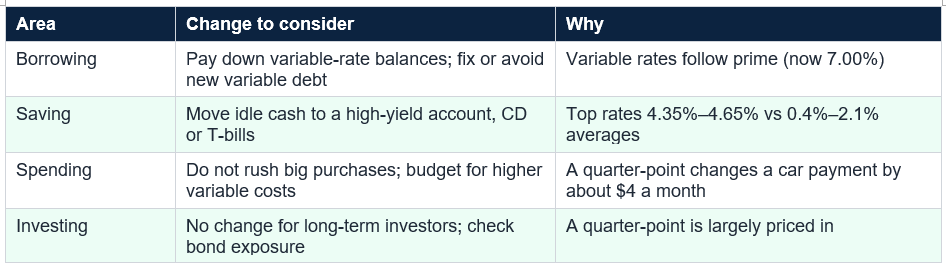
Federal funds target 3.75%–4.00% (since the September 16 hike); prime rate 7.00%; December 8–9 meeting; a quarter-point hike fully priced and about 12.5% odds of a half-point (CNBC, November 10); 2-year Treasury 4.733%, 10-year about 5%; inflation 3.7% in September, October +0.4% for the month. The rates you see: 30-year mortgage about 6.98%–7.30% (MBA forecasts 7.3% for Q4); top high-yield savings about 4.35%; top one-year CD 4.65% versus a 2.12% national average; average savings 0.38%–0.63%; card APRs about 20.9% (charged) or 11.9% (advertised average). My arithmetic: a quarter-point hike costs $25 a year per $10,000 of variable-rate debt ($125 per $50,000; $750 on a $300,000 adjustable loan) and earns $25 per $10,000 of savings if passed through; each quarter-point on a $300,000 30-year mortgage is about $51 a month; moving $10,000 from a 0.38% account to 4.35% earns about $397 more a year; a $5,000 card balance at 20.9% costs $1,045 a year.
What does that mean for your household? Mostly less than the headlines suggest, because a quarter-point move is small and widely expected, but a few things are worth checking, especially variable-rate debt and where your cash sits. This guide covers what to change about borrowing, saving and spending, what not to change and what a quarter-point actually costs or earns.
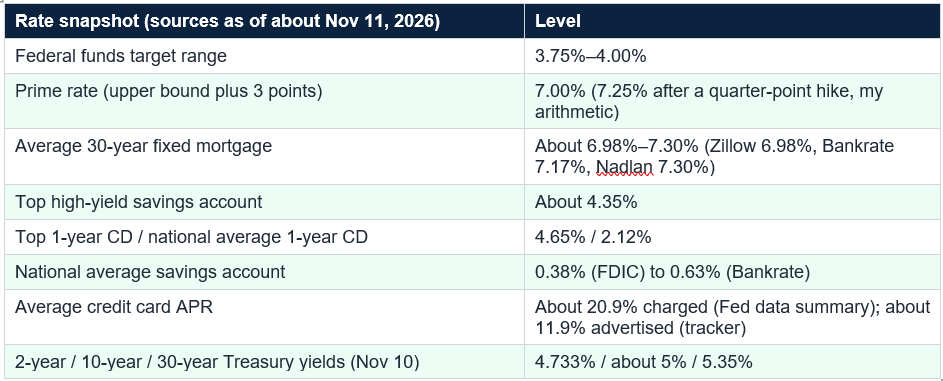
Consumer rates vary by lender and date. The average 30-year mortgage is about 6.98% to 7.30% depending on the source, with the Mortgage Bankers Association forecasting 7.3% for the fourth quarter and Fannie Mae 7.4%. Top online savings accounts pay about 4.35% and the best one-year CDs about 4.65%, while the national average one-year CD is just 2.12%. Credit card APRs actually charged averaged about 20.9% in the second quarter, though a tracker of advertised rates shows about 11.9%. Check your own statements, since your rates are what matter.
Fed funds target 3.75%–4.00%; prime 7.00%. December 8–9: quarter-point hike fully priced, about 12.5% odds of a half-point. 30-year mortgage about 6.98%–7.30%. Top savings about 4.35%; top 1-year CD 4.65% vs 2.12% average. A quarter-point costs about $25 a year per $10,000 of variable-rate debt.
Fixed mortgage rates are different. They follow the 10-year Treasury yield, which reflects expectations for growth, inflation and Fed policy over many years, so they can move independently of a Fed decision, as one source notes. That is why the 30-year rate jumped after the hot inflation report, not after the Fed acted: a Fed hike is not the day your mortgage rate changes. Watch the 10-year yield and the data that drive it instead.
So the priority is paying down the most expensive balances, not racing the Fed. If you carry a card balance, consider a lower-rate card or balance transfer only if the total cost, including fees, is lower, and have a plan to clear it. If you will carry a home equity line for years, consider fixing the rate, and if an adjustable-rate mortgage will reset soon, talk to your lender about options. Avoid new variable-rate debt just before a hike unless you have a clear payoff plan.
Mortgages deserve special care. On a $300,000 30-year loan the payment is about $1,992 a month at 6.98%, $2,030 at 7.17% and $2,057 at 7.30% in my arithmetic, so each quarter-point is about $51 a month, or about $607 a year. If you are about to close and your lender offers a lock, locking can remove uncertainty; if you are still looking, the Fed meeting is not the deadline, since the 10-year yield, not the Fed, drives your rate (the MBA expects about 7.3% for Q4). Shop several lenders, since averages differed by more than 0.3 points across the sources I found.
The choice between a savings account and a CD depends on whether you expect rates to rise. A high-yield account follows the market up, though often slowly, while a CD locks today’s rate; if Dallas Fed President Lorie Logan is right that more hikes are coming, a CD ladder of several lengths can balance the two. Keep your emergency fund in an easy-access account (Bankrate found only 46% of Americans could cover three months of expenses), check deposit insurance limits ($250,000 per bank, general knowledge) and compare current rates, since they move.
Bonds need a note. When yields rise, existing bond prices usually fall: in my rough arithmetic, a fund with a duration near 8 would lose about 2% if yields rose 25 basis points and about 4% if they rose 50, and a $20,000 fund with a duration near 6 would lose about $300 for a quarter-point rise. Those losses are temporary if you hold, since higher yields mean higher future income, but they matter if you need the money soon. Check what your retirement funds hold, and avoid selling in a panic.
Instead, budget for costs that really do move: update your monthly budget for slightly higher variable payments. With inflation at 3.7% in September and prices up 0.4% in October, a 4.35% savings account beats inflation by only about 0.6 percentage points in my arithmetic, so savings are keeping up, not racing ahead. And watch holiday spending: a balance carried at 20.9% turns a $1,000 shopping spree into hundreds of dollars of interest if not paid quickly.
Also do not assume the hike will arrive exactly as expected: the Fed might hike a half point, hold or signal more hikes in 2027. The goal of the moves above is not to win a bet on December 9 but to make your finances less sensitive to rates: less expensive variable debt, more cash earning a fair rate and no purchase that depends on a particular rate decision.
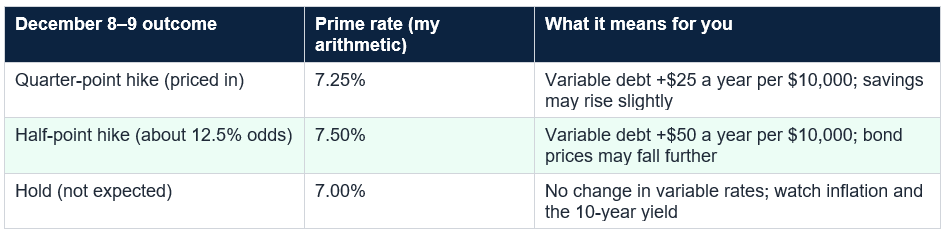
Rates and odds change quickly and nothing is decided until the Fed announces its decision on December 9. A Fed hike does not set your mortgage rate, and a quarter-point move is small compared with what high-rate debt already costs.
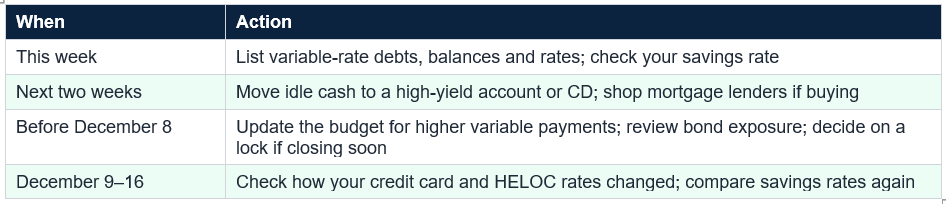
Here is a simple plan you can finish in a few weeks: list your variable-rate debts and check your savings rate this week; over the next two weeks move idle cash to a better account or CD, plan to pay down your most expensive balance and, if buying a home, ask your lender about locking; before December 8, update your budget and review bond holdings; and after the Fed acts, check how your rates changed.
Your move: Pull your latest credit card and home equity statements, write down each balance and its APR and circle the highest. Put any extra dollars there first, and move spare cash to a better-paying account on the same day. Common mistakes include panicking over a quarter-point, rushing a purchase or mortgage because of the Fed meeting, ignoring high-rate card debt while worrying about small increases, leaving thousands in a 0.4% account while top accounts pay 4.35%, forgetting that fixed mortgage rates follow the 10-year yield and assuming the Fed’s decision is certain. The Fed meeting is one event; your finances are a long game.
In my arithmetic, moving $10,000 to a top savings account earns about $397 more a year, a $5,000 card balance at 20.9% costs $1,045 a year, each quarter-point on a $300,000 mortgage is about $51 a month and a quarter-point on a $30,000 car loan is about $3.54 a month. The big money is in the habits, not the headline: check your debts, your savings rates and your budget, and let the Fed do what it does.
Markets think so. After Governor Christopher Waller’s November 10 speech and a hot October inflation report, traders fully priced a quarter-point hike at the December 8–9 meeting and put about 12.5% odds on a half-point move, according to CNBC. Waller said he leaned toward a quarter-point hike and would consider a half-point if inflation stayed hot. Nothing is decided until the Fed announces it, and the odds can change with new data.
Which of my debts are affected by a Fed hike?
Variable-rate debt, such as most credit cards, home equity lines of credit and adjustable-rate mortgages, usually moves with the prime rate, which is 7.00%, the upper bound of the 3.75%–4.00% federal funds target plus 3 points. A quarter-point hike would likely lift prime to 7.25%. Existing fixed-rate loans do not change, and new fixed mortgage rates follow the 10-year Treasury yield, which can move independently.
Should I lock in a mortgage rate before the hike?
Mortgage rates follow the 10-year Treasury yield, not the Fed’s overnight rate, so a Fed hike does not automatically raise them. Rates are near 7% today (6.98% to 7.30% depending on the source), and the Mortgage Bankers Association expects about 7.3% in the fourth quarter. If you have a closing date and a payment you can afford, locking can remove uncertainty; if you are not ready, do not rush because of the Fed. This is general education, not personal advice.
Where should I keep my savings?
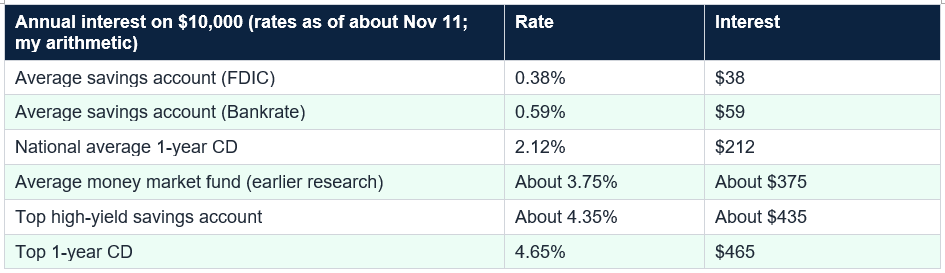
It depends on when you need the money. Top online savings accounts pay about 4.35% and the best one-year CDs about 4.65%, while the national average one-year CD yields only about 2.12% and average savings accounts about 0.4% to 0.6%. In my arithmetic, moving $10,000 from a 0.38% account to a 4.35% account earns about $397 more a year. Keep emergency money accessible and insured, and check current rates, which change often.
Should I change my investments because of the hike?
Probably not, if you invest for the long term. A quarter-point hike was largely expected and is already reflected in prices, so reacting to it is unlikely to help. You may want to check how much of your portfolio is in longer-term bonds, which usually fall in price when yields rise: for a bond fund with a duration near 8, a 25 basis point rise in yields is a loss of about 2% in my rough arithmetic.
Table of Contents
- What Is Actually Happening
- The Short Answer
- The Rates That Matter Today
- How a Fed Hike Reaches Your Wallet
- Borrowing: What to Change
- Saving: What to Change
- Spending: What to Change
- What Not to Change
- Three December Scenarios
- A Checklist Before December 8
- Common Mistakes
- Conclusion
- Frequently Asked Questions
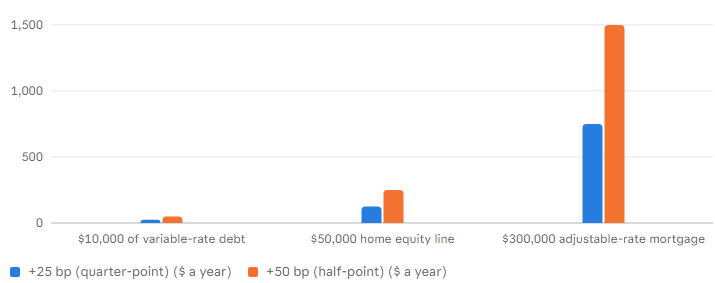
What a Fed hike costs on variable-rate debt: extra interest per year ($)
Extra interest ($ a year) by Author's arithmetic assuming full pass-through via the prime rate (now 7.00%; 3.75%-4.00% fed funds range plus 3 points); a December quarter-point hike is fully priced and a half-point has about 12.5% odds (CNBC, Nov 10, 2026)
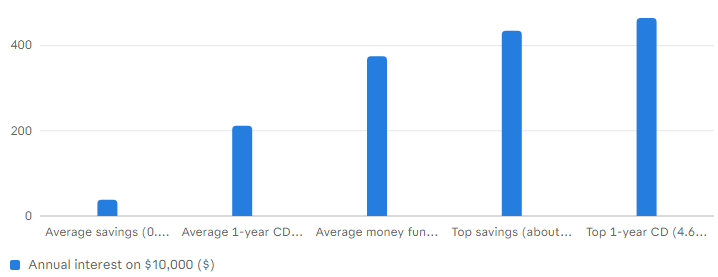
Where your cash sits matters more than the hike: annual interest on $10,000 ($)
Interest earned in a year ($) by Rates as of about Nov 11, 2026 from Bankrate, WealthVieu (FDIC average savings 0.38%; Bankrate shows 0.57%-0.63%) and earlier research (money fund average); author's arithmetic; rates change daily and may not be passed through fully
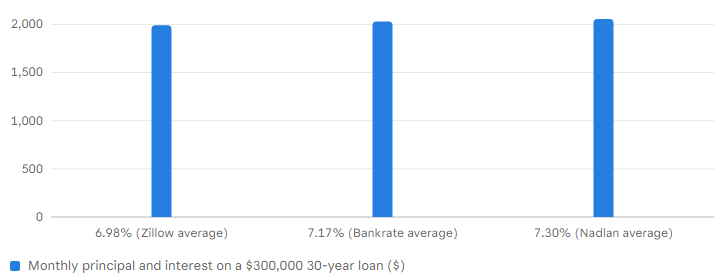
Mortgage rates differ by source: payment on a $300,000, 30-year loan ($ a month)
Payment ($ a month) by Author's arithmetic from rates reported on Nov 11, 2026; each quarter-point is about $51 a month ($607 a year); MBA forecasts about 7.3% for Q4; mortgage rates follow the 10-year Treasury yield, not the Fed's overnight rateWhat Is Actually Happening
When the Fed is expected to raise rates, the advice flying around tends to be urgent: lock this, pay that, buy now before it costs more. It is worth slowing down. On November 10, Fed Governor Christopher Waller said he was leaning toward a quarter-point increase at the December 8–9 meeting and would consider a half-point if inflation stayed hot. After a hotter-than-expected October inflation report, traders fully priced a quarter-point hike and gave about 12.5% odds to a half-point, per CNBC.What does that mean for your household? Mostly less than the headlines suggest, because a quarter-point move is small and widely expected, but a few things are worth checking, especially variable-rate debt and where your cash sits. This guide covers what to change about borrowing, saving and spending, what not to change and what a quarter-point actually costs or earns.
The Short Answer
Do three things before December 8 and ignore the rest. First, find your variable-rate debt (credit cards, home equity lines, adjustable mortgages) and pay down the most expensive balances, since a quarter-point costs only about $25 a year per $10,000 but a 20.9% card already costs $2,090. Second, move spare cash from low-yield accounts to a high-yield savings account, CD or Treasury bills, since top rates of about 4.35% to 4.65% beat averages of 0.4% to 2.1% by hundreds of dollars a year. Third, do not rush purchases or financing because of the Fed, since mortgage rates follow the 10-year Treasury yield, not the Fed’s overnight rate, and do not change your long-term investing plan.
The Rates That Matter Today
The Fed’s federal funds target range is 3.75% to 4.00%, set at its September 16 hike and held on October 28. The prime rate, the benchmark for many variable-rate loans, is 7.00%, the upper bound of that range plus 3 points, so a quarter-point hike would likely lift it to 7.25% and a half-point to 7.50% (my assumption from the usual formula). Inflation was 3.7% year over year in September, and October prices rose 0.4% for the month.Consumer rates vary by lender and date. The average 30-year mortgage is about 6.98% to 7.30% depending on the source, with the Mortgage Bankers Association forecasting 7.3% for the fourth quarter and Fannie Mae 7.4%. Top online savings accounts pay about 4.35% and the best one-year CDs about 4.65%, while the national average one-year CD is just 2.12%. Credit card APRs actually charged averaged about 20.9% in the second quarter, though a tracker of advertised rates shows about 11.9%. Check your own statements, since your rates are what matter.
Fed funds target 3.75%–4.00%; prime 7.00%. December 8–9: quarter-point hike fully priced, about 12.5% odds of a half-point. 30-year mortgage about 6.98%–7.30%. Top savings about 4.35%; top 1-year CD 4.65% vs 2.12% average. A quarter-point costs about $25 a year per $10,000 of variable-rate debt.
How a Fed Hike Reaches Your Wallet
The Fed sets a short-term target rate, and different products respond differently. Variable-rate loans such as most credit cards, home equity lines and adjustable-rate mortgages are priced off prime, so they usually rise within a billing cycle or two after the Fed acts (general knowledge). Savings accounts and CDs may rise too, but banks often pass increases to savers slowly and partially, and existing fixed-rate loans do not change at all.Fixed mortgage rates are different. They follow the 10-year Treasury yield, which reflects expectations for growth, inflation and Fed policy over many years, so they can move independently of a Fed decision, as one source notes. That is why the 30-year rate jumped after the hot inflation report, not after the Fed acted: a Fed hike is not the day your mortgage rate changes. Watch the 10-year yield and the data that drive it instead.
Borrowing: What to Change
Start by listing every variable-rate debt: credit cards, home equity lines, adjustable-rate mortgages, variable-rate private student loans and some personal or business loans, with balances and rates. In my arithmetic, a quarter-point hike adds $25 a year per $10,000 of variable debt, $125 on $50,000 and $750 on a $300,000 adjustable loan, and a half-point doubles those figures. These are small next to what high-rate debt already costs: a $5,000 card balance at 20.9% costs about $1,045 a year, and paying it off at $400 a month takes about 15 months.So the priority is paying down the most expensive balances, not racing the Fed. If you carry a card balance, consider a lower-rate card or balance transfer only if the total cost, including fees, is lower, and have a plan to clear it. If you will carry a home equity line for years, consider fixing the rate, and if an adjustable-rate mortgage will reset soon, talk to your lender about options. Avoid new variable-rate debt just before a hike unless you have a clear payoff plan.
Mortgages deserve special care. On a $300,000 30-year loan the payment is about $1,992 a month at 6.98%, $2,030 at 7.17% and $2,057 at 7.30% in my arithmetic, so each quarter-point is about $51 a month, or about $607 a year. If you are about to close and your lender offers a lock, locking can remove uncertainty; if you are still looking, the Fed meeting is not the deadline, since the 10-year yield, not the Fed, drives your rate (the MBA expects about 7.3% for Q4). Shop several lenders, since averages differed by more than 0.3 points across the sources I found.
Saving: What to Change
This is where a hike can help you, and where many people leave the most money on the table. A top high-yield savings account pays about 4.35% while the national average savings account pays about 0.38% to 0.63%, depending on the source. In my arithmetic, $10,000 earns about $38 a year at 0.38% and $435 at 4.35%, a difference of about $397 ($992 on $25,000). A top one-year CD pays about 4.65%, or $465 on $10,000, though the national average one-year CD is only 2.12%, so shopping matters, and Treasury bills paid about 4.2% to 4.5% in my earlier research.The choice between a savings account and a CD depends on whether you expect rates to rise. A high-yield account follows the market up, though often slowly, while a CD locks today’s rate; if Dallas Fed President Lorie Logan is right that more hikes are coming, a CD ladder of several lengths can balance the two. Keep your emergency fund in an easy-access account (Bankrate found only 46% of Americans could cover three months of expenses), check deposit insurance limits ($250,000 per bank, general knowledge) and compare current rates, since they move.
Bonds need a note. When yields rise, existing bond prices usually fall: in my rough arithmetic, a fund with a duration near 8 would lose about 2% if yields rose 25 basis points and about 4% if they rose 50, and a $20,000 fund with a duration near 6 would lose about $300 for a quarter-point rise. Those losses are temporary if you hold, since higher yields mean higher future income, but they matter if you need the money soon. Check what your retirement funds hold, and avoid selling in a panic.
Spending: What to Change
The biggest spending mistake before a rate hike is rushing. The idea that you should buy now because borrowing will cost more is mostly a trap, because a quarter-point adds little: in my arithmetic, a $30,000 five-year car loan costs about $594 a month at 7.00% and about $598 at 7.25%, about $3.54 more a month or $213 over the loan. That is not worth buying a car you do not need, or accepting a worse deal, because of a Fed headline.Instead, budget for costs that really do move: update your monthly budget for slightly higher variable payments. With inflation at 3.7% in September and prices up 0.4% in October, a 4.35% savings account beats inflation by only about 0.6 percentage points in my arithmetic, so savings are keeping up, not racing ahead. And watch holiday spending: a balance carried at 20.9% turns a $1,000 shopping spree into hundreds of dollars of interest if not paid quickly.
What Not to Change
Some things should stay the same. If you invest for the long term, a quarter-point hike markets already expect is not a reason to sell stocks or change contributions. Timing the market around Fed meetings has a poor record: DALBAR figures cited earlier in this series show average investors earned about 6.8% a year over 30 years against 10.2% for the S&P 500, largely because of badly timed trades. Keep your emergency fund, keep contributing at least enough to earn any employer match and keep your plan.Also do not assume the hike will arrive exactly as expected: the Fed might hike a half point, hold or signal more hikes in 2027. The goal of the moves above is not to win a bet on December 9 but to make your finances less sensitive to rates: less expensive variable debt, more cash earning a fair rate and no purchase that depends on a particular rate decision.
Three December Scenarios
It helps to think in scenarios without assigning probabilities beyond what the market implies. In the base case the Fed raises rates a quarter point, as expected: prime rises to 7.25%, variable-rate debt gets slightly more expensive and top savings rates may edge up. In a hawkish case it raises a half point (the market’s roughly 12.5% tail), doubling the effects and putting prime at 7.50%. In a surprise hold, borrowing costs stay put, but inflation data may keep the Fed hawkish into 2027.Rates and odds change quickly and nothing is decided until the Fed announces its decision on December 9. A Fed hike does not set your mortgage rate, and a quarter-point move is small compared with what high-rate debt already costs.
Here is a simple plan you can finish in a few weeks: list your variable-rate debts and check your savings rate this week; over the next two weeks move idle cash to a better account or CD, plan to pay down your most expensive balance and, if buying a home, ask your lender about locking; before December 8, update your budget and review bond holdings; and after the Fed acts, check how your rates changed.
Your move: Pull your latest credit card and home equity statements, write down each balance and its APR and circle the highest. Put any extra dollars there first, and move spare cash to a better-paying account on the same day. Common mistakes include panicking over a quarter-point, rushing a purchase or mortgage because of the Fed meeting, ignoring high-rate card debt while worrying about small increases, leaving thousands in a 0.4% account while top accounts pay 4.35%, forgetting that fixed mortgage rates follow the 10-year yield and assuming the Fed’s decision is certain. The Fed meeting is one event; your finances are a long game.
Conclusion
A quarter-point Fed hike on December 8 and 9 is largely priced in, with about 12.5% odds of a half-point, according to CNBC. For households, the effects are real but small: a quarter-point costs about $25 a year per $10,000 of variable-rate debt and earns about $25 a year per $10,000 of savings if passed through. The moves worth making are practical: pay down variable-rate and high-APR balances, move idle cash from accounts paying 0.4% to ones paying 4.35% or 4.65%, avoid rushing purchases or mortgages because of the Fed and keep your long-term investing plan.In my arithmetic, moving $10,000 to a top savings account earns about $397 more a year, a $5,000 card balance at 20.9% costs $1,045 a year, each quarter-point on a $300,000 mortgage is about $51 a month and a quarter-point on a $30,000 car loan is about $3.54 a month. The big money is in the habits, not the headline: check your debts, your savings rates and your budget, and let the Fed do what it does.
Frequently Asked Questions
Is the Fed really going to raise rates in December?Markets think so. After Governor Christopher Waller’s November 10 speech and a hot October inflation report, traders fully priced a quarter-point hike at the December 8–9 meeting and put about 12.5% odds on a half-point move, according to CNBC. Waller said he leaned toward a quarter-point hike and would consider a half-point if inflation stayed hot. Nothing is decided until the Fed announces it, and the odds can change with new data.
Which of my debts are affected by a Fed hike?
Variable-rate debt, such as most credit cards, home equity lines of credit and adjustable-rate mortgages, usually moves with the prime rate, which is 7.00%, the upper bound of the 3.75%–4.00% federal funds target plus 3 points. A quarter-point hike would likely lift prime to 7.25%. Existing fixed-rate loans do not change, and new fixed mortgage rates follow the 10-year Treasury yield, which can move independently.
Should I lock in a mortgage rate before the hike?
Mortgage rates follow the 10-year Treasury yield, not the Fed’s overnight rate, so a Fed hike does not automatically raise them. Rates are near 7% today (6.98% to 7.30% depending on the source), and the Mortgage Bankers Association expects about 7.3% in the fourth quarter. If you have a closing date and a payment you can afford, locking can remove uncertainty; if you are not ready, do not rush because of the Fed. This is general education, not personal advice.
Where should I keep my savings?
It depends on when you need the money. Top online savings accounts pay about 4.35% and the best one-year CDs about 4.65%, while the national average one-year CD yields only about 2.12% and average savings accounts about 0.4% to 0.6%. In my arithmetic, moving $10,000 from a 0.38% account to a 4.35% account earns about $397 more a year. Keep emergency money accessible and insured, and check current rates, which change often.
Should I change my investments because of the hike?
Probably not, if you invest for the long term. A quarter-point hike was largely expected and is already reflected in prices, so reacting to it is unlikely to help. You may want to check how much of your portfolio is in longer-term bonds, which usually fall in price when yields rise: for a bond fund with a duration near 8, a 25 basis point rise in yields is a loss of about 2% in my rough arithmetic.
0 Comments
Be the first to share your thoughts on this article.