
Savings
Holding Cash in a Stocks and Shares ISA: The Basics

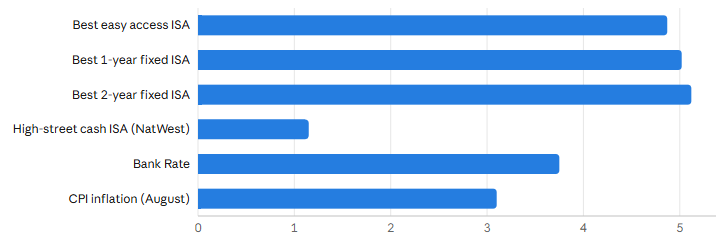
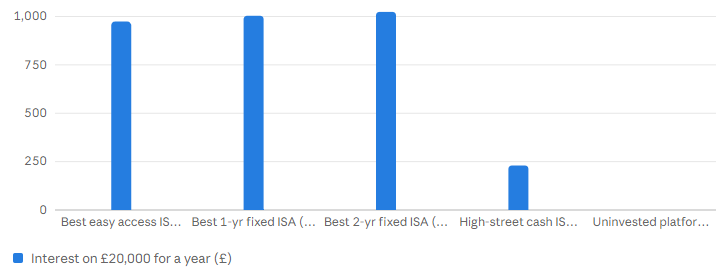
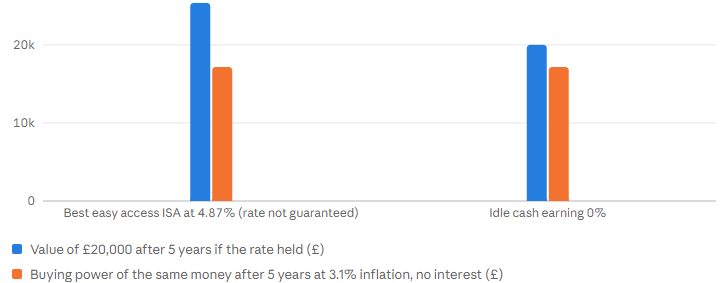
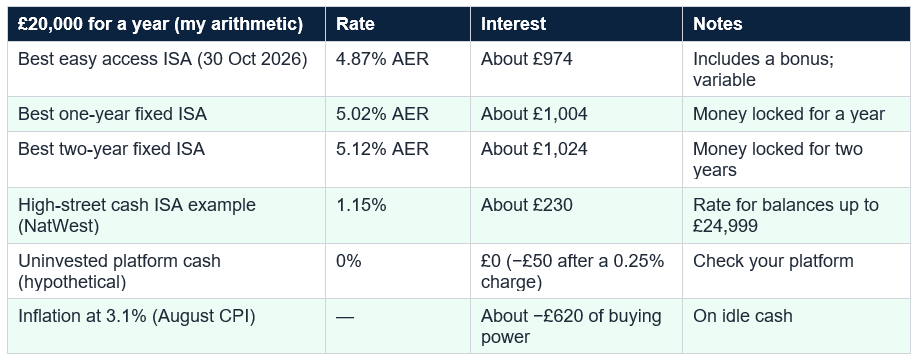
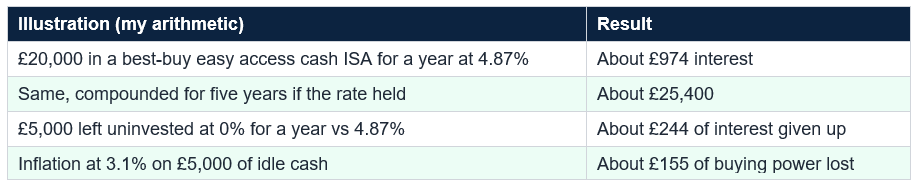
Allowance and Budget: ISA allowance £20,000 for 2026/27 (tax year ends 5 April 2027; no carry-forward); the planned £12,000 cash ISA cap for under-65s was scrapped, and reports say the planned 22% charge on uninvested cash interest in Stocks and Shares ISAs was cancelled too; a “starter investment ISA” is being explored. Rates (30 October 2026): best easy access ISA 4.87% AER, one-year fixed 5.02%, two-year fixed 5.12%; a high-street cash ISA example at 1.15%; Bank Rate 3.75% (next decision 5 November); CPI inflation 3.1% in August, expected to rise towards about 3.75% by the end of 2026. My arithmetic on £20,000: about £974 a year at 4.87%, £1,004 at 5.02%, £1,024 at 5.12% and £230 at 1.15%; 3.1% inflation erodes about £620 of purchasing power on idle cash; a 0.25% platform charge costs £50 a year; £20,000 at 4.87% compounds to about £25,400 over five years.
Percent by Moneyfacts and MoneySavingExpert (30 Oct 2026); NatWest; Bank of England (Sept 2026); ONS via MoneySavingExpert
The topic is also in the news. In the Budget on 28 October, the Chancellor scrapped plans to cap the cash ISA allowance and, according to Which?, cancelled a planned tax on interest from cash held in Stocks and Shares ISAs. So this is a good moment to understand what cash in a Stocks and Shares ISA is, what it earns, what it costs and when it makes sense, with the latest rates and some simple sums.
Your annual allowance is £20,000 in total across all adult ISAs for 2026/27, which you can split any way you like, for example £10,000 in a cash ISA and £10,000 in a Stocks and Shares ISA. The tax year ends on 5 April 2027, a fresh £20,000 arrives on 6 April and unused allowance is lost.
On 28 October 2026, the Chancellor, John Healey, scrapped the cap: the cash ISA limit stays at £20,000 for savers of all ages, according to MoneySavingExpert. Which? reports that the planned 22% tax on uninvested cash interest in Stocks and Shares ISAs was cancelled with it, and NatWest says the proposed transfer restrictions will not be introduced. The government will also explore a new incentive for first-time Stocks and Shares ISA investors, described as a starter investment ISA. One calculator site still describes a charge and says regulations are due in November, so confirm the final detail.
Budget, 28 October 2026: cash ISA limit stays at £20,000 for all ages; the planned 22% tax on cash interest in Stocks and Shares ISAs is reported cancelled; transfer restrictions will not be introduced; a starter investment ISA is to be explored. ISA allowance 2026/27: £20,000; tax year ends 5 April 2027.
The Bank of England held Bank Rate at 3.75% in September by six votes to three, with three members wanting a rise to 4%, and its next decision is on 5 November. CPI inflation was 3.1% in August, and the Bank expects it to rise to about 3.75% in the final quarter of 2026. On £20,000, 3.1% inflation erodes about £620 of purchasing power a year, so cash earning nothing loses about 3% in real terms, while a 4.87% rate gives a real return of about 1.7%.
Fees complete the picture. Platforms charge for holding your ISA, as a percentage or a flat fee, and charges can apply to cash too. As a hypothetical, a 0.25% charge on £20,000 is £50 a year: if your platform paid nothing on cash you would lose £50 plus inflation’s bite, and if it paid 3% you would net about £550. I did not retrieve real platform cash rates, so check yours.
A money market fund can improve on plain cash. These funds invest in very short-term, high-quality debt, aim to follow short-term rates and can be held inside a Stocks and Shares ISA; earlier proposals treated them as non-cash. They are still investments, so their value can fall slightly, and they carry charges, but they can pay closer to the market rate than a platform’s own cash account. Compare the fund’s yield net of charges with your platform’s cash rate.
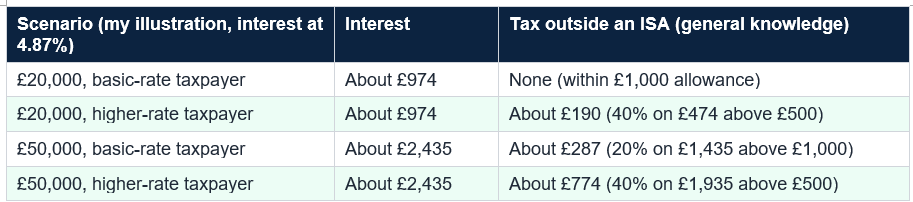
There is a tax angle too. As general knowledge I have not retrieved: basic-rate taxpayers can earn up to £1,000 of savings interest tax-free outside an ISA, higher-rate taxpayers £500 and additional-rate taxpayers nothing, so on £20,000 at 4.87% (£974) a basic-rate taxpayer would owe no tax anyway, a higher-rate taxpayer about £190, and on £50,000 (about £2,435) a higher-rate taxpayer about £774. The ISA’s tax value is greatest for larger pots. Check your own allowance on GOV.UK.
Be careful with transfers. To move an existing ISA, ask your new provider to arrange it; do not withdraw the money yourself, because cash taken out normally loses its tax-free status and uses up allowance again if repaid, unless your ISA is flexible. NatWest says existing arrangements, including transfers between Stocks and Shares and cash ISAs, will continue.
Keep in mind: Cash in a Stocks and Shares ISA is not the same as a cash ISA. The rate may be lower, charges may apply, and some holdings, such as money market funds, are investments whose value can move. Capital is at risk.
Fifth, watch the calendar: the tax year ends on 5 April 2027, and the Bank of England meets on 5 November, which could move savings rates. Sixth, review yearly, comparing your platform’s cash rate and charges with best-buy cash ISAs. If unsure, MoneyHelper offers free, government-backed guidance, and a regulated adviser can give advice tailored to you.
That is not a disaster, and a few months of waiting costs little. But if the cash sits there for years, it quietly loses ground to inflation. Put a time limit on it, invest in stages or move it to a money market fund or a cash ISA. This is an illustration with stated assumptions, not a recommendation.
So choose the wrapper for the job: a cash ISA for savings, an investment ISA for growth and, in between, check what your platform pays, consider a money market fund and put a time limit on the cash. Use your £20,000 before 5 April 2027 and confirm the final rules once the legislation appears. A qualified adviser can help you decide.
Yes. Money you pay in does not have to be invested straight away, and cash sitting in a Stocks and Shares ISA stays inside the tax-free wrapper. Whether it earns interest, and how much, depends on your platform, and many pay little or nothing on uninvested cash. Platform and fund charges may also apply, so cash held there can lose out to a best-buy cash ISA.
Did the Budget change the rules on cash in a Stocks and Shares ISA?
Yes. In the Budget on 28 October 2026 the Chancellor, John Healey, scrapped the planned cut in the cash ISA limit for under-65s, so the full £20,000 allowance stays, and Which? reports that the planned 22% tax on interest from uninvested cash in Stocks and Shares ISAs was cancelled with it. The legislation was due to be laid in November, so check the final rules with HMRC or your provider.
What is the ISA allowance for 2026/27?
£20,000 per adult, which you can split between cash, stocks and shares and other ISA types. The tax year ends on 5 April 2027, a new £20,000 allowance starts on 6 April 2027 and unused allowance cannot be carried forward.
Is cash in a Stocks and Shares ISA protected?
Protection depends on what you hold and where. Platforms normally hold client cash in separate client accounts at banks, and the Financial Services Compensation Scheme can protect eligible deposits and investments if an authorised firm fails, up to its limits. A money market fund is an investment, not a deposit, and its value is not guaranteed. I did not retrieve the current FSCS limits, so check fscs.org.uk.
When is a cash ISA better than cash in a Stocks and Shares ISA?
Usually when you want a savings account with a clearly stated rate and no investment charges, or when you will need the money soon. Best-buy cash ISAs paid up to 4.87% AER (easy access) and about 5.02% to 5.12% (one- and two-year fixed) at the end of October 2026. This is general information, not personal advice.
Table of Contents
- A Slightly Odd Question
- The Short Answer
- The Three Ways to Think About Cash in an ISA
- What the Budget Changed
- The Numbers: Rates, Inflation and Fees
- When Cash in a Stocks and Shares ISA Makes Sense
- When It Does Not
- Risks and Costs to Check
- How to Do It Step by Step
- A Worked Example
- Conclusion
- Frequently Asked Questions
ISA rates vs. Bank Rate and inflation, end of October 2026 (%)
Percent by Moneyfacts and MoneySavingExpert (30 Oct 2026); NatWest; Bank of England (Sept 2026); ONS via MoneySavingExpert
What £20,000 earns in a year, depending on where the cash sits (£)
Interest per year (£) by Author's arithmetic; rates as of 30 October 2026; platform cash rate is hypothetical (not retrieved); a 0.25% charge would cost £50 a year
Five years of idle cash vs. a best-buy ISA rate (£)
Pounds (£) by Author's illustration at constant rates; 20,000 / 1.031^5 is about 17,160 of today's buying power; real platform rates not retrieved
A Slightly Odd Question
“Investing in cash in a Stocks and Shares ISA” sounds like a contradiction: stocks and shares are where you take risk to grow money, cash is where you keep it safe. The answer is that an ISA is a wrapper, not an investment. It shields what is inside from tax, and what is inside can be shares, funds, bonds or, for a while, plain cash waiting for its next move.The topic is also in the news. In the Budget on 28 October, the Chancellor scrapped plans to cap the cash ISA allowance and, according to Which?, cancelled a planned tax on interest from cash held in Stocks and Shares ISAs. So this is a good moment to understand what cash in a Stocks and Shares ISA is, what it earns, what it costs and when it makes sense, with the latest rates and some simple sums.
The Short Answer
Yes, you can hold cash in a Stocks and Shares ISA, and it stays tax-free inside the wrapper. It is most useful as a short pause, while you decide what to buy. It is rarely the best long-term home for savings: platforms often pay little on uninvested cash, charges can eat into it and best-buy cash ISAs paid up to 4.87% AER on easy access and about 5.02% to 5.12% on fixed terms at the end of October. If you want a savings rate, use a cash ISA; if you want growth, invest; if you are in between, know what your platform pays.The Three Ways to Think About Cash in an ISA
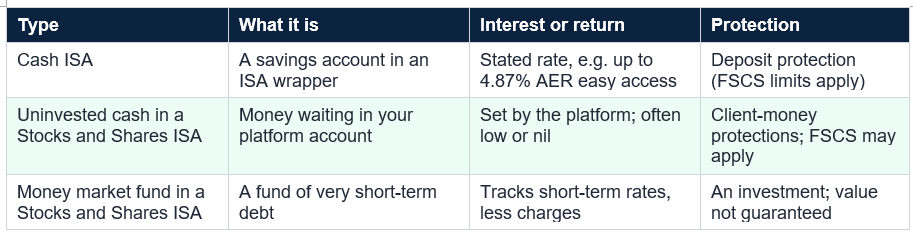
People mean three different things by cash in an ISA. A cash ISA is a savings account with a stated rate and, normally, deposit protection. Uninvested cash inside a Stocks and Shares ISA is money you have paid in but not yet used to buy anything, held in the platform’s cash account. And a cash-like investment, such as a money market fund, invests in very short-term, high-quality debt and aims to track interest rates while staying stable; it is an investment, not a deposit, so its value is not guaranteed.Your annual allowance is £20,000 in total across all adult ISAs for 2026/27, which you can split any way you like, for example £10,000 in a cash ISA and £10,000 in a Stocks and Shares ISA. The tax year ends on 5 April 2027, a fresh £20,000 arrives on 6 April and unused allowance is lost.
What the Budget Changed
A year ago, the then Chancellor announced that from April 2027 the cash ISA allowance would fall to £12,000 for under-65s, while the Stocks and Shares limit stayed at £20,000. To close a workaround, the government also planned a 22% charge on interest on cash held in investment ISAs, with money market funds treated as non-cash, and a ban on transfers from non-cash to cash ISAs for under-65s. That would have made parking cash in a Stocks and Shares ISA much less attractive.On 28 October 2026, the Chancellor, John Healey, scrapped the cap: the cash ISA limit stays at £20,000 for savers of all ages, according to MoneySavingExpert. Which? reports that the planned 22% tax on uninvested cash interest in Stocks and Shares ISAs was cancelled with it, and NatWest says the proposed transfer restrictions will not be introduced. The government will also explore a new incentive for first-time Stocks and Shares ISA investors, described as a starter investment ISA. One calculator site still describes a charge and says regulations are due in November, so confirm the final detail.
Budget, 28 October 2026: cash ISA limit stays at £20,000 for all ages; the planned 22% tax on cash interest in Stocks and Shares ISAs is reported cancelled; transfer restrictions will not be introduced; a starter investment ISA is to be explored. ISA allowance 2026/27: £20,000; tax year ends 5 April 2027.
The Numbers: Rates, Inflation and Fees
As of 30 October, Moneyfacts listed the best easy access ISA at 4.87% AER (including a bonus) from Trading 212, the best one-year fixed ISA at 5.02% from Shawbrook Bank and the best two-year fixed at 5.12%. On £20,000 that is about £974, £1,004 and £1,024 a year, by my arithmetic. High-street rates can be far lower: NatWest’s cash ISA showed 1.15% on balances up to £24,999, about £230 on £20,000.The Bank of England held Bank Rate at 3.75% in September by six votes to three, with three members wanting a rise to 4%, and its next decision is on 5 November. CPI inflation was 3.1% in August, and the Bank expects it to rise to about 3.75% in the final quarter of 2026. On £20,000, 3.1% inflation erodes about £620 of purchasing power a year, so cash earning nothing loses about 3% in real terms, while a 4.87% rate gives a real return of about 1.7%.
Fees complete the picture. Platforms charge for holding your ISA, as a percentage or a flat fee, and charges can apply to cash too. As a hypothetical, a 0.25% charge on £20,000 is £50 a year: if your platform paid nothing on cash you would lose £50 plus inflation’s bite, and if it paid 3% you would net about £550. I did not retrieve real platform cash rates, so check yours.
When Cash in a Stocks and Shares ISA Makes Sense
There are good reasons to hold some cash in a Stocks and Shares ISA. You may want to buy in stages rather than all at once, be waiting for a fund or a better price or be rebalancing after a sale. And if you are within weeks of the 5 April deadline, paying in first and investing later lets you use your allowance before it disappears.A money market fund can improve on plain cash. These funds invest in very short-term, high-quality debt, aim to follow short-term rates and can be held inside a Stocks and Shares ISA; earlier proposals treated them as non-cash. They are still investments, so their value can fall slightly, and they carry charges, but they can pay closer to the market rate than a platform’s own cash account. Compare the fund’s yield net of charges with your platform’s cash rate.
When It Does Not
It makes less sense to use a Stocks and Shares ISA as your main savings account. If you want a stated rate, easy access and no investment risk, a cash ISA is purpose-built, and best-buy rates of up to 4.87% are far above what many platforms pay on uninvested cash. It also makes less sense if you will need the money within a year or two, since a fund can fall, or if you may never invest, since you could pay platform charges for nothing.There is a tax angle too. As general knowledge I have not retrieved: basic-rate taxpayers can earn up to £1,000 of savings interest tax-free outside an ISA, higher-rate taxpayers £500 and additional-rate taxpayers nothing, so on £20,000 at 4.87% (£974) a basic-rate taxpayer would owe no tax anyway, a higher-rate taxpayer about £190, and on £50,000 (about £2,435) a higher-rate taxpayer about £774. The ISA’s tax value is greatest for larger pots. Check your own allowance on GOV.UK.
Risks and Costs to Check
Before you rely on cash in a Stocks and Shares ISA, check five things: the interest your platform pays on uninvested cash and whether it varies by balance; the platform charge and whether it applies to cash; a money market fund’s charges and yield, and that it is not a deposit; protection, since platforms normally hold client money separately and the Financial Services Compensation Scheme can protect eligible deposits and investments if a firm fails, up to limits I did not retrieve (check fscs.org.uk); and the rules, which can change, as this week’s Budget shows.Be careful with transfers. To move an existing ISA, ask your new provider to arrange it; do not withdraw the money yourself, because cash taken out normally loses its tax-free status and uses up allowance again if repaid, unless your ISA is flexible. NatWest says existing arrangements, including transfers between Stocks and Shares and cash ISAs, will continue.
Keep in mind: Cash in a Stocks and Shares ISA is not the same as a cash ISA. The rate may be lower, charges may apply, and some holdings, such as money market funds, are investments whose value can move. Capital is at risk.
How to Do It Step by Step
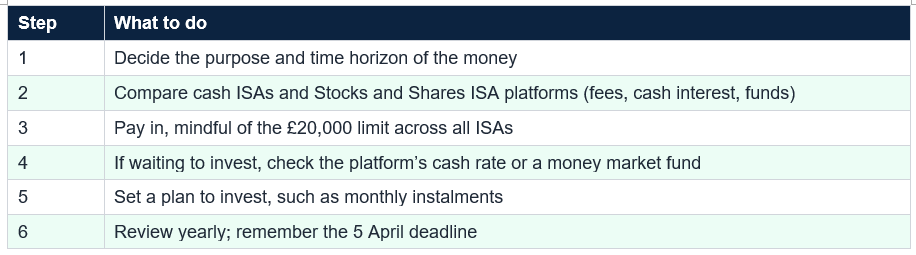
First, decide what the money is for: savings you may need soon point to cash ISAs, while investing points to comparing Stocks and Shares ISA platforms on fees, funds and cash interest. Second, pay in, remembering the £20,000 limit across all ISAs. Third, if you are not ready to invest, find out what the platform pays on cash and consider a money market fund. Fourth, set a plan to invest, for example monthly instalments, so cash does not sit idle by accident.Fifth, watch the calendar: the tax year ends on 5 April 2027, and the Bank of England meets on 5 November, which could move savings rates. Sixth, review yearly, comparing your platform’s cash rate and charges with best-buy cash ISAs. If unsure, MoneyHelper offers free, government-backed guidance, and a regulated adviser can give advice tailored to you.
A Worked Example
Imagine you have £20,000 for an ISA and are undecided. Option one is a best-buy easy access cash ISA at 4.87%: about £974 in a year, tax-free, accessible, with no investment risk, and about £25,400 after five years if the rate held, which is not guaranteed. Option two is a Stocks and Shares ISA where you invest £15,000 straight away and hold £5,000 while you decide. If the platform pays nothing on that £5,000, you give up about £244 of interest a year relative to 4.87%, and might pay a charge on it too.That is not a disaster, and a few months of waiting costs little. But if the cash sits there for years, it quietly loses ground to inflation. Put a time limit on it, invest in stages or move it to a money market fund or a cash ISA. This is an illustration with stated assumptions, not a recommendation.
Conclusion
Holding cash in a Stocks and Shares ISA is allowed, tax-free inside the wrapper and useful as a short pause, but rarely the best place for long-term savings. In late October, best-buy cash ISAs paid up to 4.87% on easy access and 5.02% to 5.12% on fixed terms, against inflation of 3.1% and Bank Rate of 3.75%, while platforms may pay far less on uninvested cash and charges can apply. The Budget helped by keeping the cash ISA allowance at £20,000 and, according to Which?, cancelling the planned 22% tax on cash interest in Stocks and Shares ISAs.So choose the wrapper for the job: a cash ISA for savings, an investment ISA for growth and, in between, check what your platform pays, consider a money market fund and put a time limit on the cash. Use your £20,000 before 5 April 2027 and confirm the final rules once the legislation appears. A qualified adviser can help you decide.
Frequently Asked Questions
Can you hold cash in a Stocks and Shares ISA?Yes. Money you pay in does not have to be invested straight away, and cash sitting in a Stocks and Shares ISA stays inside the tax-free wrapper. Whether it earns interest, and how much, depends on your platform, and many pay little or nothing on uninvested cash. Platform and fund charges may also apply, so cash held there can lose out to a best-buy cash ISA.
Did the Budget change the rules on cash in a Stocks and Shares ISA?
Yes. In the Budget on 28 October 2026 the Chancellor, John Healey, scrapped the planned cut in the cash ISA limit for under-65s, so the full £20,000 allowance stays, and Which? reports that the planned 22% tax on interest from uninvested cash in Stocks and Shares ISAs was cancelled with it. The legislation was due to be laid in November, so check the final rules with HMRC or your provider.
What is the ISA allowance for 2026/27?
£20,000 per adult, which you can split between cash, stocks and shares and other ISA types. The tax year ends on 5 April 2027, a new £20,000 allowance starts on 6 April 2027 and unused allowance cannot be carried forward.
Is cash in a Stocks and Shares ISA protected?
Protection depends on what you hold and where. Platforms normally hold client cash in separate client accounts at banks, and the Financial Services Compensation Scheme can protect eligible deposits and investments if an authorised firm fails, up to its limits. A money market fund is an investment, not a deposit, and its value is not guaranteed. I did not retrieve the current FSCS limits, so check fscs.org.uk.
When is a cash ISA better than cash in a Stocks and Shares ISA?
Usually when you want a savings account with a clearly stated rate and no investment charges, or when you will need the money soon. Best-buy cash ISAs paid up to 4.87% AER (easy access) and about 5.02% to 5.12% (one- and two-year fixed) at the end of October 2026. This is general information, not personal advice.
0 Comments
Be the first to share your thoughts on this article.