

Savings
Where’s the Best Place to Store $50,000 Now? Rate Comparison

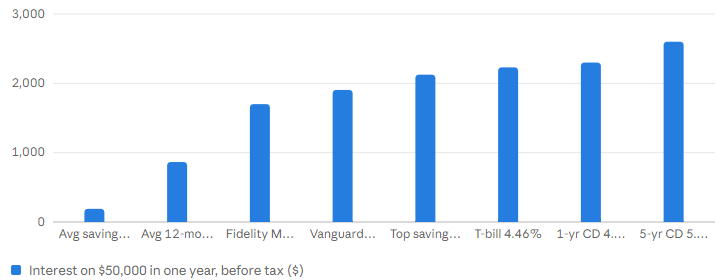
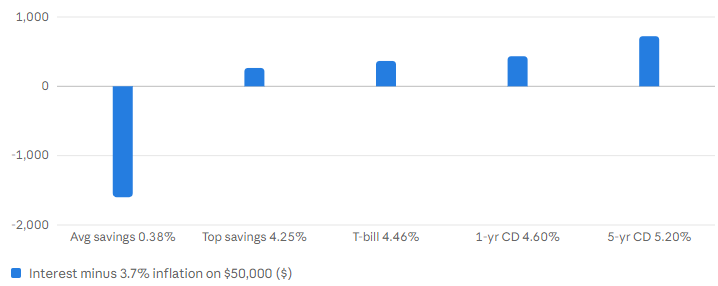
Top savings about 4.25%; 52-week T-bill 4.46%; I Bond 4.26% (first six months); brokered CDs 4.60% (1-year), 4.95% (2-year), 5.20% (5-year); money market funds 3.40%–3.87%; average savings 0.38%; FDIC average 12-month CD 1.73%; inflation 3.7%. Interest on $50,000 in a year (before tax): about $2,125 at 4.25%; $2,230 in a T-bill; $2,300 in a 1-year CD; $2,600 in a 5-year CD; $1,905 in a Vanguard money market fund; only $190 at the 0.38% average savings rate. After inflation (3.7%): a T-bill earns about $366 in real terms; a 5-year CD about $723; an average savings account loses about $1,600 of purchasing power. Coverage and size: FDIC insurance $250,000 per depositor, per bank, per ownership category; $7.92 trillion held in money market funds (ICI, October 14).
The good news is that safe places to park cash pay real interest again. A 52-week Treasury bill paid about 4.46% in mid-October, top savings accounts about 4.25% or more and some CDs up to 5.20%. The question is which tool fits your timeline, tax situation and nerves. This guide compares the main options with current numbers.
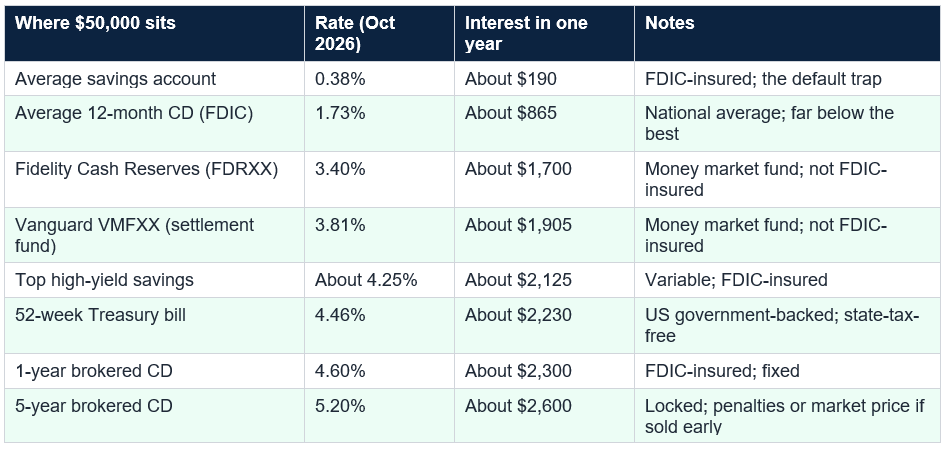
Interest on $50,000 for one year, before tax: 0.38% savings about $190; 3.81% money fund about $1,905; 4.25% top savings about $2,125; 4.46% T-bill about $2,230; 4.60% one-year CD about $2,300; 5.20% five-year CD about $2,600.
The drawback is that the rate is variable, and promotional rates can expire or have balance caps. If the Fed cuts rates, your yield will fall; if it keeps raising them, your yield may rise. That flexibility makes savings accounts the natural home for an emergency fund, which matters because Bankrate found only 46% of Americans could cover three months of expenses.
A ladder spreads money across maturities. Split $50,000 into five $10,000 pieces maturing in one to five years, so one rung comes due each year and can be reinvested at then-current rates. That gives regular access to cash and averages your rate over time. Using CD rates as an illustration, a ladder at 4.60%, 4.95%, 5.10%, 5.15% and 5.20% averages about 5.0%, or about $2,500 a year, roughly $375 more than a 4.25% savings account.
The FDIC’s average 12-month CD rate was about 1.73% in September, so your local bank’s default CD may pay a fraction of the best. Bank CDs are bought directly, and early withdrawal costs interest. Brokered CDs trade through a brokerage and can be sold on the market, but their price may be below face value if rates have risen. Also check whether a CD is callable, meaning the bank can end it early if rates fall.
Unlike bank deposits, money market funds are not FDIC-insured, though government funds are considered very low risk. Their yields are typically below the best savings accounts and CDs, the cost of convenience. A common trap is cash in a default brokerage sweep paying less than the market, so check what yours pays.
Annuities are not bank deposits. They are insurance contracts backed by the insurer, with surrender charges and limited guaranty-association protection. A higher rate can mean more risk or less flexibility, so treat annuities as a specialist choice, not a default for cash.
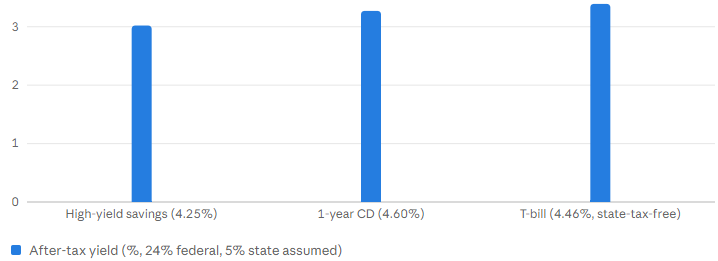
So in a high-tax state, a Treasury bill with a lower headline yield can beat a higher-yielding CD; in a state with no income tax, the CD may win. Retirement accounts such as IRAs can shelter interest entirely. In a taxable account, compare after-tax yields, not headline rates.

The numbers: On $50,000, 3.7% inflation costs about $1,850 of purchasing power a year. After inflation: 0.38% savings about −$1,600; 4.25% savings about +$265; 4.46% T-bill about +$366; 5.20% five-year CD about +$723. Choosing between floating and fixed is a bet on where rates go. The Fed raised its target range to 3.75%–4.00% in September, and Reuters reported in mid-October that another hike was back on the table. If rates rise, savings yields may follow and a locked CD may look stale; if rates fall, a CD locked at 5.20% looks smart.
Here is my own illustration. Put $50,000 in a savings account at 4.25% for a year, then assume the rate falls to 3% for four years. After five years you would have about $58,700, versus about $64,400 in a 5-year CD at 5.20%, a gap of about $5,750. If the savings rate instead rose to 5.5%, you would have about $64,600, roughly equal. No one knows which will happen, so splitting between floating and fixed is a sensible hedge.
Adjust for your life. If you have credit card debt near 21%, paying it off may beat any of these options. If you may buy a home soon, keep that money in cash or Treasuries. If your horizon is decades, consider diversified investments, since the S&P 500 has averaged about 10% a year long term, with sharp falls along the way. Your cash should reflect your needs, not a guess about interest rates.
Your move: Write down when you will need each part of the $50,000. Put the nearest needs in savings or T-bills, lock longer-term money in a ladder and compare after-tax yields before you move a dollar. Avoid leaving $50,000 in a default account paying 0.38%, which costs more than $1,900 a year. Avoid chasing teaser rates with caps or short windows. Avoid locking all the money into a long CD if you might need it, since penalties can wipe out the interest. Avoid letting a CD auto-renew at a low rate. And avoid treating cash as a long-term investment, since inflation compounds against it.
Most people end up splitting the money across several of these, matched to their goals. A few minutes of planning can be worth $1,900 a year or more compared with leaving cash in a default account. This is general education, not personalized advice, and a qualified adviser can help you tailor it.
Insured bank deposits and US Treasury securities are the safest mainstream options. The FDIC insures up to $250,000 per depositor, per insured bank, per ownership category, so $50,000 in one bank account is fully covered. Treasury bills are backed by the US government. Money market funds are not FDIC-insured, though government funds are considered very low risk.
Is a CD or a high-yield savings account better right now?
It depends on whether you may need the money. Savings accounts keep the money accessible, but the rate can change at any time. CDs lock a rate: a 1-year brokered CD paid about 4.60% and a 5-year about 5.20% in mid-October, compared with roughly 4.25% for top savings accounts. If the Fed raises rates further, a savings account rate may rise; if rates fall, a CD wins.
Are Treasury bills better than CDs?
Treasury bill interest is exempt from state and local income tax, which can make a T-bill with a lower headline yield pay more after tax in high-tax states. In my illustration at a 24% federal and 5% state rate, a 4.46% T-bill nets about 3.39%, versus 3.27% for a 4.60% CD. Without state tax, the CD would come out slightly ahead.
How much interest will $50,000 earn?
At roughly 4.25% in a top savings account it earns about $2,125 a year, at 4.46% in a T-bill about $2,230, and at 5.20% in a 5-year CD about $2,600. In an average savings account at 0.38% it earns only about $190. These are before tax and assume the rate stays the same.
Should I invest $50,000 instead of keeping it in cash?
It depends on your timeline. Money you may need within a few years belongs in cash or Treasuries, because stocks can fall sharply. Money for goals more than five years away may belong in diversified investments, where the S&P 500 has averaged about 10% a year long term, though with large swings. This is general education, not personal advice.
Table of Contents
- A Good Problem to Have
- The Short Answer: It Depends on When You Need It
- Today’s Rates on $50,000
- High-Yield Savings Accounts
- Treasury Bills and Ladders
- Certificates of Deposit
- Money Market Funds
- I Bonds and Annuities: Niche Options
- Safety: What Is Actually Insured
- Taxes: The Hidden Difference
- Inflation and the Real Return
- The Rate-Direction Gamble
- A Sample Plan for $50,000
- Mistakes to Avoid
- Conclusion
- Frequently Asked Questions
What $50,000 earns in a year: savings, money funds, T-bills and CDs ($)
After inflation: real return on $50,000 in a year ($)
Taxes change the winner: after-tax yield (%, 24% federal and 5% state assumed)
A Good Problem to Have
Maybe it is an inheritance, a bonus, a sale or years of careful saving. Whatever the source, $50,000 raises a surprisingly stressful question: where should it go? Leave it in checking and it earns almost nothing. Chase a high yield and you may lock it up or take a risk you did not intend.The good news is that safe places to park cash pay real interest again. A 52-week Treasury bill paid about 4.46% in mid-October, top savings accounts about 4.25% or more and some CDs up to 5.20%. The question is which tool fits your timeline, tax situation and nerves. This guide compares the main options with current numbers.
The Short Answer: It Depends on When You Need It
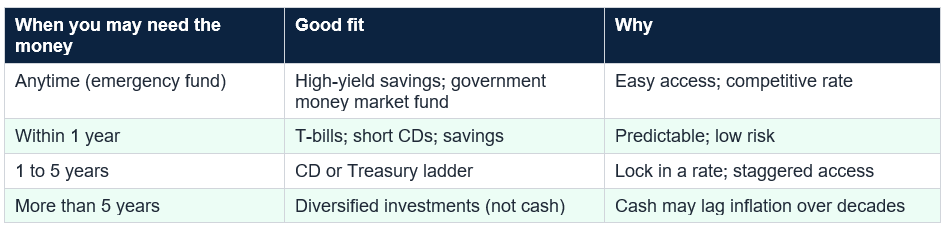
There is no single best place, because it depends on when you will need the money. Money you might need within months belongs in a high-yield savings account or Treasury bill. Money you will not need for one to five years can go into CDs or a Treasury ladder. Money for goals beyond five years may belong in investments, not cash. Most people with $50,000 split it across several buckets.
Today’s Rates on $50,000
Here is what $50,000 earns in a year, before tax, at October 2026 rates: about $2,125 in a top savings account at 4.25%, $2,230 in a 4.46% T-bill, $2,300 in a 4.60% one-year CD and $2,600 in a 5.20% five-year CD. A Vanguard money market fund at 3.81% earns about $1,905. The average savings account, at 0.38%, earns only about $190. The gap between smart and default is more than $1,900 a year.Interest on $50,000 for one year, before tax: 0.38% savings about $190; 3.81% money fund about $1,905; 4.25% top savings about $2,125; 4.46% T-bill about $2,230; 4.60% one-year CD about $2,300; 5.20% five-year CD about $2,600.
High-Yield Savings Accounts
A high-yield savings account is the simplest answer for money you may need. Online banks advertised up to about 4.25% in early October, other surveys put the best accounts at 4% to 5% and MyMoneyBlog’s October 12 survey found 4.34% to 4.50%. The money is insured, accessible and not locked up.The drawback is that the rate is variable, and promotional rates can expire or have balance caps. If the Fed cuts rates, your yield will fall; if it keeps raising them, your yield may rise. That flexibility makes savings accounts the natural home for an emergency fund, which matters because Bankrate found only 46% of Americans could cover three months of expenses.
Treasury Bills and Ladders
Treasury bills are short-term loans to the US government, and a 52-week bill paid about 4.46% in mid-October. They are government-backed, trade easily and, importantly, the interest is exempt from state and local income tax. You can buy them through TreasuryDirect or most brokerages and hold them to maturity or sell earlier.A ladder spreads money across maturities. Split $50,000 into five $10,000 pieces maturing in one to five years, so one rung comes due each year and can be reinvested at then-current rates. That gives regular access to cash and averages your rate over time. Using CD rates as an illustration, a ladder at 4.60%, 4.95%, 5.10%, 5.15% and 5.20% averages about 5.0%, or about $2,500 a year, roughly $375 more than a 4.25% savings account.
Certificates of Deposit
A CD locks a fixed rate for a set term, with a penalty for early withdrawal. On October 15, the highest brokered CDs at Schwab and Vanguard were 4.60% for one year, 4.95% for two, 5.15% for four and 5.20% for five years, according to DepositAccounts, and Goldman Sachs Bank offered 5.10% for three years. Fortune reported top CD yields up to 5.25%, while a September survey found the best national bank CDs at 4.35% to 4.55%, so shop around.The FDIC’s average 12-month CD rate was about 1.73% in September, so your local bank’s default CD may pay a fraction of the best. Bank CDs are bought directly, and early withdrawal costs interest. Brokered CDs trade through a brokerage and can be sold on the market, but their price may be below face value if rates have risen. Also check whether a CD is callable, meaning the bank can end it early if rates fall.
Money market funds invest in short-term, high-quality debt and are popular because they are easy to buy and sell. As of October 14, Vanguard’s VMFXX settlement fund yielded 3.81% and its Treasury fund (VUSXX) 3.87%. JPMorgan’s government fund (OGVXX) yielded 3.85% and Fidelity’s Cash Reserves (FDRXX) 3.40%. ICI reported $7.92 trillion held in money market funds as of the week to October 14.
Unlike bank deposits, money market funds are not FDIC-insured, though government funds are considered very low risk. Their yields are typically below the best savings accounts and CDs, the cost of convenience. A common trap is cash in a default brokerage sweep paying less than the market, so check what yours pays.
I Bonds and Annuities: Niche Options
Two niche options appear in many searches. Series I savings bonds paid 4.26% for the first six months on new purchases, according to MyMoneyBlog, with a rate tied to inflation afterward. Annual purchase limits are small and you cannot cash them in during the first year, so they are not a home for the whole $50,000. Fixed annuities, called MYGAs, are also advertised; one source lists a five-year rate of 5.95% from an A-rated insurer.Annuities are not bank deposits. They are insurance contracts backed by the insurer, with surrender charges and limited guaranty-association protection. A higher rate can mean more risk or less flexibility, so treat annuities as a specialist choice, not a default for cash.
At $50,000, safety is easy, but only if you use the right account. The FDIC insures deposits up to $250,000 per depositor, per insured bank, per ownership category, and NCUA provides similar coverage for credit unions, so a $50,000 deposit is fully covered. Treasury securities are backed by the US government.
Brokerage accounts are different. SIPC protects customers if a brokerage fails but not against investment losses. And check that any online bank or fintech is actually FDIC-insured, not just partnered with an insured bank.Taxes: The Hidden Difference
Interest on savings and CDs is taxed as ordinary income at federal and usually state level. Treasury bill interest is taxed federally but exempt from state and local taxes. That can matter. In my own illustration, assume a 24% federal and 5% state tax rate. A 4.60% CD nets about 3.27% after tax, a 4.25% savings account about 3.02% and a 4.46% T-bill about 3.39%. On $50,000, that is about $1,633, $1,509 and $1,695 respectively.So in a high-tax state, a Treasury bill with a lower headline yield can beat a higher-yielding CD; in a state with no income tax, the CD may win. Retirement accounts such as IRAs can shelter interest entirely. In a taxable account, compare after-tax yields, not headline rates.
Inflation and the Real Return
Inflation was 3.7% in September, so what matters is the return after inflation. On $50,000, inflation erodes about $1,850 of purchasing power a year. A 4.46% T-bill earns about $2,230, a real gain of about $366, and a 5.20% CD about $723. The average savings account loses about $1,600 a year. Cash keeps you roughly even with inflation, which is good for safety but not for building wealth.The numbers: On $50,000, 3.7% inflation costs about $1,850 of purchasing power a year. After inflation: 0.38% savings about −$1,600; 4.25% savings about +$265; 4.46% T-bill about +$366; 5.20% five-year CD about +$723. Choosing between floating and fixed is a bet on where rates go. The Fed raised its target range to 3.75%–4.00% in September, and Reuters reported in mid-October that another hike was back on the table. If rates rise, savings yields may follow and a locked CD may look stale; if rates fall, a CD locked at 5.20% looks smart.
Here is my own illustration. Put $50,000 in a savings account at 4.25% for a year, then assume the rate falls to 3% for four years. After five years you would have about $58,700, versus about $64,400 in a 5-year CD at 5.20%, a gap of about $5,750. If the savings rate instead rose to 5.5%, you would have about $64,600, roughly equal. No one knows which will happen, so splitting between floating and fixed is a sensible hedge.
A Sample Plan for $50,000
This is an illustration, not a recommendation. You might put $15,000 in a high-yield savings account for emergencies, $25,000 into a five-rung ladder of Treasury bills or CDs for goals one to five years away and $10,000 toward longer-term investing. On those assumptions, the savings account earns about $640 a year and the ladder about $1,250, roughly $1,890 on the cash portions.Adjust for your life. If you have credit card debt near 21%, paying it off may beat any of these options. If you may buy a home soon, keep that money in cash or Treasuries. If your horizon is decades, consider diversified investments, since the S&P 500 has averaged about 10% a year long term, with sharp falls along the way. Your cash should reflect your needs, not a guess about interest rates.
Your move: Write down when you will need each part of the $50,000. Put the nearest needs in savings or T-bills, lock longer-term money in a ladder and compare after-tax yields before you move a dollar. Avoid leaving $50,000 in a default account paying 0.38%, which costs more than $1,900 a year. Avoid chasing teaser rates with caps or short windows. Avoid locking all the money into a long CD if you might need it, since penalties can wipe out the interest. Avoid letting a CD auto-renew at a low rate. And avoid treating cash as a long-term investment, since inflation compounds against it.
Conclusion
The best place to store $50,000 now depends on when you need it. For access, use a high-yield savings account at about 4.25% or a government money market fund near 3.8%. For safety plus a state-tax edge, consider Treasury bills at about 4.46%. For locked rates, brokered CDs at 4.60% to 5.20% are available, ideally in a ladder. Compare after-tax yields, check insurance limits and remember that 3.7% inflation means cash only keeps you slightly ahead.Most people end up splitting the money across several of these, matched to their goals. A few minutes of planning can be worth $1,900 a year or more compared with leaving cash in a default account. This is general education, not personalized advice, and a qualified adviser can help you tailor it.
Frequently Asked Questions
Where is the safest place to keep $50,000?Insured bank deposits and US Treasury securities are the safest mainstream options. The FDIC insures up to $250,000 per depositor, per insured bank, per ownership category, so $50,000 in one bank account is fully covered. Treasury bills are backed by the US government. Money market funds are not FDIC-insured, though government funds are considered very low risk.
Is a CD or a high-yield savings account better right now?
It depends on whether you may need the money. Savings accounts keep the money accessible, but the rate can change at any time. CDs lock a rate: a 1-year brokered CD paid about 4.60% and a 5-year about 5.20% in mid-October, compared with roughly 4.25% for top savings accounts. If the Fed raises rates further, a savings account rate may rise; if rates fall, a CD wins.
Are Treasury bills better than CDs?
Treasury bill interest is exempt from state and local income tax, which can make a T-bill with a lower headline yield pay more after tax in high-tax states. In my illustration at a 24% federal and 5% state rate, a 4.46% T-bill nets about 3.39%, versus 3.27% for a 4.60% CD. Without state tax, the CD would come out slightly ahead.
How much interest will $50,000 earn?
At roughly 4.25% in a top savings account it earns about $2,125 a year, at 4.46% in a T-bill about $2,230, and at 5.20% in a 5-year CD about $2,600. In an average savings account at 0.38% it earns only about $190. These are before tax and assume the rate stays the same.
Should I invest $50,000 instead of keeping it in cash?
It depends on your timeline. Money you may need within a few years belongs in cash or Treasuries, because stocks can fall sharply. Money for goals more than five years away may belong in diversified investments, where the S&P 500 has averaged about 10% a year long term, though with large swings. This is general education, not personal advice.
0 Comments
Be the first to share your thoughts on this article.