

Savings
High-Yield Savings After the Fed’s Decision: Still Worth It?

The Fed: raised its target by 0.25 point on September 16 (first hike since 2023) and held at 3.75%–4.00% on October 28; markets priced nearly 75% odds of another hike by year-end; inflation 3.7%. Savings rates (Oct 28–Nov 2): Openbank 4.35%; Peak Bank 4.27%; CIT 4.25%; Newtek, Happen and EverBank 4.20%; Bread 4.05%; Sallie Mae 4.00%; Synchrony 3.75%; Marcus 3.50%; Ally, Capital One 360 and Amex about 3.20%; national average 0.59% (Bankrate). My arithmetic: $10,000 earns about $435 at 4.35% vs $59 at the 0.59% average and $320 at 3.20%; at an assumed 24% federal and 5% state tax, 4.35% nets about 3.09%, below 3.7% inflation; a savings account averaging 3.85% would earn about $385 vs $450 for a 4.50% one-year CD and $485 if rates averaged 4.85%.
If you were thinking of opening a high-yield savings account, a pause might make you wonder whether rates are about to fall or whether you have missed the best of it. This guide answers that with the latest numbers: what top accounts pay, how the Fed affects the rate you earn, the catches to watch and how savings compare with a CD or Treasury bill. The short version: still worth it for most people, with caveats.
The September hike shows this. One source reports leading one-year CD rates rising from about 4.35% in late September to 4.75% by mid-October, while Forbes Advisor described savings rates as steady on November 2. Bankrate’s national average savings rate was 0.59% on November 2, up from about 0.38% in an earlier reading from a different survey, so I would not read much into the exact change. What matters is that variable rates follow policy rates, and policy rates can go either way from here.
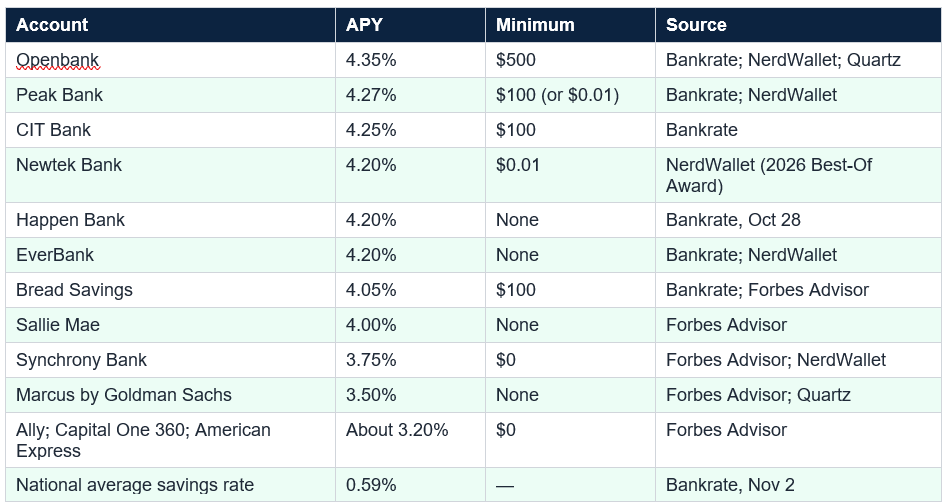
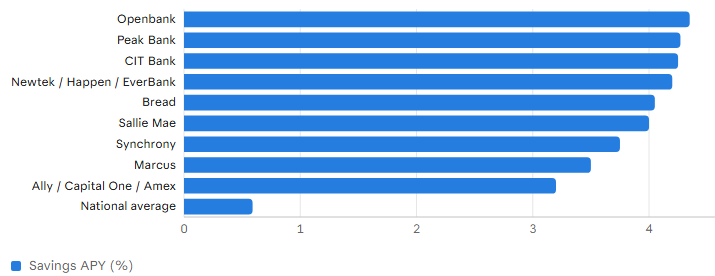
Top high-yield savings rates, late October to early November 2026: Openbank 4.35%, Peak Bank 4.27%, CIT 4.25%, Newtek, Happen and EverBank 4.20%. Big names pay less: Synchrony 3.75%, Marcus 3.50%, Ally, Capital One and Amex about 3.20%. National average 0.59% (Bankrate). Rates are variable.
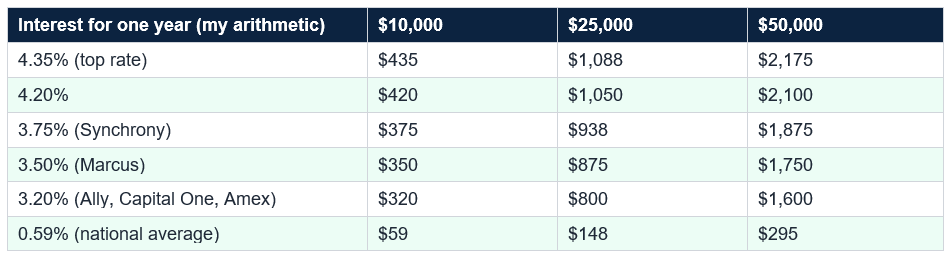
These are not life-changing sums, but they come from nothing more than choosing a better account, and because opening an online account and moving a balance typically costs nothing, the break-even is often immediate. A saver with $20,000 in a 3.20% account would earn about $230 more a year by switching to 4.35%, worth a half-hour of paperwork.
And flexibility in an uncertain moment: the Fed is on hold with a hike possible, and a savings account lets you benefit if rates rise and move your money if a better offer appears. That flexibility is what you pay for with a slightly lower rate than the best CDs, a trade-off usually worth it for money you might need within a year.
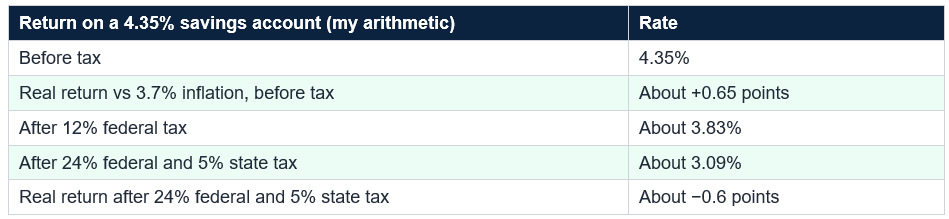
The third catch is inflation and tax. With inflation at 3.7%, a 4.35% account earns a real return of about 0.65 points before tax. Savings interest is generally taxed as ordinary income federally and by most states (general knowledge, not retrieved from the sources above): at an assumed 24% federal and 5% state rate, 4.35% nets about 3.09%, about 0.6 points below inflation, and at a 12% federal bracket about 3.83%, a hair above. A savings account protects your principal and roughly keeps pace with prices; it does not grow your purchasing power.
Promotional rates end. An account paying 4.25% for six months and 3.75% after averages about 4.00% over the first year, and a hypothetical one that drops to 3.00% after a 5.00% intro would average 4.00% too. Compare the rate you will earn over a year, not the headline.
The trade-off is flexibility versus yield. A savings account lets you leave anytime and benefit if rates rise; a CD locks your rate, which helps if rates fall, and charges a penalty for leaving early. Many savers split: an emergency fund and near-term money in savings, and money they will not need for a year or more in CDs or Treasury bills.
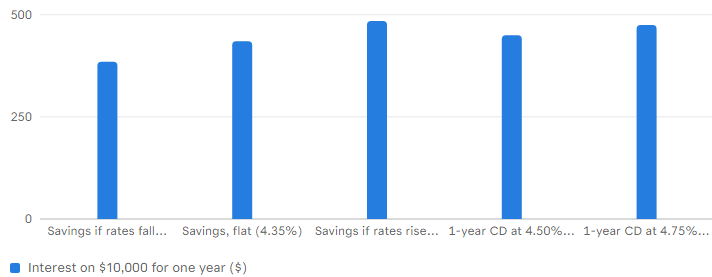
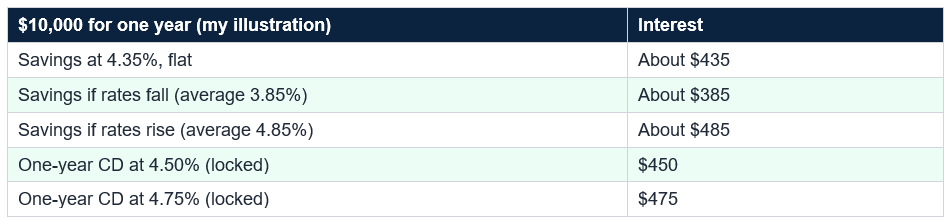
In my illustration, $10,000 in a savings account averaging 4.35% earns about $435 over a year, about $385 if rates average 3.85% and about $485 if they average 4.85%, while a one-year CD at 4.50% earns $450 whatever happens and one at 4.75% earns $475. A savings account beats the CD if rates rise enough and loses if they fall, so many savers hedge by splitting money between the two. The scenarios are assumptions, not forecasts.
It is less compelling if you already earn about 4% or more, if you will not need the money for several years and can lock a higher rate in a CD or Treasury, or if your goal is long-term growth. Do not move money into an account with an introductory rate you will not monitor. This is general information, not personal advice.
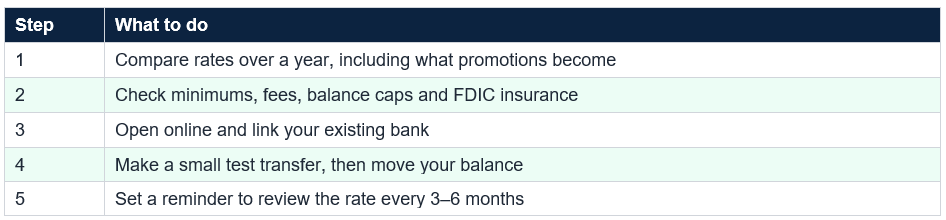
Then set a reminder to check the rate every three to six months, and consider moving if your bank falls more than half a point behind competitors. Keep your emergency fund separate from everyday checking, and if you hold more than $250,000, spread it across banks to stay within insurance limits. A savings account is not set-and-forget, but a quarterly glance is enough.
Check what your current savings account pays today. If it is under 3.5% and you hold more than a few thousand dollars, a switch could earn you hundreds of dollars a year.
But the rate is variable, promotions end and after tax a 4.35% account roughly matches 3.7% inflation. Use a high-yield account for an emergency fund and short-term money, with CDs or Treasuries for money you will not need for a year or more. Compare the rate you will actually earn, confirm the insurance, set a reminder to review it and remember that nobody knows what the Fed or your bank will do next.
For most people, yes. The Fed held its target rate at 3.75% to 4.00% on October 28, and top high-yield savings accounts were paying about 4.20% to 4.35% in early November against a national average of 0.59%. On $10,000, that is about $435 a year at the top versus about $59 at the average. The rate is variable, though, so it can change at any time.
Will savings rates go up or down after the Fed meeting?
Nobody knows. The Fed raised its target by a quarter point on September 16 and held on October 28, with markets pricing nearly 75% odds of at least one more hike by year-end. Savings rates are set by banks, move with a lag and do not track the Fed one for one. If the Fed hikes, rates may edge up; if it cuts, they would likely fall.
Why do some high-yield savings accounts pay much less than others?
Because banks set their own rates. In early November, Marcus paid 3.50%, Synchrony 3.75% and Ally, Capital One and American Express about 3.20% in Forbes Advisor’s list, while online banks such as Openbank, Peak Bank and Newtek paid 4.20% to 4.35%. A well-known brand does not guarantee a competitive rate, so compare before you open.
Are the 5.00% savings offers real?
Some are, with conditions. Axos advertises up to 5.00% APY for new customers for their first six months with a linked checking account and deposit requirements, and E*TRADE’s 4.25% rate lasts six months before dropping to 3.75%. These promotional rates can be worth taking, but check what the rate becomes afterward and any balance limits.
How safe is a high-yield savings account?
Accounts at FDIC-insured banks and NCUA-insured credit unions are insured up to $250,000 per depositor, per institution, per ownership category, and online banks are covered the same way as branch-based ones. Confirm the insurance status before you deposit. This is general education, not personal advice.
Table of Contents
- What the Fed Actually Did
- The Short Answer
- How the Fed Affects Your Savings Rate
- What High-Yield Savings Pays Right Now
- What That Means in Dollars
- The Case for Opening One
- The Catches
- Savings vs. CDs, T-Bills and I Bonds
- Three Scenarios: Hike, Hold, Cut
- Who Should Open One and Who Should Not
- How to Choose and Open One
- Common Mistakes
- Conclusion
- Frequently Asked Questions
High-yield savings rates vs. the national average, early November 2026 (APY %)
APY (%) by Bankrate (Oct 27-Nov 2), NerdWallet and Forbes Advisor (Nov 2026); rates are variable and the lists differ; fees and balance caps not verified
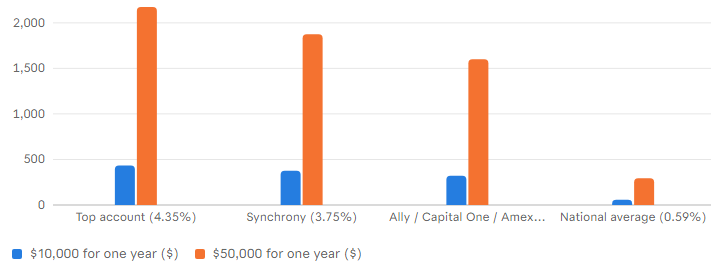
What the account you pick is worth: one year of interest ($)
Interest per year ($) by Author's arithmetic on the quoted APYs; choosing a top account over a 3.20% one adds about $115 per $10,000 and $575 per $50,000
Savings vs. a locked CD under three rate paths: $10,000 for a year ($)
Interest ($) by Author's illustration; savings paths are assumptions, not forecasts; CD rates per NerdWallet and Forbes Advisor, November 2026
What the Fed Actually Did
On September 16, the Federal Reserve raised its target rate by a quarter point, the first increase since 2023. On October 28, it held at 3.75% to 4.00%. Markets going into that meeting were pricing nearly 75% odds of at least one more hike by year-end, and inflation was 3.7% in September. So the Fed has not cut, and it has not finished raising either. It paused, and the question for savers is what that means.If you were thinking of opening a high-yield savings account, a pause might make you wonder whether rates are about to fall or whether you have missed the best of it. This guide answers that with the latest numbers: what top accounts pay, how the Fed affects the rate you earn, the catches to watch and how savings compare with a CD or Treasury bill. The short version: still worth it for most people, with caveats.
The Short Answer
Yes, for most people it is still worth opening a high-yield savings account. In early November, top accounts paid about 4.20% to 4.35%, led by Openbank at 4.35%, against a national average of 0.59%: on $10,000, about $435 a year versus $59. But the rate is variable, big-name accounts often pay less than the leaders, some headline rates are promotional and after tax the return roughly matches inflation. A high-yield account is best for an emergency fund and short-term money; for money you will not need for a year or more, a CD may pay more.How the Fed Affects Your Savings Rate
The link between the Fed and your savings account is real but loose. The Fed sets a target for the rate banks charge each other overnight, and banks then decide for themselves what to pay depositors, based on how much they need deposits, what competitors pay and what they can earn elsewhere. When the Fed raises rates, savings rates tend to rise, usually with a lag and not by the full amount; when it cuts, they tend to fall, sometimes quickly.The September hike shows this. One source reports leading one-year CD rates rising from about 4.35% in late September to 4.75% by mid-October, while Forbes Advisor described savings rates as steady on November 2. Bankrate’s national average savings rate was 0.59% on November 2, up from about 0.38% in an earlier reading from a different survey, so I would not read much into the exact change. What matters is that variable rates follow policy rates, and policy rates can go either way from here.
What High-Yield Savings Pays Right Now
Here is a snapshot from the major comparison sites in late October and early November. The leaders cluster at 4.20% to 4.35%, but several well-known names pay far less: Synchrony 3.75%, Marcus 3.50% and Ally, Capital One 360 and American Express about 3.20%, according to Forbes Advisor. The 0.59% national average is a reminder that most savers earn very little because they have not moved. The lists differ, so confirm on the bank’s own page.Top high-yield savings rates, late October to early November 2026: Openbank 4.35%, Peak Bank 4.27%, CIT 4.25%, Newtek, Happen and EverBank 4.20%. Big names pay less: Synchrony 3.75%, Marcus 3.50%, Ally, Capital One and Amex about 3.20%. National average 0.59% (Bankrate). Rates are variable.
What That Means in Dollars
In my arithmetic, $10,000 earns about $435 a year at 4.35%, $420 at 4.20%, $375 at 3.75%, $350 at 3.50% and $320 at 3.20%, against about $59 at the 0.59% average. Moving from an average account to a top one earns about $376 more a year on $10,000, and moving from 3.20% to 4.35% adds about $115 on $10,000, or $575 on $50,000. A $9,000 emergency fund, three months of $3,000 essentials, earns about $392 a year at 4.35% versus about $53 at the average.These are not life-changing sums, but they come from nothing more than choosing a better account, and because opening an online account and moving a balance typically costs nothing, the break-even is often immediate. A saver with $20,000 in a 3.20% account would earn about $230 more a year by switching to 4.35%, worth a half-hour of paperwork.
The Case for Opening One
There are four good reasons. The rate gap: top accounts pay more than seven times the national average, and above inflation before tax. Safety and access: accounts at FDIC-insured banks are protected up to $250,000 and your money is available without penalty, the natural home for an emergency fund, and Bankrate found only 47% of Americans could cover a $1,000 emergency and 46% three months of expenses. Simplicity: no lockup, no market risk and no minimum at many banks.And flexibility in an uncertain moment: the Fed is on hold with a hike possible, and a savings account lets you benefit if rates rise and move your money if a better offer appears. That flexibility is what you pay for with a slightly lower rate than the best CDs, a trade-off usually worth it for money you might need within a year.
The Catches
The first catch is that the rate is variable: the bank can lower it at any time, and if the Fed cuts, it probably will. The second is promotions. Axos advertises up to 5.00% APY for new customers for their first six months, with a linked checking account and deposit requirements; E*TRADE’s 4.25% lasts six months before dropping to 3.75%; SoFi’s up to 4.40% requires direct deposit, with a 3.30% standard rate; and Go2bank’s up to 4.50% applies to balances up to $5,000 with an active checking account. Read what the rate becomes afterward.The third catch is inflation and tax. With inflation at 3.7%, a 4.35% account earns a real return of about 0.65 points before tax. Savings interest is generally taxed as ordinary income federally and by most states (general knowledge, not retrieved from the sources above): at an assumed 24% federal and 5% state rate, 4.35% nets about 3.09%, about 0.6 points below inflation, and at a 12% federal bracket about 3.83%, a hair above. A savings account protects your principal and roughly keeps pace with prices; it does not grow your purchasing power.
Promotional rates end. An account paying 4.25% for six months and 3.75% after averages about 4.00% over the first year, and a hypothetical one that drops to 3.00% after a 5.00% intro would average 4.00% too. Compare the rate you will earn over a year, not the headline.
Savings vs. CDs, T-Bills and I Bonds
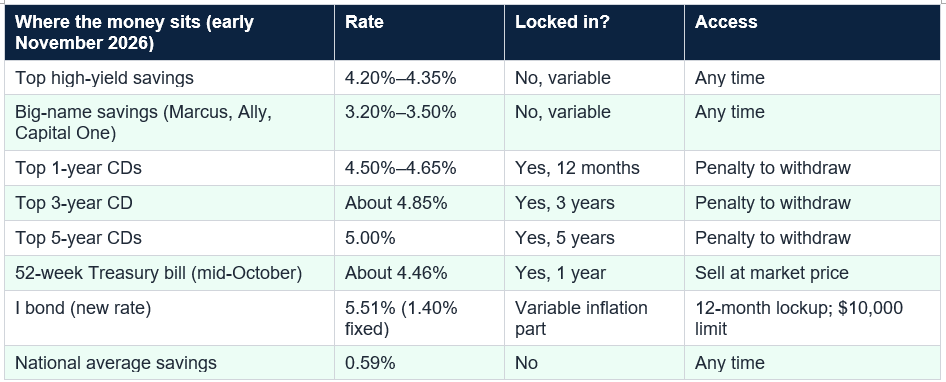
In early November, the best one-year CD paid about 4.65% at CFG Bank on NerdWallet’s list, with others at 4.50% to 4.55%, the best three-year CD 4.85% at Popular Direct and the best five-year CDs 5.00%. A 52-week Treasury bill yielded about 4.46% in mid-October, and the new I bond pays 5.51% with a 1.40% fixed rate, a $10,000 limit and a 12-month lockup. So a CD can pay about 0.15 to 0.65 points more than the top savings rate, in exchange for locking your money.The trade-off is flexibility versus yield. A savings account lets you leave anytime and benefit if rates rise; a CD locks your rate, which helps if rates fall, and charges a penalty for leaving early. Many savers split: an emergency fund and near-term money in savings, and money they will not need for a year or more in CDs or Treasury bills.
Three Scenarios: Hike, Hold, Cut
If the Fed hikes again, savings rates will probably rise, with a lag and by less than the full amount, and a flexible account would benefit while a CD locked at today’s rate would look slightly low. If the Fed holds, rates tend to stay roughly where they are. If it cuts, which the market is not pricing for now, savings rates would likely fall and a locked CD would look good.In my illustration, $10,000 in a savings account averaging 4.35% earns about $435 over a year, about $385 if rates average 3.85% and about $485 if they average 4.85%, while a one-year CD at 4.50% earns $450 whatever happens and one at 4.75% earns $475. A savings account beats the CD if rates rise enough and loses if they fall, so many savers hedge by splitting money between the two. The scenarios are assumptions, not forecasts.
Who Should Open One and Who Should Not
A high-yield savings account is a strong fit if you have no emergency fund or hold it in an account paying under 1%, if you are saving for a goal within a year or two such as a down payment or tuition, if you want your money available at any time or if you need a parking place for a lump sum while you decide what to do with it. It is also the flexible half of a savings split with CDs.It is less compelling if you already earn about 4% or more, if you will not need the money for several years and can lock a higher rate in a CD or Treasury, or if your goal is long-term growth. Do not move money into an account with an introductory rate you will not monitor. This is general information, not personal advice.
How to Choose and Open One
Start with the rate you will earn over a year, not the headline. Check the minimum balance, fees, balance caps and what the rate does after a promotion, confirm FDIC insurance and look at the app and transfer times. Compare at least three accounts on several sites, then confirm on the bank’s own page. Opening usually takes ten minutes online: link your current bank, make a small test transfer and then move the balance.Then set a reminder to check the rate every three to six months, and consider moving if your bank falls more than half a point behind competitors. Keep your emergency fund separate from everyday checking, and if you hold more than $250,000, spread it across banks to stay within insurance limits. A savings account is not set-and-forget, but a quarterly glance is enough.
Check what your current savings account pays today. If it is under 3.5% and you hold more than a few thousand dollars, a switch could earn you hundreds of dollars a year.
Common Mistakes
Common mistakes include leaving money in a branch-bank account that pays almost nothing, chasing a promotional rate without checking what it becomes, keeping an emergency fund in a CD with a penalty, forgetting to check the rate after opening and assuming a household-name bank pays a competitive rate: in early November, several paid 3.20% to 3.75% while the leaders paid 4.20% to 4.35%.Conclusion
Is it still worth opening a high-yield savings account after the Fed’s decision? For most people, yes. The Fed raised rates on September 16 and held at 3.75% to 4.00% on October 28, and top savings accounts paid about 4.20% to 4.35% in early November against a 0.59% national average: about $435 a year on $10,000 versus $59, and about $115 more than a 3.20% account from a big-name bank. The money is insured and available anytime.But the rate is variable, promotions end and after tax a 4.35% account roughly matches 3.7% inflation. Use a high-yield account for an emergency fund and short-term money, with CDs or Treasuries for money you will not need for a year or more. Compare the rate you will actually earn, confirm the insurance, set a reminder to review it and remember that nobody knows what the Fed or your bank will do next.
Frequently Asked Questions
Is it still worth opening a high-yield savings account after the Fed’s decision?For most people, yes. The Fed held its target rate at 3.75% to 4.00% on October 28, and top high-yield savings accounts were paying about 4.20% to 4.35% in early November against a national average of 0.59%. On $10,000, that is about $435 a year at the top versus about $59 at the average. The rate is variable, though, so it can change at any time.
Will savings rates go up or down after the Fed meeting?
Nobody knows. The Fed raised its target by a quarter point on September 16 and held on October 28, with markets pricing nearly 75% odds of at least one more hike by year-end. Savings rates are set by banks, move with a lag and do not track the Fed one for one. If the Fed hikes, rates may edge up; if it cuts, they would likely fall.
Why do some high-yield savings accounts pay much less than others?
Because banks set their own rates. In early November, Marcus paid 3.50%, Synchrony 3.75% and Ally, Capital One and American Express about 3.20% in Forbes Advisor’s list, while online banks such as Openbank, Peak Bank and Newtek paid 4.20% to 4.35%. A well-known brand does not guarantee a competitive rate, so compare before you open.
Are the 5.00% savings offers real?
Some are, with conditions. Axos advertises up to 5.00% APY for new customers for their first six months with a linked checking account and deposit requirements, and E*TRADE’s 4.25% rate lasts six months before dropping to 3.75%. These promotional rates can be worth taking, but check what the rate becomes afterward and any balance limits.
How safe is a high-yield savings account?
Accounts at FDIC-insured banks and NCUA-insured credit unions are insured up to $250,000 per depositor, per institution, per ownership category, and online banks are covered the same way as branch-based ones. Confirm the insurance status before you deposit. This is general education, not personal advice.
0 Comments
Be the first to share your thoughts on this article.