

Financial Literacy
Which Small Cutbacks Signal Real Money Trouble?

49% dipped into savings just to get by. 24% took on new debt. 54% saved nothing in June 2026. 61% say money is their primary life stressor. The small cuts that look ordinary can be the loudest financial warning signs. Not every spending cutback is a warning sign. Making your own coffee instead of buying one on the way to work might be the smartest $1,300-a-year decision you make. Cancelling a streaming service you barely watch is just tidy housekeeping. Switching from branded to own-brand groceries is rational economics, not financial distress. But somewhere on the spectrum of everyday cutbacks, the nature of the decision changes. It moves from ‘I am choosing to spend less here’ to ‘I cannot afford to spend more here.’ From deliberate to desperate. From budgeting to surviving. The Resume Now national survey of 1,011 employed workers, published January 7, 2026, found that 92% of Americans cut back spending in 2025 — not just on luxuries, but on essentials including groceries and healthcare. 49% dipped into savings to cover ordinary monthly costs. 24% took on new debt. The Intuit 2026 Financial Wellness survey found that 61% of Americans identify money as their primary life stressor. JD Power’s February 2026 consumer survey of 4,000 US adults found that some of the spending cuts being made ‘aren’t necessarily sustainable.’ This article examines the specific small cutbacks that function as financial warning signals — the ones that look mundane but indicate something serious is happening underneath. And it draws the line between those and the many cutbacks that are genuinely just good financial management.
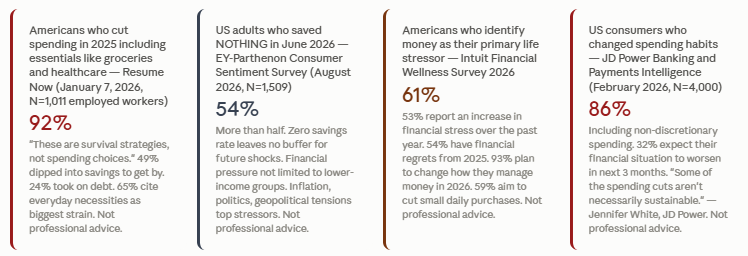
59% of consumers aim to cut back on small daily purchases (Intuit 2026). 86% have changed spending habits (JD Power February 2026, N=4,000). The key distinction: chosen vs compelled cutbacks. JD Power: 'Some of the spending cuts being made aren't necessarily sustainable.
When healthcare costs are being deferred not by choice but by necessity — when 'I'll deal with it later' is driven by the bank balance rather than a genuine assessment that it can wait — this is one of the clearest financial distress signals available. Source: Resume Now January 2026 (N=1,011) — 92% cut spending including essentials.
Cutting discretionary healthcare (cosmetic dentistry, non-urgent elective procedures) is different from deferring prescriptions, regular check-ups, or treatment for existing conditions. The latter category indicates spending pressure has moved past discretionary and into essential. If you are delaying essential healthcare for financial reasons: contact your GP or doctor's surgery about payment options, NHS referrals (UK), or community health centre alternatives (US). Financial difficulty is a health risk, not just a financial one. Speak to a debt counsellor or financial adviser.
Buying less food — not switching brands but reducing quantity — is a reliable indicator of acute financial pressure. It indicates that the grocery budget has already been cut as far as brand-switching allows, and is now being cut further. Source: JD Power February 2026 (N=4,000). This is distinct from intentional dietary reduction (intermittent fasting, calorie tracking). The signal is reduction driven by budget constraints, not choice — when the weekly shop ends earlier than usual not because the list was completed but because the budget ran out. If you are buying less food due to financial pressure: in the US, SNAP (Supplemental Nutrition Assistance Program) benefits are available for eligible households. UK: local food banks (Trussell Trust), council emergency support, and Universal Credit advances. Speak to a debt adviser.
Using savings to cover regular monthly expenses — not emergencies — is one of the clearest signs that income no longer covers costs. Each month of this pattern brings the household closer to the point where no buffer remains. Source: Resume Now January 2026 (N=1,011, 49% dipped into savings).
Distinct from a single exceptional month (Christmas, car repair, unexpected travel) where a one-off draw on savings is appropriate. The concerning pattern is when it becomes the regular mechanism for balancing the monthly budget. If savings are being used to cover regular bills: this requires a budget reset, not just a smaller cutback. Track exactly where the deficit is occurring. Consider free debt counselling (StepChange in the UK, NFCC in the US). Do not wait for savings to reach zero before seeking help.
Taking on new credit card debt, BNPL, or personal loans to cover regular monthly expenses — not large one-off purchases — is the highest-severity signal on this list. It indicates that income minus costs is consistently negative, and that the gap is being closed with expensive borrowing. Source: Resume Now January 2026 (N=1,011, 24% took on debt). Different from using a credit card for convenience and paying it off in full each month (cash-flow management). The signal is carrying a new or growing balance month-over-month, specifically to cover recurring costs. Debt taken on to cover living costs is the definition of a debt spiral risk. Free help: StepChange Debt Charity (UK), National Foundation for Credit Counselling (NFCC, US), Citizens Advice (UK). Act before the balance becomes unmanageable.
When you find yourself making the same small cuts repeatedly, feeling that your spending cannot go lower without affecting your quality of life fundamentally, and still ending each month without financial headroom — this is cut-back fatigue, and it requires a different intervention than more cutting. Source: NAB/The Nightly March 2026; Intuit 2026 (61% money = primary stressor). Different from the intentional, positive step of cutting daily coffee or streaming services as a deliberate budgeting improvement. Cut-back fatigue occurs when cuts have already been made to the point of feeling the psychological weight of sustained deprivation without relief. Cut-back fatigue indicates that the solution is not more cutting but income growth or debt restructuring. Consider: a skills-based side income, renegotiating existing debt terms, speaking to a debt adviser about debt management plans, or reviewing benefit entitlements (UK: Turn2Us benefit calculator; US: Benefits.gov).
32% of US consumers expect their financial situation to worsen in next 3 months (JD Power February 2026, N=4,000). 54% saved nothing in June 2026 (EY-Parthenon August 2026, N=1,509). 61% say money is their primary life stressor (Intuit 2026). 'These are survival strategies, not spending choices.' — Resume Now January 2026.
The key question is whether the cutback is chosen or compelled. If you are cutting a coffee shop habit because you want to redirect that money to savings, that is healthy budgeting. If you are skipping it because the bank account genuinely cannot cover it, that is a signal of financial pressure. The Resume Now January 2026 survey (N=1,011) drew the distinction precisely: '92% of Americans cut back spending including essentials. These are survival strategies, not spending choices.' The warning signals identified in this article — healthcare deferral, food quantity reduction, savings used for monthly bills, new debt for living costs, and cut-back fatigue — are the compelled ones. The Intuit 2026 survey found 59% cutting small daily purchases as a deliberate goal. That is chosen. The difference lies in whether the option to spend still exists.
Is saving nothing each month a financial warning sign?
It depends on the cause and duration. EY-Parthenon's August 2026 consumer sentiment survey (N=1,509) found that 54% of US adults saved nothing in June 2026. In isolation, a single month of zero savings is not necessarily alarming — a large one-off expense can clear the savings capacity for a month. The warning signal is when zero savings becomes the persistent monthly pattern, especially alongside other indicators: no emergency fund, a growing credit card balance, or dipping into existing savings to cover ordinary bills. The Resume Now January 2026 report found 49% dipped into savings in 2025 to get by. Combined with a zero monthly savings rate, this represents a drawdown trajectory. Not financial advice — speak to a financial adviser if this pattern is ongoing.
What is cut-back fatigue and why does it matter?
Cut-back fatigue is the term used by NAB and The Nightly (March 2026) for the experience of having cut spending to the point where willingness and ability to cut further has been exhausted. The NAB research found that the share of consumers planning to cut overall spending was at its lowest point since early 2023 — not because financial pressure had eased but because further cutting felt impossible after an extended period of restraint. It matters because it signals the end of the 'spend less' solution to financial pressure. When all discretionary spending has been removed and the pressure remains, the only remaining responses are increasing income, reducing debt costs through restructuring, or seeking external support. Cut-back fatigue is the signal that those other responses are now needed. Source: NAB/The Nightly March 2026.
What should I do if I recognise these warning signs in my own spending?
The most important step is to act before the situation deteriorates further. For UK readers: free, regulated debt advice is available from StepChange Debt Charity (stepchange.org), Citizens Advice (citizensadvice.org.uk), and National Debtline (nationaldebtline.org). For US readers: the National Foundation for Credit Counselling (nfcc.org) provides free or low-cost debt counselling. Benefits.gov helps identify benefit entitlements. If healthcare is being deferred, community health centres and NHS referrals are available options. The Intuit 2026 survey found 93% of Americans plan to change how they manage money in 2026. The question is whether the change is self-directed improvement or reactive crisis management. Acting on the warning signs early makes the first option possible.
Are these warning signs only relevant to low-income households?
No — and this is one of the most important findings in the 2025-2026 research. The EY-Parthenon Consumer Sentiment Survey from August 2026 specifically noted that 'financial pressure is not limited to lower-income groups.' The Intuit 2026 survey found 61% identifying money as their primary stressor — a finding that crosses income brackets. The Resume Now data showing 92% cut spending including essentials was from a survey of employed workers, not the unemployed or very low income. Cut-back fatigue and savings depletion are documented across the income distribution. The specific warning signals — healthcare deferral, savings used for bills, debt for living costs — can appear at any income level when spending commitments outpace income, regardless of what the absolute income level is.
Table of Contents
- Why Not Every Cutback Is a Warning — The Crucial Distinction
- Signal 1 Skipping or Delaying Healthcare — HIGH — this is a distress signal, not a budgeting choice
- Signal 2 Buying Less Food — Not Just Cheaper Food — HIGH — a marker of acute financial pressure
- Signal 3 Using Savings to Cover Monthly Bills — HIGH — emergency fund depletion is a direct distress marker
- Signal 4 Taking on New Debt to Cover Living Costs — HIGH — the most acute financial distress signal
- Signal 5 Cut-Back Fatigue: The Feeling That There Is Nothing Left to Cut — MODERATE-HIGH — signals the limit of resilience without structural change
- The Spectrum Table: Cutbacks That Are Fine vs Cutbacks That Signal Trouble
- The Bigger Picture: Why 2025-2026 Has Blurred the Lines
- Conclusion: The Question Behind the Cutback
- Frequently Asked Questions
Why Not Every Cutback Is a Warning — The Crucial Distinction
The Intuit 2026 Financial Wellness survey found that 59% of consumers aim to cut back on small daily purchases in 2026. If cutting back on small daily purchases were a universal signal of financial trouble, then the majority of the American adult population would be in distress simultaneously. They are not. The distinction that matters is whether a cutback is chosen or compelled. A chosen cutback is one where the person has the money to spend and decides not to — because they would rather save it, because they have identified it as unnecessary, because they are working toward a financial goal, or simply because they realised the spend was habitual rather than genuinely desired. A compelled cutback is one where the spend is no longer possible because the money is not there. The person skipping the coffee shop because they want to is exercising financial agency. The person skipping the coffee shop because the bank balance will not support it is experiencing financial pressure. Both look identical from the outside. They feel entirely different from the inside. JD Power’s Jennifer White identified the distinction precisely in their February 2026 report: ‘Consumers are finding ways to creatively patch together a tighter budget, but some of the spending cuts being made by a wide swath of consumers aren’t necessarily sustainable.’ The sustainable cuts are the chosen ones. The unsustainable ones — cutting healthcare, cutting food quantity, drawing on savings, taking on debt — are the compelled ones.59% of consumers aim to cut back on small daily purchases (Intuit 2026). 86% have changed spending habits (JD Power February 2026, N=4,000). The key distinction: chosen vs compelled cutbacks. JD Power: 'Some of the spending cuts being made aren't necessarily sustainable.
Signal 1 Skipping or Delaying Healthcare
Severity: HIGH — this is a distress signal, not a budgeting choice
There is a category of spending cutback that belongs in an entirely different conversation from skipping a latte or cancelling Netflix. The Resume Now national survey of 1,011 employed workers, published January 7, 2026, found that 92% of Americans cut back spending in 2025 — including essentials such as groceries and healthcare. The inclusion of healthcare in that list is the data point that distinguishes smart budgeting from financial distress. When someone skips a dental check-up because they want to save money and have the money to cover it, that is a discretionary choice. When someone skips a prescription refill, postpones a doctor’s visit, or delays a dental procedure because they literally cannot afford it this month, that is a financial emergency presenting as a healthcare decision. JD Power’s Banking and Payments Intelligence Report from February 2026 — drawing on responses from 4,000 consumers — observed that ‘some of the spending cuts being made by a wide swath of consumers aren’t necessarily sustainable.’ Senior director Jennifer White noted that consumers are ‘finding ways to creatively patch together a tighter budget’ but that ‘bubbling under the surface is a very real need for a capital infusion.’ Healthcare deferral is almost always that surface behaviour. The true cost of deferred medical care — in worsened health outcomes, emergency treatment replacing preventative care, and time off work from untreated conditions — is significantly higher than the cost being avoided in the moment.When healthcare costs are being deferred not by choice but by necessity — when 'I'll deal with it later' is driven by the bank balance rather than a genuine assessment that it can wait — this is one of the clearest financial distress signals available. Source: Resume Now January 2026 (N=1,011) — 92% cut spending including essentials.
Cutting discretionary healthcare (cosmetic dentistry, non-urgent elective procedures) is different from deferring prescriptions, regular check-ups, or treatment for existing conditions. The latter category indicates spending pressure has moved past discretionary and into essential. If you are delaying essential healthcare for financial reasons: contact your GP or doctor's surgery about payment options, NHS referrals (UK), or community health centre alternatives (US). Financial difficulty is a health risk, not just a financial one. Speak to a debt counsellor or financial adviser.
Signal 2 Buying Less Food — Not Just Cheaper Food
Severity: HIGH — a marker of acute financial pressure
Brand switching in the grocery aisle — choosing own-brand pasta instead of the named brand, own-brand cereal instead of the premium version — is one of the most widespread and largely healthy financial adaptations. JD Power’s February 2026 report noted that the vast majority of consumers have changed spending habits to ‘purchasing less expensive grocery items.’ That is a rational response to food inflation and it shows up in almost every consumer survey. The signal that belongs in a different category is the one JD Power identified immediately alongside it: ‘some purchasing less food for their households.’ Those four words are the key distinction. Switching from branded to own-brand maintains the household’s caloric intake and nutritional sufficiency. Buying less food does not. The Resume Now report called these ‘survival strategies, not spending choices.’ The EY-Parthenon Consumer Sentiment Survey from August 2026 (1,509 US consumers, June 2026 data) found that 54% of US adults saved nothing in June 2026. A household that is simultaneously buying less food and saving nothing is not budgeting. It is in financial distress. The Intuit 2026 Financial Wellness survey found that 65% of Americans’ financial stress is tied to the cost of everyday necessities. Food is the most everyday of necessities. When the volume of food in the home is declining because the budget cannot support it, the signal is clear.Buying less food — not switching brands but reducing quantity — is a reliable indicator of acute financial pressure. It indicates that the grocery budget has already been cut as far as brand-switching allows, and is now being cut further. Source: JD Power February 2026 (N=4,000). This is distinct from intentional dietary reduction (intermittent fasting, calorie tracking). The signal is reduction driven by budget constraints, not choice — when the weekly shop ends earlier than usual not because the list was completed but because the budget ran out. If you are buying less food due to financial pressure: in the US, SNAP (Supplemental Nutrition Assistance Program) benefits are available for eligible households. UK: local food banks (Trussell Trust), council emergency support, and Universal Credit advances. Speak to a debt adviser.
Signal 3 Using Savings to Cover Monthly Bills
Severity: HIGH — emergency fund depletion is a direct distress marker
An emergency fund exists to cover unexpected, one-off financial shocks: a car repair, a boiler failure, a period of illness. When it is being used to cover recurring monthly costs — rent, utilities, groceries, insurance — something structurally wrong is happening. The Resume Now national survey from January 2026 found that 49% of Americans dipped into savings just to get by in 2025. Almost half of employed workers used savings not to handle an emergency but to fund ordinary monthly life. The EY-Parthenon August 2026 survey found that 54% of US adults saved nothing in June 2026. Taken together: nearly half of households were drawing down savings, and more than half were adding nothing back. That is a mathematical trajectory toward zero. JD Power’s February 2026 report described this as ‘households draining their safety nets.’ The distinction between this signal and normal financial ebbs and flows is the repetition. Drawing on savings once, in an exceptional month, is resilience. Drawing on savings every month is a structural income-versus-cost deficit that the emergency fund is temporarily concealing. The Intuit 2026 Financial Wellness survey found that 54% of Americans had financial regrets from 2025 and 93% plan to change how they manage money in 2026. The regrets are often not about what they spent but about watching the safety net shrink and not acting sooner.Using savings to cover regular monthly expenses — not emergencies — is one of the clearest signs that income no longer covers costs. Each month of this pattern brings the household closer to the point where no buffer remains. Source: Resume Now January 2026 (N=1,011, 49% dipped into savings).
Distinct from a single exceptional month (Christmas, car repair, unexpected travel) where a one-off draw on savings is appropriate. The concerning pattern is when it becomes the regular mechanism for balancing the monthly budget. If savings are being used to cover regular bills: this requires a budget reset, not just a smaller cutback. Track exactly where the deficit is occurring. Consider free debt counselling (StepChange in the UK, NFCC in the US). Do not wait for savings to reach zero before seeking help.
Signal 4 Taking on New Debt to Cover Living Costs
Severity: HIGH — the most acute financial distress signal
The Resume Now survey’s most stark finding was not that people were cutting spending. It was that 24% of employed workers took on new debt in 2025 simply to manage living costs. Not to invest. Not to make a large purchase. Not to cover an emergency. To pay for ordinary monthly life. This is the moment when a spending problem becomes a debt problem, and debt problems compound in ways that spending problems do not. At 23%+ average credit card APR, a household that repeatedly turns to credit to cover a monthly shortfall is paying compound interest on their cost-of-living gap. Each month, the next month becomes slightly harder. The JD Power February 2026 report observed that consumers are ‘creatively patching together a tighter budget’ — but that the creativity being applied includes debt in ways that may not be visible to the person using it as a coping mechanism. Experian Australia’s July 2026 survey found that Buy Now Pay Later spending had risen 16% in 2025, identifying it as a sign of consumers using short-term borrowing in day-to-day budget management. BNPL in the grocery aisle or for utility bills is not a financial tool. It is a distress signal wearing the clothes of a payment option. The Intuit 2026 survey found that 45% admit impulse spending has derailed their financial progress. But the deeper issue is not impulse spending. It is structural borrowing to cover the gap between income and essential costs.Taking on new credit card debt, BNPL, or personal loans to cover regular monthly expenses — not large one-off purchases — is the highest-severity signal on this list. It indicates that income minus costs is consistently negative, and that the gap is being closed with expensive borrowing. Source: Resume Now January 2026 (N=1,011, 24% took on debt). Different from using a credit card for convenience and paying it off in full each month (cash-flow management). The signal is carrying a new or growing balance month-over-month, specifically to cover recurring costs. Debt taken on to cover living costs is the definition of a debt spiral risk. Free help: StepChange Debt Charity (UK), National Foundation for Credit Counselling (NFCC, US), Citizens Advice (UK). Act before the balance becomes unmanageable.
Signal 5 Cut-Back Fatigue: The Feeling That There Is Nothing Left to Cut
Severity: MODERATE-HIGH — signals the limit of resilience without structural change
In March 2026, NAB and The Nightly identified a phenomenon they named ‘cut-back fatigue’ in their consumer research: the share of consumers planning to cut overall spending had reached its lowest point since early 2023, not because financial pressure had eased but because ‘the willingness to tighten belts further was wearing thin after an extended period of financial restraint.’ This matters because the logical response to financial pressure — spend less — has a practical limit. A household that has already cut dining out, cancelled subscriptions, switched to own-brand groceries, reduced clothing spending, postponed holidays, and reduced the heating thermostat reaches a point where there is genuinely nothing left to cut without removing something essential. The Nightly reported: ‘For policymakers, recognising cut-back fatigue is important as it indicates a segment of the population may be reaching the limits of their financial resilience, raising concerns for overall wellbeing and economic participation.’ The Intuit 2026 survey found that 61% of Americans identify money as their primary life stressor, and 53% reported an increase in financial stress over the past year. When the primary response to financial stress — cutting spending — is no longer available because everything cuttable has already been cut, the only remaining responses are increasing income, reducing debt costs, or seeking external support. Cut-back fatigue is the signal that the first option has been exhausted.When you find yourself making the same small cuts repeatedly, feeling that your spending cannot go lower without affecting your quality of life fundamentally, and still ending each month without financial headroom — this is cut-back fatigue, and it requires a different intervention than more cutting. Source: NAB/The Nightly March 2026; Intuit 2026 (61% money = primary stressor). Different from the intentional, positive step of cutting daily coffee or streaming services as a deliberate budgeting improvement. Cut-back fatigue occurs when cuts have already been made to the point of feeling the psychological weight of sustained deprivation without relief. Cut-back fatigue indicates that the solution is not more cutting but income growth or debt restructuring. Consider: a skills-based side income, renegotiating existing debt terms, speaking to a debt adviser about debt management plans, or reviewing benefit entitlements (UK: Turn2Us benefit calculator; US: Benefits.gov).
The Spectrum Table: Cutbacks That Are Fine vs Cutbacks That Signal Trouble
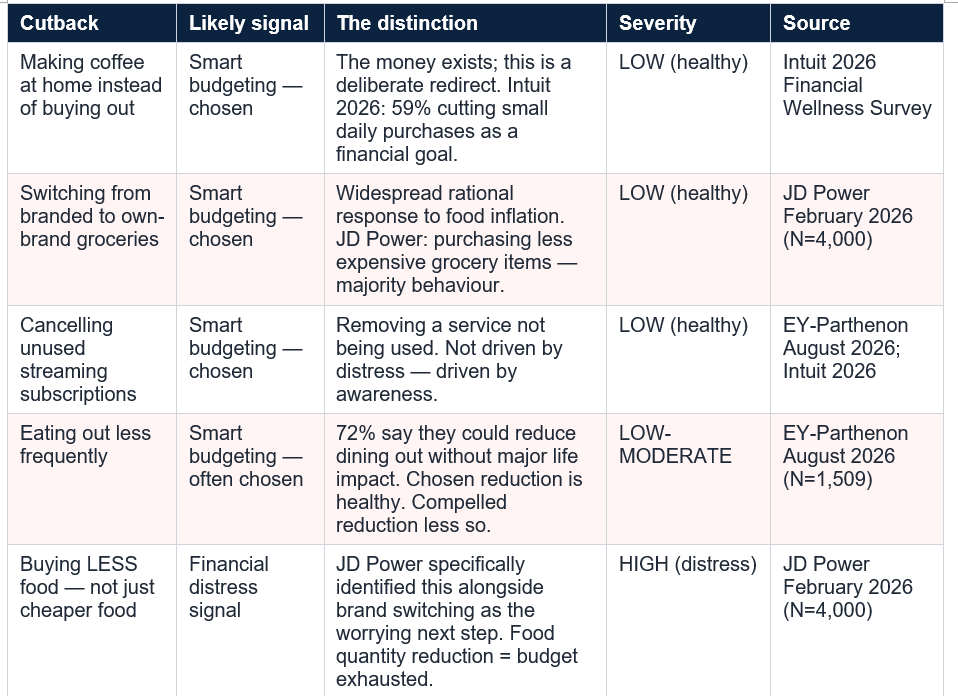
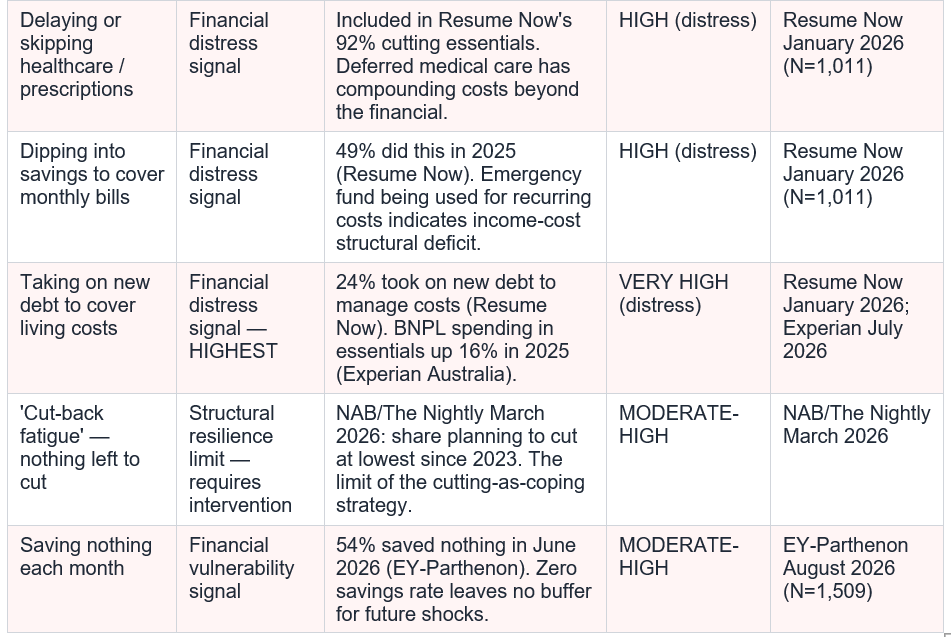
This table distinguishes common spending cutbacks on a spectrum from healthy financial management to financial distress signals, based on the research cited throughout this article. Not financial advice.
The Bigger Picture: Why 2025-2026 Has Blurred the Lines
One of the most significant findings across the 2025-2026 consumer research is how far the pressure has moved from discretionary to essential spending. Resume Now’s January 2026 data described it directly: ‘These are survival strategies, not spending choices.’ Ninety-two percent of Americans cutting spending including essentials, 49% draining savings, 24% taking on debt — these are not the numbers of a consumer population comfortably managing lifestyle preferences. They are the numbers of a population under structural financial stress. The JD Power finding that 32% of consumers expect their financial situation to worsen in the next three months, combined with the EY-Parthenon observation that 54% saved nothing in June 2026, paints a picture of widespread vulnerability without buffer. The Intuit survey’s finding that 61% identify money as their primary life stressor is not a statistical anomaly. It is the aggregate psychological cost of the spending picture the other surveys describe. What makes 2025-2026 distinctive is the convergence of several pressures simultaneously: sustained above-target inflation, high interest rates through 2024-2025, rising rents, food price inflation, and the pass-through of tariff costs to consumer goods. The result is that cutbacks which would previously have been clearly discretionary — eating out, entertainment, clothing — have already been made by most households. The next layer of cuts, for those still under pressure, is the essential layer. That is the layer where the warning signals live.32% of US consumers expect their financial situation to worsen in next 3 months (JD Power February 2026, N=4,000). 54% saved nothing in June 2026 (EY-Parthenon August 2026, N=1,509). 61% say money is their primary life stressor (Intuit 2026). 'These are survival strategies, not spending choices.' — Resume Now January 2026.
Conclusion
Every small cutback has a question behind it: ‘Am I choosing not to spend this, or can I not afford to spend this?’ The answer to that question is the difference between a healthy financial habit and a financial warning sign. The Intuit 2026 survey’s finding that 93% of Americans plan to change how they manage money in 2026 suggests enormous collective motivation for financial improvement. The 59% aiming to cut back on small daily purchases, the 54% with regrets from 2025 — these are people exercising financial agency, not experiencing financial collapse. But those numbers coexist with the Resume Now finding that 92% cut essentials, 49% drained savings, and 24% took on debt. The two sets of data describe the same country but different financial realities. The five signals in this article — deferred healthcare, reduced food quantity, savings used for regular bills, new debt for living costs, and cut-back fatigue — are the markers that place someone in the second group rather than the first. Recognising them in your own behaviour is not a reason for shame. It is information. Information that the current approach has reached its sustainable limit, and that the next step is not a smaller latte but a conversation with a debt counsellor, a benefit check, or a frank look at whether income needs to change. If you are concerned about your financial situation, please speak to a qualified financial adviser or a free debt advice service.Frequently Asked Questions
How do I know if my spending cutbacks are healthy or a warning sign?The key question is whether the cutback is chosen or compelled. If you are cutting a coffee shop habit because you want to redirect that money to savings, that is healthy budgeting. If you are skipping it because the bank account genuinely cannot cover it, that is a signal of financial pressure. The Resume Now January 2026 survey (N=1,011) drew the distinction precisely: '92% of Americans cut back spending including essentials. These are survival strategies, not spending choices.' The warning signals identified in this article — healthcare deferral, food quantity reduction, savings used for monthly bills, new debt for living costs, and cut-back fatigue — are the compelled ones. The Intuit 2026 survey found 59% cutting small daily purchases as a deliberate goal. That is chosen. The difference lies in whether the option to spend still exists.
Is saving nothing each month a financial warning sign?
It depends on the cause and duration. EY-Parthenon's August 2026 consumer sentiment survey (N=1,509) found that 54% of US adults saved nothing in June 2026. In isolation, a single month of zero savings is not necessarily alarming — a large one-off expense can clear the savings capacity for a month. The warning signal is when zero savings becomes the persistent monthly pattern, especially alongside other indicators: no emergency fund, a growing credit card balance, or dipping into existing savings to cover ordinary bills. The Resume Now January 2026 report found 49% dipped into savings in 2025 to get by. Combined with a zero monthly savings rate, this represents a drawdown trajectory. Not financial advice — speak to a financial adviser if this pattern is ongoing.
What is cut-back fatigue and why does it matter?
Cut-back fatigue is the term used by NAB and The Nightly (March 2026) for the experience of having cut spending to the point where willingness and ability to cut further has been exhausted. The NAB research found that the share of consumers planning to cut overall spending was at its lowest point since early 2023 — not because financial pressure had eased but because further cutting felt impossible after an extended period of restraint. It matters because it signals the end of the 'spend less' solution to financial pressure. When all discretionary spending has been removed and the pressure remains, the only remaining responses are increasing income, reducing debt costs through restructuring, or seeking external support. Cut-back fatigue is the signal that those other responses are now needed. Source: NAB/The Nightly March 2026.
What should I do if I recognise these warning signs in my own spending?
The most important step is to act before the situation deteriorates further. For UK readers: free, regulated debt advice is available from StepChange Debt Charity (stepchange.org), Citizens Advice (citizensadvice.org.uk), and National Debtline (nationaldebtline.org). For US readers: the National Foundation for Credit Counselling (nfcc.org) provides free or low-cost debt counselling. Benefits.gov helps identify benefit entitlements. If healthcare is being deferred, community health centres and NHS referrals are available options. The Intuit 2026 survey found 93% of Americans plan to change how they manage money in 2026. The question is whether the change is self-directed improvement or reactive crisis management. Acting on the warning signs early makes the first option possible.
Are these warning signs only relevant to low-income households?
No — and this is one of the most important findings in the 2025-2026 research. The EY-Parthenon Consumer Sentiment Survey from August 2026 specifically noted that 'financial pressure is not limited to lower-income groups.' The Intuit 2026 survey found 61% identifying money as their primary stressor — a finding that crosses income brackets. The Resume Now data showing 92% cut spending including essentials was from a survey of employed workers, not the unemployed or very low income. Cut-back fatigue and savings depletion are documented across the income distribution. The specific warning signals — healthcare deferral, savings used for bills, debt for living costs — can appear at any income level when spending commitments outpace income, regardless of what the absolute income level is.
0 Comments
Be the first to share your thoughts on this article.