

Planning
Why Financial Planners Never Panic in Market Swings
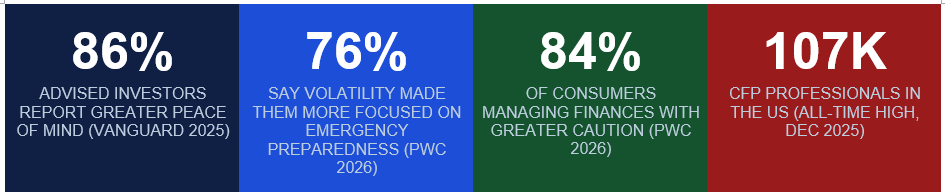
Table of Contents
- Calm Is a Strategy, Not an Attitude
- The Numbers Don’t Lie: What Panic Selling Actually Costs
- The Mindset Difference: How Planners Think vs. How Investors Feel
- What Financial Planners Actually Do During Market Drops
- The Statistics Every Investor Needs to Know
- The 2026 Volatility Context: What Has Happened This Year
- Practical Steps to Build Planner-Level Calm
- Conclusion
- Frequently Asked Questions (FAQ)
- External References & Links
Calm Is a Strategy, Not an Attitude
The S&P 500 fell nearly 10% in the first quarter of 2026. The VIX — the market’s so-called “fear gauge” — spiked above 35. Oil crossed $85 a barrel after the Middle East conflict escalated. Social media was awash in predictions of recession, crash, and financial ruin. And millions of ordinary investors stared at their portfolios, cursor hovering over the “sell” button, wondering if this was finally the moment to get out.Meanwhile, their financial planners were largely… calm. Not dismissive. Not oblivious. Calm. They were picking up the phone, calling their most anxious clients, asking a single, deceptively simple question: “When do you actually need this money?”
That question is not a deflection. It is the entire framework. It is the reason experienced financial professionals do not panic during market swings — and why, if you understand what they understand, you shouldn’t either.
This article is not about telling you to “just stay the course” and hoping that platitude is enough. It is about showing you, with specific data, exactly what panic selling costs, how financial planners are trained to think during volatility, and the concrete steps you can take right now to build the same evidence-based calm into your own investing decisions.
The Numbers Don’t Lie: What Panic Selling Actually Costs
The cost of emotional selling during market downturns is one of the most thoroughly documented phenomena in financial research. The evidence is not directional. It is overwhelming.The Best Days and Worst Days Travel Together
Here is the central, counterintuitive fact that every financial planner internalises early in their career: the market’s best days and worst days arrive together. Seven of the ten best days in the S&P 500 over the last 20 years occurred either during a bear market or within the first two months of a bull market’s start. The investors who sold during the panic were sitting in cash during the recovery.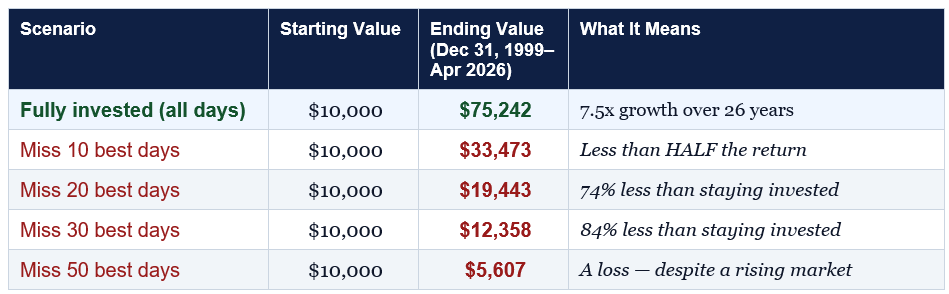
The numbers above represent a 26-year period that included the dot-com bust, September 11, the 2008 financial crisis, a global pandemic, and a sharp 2022 inflation shock. Through all of it, a patient investor who simply stayed invested multiplied $10,000 to $75,242. The investor who missed 50 of the market’s best days during that same period ended with less money than they started with.
“Seven of the ten best days happened when the market was in bear market territory. If you sell during a downturn, you are likely sitting on the sidelines when the biggest bounce-back days arrive.”
— J.P. Morgan Asset Management / Hartford Funds, 2026
DALBAR: The Annual Proof of the Behaviour Gap
DALBAR’s 2026 Quantitative Analysis of Investor Behavior report measured the real damage from badly timed trades. In 2024, the average equity investor earned 16.54% while the S&P 500 returned 25.02% — a gap of 848 basis points, the second-largest of the past decade. Over the 20-year period ending December 2024, the average equity fund investor earned about 9.24% annually while the S&P 500 returned 10.35%. Compounded over two decades, that 1.1-percentage-point annual gap represents tens or hundreds of thousands of dollars in lost wealth.The Mindset Difference: How Planners Think vs. How Investors Feel
Understanding why financial planners stay calm during market drops requires understanding how differently they frame the experience of volatility. The comparison below is not about intelligence. It is about training, process, and the systematic removal of emotion from financial decision-making.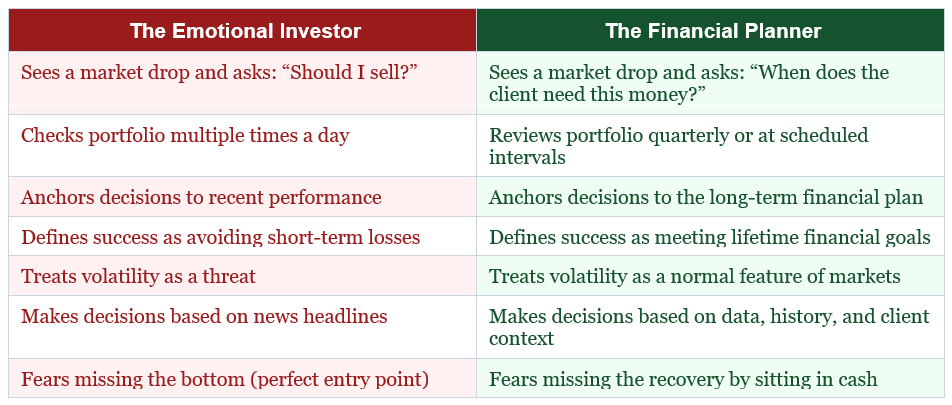
The single most important line in that table is the first one. When a market drops 10%, an emotional investor immediately asks “should I sell?” A financial planner asks: “when does the client actually need this money?” If the answer is “not for 15 years,” then what the market does today is, in the planner’s framework, almost entirely irrelevant.
THE PLANNER’S FIRST QUESTION
"Anytime volatility enters, I tell other advisors on our team, this is ‘go time’ – this is what’s going to separate you from every other advisor. My first question when someone fears a looming recession is disarmingly basic: When do you actually need this money?" — Top-rated CFP, Investment News 2026
What Financial Planners Actually Do During Market Drops
Staying calm does not mean staying passive. When markets fall sharply, experienced financial planners execute a specific set of deliberate, evidence-based actions. Here is what “calm” actually looks like in practice:- They call clients proactively — before clients call them. Outbound contact during volatile periods reduces client anxiety and prevents reactive selling decisions made in isolation.
- They reframe the timeframe. The first question is always about when the money is actually needed. Short-term money (needed within 3 years) should never have been in equities in the first place. Long-term money (15+ years) can absorb a 10% or even 30% drawdown and still reach its target.
- They look for tax-loss harvesting opportunities. A portfolio decline is not only a paper loss — it is a potential tax asset. Realising losses on positions that have fallen, while maintaining market exposure through similar (but not identical) funds, reduces the tax bill without reducing the long-term investment.
- They rebalance. When equities fall and bonds hold relatively steady, the portfolio’s asset allocation drifts. Rebalancing — selling bonds and buying equities when stocks are cheaper — is the disciplined opposite of panic selling. It systematically buys low.
- They review the plan, not the portfolio. The question is never “what did my portfolio do today?” It is “is my client still on track to meet their goals given their income, spending, timeline, and current allocations?” A 10% market drop rarely changes that answer.
The Statistics Every Investor Needs to Know
Before we look at practical steps, here is the complete statistical picture that underlies every financial planner’s calm. These are the numbers that matter.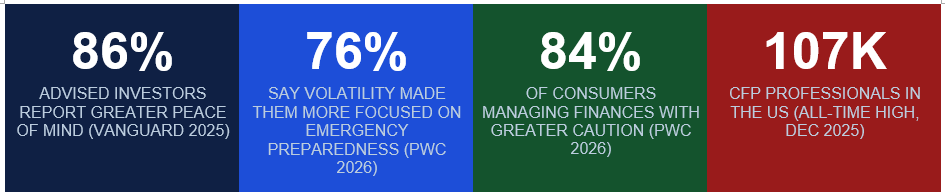
- Missing 10 best S&P 500 days over 20 years cut annualised returns from 10.60% to 6.37% (J.P. Morgan Asset Management).
- 25% of retail investors panic-sold during a geopolitical event, only to watch prices recover within weeks of their exit (MarketWise survey).
- 71% of consumers say market volatility has changed how they think about retirement (PwC 2026 Market Volatility Survey).
- $10,000 invested in the S&P 500 on December 31, 1999 grew to $75,242 by April 2026 — despite three major crashes. Missing the 10 best days cut that to $33,473 (Hightower Signature, May 2026).
- In 2024, the average equity investor underperformed the S&P 500 by 848 basis points. Over 20 years, investors earned 9.24% vs the market’s 10.35% — a massive wealth gap when compounded (DALBAR 2026).
- The number of CFP® professionals reached an all-time high of 107,529 in December 2025 — a 4.3% increase year-over-year, reflecting surging demand for professional financial guidance (CFP Board).
The 2026 Volatility Context: What Has Happened This Year
It would be easy to read the statistics above and treat them as abstract or historical. The 2026 market environment makes them immediate and personally relevant.The S&P 500 opened 2026 on unsteady footing, falling roughly 4% through the first quarter after an 18% total return in 2025. The Iran conflict sent oil above $85 per barrel and briefly triggered fears of a 1970s-style energy shock. The VIX spent much of early 2026 in the high teens to low 20s, and briefly hit 35 — a level associated with significant fear.
For investors who understand financial history, this context is important but not alarming. The S&P 500 has returned roughly 8% year-to-date through late July 2026 despite those headwinds — a pattern consistent with the long-term historical record of markets climbing through headlines that feel catastrophic in the moment.
PWC 2026 MARKET VOLATILITY SURVEY
84% of consumers say they are managing their finances with greater caution due to recent market volatility. 76% are more focused on liquidity and emergency preparedness. 71% say volatility has changed how they think about retirement — rising to 88% among Gen Z and 81% among millennials. The survey of 1,004 consumers confirms that market anxiety is widespread and real — which makes the evidence for staying invested all the more valuable.
Practical Steps to Build Planner-Level Calm
- You do not need a CFP designation to adopt the mindset of a financial planner during volatile markets. You need a process. Here are six concrete steps backed by the evidence in this article.
- Write down when you actually need the money. For each investment account, write the year you will need to draw on it. If it is more than 10 years away, a 10–20% market drop is statistically a buying opportunity, not an emergency.
- Put away the portfolio app. Frequent checking is psychologically corrosive and statistically useless for long-term decision-making. Schedule quarterly reviews. In between, let the plan run.
- Automate contributions. Dollar-cost averaging — investing a fixed amount on a schedule regardless of market conditions — mechanically buys more shares when prices are lower. It turns volatility from an enemy into an asset.
- Hold a cash buffer. Keeping 3–6 months of expenses in liquid savings eliminates the need to sell investments during downturns to cover living costs. Emergency cash is the shock absorber that makes staying invested possible.
- Write an Investment Policy Statement. One page. Describe your goals, timeline, asset allocation, and the rule: “I will not sell in response to market news.” Revisit it instead of your portfolio when markets fall.
- Talk to a fee-only financial planner. Vanguard research shows that 86% of advised investors report greater peace of mind compared with managing finances alone. The value of advice during volatile periods is not just financial — it is psychological.
CONCLUSION
Calm Is the Strategy. Data Is the Reason.
Financial planners do not stay calm during market swings because they are emotionally detached or because they know something about the future that you do not. They stay calm because they have studied the past. And the past tells a very consistent story: the investors who stay invested accumulate dramatically more wealth than those who try to exit and re-enter at the right moments.
Missing just 10 of the market’s best days over 26 years cuts your ending value by more than half. Seven of those best days happened during bear markets. In 2024, the average investor underperformed the S&P 500 by 848 basis points — not because they picked bad stocks, but because they moved in and out at the wrong times.
The 2026 market environment — with geopolitical uncertainty, a VIX that has hit 35, and persistent inflation anxiety — is exactly the kind of environment where emotional investors make expensive mistakes. It is also exactly the kind of environment where disciplined, plan-driven investors buy at lower prices and position themselves for the recoveries that, historically, have always followed.
You do not need to be a financial planner to act like one. You need a written plan, a time horizon, a cash buffer, and the discipline to ask “when do I actually need this money?” when fear arrives. Do that, and the market’s swings become background noise rather than crises.

0 Comments Comments