

Business
Why UK Retail Traders Lose £1 Billion a Year


Table of Contents
- A £1 Billion Annual Problem
- The Core Statistics: What the FCA Data Shows
- Chart 1 — UK CFD Loss Rates by Broker (2026)
- Chart 2 — Active UK Trader Population 2019–2025
- Chart 3 — Trader Attrition: The Survival Curve
- The Six Reasons UK Traders Lose Money
- Chart 4 — Loss Driver Breakdown
- The Role of Finfluencers & Social Media
- What FCA Regulation Has — and Has Not — Fixed
- How to Trade Without Becoming a Statistic
- Conclusion
- Frequently Asked Questions (FAQ)
- External References & Links
A £1 Billion Annual Problem
Every UK-regulated CFD and spread betting broker is legally required by the Financial Conduct Authority (FCA) to display a prominent risk warning on all promotional material and their website. The warning is standardised in form but varies in its precise figure: it states, in words to this effect, that between 70% and 79% of retail clients lose money when trading CFDs or spread bets with that broker.These are not worst-case estimates. They are rolling 12-month figures derived from actual client account performance, updated at least quarterly. They are required to be accurate. And for years, they have barely moved.
The Investors Centre — using FCA-mandated broker loss-rate disclosures and Investment Trends active-client data — estimates that UK retail CFD and spread bet traders lose approximately £1.0 billion per year in aggregate. Approximately 167,000 adults held an active leveraged trading account in the UK as of May 2025. The mathematics of a 70–79% loss rate applied to that population, at typical average account sizes and loss magnitudes reported in broker financials, produces a figure in the range of £1 billion annually.
This article examines the data behind that estimate, the six primary reasons UK retail traders lose money, and — critically — what traders can actually do to avoid becoming part of the statistic.

The Core Statistics: What the FCA Data Shows
The headline £1 billion estimate is built from multiple overlapping data sources, each individually verifiable from primary regulatory and broker sources.- The Investors Centre TIC CFD Loss Rate Index (April 2026) averaged 69.9% loss rate across 14 FCA-regulated brokers, ranging from 62% at the lowest to 76% at the highest.
- Plus500 reported 2025 revenue of $792 million with a 43% operating margin — revenues driven almost entirely by retail client losses on CFD products.
- CMC Markets produced £340.1 million net operating income in its year to March 2025, with revenue per active client of £4,685 — an extraordinary figure that reflects the direct relationship between platform profitability and customer losses.
- The FCA confirmed in October 2025 that more than 90,000 UK consumers lost approximately £75 million over four years at a single CFD firm promoted by social media influencers — an implied average loss of £833 per affected client at that one firm alone.
- A landmark study of 8 million retail traders making 295 million trades across 27 years (1998–2025) found a persistent failure rate of 74–89% across all platforms, education levels, and regulatory environments.
FCA DATA FOOTNOTE
The FCA does not publish a single aggregate UK retail CFD loss figure. The £1 billion estimate is a proprietary calculation by The Investors Centre, built from publicly-disclosed FCA risk warnings across regulated brokers and Investment Trends active-client survey data. It should be treated as a directional estimate, not a precise regulatory figure. Source: The Investors Centre UK Day Trading Statistics 2026 (theinvestorscentre.co.uk/trading/statistics/day-trading/).
Chart 1 — UK CFD Loss Rates by Broker (2026)
Every UK-regulated CFD broker publishes a mandatory FCA risk disclosure. The following chart compares loss rates across the major UK-regulated providers, based on The Investors Centre’s scrape of FCA-mandated disclosures (April 27, 2026).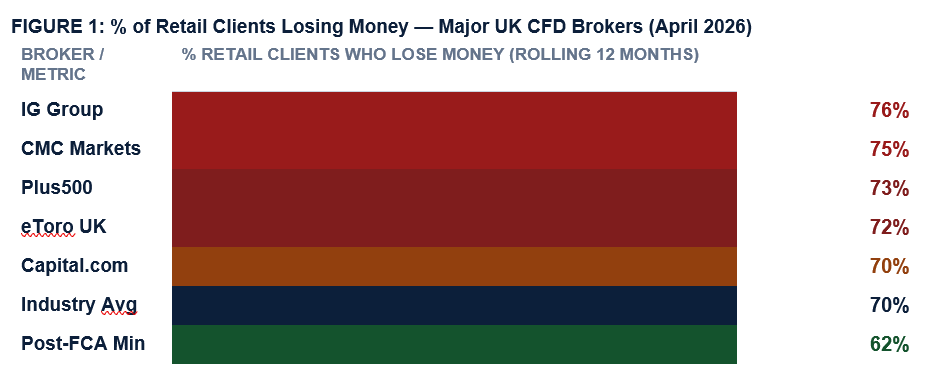
Source: The Investors Centre TIC CFD Loss Rate Index, scraped from each broker’s UK website on 27 April 2026 (FCA-mandated rolling 12-month disclosures). Industry Avg = mean of 14 brokers (69.9%). Post-FCA Min reflects the lowest single-broker disclosure. Pre-FCA intervention (2017 FCA sample) found 78% loss rate across 7 firms.
Chart 2 — Active UK Trader Population 2019–2025
The number of active UK retail leveraged traders peaked at 275,000 during the COVID-19 lockdown era and has since declined to 167,000. This chart shows the trajectory — and helps contextualise the scale of the estimated £1 billion loss figure.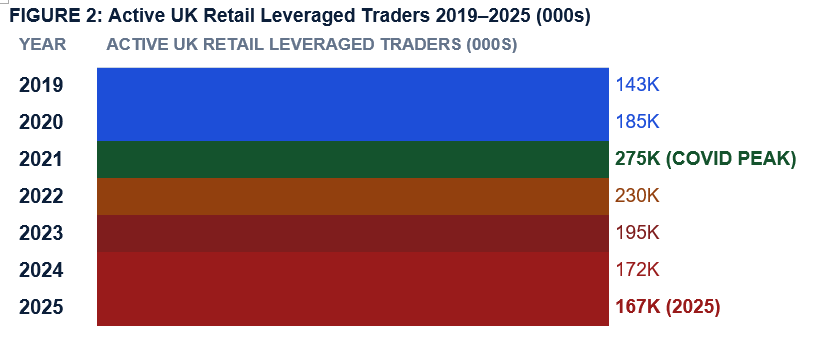
Source: Investment Trends UK Leverage Trading Reports 2019–2025 (17th edition, June 2025); 10,927-respondent survey. Active = traded in previous 3 months. Aggregates CFD accounts and spread bet accounts; FCA does not separately publish account totals for the two products.
Chart 3 — Trader Attrition: The Survival Curve
The loss-rate figures are only part of the story. The attrition rate — how quickly traders exit the market entirely — is equally revealing about the structural difficulty of retail leveraged trading.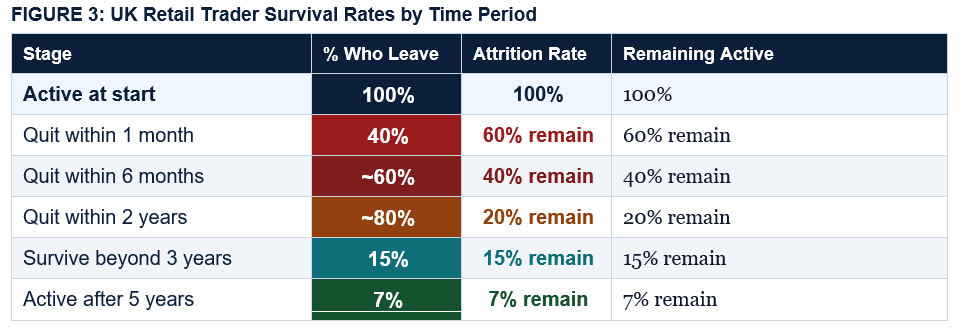
Sources: Academic meta-analysis cited in The Investors Centre UK Trading Statistics 2026; broker churn data; EBC Financial Group trading psychology analysis (September 2025). The 7% five-year survival rate is consistent across multiple independent academic studies of retail derivatives traders globally.
The survival curve illustrates the most uncomfortable fact in retail trading: 40% of new traders quit within a month — before they have even learned the basics. Only 7% remain active after five years. This is not a market where success is the exception. It is a market where attrition is the norm.
The Six Reasons UK Traders Lose Money
The consistency of the loss-rate data across decades, geographies, and regulatory environments points to structural causes rather than individual failure. Six factors appear with statistical regularity across every serious study of retail trader behaviour.Reason 1: Leverage Amplifies Every Mistake
Pre-2019 FCA intervention, UK retail traders could access leverage of up to 500:1 on major FX pairs, 200:1 on indices, and 100:1 on commodities. Post-intervention, caps fell to 30:1 for major FX, 20:1 for minor FX and gold, 10:1 for commodities other than gold, 5:1 for single-stock equities, and 2:1 for crypto. Even at 20:1, a 5% adverse move wipes out the entire margin. Leverage is the mechanism that converts a bad day into a blown account.Reason 2: Behavioural Biases Are Hardwired
Finance professor Terrance Odean’s landmark analysis of thousands of brokerage accounts found that retail traders systematically underperform due to overtrading, emotional decision-making, and overconfidence. The “disposition effect” — selling winners too early and holding losers too long — is one of the most robustly documented biases in behavioural finance. During the August 2025 crypto crash, Binance reported that 35% of liquidations resulted from traders who increased leverage after initial losses — a textbook example of revenge trading.Reason 3: Overtrading Destroys Edge
Only 19% of retail CFD clients making more than 50 trades per month are profitable, according to FCA data. Each trade pays the spread and any overnight financing charges. Even in a zero-commission account, the cumulative cost of frequent trading is substantial. Beyond the direct cost, overtrading produces more emotional decisions, which cut winners too early and hold losers too long. A 2024 survey found traders making over five trades daily were 40% more likely to experience consistent losses than selective traders.Reason 4: No Written Plan, No Defined Risk Per Trade
Professional traders and institutional desks operate within strict, rule-based frameworks: position limits, drawdown caps, predefined entry criteria, mandatory stop-losses. The retail trader enters the market with complete freedom — and that freedom is a liability until the mind is trained to use it well. Research consistently finds that trading without a defined risk-per-trade limit (typically 1–2% of account per position) is one of the fastest routes to account depletion.Reason 5: Finfluencer Promotions Target Inexperienced Traders
The FCA’s October 2025 disclosure that 90,000+ UK consumers lost £75 million at a single finfluencer-promoted CFD firm over four years is not an outlier. It is the documented outcome of a pattern the FCA has been trying to address through its December 2024 CFD Portfolio Letter and its November 2025 Consumer Duty multi-firm review. Social media creates an information environment that systematically overrepresents wins and underrepresents losses, creating a distorted picture of typical trader outcomes.Reason 6: Transaction Costs Are Silent but Continuous
Spread betting and CFD trading appears cost-efficient on the surface — many platforms advertise zero commissions. In practice, every trade pays the bid-ask spread (the difference between buying and selling price), and positions held overnight pay financing charges equivalent to the leverage applied at prevailing interest rates. For a trader who holds positions overnight at 10:1 leverage in a 4%+ rate environment, the annual financing cost on a single position approaches 40% of the nominal position size.Chart 4 — Loss Driver Breakdown
The following table presents a structured analysis of the primary drivers of UK retail trader losses, with estimated contribution weighting based on academic research, FCA disclosures, and broker data.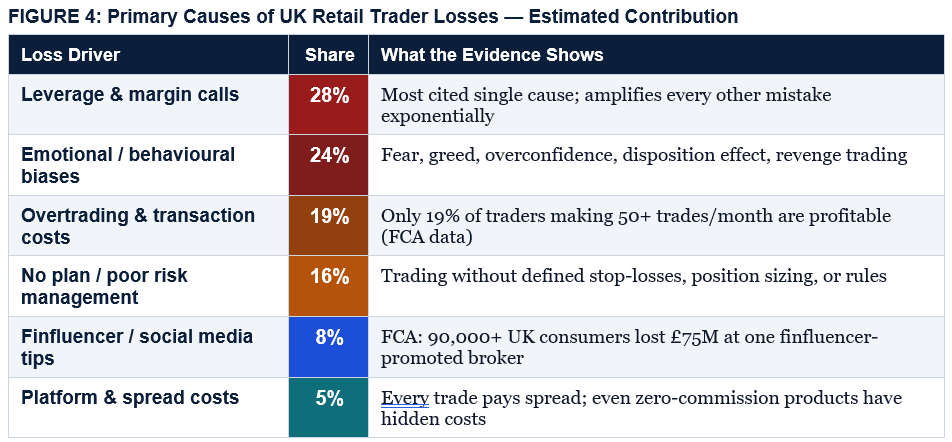
Note: Contribution weightings are editorial estimates based on aggregated academic research, FCA disclosure data, broker risk warnings, and behavioural finance literature. Causes are interrelated and overlapping; percentages represent relative prominence rather than mutually exclusive categories.
The Role of Finfluencers & Social Media
The October 2025 FCA enforcement action against a finfluencer-promoted CFD firm is the most concrete recent illustration of a broader structural problem: social media platforms create an information environment that is systemically misaligned with the statistical reality of retail trading.“Millions of trades almost read like poetry — the patterns that increased failure rates emerged with clockwork precision. Emotional self-sabotage has kept traders stuck in the same losing loop.”
— Saad Naja, Founder CEO of PiP World, November 2025 (28-year, 8M-trader study)
The FCA’s Financial Lives 2024 survey found that 47% of UK trading-app users are aged 18–34. This is the demographic most exposed to social media content about trading, most likely to follow influencer accounts promoting CFD or spread betting platforms, and statistically least likely to have the experience to evaluate the claims being made. The FCA’s December 2024 CFD Portfolio Letter set a two-year supervisory strategy focused on Consumer Duty compliance, halo firm risk, and enforcement against finfluencer promotion of high-risk products.
For context: the £75 million lost by 90,000 UK consumers at one promoted CFD firm represents £833 per person on average. The FCA annual gift exclusion for ISA contributions is £20,000. The contrast illustrates the scale of individual financial harm concentrated in a relatively young and financially inexperienced demographic.
9. What FCA Regulation Has — and Has Not — Fixed
The FCA’s July 2019 intervention on CFD leverage limits and risk warnings was one of the most significant retail trading regulatory actions in UK history. The pre-intervention loss rate (2017 FCA sample from CP18/38) was 78% across 7 firms covering ~65% of the UK CFD market. The April 2026 TIC index reading of 69.9% suggests an approximate 8 percentage-point improvement in average loss rates.The FCA itself estimated that its 2019 measures save UK retail consumers between £267 million and £451 million per year. That is a meaningful reduction — but it implies that even with the intervention, £1 billion or more in annual losses continues.
WHAT CHANGED AFTER 2019
Leverage caps (30:1 max on major FX; 2:1 on crypto). Mandatory FCA risk warnings on all promotions and websites. Prohibition of incentives to trade (bonuses, refer-a-friend cash). Negative balance protection (clients cannot lose more than their deposit). These measures reduced the worst-case outcomes but did not change the fundamental structure of the market: retail traders competing against better-informed, better-capitalised counterparties, paying spreads on every trade.How to Trade Without Becoming a Statistic
The data on retail trading losses is sobering, but it is not a counsel of despair. The 7% of traders who survive five years are doing something demonstrably different from the 93% who do not. Research on long-term successful retail traders consistently identifies the same practices.- Risk no more than 1–2% of your account on any single trade. This is the single most protective rule in trading. It means you can lose 20–50 consecutive trades in a row without blowing your account — giving the statistical edge time to work.
- Write a trading plan before you open the market. Define entry criteria, stop-loss level, take-profit target, and maximum loss for the day before any trade is placed. Do not deviate from the plan during the trading session.
- Use a trading journal. Record every trade: entry, exit, reason, emotion, outcome. Review it weekly. The traders who track and learn from their decisions are the ones who improve. Those who do not track their decisions repeat the same mistakes indefinitely.
- Trade less, not more. The 40% who quit within a month are almost always overtrading. Start with one instrument, one session per day, and a maximum of 2–3 trades. Selective trading produces better outcomes than high-frequency trading for retail participants.
- Paper trade until consistent. Before risking real money, trade on a demo account with the same rules and the same discipline you intend to apply to a live account. If you cannot be consistently profitable in simulation, you will not be consistently profitable live.
- Treat leverage as a risk multiplier, not a profit multiplier. The only sustainable use of leverage is small enough that a worst-case adverse move does not exceed your 1–2% account risk rule. Start at 1:1 or 2:1 until your edge is proven.
CONCLUSION
The £1 Billion Is Not Inevitable
The FCA risk warnings displayed on every UK CFD broker website tell a consistent story: between 70% and 79% of retail clients lose money. The Investors Centre estimates this translates to approximately £1 billion in annual losses across the UK’s 167,000 active retail leveraged traders. The broker financials confirm the economics: Plus500’s 43% operating margin on $792 million of revenue is built, almost entirely, on the losses of retail clients.The six causes of those losses are structurally well-understood: leverage amplifies mistakes, behavioural biases are hardwired, overtrading destroys edge, absent risk management accelerates account depletion, finfluencer promotions target inexperienced traders, and transaction costs accumulate silently. None of these causes are mysterious. All of them are addressable through discipline, process, and the kind of structured approach that the 7% of long-term survivors consistently apply.
The £1 billion is not inevitable. It is the aggregate cost of the gap between the discipline required to trade profitably and the discipline that most retail traders actually apply. Closing that gap — through written plans, strict risk rules, trade journals, and realistic expectations — is the only route to being on the right side of the statistic.
Frequently Asked Questions (FAQ)
How is the £1 billion annual loss figure calculated?The estimate was produced by The Investors Centre (theinvestorscentre.co.uk) using FCA-mandated broker loss-rate disclosures and active-client figures from Investment Trends. The methodology takes each major UK-regulated broker’s FCA risk disclosure (the % of retail clients losing money), applies it to Investment Trends’ active-client estimates, and uses revenue-per-client figures from broker financial reports to derive an aggregate loss figure. The FCA does not publish a single aggregate UK retail CFD loss number; this is a directional estimate, not a precise regulatory figure.
What percentage of UK CFD traders actually lose money?
Between 70% and 79% of retail clients lose money when trading CFDs at the major UK-regulated brokers, according to FCA-mandated rolling 12-month disclosures scraped by The Investors Centre in April 2026. The industry average across 14 brokers is approximately 69.9%. Individual broker disclosures range from 62% at the lowest to 76% at the highest. Before the FCA’s 2019 intervention on leverage limits and risk warnings, the rate was 78% across a sample of 7 firms covering ~65% of the UK CFD market.
Why does spread betting have a similar loss rate to CFDs?
Spread betting and CFDs are economically near-identical products for UK retail traders. Both involve trading on price movements with leverage, both charge spreads on every transaction, both carry overnight financing costs on leveraged positions, and both appeal to similar trader demographics with similar behavioural profiles. The main differences are tax treatment (spread betting profits are exempt from UK CGT; CFD profits are not) and regulatory classification. The FCA does not separately publish loss-rate data for the two products, but industry disclosures treating the products together are standard.
What did the FCA do to protect retail CFD traders?
In July 2019, following ESMA’s EU-wide temporary measures, the FCA introduced permanent rules: leverage caps (30:1 for major FX, 20:1 for minor FX and gold, 10:1 for commodities other than gold, 5:1 for single-stock equities, 2:1 for crypto); mandatory standardised risk warnings; prohibition of trading incentives; and negative balance protection (clients cannot lose more than their deposit). The FCA estimated these measures save UK retail consumers £267–451 million annually. In December 2024, the FCA issued a CFD Portfolio Letter setting a two-year supervisory focus on Consumer Duty compliance and enforcement against finfluencer promotions.
Are there UK retail traders who make money consistently?
Yes, but they represent a small minority. Research suggests approximately 7% of retail traders remain active after five years and a subset of those are profitable over time. The characteristics that distinguish longer-term survivors are well-documented: strict position sizing (1–2% account risk per trade), written trading plans followed consistently, trading journals reviewed regularly, selective low-frequency trading rather than high-volume activity, and realistic expectations about the time required to develop a genuine edge. Profitable retail trading is possible, but it requires the discipline of a professional process applied consistently over years.
Is CFD or spread betting trading gambling?
Legally, they are different: spread betting is classified as gambling by HMRC (making profits tax-free in the UK) while CFDs are regulated financial instruments subject to CGT. Behaviorally, however, academic research consistently identifies similarities: the short time horizons, the leverage, the emotional cycle of wins and losses, the role of psychological biases, and the mathematical structure (where transaction costs ensure the house has a long-run edge) all share characteristics with gambling. The Gambling Commission tracked spread betting participation as part of its gambling surveys until 2023, when it reclassified the data. Many problem gambling researchers study retail leveraged trading populations within their broader studies of financial harm
0 Comments
Be the first to share your thoughts on this article.