

Investing
Why You Shouldn’t Put All Your Money Into Roth IRAs
The Roth IRA is one of the best retirement accounts available to American savers. It is not, however, the only account that should exist in your retirement plan — and for many people, funnelling all available savings into a Roth IRA is a costly mistake. The $7,500 annual cap, income phase-out at $153,000 (single) or $242,000 (married), the tax bracket bet it requires you to win, and the employer match dollars it can cause you to forfeit all argue for a more diversified approach. This guide explains why.
The problem is not the Roth IRA itself. The problem is the financial content ecosystem that has turned ‘max your Roth IRA’ into a universal prescription regardless of income, tax bracket, employer benefits, or competing financial priorities. It hasn’t. The Roth IRA has a hard contribution cap of $7,500 per year for those under 50 in 2026 (NerdWallet; Empower May 2026). It phases out entirely for single filers above $168,000 in modified adjusted gross income. It requires you to correctly predict that your retirement tax rate will be higher than your working tax rate — a bet that many people lose. And funding it before capturing an employer’s 401(k) match is one of the most expensive mistakes in personal finance.
This guide makes the case not against the Roth IRA but against the all-Roth retirement strategy. Seven specific reasons explain why concentrating all retirement savings in a Roth IRA leaves significant value on the table for most savers. Understanding these reasons produces a better, more resilient retirement plan — one that uses the Roth IRA as a component rather than a centrepiece.
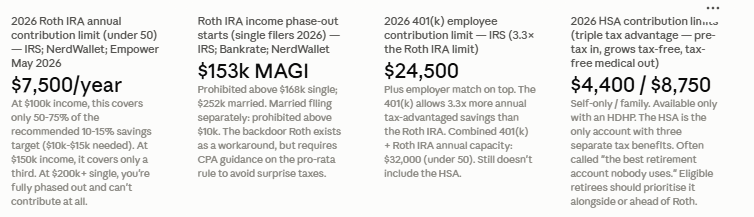
2026 Roth IRA contribution limit: $7,500 under 50; $8,600 age 50+ ($1,100 catch-up). Income phase-out: single $153k-$168k MAGI; married $242k-$252k MAGI; married filing separately $0-$10k (IRS; NerdWallet; Bankrate; Empower 2026). 2026 401(k) employee limit: $24,500 under 50; $32,500 age 50+ ($35,750 for ages 60-63). HSA 2026: $4,400 self-only; $8,750 family. Exceeding the combined IRA limit ($7,500/$8,600 across Roth + traditional) triggers a 6% annual penalty. Traditional IRA: no income limits on contributions (Bankrate 2026). Average employer 401(k) match: approximately 3-6% of salary.
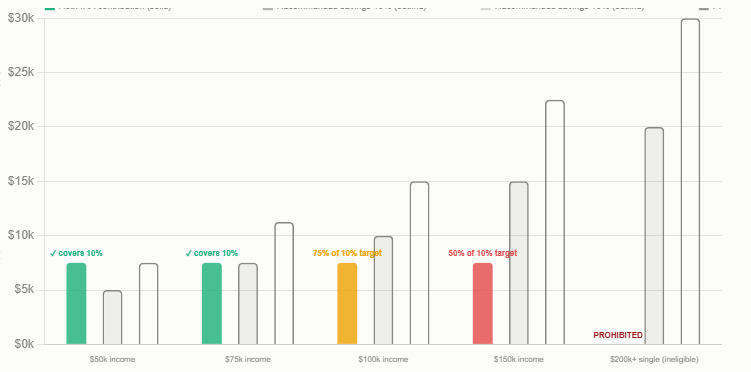
The $7,500 limit sounds significant in isolation. In the context of what most financial planners recommend for retirement savings, it is a floor, not a ceiling. A common guideline is saving 10 to 15% of gross income for retirement. At a $75,000 annual income, 10 to 15% means $7,500 to $11,250 per year — the Roth IRA barely covers the minimum end of that range, with no margin. At $100,000 income, the recommended range is $10,000 to $15,000 — the Roth IRA covers between 50 and 75% of target. At $150,000, the Roth IRA covers roughly a third of what is needed.
If the Roth IRA is the only retirement account, the annual savings gap compounds through the decades. A 35-year-old who needs to save $15,000 per year for retirement but can only put $7,500 into a Roth IRA is leaving $7,500 per year in unsheltered or uninvested capital. Over 30 working years at a 7% return, that missing $7,500 per year represents approximately $750,000 in foregone retirement wealth (simplified compound growth; not accounting for tax).
The contribution cap math: Annual savings needed (15% of income): $75k income = $11,250; $100k income = $15,000; $150k income = $22,500; $200k income = $30,000. Roth IRA covers: $75k income: 67% of target. $100k income: 50% of target. $150k income: 33% of target. $200k income: 0% (fully phased out for single filers above $168k). To close the gap at $100k income ($15k needed, $7.5k covered by Roth): remaining $7,500 needs to go somewhere. Options: employer 401(k) contribution (up to $24,500/year), HSA (up to $4,400 self-only), taxable brokerage (unlimited). The Roth IRA alone cannot carry a full retirement savings plan for most middle-to-high income earners. Not financial advice. Estimates are illustrative.
The married filing separately rule is even more restrictive: if you lived with your spouse at any time during the year, contributions begin phasing out above $0 in MAGI and are prohibited above $10,000 — effectively making Roth IRA contributions unavailable to most married filers who file separately (Bankrate 2026).
These income thresholds affect a meaningful and growing portion of the American working population, particularly in high-cost-of-living metropolitan areas where $153,000 individual income is not unusual for professionals in their 30s and 40s. The income limits also create a specific trap: a household that has been funding Roth IRAs through their lower-income years and then crosses the threshold faces the disruption of losing access to their primary savings vehicle without necessarily having built the pre-tax account infrastructure to replace it.
The backdoor Roth IRA — making a non-deductible traditional IRA contribution and then converting it to Roth — exists as a workaround for high earners. But it requires careful navigation of the pro-rata rule (which taxes conversions proportionally if you have existing pre-tax IRA money), does not eliminate the $7,500 cap, and adds tax complexity that is best handled by a CPA or tax-savvy financial adviser. It is a solution, but it underscores that the Roth IRA was not designed to be the primary savings vehicle for high-income earners.
The pro-rata rule trap: if you have existing pre-tax money in any traditional IRA (including rollover IRAs from old 401(k)s), the backdoor Roth conversion is taxed proportionally, not on just the non-deductible contribution. Example: $50,000 in a traditional rollover IRA + $7,500 non-deductible traditional IRA contribution. When you convert the $7,500 to Roth, the IRS treats your total IRA money as a pool ($57,500) and taxes the conversion proportionally: only $7,500/$57,500 = 13.04% of the conversion is non-taxable. The remaining 86.96% is taxable. Avoid the backdoor Roth if you have pre-existing traditional IRA balances without a strategy to address this. Not tax advice. Consult a CPA.
Many financial content creators treat this as a near-certainty: tax rates will surely rise, so of course you should pay now. But that certainty is not supported by the historical record. Tax rates in the United States have fluctuated dramatically across administrations and decades. The top marginal rate was 91% in the 1950s, fell to 28% under the 1986 Tax Reform Act, rose to 39.6% in the 1990s, and sits at 37% under the post-TCJA framework that was extended permanently by the One Big Beautiful Budget Act (OBBBA) of 2025. Future rates are genuinely uncertain. The 2026 standard deduction of $15,000 single / $30,000 married (OBBBA) reduces taxable income significantly for most retirees.
More practically: the majority of retirees find themselves in lower tax brackets in retirement than during their peak earning years. A person who earned $150,000 per year during their working career and contributed heavily to a Roth IRA may retire with Social Security income of $35,000 per year (inflation-adjusted), a pension of $20,000, and small traditional IRA distributions. At $55,000 in taxable income, a couple’s 2026 tax rate would be in the 12% or 22% bracket — substantially lower than the 24% or 32% they were paying during peak earning years. In that scenario, the traditional pre-tax account wins.
The tax bracket uncertainty argument does not mean the Roth IRA is wrong. It means the all-Roth approach is a concentrated bet. Tax diversification — holding both Roth and pre-tax accounts — is the rational response to genuine uncertainty about future tax rates, healthcare costs, Social Security tax exposure, and IRMAA (Medicare premium surcharges that kick in above $109,000/$218,000 in income). Having both types of accounts in retirement gives you flexibility to draw from whichever bucket minimises your tax burden in any given year. Not financial advice.
A common 401(k) employer match structure is 50 cents per dollar contributed, up to 6% of salary. At an $80,000 salary, the maximum employer match is $2,400 per year (6% of $80,000 = $4,800 in employee contributions, matched at 50% = $2,400). To capture this match, the employee needs to contribute at least $4,800 of their own money to the 401(k). Any dollar redirected away from the 401(k) toward a Roth IRA before that $4,800 threshold forfeits a corresponding portion of the employer match.
The mathematics are unambiguous. A dollar of salary contributed to the 401(k) up to the match threshold instantly doubles (100% match) or increases by 50% (50-cent-on-dollar match). A dollar contributed to a Roth IRA instead returns whatever the market returns over the investment horizon — typically 7-10% per year on a broad index fund. The 50-100% immediate return from the employer match is orders of magnitude larger than any investment return, particularly in the short term. There is no reasonable asset allocation that can replicate the instant return of a 100% employer match.
The correct sequencing: contribute to the 401(k) up to the full employer match first, then fund the Roth IRA, then return to the 401(k) if budget allows. This sequencing is almost universally agreed upon by financial planners. An all-Roth strategy that ignores the 401(k) pre-match is not tax-efficient planning; it is leaving guaranteed money on the table.
The match-first rule: before contributing a dollar to a Roth IRA, calculate the exact employee contribution threshold that triggers the full employer match in your 401(k) plan. For a common 50%-up-to-6%-of-salary match structure: multiply your salary by 6%. Contribute that exact amount to the 401(k). Only after that threshold is met should the next dollar go into the Roth IRA. Then return to the 401(k) with any remaining savings budget. This sequence is not debatable. Not financial advice -- consult a financial planner for your specific situation.
The 2026 HSA contribution limits are $4,400 for self-only coverage and $8,750 for family coverage, with an additional $1,000 catch-up for those 55 and older (IRS; US reference data 2026). An HSA is available to anyone enrolled in a High Deductible Health Plan (HDHP). Unlike a Flexible Spending Account (FSA), unused HSA funds roll over indefinitely — the account does not need to be spent down annually.
The retirement-planning implication is powerful. An HSA invested in low-cost index funds accumulates triple-tax-advantaged growth over a career. In retirement, the funds can be used for Medicare premiums, out-of-pocket medical costs, prescription drugs, and virtually any qualifying healthcare expense — tax-free. After age 65, HSA funds can be withdrawn for any purpose, paying only ordinary income tax (identical to a traditional IRA withdrawal). This makes the HSA function as both a healthcare reserve and a general retirement account.
Given that the Employee Benefit Research Institute estimates a 65-year-old couple will need $351,000 to $413,000 for healthcare costs in retirement (not counting long-term care), having a dedicated tax-advantaged pool specifically for this expense category is not a nice-to-have. It is a critical component of retirement financial planning that the Roth IRA does not replicate.
Savers who are eligible for an HSA and are directing all additional savings into a Roth IRA instead are passing up a tax deduction today and a tax-free withdrawal vehicle for their single largest expected retirement expense category. For most people in HDHPs, the HSA should rank alongside or ahead of the Roth IRA in the savings priority sequence.
Consider a 45-year-old in the 24% federal tax bracket, with a state income tax rate of 6%, for a combined marginal rate of 30%. A $7,500 traditional 401(k) contribution saves this person $2,250 in taxes this year (30% of $7,500). That $2,250 is available immediately — it can be invested in additional accounts, used to pay down debt, or support cash flow. The Roth IRA offers no such current-year benefit: the contribution comes from after-tax money, and the tax relief only appears decades later in retirement.
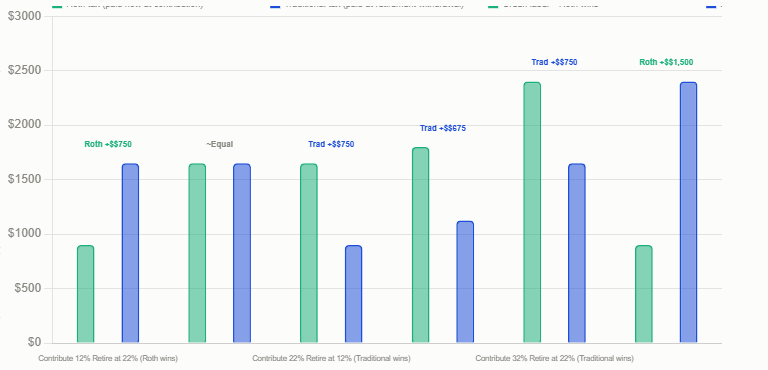
For someone whose income is likely to be lower in retirement than during their peak earning years — and the majority of earners fit this description — the pre-tax account produces the better lifetime tax outcome. The contribution-year deduction saves tax at 30% (the high rate). The retirement withdrawal is taxed at 15% or 22% (the lower rate). The traditional account wins by the spread between those rates.
The Roth wins when the direction of rates is reversed: contribute at a low tax rate now, withdraw at a higher rate in retirement. This is the scenario that makes the Roth IRA ideal for young earners just starting out, those in lower income brackets, or those who expect a dramatic income increase in later years. It is not universally the better choice for someone in a high bracket today.
Long-term capital gains rates in a taxable account are 0%, 15%, or 20% depending on income — significantly lower than ordinary income rates. The 0% capital gains threshold in 2026 is $49,450 for single filers (OBBBA). A retiree managing their income carefully can recognise substantial investment gains at zero federal tax by staying below this threshold. This is more difficult to achieve with a Roth IRA because the Roth conversion of large balances creates income recognition in the conversion year.
Taxable brokerage accounts also offer unrestricted access: no penalties, no age requirements, no contribution limits, no income restrictions. The flexibility for large purchases, bridge income before Social Security, or unexpected expenses is significantly greater in a taxable account than in any tax-advantaged vehicle. And under current law, assets in a taxable brokerage receive a stepped-up cost basis at death, potentially eliminating capital gains tax on appreciated holdings entirely for the heirs.
For a high-income earner who has already maxed the 401(k), the HSA, and the backdoor Roth IRA: the taxable brokerage is the natural next destination for retirement savings, and it is not inherently inferior to the Roth given the combination of long-term capital gains rates, basis step-up at death, and liquidity flexibility.
In retirement, income from different sources has different tax treatment. Social Security income is taxable if combined income exceeds $32,000 (married filing jointly) or $25,000 (single) — and up to 85% of Social Security benefits can be included in taxable income for those above $44,000 (MFJ) or $34,000 (single). Traditional IRA and 401(k) distributions count as ordinary income and push income higher. Roth IRA distributions do not count as income and do not appear in the calculation.
A retiree with only pre-tax accounts faces a mandatory inclusion of all withdrawals in taxable income, which can push Social Security benefits into higher taxation tiers, trigger IRMAA Medicare premium surcharges (starting at $109,000/$218,000 in 2026), and reduce eligibility for income-based programs. A retiree with only Roth accounts has perfectly tax-free withdrawals but has paid all taxes upfront without benefiting from the deduction during high-earning, high-bracket years.
A retiree with both types of accounts has the flexibility to draw from whichever bucket minimises total tax in any given year. In a year with significant medical expenses (which create large itemised deductions), traditional IRA withdrawals may produce very little tax. In a year with large capital gains from a taxable account, Roth withdrawals avoid adding to the income total. This flexibility — which financial planners call tax location flexibility or tax bracket management — can save tens of thousands of dollars in lifetime tax relative to either all-Roth or all-pre-tax approaches.
Kiplinger’s 2026 Roth IRA guide makes this point directly: ‘Those tax-free Roth withdrawals in retirement won’t contribute to your taxable income, which is used to determine how much you pay for Medicare, including any surcharges (also known as income-related monthly adjustment amounts or IRMAAs).’ Having some Roth in the mix produces this IRMAA protection. Having all Roth eliminates the tax deduction in the contribution years.
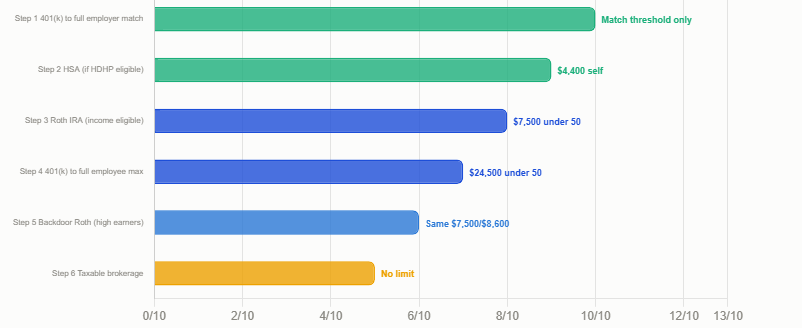
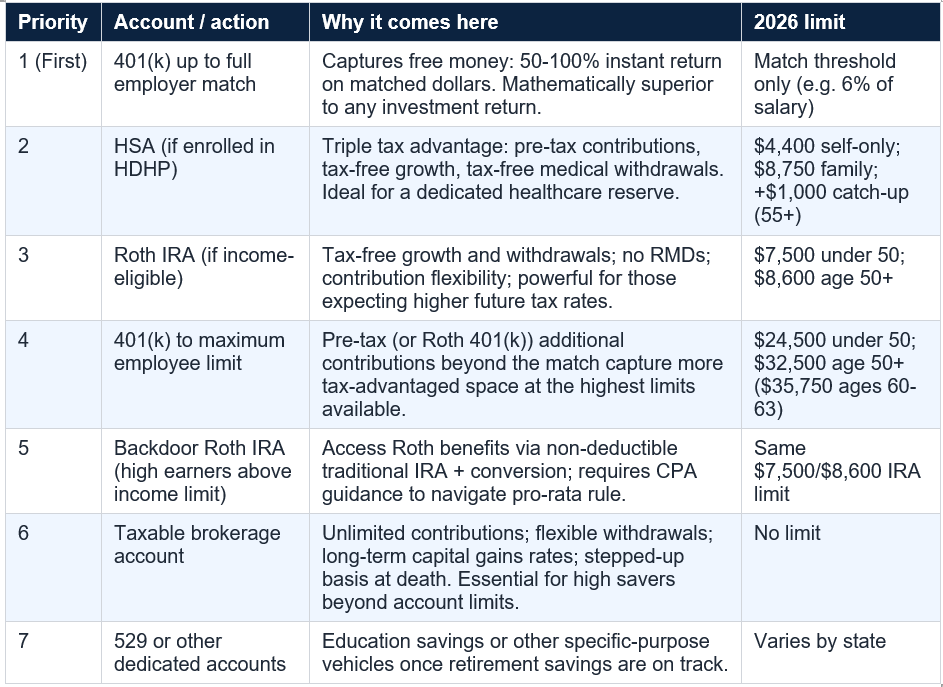
The financially optimal approach for most working savers is a sequenced, diversified strategy: employer 401(k) match first (always), then HSA if eligible, then Roth IRA within income limits, then back to the 401(k) to the maximum employee limit, then taxable brokerage for any remaining retirement savings. This sequence captures free money, triple tax advantage, tax-free growth, pre-tax contribution room, and unlimited savings capacity — in that order.
In retirement, the goal is to have multiple income buckets with different tax treatments, giving you the flexibility to manage taxable income year by year in response to Social Security thresholds, IRMAA brackets, capital gains rates, and healthcare deductions. The all-Roth retiree has tax-free income but paid full tax on every contribution in their working years. The all-pre-tax retiree has deferred income but pays ordinary rates on every withdrawal. The diversified retiree has options. Options are worth more than certainty in a tax environment that changes with every administration. Not financial advice — consult a qualified financial adviser, CPA, or tax professional.
For 2026, the Roth IRA contribution limit is $7,500 for individuals under age 50. Those aged 50 and older can make an additional $1,100 catch-up contribution, bringing the total to $8,600. These limits apply to the combined total across all IRA accounts — Roth and traditional together. If you contribute $7,500 to a Roth IRA, you cannot also contribute to a traditional IRA in the same year. Contributing more than the annual limit triggers a 6% IRS penalty on the excess amount for each year it remains in the account. You can only contribute up to your annual earned income — if you earned $5,000 in 2026, that is the maximum you can contribute regardless of the published limit. Sources: NerdWallet; Empower (May 2026); Kiplinger 2026; IRS. Not financial advice.
What are the income limits for Roth IRA contributions in 2026?
In 2026, direct Roth IRA contributions phase out based on modified adjusted gross income (MAGI) as follows: for single filers and heads of household, the phase-out begins at $153,000 and contributions are prohibited above $168,000 MAGI. For married filing jointly, the phase-out begins at $242,000 and contributions are prohibited above $252,000 MAGI. For married filing separately (if you lived with your spouse at any point during the year), the phase-out begins above $0 and contributions are prohibited above $10,000 MAGI. If your income exceeds these limits, a backdoor Roth IRA — contributing to a non-deductible traditional IRA and then converting to Roth — may still be an option, but requires careful tax planning around the pro-rata rule if you have existing pre-tax IRA balances. Traditional IRAs have no income limits on contributions (though the deductibility of traditional IRA contributions has income limits for workplace retirement plan participants). Sources: Bankrate; NerdWallet; IRS 2026. Not tax advice — consult a CPA.
Should I max my 401(k) or Roth IRA first?
The standard financial planning guidance is a specific sequence: capture the full employer 401(k) match first, then fund the Roth IRA (or HSA), then return to the 401(k) for additional contributions. The employer match takes priority because it represents an instant 50-100% return on matched dollars — no investment can reliably replicate that guaranteed immediate return. A dollar put into a Roth IRA instead of capturing the employer match effectively foregoes a 50-100% immediate return in exchange for tax-free growth, which takes years to compensate for the forgone match. After capturing the full match, the Roth IRA is typically the next priority for those within income limits, especially younger savers in lower tax brackets. The 401(k) additional contributions (beyond the match threshold) typically follow the Roth IRA in the sequencing because they provide more annual contribution capacity ($24,500 vs $7,500) and a current-year tax deduction that benefits higher-bracket earners. Not financial advice.
Is a Roth IRA better than a traditional IRA?
Neither is universally better — the optimal choice depends on your current tax rate relative to your expected retirement tax rate. The Roth IRA is better if your retirement tax rate will be higher than your current rate (common for young, low-income earners). The traditional IRA is better if your retirement tax rate will be lower than your current rate (common for peak-earning, high-bracket workers). The honest answer is that neither you nor any financial planner can predict future tax rates with certainty. This uncertainty is the primary reason financial planners recommend tax diversification — holding both Roth and pre-tax accounts in retirement, which gives you the flexibility to draw from whichever account produces the best tax outcome in any given year. Having only Roth accounts in retirement is tax-efficient but forfeits the current-year deduction during high-bracket years. Having only pre-tax accounts is efficient during the contribution years but potentially expensive in retirement. Having both accounts provides flexibility. Not financial advice — consult a financial adviser for guidance specific to your tax situation.
Can I contribute to both a Roth IRA and a 401(k) in the same year?
Yes. Roth IRA contributions and 401(k) contributions are tracked separately by the IRS with separate annual limits. You can contribute up to $7,500 (under 50) or $8,600 (50+) to IRAs (Roth and/or traditional combined), AND up to $24,500 (under 50) or $32,500/$35,750 (50 and older) to your 401(k) as an employee contribution, all in the same calendar year. Your employer’s matching contributions do not count toward these limits. The ability to use both accounts simultaneously is exactly why the optimal savings strategy involves both rather than concentrating on one. Note that a Roth 401(k) — offered by many employers — is a separate option from a Roth IRA: contributions to a Roth 401(k) count toward the 401(k) limit, not the IRA limit, and a Roth 401(k) has no income limits for participation. Sources: NerdWallet; Bankrate; IRS 2026. Not financial advice.
Table of Contents
- The Roth IRA Is Great, But It’s Not Everything
- Reason #1: The $7,500 Annual Cap Is Too Small to Retire On Alone
- Reason #2: Income Limits Lock Out Many Mid-to-High Earners
- Reason #3: You’re Making a Tax Bet You May Not Win
- Reason #4: You Might Be Forfeiting Free Employer Match Money
- Reason #5: You’re Missing the HSA Triple Tax Advantage
- Reason #6: Pre-Tax Accounts Give You a Tax Break When It Hurts Most
- Reason #7: A Taxable Brokerage Often Beats the Roth in High-Income Years
- The Optimal Savings Priority Order (That Isn’t All-Roth)
- Tax Diversification: Why You Want Both Roth and Pre-Tax in Retirement
- Who Actually Should Prioritise the Roth IRA?
- Conclusion: The Roth IRA Is a Tool, Not a Strategy
- Frequently Asked Questions
The Roth IRA savings gap — what $7,500 actually covers by income
The optimal savings priority order (that isn't all-Roth)
The tax bet: when Roth wins and when pre-tax wins
The Roth IRA Is Great, But It’s Not Everything
The Roth IRA has earned its reputation as one of the most powerful retirement accounts available to American savers. Contributions go in after tax. The money grows tax-free. Qualified withdrawals in retirement are completely tax-free. There are no required minimum distributions during the owner’s lifetime. The flexibility to withdraw contributions (not earnings) at any time without penalty provides a layer of liquidity that most retirement accounts don’t offer. For the right person in the right situation, the Roth IRA is genuinely exceptional.The problem is not the Roth IRA itself. The problem is the financial content ecosystem that has turned ‘max your Roth IRA’ into a universal prescription regardless of income, tax bracket, employer benefits, or competing financial priorities. It hasn’t. The Roth IRA has a hard contribution cap of $7,500 per year for those under 50 in 2026 (NerdWallet; Empower May 2026). It phases out entirely for single filers above $168,000 in modified adjusted gross income. It requires you to correctly predict that your retirement tax rate will be higher than your working tax rate — a bet that many people lose. And funding it before capturing an employer’s 401(k) match is one of the most expensive mistakes in personal finance.
This guide makes the case not against the Roth IRA but against the all-Roth retirement strategy. Seven specific reasons explain why concentrating all retirement savings in a Roth IRA leaves significant value on the table for most savers. Understanding these reasons produces a better, more resilient retirement plan — one that uses the Roth IRA as a component rather than a centrepiece.
2026 Roth IRA contribution limit: $7,500 under 50; $8,600 age 50+ ($1,100 catch-up). Income phase-out: single $153k-$168k MAGI; married $242k-$252k MAGI; married filing separately $0-$10k (IRS; NerdWallet; Bankrate; Empower 2026). 2026 401(k) employee limit: $24,500 under 50; $32,500 age 50+ ($35,750 for ages 60-63). HSA 2026: $4,400 self-only; $8,750 family. Exceeding the combined IRA limit ($7,500/$8,600 across Roth + traditional) triggers a 6% annual penalty. Traditional IRA: no income limits on contributions (Bankrate 2026). Average employer 401(k) match: approximately 3-6% of salary.
Reason #1: The $7,500 Annual Cap Is Too Small to Retire On Alone
The most immediate structural limitation of the Roth IRA is its contribution cap. In 2026, the maximum annual contribution is $7,500 for savers under 50, or $8,600 for those 50 and older (NerdWallet; Empower, May 2026). These limits apply to the combined total across all IRA accounts — Roth and traditional together. Contributing $7,500 to a Roth IRA means you cannot contribute anything additional to a traditional IRA in the same year.The $7,500 limit sounds significant in isolation. In the context of what most financial planners recommend for retirement savings, it is a floor, not a ceiling. A common guideline is saving 10 to 15% of gross income for retirement. At a $75,000 annual income, 10 to 15% means $7,500 to $11,250 per year — the Roth IRA barely covers the minimum end of that range, with no margin. At $100,000 income, the recommended range is $10,000 to $15,000 — the Roth IRA covers between 50 and 75% of target. At $150,000, the Roth IRA covers roughly a third of what is needed.
If the Roth IRA is the only retirement account, the annual savings gap compounds through the decades. A 35-year-old who needs to save $15,000 per year for retirement but can only put $7,500 into a Roth IRA is leaving $7,500 per year in unsheltered or uninvested capital. Over 30 working years at a 7% return, that missing $7,500 per year represents approximately $750,000 in foregone retirement wealth (simplified compound growth; not accounting for tax).
The contribution cap math: Annual savings needed (15% of income): $75k income = $11,250; $100k income = $15,000; $150k income = $22,500; $200k income = $30,000. Roth IRA covers: $75k income: 67% of target. $100k income: 50% of target. $150k income: 33% of target. $200k income: 0% (fully phased out for single filers above $168k). To close the gap at $100k income ($15k needed, $7.5k covered by Roth): remaining $7,500 needs to go somewhere. Options: employer 401(k) contribution (up to $24,500/year), HSA (up to $4,400 self-only), taxable brokerage (unlimited). The Roth IRA alone cannot carry a full retirement savings plan for most middle-to-high income earners. Not financial advice. Estimates are illustrative.
Reason #2: Income Limits Lock Out Many Mid-to-High Earners
The Roth IRA’s income limits are the second hard constraint. For 2026, the ability to contribute to a Roth IRA begins phasing out at $153,000 in modified adjusted gross income (MAGI) for single filers and $242,000 for married filing jointly (Bankrate; NerdWallet; IRS 2026). Above $168,000 (single) or $252,000 (married), no direct Roth IRA contribution is permitted.The married filing separately rule is even more restrictive: if you lived with your spouse at any time during the year, contributions begin phasing out above $0 in MAGI and are prohibited above $10,000 — effectively making Roth IRA contributions unavailable to most married filers who file separately (Bankrate 2026).
These income thresholds affect a meaningful and growing portion of the American working population, particularly in high-cost-of-living metropolitan areas where $153,000 individual income is not unusual for professionals in their 30s and 40s. The income limits also create a specific trap: a household that has been funding Roth IRAs through their lower-income years and then crosses the threshold faces the disruption of losing access to their primary savings vehicle without necessarily having built the pre-tax account infrastructure to replace it.
The backdoor Roth IRA — making a non-deductible traditional IRA contribution and then converting it to Roth — exists as a workaround for high earners. But it requires careful navigation of the pro-rata rule (which taxes conversions proportionally if you have existing pre-tax IRA money), does not eliminate the $7,500 cap, and adds tax complexity that is best handled by a CPA or tax-savvy financial adviser. It is a solution, but it underscores that the Roth IRA was not designed to be the primary savings vehicle for high-income earners.
The pro-rata rule trap: if you have existing pre-tax money in any traditional IRA (including rollover IRAs from old 401(k)s), the backdoor Roth conversion is taxed proportionally, not on just the non-deductible contribution. Example: $50,000 in a traditional rollover IRA + $7,500 non-deductible traditional IRA contribution. When you convert the $7,500 to Roth, the IRS treats your total IRA money as a pool ($57,500) and taxes the conversion proportionally: only $7,500/$57,500 = 13.04% of the conversion is non-taxable. The remaining 86.96% is taxable. Avoid the backdoor Roth if you have pre-existing traditional IRA balances without a strategy to address this. Not tax advice. Consult a CPA.
Reason #3: You’re Making a Tax Bet You May Not Win
The Roth IRA’s fundamental value proposition rests on a prediction: that your tax rate in retirement will be higher than your tax rate while contributing. You pay tax now (at your current rate) to avoid paying tax later (at your future rate). If that prediction is correct, the Roth wins over the traditional IRA. If it is wrong — if your retirement rate is lower than your contribution-year rate — you paid more tax than necessary, and the traditional IRA would have served you better.Many financial content creators treat this as a near-certainty: tax rates will surely rise, so of course you should pay now. But that certainty is not supported by the historical record. Tax rates in the United States have fluctuated dramatically across administrations and decades. The top marginal rate was 91% in the 1950s, fell to 28% under the 1986 Tax Reform Act, rose to 39.6% in the 1990s, and sits at 37% under the post-TCJA framework that was extended permanently by the One Big Beautiful Budget Act (OBBBA) of 2025. Future rates are genuinely uncertain. The 2026 standard deduction of $15,000 single / $30,000 married (OBBBA) reduces taxable income significantly for most retirees.
More practically: the majority of retirees find themselves in lower tax brackets in retirement than during their peak earning years. A person who earned $150,000 per year during their working career and contributed heavily to a Roth IRA may retire with Social Security income of $35,000 per year (inflation-adjusted), a pension of $20,000, and small traditional IRA distributions. At $55,000 in taxable income, a couple’s 2026 tax rate would be in the 12% or 22% bracket — substantially lower than the 24% or 32% they were paying during peak earning years. In that scenario, the traditional pre-tax account wins.
The tax bracket uncertainty argument does not mean the Roth IRA is wrong. It means the all-Roth approach is a concentrated bet. Tax diversification — holding both Roth and pre-tax accounts — is the rational response to genuine uncertainty about future tax rates, healthcare costs, Social Security tax exposure, and IRMAA (Medicare premium surcharges that kick in above $109,000/$218,000 in income). Having both types of accounts in retirement gives you flexibility to draw from whichever bucket minimises your tax burden in any given year. Not financial advice.
Reason #4: You Might Be Forfeiting Free Employer Match Money
Perhaps the most financially damaging consequence of an all-Roth-IRA strategy is a sequencing error that millions of American savers make: contributing to a Roth IRA before capturing the full employer 401(k) match. The employer match is, in the specific context of personal finance, as close to a guaranteed return as exists outside of government bonds.A common 401(k) employer match structure is 50 cents per dollar contributed, up to 6% of salary. At an $80,000 salary, the maximum employer match is $2,400 per year (6% of $80,000 = $4,800 in employee contributions, matched at 50% = $2,400). To capture this match, the employee needs to contribute at least $4,800 of their own money to the 401(k). Any dollar redirected away from the 401(k) toward a Roth IRA before that $4,800 threshold forfeits a corresponding portion of the employer match.
The mathematics are unambiguous. A dollar of salary contributed to the 401(k) up to the match threshold instantly doubles (100% match) or increases by 50% (50-cent-on-dollar match). A dollar contributed to a Roth IRA instead returns whatever the market returns over the investment horizon — typically 7-10% per year on a broad index fund. The 50-100% immediate return from the employer match is orders of magnitude larger than any investment return, particularly in the short term. There is no reasonable asset allocation that can replicate the instant return of a 100% employer match.
The correct sequencing: contribute to the 401(k) up to the full employer match first, then fund the Roth IRA, then return to the 401(k) if budget allows. This sequencing is almost universally agreed upon by financial planners. An all-Roth strategy that ignores the 401(k) pre-match is not tax-efficient planning; it is leaving guaranteed money on the table.
The match-first rule: before contributing a dollar to a Roth IRA, calculate the exact employee contribution threshold that triggers the full employer match in your 401(k) plan. For a common 50%-up-to-6%-of-salary match structure: multiply your salary by 6%. Contribute that exact amount to the 401(k). Only after that threshold is met should the next dollar go into the Roth IRA. Then return to the 401(k) with any remaining savings budget. This sequence is not debatable. Not financial advice -- consult a financial planner for your specific situation.
Reason #5: You’re Missing the HSA Triple Tax Advantage
If the employer 401(k) match is the most underused free return in retirement planning, the Health Savings Account (HSA) is the most underused tax advantage. The HSA provides what no other retirement account offers: three separate tax benefits applied to the same dollar. Contributions are pre-tax (reducing this year’s taxable income). The money grows tax-free inside the account. Withdrawals for qualified medical expenses are tax-free.The 2026 HSA contribution limits are $4,400 for self-only coverage and $8,750 for family coverage, with an additional $1,000 catch-up for those 55 and older (IRS; US reference data 2026). An HSA is available to anyone enrolled in a High Deductible Health Plan (HDHP). Unlike a Flexible Spending Account (FSA), unused HSA funds roll over indefinitely — the account does not need to be spent down annually.
The retirement-planning implication is powerful. An HSA invested in low-cost index funds accumulates triple-tax-advantaged growth over a career. In retirement, the funds can be used for Medicare premiums, out-of-pocket medical costs, prescription drugs, and virtually any qualifying healthcare expense — tax-free. After age 65, HSA funds can be withdrawn for any purpose, paying only ordinary income tax (identical to a traditional IRA withdrawal). This makes the HSA function as both a healthcare reserve and a general retirement account.
Given that the Employee Benefit Research Institute estimates a 65-year-old couple will need $351,000 to $413,000 for healthcare costs in retirement (not counting long-term care), having a dedicated tax-advantaged pool specifically for this expense category is not a nice-to-have. It is a critical component of retirement financial planning that the Roth IRA does not replicate.
Savers who are eligible for an HSA and are directing all additional savings into a Roth IRA instead are passing up a tax deduction today and a tax-free withdrawal vehicle for their single largest expected retirement expense category. For most people in HDHPs, the HSA should rank alongside or ahead of the Roth IRA in the savings priority sequence.
Reason #6: Pre-Tax Accounts Give You a Tax Break When It Hurts Most
The Roth IRA's tax benefit arrives in retirement, when you make tax-free withdrawals. The traditional 401(k) or traditional IRA's tax benefit arrives now, in the current tax year, when the contribution reduces your taxable income. For many savers, particularly those in peak earning years with peak tax exposure, the now is when the tax break is most valuable.Consider a 45-year-old in the 24% federal tax bracket, with a state income tax rate of 6%, for a combined marginal rate of 30%. A $7,500 traditional 401(k) contribution saves this person $2,250 in taxes this year (30% of $7,500). That $2,250 is available immediately — it can be invested in additional accounts, used to pay down debt, or support cash flow. The Roth IRA offers no such current-year benefit: the contribution comes from after-tax money, and the tax relief only appears decades later in retirement.
For someone whose income is likely to be lower in retirement than during their peak earning years — and the majority of earners fit this description — the pre-tax account produces the better lifetime tax outcome. The contribution-year deduction saves tax at 30% (the high rate). The retirement withdrawal is taxed at 15% or 22% (the lower rate). The traditional account wins by the spread between those rates.
The Roth wins when the direction of rates is reversed: contribute at a low tax rate now, withdraw at a higher rate in retirement. This is the scenario that makes the Roth IRA ideal for young earners just starting out, those in lower income brackets, or those who expect a dramatic income increase in later years. It is not universally the better choice for someone in a high bracket today.
Reason #7: A Taxable Brokerage Often Beats the Roth in High-Income Years
For earners above the Roth IRA income limits — single filers above $168,000 or married filers above $252,000 — the choice between a Roth IRA (via backdoor conversion) and a taxable brokerage account is more nuanced than it first appears. The Roth’s tax-free growth sounds superior to the taxable account’s taxable growth, and in many scenarios it is. But the taxable brokerage has advantages that are frequently overlooked.Long-term capital gains rates in a taxable account are 0%, 15%, or 20% depending on income — significantly lower than ordinary income rates. The 0% capital gains threshold in 2026 is $49,450 for single filers (OBBBA). A retiree managing their income carefully can recognise substantial investment gains at zero federal tax by staying below this threshold. This is more difficult to achieve with a Roth IRA because the Roth conversion of large balances creates income recognition in the conversion year.
Taxable brokerage accounts also offer unrestricted access: no penalties, no age requirements, no contribution limits, no income restrictions. The flexibility for large purchases, bridge income before Social Security, or unexpected expenses is significantly greater in a taxable account than in any tax-advantaged vehicle. And under current law, assets in a taxable brokerage receive a stepped-up cost basis at death, potentially eliminating capital gains tax on appreciated holdings entirely for the heirs.
For a high-income earner who has already maxed the 401(k), the HSA, and the backdoor Roth IRA: the taxable brokerage is the natural next destination for retirement savings, and it is not inherently inferior to the Roth given the combination of long-term capital gains rates, basis step-up at death, and liquidity flexibility.
The Optimal Savings Priority Order (That Isn’t All-Roth)
The retirement savings priority sequence that most financial planners recommend recognises the specific advantages of each account type and stacks them in order of return on savings dollar:
Tax Diversification: Why You Want Both Roth and Pre-Tax in Retirement
The most sophisticated argument against an all-Roth retirement strategy is not about tax brackets or contribution limits — it is about flexibility. Holding both Roth and pre-tax accounts in retirement gives you control over your annual taxable income in a way that holding only Roth accounts does not.In retirement, income from different sources has different tax treatment. Social Security income is taxable if combined income exceeds $32,000 (married filing jointly) or $25,000 (single) — and up to 85% of Social Security benefits can be included in taxable income for those above $44,000 (MFJ) or $34,000 (single). Traditional IRA and 401(k) distributions count as ordinary income and push income higher. Roth IRA distributions do not count as income and do not appear in the calculation.
A retiree with only pre-tax accounts faces a mandatory inclusion of all withdrawals in taxable income, which can push Social Security benefits into higher taxation tiers, trigger IRMAA Medicare premium surcharges (starting at $109,000/$218,000 in 2026), and reduce eligibility for income-based programs. A retiree with only Roth accounts has perfectly tax-free withdrawals but has paid all taxes upfront without benefiting from the deduction during high-earning, high-bracket years.
A retiree with both types of accounts has the flexibility to draw from whichever bucket minimises total tax in any given year. In a year with significant medical expenses (which create large itemised deductions), traditional IRA withdrawals may produce very little tax. In a year with large capital gains from a taxable account, Roth withdrawals avoid adding to the income total. This flexibility — which financial planners call tax location flexibility or tax bracket management — can save tens of thousands of dollars in lifetime tax relative to either all-Roth or all-pre-tax approaches.
Kiplinger’s 2026 Roth IRA guide makes this point directly: ‘Those tax-free Roth withdrawals in retirement won’t contribute to your taxable income, which is used to determine how much you pay for Medicare, including any surcharges (also known as income-related monthly adjustment amounts or IRMAAs).’ Having some Roth in the mix produces this IRMAA protection. Having all Roth eliminates the tax deduction in the contribution years.
Who Actually Should Prioritise the Roth IRA?
This guide has argued against an all-Roth strategy. It has not argued against the Roth IRA itself. There are specific financial profiles for whom the Roth IRA should be the primary or dominant retirement savings vehicle:- • Young earners in the 10% or 12% federal tax bracket: if your current tax rate is 12% or lower, the probability that your retirement tax rate will be higher is significant. Paying 12% tax now to lock in tax-free growth is a compelling bet. The Roth IRA is almost universally the better choice in the lowest tax brackets.
- • Those who expect significant income growth: a 25-year-old software engineer currently in the 22% bracket who expects to be in the 32% or 35% bracket within ten years has a strong case for Roth contributions now, before the income scales up. The earlier years of lower-rate contributions lock in the tax advantage before the higher rates arrive.
- • Savers who have substantial pre-tax balances and limited Roth: as a career progresses and a large traditional 401(k) accumulates, the additional Roth contributions serve as tax diversification rather than a primary strategy. Adding Roth exposure when you already have significant pre-tax balances is specifically what financial planners recommend.
- • Those who want the inheritance flexibility: the Roth IRA’s lack of required minimum distributions during the owner’s lifetime, combined with the ability to leave a Roth IRA to heirs who take tax-free distributions (subject to the 10-year rule for inherited IRAs under SECURE 2.0), makes it a superior estate planning vehicle for those whose retirement savings exceed their personal income needs.
- • Savers in states with high income tax who will retire in lower-tax states: paying state income tax on Roth contributions in California (13.3% top rate) or New York (10.9%) and then retiring to Florida, Texas, or another no-income-tax state effectively locks in a state tax deduction that is permanent. The Roth works better when state tax rates are both high during contribution and eliminated in retirement.
Conclusion
The Roth IRA is an excellent retirement account. The $7,500 annual cap, the income phase-out beginning at $153,000 single and $242,000 married, the tax bracket bet it requires you to win, the employer match dollars it can cause you to forfeit, the HSA triple advantage it cannot replicate, the current-year tax relief it does not provide, and the taxable brokerage’s competitiveness at high income levels are all reasons why it cannot function as a complete retirement strategy by itself.The financially optimal approach for most working savers is a sequenced, diversified strategy: employer 401(k) match first (always), then HSA if eligible, then Roth IRA within income limits, then back to the 401(k) to the maximum employee limit, then taxable brokerage for any remaining retirement savings. This sequence captures free money, triple tax advantage, tax-free growth, pre-tax contribution room, and unlimited savings capacity — in that order.
In retirement, the goal is to have multiple income buckets with different tax treatments, giving you the flexibility to manage taxable income year by year in response to Social Security thresholds, IRMAA brackets, capital gains rates, and healthcare deductions. The all-Roth retiree has tax-free income but paid full tax on every contribution in their working years. The all-pre-tax retiree has deferred income but pays ordinary rates on every withdrawal. The diversified retiree has options. Options are worth more than certainty in a tax environment that changes with every administration. Not financial advice — consult a qualified financial adviser, CPA, or tax professional.
Frequently Asked Questions
What are the Roth IRA contribution limits for 2026?For 2026, the Roth IRA contribution limit is $7,500 for individuals under age 50. Those aged 50 and older can make an additional $1,100 catch-up contribution, bringing the total to $8,600. These limits apply to the combined total across all IRA accounts — Roth and traditional together. If you contribute $7,500 to a Roth IRA, you cannot also contribute to a traditional IRA in the same year. Contributing more than the annual limit triggers a 6% IRS penalty on the excess amount for each year it remains in the account. You can only contribute up to your annual earned income — if you earned $5,000 in 2026, that is the maximum you can contribute regardless of the published limit. Sources: NerdWallet; Empower (May 2026); Kiplinger 2026; IRS. Not financial advice.
What are the income limits for Roth IRA contributions in 2026?
In 2026, direct Roth IRA contributions phase out based on modified adjusted gross income (MAGI) as follows: for single filers and heads of household, the phase-out begins at $153,000 and contributions are prohibited above $168,000 MAGI. For married filing jointly, the phase-out begins at $242,000 and contributions are prohibited above $252,000 MAGI. For married filing separately (if you lived with your spouse at any point during the year), the phase-out begins above $0 and contributions are prohibited above $10,000 MAGI. If your income exceeds these limits, a backdoor Roth IRA — contributing to a non-deductible traditional IRA and then converting to Roth — may still be an option, but requires careful tax planning around the pro-rata rule if you have existing pre-tax IRA balances. Traditional IRAs have no income limits on contributions (though the deductibility of traditional IRA contributions has income limits for workplace retirement plan participants). Sources: Bankrate; NerdWallet; IRS 2026. Not tax advice — consult a CPA.
Should I max my 401(k) or Roth IRA first?
The standard financial planning guidance is a specific sequence: capture the full employer 401(k) match first, then fund the Roth IRA (or HSA), then return to the 401(k) for additional contributions. The employer match takes priority because it represents an instant 50-100% return on matched dollars — no investment can reliably replicate that guaranteed immediate return. A dollar put into a Roth IRA instead of capturing the employer match effectively foregoes a 50-100% immediate return in exchange for tax-free growth, which takes years to compensate for the forgone match. After capturing the full match, the Roth IRA is typically the next priority for those within income limits, especially younger savers in lower tax brackets. The 401(k) additional contributions (beyond the match threshold) typically follow the Roth IRA in the sequencing because they provide more annual contribution capacity ($24,500 vs $7,500) and a current-year tax deduction that benefits higher-bracket earners. Not financial advice.
Is a Roth IRA better than a traditional IRA?
Neither is universally better — the optimal choice depends on your current tax rate relative to your expected retirement tax rate. The Roth IRA is better if your retirement tax rate will be higher than your current rate (common for young, low-income earners). The traditional IRA is better if your retirement tax rate will be lower than your current rate (common for peak-earning, high-bracket workers). The honest answer is that neither you nor any financial planner can predict future tax rates with certainty. This uncertainty is the primary reason financial planners recommend tax diversification — holding both Roth and pre-tax accounts in retirement, which gives you the flexibility to draw from whichever account produces the best tax outcome in any given year. Having only Roth accounts in retirement is tax-efficient but forfeits the current-year deduction during high-bracket years. Having only pre-tax accounts is efficient during the contribution years but potentially expensive in retirement. Having both accounts provides flexibility. Not financial advice — consult a financial adviser for guidance specific to your tax situation.
Can I contribute to both a Roth IRA and a 401(k) in the same year?
Yes. Roth IRA contributions and 401(k) contributions are tracked separately by the IRS with separate annual limits. You can contribute up to $7,500 (under 50) or $8,600 (50+) to IRAs (Roth and/or traditional combined), AND up to $24,500 (under 50) or $32,500/$35,750 (50 and older) to your 401(k) as an employee contribution, all in the same calendar year. Your employer’s matching contributions do not count toward these limits. The ability to use both accounts simultaneously is exactly why the optimal savings strategy involves both rather than concentrating on one. Note that a Roth 401(k) — offered by many employers — is a separate option from a Roth IRA: contributions to a Roth 401(k) count toward the 401(k) limit, not the IRA limit, and a Roth 401(k) has no income limits for participation. Sources: NerdWallet; Bankrate; IRS 2026. Not financial advice.

0 Comments Comments