

Retirement
X Bills to Cut When You Start Collecting Social Security

The average 2026 Social Security check is $2,071/month. After Medicare Part B, taxes, and inflation, the real number is smaller. Here are the 9 specific expense categories to cut — and what to replace them with


Then there is inflation, which 77 percent of older adults in an AARP survey said a 3 percent COLA would not adequately address. And taxes: approximately 50 percent of Social Security recipients pay federal income tax on their benefits, with the taxable share rising every year because the income thresholds that trigger taxation are not adjusted for inflation, according to the Senior Citizens League and The Motley Fool’s January 2026 analysis.
All of which means that the transition to Social Security is not simply a matter of replacing your paycheck with your benefit. It is a restructuring of your entire financial life — one that creates specific opportunities to reduce expenses that were directly tied to your working years, and specific risks in areas like healthcare and housing. This guide identifies the nine specific expense categories that new Social Security recipients should review and, in most cases, significantly reduce or eliminate.
The Numbers: Average 2026 Social Security retired-worker benefit: $2,071/month (up $56 from 2025, SSA/Kiplinger). Medicare Part B: $202.90/month in 2026 (up 9.7%, deducted from most SS checks). Net COLA gain after Medicare: approximately $38/month. 77% of seniors say the COLA does not keep pace with their costs (AARP November 2025). 69 million Americans receive Social Security payments.
GoBankingRates’ August 2026 retirement budget analysis, quoting financial expert Shirshikov, articulates the proper structure: Social Security, pensions, and annuities should ideally cover housing, healthcare, and food, while portfolio withdrawals fund discretionary spending. This structure is the target. Getting there requires systematically eliminating the expenses that were tied to your employment and replacing them, where appropriate, with retirement-appropriate alternatives.
The nine bills below fall into three categories:
Medicare Part A (hospital insurance) is generally premium-free for those who paid Medicare taxes for 10 or more years. Medicare Part B (medical insurance) costs $202.90 per month in 2026, automatically deducted from your Social Security benefit. The combined Medicare structure typically costs significantly less than active employee contributions to employer-sponsored family plans, where employee-only contribution averages can exceed $100 to $200 per month even before deductibles, and family coverage contributions can exceed $500 to $700 per month.
However, Medicare does not cover everything that employer plans covered. Dental, vision, and hearing are not included in Original Medicare. Long-term care is not covered. SeniorLiving.org’s February 2026 senior budgeting guide notes that out-of-pocket costs for dental and vision can add up quickly. The appropriate response is to add a Medicare Supplement (Medigap) plan and a Part D prescription drug plan, or to choose Medicare Advantage (Part C), which bundles all components, often with dental and vision included.
Action: Contact the Social Security Administration or Medicare.gov to enroll in Part B no more than 3 months before your 65th birthday. Missing the Initial Enrollment Period results in a permanent 10% surcharge on Part B premiums for each 12-month period you delayed enrollment, for as long as you have Medicare coverage.
U.S. News’ retirement expenses guide identifies life insurance as one of the first expenses to reconsider in retirement. Term life insurance that was purchased to cover a working career and provide income replacement has served its purpose when the career ends. Whole life insurance is more complex: the cash value may represent a meaningful asset worth surrendering for lump-sum capital, converting to a paid-up policy with no further premiums, or continuing for estate planning purposes if the death benefit is part of a wealth transfer strategy.
The question to ask: if I died today, what financial problem would the death benefit solve for my surviving family members? If the honest answer is ‘none that could not be managed from existing assets and Social Security survivor benefits,’ the premium is likely a candidate for elimination.
Warning: Do not cancel any life insurance policy without a professional review of your specific situation, survivor’s benefit needs, estate plan, and whether any cash value is available. Consult a fee-only financial adviser or insurance specialist before making any coverage decision.
When you retire, this expense does not simply reduce — it largely disappears. You no longer need to maintain a vehicle specifically capable of highway commuting. You no longer pay for monthly parking. You no longer purchase transit passes. You no longer fill the tank twice a week. The vehicle you keep in retirement may accumulate a fraction of the annual mileage it did during your working years, dramatically reducing both fuel and maintenance costs and, potentially, allowing you to reduce insurance coverage.
U.S. News’ retirement expenses guide notes that with a flexible retirement schedule, seniors can also reduce or eliminate costs previously incurred from convenience-driven spending — the expensive pre-work coffee, the overpriced lunch near the office, the parking garage fees. All of these go to zero on the first day of retirement.
Key Point: The retirement transportation budget needs to be rebuilt from zero based on actual expected mileage, not adjusted down from your working-life vehicle budget. A retiree who drives 5,000 miles per year has dramatically different insurance, fuel, and maintenance costs than one who drove 15,000 during their working years.
U.S. News’ retirement expense guide specifically identifies work-related spending as a category that shrinks in retirement: you might spend less on office clothes, time-saving services, and work-related spending. The BLS Consumer Expenditure data confirms this: apparel spending for retiree households is lower than for working-age households, reflecting the shift from business to casual and the reduction in frequency of new purchases.
The replacement cost in retirement is casual or leisure clothing purchased much less frequently at a lower price point per item. Dry cleaning bills often drop to near zero for those who switch entirely to casual and wash-and-wear. Regular haircuts may continue but at a less premium-priced establishment or less frequently. Professional grooming routines driven by workplace expectations can be replaced by more relaxed, less costly personal care habits.
When you retire and shift to living on Social Security benefits, pension income, and investment withdrawals, you stop paying FICA on your income (investment income, retirement account withdrawals, and Social Security benefits are not subject to FICA). This is a substantial and automatic improvement in the effective income-to-bill ratio of your monthly budget. The money does not go away — it stays in your take-home retirement income rather than going to the federal government.
Key Point: FICA is the one bill on this list you genuinely cannot cut — because it stops the moment you retire. It is worth understanding its size precisely because new retirees sometimes fail to account for the income increase it represents. Your retirement income is not equivalent to your pre-retirement take-home pay; it needs to cover what your prior paycheck covered minus the FICA and other payroll deductions that no longer apply.
Categories to review immediately upon retirement:
Steps to take immediately at retirement:
U.S. News’ retirement expenses guide frames this directly: paying off your mortgage eliminates one of your largest monthly bills. You no longer need to make interest payments to a lender. While you will still pay insurance and property taxes and continue to maintain your home, these costs are likely a fraction of what you were paying for your mortgage.
The three strategic options for the mortgage at retirement:
The 2026 developments affecting Social Security recipients’ tax bills:
Bill Category Typical Pre-Retirement Monthly Cost Typical Retirement Reduction Annual Saving Potential Key Action
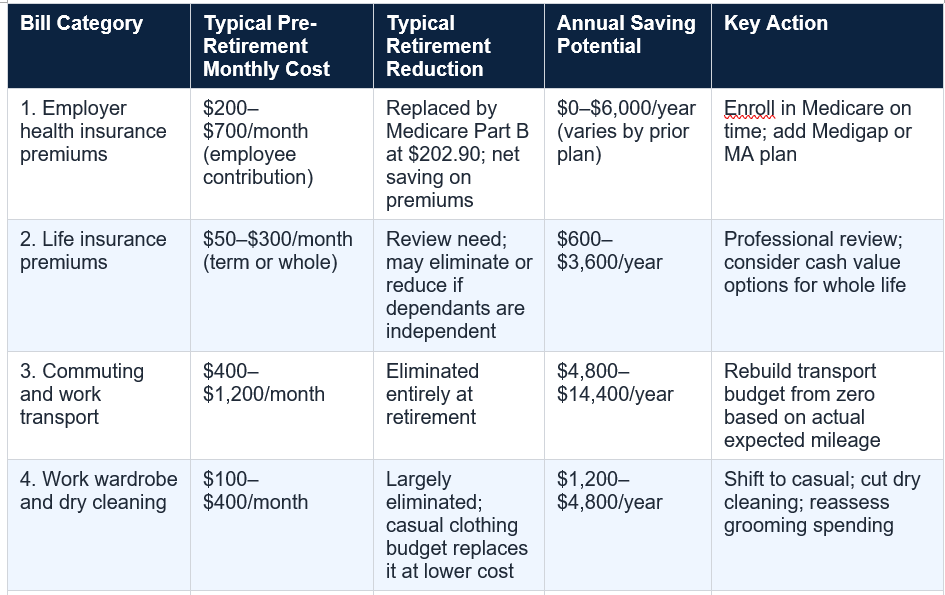
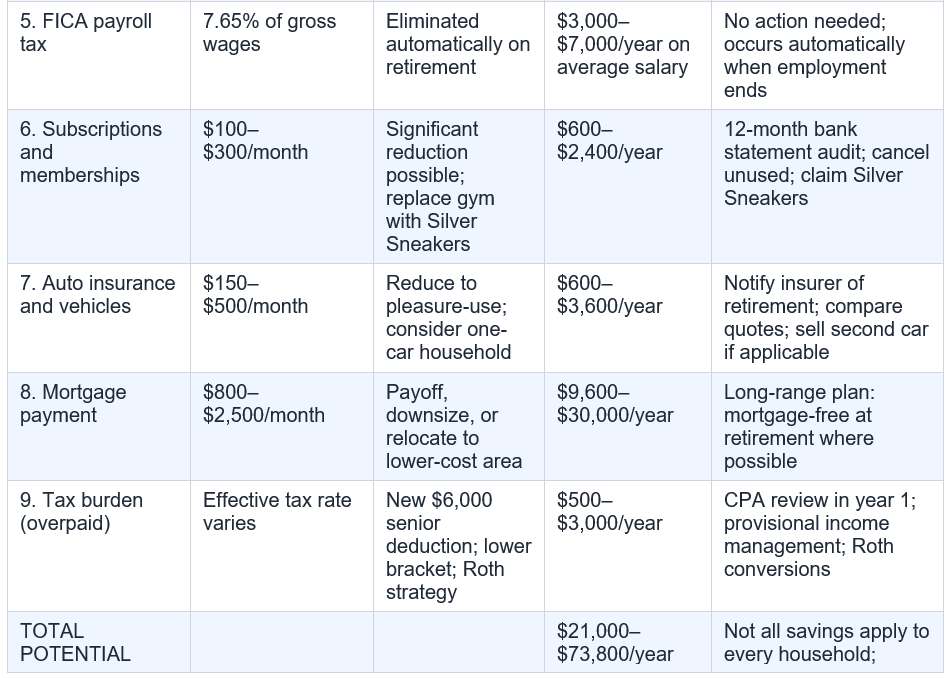
The total potential savings range of $1,750 to $6,150 per month is illustrative. Not every household will capture every category. For many new Social Security recipients, however, even capturing three or four of these categories represents the difference between a comfortable retirement budget and a monthly cash flow shortfall.
The practical fix: as soon as you begin receiving Social Security, call each major biller (mortgage or rent, utilities, insurance) and request that the due date be moved to two to three days after your Social Security payment date. Most billers accommodate this request at no cost. For those managing multiple income sources (pension, part-time work, and Social Security), stagger major bill dates to avoid cash-flow crunches in the first week of the month.
This is the context in which every bill-cutting and budget-optimisation decision made now is worth making. A 22 to 28 percent reduction in Social Security benefits in 2032 — averaging $460 per month or more based on current benefit levels, per Newsweek’s January 2026 analysis — would represent a severe financial shock for households whose budgets are built around current benefit levels. The households best positioned to absorb such a shock are those that have already eliminated unnecessary expenses, built supplemental income or investment withdrawals, and reduced fixed obligations like mortgage payments.
Congress has acted before — the 1983 bipartisan reform package addressed a similar crisis — and most analysts consider it unlikely that benefits would actually be cut to 78 percent without legislative intervention. But the fiscal math is real, the timeline is closer than it has ever been, and the prudent retirement financial plan accounts for some level of benefit uncertainty.
Charles Schwab (July 2026): It is unlikely that retirement benefits would disappear entirely. Social Security is a popular program, and eliminating it would take an act of Congress. However, the projection of the retirement trust fund becoming insolvent in 2032 means the crisis will come during the term of the next president, and the pressure on Congress to address it will grow.
The retirees who make the transition most smoothly are not necessarily those with the highest Social Security benefits. They are the ones who approach the first check as the beginning of a new budget — one that is audited honestly, restructured deliberately, and aligned with the actual costs of retirement life rather than the habit costs of working life. The nine cuts in this guide are where that process starts.
The average retired-worker Social Security benefit in 2026 is approximately $2,071 per month, following the 2.8% cost-of-living adjustment (COLA) that took effect with January 2026 payments (SSA; Kiplinger, April 2026). This is up from approximately $2,015 in 2025. However, Medicare Part B premiums of $202.90 per month are automatically deducted from most Social Security checks, and federal income taxes apply to benefits for approximately 50% of recipients. After these deductions, the net amount available for living expenses is typically $1,750 to $1,900 for the average beneficiary before any applicable state income taxes.
What expenses go away when you retire and start collecting Social Security?
Several significant expenses either disappear entirely or can be reduced when you retire and stop working: FICA payroll taxes (Social Security and Medicare tax on wages, 7.65% of earnings) disappear automatically; commuting costs (gas, transit, parking, tolls, vehicle wear) can be largely eliminated; work wardrobe and dry cleaning expenses drop significantly; professional membership fees no longer required; and in some cases, employer health insurance contributions are replaced by lower-cost Medicare. These automatic reductions, combined with strategic cuts to life insurance, subscriptions, and auto insurance, can free $500 to $2,000 or more per month depending on the individual's prior spending pattern.
Should I drop life insurance when I start collecting Social Security?
This depends on your specific situation and should be evaluated with a financial adviser rather than decided automatically. Life insurance should be reconsidered if: your children are financially independent adults; your mortgage is paid off or manageable by your surviving spouse; your spouse would receive adequate Social Security survivor benefits; and your estate is large enough to cover final expenses without a death benefit. If any of these conditions are not met, maintaining coverage may be appropriate. For whole life policies with accumulated cash value, the options include surrendering for cash, converting to a reduced paid-up policy, or using the cash value to fund a premium offset. Never cancel without a professional review of your specific estate and survivor needs.
How does Medicare replace my employer health insurance when I retire?
When you turn 65 and enroll in Medicare, Part A (hospital coverage) is generally premium-free for those with 40+ quarters of Medicare-covered work history. Part B (medical coverage) costs $202.90 per month in 2026, automatically deducted from your Social Security benefit. Medicare does not cover dental, vision, hearing, or long-term care, which employer plans may have covered. To fill these gaps, most retirees add either a Medicare Supplement (Medigap) plan plus a Part D drug plan, or a Medicare Advantage (Part C) plan that bundles all components, often including dental and vision. Missing your Initial Enrollment Period (3 months before to 3 months after your 65th birthday) results in permanent premium surcharges of 10% per year for Part B and 1% per month for Part D, for life.
What is the Social Security trust fund depletion date and what does it mean for my benefits?
The 2026 Social Security Trustees Report, released June 9, 2026, projected that the Old-Age and Survivors Insurance (OASI) Trust Fund will be depleted in the fourth quarter of 2032. At that point, if Congress has not acted, Social Security would be able to pay approximately 78% of scheduled retirement benefits from incoming payroll tax revenue, according to the Trustees' estimate. The Congressional Budget Office's February 2026 projection reached the same 2032 depletion date with a slightly larger 28% potential cut. It is important to understand that depletion does not mean benefits stop — it means benefits would be reduced to what incoming taxes can support. Congress has intervened before (the 1983 reform) and most analysts expect intervention before depletion, but the fiscal math is real. Prudent retirement planning accounts for some level of benefit uncertainty by building supplemental income sources and reducing fixed obligations now.
Can I work while collecting Social Security?
Yes, but with important limits for those below full retirement age (FRA). In 2026, the retirement earnings test limits are: for those under FRA for the entire year, $24,480 ($2,040/month); SSA deducts $1 from benefits for every $2 earned above this limit. For those reaching FRA in 2026, the limit is $65,160 for the months before FRA; SSA deducts $1 for every $3 above this limit. Once you reach full retirement age, there is no limit on employment income and no reduction in benefits regardless of how much you earn. The Senior Citizens' Freedom to Work Act, introduced in Congress in 2026, would eliminate the retirement earnings test entirely, but as of August 2026 it has not been enacted (Fox Business, April 2026).
Table of Contents
- The Real Value of Your Social Security Check in 2026
- The New Retirement Budget: What Actually Changes When Benefits Start
- Bill #1: Employer-Provided Health Insurance Premiums
- Bill #2: High-Premium Life Insurance Policies
- Bill #3: Commuting and Work-Related Expenses
- Bill #4: Work Wardrobe, Dry Cleaning, and Professional Grooming
- Bill #5: Payroll Tax Contributions
- Bill #6: Certain Subscriptions, Memberships, and Streaming Services
- Bill #7: Full-Price Auto Insurance (and Possibly One Vehicle)
- Bill #8: Mortgage Payment (Through Downsizing or Payoff Strategy)
- Bill #9: Higher Tax Burden (With the Right Planning)
- The Bills You Must NOT Cut
- The Full Savings Potential: What the Cuts Add Up To
- How to Synchronise Your New Budget With Your Payment Date
- Looking Ahead: Planning for Social Security’s Uncertain Future
- Conclusion: The First Check Is the Start of a New Budget
- Frequently Asked Questions
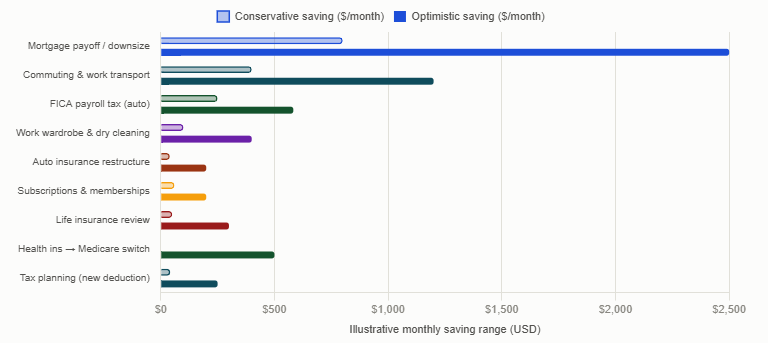
Monthly Saving By Bill Cut
Retiree Spending Breakdown
The Real Value of Your Social Security Check in 2026
The 2026 Social Security cost-of-living adjustment brought the average retired-worker benefit to approximately $2,071 per month — a $56 increase from $2,015 in 2025. That headline figure looks like welcome relief after years of inflation. The lived reality is more complicated. The Medicare Part B premium rose 9.7 percent in 2026, from $185 to $202.90 per month, which is automatically deducted from most Social Security checks before the money arrives. After the Medicare premium deduction, the net gain from the 2.8 percent COLA was approximately $38 per month for most recipients, according to FinanceBuzz’s June 2026 analysis.Then there is inflation, which 77 percent of older adults in an AARP survey said a 3 percent COLA would not adequately address. And taxes: approximately 50 percent of Social Security recipients pay federal income tax on their benefits, with the taxable share rising every year because the income thresholds that trigger taxation are not adjusted for inflation, according to the Senior Citizens League and The Motley Fool’s January 2026 analysis.
All of which means that the transition to Social Security is not simply a matter of replacing your paycheck with your benefit. It is a restructuring of your entire financial life — one that creates specific opportunities to reduce expenses that were directly tied to your working years, and specific risks in areas like healthcare and housing. This guide identifies the nine specific expense categories that new Social Security recipients should review and, in most cases, significantly reduce or eliminate.
The Numbers: Average 2026 Social Security retired-worker benefit: $2,071/month (up $56 from 2025, SSA/Kiplinger). Medicare Part B: $202.90/month in 2026 (up 9.7%, deducted from most SS checks). Net COLA gain after Medicare: approximately $38/month. 77% of seniors say the COLA does not keep pace with their costs (AARP November 2025). 69 million Americans receive Social Security payments.
The New Retirement Budget: What Actually Changes When Benefits Start
Retiree households led by someone 65 or older spent an average of $61,432 in 2024 — approximately $5,100 per month — according to Bureau of Labor Statistics Consumer Expenditure data, as analysed by Vision Retirement in January 2026. This is less than the average for all US households ($78,535), but the composition of spending is dramatically different. Housing dominates at $22,193 per year, over 36 percent of total spending. Healthcare takes a growing share. Meanwhile, many working-life expenses disappear or shrink significantly.GoBankingRates’ August 2026 retirement budget analysis, quoting financial expert Shirshikov, articulates the proper structure: Social Security, pensions, and annuities should ideally cover housing, healthcare, and food, while portfolio withdrawals fund discretionary spending. This structure is the target. Getting there requires systematically eliminating the expenses that were tied to your employment and replacing them, where appropriate, with retirement-appropriate alternatives.
The nine bills below fall into three categories:
- Expenses that disappear entirely when you stop working (payroll tax, commuting costs, work wardrobe).
- Expenses that should be replaced with cheaper alternatives (employer health insurance → Medicare; full-coverage auto → appropriate senior coverage; streaming bundles → curated single services).
- Expenses that require active strategic action to reduce (mortgage, life insurance, tax burden).
Bill #1: Employer-Provided Health Insurance Premiums
For most Americans who retire at 65 or older, this is the single most significant bill that can be eliminated or dramatically restructured at the point of Social Security collection. If you have been paying into an employer-sponsored health plan through payroll deductions — which average several hundred dollars per month for employee contributions, sometimes more for family coverage — Medicare replaces this coverage.Medicare Part A (hospital insurance) is generally premium-free for those who paid Medicare taxes for 10 or more years. Medicare Part B (medical insurance) costs $202.90 per month in 2026, automatically deducted from your Social Security benefit. The combined Medicare structure typically costs significantly less than active employee contributions to employer-sponsored family plans, where employee-only contribution averages can exceed $100 to $200 per month even before deductibles, and family coverage contributions can exceed $500 to $700 per month.
However, Medicare does not cover everything that employer plans covered. Dental, vision, and hearing are not included in Original Medicare. Long-term care is not covered. SeniorLiving.org’s February 2026 senior budgeting guide notes that out-of-pocket costs for dental and vision can add up quickly. The appropriate response is to add a Medicare Supplement (Medigap) plan and a Part D prescription drug plan, or to choose Medicare Advantage (Part C), which bundles all components, often with dental and vision included.
Action: Contact the Social Security Administration or Medicare.gov to enroll in Part B no more than 3 months before your 65th birthday. Missing the Initial Enrollment Period results in a permanent 10% surcharge on Part B premiums for each 12-month period you delayed enrollment, for as long as you have Medicare coverage.
Bill #2: High-Premium Life Insurance Policies
Life insurance exists primarily to replace lost income for dependants and to cover debts that would burden survivors. In retirement, both of these justifications often weaken significantly. If your children are financially independent adults, if your mortgage is paid off or manageable by your spouse on their own income, and if your surviving spouse would receive Social Security survivor benefits adequate to cover their expenses, the argument for maintaining expensive life insurance premiums diminishes considerably.U.S. News’ retirement expenses guide identifies life insurance as one of the first expenses to reconsider in retirement. Term life insurance that was purchased to cover a working career and provide income replacement has served its purpose when the career ends. Whole life insurance is more complex: the cash value may represent a meaningful asset worth surrendering for lump-sum capital, converting to a paid-up policy with no further premiums, or continuing for estate planning purposes if the death benefit is part of a wealth transfer strategy.
The question to ask: if I died today, what financial problem would the death benefit solve for my surviving family members? If the honest answer is ‘none that could not be managed from existing assets and Social Security survivor benefits,’ the premium is likely a candidate for elimination.
Warning: Do not cancel any life insurance policy without a professional review of your specific situation, survivor’s benefit needs, estate plan, and whether any cash value is available. Consult a fee-only financial adviser or insurance specialist before making any coverage decision.
Bill #3: Commuting and Work-Related Transportation Expenses
The daily commute represents one of the most significant and least celebrated budget line items that retirement eliminates entirely. The cost of commuting in the United States encompasses gasoline or transit fares, vehicle wear and maintenance acceleration, parking fees, tolls, and the hidden cost of higher annual mileage on vehicle depreciation schedules. Cost studies have estimated average US commuter transportation spending at well over $8,000 per year before accounting for time value.When you retire, this expense does not simply reduce — it largely disappears. You no longer need to maintain a vehicle specifically capable of highway commuting. You no longer pay for monthly parking. You no longer purchase transit passes. You no longer fill the tank twice a week. The vehicle you keep in retirement may accumulate a fraction of the annual mileage it did during your working years, dramatically reducing both fuel and maintenance costs and, potentially, allowing you to reduce insurance coverage.
U.S. News’ retirement expenses guide notes that with a flexible retirement schedule, seniors can also reduce or eliminate costs previously incurred from convenience-driven spending — the expensive pre-work coffee, the overpriced lunch near the office, the parking garage fees. All of these go to zero on the first day of retirement.
Key Point: The retirement transportation budget needs to be rebuilt from zero based on actual expected mileage, not adjusted down from your working-life vehicle budget. A retiree who drives 5,000 miles per year has dramatically different insurance, fuel, and maintenance costs than one who drove 15,000 during their working years.
Bill #4: Work Wardrobe, Dry Cleaning, and Professional Grooming
Professional clothing, workplace grooming standards, and business-appropriate accessories represent a recurring but often underestimated cost category during working years. Dry cleaning bills, monthly haircuts at a professional salon, new suits or business wear purchased for interviews or promotions, work shoes, and accessories all have workplace-specific price points that retirement makes unnecessary.U.S. News’ retirement expense guide specifically identifies work-related spending as a category that shrinks in retirement: you might spend less on office clothes, time-saving services, and work-related spending. The BLS Consumer Expenditure data confirms this: apparel spending for retiree households is lower than for working-age households, reflecting the shift from business to casual and the reduction in frequency of new purchases.
The replacement cost in retirement is casual or leisure clothing purchased much less frequently at a lower price point per item. Dry cleaning bills often drop to near zero for those who switch entirely to casual and wash-and-wear. Regular haircuts may continue but at a less premium-priced establishment or less frequently. Professional grooming routines driven by workplace expectations can be replaced by more relaxed, less costly personal care habits.
Bill #5: Payroll Tax Contributions (FICA)
This is the expense that disappears automatically the moment you stop working — no cancellation required. The Federal Insurance Contributions Act (FICA) payroll tax funds Social Security and Medicare. Employees pay 6.2 percent of earnings to Social Security on wages up to the 2026 wage base of $184,500, and 1.45 percent to Medicare on all wages, with no cap. For someone earning $60,000 per year, FICA contributions total approximately $4,590 annually.When you retire and shift to living on Social Security benefits, pension income, and investment withdrawals, you stop paying FICA on your income (investment income, retirement account withdrawals, and Social Security benefits are not subject to FICA). This is a substantial and automatic improvement in the effective income-to-bill ratio of your monthly budget. The money does not go away — it stays in your take-home retirement income rather than going to the federal government.
Key Point: FICA is the one bill on this list you genuinely cannot cut — because it stops the moment you retire. It is worth understanding its size precisely because new retirees sometimes fail to account for the income increase it represents. Your retirement income is not equivalent to your pre-retirement take-home pay; it needs to cover what your prior paycheck covered minus the FICA and other payroll deductions that no longer apply.
Bill #6: Subscriptions, Memberships, and Streaming Services
Subscription spending is one of the most well-documented areas of financial leakage for American households of all ages. Research on subscription audit behaviour consistently shows that households have significantly more active subscriptions than they can name from memory, paying for services they rarely or never use. At the start of retirement and a transition to fixed income, a systematic subscription audit is both timely and impactful.Categories to review immediately upon retirement:
- Streaming services: most households maintain three to five streaming subscriptions simultaneously, with combined monthly costs of $50 to $100+. A retirement audit should identify which services are actually watched weekly vs. which are passively maintained. Cancelling two unused services and keeping two actively used ones typically saves $25 to $50 per month.
- Professional memberships and trade associations: if these were job-related (industry association memberships, professional certification renewal fees, LinkedIn Premium for career purposes), they may no longer have any practical value in retirement.
- Gym memberships: many seniors are eligible for Silver Sneakers, a fitness program available at no additional cost through most Medicare Advantage plans and some Medigap plans, providing gym access at participating locations nationwide. Check eligibility before renewing any paid gym membership.
- News and content subscriptions: many seniors pay full price for subscriptions that offer significantly reduced rates for those 60+. Call and ask for the senior rate; a surprising number of providers offer 20 to 50 percent discounts that are not advertised.
- Apps and software tied to work: cloud storage plans sized for work files, software suites used only for professional purposes, project management tools, and career development apps can all be cancelled or downgraded to free tiers.
Bill #7: Full-Premium Auto Insurance (and Possibly One Vehicle)
Auto insurance premiums during working years reflect the risk profile of a commuter: high annual mileage, regular highway driving, rush-hour traffic exposure, and vehicle usage in high-density conditions. Retirement changes all of these risk factors simultaneously, and your insurance premium should reflect this change.Steps to take immediately at retirement:
- Inform your insurer that you are no longer commuting. Many insurers offer specific low-mileage or pleasure-use discounts that reduce premiums by 5 to 15 percent.
- Review whether your vehicle is still appropriate for your driving patterns. If you previously maintained two cars to support two separate work commutes, retirement may allow you to consolidate to one vehicle, eliminating one car’s insurance, registration, maintenance, and loan payment entirely.
- Shop the market. U.S. News’ retirement expense guide recommends reviewing transportation costs including gas, maintenance, insurance, and using a single car where feasible. Insurers price premiums individually; the market may have shifted significantly since your last comparison.
- Check for senior discounts. Many insurers offer discounts for completion of a defensive driving course for those 55+. AAA, AARP, and several state programs subsidise these courses specifically to help seniors access lower auto premiums.
Bill #8: The Mortgage Payment (Through Strategy, Not Desperation)
Housing is the largest single expense category for retirees: $22,193 per year on average, representing over 36 percent of total annual spending (BLS data, Vision Retirement). For the subset of retirees still carrying a mortgage payment into retirement, this bill represents both the greatest financial burden and, potentially, the greatest opportunity to free up monthly cash flow.U.S. News’ retirement expenses guide frames this directly: paying off your mortgage eliminates one of your largest monthly bills. You no longer need to make interest payments to a lender. While you will still pay insurance and property taxes and continue to maintain your home, these costs are likely a fraction of what you were paying for your mortgage.
The three strategic options for the mortgage at retirement:
- Pay off the mortgage before retirement: for those who have the financial capacity, entering retirement mortgage-free is the single most effective monthly cash-flow improvement available. A mortgage of $200,000 at 4% with 10 years remaining generates approximately $2,025 in monthly payments (principal, interest, insurance, taxes). Eliminating this converts $24,300 in annual obligations into zero.
- Downsize: Jordan Mangaliman, CEO of Goldline Financial Services, told U.S. News that ‘retirement is a great opportunity to reevaluate how much house you need.’ Selling a larger home, purchasing a smaller, lower-maintenance property with cash from the sale, can eliminate both the mortgage and the ongoing costs (utilities, property tax, maintenance) of maintaining more space than retirement life requires.
- Relocate to a lower cost-of-living area: housing costs vary enormously by geography. Some retirees in high-cost coastal metros find that relocating to a lower-cost region allows them to purchase or rent a comparable-quality home for 40 to 60 percent less, substantially improving their Social Security’s purchasing power.
Bill #9: A Higher Tax Burden Than Necessary
Taxes are not a subscription you can cancel, but they are a bill that many new Social Security recipients dramatically overestimate or undermanage. The transition to retirement creates several legitimate tax reduction opportunities that did not exist during working years.The 2026 developments affecting Social Security recipients’ tax bills:
- • New senior deduction (OBBB): under the One Big Beautiful Bill Act, individuals aged 65 and older are eligible for a new deduction of up to $6,000 against taxable income. The deduction phases out above $75,000 MAGI for individuals and $150,000 for married couples filing jointly. AARP’s November 2025 analysis and the Tax Policy Center confirm this applies to tax year 2025 and is effective through 2028.
- • Reduced income tax bracket: many retirees find themselves in a lower marginal tax bracket than during their working years, as employment income drops and is replaced by tax-advantaged Social Security benefits and qualified dividend or long-term capital gain income (taxed at preferential rates).
- • Roth conversion strategy: in the years immediately after retirement but before Required Minimum Distributions (RMDs) begin at age 73 (under current law), many retirees have a low-income window ideal for converting traditional IRA funds to Roth IRA at lower tax rates, reducing future RMDs and future tax bills.
- • Managing provisional income: up to 85 percent of Social Security benefits can be taxable if provisional income exceeds $34,000 (single) or $44,000 (married). Managing distributions from different account types — Roth vs. traditional — can keep provisional income below these thresholds.
12. The Bills You Must NOT Cut
This guide focuses on the expenses that appropriately shrink or disappear at retirement. Equal caution is warranted about expenses that must not be cut:- Medicare Part B premium: this is deducted automatically. Do not attempt to stop it. Dropping Part B results in a permanent premium surcharge of 10 percent for every 12-month period of non-enrollment, for life.
- Medicare Part D (prescription drug coverage) or Medicare Advantage: seniors who forgo drug coverage and later need expensive prescriptions face both the drug cost and a permanent late-enrollment penalty.
- Supplemental health coverage (Medigap or Medicare Advantage): the gap between what Original Medicare covers and what a health event costs is significant. A major health event without supplemental coverage can consume years of savings.
- Homeowner’s or renter’s insurance: a catastrophic home loss without insurance is financially unrecoverable for most retirees. Reduce the premium through competitive shopping, not coverage reduction.
- Long-term care insurance: if you have it, this is generally not the time to drop it. If you don’t have it, consult a financial adviser about hybrid life-LTC products, which may provide coverage at a lower combined premium than standalone LTC policies.
- Basic food, utilities, and essential transportation: these are non-negotiable even on a fixed income. The goal is to have enough recurring savings from the nine bills above that these essentials are never at risk.
13. The Full Savings Potential: What the Cuts Add Up To
Bill Category Typical Pre-Retirement Monthly Cost Typical Retirement Reduction Annual Saving Potential Key Action
The total potential savings range of $1,750 to $6,150 per month is illustrative. Not every household will capture every category. For many new Social Security recipients, however, even capturing three or four of these categories represents the difference between a comfortable retirement budget and a monthly cash flow shortfall.
How to Synchronise Your New Budget With Your Payment Date
Social Security benefit payments are made on a specific day of the month based on the recipient’s birth date. Many new retirees discover that their Social Security payment date and their major bill due dates are misaligned — and TheStreet’s December 2025 analysis notes that according to AARP, many seniors get hit with overdraft fees simply because benefit dates and bill dates are out of sync, not because their total income is too low.The practical fix: as soon as you begin receiving Social Security, call each major biller (mortgage or rent, utilities, insurance) and request that the due date be moved to two to three days after your Social Security payment date. Most billers accommodate this request at no cost. For those managing multiple income sources (pension, part-time work, and Social Security), stagger major bill dates to avoid cash-flow crunches in the first week of the month.
Looking Ahead: Planning for Social Security’s Uncertain Future
The 2026 Social Security Trustees Report, released on June 9, 2026, projected that the Old-Age and Survivors Insurance (OASI) Trust Fund will be depleted in the fourth quarter of 2032 — one quarter earlier than the previous year’s projection. At depletion, if Congress has not acted, Social Security would pay approximately 78 percent of scheduled benefits from incoming payroll tax revenue (Budget Seniors, August 2026; Charles Schwab, July 2026). The Congressional Budget Office’s February 2026 projection reached the same 2032 depletion date with a slightly larger 28 percent potential cut.This is the context in which every bill-cutting and budget-optimisation decision made now is worth making. A 22 to 28 percent reduction in Social Security benefits in 2032 — averaging $460 per month or more based on current benefit levels, per Newsweek’s January 2026 analysis — would represent a severe financial shock for households whose budgets are built around current benefit levels. The households best positioned to absorb such a shock are those that have already eliminated unnecessary expenses, built supplemental income or investment withdrawals, and reduced fixed obligations like mortgage payments.
Congress has acted before — the 1983 bipartisan reform package addressed a similar crisis — and most analysts consider it unlikely that benefits would actually be cut to 78 percent without legislative intervention. But the fiscal math is real, the timeline is closer than it has ever been, and the prudent retirement financial plan accounts for some level of benefit uncertainty.
Charles Schwab (July 2026): It is unlikely that retirement benefits would disappear entirely. Social Security is a popular program, and eliminating it would take an act of Congress. However, the projection of the retirement trust fund becoming insolvent in 2032 means the crisis will come during the term of the next president, and the pressure on Congress to address it will grow.
Conclusion
Your first Social Security check — approximately $2,071 on average in 2026, minus $202.90 for Medicare Part B, minus any applicable taxes — is not a replacement paycheck. It is the anchor of a restructured financial life that looks very different from your working years. The nine bill categories in this guide represent the places where that restructuring produces the most opportunity: expenses tied to employment that no longer exist, coverage that needs to be right-sized to your retirement situation, and strategic choices about housing and taxes that can dramatically change your monthly cash flow.The retirees who make the transition most smoothly are not necessarily those with the highest Social Security benefits. They are the ones who approach the first check as the beginning of a new budget — one that is audited honestly, restructured deliberately, and aligned with the actual costs of retirement life rather than the habit costs of working life. The nine cuts in this guide are where that process starts.
Frequently Asked Questions
What is the average Social Security check in 2026?The average retired-worker Social Security benefit in 2026 is approximately $2,071 per month, following the 2.8% cost-of-living adjustment (COLA) that took effect with January 2026 payments (SSA; Kiplinger, April 2026). This is up from approximately $2,015 in 2025. However, Medicare Part B premiums of $202.90 per month are automatically deducted from most Social Security checks, and federal income taxes apply to benefits for approximately 50% of recipients. After these deductions, the net amount available for living expenses is typically $1,750 to $1,900 for the average beneficiary before any applicable state income taxes.
What expenses go away when you retire and start collecting Social Security?
Several significant expenses either disappear entirely or can be reduced when you retire and stop working: FICA payroll taxes (Social Security and Medicare tax on wages, 7.65% of earnings) disappear automatically; commuting costs (gas, transit, parking, tolls, vehicle wear) can be largely eliminated; work wardrobe and dry cleaning expenses drop significantly; professional membership fees no longer required; and in some cases, employer health insurance contributions are replaced by lower-cost Medicare. These automatic reductions, combined with strategic cuts to life insurance, subscriptions, and auto insurance, can free $500 to $2,000 or more per month depending on the individual's prior spending pattern.
Should I drop life insurance when I start collecting Social Security?
This depends on your specific situation and should be evaluated with a financial adviser rather than decided automatically. Life insurance should be reconsidered if: your children are financially independent adults; your mortgage is paid off or manageable by your surviving spouse; your spouse would receive adequate Social Security survivor benefits; and your estate is large enough to cover final expenses without a death benefit. If any of these conditions are not met, maintaining coverage may be appropriate. For whole life policies with accumulated cash value, the options include surrendering for cash, converting to a reduced paid-up policy, or using the cash value to fund a premium offset. Never cancel without a professional review of your specific estate and survivor needs.
How does Medicare replace my employer health insurance when I retire?
When you turn 65 and enroll in Medicare, Part A (hospital coverage) is generally premium-free for those with 40+ quarters of Medicare-covered work history. Part B (medical coverage) costs $202.90 per month in 2026, automatically deducted from your Social Security benefit. Medicare does not cover dental, vision, hearing, or long-term care, which employer plans may have covered. To fill these gaps, most retirees add either a Medicare Supplement (Medigap) plan plus a Part D drug plan, or a Medicare Advantage (Part C) plan that bundles all components, often including dental and vision. Missing your Initial Enrollment Period (3 months before to 3 months after your 65th birthday) results in permanent premium surcharges of 10% per year for Part B and 1% per month for Part D, for life.
What is the Social Security trust fund depletion date and what does it mean for my benefits?
The 2026 Social Security Trustees Report, released June 9, 2026, projected that the Old-Age and Survivors Insurance (OASI) Trust Fund will be depleted in the fourth quarter of 2032. At that point, if Congress has not acted, Social Security would be able to pay approximately 78% of scheduled retirement benefits from incoming payroll tax revenue, according to the Trustees' estimate. The Congressional Budget Office's February 2026 projection reached the same 2032 depletion date with a slightly larger 28% potential cut. It is important to understand that depletion does not mean benefits stop — it means benefits would be reduced to what incoming taxes can support. Congress has intervened before (the 1983 reform) and most analysts expect intervention before depletion, but the fiscal math is real. Prudent retirement planning accounts for some level of benefit uncertainty by building supplemental income sources and reducing fixed obligations now.
Can I work while collecting Social Security?
Yes, but with important limits for those below full retirement age (FRA). In 2026, the retirement earnings test limits are: for those under FRA for the entire year, $24,480 ($2,040/month); SSA deducts $1 from benefits for every $2 earned above this limit. For those reaching FRA in 2026, the limit is $65,160 for the months before FRA; SSA deducts $1 for every $3 above this limit. Once you reach full retirement age, there is no limit on employment income and no reduction in benefits regardless of how much you earn. The Senior Citizens' Freedom to Work Act, introduced in Congress in 2026, would eliminate the retirement earnings test entirely, but as of August 2026 it has not been enacted (Fox Business, April 2026).
0 Comments
Be the first to share your thoughts on this article.