

Savings
10 Medicare Mistakes to Avoid — Costs & Fixes
A 2-year delay in signing up for Medicare Part B adds $40.58 to your monthly premium for life — over $12,000 in penalties over a 25-year retirement, for coverage you would have paid for anyway. IRMAA surcharges can more than triple Part B costs if your income from two years ago crosses a threshold you may not know about. The Medigap guaranteed-issue window is just six months. Medicare is one of the most consequential financial decisions you will make in retirement — and its most costly mistakes are also the most preventable. This guide names all ten.
The Medicare system is designed around specific enrollment windows — most of them measured in months, not years — and penalties that activate the moment those windows close. The Initial Enrollment Period is seven months. The Medigap guaranteed-issue window is six months from your Part B effective date. IRMAA surcharges are calculated from tax returns filed two years before the relevant premium year. HSA contribution rules interact with Medicare enrollment in ways that create tax penalties if a specific six-month trigger is missed. These are not obscure provisions in fine print — they are the structural rules that govern a programme used by over 65 million Americans. But they are opaque enough that the most common mistakes are made by thoughtful, financially literate people who simply did not know the rule in time.
This guide addresses ten of the most costly and most common Medicare mistakes in 2026. Each one is preventable. Each one has a specific, actionable fix. And each one is best acted on before the relevant window closes — which, in several cases, means before your 65th birthday.
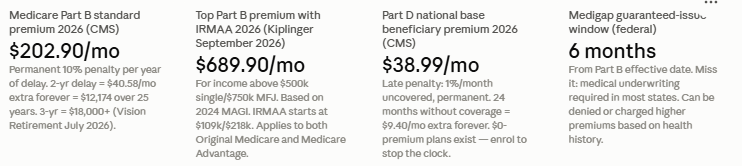
Part B standard premium 2026: $202.90/month (CMS). Part B late penalty: 10% per 12-month delay period, permanent. 2-year delay = $40.58/month extra forever. Over 25 years: more than $18,000 in penalties for a 3-year delay (Vision Retirement July 2026). Part D national base beneficiary premium 2026: $38.99/month. Part D late penalty: 1% per uncovered month, permanent. IRMAA surcharges begin at $109,000 income (single) / $218,000 (MFJ) in 2026; based on 2024 MAGI. Top Part B premium with IRMAA 2026: $689.90/month (Kiplinger September 2026). Medigap open enrollment: 6 months from Part B effective date — guaranteed issue only during this window. IEP: 7 months centred on 65th birthday.
The timing matters within the IEP. If you enrol during the three months before your birthday month, your Part B coverage begins on the first of your birthday month. If you enrol during your birthday month or the three months after, coverage is delayed by one, two, or three months respectively. For the earliest possible coverage start date, enrol three months before your birthday month. The paulbinsurance.com June 2026 Medicare guide offers a practical reminder: mark your 65th birthday on your calendar and count back three months — that is the first day you can enrol with the earliest possible coverage start date.
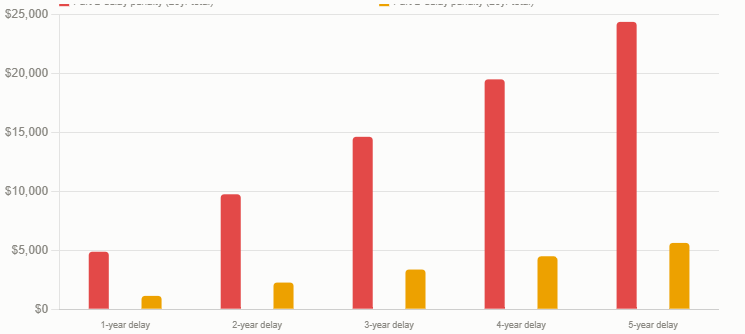
The lifetime cost of missing the IEP. Part B standard premium 2026: $202.90/month. 1-year delay (10% penalty): +$20.29/month extra = $243.48/month. Over 25 years at that penalty rate: $6,087 extra. 2-year delay (20% penalty): +$40.58/month extra. Over 25 years: $12,174 extra. 3-year delay (30% penalty): +$60.87/month extra. Over 25 years: $18,261 extra (Vision Retirement July 2026: 'more than $18,000 in penalties'). Note: the standard premium adjusts annually with CMS increases, so the true lifetime penalty is larger than these fixed-rate calculations. Penalties are also recalculated each year based on the new standard premium — so the dollar amount can increase over time. Not financial advice.
IEP: begins 3 months before your 65th birthday month; ends 3 months after. Enrol in the first 3 months for earliest coverage start. Miss it: wait until General Enrollment Period (Jan 1–Mar 31), coverage starts July 1. To enrol: visit SSA.gov or call 1-800-772-1213 (Social Security). If already receiving Social Security benefits at 65, you are enrolled in Parts A and B automatically — confirm coverage start date with SSA.
Mark the month that is 3 months before your 65th birthday. Begin the Medicare.gov comparison process during that month. If you have employer coverage that qualifies you to delay, confirm in writing with your HR department that it is active employer group health coverage — not COBRA, not retiree coverage. Keep documentation. If you are within 3 months of turning 65 and have not enrolled, do so immediately at SSA.gov or by calling 1-800-772-1213. Do not wait for any additional information — the 7-month window is already open.
The consequence of this mistake is severe. A person who retires at 65, takes COBRA, and skips Medicare Part B enrollment is not protected from the Part B late enrollment penalty. The penalty clock begins running from the end of their IEP. Every full 12-month period they continue on COBRA without Part B enrollment is another 10% permanent penalty on their Part B premium. paulbinsurance.com's July 2026 guide states it directly: 'COBRA is continuation coverage, not active employer coverage. At $202.90/month in 2026, two years of delay costs an extra $40.58 every month for life.'
The same misconception applies to retiree health benefits — coverage a former employer provides in retirement. Many retiree plans do not count as creditable coverage for Part B purposes. The Medicare Coach's May 2026 guide notes: 'Does retiree health insurance count as creditable coverage? It depends on the specific policy you hold. Many retiree plans do not count as creditable coverage for Part B, which means you could still face a permanent penalty. Always verify your plan's status with your benefits administrator directly.' The word 'retiree' in the plan name does not make it equivalent to active employer coverage for Medicare purposes.
The Mistake: The COBRA trap: A beneficiary who retired at 65 and took COBRA for 18 months, assuming it bridged their Medicare enrollment, may have accumulated an 18-month delay. At 10% per 12-month period, that is a 10% permanent penalty. At $202.90/month in 2026, that is $20.29/month extra for life — $6,087 over a 25-year retirement. And they received no coverage gap protection, because COBRA ended at 18 months with no guaranteed Medicare transition. The fix: enrol in Medicare Part B before or at the same time as leaving employer coverage, unless you have confirmed active employer group health coverage from a current employer.
Before retiring or leaving employer coverage, contact your HR department and ask specifically: 'Does this coverage qualify as active employer group health coverage for the purpose of delaying Medicare Part B enrollment without penalty?' Get the answer in writing. If the answer is COBRA, retiree coverage, or any form of continuation coverage: enrol in Medicare Part B immediately. The IEP or a Special Enrollment Period triggered by the loss of qualifying coverage is the correct window. If you have already delayed based on COBRA and suspect you have accrued a penalty, contact 1-800-MEDICARE to assess your situation. In some cases, if a Social Security or Medicare representative gave incorrect advice that caused the delay, equitable relief may be available.
The Part D late enrollment penalty is calculated as 1% of the national base beneficiary premium ($38.99 in 2026) for every month you went without creditable prescription drug coverage after your IEP closed. At 24 months without coverage: the penalty is 24% of $38.99 = $9.36/month, rounded to the nearest $0.10 = $9.40/month, added permanently to your Part D premium for as long as you have Medicare. Over 20 years of retirement: $2,256 in extra premiums for having skipped coverage you did not need.
The fix is straightforward and inexpensive. In 2026, there are $0-premium Part D plans available in most areas. Enrolling in a $0-premium Part D plan at the time of initial Medicare eligibility costs nothing and stops the penalty clock permanently. When medications are eventually needed, the $0-premium plan can be changed during Annual Enrollment Period to one that actually covers the specific drugs required. The Vision Retirement July 2026 guide states the strategy plainly: 'If you don't have a creditable plan through an employer or retiree health benefit, enroll in a low-cost (or even $0-premium) Part D plan to keep the clock from ticking.'
At the time of Medicare initial enrollment: locate $0-premium or low-cost Part D plans in your area using the Medicare Plan Finder at Medicare.gov. Enrol in one. Cost: $0 or minimal per month. Benefit: permanent protection from the Part D late enrollment penalty. When your drug needs change, switch to a better-matched plan during Annual Enrollment Period (October 15 – December 7) each year. If you have creditable drug coverage through an employer, confirm its creditable status in writing — your employer is required to notify you annually whether their coverage meets the Medicare Part D standard.
The guaranteed-issue window for Medigap is six months from the effective date of Medicare Part B. During this window, insurers are legally required to sell any Medigap policy they offer, at the same price as any other enrollee, regardless of health conditions. This is the most important window in Medicare planning for people who intend to choose Original Medicare plus Medigap — and it is the one most commonly missed.
Outside this window, Medigap insurers can apply medical underwriting in most states — they can charge higher premiums for pre-existing conditions or deny coverage entirely. The MedicareResources.org February 2026 guide notes: 'Switching from Medicare Advantage to Medigap later requires medical underwriting in most states.' A beneficiary who chose Medicare Advantage at 65 because the premiums were lower, and who later develops a serious health condition and wants to switch to Original Medicare plus Medigap, may find they are uninsurable or face premiums that are unaffordable. The guaranteed-issue window that was available at 65 is gone.
The Mistake: The Medicare Advantage trap: choosing Medicare Advantage at 65 because of lower premiums or added benefits (dental, vision, gym memberships) is a legitimate choice. But the decision must be made with the understanding that switching back to Original Medicare plus Medigap later is not guaranteed. If you develop a major illness while on Medicare Advantage and attempt to switch, the medical underwriting rules in most states mean your health condition will affect your Medigap insurability. The paulbinsurance.com June 2026 guide on Medicare enrollment mistakes identifies this as one of the most painful outcomes: 'Your Medigap guaranteed issue window lasts only six months from your Part B effective date. Miss it and you may face medical underwriting — or be denied coverage entirely.'
Within 6 months of your Part B effective date: research Medigap plans in your state using the Medicare.gov Plan Finder or a licensed Medicare insurance agent. Compare Plan G and Plan N as starting points. Obtain quotes from at least three insurers — premiums for the same plan vary significantly between insurers even though the coverage is standardised. If you are considering Medicare Advantage, understand specifically what will happen if you want to switch to Medigap in 5 or 10 years — including what states offer additional guaranteed issue windows and what conditions they apply. A few states (Connecticut, Massachusetts, New York, and Maine) have additional Medigap protections beyond the federal 6-month window. Confirm the rules in your specific state.
The IRMAA shock arrives because of the two-year lookback rule. IRMAA for 2026 is based on MAGI from the 2024 tax return. This means that a worker who earned a high income in 2024 — including a large bonus, stock option vesting, business sale, or final year of work before retiring — may face unexpectedly high Medicare premiums in 2026 even if their retirement income is modest. The CompareMedicare IRMAA guide confirms: 'Retirees are especially vulnerable to IRMAA in the first two years on Medicare because your final working years (bonuses, stock options, vested equity, or a high-income retirement year) directly feed the IRMAA calculation.' The surcharge can be both substantial and temporary — but only if the beneficiary knows it can be appealed.
Crucially, IRMAA applies to both Original Medicare and Medicare Advantage plans. A $0-premium Medicare Advantage plan still requires the beneficiary to pay their Part B premium, including any IRMAA surcharge, on top of the plan's stated premium. The Medigap Advisors June 2026 guide is explicit: 'Yes, IRMAA surcharges apply regardless of whether you have Original Medicare or Medicare Advantage. The additional amount is based on your income, not your plan type.'
IRMAA can be reduced through smart account management before and during Medicare enrollment. Roth IRA withdrawals, Roth 401(k) withdrawals, HSA distributions for qualified medical expenses, and Qualified Charitable Distributions (QCDs) from IRAs do not count toward MAGI for IRMAA purposes. Traditional IRA and 401(k) withdrawals DO count toward MAGI. Proactively managing the sequence and source of retirement income withdrawals — particularly in the years before Medicare begins — can prevent or reduce IRMAA exposure. A large Roth conversion in the year before Medicare that pushes MAGI above an IRMAA threshold will increase Medicare premiums two years later. This interaction must be modelled in advance. Not financial advice — consult a tax professional.
How to Avoid It: IRMAA management checklist. 1) Look up your 2024 MAGI (from your 2024 federal tax return): AGI + tax-exempt interest. 2) Check whether your 2024 MAGI exceeds $109,000 (single) or $218,000 (MFJ) — the 2026 IRMAA thresholds. 3) If yes: your 2026 Part B premium is higher than $202.90/month. 4) If your income was unusually high in 2024 due to a one-time event (final year of work, pension lump sum, business sale), file Form SSA-44 to appeal the IRMAA on the basis of a qualifying life event (retirement). 5) Plan 2025 income carefully: your 2025 MAGI determines your 2027 IRMAA. Coordinate Roth conversions, asset sales, and IRA withdrawals with a tax professional to avoid unintentional IRMAA triggers. Contact 1-800-MEDICARE or SSA for Form SSA-44.
The trap is the Part A retroactive enrollment rule. If you apply for Social Security benefits at age 65 or older, Medicare Part A is automatically enrolled and may be applied retroactively for up to six months. This means that a person who delays Social Security until 70 but applies at 69 will have Part A backdated to their application date minus six months — making any HSA contributions made during that six-month period an excess contribution subject to a 6% IRS excise tax per year until corrected.
The paulbinsurance.com June 2026 Medicare enrollment mistakes guide illustrates the scenario: 'When you enroll in Medicare in June 2026, Part A is retroactively applied to December 2025. Your entire 2026 HSA contribution is now excess — and subject to a 6% annual penalty until corrected.' The fix is to stop HSA contributions at least six months before planning to apply for Social Security benefits or Medicare enrollment. If contributions have already been made after Part A effective date, contact the HSA administrator promptly to withdraw the excess amount and any earnings before the tax filing deadline.
Stop HSA contributions: at least 6 months before applying for Social Security benefits or Medicare enrollment. If already enrolled in Medicare Part A: stop immediately and take no further HSA contributions. If you have made excess contributions: contact your HSA administrator to request a correction withdrawal of excess contributions plus earnings before your tax return is filed. This avoids or minimises the 6% excise tax. HSA funds already accumulated before Medicare enrollment can still be used tax-free for qualified medical expenses in retirement, including Medicare premiums (Parts B, D, and Medicare Advantage premiums), dental, vision, and long-term care insurance premiums up to the eligible limit. Stop contributions; do not close the account — it remains a valuable tax-free spending tool for healthcare costs.
ACA marketplace premium subsidies end the moment a beneficiary becomes eligible for premium-free Medicare Part A — not the moment they actually enrol. Once Medicare Part A eligibility is established, continued receipt of ACA subsidies creates a tax liability: the beneficiary will owe the subsidies back on their tax return. The paulbinsurance.com June 2026 guide states the rule clearly: 'The marketplace coverage trap: if you have ACA marketplace coverage with subsidies, those subsidies end the moment you become eligible for premium-free Part A — even if you have not yet enrolled.'
This creates a transitional issue for people who delay Medicare enrollment past 65 while on ACA marketplace coverage. If they are eligible for premium-free Part A at 65 (based on their work history), the ACA subsidies should stop at that point regardless of whether they have completed Medicare enrollment. Continuing to receive and use the subsidies after that point requires reconciliation on the tax return and can result in unexpected tax bills.
ACA to Medicare transition checklist. 1) Identify the month you turn 65 and confirm whether you qualify for premium-free Medicare Part A (based on your or your spouse's 40+ quarters of Medicare-covered employment). 2) If yes, cancel ACA marketplace coverage and notify the marketplace of the change in eligibility in the same month Medicare Part A begins — this stops subsidies correctly. 3) Enrol in Medicare Parts A and B during the IEP to avoid any coverage gap. 4) If you are not eligible for premium-free Part A and are delaying Medicare enrollment with active employer group health coverage, confirm your eligibility status specifically with the marketplace to understand when subsidy eligibility ends. Contact HealthCare.gov or your state marketplace for the correct reporting procedure.
Medicare Advantage plans use provider networks — HMO or PPO structures — that restrict coverage to specific healthcare providers and facilities. Out-of-network care typically involves significantly higher cost-sharing or may not be covered at all outside emergency situations. A beneficiary with a preferred oncologist, a specific hospital system, or a chronic condition requiring regular specialist care who enrols in a Medicare Advantage plan that does not include those providers will face either disrupted care or substantial out-of-pocket costs.
Networks can also change year to year. The CMS September 2025 press release announcing 2026 Medicare plan changes noted that new tools were added to Medicare.gov to allow beneficiaries to compare which plans accept their current providers. Using these tools at every Annual Enrollment Period — not just at initial enrollment — is the correct practice. The Modern Medicare Agency's March 2026 guide identifies the scenario: 'Her specific medications weren't on her plan's formulary' — the same problem applies to preferred providers. Verify both formulary coverage and provider network every year, not just at enrollment.
Before choosing or keeping a Medicare Advantage plan. 1) Log in to Medicare.gov and use the Plan Finder tool. 2) Enter your current doctors, hospitals, and specialists — specifically include your primary care physician, any specialists you see regularly, and your preferred hospital system. 3) Filter plans by those that include all your current providers as in-network. 4) Check the plan's drug formulary against your current medications at their current dosages and quantities. 5) Review the plan's out-of-pocket maximum — how much would you owe in a worst-case year of major illness? 6) Confirm the annual premium increase pattern from prior years — a $0-premium plan that increases to $45/month the following year is a cost that was not visible at enrollment. Repeat this process every year during Annual Enrollment Period (October 15 – December 7).
The cost of inertia in Medicare plan selection is real and quantifiable. Drug formularies change every year — a medication covered in 2026 may be moved to a higher tier, dropped from formulary, or have prior authorisation requirements added in 2027. Provider networks change. Premiums change. Out-of-pocket limits change. A beneficiary who enrolled in 2023 and has never reviewed their plan has potentially been paying for coverage that is no longer the best available match for their current health needs and budget.
The Medicare Plan Finder at Medicare.gov provides a direct comparison of every plan available in the beneficiary's zip code, with personalised cost estimates based on current medications. The comparison takes approximately 30 to 60 minutes. For most beneficiaries, the result either confirms their current plan is still competitive or identifies a meaningfully better option. The CMS 2026 update to Medicare.gov specifically added enhanced tools for comparing plans based on provider acceptance and supplemental benefits — capabilities that were not available in prior years.
Annual Enrollment Period checklist (October 15 – December 7 each year). 1) Log in to Medicare.gov. 2) Open the Plan Finder. 3) Enter your current medications at current dosages. 4) Enter your current preferred providers and facilities. 5) Review the Annual Notice of Change (ANOC) — your current plan must send this by September 30 each year, documenting all changes to premiums, formulary, and cost-sharing for the following year. 6) Compare your current plan against the three or four highest-rated alternatives in your area. 7) If switching plans: confirm the new plan's coverage begins January 1 before stopping any medications or provider visits that depend on the current year's coverage. Set a calendar reminder for October 15 each year.
What Original Medicare does not cover includes: routine dental care (cleanings, fillings, extractions, dentures); routine vision care (eye exams, glasses, contact lenses — though it does cover medically necessary ophthalmology); hearing aids and routine hearing exams; most long-term care (skilled nursing for recovery is covered; custodial care — help with daily living activities — is not); and most care outside the United States. Fidelity's 2026 healthcare retirement estimate of $185,000 covers Medicare-covered costs. Long-term care costs are entirely separate — 70% of people turning 65 today will require some form of long-term care, and average annual costs for a private nursing home room in 2026 run approximately $108,000.
Original Medicare also has no annual out-of-pocket maximum — the most consequential gap in its design. For a beneficiary with a serious illness requiring repeated hospitalisation, the Part A deductible ($1,676 per benefit period in 2026) can apply multiple times in a single year. The Part B 20% coinsurance on doctor and outpatient services has no cap. A Medigap policy (Plan G or Plan N) addresses most of these gaps. Medicare Advantage plans have an annual out-of-pocket maximum, which provides some protection — but the maximum can be as high as $8,850 for in-network care in 2026, and higher for out-of-network care on PPO plans.
Coverage gap review checklist. Dental: identify whether your Medicare Advantage plan includes dental benefits (many do) and what specifically is covered. If on Original Medicare: compare standalone dental insurance or dental savings plans. Vision: verify whether routine eye exams and glasses are covered. Hearing: verify hearing aid coverage — Original Medicare does not cover; many Medicare Advantage plans do. Long-term care: review whether you have long-term care insurance, sufficient assets to self-fund, or are relying on Medicaid (which requires near-depletion of assets). Review your out-of-pocket maximum: if on Original Medicare, obtain a Medigap quote. If on Medicare Advantage, confirm your plan's maximum out-of-pocket for both in-network and out-of-network care. Review annually during the AEP.
The asymmetry of Medicare's penalty structure is precisely why it produces so many costly mistakes. The decisions that trigger permanent consequences are often made passively — by not enrolling, not reviewing, not confirming, not cancelling. The beneficiary who takes COBRA and assumes it covers the Medicare Part B delay is not making an active bad decision; they are failing to make a specific active good decision at a specific time. The beneficiary who skips Part D because they take no medications is choosing inaction that has the same penalty consequence as active non-enrollment.
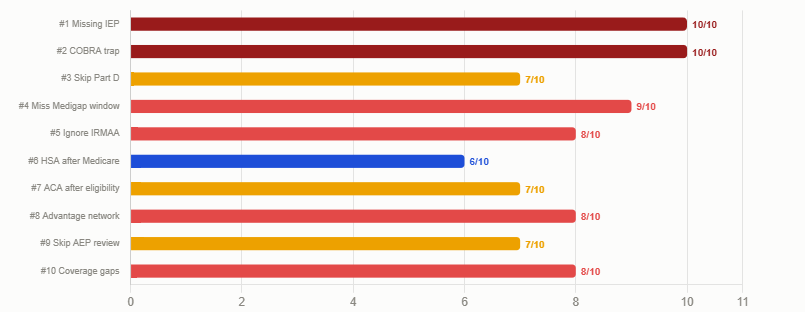
The ten mistakes in this guide are not ranked in order of cost — each has the potential to be the most expensive mistake a specific person makes, depending on their income, their health, their longevity, and their coverage choices. What they share is that all ten can be addressed with planning, time, and the right information before the relevant window closes. The best Medicare decision is the informed one made before the deadline — not the appeal filed after it.
The Medicare Part B late enrollment penalty is a permanent, lifetime surcharge added to your monthly Part B premium if you did not enrol when first eligible and did not have qualifying coverage that exempted you from the requirement. The penalty is 10% of the standard Part B premium for each full 12-month period you were eligible for but did not have Part B. In 2026, the standard Part B premium is $202.90 per month. A 2-year delay produces a 20% permanent penalty: $40.58 extra every month for life. Over a 25-year retirement, a 3-year delay adds more than $18,000 in penalties, according to Vision Retirement's July 2026 analysis. The penalty is recalculated each year based on the new standard premium — so as CMS increases the base premium annually, the dollar amount of the penalty also increases. The penalty cannot be removed in most cases, though appeals are possible if the delay resulted from incorrect advice from a government representative (documented in writing).
Does COBRA count as coverage that lets me delay Medicare without penalty?
No — COBRA does not count as qualifying employer group health coverage for the purpose of delaying Medicare Part B enrollment without penalty. Only active employer group health coverage from a current employer qualifies. COBRA is continuation coverage from a former employer. This is identified as the single most expensive Medicare misconception by multiple 2026 guidance sources. A person who retires at 65, takes COBRA, and skips Medicare Part B enrollment is accruing a permanent Part B penalty from the end of their Initial Enrollment Period (IEP). At $202.90/month in 2026, a 2-year delay via COBRA produces a $40.58/month permanent penalty. Retiree coverage — health benefits provided by a former employer in retirement — also typically does not count as qualifying active employer coverage. Always confirm your specific coverage's status in writing with your HR department or benefits administrator before making any decision to delay Medicare enrollment.
What is IRMAA and how can I reduce it?
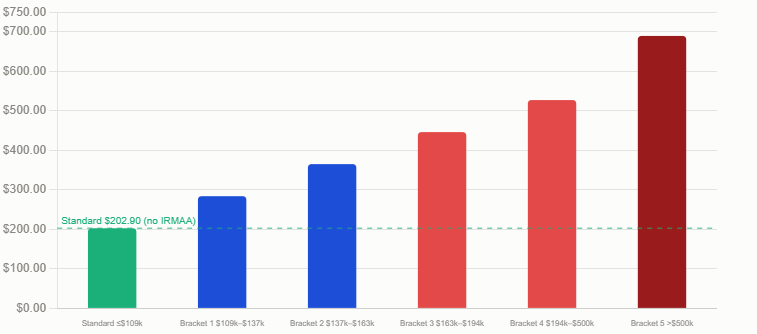
IRMAA (Income-Related Monthly Adjustment Amount) is a surcharge added to Medicare Part B and Part D premiums for beneficiaries whose income exceeds certain thresholds. For 2026, IRMAA begins at income above $109,000 for single filers and $218,000 for married filing jointly, based on 2024 MAGI (Modified Adjusted Gross Income). Part B premiums with IRMAA range from $284.10 to $689.90 per month in 2026 (Kiplinger September 2026). IRMAA applies to both Original Medicare and Medicare Advantage — it is calculated on income, not plan type. To reduce IRMAA: file Form SSA-44 to appeal if you had a qualifying life event (retirement, divorce, death of a spouse, loss of pension) that reduced your income since the tax year used for the calculation. Plan income-producing events (Roth conversions, asset sales, IRA withdrawals) in years before Medicare begins to avoid pushing MAGI above thresholds. Use Roth IRA withdrawals and HSA distributions for qualified medical expenses — these do not count toward MAGI for IRMAA purposes. Work with a tax professional to model the IRMAA implications of large income events.
What is the Medigap open enrollment window and what happens if I miss it?
The Medigap (Medicare Supplement) open enrollment period is the six months beginning on the first day that you are both age 65 or older and enrolled in Medicare Part B. During this window, you have guaranteed issue rights — any insurer selling Medigap policies in your state must sell you any plan they offer, at the same standard rates, regardless of your health history or pre-existing conditions. After this window closes, Medigap insurers in most states can apply medical underwriting — they can charge higher premiums based on health conditions or refuse coverage entirely. This is particularly consequential for people who choose Medicare Advantage at 65 and later wish to switch to Original Medicare plus Medigap. If they have developed a serious health condition in the intervening years, they may be unable to obtain Medigap coverage at all, or only at prohibitively high premiums. A few states — Connecticut, Massachusetts, New York, and Maine — provide additional guaranteed issue protections. Outside those states, missing the six-month Medigap open enrollment window is typically permanent. Verify the rules in your specific state with a licensed Medicare insurance agent.
When should I stop contributing to an HSA before starting Medicare?
You should stop making Health Savings Account (HSA) contributions at least six months before you plan to apply for Medicare or Social Security benefits. The reason: Medicare Part A can be applied retroactively for up to six months when you apply at age 65 or later. Once Part A is effective — even if backdated — you are no longer eligible to make HSA contributions. Any contributions made after your Part A effective date are excess contributions subject to a 6% IRS excise tax annually until corrected. The six-month buffer before applying prevents retroactive Part A from making recent contributions excess. Example: if you plan to enrol in Medicare in June 2027, stop HSA contributions no later than December 2026. HSA funds already accumulated can still be used tax-free for qualified medical expenses in retirement, including Medicare Part B, Part D, and Medicare Advantage premiums. Stop the contributions; preserve the accumulated balance as a tax-free healthcare spending tool.
What does Medicare not cover that I should plan for separately?
Original Medicare (Parts A and B) does not cover: routine dental care (cleanings, fillings, dentures); routine vision care (eye exams, glasses, contacts — though medically necessary eye care is covered); hearing aids and routine hearing exams; most long-term care (custodial care — help with daily living activities — is not covered; only skilled nursing for recovery is covered); and most care outside the United States. Original Medicare also has no annual out-of-pocket maximum — there is no cap on total personal liability in a single year. A Medigap policy (Plan G or Plan N) addresses most cost-sharing gaps and effectively creates an out-of-pocket cap. Medicare Advantage plans include an annual out-of-pocket maximum (up to $8,850 in-network for many plans in 2026) and often include dental, vision, and hearing benefits not available in Original Medicare. Long-term care is a separate, very significant planning need: 70% of people turning 65 today will require some form of long-term care, and the average annual cost of a private nursing home room runs approximately $108,000 in 2026. Long-term care insurance, hybrid life/LTC policies, or self-funding from retirement assets are the primary approaches. Fidelity's 2026 estimate of $185,000 in lifetime healthcare costs for a 65-year-old retiring today covers Medicare-eligible expenses only and does not include long-term care.
Table of Contents
- Why Medicare Mistakes Are Unlike Other Financial Mistakes
- Mistake #1 — Missing the Initial Enrollment Period
- Mistake #2 — Assuming COBRA Counts as Qualifying Coverage
- Mistake #3 — Skipping Part D Because You Don't Take Medications
- Mistake #4 — Missing the Medigap Guaranteed-Issue Window
- Mistake #5 — Ignoring IRMAA — Until It Appears on Your Bill
- Mistake #6 — Contributing to an HSA After Medicare Begins
- Mistake #7 — Keeping ACA Marketplace Coverage Past Medicare Eligibility
- Mistake #8 — Choosing Medicare Advantage Without Understanding the Network
- Mistake #9 — Not Reviewing Your Plan During Annual Enrollment
- Mistake #10 — Assuming Medicare Covers Everything
- Medicare Enrollment Periods: A Complete Calendar
- Conclusion: The Permanent Penalties Are the Preventable Ones
- Frequently Asked Questions
Lifetime penalty costs: Part B and Part D delay
IRMAA brackets 2026: how income raises your premiums
The 10 mistakes: severity and how to avoid each one
Why Medicare Mistakes Are Unlike Other Financial Mistakes
Most financial mistakes are reversible. A poorly chosen investment can be sold. A missed tax deduction can sometimes be corrected with an amended return. A credit card balance can be paid down. Medicare mistakes are different. The Part B late enrollment penalty — 10% of the standard premium for every full 12-month period of delay — is permanent. It is added to your Medicare bill for the rest of your life, for coverage you would have paid for anyway. A 3-year delay at 2026 rates adds more than $18,000 in penalties over a 25-year retirement, according to Vision Retirement's July 2026 analysis. Not because you chose bad coverage. Because you enrolled three years late.The Medicare system is designed around specific enrollment windows — most of them measured in months, not years — and penalties that activate the moment those windows close. The Initial Enrollment Period is seven months. The Medigap guaranteed-issue window is six months from your Part B effective date. IRMAA surcharges are calculated from tax returns filed two years before the relevant premium year. HSA contribution rules interact with Medicare enrollment in ways that create tax penalties if a specific six-month trigger is missed. These are not obscure provisions in fine print — they are the structural rules that govern a programme used by over 65 million Americans. But they are opaque enough that the most common mistakes are made by thoughtful, financially literate people who simply did not know the rule in time.
This guide addresses ten of the most costly and most common Medicare mistakes in 2026. Each one is preventable. Each one has a specific, actionable fix. And each one is best acted on before the relevant window closes — which, in several cases, means before your 65th birthday.
Part B standard premium 2026: $202.90/month (CMS). Part B late penalty: 10% per 12-month delay period, permanent. 2-year delay = $40.58/month extra forever. Over 25 years: more than $18,000 in penalties for a 3-year delay (Vision Retirement July 2026). Part D national base beneficiary premium 2026: $38.99/month. Part D late penalty: 1% per uncovered month, permanent. IRMAA surcharges begin at $109,000 income (single) / $218,000 (MFJ) in 2026; based on 2024 MAGI. Top Part B premium with IRMAA 2026: $689.90/month (Kiplinger September 2026). Medigap open enrollment: 6 months from Part B effective date — guaranteed issue only during this window. IEP: 7 months centred on 65th birthday.
Mistake #1 — Missing the Initial Enrollment Period
Medicare's Initial Enrollment Period (IEP) is a 7-month window that begins three months before the month you turn 65, includes the month of your 65th birthday, and ends three months after. It is the first — and most important — enrollment opportunity available to most Americans. Missing it without a qualifying reason triggers the Part B late enrollment penalty and forces you to wait until the next General Enrollment Period (January 1 through March 31), with coverage not starting until July 1 of that year.The timing matters within the IEP. If you enrol during the three months before your birthday month, your Part B coverage begins on the first of your birthday month. If you enrol during your birthday month or the three months after, coverage is delayed by one, two, or three months respectively. For the earliest possible coverage start date, enrol three months before your birthday month. The paulbinsurance.com June 2026 Medicare guide offers a practical reminder: mark your 65th birthday on your calendar and count back three months — that is the first day you can enrol with the earliest possible coverage start date.
The lifetime cost of missing the IEP. Part B standard premium 2026: $202.90/month. 1-year delay (10% penalty): +$20.29/month extra = $243.48/month. Over 25 years at that penalty rate: $6,087 extra. 2-year delay (20% penalty): +$40.58/month extra. Over 25 years: $12,174 extra. 3-year delay (30% penalty): +$60.87/month extra. Over 25 years: $18,261 extra (Vision Retirement July 2026: 'more than $18,000 in penalties'). Note: the standard premium adjusts annually with CMS increases, so the true lifetime penalty is larger than these fixed-rate calculations. Penalties are also recalculated each year based on the new standard premium — so the dollar amount can increase over time. Not financial advice.
IEP: begins 3 months before your 65th birthday month; ends 3 months after. Enrol in the first 3 months for earliest coverage start. Miss it: wait until General Enrollment Period (Jan 1–Mar 31), coverage starts July 1. To enrol: visit SSA.gov or call 1-800-772-1213 (Social Security). If already receiving Social Security benefits at 65, you are enrolled in Parts A and B automatically — confirm coverage start date with SSA.
Mark the month that is 3 months before your 65th birthday. Begin the Medicare.gov comparison process during that month. If you have employer coverage that qualifies you to delay, confirm in writing with your HR department that it is active employer group health coverage — not COBRA, not retiree coverage. Keep documentation. If you are within 3 months of turning 65 and have not enrolled, do so immediately at SSA.gov or by calling 1-800-772-1213. Do not wait for any additional information — the 7-month window is already open.
Mistake #2 — Assuming COBRA Counts as Qualifying Coverage
This is described by multiple 2026 Medicare guidance sources as the single most expensive misconception in Medicare enrollment. When someone retires or loses employer coverage, COBRA — continuation coverage that allows them to keep their former employer's health plan for up to 18 months — feels like a seamless bridge to Medicare. The critical error: COBRA does not count as qualifying employer coverage for the purpose of delaying Medicare Part B without penalty. Only active employer group health coverage from a current employer does.The consequence of this mistake is severe. A person who retires at 65, takes COBRA, and skips Medicare Part B enrollment is not protected from the Part B late enrollment penalty. The penalty clock begins running from the end of their IEP. Every full 12-month period they continue on COBRA without Part B enrollment is another 10% permanent penalty on their Part B premium. paulbinsurance.com's July 2026 guide states it directly: 'COBRA is continuation coverage, not active employer coverage. At $202.90/month in 2026, two years of delay costs an extra $40.58 every month for life.'
The same misconception applies to retiree health benefits — coverage a former employer provides in retirement. Many retiree plans do not count as creditable coverage for Part B purposes. The Medicare Coach's May 2026 guide notes: 'Does retiree health insurance count as creditable coverage? It depends on the specific policy you hold. Many retiree plans do not count as creditable coverage for Part B, which means you could still face a permanent penalty. Always verify your plan's status with your benefits administrator directly.' The word 'retiree' in the plan name does not make it equivalent to active employer coverage for Medicare purposes.
The Mistake: The COBRA trap: A beneficiary who retired at 65 and took COBRA for 18 months, assuming it bridged their Medicare enrollment, may have accumulated an 18-month delay. At 10% per 12-month period, that is a 10% permanent penalty. At $202.90/month in 2026, that is $20.29/month extra for life — $6,087 over a 25-year retirement. And they received no coverage gap protection, because COBRA ended at 18 months with no guaranteed Medicare transition. The fix: enrol in Medicare Part B before or at the same time as leaving employer coverage, unless you have confirmed active employer group health coverage from a current employer.
Before retiring or leaving employer coverage, contact your HR department and ask specifically: 'Does this coverage qualify as active employer group health coverage for the purpose of delaying Medicare Part B enrollment without penalty?' Get the answer in writing. If the answer is COBRA, retiree coverage, or any form of continuation coverage: enrol in Medicare Part B immediately. The IEP or a Special Enrollment Period triggered by the loss of qualifying coverage is the correct window. If you have already delayed based on COBRA and suspect you have accrued a penalty, contact 1-800-MEDICARE to assess your situation. In some cases, if a Social Security or Medicare representative gave incorrect advice that caused the delay, equitable relief may be available.
Mistake #3 — Skipping Part D Because You Don't Take Medications
Medicare Part D covers prescription drugs. It is technically optional. Its late enrollment penalty is not optional — and it applies regardless of whether you actually needed drug coverage. The trap, identified in multiple 2026 Medicare guides, is that pre-retirees who take no medications assume they can skip Part D and enrol later if they need it. The penalty does not care whether you needed coverage. It only cares whether you had it.The Part D late enrollment penalty is calculated as 1% of the national base beneficiary premium ($38.99 in 2026) for every month you went without creditable prescription drug coverage after your IEP closed. At 24 months without coverage: the penalty is 24% of $38.99 = $9.36/month, rounded to the nearest $0.10 = $9.40/month, added permanently to your Part D premium for as long as you have Medicare. Over 20 years of retirement: $2,256 in extra premiums for having skipped coverage you did not need.
The fix is straightforward and inexpensive. In 2026, there are $0-premium Part D plans available in most areas. Enrolling in a $0-premium Part D plan at the time of initial Medicare eligibility costs nothing and stops the penalty clock permanently. When medications are eventually needed, the $0-premium plan can be changed during Annual Enrollment Period to one that actually covers the specific drugs required. The Vision Retirement July 2026 guide states the strategy plainly: 'If you don't have a creditable plan through an employer or retiree health benefit, enroll in a low-cost (or even $0-premium) Part D plan to keep the clock from ticking.'
At the time of Medicare initial enrollment: locate $0-premium or low-cost Part D plans in your area using the Medicare Plan Finder at Medicare.gov. Enrol in one. Cost: $0 or minimal per month. Benefit: permanent protection from the Part D late enrollment penalty. When your drug needs change, switch to a better-matched plan during Annual Enrollment Period (October 15 – December 7) each year. If you have creditable drug coverage through an employer, confirm its creditable status in writing — your employer is required to notify you annually whether their coverage meets the Medicare Part D standard.
Mistake #4 — Missing the Medigap Guaranteed-Issue Window
Original Medicare (Parts A and B) has no out-of-pocket maximum. There is no cap on what a beneficiary can owe in a single year. A serious illness, extended hospital stay, or major surgery can produce bills in the tens of thousands of dollars. Most people who choose Original Medicare address this risk by adding a Medigap (Medicare Supplement) policy — a private insurance policy that pays some or all of the costs that Medicare does not, including copays, coinsurance, and deductibles. In 2026, the most popular Medigap plans are Plan G (which covers everything Original Medicare covers except the $257 Part B deductible) and Plan N (lower premiums with small copays).The guaranteed-issue window for Medigap is six months from the effective date of Medicare Part B. During this window, insurers are legally required to sell any Medigap policy they offer, at the same price as any other enrollee, regardless of health conditions. This is the most important window in Medicare planning for people who intend to choose Original Medicare plus Medigap — and it is the one most commonly missed.
Outside this window, Medigap insurers can apply medical underwriting in most states — they can charge higher premiums for pre-existing conditions or deny coverage entirely. The MedicareResources.org February 2026 guide notes: 'Switching from Medicare Advantage to Medigap later requires medical underwriting in most states.' A beneficiary who chose Medicare Advantage at 65 because the premiums were lower, and who later develops a serious health condition and wants to switch to Original Medicare plus Medigap, may find they are uninsurable or face premiums that are unaffordable. The guaranteed-issue window that was available at 65 is gone.
The Mistake: The Medicare Advantage trap: choosing Medicare Advantage at 65 because of lower premiums or added benefits (dental, vision, gym memberships) is a legitimate choice. But the decision must be made with the understanding that switching back to Original Medicare plus Medigap later is not guaranteed. If you develop a major illness while on Medicare Advantage and attempt to switch, the medical underwriting rules in most states mean your health condition will affect your Medigap insurability. The paulbinsurance.com June 2026 guide on Medicare enrollment mistakes identifies this as one of the most painful outcomes: 'Your Medigap guaranteed issue window lasts only six months from your Part B effective date. Miss it and you may face medical underwriting — or be denied coverage entirely.'
Within 6 months of your Part B effective date: research Medigap plans in your state using the Medicare.gov Plan Finder or a licensed Medicare insurance agent. Compare Plan G and Plan N as starting points. Obtain quotes from at least three insurers — premiums for the same plan vary significantly between insurers even though the coverage is standardised. If you are considering Medicare Advantage, understand specifically what will happen if you want to switch to Medigap in 5 or 10 years — including what states offer additional guaranteed issue windows and what conditions they apply. A few states (Connecticut, Massachusetts, New York, and Maine) have additional Medigap protections beyond the federal 6-month window. Confirm the rules in your specific state.
Mistake #5 — Ignoring IRMAA — Until It Appears on Your Bill
IRMAA — the Income-Related Monthly Adjustment Amount — is a surcharge added to Medicare Part B and Part D premiums for beneficiaries whose income exceeds certain thresholds. For 2026, IRMAA begins at income above $109,000 for single filers and $218,000 for married filing jointly. Total Part B premiums with IRMAA range from $284.10 to $689.90 per month depending on income bracket, according to Kiplinger's September 2026 IRMAA guide.The IRMAA shock arrives because of the two-year lookback rule. IRMAA for 2026 is based on MAGI from the 2024 tax return. This means that a worker who earned a high income in 2024 — including a large bonus, stock option vesting, business sale, or final year of work before retiring — may face unexpectedly high Medicare premiums in 2026 even if their retirement income is modest. The CompareMedicare IRMAA guide confirms: 'Retirees are especially vulnerable to IRMAA in the first two years on Medicare because your final working years (bonuses, stock options, vested equity, or a high-income retirement year) directly feed the IRMAA calculation.' The surcharge can be both substantial and temporary — but only if the beneficiary knows it can be appealed.
Crucially, IRMAA applies to both Original Medicare and Medicare Advantage plans. A $0-premium Medicare Advantage plan still requires the beneficiary to pay their Part B premium, including any IRMAA surcharge, on top of the plan's stated premium. The Medigap Advisors June 2026 guide is explicit: 'Yes, IRMAA surcharges apply regardless of whether you have Original Medicare or Medicare Advantage. The additional amount is based on your income, not your plan type.'
IRMAA can be reduced through smart account management before and during Medicare enrollment. Roth IRA withdrawals, Roth 401(k) withdrawals, HSA distributions for qualified medical expenses, and Qualified Charitable Distributions (QCDs) from IRAs do not count toward MAGI for IRMAA purposes. Traditional IRA and 401(k) withdrawals DO count toward MAGI. Proactively managing the sequence and source of retirement income withdrawals — particularly in the years before Medicare begins — can prevent or reduce IRMAA exposure. A large Roth conversion in the year before Medicare that pushes MAGI above an IRMAA threshold will increase Medicare premiums two years later. This interaction must be modelled in advance. Not financial advice — consult a tax professional.
How to Avoid It: IRMAA management checklist. 1) Look up your 2024 MAGI (from your 2024 federal tax return): AGI + tax-exempt interest. 2) Check whether your 2024 MAGI exceeds $109,000 (single) or $218,000 (MFJ) — the 2026 IRMAA thresholds. 3) If yes: your 2026 Part B premium is higher than $202.90/month. 4) If your income was unusually high in 2024 due to a one-time event (final year of work, pension lump sum, business sale), file Form SSA-44 to appeal the IRMAA on the basis of a qualifying life event (retirement). 5) Plan 2025 income carefully: your 2025 MAGI determines your 2027 IRMAA. Coordinate Roth conversions, asset sales, and IRA withdrawals with a tax professional to avoid unintentional IRMAA triggers. Contact 1-800-MEDICARE or SSA for Form SSA-44.
Mistake #6 — Contributing to an HSA After Medicare Begins
Health Savings Accounts (HSAs) are triple-tax-advantaged accounts: contributions are pre-tax, growth is tax-free, and withdrawals for qualified medical expenses are tax-free. They are powerful tools for funding healthcare costs — including the $185,000 Fidelity estimates a 65-year-old will spend on healthcare in retirement. The critical interaction with Medicare: you cannot make HSA contributions after you are enrolled in Medicare. Any part of Medicare — Part A, Part B, Part D, or Medicare Advantage — makes you ineligible to contribute to an HSA.The trap is the Part A retroactive enrollment rule. If you apply for Social Security benefits at age 65 or older, Medicare Part A is automatically enrolled and may be applied retroactively for up to six months. This means that a person who delays Social Security until 70 but applies at 69 will have Part A backdated to their application date minus six months — making any HSA contributions made during that six-month period an excess contribution subject to a 6% IRS excise tax per year until corrected.
The paulbinsurance.com June 2026 Medicare enrollment mistakes guide illustrates the scenario: 'When you enroll in Medicare in June 2026, Part A is retroactively applied to December 2025. Your entire 2026 HSA contribution is now excess — and subject to a 6% annual penalty until corrected.' The fix is to stop HSA contributions at least six months before planning to apply for Social Security benefits or Medicare enrollment. If contributions have already been made after Part A effective date, contact the HSA administrator promptly to withdraw the excess amount and any earnings before the tax filing deadline.
Stop HSA contributions: at least 6 months before applying for Social Security benefits or Medicare enrollment. If already enrolled in Medicare Part A: stop immediately and take no further HSA contributions. If you have made excess contributions: contact your HSA administrator to request a correction withdrawal of excess contributions plus earnings before your tax return is filed. This avoids or minimises the 6% excise tax. HSA funds already accumulated before Medicare enrollment can still be used tax-free for qualified medical expenses in retirement, including Medicare premiums (Parts B, D, and Medicare Advantage premiums), dental, vision, and long-term care insurance premiums up to the eligible limit. Stop contributions; do not close the account — it remains a valuable tax-free spending tool for healthcare costs.
Mistake #7 — Keeping ACA Marketplace Coverage Past Medicare Eligibility
Many pre-retirees use Affordable Care Act marketplace plans with income-based premium tax credits to bridge coverage between employer coverage and Medicare. This is a reasonable and widely used strategy. The mistake is failing to cancel the marketplace plan — and return the premium tax credit subsidies — at the correct point.ACA marketplace premium subsidies end the moment a beneficiary becomes eligible for premium-free Medicare Part A — not the moment they actually enrol. Once Medicare Part A eligibility is established, continued receipt of ACA subsidies creates a tax liability: the beneficiary will owe the subsidies back on their tax return. The paulbinsurance.com June 2026 guide states the rule clearly: 'The marketplace coverage trap: if you have ACA marketplace coverage with subsidies, those subsidies end the moment you become eligible for premium-free Part A — even if you have not yet enrolled.'
This creates a transitional issue for people who delay Medicare enrollment past 65 while on ACA marketplace coverage. If they are eligible for premium-free Part A at 65 (based on their work history), the ACA subsidies should stop at that point regardless of whether they have completed Medicare enrollment. Continuing to receive and use the subsidies after that point requires reconciliation on the tax return and can result in unexpected tax bills.
ACA to Medicare transition checklist. 1) Identify the month you turn 65 and confirm whether you qualify for premium-free Medicare Part A (based on your or your spouse's 40+ quarters of Medicare-covered employment). 2) If yes, cancel ACA marketplace coverage and notify the marketplace of the change in eligibility in the same month Medicare Part A begins — this stops subsidies correctly. 3) Enrol in Medicare Parts A and B during the IEP to avoid any coverage gap. 4) If you are not eligible for premium-free Part A and are delaying Medicare enrollment with active employer group health coverage, confirm your eligibility status specifically with the marketplace to understand when subsidy eligibility ends. Contact HealthCare.gov or your state marketplace for the correct reporting procedure.
Mistake #8 — Choosing Medicare Advantage Without Understanding the Network
Medicare Advantage (Part C) plans bundle Parts A, B, and often D into a single private plan, frequently with added benefits including dental, vision, hearing, and gym memberships at lower stated premiums than Original Medicare plus Medigap. For many beneficiaries, Medicare Advantage is the right choice. The mistake is selecting a plan based on premium cost, extra benefits, or brand recognition without verifying that the specific doctors, hospitals, and specialist facilities that matter to the beneficiary are in-network.Medicare Advantage plans use provider networks — HMO or PPO structures — that restrict coverage to specific healthcare providers and facilities. Out-of-network care typically involves significantly higher cost-sharing or may not be covered at all outside emergency situations. A beneficiary with a preferred oncologist, a specific hospital system, or a chronic condition requiring regular specialist care who enrols in a Medicare Advantage plan that does not include those providers will face either disrupted care or substantial out-of-pocket costs.
Networks can also change year to year. The CMS September 2025 press release announcing 2026 Medicare plan changes noted that new tools were added to Medicare.gov to allow beneficiaries to compare which plans accept their current providers. Using these tools at every Annual Enrollment Period — not just at initial enrollment — is the correct practice. The Modern Medicare Agency's March 2026 guide identifies the scenario: 'Her specific medications weren't on her plan's formulary' — the same problem applies to preferred providers. Verify both formulary coverage and provider network every year, not just at enrollment.
Before choosing or keeping a Medicare Advantage plan. 1) Log in to Medicare.gov and use the Plan Finder tool. 2) Enter your current doctors, hospitals, and specialists — specifically include your primary care physician, any specialists you see regularly, and your preferred hospital system. 3) Filter plans by those that include all your current providers as in-network. 4) Check the plan's drug formulary against your current medications at their current dosages and quantities. 5) Review the plan's out-of-pocket maximum — how much would you owe in a worst-case year of major illness? 6) Confirm the annual premium increase pattern from prior years — a $0-premium plan that increases to $45/month the following year is a cost that was not visible at enrollment. Repeat this process every year during Annual Enrollment Period (October 15 – December 7).
Mistake #9 — Not Reviewing Your Plan During Annual Enrollment
The Annual Enrollment Period — October 15 to December 7 each year — is the window in which all Medicare beneficiaries can change their coverage for the following year: switching from Original Medicare to Medicare Advantage, from one Medicare Advantage plan to another, changing Part D plans, or returning to Original Medicare. It is also the window most beneficiaries ignore after their initial enrollment.The cost of inertia in Medicare plan selection is real and quantifiable. Drug formularies change every year — a medication covered in 2026 may be moved to a higher tier, dropped from formulary, or have prior authorisation requirements added in 2027. Provider networks change. Premiums change. Out-of-pocket limits change. A beneficiary who enrolled in 2023 and has never reviewed their plan has potentially been paying for coverage that is no longer the best available match for their current health needs and budget.
The Medicare Plan Finder at Medicare.gov provides a direct comparison of every plan available in the beneficiary's zip code, with personalised cost estimates based on current medications. The comparison takes approximately 30 to 60 minutes. For most beneficiaries, the result either confirms their current plan is still competitive or identifies a meaningfully better option. The CMS 2026 update to Medicare.gov specifically added enhanced tools for comparing plans based on provider acceptance and supplemental benefits — capabilities that were not available in prior years.
Annual Enrollment Period checklist (October 15 – December 7 each year). 1) Log in to Medicare.gov. 2) Open the Plan Finder. 3) Enter your current medications at current dosages. 4) Enter your current preferred providers and facilities. 5) Review the Annual Notice of Change (ANOC) — your current plan must send this by September 30 each year, documenting all changes to premiums, formulary, and cost-sharing for the following year. 6) Compare your current plan against the three or four highest-rated alternatives in your area. 7) If switching plans: confirm the new plan's coverage begins January 1 before stopping any medications or provider visits that depend on the current year's coverage. Set a calendar reminder for October 15 each year.
Mistake #10 — Assuming Medicare Covers Everything
Medicare is comprehensive. It is not complete. Several categories of healthcare costs that retirees commonly need are not covered by Original Medicare — and not automatically covered by Medicare Advantage either. Assuming full coverage without reviewing these gaps leads to unexpected out-of-pocket costs that can destabilise retirement budgets.What Original Medicare does not cover includes: routine dental care (cleanings, fillings, extractions, dentures); routine vision care (eye exams, glasses, contact lenses — though it does cover medically necessary ophthalmology); hearing aids and routine hearing exams; most long-term care (skilled nursing for recovery is covered; custodial care — help with daily living activities — is not); and most care outside the United States. Fidelity's 2026 healthcare retirement estimate of $185,000 covers Medicare-covered costs. Long-term care costs are entirely separate — 70% of people turning 65 today will require some form of long-term care, and average annual costs for a private nursing home room in 2026 run approximately $108,000.
Original Medicare also has no annual out-of-pocket maximum — the most consequential gap in its design. For a beneficiary with a serious illness requiring repeated hospitalisation, the Part A deductible ($1,676 per benefit period in 2026) can apply multiple times in a single year. The Part B 20% coinsurance on doctor and outpatient services has no cap. A Medigap policy (Plan G or Plan N) addresses most of these gaps. Medicare Advantage plans have an annual out-of-pocket maximum, which provides some protection — but the maximum can be as high as $8,850 for in-network care in 2026, and higher for out-of-network care on PPO plans.
Coverage gap review checklist. Dental: identify whether your Medicare Advantage plan includes dental benefits (many do) and what specifically is covered. If on Original Medicare: compare standalone dental insurance or dental savings plans. Vision: verify whether routine eye exams and glasses are covered. Hearing: verify hearing aid coverage — Original Medicare does not cover; many Medicare Advantage plans do. Long-term care: review whether you have long-term care insurance, sufficient assets to self-fund, or are relying on Medicaid (which requires near-depletion of assets). Review your out-of-pocket maximum: if on Original Medicare, obtain a Medigap quote. If on Medicare Advantage, confirm your plan's maximum out-of-pocket for both in-network and out-of-network care. Review annually during the AEP.
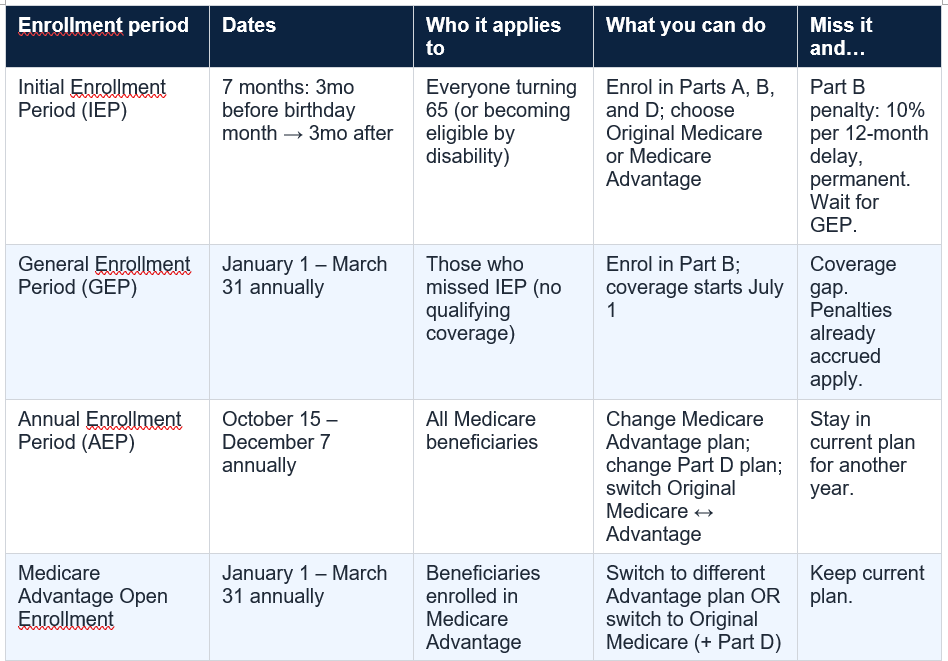
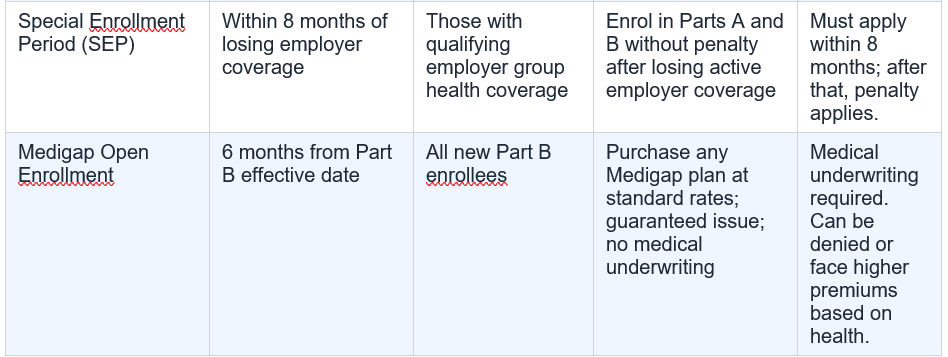
Medicare Enrollment Periods: A Complete Calendar
Understanding all Medicare enrollment windows — and which ones apply to your specific situation — is the foundation of avoiding the mistakes in this guide.
Conclusion
Every penalty described in this guide is permanent — and every one is preventable with timely action. The Part B late enrollment penalty runs for life, calculated on an annually increasing base premium, for a delay measured in months rather than years. The Part D penalty compounds indefinitely for coverage you could have obtained at zero cost. The Medigap window, once closed, typically cannot be reopened without medical underwriting. IRMAA is based on income from two years before it is assessed — a trigger that cannot be corrected after the fact.The asymmetry of Medicare's penalty structure is precisely why it produces so many costly mistakes. The decisions that trigger permanent consequences are often made passively — by not enrolling, not reviewing, not confirming, not cancelling. The beneficiary who takes COBRA and assumes it covers the Medicare Part B delay is not making an active bad decision; they are failing to make a specific active good decision at a specific time. The beneficiary who skips Part D because they take no medications is choosing inaction that has the same penalty consequence as active non-enrollment.
The ten mistakes in this guide are not ranked in order of cost — each has the potential to be the most expensive mistake a specific person makes, depending on their income, their health, their longevity, and their coverage choices. What they share is that all ten can be addressed with planning, time, and the right information before the relevant window closes. The best Medicare decision is the informed one made before the deadline — not the appeal filed after it.
Frequently Asked Questions
What is the Medicare Part B late enrollment penalty and how is it calculated?The Medicare Part B late enrollment penalty is a permanent, lifetime surcharge added to your monthly Part B premium if you did not enrol when first eligible and did not have qualifying coverage that exempted you from the requirement. The penalty is 10% of the standard Part B premium for each full 12-month period you were eligible for but did not have Part B. In 2026, the standard Part B premium is $202.90 per month. A 2-year delay produces a 20% permanent penalty: $40.58 extra every month for life. Over a 25-year retirement, a 3-year delay adds more than $18,000 in penalties, according to Vision Retirement's July 2026 analysis. The penalty is recalculated each year based on the new standard premium — so as CMS increases the base premium annually, the dollar amount of the penalty also increases. The penalty cannot be removed in most cases, though appeals are possible if the delay resulted from incorrect advice from a government representative (documented in writing).
Does COBRA count as coverage that lets me delay Medicare without penalty?
No — COBRA does not count as qualifying employer group health coverage for the purpose of delaying Medicare Part B enrollment without penalty. Only active employer group health coverage from a current employer qualifies. COBRA is continuation coverage from a former employer. This is identified as the single most expensive Medicare misconception by multiple 2026 guidance sources. A person who retires at 65, takes COBRA, and skips Medicare Part B enrollment is accruing a permanent Part B penalty from the end of their Initial Enrollment Period (IEP). At $202.90/month in 2026, a 2-year delay via COBRA produces a $40.58/month permanent penalty. Retiree coverage — health benefits provided by a former employer in retirement — also typically does not count as qualifying active employer coverage. Always confirm your specific coverage's status in writing with your HR department or benefits administrator before making any decision to delay Medicare enrollment.
What is IRMAA and how can I reduce it?
IRMAA (Income-Related Monthly Adjustment Amount) is a surcharge added to Medicare Part B and Part D premiums for beneficiaries whose income exceeds certain thresholds. For 2026, IRMAA begins at income above $109,000 for single filers and $218,000 for married filing jointly, based on 2024 MAGI (Modified Adjusted Gross Income). Part B premiums with IRMAA range from $284.10 to $689.90 per month in 2026 (Kiplinger September 2026). IRMAA applies to both Original Medicare and Medicare Advantage — it is calculated on income, not plan type. To reduce IRMAA: file Form SSA-44 to appeal if you had a qualifying life event (retirement, divorce, death of a spouse, loss of pension) that reduced your income since the tax year used for the calculation. Plan income-producing events (Roth conversions, asset sales, IRA withdrawals) in years before Medicare begins to avoid pushing MAGI above thresholds. Use Roth IRA withdrawals and HSA distributions for qualified medical expenses — these do not count toward MAGI for IRMAA purposes. Work with a tax professional to model the IRMAA implications of large income events.
What is the Medigap open enrollment window and what happens if I miss it?
The Medigap (Medicare Supplement) open enrollment period is the six months beginning on the first day that you are both age 65 or older and enrolled in Medicare Part B. During this window, you have guaranteed issue rights — any insurer selling Medigap policies in your state must sell you any plan they offer, at the same standard rates, regardless of your health history or pre-existing conditions. After this window closes, Medigap insurers in most states can apply medical underwriting — they can charge higher premiums based on health conditions or refuse coverage entirely. This is particularly consequential for people who choose Medicare Advantage at 65 and later wish to switch to Original Medicare plus Medigap. If they have developed a serious health condition in the intervening years, they may be unable to obtain Medigap coverage at all, or only at prohibitively high premiums. A few states — Connecticut, Massachusetts, New York, and Maine — provide additional guaranteed issue protections. Outside those states, missing the six-month Medigap open enrollment window is typically permanent. Verify the rules in your specific state with a licensed Medicare insurance agent.
When should I stop contributing to an HSA before starting Medicare?
You should stop making Health Savings Account (HSA) contributions at least six months before you plan to apply for Medicare or Social Security benefits. The reason: Medicare Part A can be applied retroactively for up to six months when you apply at age 65 or later. Once Part A is effective — even if backdated — you are no longer eligible to make HSA contributions. Any contributions made after your Part A effective date are excess contributions subject to a 6% IRS excise tax annually until corrected. The six-month buffer before applying prevents retroactive Part A from making recent contributions excess. Example: if you plan to enrol in Medicare in June 2027, stop HSA contributions no later than December 2026. HSA funds already accumulated can still be used tax-free for qualified medical expenses in retirement, including Medicare Part B, Part D, and Medicare Advantage premiums. Stop the contributions; preserve the accumulated balance as a tax-free healthcare spending tool.
What does Medicare not cover that I should plan for separately?
Original Medicare (Parts A and B) does not cover: routine dental care (cleanings, fillings, dentures); routine vision care (eye exams, glasses, contacts — though medically necessary eye care is covered); hearing aids and routine hearing exams; most long-term care (custodial care — help with daily living activities — is not covered; only skilled nursing for recovery is covered); and most care outside the United States. Original Medicare also has no annual out-of-pocket maximum — there is no cap on total personal liability in a single year. A Medigap policy (Plan G or Plan N) addresses most cost-sharing gaps and effectively creates an out-of-pocket cap. Medicare Advantage plans include an annual out-of-pocket maximum (up to $8,850 in-network for many plans in 2026) and often include dental, vision, and hearing benefits not available in Original Medicare. Long-term care is a separate, very significant planning need: 70% of people turning 65 today will require some form of long-term care, and the average annual cost of a private nursing home room runs approximately $108,000 in 2026. Long-term care insurance, hybrid life/LTC policies, or self-funding from retirement assets are the primary approaches. Fidelity's 2026 estimate of $185,000 in lifetime healthcare costs for a 65-year-old retiring today covers Medicare-eligible expenses only and does not include long-term care.

0 Comments Comments