

Investing
10 Questions to Ask Before Investing Your Money In The Market

Not every pound or dollar that feels spare is ready to be invested. These 10 questions are the framework that separates genuinely ready money from money that needs another home first.
There is something seductive about putting money into the market. Markets have risen over the long run. The historical average US stock market return is around 10% per year before inflation. Wealth compounds. Staying out feels like the bigger risk. These things are all broadly true — and they are the reasons that people with genuinely ready money should invest for the long term. The problem is that ‘money I have’ and ‘money that is ready to invest’ are not always the same thing. Gordon Achtermann, a Virginia-based Certified Financial Planner speaking to CNBC Select, put the framework plainly: there is a mental checklist of questions to answer with a ‘solid yes’ before investing — because without them, a market correction becomes a financial crisis rather than an expected event you were prepared for. This article works through ten of those questions, grounded in the frameworks of financial regulators, independent financial planners, and evidence-based investor education. Answer them honestly before committing new money to the market in 2027.
The right question is not ‘is now a good time for the market?’ It is ‘is now the right time for me?’ And that question has a structured answer. CNBC Select, speaking with financial planners, described a ‘mental checklist’ of readiness conditions. Interactive Investor, Moneybox, the NASAA, and the FPA all converge on the same framework: specific financial prerequisites, a clear goal and time horizon, a genuine understanding of risk, and an honest self-assessment of whether the money and the mindset are actually prepared. The ten questions in this article are that framework.
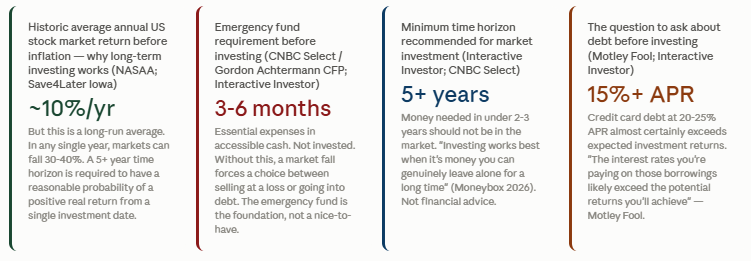
Historic average US stock market return: approximately 10% annually before inflation (NASAA). Markets can fall 30-40% in a single year. Dollar-cost averaging: the solution to the timing problem — regular fixed investment regardless of conditions. Gordon Achtermann CFP: 'solid yes' required on all three readiness questions before investing. Interactive Investor: commit to at least 5 years. 'Investing works best when it's money you can genuinely leave alone for a long time' (Moneybox 2026). Sources cited.
Am I confident I have 3-6 months of essential expenses in accessible cash, so that I would never need to sell investments to cover an emergency? If no: build the emergency fund first.
Have I eliminated — or at least substantially reduced — any debt costing more than 15% interest? If no: the guaranteed return from debt repayment likely exceeds expected market returns.
Is this money I can genuinely leave untouched for at least 5 years, without needing to sell if markets fall in the first 1-3 years? If no: cash or near-cash is more appropriate.
Question 4: Do I Understand What I’m Investing In?
The financial literacy question is one that many new investors skip because they feel embarrassed to admit what they do not know. Joe Pitzl, CFP, at Intelligent Financial Strategies, was quoted by PlannersSearch.org: ‘Some level of financial literacy is a must before you start investing. If you don’t know the difference between a stock and a bond, access the Internet, bookstore or library for objective information on investing fundamentals.’ The Moneybox investing checklist (2026) builds on this with a specific framing: ‘Before you invest, you should be able to say: I understand the basics of investing. I know why I’m investing. I can leave this money invested for the long term. And I understand what I’m putting my money into.’ The NASAA (North American Securities Administrators Association) includes financial literacy as one of its four pre-investment questions. In practice, the minimum required is not encyclopaedic knowledge. It is the ability to answer: what is the difference between a stock and a bond? What is a fund or ETF, and how does it differ from buying an individual share? What does ‘diversification’ mean in practice? If any of those questions produce a blank, the knowledge gap is worth addressing before committing real money. Not financial advice.
Can I explain the difference between a stock, a bond, and a fund? Do I understand what the specific investment I'm considering actually owns and how it generates returns? If no: build the knowledge first.
Can I state clearly: I am investing for [specific goal] by [specific timeframe]. Without this, investment decisions lack a framework.
If my portfolio fell 30-40% within the first year — which is historically possible in equity markets — could I stay invested and not sell? If the honest answer is no: a more conservative allocation is appropriate.
Is this investment decision driven by a plan with a goal and a rationale — or by recent market performance, social media, or a fear of missing out? If the latter: pause.
Have I maximised my ISA allowance (UK) or captured my full employer 401k match (US) before investing in a taxable account? If not: fill the tax-efficient wrapper first.
Can I describe what this specific investment owns, how it generates returns, what it charges, and what its main risks are? If no: find one you can describe — or seek qualified advice.
When — not if — the market falls 20-30% within the first few years, will I stay invested? If yes: invest. If uncertain: revisit questions 1-9 until the foundation is solid enough to survive the volatility.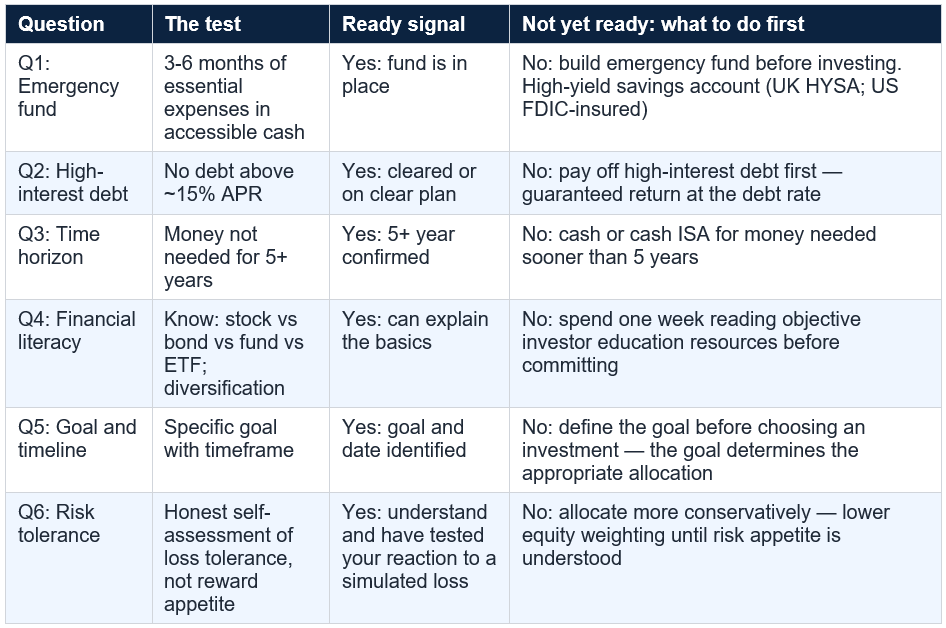
CNBC Select’s CFP said it plainly: ‘Saving is ultimately the first step to investing because, without it, you’re not ready to take on the risk of putting your money in the market.’ The ten questions in this article are the bridge between having money and having ready money. Work through them honestly. If all ten produce a confident yes: invest, stay invested, and resist the urge to check the balance daily. If any produce a no or an uncertain: the work required to convert that no into a yes is the most valuable financial step available to you right now. Not financial or investment advice. Consult a qualified financial adviser for guidance specific to your circumstances.
Yes, this is the consistent position of every credible pre-investment checklist surveyed for this article. Gordon Achtermann, a Virginia-based CFP speaking to CNBC Select, identifies the emergency fund as the first 'solid yes' required before investing. Interactive Investor's investing guide says to 'set aside some money in an easy-access savings account for any emergencies and short-term spending needs' before buying any market investment. The Moneybox investing checklist (2026) requires 'financial breathing room — money for short-term expenses, an emergency fund for unexpected costs, and confidence that you're not investing money you might need soon.' The practical reason: without an emergency fund, any unexpected expense creates a choice between selling investments at whatever price the market offers that day, or going into high-interest debt. Both outcomes are significantly worse than having kept 3-6 months of essential expenses in accessible cash before investing a single pound or dollar. Sources: CNBC Select / Gordon Achtermann CFP; Interactive Investor; Moneybox 2026.
Should I pay off debt before investing?
For high-interest debt (broadly: debt costing 15%+ interest), the answer from most financial professionals is yes. The Motley Fool's investing readiness guide states: 'The interest rates you're paying on those borrowings likely exceed the potential returns you'll achieve investing in stocks.' At 20-25% APR (typical credit card rates), paying off debt produces a guaranteed, risk-free return at the debt's interest rate. No market investment reliably matches a guaranteed 22% return. Interactive Investor's pre-investment guide lists 'pay off any short-term debts which have high interest rates' as a prerequisite. For lower-rate debt (student loans at 6%, a mortgage at 4-5%), the calculation is less clear-cut — there is a reasonable case for investing alongside manageable lower-rate debt, particularly when long-term market returns historically exceed that rate. The key threshold for most investors: debt above 15% interest should be prioritised over market investment. Debt below 8% involves more nuance. Sources: Motley Fool; Interactive Investor; CNBC Select.
How long should I plan to invest before expecting to see returns?
The consistent guidance from multiple sources is a minimum of five years, with ten years or more preferred for equity investments. CNBC Select, citing CFP Gordon Achtermann, identifies money needed within 'less than two to three years' as inappropriate for market investment due to short-term volatility risk. Interactive Investor specifies 'commit to investing for at least five years.' The NASAA connects time horizon to recovery capacity: 'The sooner you start investing, the more time you have to make up for potential losses.' The historic average US stock market return is approximately 10% annually before inflation (NASAA), but this figure is deeply misleading in short-term context — in any single year, markets can fall 30%, 40%, or more. The probability of a positive real return increases significantly over time horizons of 5-10 years. Money with a definite near-term need (house purchase, tuition, planned large expense) belongs in savings accounts or near-cash instruments. Sources: CNBC Select; Interactive Investor; NASAA. Not financial advice. Past performance does not predict future returns.
What is the difference between risk tolerance and appetite for reward?
Interactive Investor's pre-investment guide draws a distinction that is psychologically important: it advises investors to 'understand your tolerance to risk rather than appetite for reward.' These are different assessments. Risk appetite (or reward appetite) is how excited you feel about a potential 20% gain. Risk tolerance is how you actually behave when your portfolio is down 25% and the news is pessimistic and everyone around you says it will fall further. Most new investors substantially overestimate their risk tolerance when markets are rising — they have not experienced a real drawdown and mistake their enthusiasm for growth with comfort with loss. The NASAA includes risk tolerance understanding as a core pre-investment question. A practical test: imagine your portfolio falling to 65-70% of its initial value. Your honest emotional and behavioural response to that scenario is your actual risk tolerance, not your theoretical response to a questionnaire during a bull market. Source: Interactive Investor (ii.co.uk); NASAA.
What is dollar-cost averaging and should I use it?
Dollar-cost averaging (DCA) is the practice of investing a fixed amount of money at regular intervals — monthly, for example — regardless of current market conditions. When markets are high, your fixed amount buys fewer units; when markets are low, it buys more. Over time, this produces an average purchase price that is smoothed across market cycles, reducing the risk of committing all your money at a market peak. The Motley Fool's investing readiness guide recommends DCA specifically because it 'eliminates the need to time the market in the first place, and it encourages important habits: regular saving and investing.' For most new investors, a regular monthly contribution to a diversified low-cost index fund or ETF within a tax-efficient wrapper (Stocks and Shares ISA in the UK; 401k or IRA in the US) is a well-evidenced starting approach. It is simple, accessible, and removes the anxiety of the 'when is the right time to invest?' question. Source: Motley Fool; CNBC Select. Not financial advice. Consult a qualified financial adviser for advice specific to your circumstances.
There is something seductive about putting money into the market. Markets have risen over the long run. The historical average US stock market return is around 10% per year before inflation. Wealth compounds. Staying out feels like the bigger risk. These things are all broadly true — and they are the reasons that people with genuinely ready money should invest for the long term. The problem is that ‘money I have’ and ‘money that is ready to invest’ are not always the same thing. Gordon Achtermann, a Virginia-based Certified Financial Planner speaking to CNBC Select, put the framework plainly: there is a mental checklist of questions to answer with a ‘solid yes’ before investing — because without them, a market correction becomes a financial crisis rather than an expected event you were prepared for. This article works through ten of those questions, grounded in the frameworks of financial regulators, independent financial planners, and evidence-based investor education. Answer them honestly before committing new money to the market in 2027.
Table of Contents
- Why These Questions Matter More Than Market Timing
- Question 1: Do I Have a Genuine Emergency Fund?
- Question 2: Have I Dealt With High-Interest Debt First?
- Question 3: Is This Money I Won’t Need for at Least Five Years?
- Question 4: Do I Understand What I’m Investing In?
- Question 5: What Am I Investing For — and When Will I Need It?
- Question 6: What Is My Honest Risk Tolerance — Not My Appetite for Reward?
- Question 7: Am I Investing From a Plan — or From Fear of Missing Out?
- Question 8: Have I Checked My Tax-Efficient Wrappers First?
- Question 9: Do I Understand Exactly What I’m Investing In?
- Question 10: Am I Prepared for a Significant Drawdown — and Will I Stay Invested?
- The Investing Readiness Scorecard
- Conclusion: Ready Money Is Patient Money
- Frequently Asked Questions
Why These Questions Matter More Than Market Timing
The single most common question asked by people considering putting new money into the market is: ‘Is now a good time?’ It is the wrong question. As the Motley Fool noted in its investing readiness analysis, no one can accurately predict when the stock market is going to bottom out before it starts to rise again. Attempting to time entry into the market produces, for most investors, worse returns than simply investing when the money is ready and staying invested. The research on this is consistent enough that the Motley Fool recommends dollar-cost averaging — investing a fixed amount at regular intervals regardless of conditions — specifically because it eliminates the timing question entirely.The right question is not ‘is now a good time for the market?’ It is ‘is now the right time for me?’ And that question has a structured answer. CNBC Select, speaking with financial planners, described a ‘mental checklist’ of readiness conditions. Interactive Investor, Moneybox, the NASAA, and the FPA all converge on the same framework: specific financial prerequisites, a clear goal and time horizon, a genuine understanding of risk, and an honest self-assessment of whether the money and the mindset are actually prepared. The ten questions in this article are that framework.
Historic average US stock market return: approximately 10% annually before inflation (NASAA). Markets can fall 30-40% in a single year. Dollar-cost averaging: the solution to the timing problem — regular fixed investment regardless of conditions. Gordon Achtermann CFP: 'solid yes' required on all three readiness questions before investing. Interactive Investor: commit to at least 5 years. 'Investing works best when it's money you can genuinely leave alone for a long time' (Moneybox 2026). Sources cited.
Question 1: Do I Have a Genuine Emergency Fund?
The emergency fund question is the foundation of every credible investing readiness checklist, and the reason is simple: you cannot invest money you might urgently need. When markets fall — and in any given five-year period, they almost certainly will at some point — the investor without an emergency fund faces a choice between selling at a loss to cover an unexpected expense or going into high-interest debt. Both outcomes are significantly worse than having waited to build the buffer before investing. CNBC Select spoke with Gordon Achtermann, a Virginia-based CFP, who identified the emergency fund as the first question to answer with a ‘solid yes’ before investing. Interactive Investor’s pre-investment guide says it directly: ‘Set aside some money in an easy-access savings account for any emergencies and short-term spending needs’ before buying any market investment. The standard guidance is 3-6 months of essential expenses in an accessible account — not invested, not locked away, not in premium bonds that take days to access. Cash. The amount varies by income stability: the self-employed or those with variable income should aim for six months; those with stable employment and no dependants may be comfortable with three.Am I confident I have 3-6 months of essential expenses in accessible cash, so that I would never need to sell investments to cover an emergency? If no: build the emergency fund first.
Question 2: Have I Dealt With High-Interest Debt First?
The mathematics of high-interest debt versus expected investment returns is unambiguous. Credit card debt at 20-25% APR represents a guaranteed cost. Stock market investments have historically returned approximately 10% per year before inflation — but that historical average is backward-looking, involves significant volatility, and is not guaranteed. The Motley Fool made the comparison directly in its investing readiness guide: ‘The interest rates you’re paying on those borrowings likely exceed the potential returns you’ll achieve investing in stocks.’ Interactive Investor’s pre-investment checklist similarly says to ‘pay off any short-term debts which have high interest rates’ before starting. The practical implication: paying off a credit card balance at 22% APR is a guaranteed 22% return, risk-free. No market investment reliably matches that. The threshold for ‘high-interest’ varies by context — in a market where risk-free rates are 4-5%, debts at 15%+ clearly meet the standard; debts at 6-8% (student loans, car finance) involve more nuance. The key principle is that investing while carrying significant high-interest debt means you are likely paying more in interest than you are earning in returns, which is a mathematical loss regardless of what the portfolio statement shows.Have I eliminated — or at least substantially reduced — any debt costing more than 15% interest? If no: the guaranteed return from debt repayment likely exceeds expected market returns.
Question 3: Is This Money I Won’t Need for at Least Five Years?
The time horizon question is not just about investor patience — it is about mathematical probability. Short-term market movements are essentially unpredictable. Over any single year, markets can fall 30%, 40%, or more. Over any five-year period, the historical probability of a positive total return in broad equity markets improves substantially. Over a ten-year period, it becomes statistically very likely, though never guaranteed. CNBC Select’s investing readiness guide, citing CFP Gordon Achtermann, is specific: ‘If you think you will need the money in the near-term (less than two to three years), avoid investing it because of the additional risk you take on by putting your money in the market.’ Interactive Investor’s guidance sets the minimum at five years: ‘Commit to investing for at least five years.’ The Moneybox investing checklist (2026) captures the principle clearly: ‘Investing works best when it’s money you can genuinely leave alone for a long time.’ The goal here is not perfection — nobody has certainty about any five-year window. The goal is honest assessment. Money that has a reasonable probability of being needed within three years — for a house deposit, a wedding, a business investment — belongs in a savings account or a cash ISA, not in the market.Is this money I can genuinely leave untouched for at least 5 years, without needing to sell if markets fall in the first 1-3 years? If no: cash or near-cash is more appropriate.
Question 4: Do I Understand What I’m Investing In?
The financial literacy question is one that many new investors skip because they feel embarrassed to admit what they do not know. Joe Pitzl, CFP, at Intelligent Financial Strategies, was quoted by PlannersSearch.org: ‘Some level of financial literacy is a must before you start investing. If you don’t know the difference between a stock and a bond, access the Internet, bookstore or library for objective information on investing fundamentals.’ The Moneybox investing checklist (2026) builds on this with a specific framing: ‘Before you invest, you should be able to say: I understand the basics of investing. I know why I’m investing. I can leave this money invested for the long term. And I understand what I’m putting my money into.’ The NASAA (North American Securities Administrators Association) includes financial literacy as one of its four pre-investment questions. In practice, the minimum required is not encyclopaedic knowledge. It is the ability to answer: what is the difference between a stock and a bond? What is a fund or ETF, and how does it differ from buying an individual share? What does ‘diversification’ mean in practice? If any of those questions produce a blank, the knowledge gap is worth addressing before committing real money. Not financial advice.
Can I explain the difference between a stock, a bond, and a fund? Do I understand what the specific investment I'm considering actually owns and how it generates returns? If no: build the knowledge first.
Question 5: What Am I Investing For — and When Will I Need It?
Every investment should have a purpose, and that purpose should have a timeline. The NASAA’s four-question framework puts goal-setting first: ‘Know your goals before investing in the stock market. Are you investing for a long-term goal such as retirement or a college education?’ The Moneybox checklist (2026) is even more direct: ‘Every investment should have a purpose. Ask yourself: what am I investing for? When will I need this money? What would success look like?’ The goal does not need to be singular — many investors have multiple goals with different time horizons, served by different allocations. A 25-year-old investing for retirement in 2060 has a very different appropriate allocation to a 45-year-old investing for a house purchase in five years. PlannersSearch.org notes that investing can provide the means for big financial goals: a house, a child’s education, retirement, financial security. But ‘the means’ only materialises when the investment is matched to the goal’s specific time horizon and liquidity requirements. An investor who knows they want the money in ten years for retirement can weather a 30% drawdown in year two without distress. An investor who is vague about the goal may sell at the worst possible moment simply because they have no framework for why the money should stay invested.Can I state clearly: I am investing for [specific goal] by [specific timeframe]. Without this, investment decisions lack a framework.
Question 6: What Is My Honest Risk Tolerance — Not My Appetite for Reward?
Interactive Investor’s guide to investing fundamentals contains one of the most psychologically perceptive observations in mainstream investor education: ‘Understand your tolerance to risk rather than appetite for reward.’ These are not the same question. Risk appetite is how excited you are about a potential 20% gain. Risk tolerance is how you actually behave when you are down 20% and the news is bad and everyone around you says the market is going to fall further. Most new investors substantially overestimate their risk tolerance when markets are rising and discover their true tolerance only during a significant drawdown. The NASAA’s framework includes risk tolerance as a core pre-investment question: ‘Investments in the stock market are subject to losses, so understanding your risk tolerance is important. Stock market decisions need to be within your risk tolerance.’ A practical test: imagine your £10,000 or $10,000 invested portfolio falls to £6,500 or $6,500 within its first six months because of a market correction. What do you do? If the honest answer is ‘sell everything,’ you have high risk aversion that needs to be matched to a lower-volatility portfolio allocation. Selling at a loss when markets fall is the primary way that individual investors underperform the market averages they were trying to match.If my portfolio fell 30-40% within the first year — which is historically possible in equity markets — could I stay invested and not sell? If the honest answer is no: a more conservative allocation is appropriate.
Question 7: Am I Investing From a Plan — or From Fear of Missing Out?
The emotional drivers of investment decisions are well-documented and reliably damaging. FOMO — fear of missing out — is the condition in which investors pile into assets that have already risen substantially because they see others making gains and fear being left behind. It is the dominant driver of bubble formation and the mechanism by which most retail investors buy near peaks. The Motley Fool’s investing readiness guide addresses the timing psychology: ‘No one can accurately predict when the stock market is going to bottom out before it starts to rise again.’ The solution it recommends is dollar-cost averaging — investing a fixed amount at regular intervals regardless of conditions, which ‘eliminates the need to time the market in the first place, and it encourages important habits: regular saving and investing.’ The critical self-assessment here is distinguishing between a planned decision (‘I am putting this money into a globally diversified index fund as part of my long-term retirement savings plan’) and a reactive one (‘I’m investing because X asset class has gone up a lot and I don’t want to miss the next move’). The former has a framework; the latter is speculation dressed as investment.Is this investment decision driven by a plan with a goal and a rationale — or by recent market performance, social media, or a fear of missing out? If the latter: pause.
Question 8: Have I Checked My Tax-Efficient Wrappers First?
Before investing in any taxable account, it is worth confirming that the available tax-efficient wrappers have been used. In the UK, the Stocks and Shares ISA provides tax-free growth and tax-free income on up to £20,000 per year overall (from April 2027: under-65s can put a minimum of £8,000 into a Stocks and Shares ISA as part of the overall £20,000 limit; the cash ISA limit falls to £12,000 — see ISA changes 2027 for full details). In the US, the employer 401(k) match is the most important first step: contributing enough to capture the full employer match produces an immediate 50-100% return before any investment growth. The 2026 IRS contribution limit for 401(k) plans is $23,500 for those under 50. For individual investors without employer matching, the Traditional or Roth IRA (individual retirement account) provides tax-advantaged growth on up to $7,000 per year (under 50). Interactive Investor’s pre-investment guide notes that tax efficiency is a key consideration. CNBC Select references ISA and retirement account use. Investing outside a tax wrapper in a taxable brokerage account when an ISA or 401k/IRA allowance is unfilled is leaving a tax benefit unused.Have I maximised my ISA allowance (UK) or captured my full employer 401k match (US) before investing in a taxable account? If not: fill the tax-efficient wrapper first.
Question 9: Do I Understand Exactly What I’m Investing In?
The Moneybox investing checklist (2026) ends with a question that sounds simple but often stops investors in their tracks: ‘Is it a fund or a stock? Before you invest, you should be able to say I understand what I’m putting my money into.’ This is a more demanding question than it appears. A stock is an ownership stake in a specific company, whose fortunes depend on that company’s performance. A fund (unit trust, OEIC, mutual fund) pools money to invest across many companies, providing diversification within the fund. An ETF (exchange-traded fund) is similar to a fund but trades on an exchange like a stock. An index fund tracks a specific market index (like the FTSE All-World or S&P 500) and typically has low ongoing costs. Understanding whether a fund is actively managed or passive, what it charges in ongoing costs (the ongoing charge figure or expense ratio), what index or strategy it follows, and what geographic and sector exposure it provides — these are the questions that separate informed investment from uninformed speculation. An investor who can answer these questions about the specific instrument they are considering is adequately prepared. One who cannot is speculating, regardless of how confident they feel. Not financial advice.Can I describe what this specific investment owns, how it generates returns, what it charges, and what its main risks are? If no: find one you can describe — or seek qualified advice.
Question 10: Am I Prepared for a Significant Drawdown — and Will I Stay Invested?
The final question is the one that separates investors who achieve long-term market returns from those who achieve a fraction of them. The S&P 500 has experienced drawdowns of 20% or more in ten separate years since 1970. The FTSE All-World has experienced similar. These are not exceptional events; they are the price of admission for long-term equity returns. The investor who understands this in advance and has built their plan around it — with a cash buffer, a long time horizon, no need to sell, and an understanding of why they are invested — can stay the course. The investor who discovered this intellectually but had not internalised it tends to sell at the bottom. Interactive Investor puts the commitment plainly: ‘Don’t invest more than you can afford to lose.’ The NASAA’s guidance connects time horizon directly to recovery capacity: ‘Investing in the stock market for retirement during your 20s looks different than if you start investing for retirement in your 50s. The sooner you start investing, the more time you have to make up for potential losses.’ The question is not ‘am I comfortable with the idea of a market fall?’ It is ‘am I confident that when the fall actually happens — and my portfolio is visibly down — I will stay invested?’ If the honest answer is yes: invest. If the honest answer is uncertain: revisit the earlier questions.When — not if — the market falls 20-30% within the first few years, will I stay invested? If yes: invest. If uncertain: revisit questions 1-9 until the foundation is solid enough to survive the volatility.
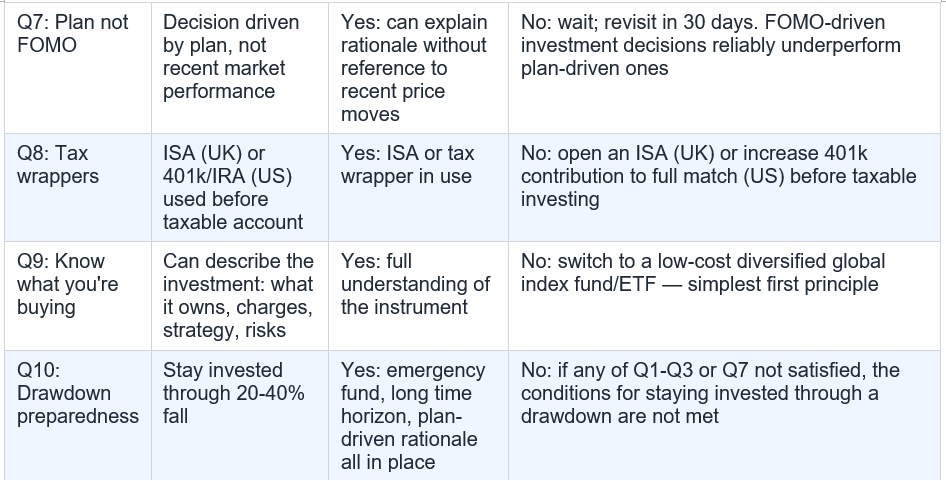
The Investing Readiness Scorecard
Conclusion
The market does not care when you enter it. It will rise, fall, and rise again on a timeline that has nothing to do with your personal financial situation. What determines whether market investing works for you is not the entry date — it is whether the money was genuinely ready to invest. Ready money has a foundation of emergency savings beneath it. It is not competing with high-interest debt for a positive return. It has a time horizon long enough to survive volatility without being forced to sell. It is allocated to an investment the owner actually understands. And it has a plan behind it — a goal, a rationale, a structure — that can survive the experience of seeing the balance drop significantly before it rises.CNBC Select’s CFP said it plainly: ‘Saving is ultimately the first step to investing because, without it, you’re not ready to take on the risk of putting your money in the market.’ The ten questions in this article are the bridge between having money and having ready money. Work through them honestly. If all ten produce a confident yes: invest, stay invested, and resist the urge to check the balance daily. If any produce a no or an uncertain: the work required to convert that no into a yes is the most valuable financial step available to you right now. Not financial or investment advice. Consult a qualified financial adviser for guidance specific to your circumstances.
Frequently Asked Questions
Do I need an emergency fund before I start investing?Yes, this is the consistent position of every credible pre-investment checklist surveyed for this article. Gordon Achtermann, a Virginia-based CFP speaking to CNBC Select, identifies the emergency fund as the first 'solid yes' required before investing. Interactive Investor's investing guide says to 'set aside some money in an easy-access savings account for any emergencies and short-term spending needs' before buying any market investment. The Moneybox investing checklist (2026) requires 'financial breathing room — money for short-term expenses, an emergency fund for unexpected costs, and confidence that you're not investing money you might need soon.' The practical reason: without an emergency fund, any unexpected expense creates a choice between selling investments at whatever price the market offers that day, or going into high-interest debt. Both outcomes are significantly worse than having kept 3-6 months of essential expenses in accessible cash before investing a single pound or dollar. Sources: CNBC Select / Gordon Achtermann CFP; Interactive Investor; Moneybox 2026.
Should I pay off debt before investing?
For high-interest debt (broadly: debt costing 15%+ interest), the answer from most financial professionals is yes. The Motley Fool's investing readiness guide states: 'The interest rates you're paying on those borrowings likely exceed the potential returns you'll achieve investing in stocks.' At 20-25% APR (typical credit card rates), paying off debt produces a guaranteed, risk-free return at the debt's interest rate. No market investment reliably matches a guaranteed 22% return. Interactive Investor's pre-investment guide lists 'pay off any short-term debts which have high interest rates' as a prerequisite. For lower-rate debt (student loans at 6%, a mortgage at 4-5%), the calculation is less clear-cut — there is a reasonable case for investing alongside manageable lower-rate debt, particularly when long-term market returns historically exceed that rate. The key threshold for most investors: debt above 15% interest should be prioritised over market investment. Debt below 8% involves more nuance. Sources: Motley Fool; Interactive Investor; CNBC Select.
How long should I plan to invest before expecting to see returns?
The consistent guidance from multiple sources is a minimum of five years, with ten years or more preferred for equity investments. CNBC Select, citing CFP Gordon Achtermann, identifies money needed within 'less than two to three years' as inappropriate for market investment due to short-term volatility risk. Interactive Investor specifies 'commit to investing for at least five years.' The NASAA connects time horizon to recovery capacity: 'The sooner you start investing, the more time you have to make up for potential losses.' The historic average US stock market return is approximately 10% annually before inflation (NASAA), but this figure is deeply misleading in short-term context — in any single year, markets can fall 30%, 40%, or more. The probability of a positive real return increases significantly over time horizons of 5-10 years. Money with a definite near-term need (house purchase, tuition, planned large expense) belongs in savings accounts or near-cash instruments. Sources: CNBC Select; Interactive Investor; NASAA. Not financial advice. Past performance does not predict future returns.
What is the difference between risk tolerance and appetite for reward?
Interactive Investor's pre-investment guide draws a distinction that is psychologically important: it advises investors to 'understand your tolerance to risk rather than appetite for reward.' These are different assessments. Risk appetite (or reward appetite) is how excited you feel about a potential 20% gain. Risk tolerance is how you actually behave when your portfolio is down 25% and the news is pessimistic and everyone around you says it will fall further. Most new investors substantially overestimate their risk tolerance when markets are rising — they have not experienced a real drawdown and mistake their enthusiasm for growth with comfort with loss. The NASAA includes risk tolerance understanding as a core pre-investment question. A practical test: imagine your portfolio falling to 65-70% of its initial value. Your honest emotional and behavioural response to that scenario is your actual risk tolerance, not your theoretical response to a questionnaire during a bull market. Source: Interactive Investor (ii.co.uk); NASAA.
What is dollar-cost averaging and should I use it?
Dollar-cost averaging (DCA) is the practice of investing a fixed amount of money at regular intervals — monthly, for example — regardless of current market conditions. When markets are high, your fixed amount buys fewer units; when markets are low, it buys more. Over time, this produces an average purchase price that is smoothed across market cycles, reducing the risk of committing all your money at a market peak. The Motley Fool's investing readiness guide recommends DCA specifically because it 'eliminates the need to time the market in the first place, and it encourages important habits: regular saving and investing.' For most new investors, a regular monthly contribution to a diversified low-cost index fund or ETF within a tax-efficient wrapper (Stocks and Shares ISA in the UK; 401k or IRA in the US) is a well-evidenced starting approach. It is simple, accessible, and removes the anxiety of the 'when is the right time to invest?' question. Source: Motley Fool; CNBC Select. Not financial advice. Consult a qualified financial adviser for advice specific to your circumstances.
0 Comments
Be the first to share your thoughts on this article.