
Investing
3 Best Index Funds to Supercharge Your Roth IRA

The S&P 500 has returned approximately 10.5% per year historically. Inside a Roth IRA, every dollar of that return is yours permanently — no capital gains tax, no income tax at withdrawal, no RMDs. The 2026 contribution limit just rose to $7,500. Expense ratios on the best index funds are now as low as 0.00%. The combination has never been more powerful. Here are the three funds that belong in it.

The scale of the tax advantage is not abstract. As Wealthvieu’s May 2026 Roth IRA guide quantifies it: $500,000 in a Roth IRA at retirement is genuinely $500,000 in spending power. The same $500,000 in a traditional IRA is $500,000 minus your marginal tax rate in retirement — often 22 to 32 percent, leaving roughly $340,000 to $390,000 after taxes. The Roth IRA does not reduce your current-year tax bill. It does something more valuable: it permanently removes the investment growth from any future tax obligation.
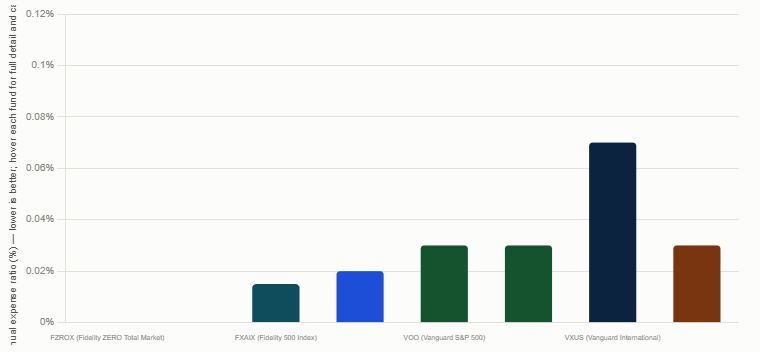
Layer onto this the cost structure of modern index funds. The expense ratio on the best S&P 500 index funds in 2026 is 0.02 percent (Schwab’s SWPPX) or 0.03 percent (Vanguard’s VOO). The Fidelity ZERO Total Market fund (FZROX) charges literally nothing — 0.00 percent. At these costs, the fund’s return is effectively the same as the market’s return, with no meaningful drag. And the market’s return — the S&P 500 has delivered approximately 10.5 percent per year historically since 1926 — compounds tax-free inside the Roth wrapper forever.
This guide covers exactly three index funds that belong in most Roth IRAs, why they belong there, and what they have returned. It also covers the 2026 contribution rules, the compounding mathematics, and the most common mistakes that prevent investors from capturing the full value of this combination.
Roth IRA 2026 contribution limit: $7,500 (under 50); $8,600 (age 50+). Income phase-out: $168,000 MAGI (single); $252,000 (MFJ). S&P 500 historical avg: ~10–11%/yr since 1926, dividends reinvested. S&P 500 YTD through Jul 2026: ~11%. S&P 500 5-yr annualised return through Jul 2026: ~17%. $7,500/yr into an S&P 500 fund at 10.5%/yr for 30 years: approximately $1.49 million tax-free.
The 2026 rules, confirmed by Fidelity and Vanguard citing IRS guidance from November 13, 2025:
The performance record is the S&P 500 itself, which is the most studied equity benchmark in the world. The S&P 500 has delivered approximately 10 to 11 percent per year in average nominal annual returns since 1926, with dividends reinvested (S&P Dow Jones Indices SPIVA data; Federal Reserve historical records). The S&P 500 delivered approximately 11 percent year-to-date through July 2026 (Motley Fool), with a 5-year annualised return through July 2026 of approximately 17 percent.
Wealthvieu’s May 2026 S&P 500 index fund guide confirms the core case: ‘VOO (Vanguard, 0.03%), IVV (iShares, 0.03%), and FXAIX (Fidelity, 0.015%) — all track the same 500 companies at near-identical performance. The only meaningful difference is expense ratio and where you can buy them.’ For investors who want ETF structure (tradeable throughout the day, available at any broker), VOO at 0.03 percent is the benchmark choice.
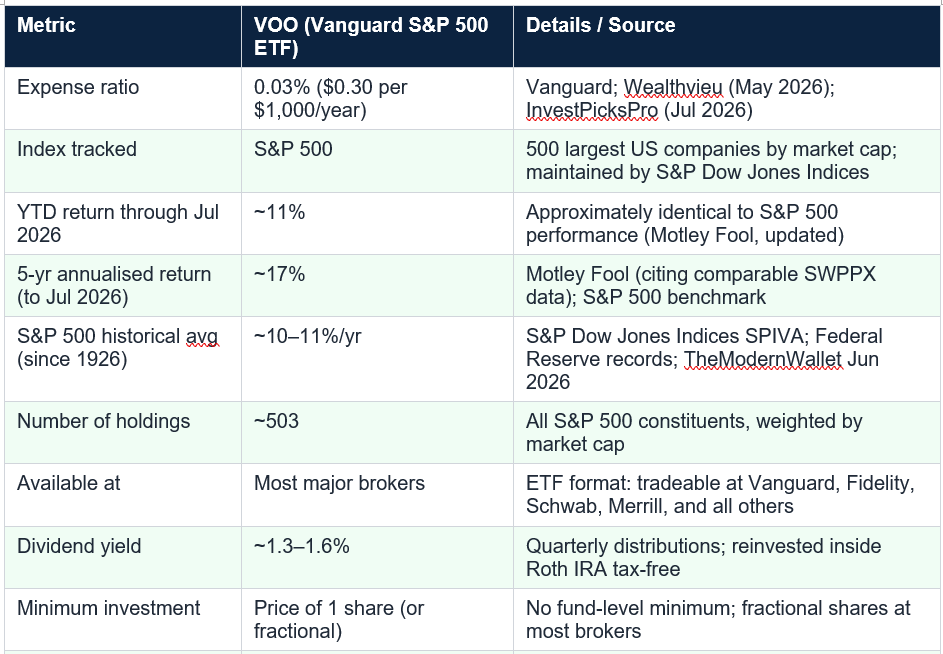

The case for VOO as Fund #1: it is simple, cheap, maximally diversified within its category, available everywhere, and has a track record that spans a century of US economic history. For most Roth IRA investors, it alone — funded annually and held for decades — would produce superior retirement outcomes to most investment strategies available to retail investors.
The S&P 500 represents roughly 80% of total US stock market capitalisation and exclusively holds US companies. It does not include international stocks. In years when international markets outperform US markets, an S&P 500-only portfolio will underperform a globally diversified one. A single S&P 500 fund is an excellent and validated starting point — but it is not globally complete. VXUS (Fund #2 below) addresses this.
The case for including VXUS alongside a US index fund is one of diversification, not performance chasing. US stocks have outperformed international stocks significantly over the past decade — the S&P 500’s 5-year annualised return through July 2026 was approximately 17%, while the Schwab emerging markets fund delivered approximately 6% over the same period. But historical dominance by any single market does not guarantee future dominance, and owning only US stocks means owning roughly 60% of global market capitalisation while ignoring the other 40%.
InvestPicksPro (July 2026) makes the diversification case explicitly: ‘A common blind spot for US investors is that both the S&P 500 and total market funds hold exclusively US companies. Vanguard’s VXUS is the standard complement, giving exposure to developed and emerging markets outside the US. Many target-date and three-fund portfolio strategies pair a US total market fund with an international fund and a bond fund specifically to avoid this concentration.’
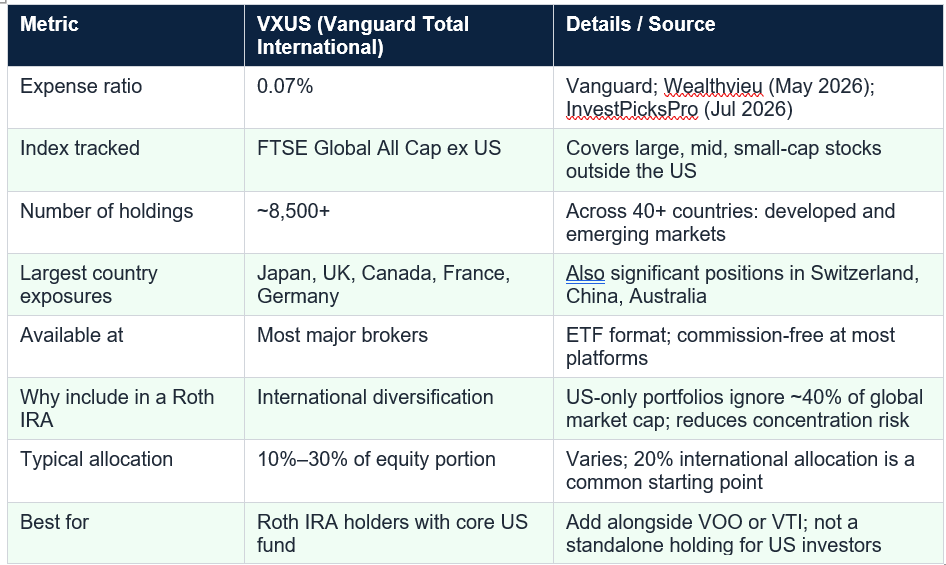
The standard approach: hold VOO or VTI as the core US equity position (typically 70 to 80 percent of the equity allocation) and VXUS as the international complement (typically 20 to 30 percent). This combination — the first two thirds of the classic three-fund portfolio — provides genuinely global equity exposure at a combined expense ratio of approximately 0.03 to 0.05 percent.
A simple 80/20 starting point: 80% of the equity portion of your Roth IRA in VOO (or VTI) and 20% in VXUS. At a $7,500 annual contribution, this means approximately $6,000 to VOO and $1,500 to VXUS per year. Review annually. You do not need to rebalance more frequently than once per year. Complexity beyond this two-fund structure adds cost and effort without meaningfully improving expected outcomes for most investors.
The Motley Fool’s August 2026 index fund guide identifies FZROX’s specific attraction: ‘The “ZERO” in the fund’s name denotes that its expense ratio is 0%. There’s also no minimum investment, making the fund a good choice for beginning investors.’ TheModernWallet’s June 2026 roundup (InvestPicksPro citing it) confirms: ‘FZROX charges literally 0.00% — no expense ratio at all.’
The performance relative to VTI (Vanguard’s total market equivalent at 0.03%) is essentially identical, because the underlying holdings are the same collection of US stocks weighted by market capitalisation. The 0.03% difference is $3 per $10,000 invested per year. Over 30 years on a $100,000 portfolio, the compounded value of that $3 per year amounts to approximately $150 in additional wealth — less than one cup of coffee per month. The fee advantage of FZROX over VTI is therefore real but extremely small.
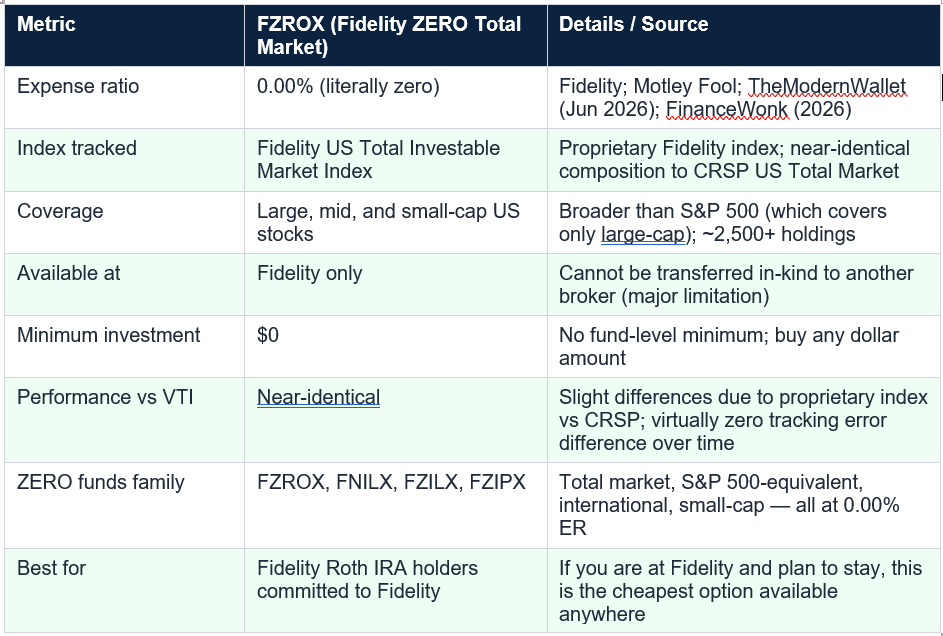
FZROX cannot be transferred in-kind to another broker. If you move your Roth IRA from Fidelity to Vanguard or Schwab, FZROX shares must be sold first — triggering a liquidation event (though inside a Roth IRA this has no tax consequence) and a period out of the market during transfer. InvestPicksPro (July 2026) specifically flags this: 'Fidelity ZERO funds carry a 0.00% expense ratio but track proprietary Fidelity indexes — available only at Fidelity.' If there is any possibility you may change brokers, VTI or FXAIX (both transferable) are safer choices despite carrying marginally higher expense ratios.
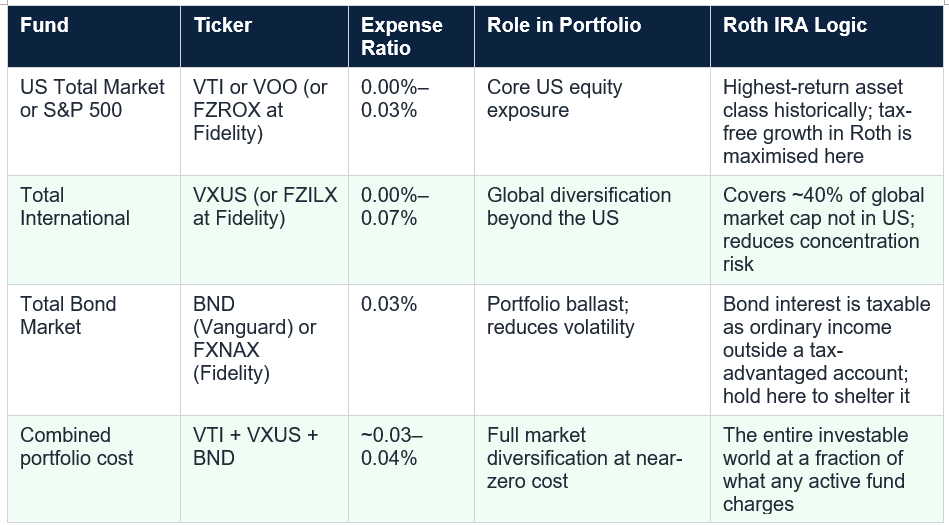
The unil.ink May 2026 index fund guide summarises the three-fund approach succinctly: ‘The three-fund portfolio — VTI + VXUS + BND — is the most replicated retirement strategy of the last decade and still works in 2026. Anything with an expense ratio over 0.20% needs a very specific reason to exist in your account. Most don’t have one.’
For most Roth IRA investors who are younger (more than 20 years from retirement), the bond allocation can be minimal or zero — bonds are lower-return assets, and inside a Roth the highest-return asset produces the most tax-free wealth over time. A common simplification for a 30-year-old Roth IRA holder: 80% VTI, 20% VXUS, 0% BND, with the bond allocation increasing gradually as retirement approaches.
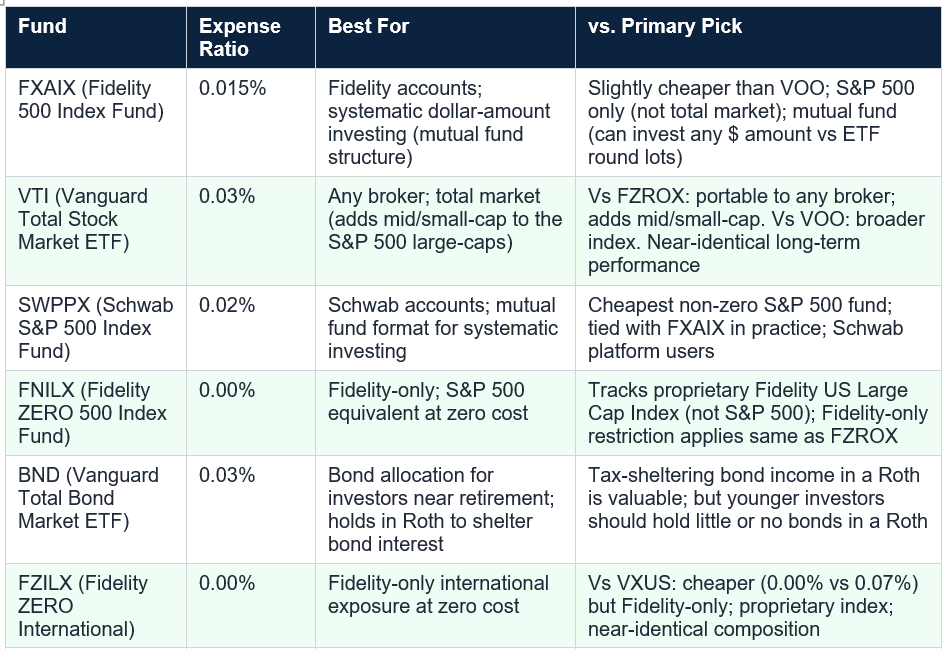

The specific fund matters far less than the following three decisions: (1) open the account, (2) fund it as close to the $7,500 annual limit as possible, and (3) invest the money in an equity index fund immediately rather than leaving it in cash. Any of the major S&P 500 or total market funds from Vanguard, Fidelity, Schwab, or iShares will deliver the same long-run outcome. The best fund is the one available at your broker, with the lowest expense ratio, that you will actually hold consistently for decades.
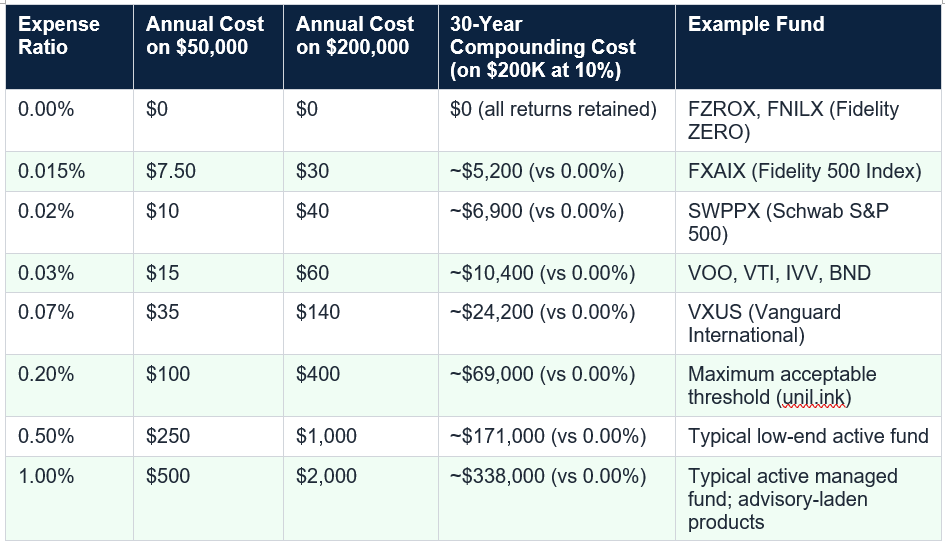
The compounding costs in the table above assume a $200,000 portfolio growing at 10% annually for 30 years, comparing each expense ratio to the 0.00% baseline. A 1% expense ratio costs approximately $338,000 in foregone wealth over 30 years on a $200,000 starting portfolio. That is not a fee — it is a retirement account.
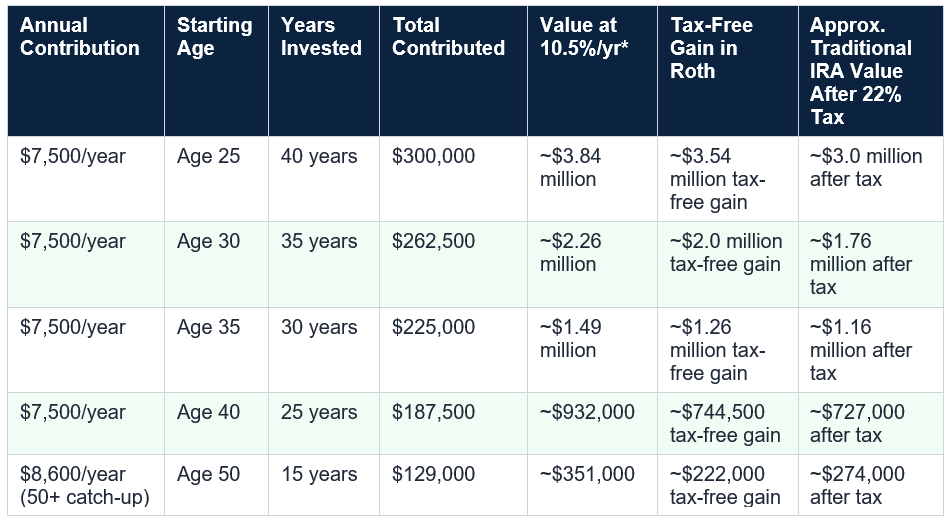
*Figures are illustrative projections using a constant 10.5% annual return. Actual returns vary significantly year to year; the S&P 500’s historical average includes multiple severe drawdowns (including a 37% fall in 2008) before recovery. These calculations are not a guarantee of future performance. The Roth vs traditional IRA comparison uses a 22% effective tax rate on traditional withdrawals, which may be higher or lower depending on individual circumstances.
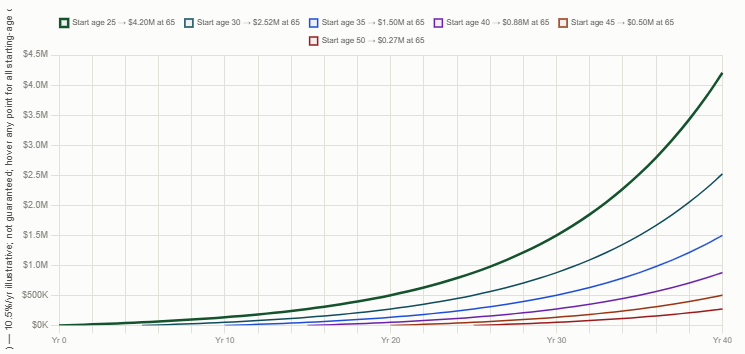
The single most impactful variable is the starting age, not the contribution amount. The difference between starting at 25 and starting at 35 — with identical annual contributions — is approximately $2.35 million in final portfolio value at 10.5% annual growth. Wealthvieu (May 2026) makes this concrete: ‘$7,000 invested at age 25 grows to approximately $122,000 by age 65 at 7%. The same $7,000 invested at age 45 grows to only approximately $27,000’ — a 4.5x difference for a 20-year delay.
The case for action is mathematical and time-sensitive. The $7,500 contribution made in January 2027 has 12 fewer months of compound growth than the $7,500 made in January 2026. The investor who started at 25 arrives at 65 with approximately 4.5 times more money than the equivalent investor who started at 45 — not because they made better choices, but because they made the same choices earlier.
The required skill set is minimal: open a Roth IRA at Fidelity, Vanguard, or Schwab; fund it up to $7,500; buy one or two broad index funds; reinvest dividends; rebalance once per year; do not sell during downturns. Every additional complexity added to this strategy — more funds, more frequent trading, active management — reduces expected outcomes rather than improving them. The simplest version works best. And it works best, most powerfully, inside a Roth IRA.
The 2026 Roth IRA contribution limit is $7,500 for those under age 50 and $8,600 for those aged 50 and older (with the $1,100 catch-up contribution). This is an increase from the 2025 limits of $7,000 (under 50) and $8,000 (50+). The $7,500 is the combined limit across all IRA types — you cannot contribute the full amount to both a Roth and a traditional IRA in the same year. The income phase-out for Roth IRA contributions begins at $168,000 MAGI for single filers and $252,000 for married filing jointly in 2026. High earners above these thresholds can use the backdoor Roth process (contributing to a traditional IRA and immediately converting) to access the Roth tax benefit. Sources: Fidelity.com; Vanguard.com; IRS Rev. Proc. 2025-32 (November 13, 2025).
Why is VOO better than an actively managed fund for a Roth IRA?
VOO is not necessarily better than every active fund in any given year. It is better than almost all active funds over 10 to 20 years, because of the cost structure. An actively managed fund typically charges 0.50 to 1.50% per year in expenses. VOO charges 0.03%. On a $200,000 portfolio growing at 10%, a 1% fee difference compounds to approximately $338,000 in lost wealth over 30 years. The S&P Dow Jones Indices SPIVA Scorecard consistently shows that the majority of actively managed funds underperform their benchmark index over 10 and 15-year periods, after fees are accounted for. DALBAR research confirms that the average investor underperforms the market through poor timing decisions. The Roth IRA's permanent tax-free structure makes it the account where you most want the highest expected long-term return — which the low-cost index fund delivers more reliably than active management.
Should I hold bonds in my Roth IRA?
For most investors who are more than 10 to 15 years from retirement, the answer is no — or very little. The logic: bond interest is taxed as ordinary income in taxable accounts, which makes sheltering bonds in a tax-advantaged account valuable. But the Roth IRA is most valuable when used for the highest-return asset, because every dollar of return is permanently tax-free. Holding a 10% annual-return equity fund in a Roth produces far more tax-free wealth than holding a 4% bond fund. The conventional wisdom (unil.ink, May 2026; multiple retirement planning sources) is: hold equity index funds in your Roth IRA; hold bonds in your traditional 401(k) or traditional IRA where the bond income is sheltered in a tax-deferred wrapper. As you approach retirement, shifting some Roth holdings to bonds reduces volatility at the cost of lower long-term returns — an acceptable trade-off for many retirees.
What is the difference between VOO and VTI?
VOO (Vanguard S&P 500 ETF) tracks the S&P 500 — 500 large US companies selected by a committee. VTI (Vanguard Total Stock Market ETF) tracks the CRSP US Total Market Index — essentially all publicly traded US companies, including large, mid, and small-cap stocks. In practice, over long periods, VOO and VTI have produced nearly identical returns, because large-cap stocks (S&P 500) dominate both indexes by market cap weighting — the 500 companies in the S&P 500 represent approximately 80% of VTI's weight. VTI adds slightly broader diversification by including mid and small-cap companies. Both charge 0.03% and are available at any broker. The choice between them is genuinely trivial; either is an excellent core Roth IRA holding.
Is FZROX safe if it has a 0.00% expense ratio?
Yes. FZROX's zero expense ratio is not a sign of risk or financial instability — it is a deliberate competitive strategy by Fidelity to attract and retain investors on its platform. Fidelity makes money from FZROX holders through other products and services, not through the fund's expense ratio. The fund is backed by Fidelity Investments — one of the largest financial services companies in the world with trillions of dollars in assets under management. The primary practical risk of FZROX is not financial instability; it is the broker-lock issue. FZROX tracks a proprietary Fidelity index and cannot be transferred in-kind to another broker. If you move your Roth IRA from Fidelity, FZROX must be sold first. Inside a Roth IRA, this sale generates no tax consequence, but it does require a period out of the market during the transfer. If you are committed to Fidelity as your long-term broker, FZROX is an excellent choice. If you might change brokers, VTI or FXAIX are safer alternatives.
How do I actually invest in these funds inside a Roth IRA?
The process: (1) Open a Roth IRA at Fidelity, Vanguard, or Schwab — all three offer $0 account minimums, no trading commissions on their own funds and ETFs, and user-friendly interfaces for both desktop and mobile. (2) Fund the account via bank transfer, up to $7,500 for tax year 2026 (or until April 15, 2027). (3) Invest the cash immediately: search for the fund ticker (VOO, VXUS, FZROX, or your chosen equivalent), enter the amount you want to invest, and place the order. ETFs like VOO require buying in share increments unless your broker offers fractional shares (Fidelity and Schwab do; Vanguard limits fractional shares to its own funds). FZROX and FXAIX are mutual funds, so you can invest any dollar amount. (4) Set up automatic investment and automatic dividend reinvestment. (5) Rebalance once per year by reviewing your target allocation and adjusting as needed. The entire setup takes approximately 30 minutes; the investment discipline takes decades.
Table of Contents
- Why the Roth IRA + Index Fund Combination Is So Powerful
- What Is a Roth IRA? The 2026 Rules You Need to Know
- Why Index Funds (Not Stock-Picking) Belong in a Roth IRA
- What Makes a Great Roth IRA Index Fund?
- Fund #1: Vanguard S&P 500 ETF (VOO) — The Bedrock Holding
- Fund #2: Vanguard Total International Stock ETF (VXUS) — The Global Layer
- Fund #3: Fidelity ZERO Total Market Index Fund (FZROX) — The Zero-Cost Alternative
- The Three-Fund Portfolio: Combining All Three
- The Alternatives: What About FXAIX, VTI, SWPPX, BND?
- Why Expense Ratios Matter More Than You Think
- The Compounding Maths: What $7,500 per Year Becomes
- What NOT to Hold in Your Roth IRA
- Common Roth IRA Index Fund Mistakes
- Conclusion: Three Funds, One Account, a Lifetime of Tax-Free Growth
- Frequently Asked Questions
Fund Comparison: Expense Ratios and Coverage
The Compounding Power: $7,500 /yr in a Roth IRA By Starting Age
Why the Roth IRA + Index Fund Combination Is So Powerful
There are very few genuinely powerful intersections in personal finance — places where multiple advantages compound on each other. The Roth IRA funded with low-cost index funds is one of them. In 2026, the combination offers three things simultaneously: tax-free growth on every dollar invested, access to the full historical return of the US stock market at an expense ratio as low as 0.00%, and a withdrawal regime in retirement that is completely free of federal income tax.The scale of the tax advantage is not abstract. As Wealthvieu’s May 2026 Roth IRA guide quantifies it: $500,000 in a Roth IRA at retirement is genuinely $500,000 in spending power. The same $500,000 in a traditional IRA is $500,000 minus your marginal tax rate in retirement — often 22 to 32 percent, leaving roughly $340,000 to $390,000 after taxes. The Roth IRA does not reduce your current-year tax bill. It does something more valuable: it permanently removes the investment growth from any future tax obligation.
Layer onto this the cost structure of modern index funds. The expense ratio on the best S&P 500 index funds in 2026 is 0.02 percent (Schwab’s SWPPX) or 0.03 percent (Vanguard’s VOO). The Fidelity ZERO Total Market fund (FZROX) charges literally nothing — 0.00 percent. At these costs, the fund’s return is effectively the same as the market’s return, with no meaningful drag. And the market’s return — the S&P 500 has delivered approximately 10.5 percent per year historically since 1926 — compounds tax-free inside the Roth wrapper forever.
This guide covers exactly three index funds that belong in most Roth IRAs, why they belong there, and what they have returned. It also covers the 2026 contribution rules, the compounding mathematics, and the most common mistakes that prevent investors from capturing the full value of this combination.
Roth IRA 2026 contribution limit: $7,500 (under 50); $8,600 (age 50+). Income phase-out: $168,000 MAGI (single); $252,000 (MFJ). S&P 500 historical avg: ~10–11%/yr since 1926, dividends reinvested. S&P 500 YTD through Jul 2026: ~11%. S&P 500 5-yr annualised return through Jul 2026: ~17%. $7,500/yr into an S&P 500 fund at 10.5%/yr for 30 years: approximately $1.49 million tax-free.
What Is a Roth IRA? The 2026 Rules You Need to Know
A Roth IRA (Individual Retirement Account) is a tax-advantaged retirement savings account established by US tax law. Contributions are made with after-tax dollars — there is no upfront federal income tax deduction, unlike a traditional IRA. In exchange, all investment growth inside the account is tax-free, and qualified withdrawals in retirement (after age 59½ and after the account has been open for five years) are completely free of federal income tax.The 2026 rules, confirmed by Fidelity and Vanguard citing IRS guidance from November 13, 2025:
- Contribution limit 2026: $7,500 for those under 50; $8,600 for those aged 50 or older (the $1,100 catch-up contribution increased from the $1,000 catch-up in 2025).
- Combined IRA limit: the $7,500 is the combined maximum for all IRAs — traditional and Roth combined. You cannot contribute $7,500 to a Roth and $7,500 to a traditional in the same tax year.
- Income limits: the ability to contribute phases out beginning at $168,000 MAGI for single filers and $252,000 MAGI for married filing jointly in 2026. Above these thresholds, either a partial contribution or no direct contribution is permitted. Backdoor Roth conversion (contributing to a traditional IRA and immediately converting) remains available for higher earners.
- Contribution deadline: contributions for tax year 2026 can be made until April 15, 2027 — the individual tax filing deadline. This gives high earners who do not know their final MAGI until late in the year time to confirm eligibility.
- Withdrawal rules: contributions (not earnings) can be withdrawn at any time, for any reason, tax-free and penalty-free. Earnings are subject to tax and a 10% penalty if withdrawn before age 59½ or before the five-year rule is satisfied. There are no required minimum distributions (RMDs) from a Roth IRA during the owner’s lifetime.
Why Index Funds (Not Stock-Picking) Belong in a Roth IRA
The case for index funds over individual stock selection or actively managed funds rests on three decades of increasingly robust evidence, and it is particularly compelling inside a Roth IRA:- The performance record: the S&P Dow Jones Indices SPIVA Scorecard consistently shows that the majority of actively managed funds underperform their benchmark index over 10 and 15-year periods, after fees. The longer the time horizon, the worse the active fund performance relative to the passive alternative. DALBAR research (cited by My ETF Journey, June 2026) confirms that the average investor earns far less than market returns due to poor timing decisions and fund selection.
- The cost structure: an actively managed fund typically charges 0.5 to 1.5 percent in annual expenses. An index fund costs 0.00 to 0.03 percent. Over 30 years, this difference in fees compounds into a difference of hundreds of thousands of dollars on a typical portfolio. The fee drag is the primary structural reason why most active funds underperform their benchmark.
- The tax-efficiency alignment: index funds have very low portfolio turnover, which means they generate few taxable capital gains distributions. Inside a Roth IRA, this specific benefit is irrelevant — there is no tax on anything — but the philosophy that underlies index funds (buy the market, hold it, do not trade) is precisely the behaviour that produces the best long-term outcomes in any account type.
- The specific logic for Roth IRA placement: the Roth IRA is the most tax-efficient account available. The most tax-efficient investment for that account is the one with the highest expected long-term return, because every percentage point of additional return in a Roth is permanently tax-free. High-growth equity index funds produce higher expected long-term returns than bonds or cash. They therefore produce more tax-free wealth inside a Roth than bonds or cash would.
What Makes a Great Roth IRA Index Fund?
Not all index funds are equal for Roth IRA use. The criteria that separate the best from the rest:- Expense ratio: the single most important variable for an index fund, because all funds tracking the same index deliver the same returns before fees. After fees, the cheapest fund wins, mathematically and inevitably. Target 0.03 percent or less for a US equity index fund.
- Broad diversification: a fund holding hundreds or thousands of companies spreads risk across the economy. Single-sector or narrow-index funds concentrate risk in ways that increase volatility without increasing expected return for the average investor.
- Reputable, well-capitalised provider: Vanguard, Fidelity, Schwab, and iShares (BlackRock) are the four major providers. All four have stable, long-track-record funds with billions in assets under management. This matters because a fund with very low AUM may be at risk of closure.
- Tax location advantage: as noted above, high-expected-return assets (equity index funds) belong in the Roth because every dollar of gain is tax-free forever. Lower-return, taxable-income-generating assets (bonds, REITs) belong in tax-deferred accounts.
- No or low investment minimum: for accounts being built over time through regular contributions, fractional shares and low minimums matter. Most ETFs have no minimum (you can buy one share or a fractional share). Fidelity’s mutual funds also carry no minimum, making them ideal for systematic investing of specific dollar amounts.
Fund #1: Vanguard S&P 500 ETF (VOO) — The Bedrock Holding
VOO — Vanguard S&P 500 ETF | Expense ratio: 0.03%
VOO is the largest S&P 500 ETF by assets under management and the core holding in more Roth IRAs and taxable accounts than arguably any other fund. It tracks the S&P 500 Index — 500 of the largest publicly traded US companies, selected by a committee based on market capitalisation, liquidity, and financial viability. When you buy VOO, you own a proportional slice of the US economy’s most significant companies: Apple, Microsoft, NVIDIA, Amazon, Alphabet, Meta, and 494 others.The performance record is the S&P 500 itself, which is the most studied equity benchmark in the world. The S&P 500 has delivered approximately 10 to 11 percent per year in average nominal annual returns since 1926, with dividends reinvested (S&P Dow Jones Indices SPIVA data; Federal Reserve historical records). The S&P 500 delivered approximately 11 percent year-to-date through July 2026 (Motley Fool), with a 5-year annualised return through July 2026 of approximately 17 percent.
Wealthvieu’s May 2026 S&P 500 index fund guide confirms the core case: ‘VOO (Vanguard, 0.03%), IVV (iShares, 0.03%), and FXAIX (Fidelity, 0.015%) — all track the same 500 companies at near-identical performance. The only meaningful difference is expense ratio and where you can buy them.’ For investors who want ETF structure (tradeable throughout the day, available at any broker), VOO at 0.03 percent is the benchmark choice.
The case for VOO as Fund #1: it is simple, cheap, maximally diversified within its category, available everywhere, and has a track record that spans a century of US economic history. For most Roth IRA investors, it alone — funded annually and held for decades — would produce superior retirement outcomes to most investment strategies available to retail investors.
The S&P 500 represents roughly 80% of total US stock market capitalisation and exclusively holds US companies. It does not include international stocks. In years when international markets outperform US markets, an S&P 500-only portfolio will underperform a globally diversified one. A single S&P 500 fund is an excellent and validated starting point — but it is not globally complete. VXUS (Fund #2 below) addresses this.
Fund #2: Vanguard Total International Stock ETF (VXUS) — The Global Layer
VXUS — Vanguard Total International Stock ETF | Expense ratio: 0.07%
VXUS is Vanguard’s total international equity ETF, providing exposure to thousands of companies in developed and emerging markets outside the United States. It tracks the FTSE Global All Cap ex US Index and holds over 8,500 securities across more than 40 countries. The largest country weightings include Japan, the United Kingdom, Canada, France, Germany, Switzerland, and China.The case for including VXUS alongside a US index fund is one of diversification, not performance chasing. US stocks have outperformed international stocks significantly over the past decade — the S&P 500’s 5-year annualised return through July 2026 was approximately 17%, while the Schwab emerging markets fund delivered approximately 6% over the same period. But historical dominance by any single market does not guarantee future dominance, and owning only US stocks means owning roughly 60% of global market capitalisation while ignoring the other 40%.
InvestPicksPro (July 2026) makes the diversification case explicitly: ‘A common blind spot for US investors is that both the S&P 500 and total market funds hold exclusively US companies. Vanguard’s VXUS is the standard complement, giving exposure to developed and emerging markets outside the US. Many target-date and three-fund portfolio strategies pair a US total market fund with an international fund and a bond fund specifically to avoid this concentration.’
The standard approach: hold VOO or VTI as the core US equity position (typically 70 to 80 percent of the equity allocation) and VXUS as the international complement (typically 20 to 30 percent). This combination — the first two thirds of the classic three-fund portfolio — provides genuinely global equity exposure at a combined expense ratio of approximately 0.03 to 0.05 percent.
A simple 80/20 starting point: 80% of the equity portion of your Roth IRA in VOO (or VTI) and 20% in VXUS. At a $7,500 annual contribution, this means approximately $6,000 to VOO and $1,500 to VXUS per year. Review annually. You do not need to rebalance more frequently than once per year. Complexity beyond this two-fund structure adds cost and effort without meaningfully improving expected outcomes for most investors.
Fund #3: Fidelity ZERO Total Market Index Fund (FZROX) — The Zero-Cost Alternative
FZROX — Fidelity ZERO Total Market Index Fund | Expense ratio: 0.00%
FZROX is a genuinely different kind of fund: it charges a 0.00% expense ratio. Not 0.01%. Not 0.03%. Literally zero. The fund tracks a proprietary Fidelity index (the Fidelity US Total Investable Market Index) rather than a licensed third-party index like the S&P 500 or CRSP US Total Market, which is how Fidelity avoids the licensing fees that even the cheapest funds pay. The result is total US market exposure — large, mid, and small-cap US stocks — at no cost to the investor.The Motley Fool’s August 2026 index fund guide identifies FZROX’s specific attraction: ‘The “ZERO” in the fund’s name denotes that its expense ratio is 0%. There’s also no minimum investment, making the fund a good choice for beginning investors.’ TheModernWallet’s June 2026 roundup (InvestPicksPro citing it) confirms: ‘FZROX charges literally 0.00% — no expense ratio at all.’
The performance relative to VTI (Vanguard’s total market equivalent at 0.03%) is essentially identical, because the underlying holdings are the same collection of US stocks weighted by market capitalisation. The 0.03% difference is $3 per $10,000 invested per year. Over 30 years on a $100,000 portfolio, the compounded value of that $3 per year amounts to approximately $150 in additional wealth — less than one cup of coffee per month. The fee advantage of FZROX over VTI is therefore real but extremely small.
FZROX cannot be transferred in-kind to another broker. If you move your Roth IRA from Fidelity to Vanguard or Schwab, FZROX shares must be sold first — triggering a liquidation event (though inside a Roth IRA this has no tax consequence) and a period out of the market during transfer. InvestPicksPro (July 2026) specifically flags this: 'Fidelity ZERO funds carry a 0.00% expense ratio but track proprietary Fidelity indexes — available only at Fidelity.' If there is any possibility you may change brokers, VTI or FXAIX (both transferable) are safer choices despite carrying marginally higher expense ratios.
The Three-Fund Portfolio: Combining All Three
The ‘three-fund portfolio’ is the most widely replicated DIY retirement investing strategy of the last decade — and it remains as valid in 2026 as when it was popularised by the Bogleheads community. The classic three funds are a US total market fund, an international total market fund, and a bond fund. In Roth IRA terms:The unil.ink May 2026 index fund guide summarises the three-fund approach succinctly: ‘The three-fund portfolio — VTI + VXUS + BND — is the most replicated retirement strategy of the last decade and still works in 2026. Anything with an expense ratio over 0.20% needs a very specific reason to exist in your account. Most don’t have one.’
For most Roth IRA investors who are younger (more than 20 years from retirement), the bond allocation can be minimal or zero — bonds are lower-return assets, and inside a Roth the highest-return asset produces the most tax-free wealth over time. A common simplification for a 30-year-old Roth IRA holder: 80% VTI, 20% VXUS, 0% BND, with the bond allocation increasing gradually as retirement approaches.
The Alternatives: What About FXAIX, VTI, SWPPX, BND?
The three funds highlighted above (VOO, VXUS, FZROX) represent one optimal set of choices. The table below maps out the full field and explains when each alternative makes sense:The specific fund matters far less than the following three decisions: (1) open the account, (2) fund it as close to the $7,500 annual limit as possible, and (3) invest the money in an equity index fund immediately rather than leaving it in cash. Any of the major S&P 500 or total market funds from Vanguard, Fidelity, Schwab, or iShares will deliver the same long-run outcome. The best fund is the one available at your broker, with the lowest expense ratio, that you will actually hold consistently for decades.
Why Expense Ratios Matter More Than You Think
The expense ratio is the only persistent, compounding drag on an index fund’s return. Unlike trading decisions, fund selection, or market timing, the fee is automatic and relentless. Understanding how small differences in expense ratio compound over time is one of the most important concepts in long-term investing.The compounding costs in the table above assume a $200,000 portfolio growing at 10% annually for 30 years, comparing each expense ratio to the 0.00% baseline. A 1% expense ratio costs approximately $338,000 in foregone wealth over 30 years on a $200,000 starting portfolio. That is not a fee — it is a retirement account.
The Compounding Maths: What $7,500 per Year Becomes
The 2026 Roth IRA contribution limit of $7,500 (under age 50) seems modest in isolation. Compounded over decades inside a tax-free wrapper invested in equity index funds, it is transformative. The mathematics, using the S&P 500’s approximate historical long-run average of 10.5 percent:*Figures are illustrative projections using a constant 10.5% annual return. Actual returns vary significantly year to year; the S&P 500’s historical average includes multiple severe drawdowns (including a 37% fall in 2008) before recovery. These calculations are not a guarantee of future performance. The Roth vs traditional IRA comparison uses a 22% effective tax rate on traditional withdrawals, which may be higher or lower depending on individual circumstances.
The single most impactful variable is the starting age, not the contribution amount. The difference between starting at 25 and starting at 35 — with identical annual contributions — is approximately $2.35 million in final portfolio value at 10.5% annual growth. Wealthvieu (May 2026) makes this concrete: ‘$7,000 invested at age 25 grows to approximately $122,000 by age 65 at 7%. The same $7,000 invested at age 45 grows to only approximately $27,000’ — a 4.5x difference for a 20-year delay.
What NOT to Hold in Your Roth IRA
The Roth IRA’s tax-free status is most valuable for high-growth, long-duration assets. Some investors inadvertently reduce the account’s effectiveness by holding low-return or wrong-fit assets:- Leaving contributions in cash or a money market fund: Wealthvieu (May 2026) identifies this as the single most common Roth IRA mistake: ‘Many people open a Roth IRA, deposit money, and leave it sitting in the default money market fund — earning 4–5% instead of the 7–10% they’d get in a stock index fund.’ The money market fund earns in the right direction, but wastes the tax-free growth opportunity on low-returning cash.
- Bonds in a Roth (for young investors): bond interest income is taxable as ordinary income outside a tax-advantaged account — which is a strong reason to shelter it in a traditional IRA or 401(k). But in a Roth IRA, the shelter is wasted on a low-expected-return asset. Younger investors holding bonds in a Roth are using their most valuable tax shelter for their lowest-return asset. The general principle: hold equity index funds in your Roth; hold bonds in your traditional 401(k) or traditional IRA.
- Individual stocks: concentrating a Roth IRA in a single company’s stock amplifies risk without the portfolio-wide tax benefit. If the single stock falls 60%, the Roth has lost 60% of its permanent tax-free status. Index funds ensure the account’s tax-free value is diversified across the full market.
- High-expense-ratio products: an annuity, a high-fee managed fund, or a target-date fund with a 0.75% expense ratio inside a Roth IRA causes decades of fee drag on tax-free growth. The purpose of the Roth is to maximise long-term wealth; high fees systematically reduce it. Every basis point of expense ratio is a permanent tax on your tax-free account.
Common Roth IRA Index Fund Mistakes
Beyond wrong asset placement, five specific investment behaviour mistakes consistently reduce Roth IRA outcomes for investors who have otherwise done everything right:- Not contributing early in the tax year: contributions can be made any time before April 15 of the following year. Investors who wait until April 2027 to make their 2026 contribution lose up to 15 months of potential compound growth relative to investing on January 1, 2026.
- Overcomplicating the portfolio: holding six overlapping S&P 500 ETFs from different providers accomplishes nothing that one fund does not. unil.ink’s May 2026 guide makes this explicit: ‘Picking index funds in 2026 is the easiest it has ever been — and somehow people still get it wrong. They buy six overlapping S&P 500 ETFs.’ One or two broad index funds is sufficient for most investors.
- Switching funds during market downturns: the evidence from DALBAR and multiple academic studies is consistent. The average investor earns significantly less than the market return because they sell during drawdowns and buy after recoveries. Inside a Roth IRA, where withdrawal flexibility exists, the temptation to act during a 30% drawdown must be resisted. The 2009 and 2020 investors who held through the lows captured all of the subsequent recovery; those who sold did not.
- Chasing last year’s best-performing fund: the fund that outperformed the S&P 500 last year is typically the fund that underperforms the S&P 500 next year, because performance chasing bids up prices and creates reversion effects. The Roth IRA strategy is to own the market, not to predict which corner of it will outperform.
- Exceeding income limits without using backdoor conversion: contributing to a Roth IRA when your MAGI exceeds the phase-out limit triggers a 6% excise tax per year until corrected. High earners above $168,000 single/$252,000 MFJ in 2026 should use the backdoor Roth process or verify eligibility before contributing.
Conclusion
The three funds in this guide — VOO for core US equity exposure, VXUS for global diversification, and FZROX as the zero-cost alternative at Fidelity — cover the entire case for long-term Roth IRA investing. Together, they deliver the full return of the US and global equity markets at a combined expense ratio of 0.00 to 0.05 percent, inside a tax wrapper that permanently shelters every dollar of growth from federal income tax.The case for action is mathematical and time-sensitive. The $7,500 contribution made in January 2027 has 12 fewer months of compound growth than the $7,500 made in January 2026. The investor who started at 25 arrives at 65 with approximately 4.5 times more money than the equivalent investor who started at 45 — not because they made better choices, but because they made the same choices earlier.
The required skill set is minimal: open a Roth IRA at Fidelity, Vanguard, or Schwab; fund it up to $7,500; buy one or two broad index funds; reinvest dividends; rebalance once per year; do not sell during downturns. Every additional complexity added to this strategy — more funds, more frequent trading, active management — reduces expected outcomes rather than improving them. The simplest version works best. And it works best, most powerfully, inside a Roth IRA.
Frequently Asked Questions
What is the Roth IRA contribution limit for 2026?The 2026 Roth IRA contribution limit is $7,500 for those under age 50 and $8,600 for those aged 50 and older (with the $1,100 catch-up contribution). This is an increase from the 2025 limits of $7,000 (under 50) and $8,000 (50+). The $7,500 is the combined limit across all IRA types — you cannot contribute the full amount to both a Roth and a traditional IRA in the same year. The income phase-out for Roth IRA contributions begins at $168,000 MAGI for single filers and $252,000 for married filing jointly in 2026. High earners above these thresholds can use the backdoor Roth process (contributing to a traditional IRA and immediately converting) to access the Roth tax benefit. Sources: Fidelity.com; Vanguard.com; IRS Rev. Proc. 2025-32 (November 13, 2025).
Why is VOO better than an actively managed fund for a Roth IRA?
VOO is not necessarily better than every active fund in any given year. It is better than almost all active funds over 10 to 20 years, because of the cost structure. An actively managed fund typically charges 0.50 to 1.50% per year in expenses. VOO charges 0.03%. On a $200,000 portfolio growing at 10%, a 1% fee difference compounds to approximately $338,000 in lost wealth over 30 years. The S&P Dow Jones Indices SPIVA Scorecard consistently shows that the majority of actively managed funds underperform their benchmark index over 10 and 15-year periods, after fees are accounted for. DALBAR research confirms that the average investor underperforms the market through poor timing decisions. The Roth IRA's permanent tax-free structure makes it the account where you most want the highest expected long-term return — which the low-cost index fund delivers more reliably than active management.
Should I hold bonds in my Roth IRA?
For most investors who are more than 10 to 15 years from retirement, the answer is no — or very little. The logic: bond interest is taxed as ordinary income in taxable accounts, which makes sheltering bonds in a tax-advantaged account valuable. But the Roth IRA is most valuable when used for the highest-return asset, because every dollar of return is permanently tax-free. Holding a 10% annual-return equity fund in a Roth produces far more tax-free wealth than holding a 4% bond fund. The conventional wisdom (unil.ink, May 2026; multiple retirement planning sources) is: hold equity index funds in your Roth IRA; hold bonds in your traditional 401(k) or traditional IRA where the bond income is sheltered in a tax-deferred wrapper. As you approach retirement, shifting some Roth holdings to bonds reduces volatility at the cost of lower long-term returns — an acceptable trade-off for many retirees.
What is the difference between VOO and VTI?
VOO (Vanguard S&P 500 ETF) tracks the S&P 500 — 500 large US companies selected by a committee. VTI (Vanguard Total Stock Market ETF) tracks the CRSP US Total Market Index — essentially all publicly traded US companies, including large, mid, and small-cap stocks. In practice, over long periods, VOO and VTI have produced nearly identical returns, because large-cap stocks (S&P 500) dominate both indexes by market cap weighting — the 500 companies in the S&P 500 represent approximately 80% of VTI's weight. VTI adds slightly broader diversification by including mid and small-cap companies. Both charge 0.03% and are available at any broker. The choice between them is genuinely trivial; either is an excellent core Roth IRA holding.
Is FZROX safe if it has a 0.00% expense ratio?
Yes. FZROX's zero expense ratio is not a sign of risk or financial instability — it is a deliberate competitive strategy by Fidelity to attract and retain investors on its platform. Fidelity makes money from FZROX holders through other products and services, not through the fund's expense ratio. The fund is backed by Fidelity Investments — one of the largest financial services companies in the world with trillions of dollars in assets under management. The primary practical risk of FZROX is not financial instability; it is the broker-lock issue. FZROX tracks a proprietary Fidelity index and cannot be transferred in-kind to another broker. If you move your Roth IRA from Fidelity, FZROX must be sold first. Inside a Roth IRA, this sale generates no tax consequence, but it does require a period out of the market during the transfer. If you are committed to Fidelity as your long-term broker, FZROX is an excellent choice. If you might change brokers, VTI or FXAIX are safer alternatives.
How do I actually invest in these funds inside a Roth IRA?
The process: (1) Open a Roth IRA at Fidelity, Vanguard, or Schwab — all three offer $0 account minimums, no trading commissions on their own funds and ETFs, and user-friendly interfaces for both desktop and mobile. (2) Fund the account via bank transfer, up to $7,500 for tax year 2026 (or until April 15, 2027). (3) Invest the cash immediately: search for the fund ticker (VOO, VXUS, FZROX, or your chosen equivalent), enter the amount you want to invest, and place the order. ETFs like VOO require buying in share increments unless your broker offers fractional shares (Fidelity and Schwab do; Vanguard limits fractional shares to its own funds). FZROX and FXAIX are mutual funds, so you can invest any dollar amount. (4) Set up automatic investment and automatic dividend reinvestment. (5) Rebalance once per year by reviewing your target allocation and adjusting as needed. The entire setup takes approximately 30 minutes; the investment discipline takes decades.
0 Comments
Be the first to share your thoughts on this article.