
Investing
5 Cash Cows With Massive Reserves: How Bulletproof Are They?

Berkshire Hathaway, Alphabet, Nvidia, Meta Platforms and Amazon are often described as bulletproof. The latest filings tell a more nuanced story. Berkshire cash $377.4B; Alphabet $265.1B; Amazon about $114B; Meta $82.5B; Nvidia $53.5B (cash and marketable debt securities); Nvidia Q3 free cash flow $43.8B.
The headline idea is appealing: five giants, each sitting on more than $80 billion, built to ride out almost any storm. The latest filings support part of that and complicate the rest.
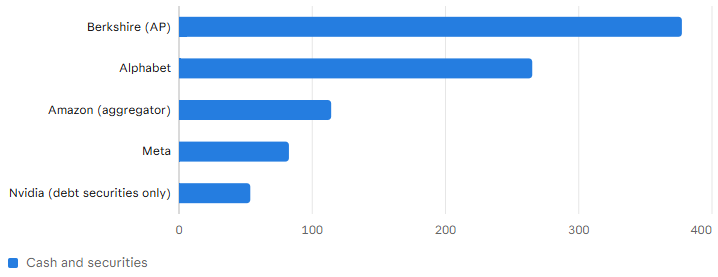
On cash piles alone, four of the five clear $80 billion, though Meta only just. Berkshire Hathaway reported $377.4 billion at the end of September, Alphabet $265.1 billion, and Meta $82.45 billion [9]. Amazon's cash and short-term investments were about $114 billion on one data aggregator's figures. Nvidia is the exception: its cash and marketable debt securities were $53.5 billion.
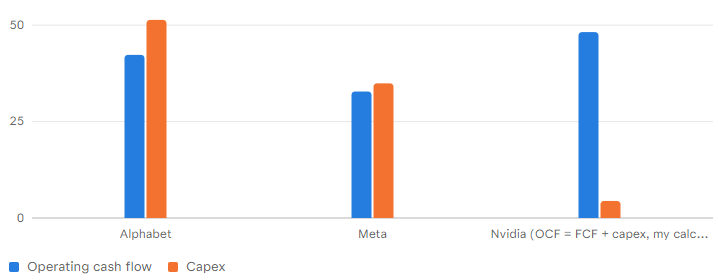
The bigger caveat is cash flow. Alphabet, Meta and Amazon have all been spending more on AI infrastructure than their operations generated in recent periods. Alphabet's free cash flow was negative $9.1 billion last quarter [6], Meta's was negative $2.1 billion, and Amazon's trailing twelve-month free cash flow was an outflow of $42.4 billion.
Key takeaway: Big reserves are real, but a true cash cow also produces more cash than it spends. Right now, Nvidia and Berkshire fit that picture best, while Alphabet, Meta and Amazon are choosing to spend heavily and, in places, borrow.
A third measure, which many people forget, is debt. A company with $100 billion in cash and $150 billion in debt is in a different position from one with $100 billion in cash and no debt. This post looks at all three, so you can see the full picture rather than only the headline number. One more note on wording. The "more than $80 billion" in the headline is a handy line to test, and I use it throughout. But I will show where a company does and does not clear it, because the details matter.
What is Berkshire doing with it? Under new CEO Greg Abel, it bought back $9.6 billion of stock in the quarter, on top of $4.8 billion earlier in the year and about $2 billion in the first four weeks of October. For context, its biggest buyback year was 2021, at $27 billion. The operating business is steady rather than spectacular. Quarterly operating profit fell 6% to $12.71 billion, weighed down by insurance, and Berkshire also owned $335.5 billion of stocks such as Alphabet, Apple and American Express. The company also warned of "considerable uncertainty" and sluggish demand at several retail businesses. Investors have noticed the strength of the balance sheet. Berkshire shares reached record highs in early November despite a broader selloff, and since the end of September they have outgained the S&P 500 by more than 18 percentage points.
How is the gap being filled? Beancount's analysis says it was filled with $29 billion of new notes and $12.4 billion of newly issued stock. That is a real shift for a company long known for funding itself from profits. And the spending is not slowing. Alphabet maintained 2026 capex guidance of $195 billion to $205 billion and signalled that 2027 capex will top $300 billion. So Alphabet's reserves are huge, but it is in an investment phase, not a harvest phase.
Now the catch for our headline. Nvidia's cash, cash equivalents and marketable debt securities were $53.5 billion, down from $56.7 billion a year ago and $56.6 billion a quarter ago. That is below $80 billion. The reason is that Nvidia is handing money back: it returned a record $28.1 billion to shareholders in the quarter, and had $227.3 billion of buyback authorisation remaining. There is a second side to the story. Nvidia carried $109.7 billion of marketable equity and non-marketable securities, about 2.1 times its cash, according to FourWeekMBA's reading of the balance sheet. Those are stakes in other companies, not spare cash, so I would not count them as reserves. Even if you did, that is my calculation, and it would change what "reserves" means. Also worth noting: receivables rose to $81.0 billion and inventory to $39.7 billion, which ties up cash. A fast-growing business often does that, but it is a reminder that profit and cash are not identical.
Operating income fell 37%, and the operating margin dropped from 40% to 20%. Capex is expected to total about $140 billion at the midpoint in 2026. Meta is therefore an example of a company with a big cash pile that is shrinking quarter to quarter while it builds. That is not a warning sign by itself, as profits remain strong, but it is not what most people picture when they hear "cash cow".
On reserves, Arincen's balance sheet page lists $114.23 billion of cash and short-term investments at 30 September 2026, against total debt of $271.95 billion, for net debt of $157.72 billion. This comes from a data aggregator, not Amazon's own release, so I treat it as indicative. StockAnalysis showed $122.99 billion at 30 June, which suggests the pile has been drifting down. So Amazon passes the $80 billion test on cash, but it has more debt than cash on those figures. Whether that matters depends on how quickly AWS growth pays back the investment, which management is confident about, though that is a forecast, not a fact.
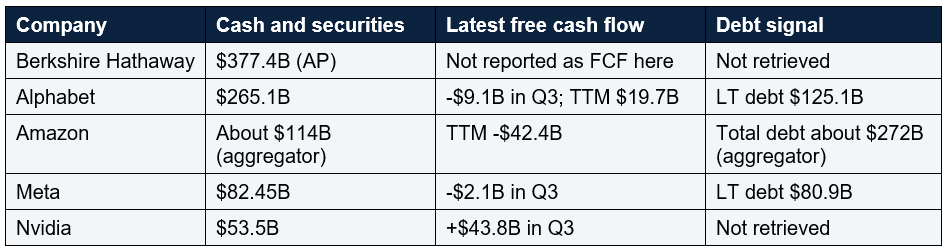
Two patterns jump out. First, the largest cash piles do not belong to the best cash generators. Second, the companies with the biggest AI building programmes are the ones where free cash flow has turned negative. I could not retrieve Berkshire's or Nvidia's debt figures, and I could not find Amazon's quarterly free cash flow in the sources I had, so those cells are marked rather than filled with guesses.
Remember diversification. Holding several of these names in a fund may mean you already own most of them. Check overlap before adding more. And keep your own timeline in mind. A reserve built for storms is most valuable to someone who might need it in the next few years, not to someone investing for decades who can simply wait out volatility.
If you are studying any of these five, here are some questions to ask. How much cash does the company have, and how much debt? Is free cash flow positive, and if not, why? Is the spending building something with clear returns? How much is being returned to shareholders? What happens to the numbers if growth slows? Also ask what you are paying. A strong balance sheet is often already reflected in the share price. This post does not assess valuation, so that is a separate step you would need to take.
Finally, check the source. Several figures here come from news coverage and data aggregators, not primary filings. If you are making a decision, read the company's own results release and quarterly filing.
So the lesson is to look beyond the headline. A big cash pile is comforting, but free cash flow, debt and capital spending tell you whether it is growing, holding or draining. These are strong companies. But strong does not mean bulletproof, and it does not mean the shares cannot fall.
Berkshire Hathaway, with $377.4 billion at the end of September per AP, although Reuters cites $356.9 billion in "cash and equivalents".
Does Nvidia have more than $80 billion in cash?
Not by its own measure. Cash, cash equivalents and marketable debt securities were $53.5 billion. It holds more in other investments, but those are not spare cash.
Why is Alphabet's free cash flow negative?
Capital spending of $51.4 billion exceeded operating cash flow of $42.3 billion in Q3, and the gap was filled with new notes and stock.
Is Amazon's free cash flow really negative?
Yes, on a trailing twelve-month basis it was an outflow of $42.4 billion, driven by a $94.8 billion rise in capital spending.
Does a big cash pile make a stock safe?
No. It protects the business, but share prices can still fall, and cash can be spent or offset by debt, as with Meta, whose cash fell $7.8 billion in a quarter [9] (my calculation).
Table of Contents
- What makes a cash cow
- Berkshire Hathaway: the classic cash pile
- Alphabet: big reserves, heavy spending
- Nvidia: the real cash machine
- Meta Platforms: reserves above $80 billion, but thinner
- Amazon: huge cash flow, even bigger capex
- Side by side: cash, cash flow and debt
- Why cash alone is not safety
- What it means for everyday investors
- What to watch next
- Questions to ask before you buy
- Conclusion
- FAQ
Cash and marketable securities, latest quarter ($ billion)
$ billion by Source: company releases and news reports; $80B test line not drawn
Operating cash flow vs capex, latest quarter ($ billion)
$ billion by Source: Quartr, FourWeekMBA, Gupta
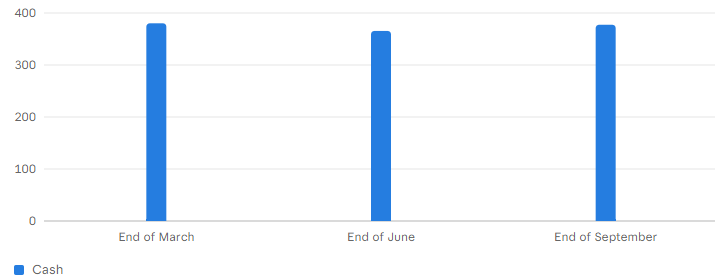
Berkshire Hathaway cash pile through 2026 ($ billion)
$ billion by Source: Reuters, AP (Reuters also cites $356.9B for September)The headline idea is appealing: five giants, each sitting on more than $80 billion, built to ride out almost any storm. The latest filings support part of that and complicate the rest.
On cash piles alone, four of the five clear $80 billion, though Meta only just. Berkshire Hathaway reported $377.4 billion at the end of September, Alphabet $265.1 billion, and Meta $82.45 billion [9]. Amazon's cash and short-term investments were about $114 billion on one data aggregator's figures. Nvidia is the exception: its cash and marketable debt securities were $53.5 billion.
The bigger caveat is cash flow. Alphabet, Meta and Amazon have all been spending more on AI infrastructure than their operations generated in recent periods. Alphabet's free cash flow was negative $9.1 billion last quarter [6], Meta's was negative $2.1 billion, and Amazon's trailing twelve-month free cash flow was an outflow of $42.4 billion.
Key takeaway: Big reserves are real, but a true cash cow also produces more cash than it spends. Right now, Nvidia and Berkshire fit that picture best, while Alphabet, Meta and Amazon are choosing to spend heavily and, in places, borrow.
What makes a cash cow
A cash cow is a business that throws off more cash than it needs to run and grow, so the owners can collect it. Think of a dairy cow that keeps producing milk without costing much to feed. Investors usually judge this with two simple measures. The first is the cash pile on the balance sheet: cash, cash equivalents and marketable securities. The second is free cash flow, which is the cash a company generates from operations after paying for the equipment and buildings it needs. Alphabet, for instance, defines free cash flow as operating cash flow minus capital expenditure.A third measure, which many people forget, is debt. A company with $100 billion in cash and $150 billion in debt is in a different position from one with $100 billion in cash and no debt. This post looks at all three, so you can see the full picture rather than only the headline number. One more note on wording. The "more than $80 billion" in the headline is a handy line to test, and I use it throughout. But I will show where a company does and does not clear it, because the details matter.
Berkshire Hathaway: the classic cash pile
Berkshire is the textbook example. AP reported its cash pile reached $377.4 billion at the end of the third quarter, up from $365.5 billion at the end of June. Reuters reported cash holdings had declined from $380.2 billion at the end of March. There is a conflict in the coverage. Reuters, via The Standard, says Berkshire ended September with $356.9 billion of "cash and equivalents", a figure Finimize repeats. I could not tell from the articles why the two numbers differ. My inference is that they use different definitions, perhaps including or excluding some Treasury holdings, but I cannot confirm that. Either number is far above $80 billion.What is Berkshire doing with it? Under new CEO Greg Abel, it bought back $9.6 billion of stock in the quarter, on top of $4.8 billion earlier in the year and about $2 billion in the first four weeks of October. For context, its biggest buyback year was 2021, at $27 billion. The operating business is steady rather than spectacular. Quarterly operating profit fell 6% to $12.71 billion, weighed down by insurance, and Berkshire also owned $335.5 billion of stocks such as Alphabet, Apple and American Express. The company also warned of "considerable uncertainty" and sluggish demand at several retail businesses. Investors have noticed the strength of the balance sheet. Berkshire shares reached record highs in early November despite a broader selloff, and since the end of September they have outgained the S&P 500 by more than 18 percentage points.
Alphabet: big reserves, heavy spending
Alphabet has the second-largest pile in this group. Quartr's summary of the third-quarter results lists cash and marketable securities of $265.1 billion, against long-term debt of $125.1 billion [5]. Revenue rose 25% to $127.6 billion, and Google Cloud revenue jumped 103%. The cash-flow picture is where it gets interesting. Operating cash flow was $42.29 billion, but property and equipment purchases were $51.355 billion, leaving free cash flow of negative $9.065 billion. PPC Land notes that it was the second negative quarter in a row, and that trailing twelve-month free cash flow dropped 73% to $19.7 billion [6].How is the gap being filled? Beancount's analysis says it was filled with $29 billion of new notes and $12.4 billion of newly issued stock. That is a real shift for a company long known for funding itself from profits. And the spending is not slowing. Alphabet maintained 2026 capex guidance of $195 billion to $205 billion and signalled that 2027 capex will top $300 billion. So Alphabet's reserves are huge, but it is in an investment phase, not a harvest phase.
Nvidia: the real cash machine
If any company here is a true cash machine at the moment, it is Nvidia. For the quarter ended 25 October 2026, revenue was $115.8 billion, up 103% from a year earlier, with data center revenue of $107.6 billion. GAAP net income was $65.3 billion. Free cash flow was $43.78 billion, up 98.2% from $22.09 billion a year earlier, and capital spending was just $4.42 billion. StockStory puts the free cash flow margin at 37.8%. In other words, Nvidia spends little on buildings relative to what it earns.Now the catch for our headline. Nvidia's cash, cash equivalents and marketable debt securities were $53.5 billion, down from $56.7 billion a year ago and $56.6 billion a quarter ago. That is below $80 billion. The reason is that Nvidia is handing money back: it returned a record $28.1 billion to shareholders in the quarter, and had $227.3 billion of buyback authorisation remaining. There is a second side to the story. Nvidia carried $109.7 billion of marketable equity and non-marketable securities, about 2.1 times its cash, according to FourWeekMBA's reading of the balance sheet. Those are stakes in other companies, not spare cash, so I would not count them as reserves. Even if you did, that is my calculation, and it would change what "reserves" means. Also worth noting: receivables rose to $81.0 billion and inventory to $39.7 billion, which ties up cash. A fast-growing business often does that, but it is a reminder that profit and cash are not identical.
Meta Platforms: reserves above $80 billion, but thinner
Meta does clear $80 billion, but only just. Its cash, cash equivalents and marketable securities were $82.45 billion on 30 September, down from $90.26 billion on 30 June, while long-term debt was $80.92 billion. So its cash is roughly equal to its long-term debt. Third-quarter revenue was $64.60 billion, up 26%. But capital expenditure of $34.91 billion exceeded the $32.79 billion generated by operations, leaving free cash flow at negative $2.12 billion. The Motley Fool says it is the first negative free cash flow quarter since 2012, the year Meta went public.Operating income fell 37%, and the operating margin dropped from 40% to 20%. Capex is expected to total about $140 billion at the midpoint in 2026. Meta is therefore an example of a company with a big cash pile that is shrinking quarter to quarter while it builds. That is not a warning sign by itself, as profits remain strong, but it is not what most people picture when they hear "cash cow".
Amazon: huge cash flow, even bigger capex
Amazon is a special case because of the scale of its operations. Trailing twelve-month operating cash flow rose 29% to $168.3 billion. But net purchases of property and equipment were $210.657 billion, up from $115.903 billion, so free cash flow was negative $42.357 billion, against a positive $14.788 billion a year earlier. The company attributes the swing primarily to a $94.8 billion year-over-year increase in capital spending, driven by AI infrastructure. Meanwhile the business itself is healthy: operating income was $28.1 billion, an operating margin of 13.9%, the highest ever, and AWS sales rose 39% to $46.0 billion.On reserves, Arincen's balance sheet page lists $114.23 billion of cash and short-term investments at 30 September 2026, against total debt of $271.95 billion, for net debt of $157.72 billion. This comes from a data aggregator, not Amazon's own release, so I treat it as indicative. StockAnalysis showed $122.99 billion at 30 June, which suggests the pile has been drifting down. So Amazon passes the $80 billion test on cash, but it has more debt than cash on those figures. Whether that matters depends on how quickly AWS growth pays back the investment, which management is confident about, though that is a forecast, not a fact.
Side by side: cash, cash flow and debt
Here is the group in one view. Cash and marketable securities: Berkshire $377.4 billion, Alphabet $265.1 billion [5], Amazon about $114 billion, Meta $82.45 billion [9], Nvidia $53.5 billion.Two patterns jump out. First, the largest cash piles do not belong to the best cash generators. Second, the companies with the biggest AI building programmes are the ones where free cash flow has turned negative. I could not retrieve Berkshire's or Nvidia's debt figures, and I could not find Amazon's quarterly free cash flow in the sources I had, so those cells are marked rather than filled with guesses.
Why cash alone is not safety
Cash is reassuring, but it is not the same as safety. Consider three reasons. First, cash can be spent. Meta's cash fell from $90.26 billion to $82.45 billion in one quarter. Nvidia's fell while it returned $28.1 billion to shareholders. Reserves are only as good as management's discipline. Second, debt offsets cash. Alphabet's $125.1 billion of long-term debt and Meta's $80.92 billion are large next to their cash piles. When free cash flow is negative, borrowing and issuing shares can fill the gap, as Alphabet did. Third, the picture depends on assumptions about the future. The capex boom only pays off if AI demand grows as management expects. Amazon's CEO projects AWS growth above 40% in 2027 and 2028, and Nvidia guides to $130 billion of revenue next quarter. These are forecasts, and forecasts can miss. None of this means the companies are in trouble. It means that "bulletproof" is a strong word, and the details vary.What it means for everyday investors
I cannot tell you what to buy. But here are a few general ideas that investors often find useful. Look at free cash flow as well as the cash pile. A shrinking pile or negative free cash flow is not necessarily bad, but it tells you the company is investing hard, and you should understand why. Do not assume a big company equals a safe stock. A strong balance sheet protects the business, but it does not protect the share price from falling if expectations drop, as the early-November selloff, driven by worries about AI and debt-fuelled tech spending, showed.Remember diversification. Holding several of these names in a fund may mean you already own most of them. Check overlap before adding more. And keep your own timeline in mind. A reserve built for storms is most valuable to someone who might need it in the next few years, not to someone investing for decades who can simply wait out volatility.
What to watch next
Several things will shape this story. The first is the capex path. Alphabet says 2027 capex will top $300 billion. Whether cash flow turns positive again will depend on how quickly revenue catches up. The second is shareholder returns. Berkshire's buybacks have picked up under Abel, and Nvidia has $227.3 billion of authorisation to use. Watch whether they keep buying when prices rise, since Berkshire's buybacks may have slowed recently as its shares hit new highs. The third is debt. If Alphabet and Meta keep borrowing to fund building, their interest costs will matter more, especially if rates stay high. The fourth is Nvidia's cash use. With $390 billion of supply and capacity commitments, according to Deepak Gupta's reading of its filings, how Nvidia balances buybacks, investments and inventory will be worth watching.If you are studying any of these five, here are some questions to ask. How much cash does the company have, and how much debt? Is free cash flow positive, and if not, why? Is the spending building something with clear returns? How much is being returned to shareholders? What happens to the numbers if growth slows? Also ask what you are paying. A strong balance sheet is often already reflected in the share price. This post does not assess valuation, so that is a separate step you would need to take.
Finally, check the source. Several figures here come from news coverage and data aggregators, not primary filings. If you are making a decision, read the company's own results release and quarterly filing.
Conclusion
The "5 cash cows" label fits only partly. Berkshire has the largest reserves, at $377.4 billion by AP's count. Alphabet, Meta and Amazon all have more than $80 billion of cash and securities, though their free cash flow has turned negative as they pour money into AI. Nvidia generates the most cash, with $43.8 billion of free cash flow in a quarter, but its cash and marketable debt securities of $53.5 billion are below the $80 billion line.So the lesson is to look beyond the headline. A big cash pile is comforting, but free cash flow, debt and capital spending tell you whether it is growing, holding or draining. These are strong companies. But strong does not mean bulletproof, and it does not mean the shares cannot fall.
FAQ
Which of the five has the most cash?Berkshire Hathaway, with $377.4 billion at the end of September per AP, although Reuters cites $356.9 billion in "cash and equivalents".
Does Nvidia have more than $80 billion in cash?
Not by its own measure. Cash, cash equivalents and marketable debt securities were $53.5 billion. It holds more in other investments, but those are not spare cash.
Why is Alphabet's free cash flow negative?
Capital spending of $51.4 billion exceeded operating cash flow of $42.3 billion in Q3, and the gap was filled with new notes and stock.
Is Amazon's free cash flow really negative?
Yes, on a trailing twelve-month basis it was an outflow of $42.4 billion, driven by a $94.8 billion rise in capital spending.
Does a big cash pile make a stock safe?
No. It protects the business, but share prices can still fall, and cash can be spent or offset by debt, as with Meta, whose cash fell $7.8 billion in a quarter [9] (my calculation).
0 Comments
Be the first to share your thoughts on this article.