

Investing
5 ETFs to Build Your Emergency Fund and Keep It Safe

70% of Americans have less than $1,000 in emergency savings. 18% have none at all. Meanwhile, the best Treasury bill ETFs are paying approximately 3.6–4.3% in 2026 — safely, in government-backed securities, with monthly income distributions. If you have a brokerage account and a funded 401(k) but your emergency fund is sitting in a checking account at 0.07%, something is wrong with the structure. These five ETFs are the tools to fix it. Not financial advice.
But ‘not an investment’ does not mean ‘should earn nothing.’ An emergency fund sitting in a standard checking account (national average: 0.07% as of March 2026) is losing ground to inflation every single month. At 3.5% inflation, a $15,000 emergency fund in a checking account loses approximately $525 in purchasing power per year. The same $15,000 in SGOV (approximately 3.6% yield) preserves its real value and generates approximately $540 in income. The difference between the two choices is not risk: both are about as safe as money can be. The difference is knowledge of the options available.
Ultra-short Treasury ETFs — a category that barely existed in scale a decade ago — have emerged as one of the most compelling cash management tools in the modern brokerage account. In just six weeks following the April 2026 energy shock, SGOV, BIL, SHV, and TBIL saw net inflows exceeding $25 billion (FMInvest, April 17, 2026). The reason: investors recognised these ETFs as safe, yielding, government-backed cash vehicles that could outperform sitting idle in a bank account. This article covers the five best options for building an emergency fund within this category. Not financial advice.
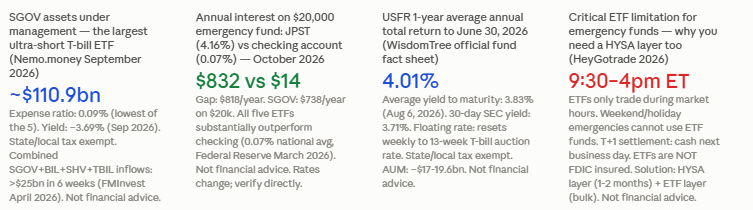
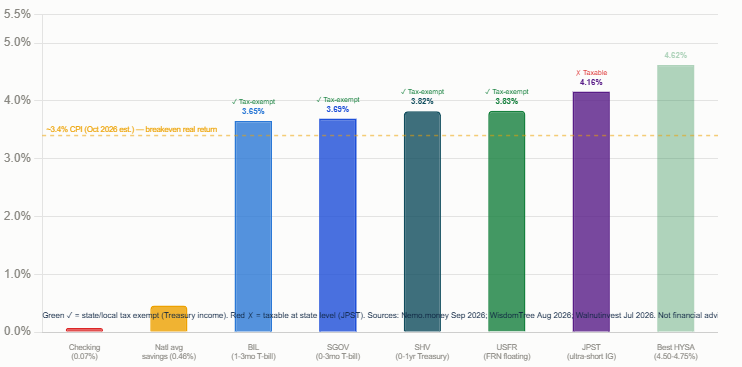
70% of Americans have less than $1,000 in emergency savings (ContentSnare, June 2026). 18% had none at all in 2025 (Bankrate/WSAW January 2026). Federal funds rate target range (September 16, 2026): 3.75%–4.00%. Best T-bill ETF yields (approximate, October 2026): SGOV 3.69%; BIL ~3.65%; USFR 3.71-3.81%; JPST 4.16%; SHV ~3.75-3.9%. SGOV AUM: ~$110.9bn (September 2026, Nemo.money). SGOV + BIL + SHV + TBIL combined inflows in 6 weeks post-energy-shock: >$25bn (FMInvest April 2026). Not financial advice.
Capital preservation: the ETF should hold assets where the risk of nominal loss is as close to zero as possible. For Treasury ETFs, this means the assets are backed by the US government, eliminating credit risk entirely. For JPST and similar ultra-short corporate bond ETFs, the credit risk is minimal but non-zero. The price of a Treasury bill ETF fluctuates only marginally with changes in interest rates (because the maturity is so short that the price is barely affected), making capital loss in the short run extremely unlikely but not technically impossible.
Near-zero volatility: ultra-short Treasury ETFs with maturities under 3 months have a weighted average duration measured in days or weeks, not years. A 100 basis point rise in interest rates would move the price of SGOV by approximately 0.09% (0.09 years duration times 1%). This is negligible. Compare to a long-term bond ETF, which might move 15–20% for the same rate change. Not financial advice.
Consistent income: all five ETFs featured in this article distribute income monthly — reflecting the monthly payment schedule of the underlying Treasury bills or notes. This makes them suitable for investors who want regular income from their emergency fund while it sits uninvested.
Rapid liquidity: Treasury ETFs trade on the NYSE Arca during US market hours. After selling, cash settles T+1 (arrives in your brokerage account the next business day). From there, it can be transferred to a bank account. The key limitation — covered next — is that this liquidity requires market hours and a settlement day. Not financial advice.
The second limitation is T+1 settlement. After selling SGOV during market hours on a Monday, the cash settles into the brokerage account on Tuesday. Transferring it to a bank account then takes one to three additional business days, depending on the institution. From sale to usable cash in a bank account: potentially two to five business days. For emergencies that can be paid by credit card (most of them) and cleared later from the ETF proceeds, this is manageable. For emergencies requiring immediate cash in hand, it is not.
The recommended structure (covered in Section 11) therefore uses two tiers: a smaller, immediately accessible liquid layer in a high-yield savings account or money market fund (for Saturday-night emergencies), and a larger, yield-generating layer in Treasury ETFs (for the bulk of the emergency fund that earns income while waiting). This two-tier approach is explicitly endorsed by HeyGotrade (2026) and Walnutinvest (June 2026). Not financial advice.
ETF emergency fund limitations: (1) ETFs only trade 9:30 AM–4:00 PM ET on business days. Weekend and holiday emergencies cannot be addressed by ETF liquidation. (2) T+1 settlement: cash arrives next business day after sale, then transfer to bank adds 1-3 more days. (3) ETFs are NOT FDIC insured. FMInvest (April 2026): 'Money markets and high yield savings accounts offered through banks are FDIC guaranteed and ETFs do not have guarantees.' (4) Treasury bill ETF price can fluctuate (minimally); not a guaranteed $1 NAV like a money market fund. Not financial advice.
SGOV has grown to be one of the largest ETFs in this category: approximately $110.9 billion in assets under management as of September 2026, up from approximately $75 billion cited in March 2026, reflecting consistent inflows from investors seeking safe yield. Year-to-date to April 2026, SGOV saw approximately $16.79 billion in net inflows, dwarfing USFR’s $1.66 billion. Its expense ratio of 0.09% is the lowest of the five ETFs featured in this article.
The yield as of October 2026: approximately 3.69% dividend yield (Nemo.money, September 2026), tracking the federal funds rate closely. The 24/7 Wall St profile is precise: ‘The yield moves with policy. With the Fed’s target rate at 3.75% as of March 31, 2026, SGOV’s 3.6% dividend yield reflects that reality directly.’ After the September 2026 rate rise to 3.75–4.00%, yields are trending toward 3.7%+ for subsequent months.
Ticker: SGOV | Full name: iShares 0-3 Month Treasury Bond ETF (BlackRock) | Expense ratio: 0.09% | AUM (approx.): ~$110.9bn (Sep 2026) | Yield (approx.): ~3.69% (trailing); ~3.6-3.7% 30-day SEC yield | State/local tax-exempt: YES — T-bill income state/local tax exempt | Best for: Emergency fund in brokerage; highest AUM + lowest ER in category. Not financial advice. Verify current data at fund issuer website.
SGOV state tax advantage: T-bill income is exempt from state and local income taxes. For a New York City resident (combined state + city rate up to 12.7%): $1,000 of SGOV income = $1,000 taxable only federally. Same $1,000 from a money market fund with taxable income = approximately $873 after NY state+city tax. The after-tax yield advantage is approximately 0.5 percentage points for high-tax-state investors. Not tax advice. Consult a tax professional.
BIL’s expense ratio of 0.14% is higher than SGOV’s 0.09%. On $20,000, this difference is $10 per year — not a consequential distinction, but worth noting. Its AUM is approximately $34–43 billion depending on the source, also substantial and liquid. BIL’s yield is comparable to SGOV — approximately 3.6–3.7% in the current environment. The choice between BIL and SGOV for most emergency fund applications comes down to a preference for SGOV’s lower expense ratio vs BIL’s longer operational history.
For investors who value track record above marginal cost savings: BIL’s 2007 inception means it has a verifiable history of capital preservation across more market conditions than SGOV (which launched in 2020 and has only operated in the high-rate environment). During the COVID-19 March 2020 liquidity crisis, BIL maintained its NAV stability. That track record has value for a vehicle whose primary purpose is to be there in a crisis. Not financial advice.
Ticker: BIL | Full name: SPDR Bloomberg 1-3 Month T-Bill ETF (State Street) | Expense ratio: 0.14% | AUM (approx.): ~$34-43bn | Yield (approx.): ~3.65% (trailing) | State/local tax-exempt: YES — T-bill income state/local tax exempt | Best for: Investors who prioritise track record (2007 inception); slightly longer maturity than SGOV. Not financial advice. Verify current data at fund issuer website.
USFR’s yield as of August 6, 2026: average yield to maturity 3.83% (WisdomTree official fund data); 30-day SEC yield 3.71%; trailing dividend yield approximately 3.74–3.81%. Its 1-year average annual total return as of June 30, 2026 was 4.01% (WisdomTree). The 3-year average: 3.72% (reflecting the rate cycle from the 2023–2025 period). The fund has approximately $17–19.6 billion in AUM and charges 0.15% in expenses.
The specific advantage of USFR’s floating-rate structure for an emergency fund: in an environment where the Fed is potentially raising rates further (as it did in September 2026), USFR’s yield automatically rises with each rate adjustment, without any price volatility. SGOV also benefits from rate rises (as old bills mature and are replaced at higher rates), but USFR adjusts weekly rather than over a rolling 0–3 month maturity window. For investors who believe rates will remain elevated or rise further: USFR is the most rate-sensitive in the best direction. Not financial advice.
Ticker: USFR | Full name: WisdomTree Floating Rate Treasury Fund (WisdomTree) | Expense ratio: 0.15% | AUM (approx.): ~$17-19.6bn | Yield (approx.): ~3.71-3.83% (30-day/YTM Aug 2026); 4.01% 1-yr return (Jun 2026) | State/local tax-exempt: YES — Treasury FRN income state/local tax exempt | Best for: Investors expecting rates to rise or hold; maximum rate-adjustment speed; zero duration. Not financial advice. Verify current data at fund issuer website.
SGOV vs Others: USFR vs SGOV: SGOV holds 0-3 month T-bills (fixed rate, rolling maturity). USFR holds floating-rate Treasury notes (2-year maturity, rate resets weekly to 13-week T-bill rate). Both state/local tax exempt. SGOV has lower expense ratio (0.09% vs 0.15%). USFR adjusts faster when rates rise. SGOV is cheaper and bigger. For emergency fund use: both are excellent; SGOV edge on cost and AUM; USFR edge on floating-rate pure rate tracking. Not financial advice.
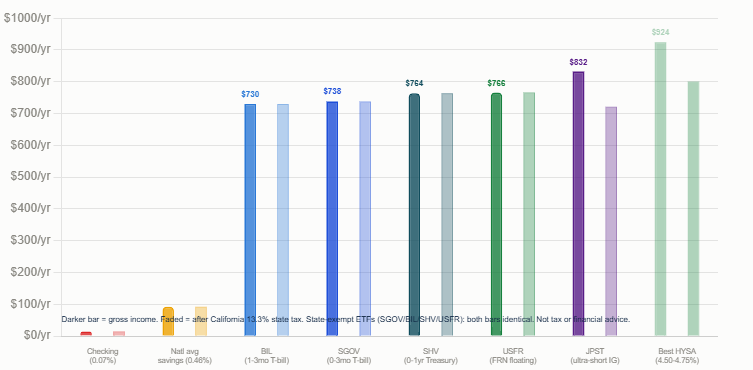
The yield premium over SGOV is the primary reason to consider JPST: approximately 4.16% dividend yield (September 2026, Nemo.money) vs SGOV’s approximately 3.69% — a premium of approximately 0.47 percentage points. On $20,000, this extra yield generates approximately $94 per year. The cost: credit risk (corporate bonds can default; SGOV’s US Treasuries essentially cannot), slightly more price volatility, and the loss of state tax exemption (JPST income is subject to state and local taxes).
For the emergency fund use case, JPST is best suited to investors who: (a) are in states with low or no state income tax (where the loss of tax exemption is less significant); (b) have already established the Treasury ETF layer of their emergency fund and want to allocate a smaller additional yield-seeking portion; or (c) hold the fund in a tax-advantaged account (IRA or 401(k)) where state tax treatment is irrelevant. For core emergency fund allocation, SGOV’s purity of Treasury backing and state tax exemption make it the more appropriate default. JPST is a supplement for investors seeking marginally more yield. Not financial advice.
Ticker: JPST | Full name: JPMorgan Ultra-Short Income ETF (J.P. Morgan) | Expense ratio: 0.18% | AUM (approx.): ~$39-42bn | Yield (approx.): ~4.16% (trailing Sep 2026); ~4.0% 30-day SEC yield | State/local tax-exempt: NO — holds corporate bonds, NOT state/local tax exempt | Best for: Investors in low/no income tax states seeking modest yield premium; tax-advantaged accounts. Not financial advice. Verify current data at fund issuer website.
JPST risk note: unlike SGOV, BIL, USFR, and SHV, JPST holds corporate bonds, commercial paper, and asset-backed securities. These are investment-grade with short maturities, but they carry non-zero credit risk. In a severe credit crisis (2008-style), short-term corporate paper can experience significant stress. During March 2020 COVID liquidity crisis, some ultra-short corporate bond ETFs experienced wider bid-ask spreads and temporary NAV dislocation. SGOV and BIL did not (pure Treasuries). For emergency fund core: Treasury ETFs preferred. Not financial advice.
SHV’s AUM is approximately $18.4–19.4 billion, and its expense ratio is 0.15%. Its inception date of January 2007 makes it, alongside BIL, one of the veteran Treasury ETFs that has operated through multiple market cycles. The HeyGotrade 2026 emergency fund guide lists SHV alongside SGOV as the two primary choices for the ‘Layer 2’ of a cash emergency fund structure: ‘Layer 2 is 2-5 months in SGOV or a money market fund for yield with same-day liquidity.’ SHV is the appropriate choice within this layer for investors who are comfortable with the slightly wider maturity exposure and want marginally more yield.
SHV was also one of the four ETFs cited by FMInvest (April 17, 2026) as receiving massive inflows in the six weeks following the energy shock: ‘SGOV, BIL, SHV, and TBIL — have seen net inflows exceeding $25 billion.’ The fund’s track record through the 2022-2026 rate cycle confirms its stability as an emergency fund vehicle. Not financial advice.
Ticker: SHV | Full name: iShares Short Treasury Bond ETF (BlackRock) | Expense ratio: 0.15% | AUM (approx.): ~$18.4-19.4bn | Yield (approx.): ~3.75-3.9% (slightly higher than SGOV due to wider maturity) | State/local tax-exempt: YES — Treasury income state/local tax exempt | Best for: Investors wanting slightly more yield than SGOV with same Treasury safety; 0-1 year maturity. Not financial advice. Verify current data at fund issuer website.
An illustration: California’s top marginal state income tax rate is 13.3%. A California resident earning $1,000 in annual income from SGOV pays zero California state tax on that income. The same $1,000 from a money market fund that invests in repurchase agreements (repos) rather than pure Treasuries is subject to California state income tax: $1,000 × 13.3% = $133 in additional state tax. Net after-tax income: $867. SGOV: $1,000. The after-tax advantage of SGOV over a non-Treasury money market fund for this California investor is approximately 1.33 percentage points of yield.
This is why FMInvest (April 17, 2026) explicitly noted: ‘For investors in high-tax states, the “tax-equivalent yield” can make Treasury ETFs more attractive than high-yield savings accounts, CDs or even money market funds that invest primarily in repos, which generate income that is taxable at the state level.’ JPST does not provide this benefit: it holds corporate bonds and commercial paper, and its income is fully subject to state and local taxes. Not tax advice. Individual tax situations vary. Consult a tax professional.
State tax equivalence calculation (illustrative): SGOV yield 3.69% (state-tax-exempt). In California (13.3% top state rate): equivalent taxable yield needed = 3.69% / (1 - 0.133) = approximately 4.26%. If a money market fund pays 4.10% but is fully taxable at the state level, its after-state-tax return in California is 4.10% × (1 - 0.133) = approximately 3.55%. The SGOV (3.69%) BEATS the money market fund (4.10% stated yield) after California state tax. States with highest income tax: California (13.3%), Hawaii (11%), New Jersey (10.75%), Oregon (9.9%), Minnesota (9.85%), New York (10.9%). Not tax advice. Verify with a tax professional.
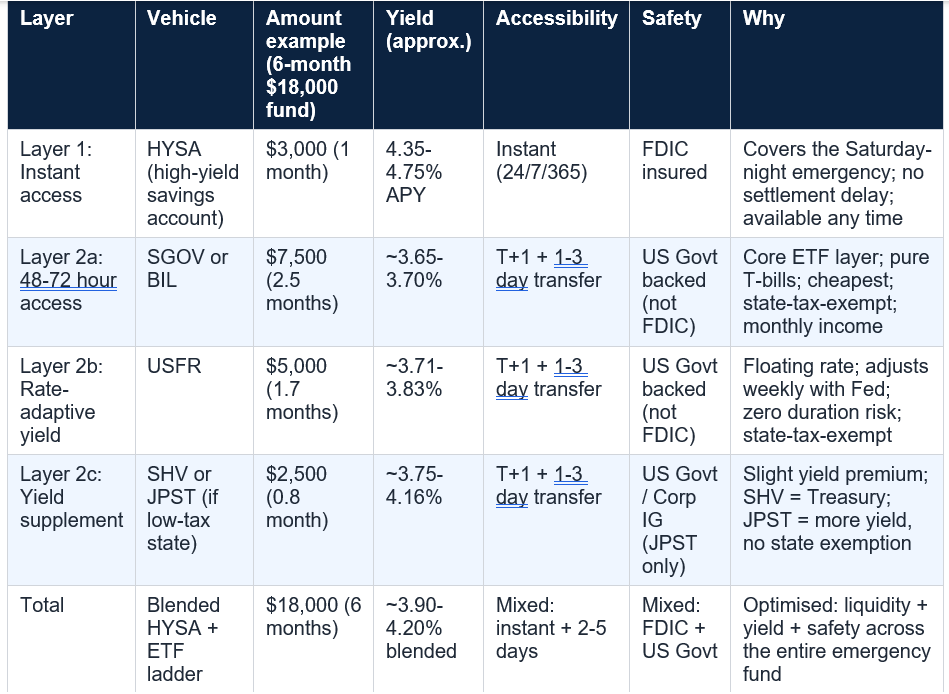
Note: this structure is for general informational purposes only and is not personalised financial advice. The right split depends on: (a) how much you already have accessible in a HYSA; (b) whether you hold a brokerage account where ETFs can be held; (c) your state income tax rate (determines value of state-tax exemption); (d) your risk tolerance regarding FDIC vs US government backing. Not financial advice. Consult a qualified financial adviser.
The critical structure point: ETFs are not FDIC insured, and they cannot solve a Saturday-night emergency. A one-to-two-month layer in an HYSA handles instant access; the Treasury ETFs handle the bulk of the fund, earning competitive yield while the market is open. Investors in high-tax states (California, New York, New Jersey, Oregon) have an additional reason to favour Treasury ETFs: the state and local tax exemption on T-bill income can make their after-tax yield competitive with or superior to higher-stated-yield products that lose that exemption.
The emergency fund is the foundation of financial resilience. It deserves the same thoughtfulness as the investment portfolio built on top of it. Not financial, investment, or tax advice. Consult a qualified financial adviser for advice specific to your circumstances.
SGOV (iShares 0-3 Month Treasury Bond ETF) is among the safest places to hold cash in a brokerage account. It holds US Treasury bills with maturities of 0-3 months -- the safest instruments in the world, backed by the full faith and credit of the US government. Its expense ratio is 0.09% and its AUM is approximately $110.9 billion (September 2026). Price volatility is negligible (weighted average duration approximately 0.09 years). HOWEVER: SGOV is NOT FDIC insured. It is not a bank account. Its price can fluctuate (minimally). And it can only be sold during US market hours, with T+1 settlement. For a complete emergency fund: use SGOV for the bulk of the fund and maintain a smaller HYSA layer for instant-access emergencies. Not financial advice.
What is the difference between SGOV and BIL?
Both SGOV and BIL hold US Treasury bills and are state/local income tax exempt. The key differences: SGOV holds T-bills maturing within 0-3 months; BIL holds 1-3 months (slightly longer). SGOV has a lower expense ratio (0.09% vs BIL's 0.14%). SGOV is considerably larger ($110.9bn vs BIL's ~$34-43bn). BIL was launched in 2007 and has a longer operational history, including through the 2008 financial crisis. Yields are comparable (~3.65-3.70% for both as of October 2026). For most investors: SGOV is the default pick based on lower cost and larger AUM. BIL is the choice for investors who specifically value the 2007 inception date and crisis-era track record. Sources: HeyGotrade 2026; mezzi.com; ETF.com. Not financial advice.
Should I use JPST or SGOV for my emergency fund?
For the core emergency fund: SGOV is preferred for most investors. The reasons: (1) SGOV holds pure US Treasuries (zero credit risk; essentially default-proof); JPST holds corporate bonds and commercial paper (minimal but non-zero credit risk). (2) SGOV income is exempt from state and local taxes; JPST income is not. (3) SGOV costs less (0.09% vs 0.18%). JPST's advantage: it yields approximately 0.47% more than SGOV (~4.16% vs ~3.69% as of September 2026). On $20,000 emergency fund: approximately $94 extra per year for JPST, in exchange for more credit risk and no state tax exemption. JPST is more appropriate as a supplemental higher-yield layer (not the core), or in tax-advantaged accounts where state tax treatment is irrelevant, or for investors in states with no income tax. Not financial advice.
What is USFR and why is it different from SGOV?
USFR (WisdomTree Floating Rate Treasury Fund) holds US Treasury Floating Rate Notes -- 2-year Treasury securities with interest rates that reset weekly to the latest 13-week T-bill auction rate. SGOV holds fixed-rate 0-3 month T-bills. The key difference: USFR's yield floats with short-term rates immediately (adjusting weekly), while SGOV's yield adjusts as bills mature and are rolled (over a 0-3 month cycle). Both are state/local tax exempt. USFR has a slightly higher expense ratio (0.15% vs SGOV's 0.09%) and is smaller (~$17-19.6bn vs SGOV's ~$110.9bn). For emergency fund use: USFR is preferred if you believe short-term rates will rise further (the weekly reset captures rate increases faster than SGOV's rolling maturity). SGOV is preferred if you want lower cost and maximum AUM. Source: ETFbff.com comparison; WisdomTree fact sheet; Walnutinvest. Not financial advice.
How many months of expenses should my emergency fund cover?
The standard recommendation is 3-6 months of essential living expenses (housing, food, utilities, transport, minimum debt payments). Three months is appropriate for: stable employment in a sector with readily available equivalent roles, no dependants, and a strong support network. Six months is appropriate for: the self-employed or contractors with variable income, single-income households, people with dependants, homeowners with potentially expensive maintenance liabilities, or workers in industries with longer typical job-search timelines. The emergency fund should cover ESSENTIAL expenses only -- not total current spending (which includes discretionary items). In October 2026: 70% of Americans have less than $1,000 in emergency savings (ContentSnare, June 2026). If you are in this group: starting with a $500-$1,000 HYSA starter fund is the immediate priority before moving to the ETF structure described in this article. Not financial advice.
Table of Contents
- Why Your Emergency Fund Belongs in More Than a Checking Account
- What Makes an ETF Suitable for an Emergency Fund?
- The Critical Warning: What ETFs Cannot Do That a HYSA Can
- ETF #1 — SGOV: The Gold Standard for Brokerage Emergency Cash
- ETF #2 — BIL: The Long-Track-Record T-Bill Veteran
- ETF #3 — USFR: The Floating-Rate Option for Rate Uncertainty
- ETF #4 — JPST: The Slight Yield Premium Over Pure Treasuries
- ETF #5 — SHV: The Slightly Longer Maturity, Slightly More Yield
- The Full Comparison: All Five ETFs Side by Side
- The State Tax Advantage: Why High-Tax-State Residents Should Pay Attention
- The Recommended Structure: How to Layer Your Emergency Fund
- Conclusion: Your Emergency Fund Should Work as Hard as the Rest of Your Money
- Frequently Asked Questions
ETF yield comparison — all 5 funds vs alternatives
Annual income on $20,000 --- what each fund pays
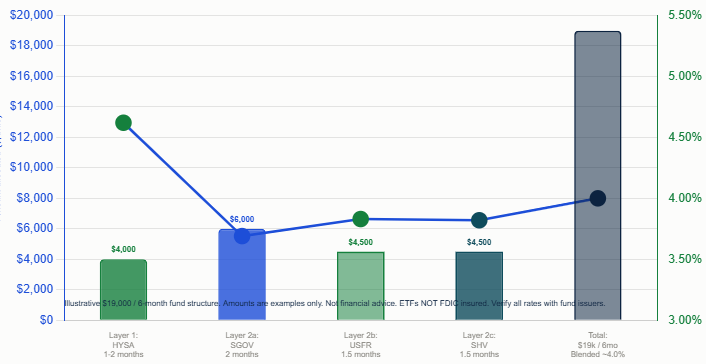
Emergency fund layers — the recommended structure
Why Your Emergency Fund Belongs in More Than a Checking Account
An emergency fund is not an investment. Its primary purpose is to be there — accessible, intact, and in the right amount — when something goes wrong. A job loss, a medical bill, a boiler breakdown, a car repair: these do not announce themselves in advance, and they do not accommodate market hours. The emergency fund exists to prevent a temporary setback from becoming a spiral into high-interest debt.But ‘not an investment’ does not mean ‘should earn nothing.’ An emergency fund sitting in a standard checking account (national average: 0.07% as of March 2026) is losing ground to inflation every single month. At 3.5% inflation, a $15,000 emergency fund in a checking account loses approximately $525 in purchasing power per year. The same $15,000 in SGOV (approximately 3.6% yield) preserves its real value and generates approximately $540 in income. The difference between the two choices is not risk: both are about as safe as money can be. The difference is knowledge of the options available.
Ultra-short Treasury ETFs — a category that barely existed in scale a decade ago — have emerged as one of the most compelling cash management tools in the modern brokerage account. In just six weeks following the April 2026 energy shock, SGOV, BIL, SHV, and TBIL saw net inflows exceeding $25 billion (FMInvest, April 17, 2026). The reason: investors recognised these ETFs as safe, yielding, government-backed cash vehicles that could outperform sitting idle in a bank account. This article covers the five best options for building an emergency fund within this category. Not financial advice.
70% of Americans have less than $1,000 in emergency savings (ContentSnare, June 2026). 18% had none at all in 2025 (Bankrate/WSAW January 2026). Federal funds rate target range (September 16, 2026): 3.75%–4.00%. Best T-bill ETF yields (approximate, October 2026): SGOV 3.69%; BIL ~3.65%; USFR 3.71-3.81%; JPST 4.16%; SHV ~3.75-3.9%. SGOV AUM: ~$110.9bn (September 2026, Nemo.money). SGOV + BIL + SHV + TBIL combined inflows in 6 weeks post-energy-shock: >$25bn (FMInvest April 2026). Not financial advice.
What Makes an ETF Suitable for an Emergency Fund?
Not every ETF is suitable for emergency fund use. An emergency fund ETF must satisfy four specific criteria that most equity ETFs fail: capital preservation, near-zero volatility, consistent income, and rapid liquidity. A brief definition of each criterion as it applies to emergency fund use.Capital preservation: the ETF should hold assets where the risk of nominal loss is as close to zero as possible. For Treasury ETFs, this means the assets are backed by the US government, eliminating credit risk entirely. For JPST and similar ultra-short corporate bond ETFs, the credit risk is minimal but non-zero. The price of a Treasury bill ETF fluctuates only marginally with changes in interest rates (because the maturity is so short that the price is barely affected), making capital loss in the short run extremely unlikely but not technically impossible.
Near-zero volatility: ultra-short Treasury ETFs with maturities under 3 months have a weighted average duration measured in days or weeks, not years. A 100 basis point rise in interest rates would move the price of SGOV by approximately 0.09% (0.09 years duration times 1%). This is negligible. Compare to a long-term bond ETF, which might move 15–20% for the same rate change. Not financial advice.
Consistent income: all five ETFs featured in this article distribute income monthly — reflecting the monthly payment schedule of the underlying Treasury bills or notes. This makes them suitable for investors who want regular income from their emergency fund while it sits uninvested.
Rapid liquidity: Treasury ETFs trade on the NYSE Arca during US market hours. After selling, cash settles T+1 (arrives in your brokerage account the next business day). From there, it can be transferred to a bank account. The key limitation — covered next — is that this liquidity requires market hours and a settlement day. Not financial advice.
The Critical Warning: What ETFs Cannot Do That a HYSA Can
Before covering the five ETFs in detail, the most important caveat: an ETF is not a bank account, and it cannot function like one for the most urgent emergencies. HeyGotrade (2026) states this plainly: ‘They only trade during US market hours, 9:30 AM to 4:00 PM ET, so a Saturday night emergency cannot be solved by selling SGOV then.’ If a medical emergency occurs on a weekend, if a car repair needs payment at midnight, or if funds are needed immediately on a public holiday, an ETF position cannot be liquidated in time.The second limitation is T+1 settlement. After selling SGOV during market hours on a Monday, the cash settles into the brokerage account on Tuesday. Transferring it to a bank account then takes one to three additional business days, depending on the institution. From sale to usable cash in a bank account: potentially two to five business days. For emergencies that can be paid by credit card (most of them) and cleared later from the ETF proceeds, this is manageable. For emergencies requiring immediate cash in hand, it is not.
The recommended structure (covered in Section 11) therefore uses two tiers: a smaller, immediately accessible liquid layer in a high-yield savings account or money market fund (for Saturday-night emergencies), and a larger, yield-generating layer in Treasury ETFs (for the bulk of the emergency fund that earns income while waiting). This two-tier approach is explicitly endorsed by HeyGotrade (2026) and Walnutinvest (June 2026). Not financial advice.
ETF emergency fund limitations: (1) ETFs only trade 9:30 AM–4:00 PM ET on business days. Weekend and holiday emergencies cannot be addressed by ETF liquidation. (2) T+1 settlement: cash arrives next business day after sale, then transfer to bank adds 1-3 more days. (3) ETFs are NOT FDIC insured. FMInvest (April 2026): 'Money markets and high yield savings accounts offered through banks are FDIC guaranteed and ETFs do not have guarantees.' (4) Treasury bill ETF price can fluctuate (minimally); not a guaranteed $1 NAV like a money market fund. Not financial advice.
ETF #1 SGOV — iShares 0-3 Month Treasury Bond ETF
SGOV is the leading candidate for brokerage-based emergency fund cash. Managed by BlackRock’s iShares, it holds US Treasury bills maturing within zero to three months, rolling them continuously as they mature. The result is an extraordinarily stable fund: its weighted average maturity is approximately 0.09 years (around 33 days), giving it negligible duration risk. As 24/7 Wall St described it: ‘Think of it as a brokerage account money market fund with a government-only mandate and a published expense ratio of 0.09%.’SGOV has grown to be one of the largest ETFs in this category: approximately $110.9 billion in assets under management as of September 2026, up from approximately $75 billion cited in March 2026, reflecting consistent inflows from investors seeking safe yield. Year-to-date to April 2026, SGOV saw approximately $16.79 billion in net inflows, dwarfing USFR’s $1.66 billion. Its expense ratio of 0.09% is the lowest of the five ETFs featured in this article.
The yield as of October 2026: approximately 3.69% dividend yield (Nemo.money, September 2026), tracking the federal funds rate closely. The 24/7 Wall St profile is precise: ‘The yield moves with policy. With the Fed’s target rate at 3.75% as of March 31, 2026, SGOV’s 3.6% dividend yield reflects that reality directly.’ After the September 2026 rate rise to 3.75–4.00%, yields are trending toward 3.7%+ for subsequent months.
Ticker: SGOV | Full name: iShares 0-3 Month Treasury Bond ETF (BlackRock) | Expense ratio: 0.09% | AUM (approx.): ~$110.9bn (Sep 2026) | Yield (approx.): ~3.69% (trailing); ~3.6-3.7% 30-day SEC yield | State/local tax-exempt: YES — T-bill income state/local tax exempt | Best for: Emergency fund in brokerage; highest AUM + lowest ER in category. Not financial advice. Verify current data at fund issuer website.
SGOV state tax advantage: T-bill income is exempt from state and local income taxes. For a New York City resident (combined state + city rate up to 12.7%): $1,000 of SGOV income = $1,000 taxable only federally. Same $1,000 from a money market fund with taxable income = approximately $873 after NY state+city tax. The after-tax yield advantage is approximately 0.5 percentage points for high-tax-state investors. Not tax advice. Consult a tax professional.
ETF #2 BIL — SPDR Bloomberg 1-3 Month T-Bill ETF
BIL, managed by State Street Global Advisors (the SPDR brand), is the oldest and most battle-tested ETF in this category. Launched in 2007, it has operated through the 2008 financial crisis, the COVID-19 pandemic, the 2022 rate-hiking cycle, and multiple periods of market stress. It holds 1-3 month Treasury bills specifically (slightly longer than SGOV’s 0-3 month range), making it marginally more exposed to rate changes but still negligibly so.BIL’s expense ratio of 0.14% is higher than SGOV’s 0.09%. On $20,000, this difference is $10 per year — not a consequential distinction, but worth noting. Its AUM is approximately $34–43 billion depending on the source, also substantial and liquid. BIL’s yield is comparable to SGOV — approximately 3.6–3.7% in the current environment. The choice between BIL and SGOV for most emergency fund applications comes down to a preference for SGOV’s lower expense ratio vs BIL’s longer operational history.
For investors who value track record above marginal cost savings: BIL’s 2007 inception means it has a verifiable history of capital preservation across more market conditions than SGOV (which launched in 2020 and has only operated in the high-rate environment). During the COVID-19 March 2020 liquidity crisis, BIL maintained its NAV stability. That track record has value for a vehicle whose primary purpose is to be there in a crisis. Not financial advice.
Ticker: BIL | Full name: SPDR Bloomberg 1-3 Month T-Bill ETF (State Street) | Expense ratio: 0.14% | AUM (approx.): ~$34-43bn | Yield (approx.): ~3.65% (trailing) | State/local tax-exempt: YES — T-bill income state/local tax exempt | Best for: Investors who prioritise track record (2007 inception); slightly longer maturity than SGOV. Not financial advice. Verify current data at fund issuer website.
ETF #3 USFR — WisdomTree Floating Rate Treasury Fund
USFR takes a different approach to the same goal. Instead of holding fixed-rate Treasury bills with very short maturities (like SGOV and BIL), USFR holds Treasury Floating Rate Notes — 2-year Treasury securities whose interest rates reset weekly based on the latest 13-week T-bill auction. The result: a fund with virtually zero price sensitivity to interest rate changes. Because the yield floats with short-term rates, there is no mechanism for the price to move when rates change; the income adjusts instead. Both USFR and SGOV ‘are safe, state-tax-exempt homes for cash that pay current short-term rates’ (ETFbff.com).USFR’s yield as of August 6, 2026: average yield to maturity 3.83% (WisdomTree official fund data); 30-day SEC yield 3.71%; trailing dividend yield approximately 3.74–3.81%. Its 1-year average annual total return as of June 30, 2026 was 4.01% (WisdomTree). The 3-year average: 3.72% (reflecting the rate cycle from the 2023–2025 period). The fund has approximately $17–19.6 billion in AUM and charges 0.15% in expenses.
The specific advantage of USFR’s floating-rate structure for an emergency fund: in an environment where the Fed is potentially raising rates further (as it did in September 2026), USFR’s yield automatically rises with each rate adjustment, without any price volatility. SGOV also benefits from rate rises (as old bills mature and are replaced at higher rates), but USFR adjusts weekly rather than over a rolling 0–3 month maturity window. For investors who believe rates will remain elevated or rise further: USFR is the most rate-sensitive in the best direction. Not financial advice.
Ticker: USFR | Full name: WisdomTree Floating Rate Treasury Fund (WisdomTree) | Expense ratio: 0.15% | AUM (approx.): ~$17-19.6bn | Yield (approx.): ~3.71-3.83% (30-day/YTM Aug 2026); 4.01% 1-yr return (Jun 2026) | State/local tax-exempt: YES — Treasury FRN income state/local tax exempt | Best for: Investors expecting rates to rise or hold; maximum rate-adjustment speed; zero duration. Not financial advice. Verify current data at fund issuer website.
SGOV vs Others: USFR vs SGOV: SGOV holds 0-3 month T-bills (fixed rate, rolling maturity). USFR holds floating-rate Treasury notes (2-year maturity, rate resets weekly to 13-week T-bill rate). Both state/local tax exempt. SGOV has lower expense ratio (0.09% vs 0.15%). USFR adjusts faster when rates rise. SGOV is cheaper and bigger. For emergency fund use: both are excellent; SGOV edge on cost and AUM; USFR edge on floating-rate pure rate tracking. Not financial advice.
ETF #4 JPST — JPMorgan Ultra-Short Income ETF
JPST is the one non-Treasury ETF in this article, and its inclusion comes with explicit caveats. Managed actively by J.P. Morgan Asset Management, JPST holds a blend of short-term investment-grade corporate bonds, commercial paper, asset-backed securities, and some government debt — all with maturities generally under one year. It is the largest active ETF in the ultra-short space, with approximately $39–42 billion in AUM (Walnutinvest July 2026; Nemo.money September 2026).The yield premium over SGOV is the primary reason to consider JPST: approximately 4.16% dividend yield (September 2026, Nemo.money) vs SGOV’s approximately 3.69% — a premium of approximately 0.47 percentage points. On $20,000, this extra yield generates approximately $94 per year. The cost: credit risk (corporate bonds can default; SGOV’s US Treasuries essentially cannot), slightly more price volatility, and the loss of state tax exemption (JPST income is subject to state and local taxes).
For the emergency fund use case, JPST is best suited to investors who: (a) are in states with low or no state income tax (where the loss of tax exemption is less significant); (b) have already established the Treasury ETF layer of their emergency fund and want to allocate a smaller additional yield-seeking portion; or (c) hold the fund in a tax-advantaged account (IRA or 401(k)) where state tax treatment is irrelevant. For core emergency fund allocation, SGOV’s purity of Treasury backing and state tax exemption make it the more appropriate default. JPST is a supplement for investors seeking marginally more yield. Not financial advice.
Ticker: JPST | Full name: JPMorgan Ultra-Short Income ETF (J.P. Morgan) | Expense ratio: 0.18% | AUM (approx.): ~$39-42bn | Yield (approx.): ~4.16% (trailing Sep 2026); ~4.0% 30-day SEC yield | State/local tax-exempt: NO — holds corporate bonds, NOT state/local tax exempt | Best for: Investors in low/no income tax states seeking modest yield premium; tax-advantaged accounts. Not financial advice. Verify current data at fund issuer website.
JPST risk note: unlike SGOV, BIL, USFR, and SHV, JPST holds corporate bonds, commercial paper, and asset-backed securities. These are investment-grade with short maturities, but they carry non-zero credit risk. In a severe credit crisis (2008-style), short-term corporate paper can experience significant stress. During March 2020 COVID liquidity crisis, some ultra-short corporate bond ETFs experienced wider bid-ask spreads and temporary NAV dislocation. SGOV and BIL did not (pure Treasuries). For emergency fund core: Treasury ETFs preferred. Not financial advice.
ETF #5 SHV — iShares Short Treasury Bond ETF
SHV, also from BlackRock’s iShares, extends the Treasury maturity window to 0-1 year (compared to SGOV’s 0-3 months). This broader coverage of the short Treasury curve means SHV holds not just T-bills but also Treasury notes and other government securities approaching maturity within 12 months. The result is a slightly higher yield than SGOV — because the 6-12 month Treasury rate is typically modestly above the 1-3 month rate — and marginally more duration sensitivity (still extremely small in absolute terms).SHV’s AUM is approximately $18.4–19.4 billion, and its expense ratio is 0.15%. Its inception date of January 2007 makes it, alongside BIL, one of the veteran Treasury ETFs that has operated through multiple market cycles. The HeyGotrade 2026 emergency fund guide lists SHV alongside SGOV as the two primary choices for the ‘Layer 2’ of a cash emergency fund structure: ‘Layer 2 is 2-5 months in SGOV or a money market fund for yield with same-day liquidity.’ SHV is the appropriate choice within this layer for investors who are comfortable with the slightly wider maturity exposure and want marginally more yield.
SHV was also one of the four ETFs cited by FMInvest (April 17, 2026) as receiving massive inflows in the six weeks following the energy shock: ‘SGOV, BIL, SHV, and TBIL — have seen net inflows exceeding $25 billion.’ The fund’s track record through the 2022-2026 rate cycle confirms its stability as an emergency fund vehicle. Not financial advice.
Ticker: SHV | Full name: iShares Short Treasury Bond ETF (BlackRock) | Expense ratio: 0.15% | AUM (approx.): ~$18.4-19.4bn | Yield (approx.): ~3.75-3.9% (slightly higher than SGOV due to wider maturity) | State/local tax-exempt: YES — Treasury income state/local tax exempt | Best for: Investors wanting slightly more yield than SGOV with same Treasury safety; 0-1 year maturity. Not financial advice. Verify current data at fund issuer website.
The Full Comparison: All Five ETFs Side by Side
| Ticker | Full name | Expense ratio | AUM (approx.) | Yield (approx. Oct 2026) | Maturity range | State/local tax exempt | Holdings type | FDIC insured | Best emergency fund use |
| SGOV | iShares 0-3 Month Treasury Bond ETF | 0.09% | ~$110.9bn | ~3.69% | 0-3 months | YES | Pure T-bills | No (US Govt backed) | Primary brokerage cash layer; default pick; cheapest + largest |
| BIL | SPDR Bloomberg 1-3 Month T-Bill ETF | 0.14% | ~$34-43bn | ~3.65% | 1-3 months | YES | Pure T-bills | No (US Govt backed) | Investors prioritising track record (2007 inception); crisis-tested |
| USFR | WisdomTree Floating Rate Treasury Fund | 0.15% | ~$17-19.6bn | ~3.71-3.83% | Floating (resets weekly) | YES | Treasury FRNs | No (US Govt backed) | Investors expecting rates to rise or hold; zero duration; rapid rate tracking |
| JPST | JPMorgan Ultra-Short Income ETF | 0.18% | ~$39-42bn | ~4.16% | <1 year | NO | Corp bonds + commercial paper + ABS | No | Yield-seekers in low/no income tax states; supplemental layer; active mgmt |
| SHV | iShares Short Treasury Bond ETF | 0.15% | ~$18.4-19.4bn | ~3.75-3.9% | 0-1 year | YES | T-bills + short Treasury notes | No (US Govt backed) | Slightly more yield than SGOV; same Treasury safety; 0-1 yr maturity |
The State Tax Advantage: Why High-Tax-State Residents Should Pay Attention
Four of the five ETFs featured in this article — SGOV, BIL, USFR, and SHV — hold US Treasury securities exclusively. Treasury interest income is exempt from state and local income taxes under federal law. This exemption is not theoretical; it has measurable dollar value for residents of high-tax states.An illustration: California’s top marginal state income tax rate is 13.3%. A California resident earning $1,000 in annual income from SGOV pays zero California state tax on that income. The same $1,000 from a money market fund that invests in repurchase agreements (repos) rather than pure Treasuries is subject to California state income tax: $1,000 × 13.3% = $133 in additional state tax. Net after-tax income: $867. SGOV: $1,000. The after-tax advantage of SGOV over a non-Treasury money market fund for this California investor is approximately 1.33 percentage points of yield.
This is why FMInvest (April 17, 2026) explicitly noted: ‘For investors in high-tax states, the “tax-equivalent yield” can make Treasury ETFs more attractive than high-yield savings accounts, CDs or even money market funds that invest primarily in repos, which generate income that is taxable at the state level.’ JPST does not provide this benefit: it holds corporate bonds and commercial paper, and its income is fully subject to state and local taxes. Not tax advice. Individual tax situations vary. Consult a tax professional.
State tax equivalence calculation (illustrative): SGOV yield 3.69% (state-tax-exempt). In California (13.3% top state rate): equivalent taxable yield needed = 3.69% / (1 - 0.133) = approximately 4.26%. If a money market fund pays 4.10% but is fully taxable at the state level, its after-state-tax return in California is 4.10% × (1 - 0.133) = approximately 3.55%. The SGOV (3.69%) BEATS the money market fund (4.10% stated yield) after California state tax. States with highest income tax: California (13.3%), Hawaii (11%), New Jersey (10.75%), Oregon (9.9%), Minnesota (9.85%), New York (10.9%). Not tax advice. Verify with a tax professional.
The Recommended Structure: How to Layer Your Emergency Fund
The two-tier emergency fund structure described by HeyGotrade (2026) is the most practical approach for individuals who hold brokerage accounts and want to maximise the yield of their emergency fund without sacrificing instant access. Layer 1 is the Saturday-night-emergency fund: one to two months of essential expenses in a HYSA or money market fund — accessible immediately, any time, via mobile transfer. Layer 2 is the higher-earning bulk of the fund: two to five months in SGOV, USFR, or a combination of the five ETFs above — accessible within one to five business days but earning a meaningfully higher yield.Note: this structure is for general informational purposes only and is not personalised financial advice. The right split depends on: (a) how much you already have accessible in a HYSA; (b) whether you hold a brokerage account where ETFs can be held; (c) your state income tax rate (determines value of state-tax exemption); (d) your risk tolerance regarding FDIC vs US government backing. Not financial advice. Consult a qualified financial adviser.
Conclusion
An emergency fund is not an afterthought and it is not inert. It is capital with a purpose: to be available when needed, intact when retrieved, and productive while it waits. In October 2026, the five ETFs in this article — SGOV, BIL, USFR, JPST, and SHV — provide yields ranging from approximately 3.65% to 4.16% on instruments that are either backed by the US government or hold the highest-quality short-term investment-grade debt. The gap between leaving emergency cash in a checking account (0.07%) and placing it in SGOV (3.69%) is $1,102 per year on a $30,000 emergency fund.The critical structure point: ETFs are not FDIC insured, and they cannot solve a Saturday-night emergency. A one-to-two-month layer in an HYSA handles instant access; the Treasury ETFs handle the bulk of the fund, earning competitive yield while the market is open. Investors in high-tax states (California, New York, New Jersey, Oregon) have an additional reason to favour Treasury ETFs: the state and local tax exemption on T-bill income can make their after-tax yield competitive with or superior to higher-stated-yield products that lose that exemption.
The emergency fund is the foundation of financial resilience. It deserves the same thoughtfulness as the investment portfolio built on top of it. Not financial, investment, or tax advice. Consult a qualified financial adviser for advice specific to your circumstances.
Frequently Asked Questions
Is SGOV safe for an emergency fund?SGOV (iShares 0-3 Month Treasury Bond ETF) is among the safest places to hold cash in a brokerage account. It holds US Treasury bills with maturities of 0-3 months -- the safest instruments in the world, backed by the full faith and credit of the US government. Its expense ratio is 0.09% and its AUM is approximately $110.9 billion (September 2026). Price volatility is negligible (weighted average duration approximately 0.09 years). HOWEVER: SGOV is NOT FDIC insured. It is not a bank account. Its price can fluctuate (minimally). And it can only be sold during US market hours, with T+1 settlement. For a complete emergency fund: use SGOV for the bulk of the fund and maintain a smaller HYSA layer for instant-access emergencies. Not financial advice.
What is the difference between SGOV and BIL?
Both SGOV and BIL hold US Treasury bills and are state/local income tax exempt. The key differences: SGOV holds T-bills maturing within 0-3 months; BIL holds 1-3 months (slightly longer). SGOV has a lower expense ratio (0.09% vs BIL's 0.14%). SGOV is considerably larger ($110.9bn vs BIL's ~$34-43bn). BIL was launched in 2007 and has a longer operational history, including through the 2008 financial crisis. Yields are comparable (~3.65-3.70% for both as of October 2026). For most investors: SGOV is the default pick based on lower cost and larger AUM. BIL is the choice for investors who specifically value the 2007 inception date and crisis-era track record. Sources: HeyGotrade 2026; mezzi.com; ETF.com. Not financial advice.
Should I use JPST or SGOV for my emergency fund?
For the core emergency fund: SGOV is preferred for most investors. The reasons: (1) SGOV holds pure US Treasuries (zero credit risk; essentially default-proof); JPST holds corporate bonds and commercial paper (minimal but non-zero credit risk). (2) SGOV income is exempt from state and local taxes; JPST income is not. (3) SGOV costs less (0.09% vs 0.18%). JPST's advantage: it yields approximately 0.47% more than SGOV (~4.16% vs ~3.69% as of September 2026). On $20,000 emergency fund: approximately $94 extra per year for JPST, in exchange for more credit risk and no state tax exemption. JPST is more appropriate as a supplemental higher-yield layer (not the core), or in tax-advantaged accounts where state tax treatment is irrelevant, or for investors in states with no income tax. Not financial advice.
What is USFR and why is it different from SGOV?
USFR (WisdomTree Floating Rate Treasury Fund) holds US Treasury Floating Rate Notes -- 2-year Treasury securities with interest rates that reset weekly to the latest 13-week T-bill auction rate. SGOV holds fixed-rate 0-3 month T-bills. The key difference: USFR's yield floats with short-term rates immediately (adjusting weekly), while SGOV's yield adjusts as bills mature and are rolled (over a 0-3 month cycle). Both are state/local tax exempt. USFR has a slightly higher expense ratio (0.15% vs SGOV's 0.09%) and is smaller (~$17-19.6bn vs SGOV's ~$110.9bn). For emergency fund use: USFR is preferred if you believe short-term rates will rise further (the weekly reset captures rate increases faster than SGOV's rolling maturity). SGOV is preferred if you want lower cost and maximum AUM. Source: ETFbff.com comparison; WisdomTree fact sheet; Walnutinvest. Not financial advice.
How many months of expenses should my emergency fund cover?
The standard recommendation is 3-6 months of essential living expenses (housing, food, utilities, transport, minimum debt payments). Three months is appropriate for: stable employment in a sector with readily available equivalent roles, no dependants, and a strong support network. Six months is appropriate for: the self-employed or contractors with variable income, single-income households, people with dependants, homeowners with potentially expensive maintenance liabilities, or workers in industries with longer typical job-search timelines. The emergency fund should cover ESSENTIAL expenses only -- not total current spending (which includes discretionary items). In October 2026: 70% of Americans have less than $1,000 in emergency savings (ContentSnare, June 2026). If you are in this group: starting with a $500-$1,000 HYSA starter fund is the immediate priority before moving to the ETF structure described in this article. Not financial advice.
0 Comments
Be the first to share your thoughts on this article.