

Investing
5 ETFs to Buy for Rising Interest Rates: Yields, Fees, Risks

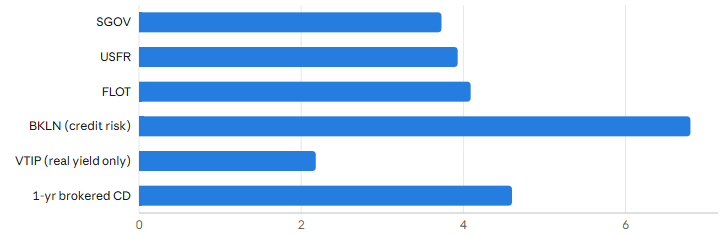
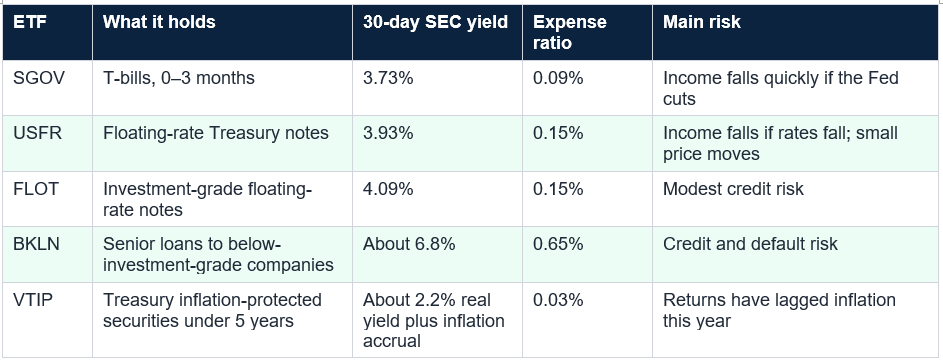
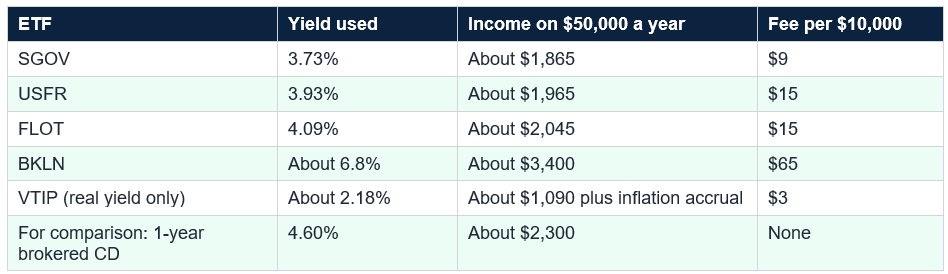
30-day SEC yields and fees (Oct 12 unless noted): SGOV 3.73% (0.09%); USFR 3.93% (0.15%); FLOT 4.09% (0.15%); BKLN about 6.8% (0.65%; U.S. News, September); VTIP about 2.18% real yield plus inflation accrual (0.03%; secondary source). T-bill 4.46%; 1-year brokered CD 4.60%; 10-year Treasury 4.93%; inflation 3.7%. Why duration matters: 2026 year-to-date returns of −1.65% for a 1-to-3-year Treasury fund (SHY), −4.23% for an intermediate fund (SPTI) and −5.93% for a longer one (TLH) as of October 27; VTIP is up 2.16%, below inflation. My arithmetic on $50,000: annual income of about $1,865 (SGOV), $1,965 (USFR), $2,045 (FLOT), $3,400 (BKLN); a quarter-point hike adds about $125 a year of income to a floating or T-bill fund, while a 1.8-year-duration fund would lose about $225 in price.
The answer depends heavily on which funds you own. Funds holding fixed-rate bonds lose value when rates rise, and the longer their bonds last, the more they lose. Funds whose income adjusts with short-term rates behave very differently. This guide looks at five of them, with the latest yields and fees I could verify, what each is built to do and where each can hurt you. I will not tell you which to buy, since your goals matter, but I can show you what the numbers say.
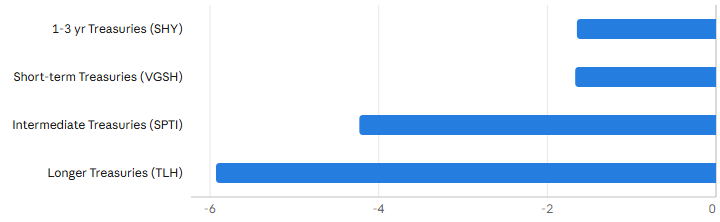
This year is a live example. According to ETF Beacon data as of October 27, the Vanguard Short-Term Treasury fund (VGSH) was down about 1.67% and the iShares 1-3 Year Treasury fund (SHY) down 1.65%, while an intermediate fund (SPTI) was down 4.23% and a longer fund (TLH) down 5.93%. Funds near zero duration were slightly positive. The lesson is not that bonds are bad but that the type of bond fund matters more than the label.

ETF Beacon, October 27, 2026: SHY −1.65%, VGSH −1.67%, SPTI −4.23%, TLH −5.93% year to date. Duration of about 1.8 years means roughly a 1.8% price drop for each one-point rise in yields.
The downside is symmetrical: if the Fed cuts, the yield falls just as fast. And at 3.73%, SGOV pays less than a one-year brokered CD at 4.60% or a 52-week T-bill at 4.46%, because it holds the shortest bills. In my illustration, $50,000 earns about $1,865 a year, and a quarter-point hike would add about $125 if the yield followed. SGOV is a flexible, liquid place for cash that wants to ride rate changes.
The trade-offs are a slightly higher fee, about $15 a year per $10,000 versus $9 for SGOV, and slightly more price movement than a T-bill fund. For investors who expect hikes and want government-only credit, USFR is a natural candidate, and the iShares Treasury Floating Rate Bond ETF (TFLO) is a close alternative at about 3.8% in older data. As with SGOV, a rate cut would pull the yield down.
The extra yield, about 0.16 points over USFR and 0.36 over SGOV, is payment for credit risk: if companies get into trouble, these notes can fall and spreads can widen. Investment grade means moderate risk, not zero, though far lower than in senior loans.
But that extra income is compensation for credit risk. The 3.07-point premium over SGOV shrinks quickly if defaults rise: after a 2% loss rate the net yield would be about 4.8%, and after 3%, about 3.8%, below SGOV. U.S. News warns that the loans are below investment grade, leaving them vulnerable when credit conditions deteriorate, and the $65-per-$10,000 fee is high. BKLN is an income-and-credit investment that happens to float, not a cash substitute.
Senior loan funds can fall sharply in a credit downturn, including when the economy weakens. A higher yield is not free: it reflects the chance of loss. Size BKLN as a small slice of a bond allocation, not as a replacement for T-bills.
That gap is a useful warning. TIPS adjust with a lag and their prices can fall when real yields rise, so VTIP is an inflation hedge, not a rate-hike hedge in the same sense as floaters; it fell about 1.14% in the month to September 25. It suits investors worried that inflation, not just rates, will rise, as a complement to the floaters.
Common mistakes include buying BKLN for the headline yield without understanding credit risk, assuming floating means safe, ignoring fees and forgetting that rate-hike hedges become drags if the Fed cuts. Keep perspective too: inflation was 3.7% in September, so even a 4% yield only just keeps pace. These funds protect your principal from rate hikes; they are not the place for long-term growth money.
Write down when you will need the money, then match the fund: a fixed date suggests a CD or T-bill; cash that might be needed anytime suggests SGOV or USFR; a little extra yield with some credit risk suggests FLOT; inflation worry suggests VTIP. Check the current yield and fee on the fund company’s page before buying.
None of this guarantees profit. If the Fed cuts, these funds’ yields fall quickly, and none of them matches the 4.60% a one-year CD can lock in. Pick the fund that fits your time horizon and risk, keep an eye on fees and use them as the rate-protection part of a broader plan. This is general education, not personalized advice, and a qualified adviser can help you decide.
Because existing bonds pay a fixed coupon that becomes less attractive when new bonds pay more, so their prices drop. The longer a fund’s duration, the bigger the drop. In 2026, ETF Beacon data showed 1-to-3-year Treasury funds down about 1.65% for the year, an intermediate Treasury fund down about 4.2% and a longer fund down about 5.9%.
Which ETF benefits most from a rate hike?
Funds whose income resets with short-term rates benefit most: T-bill ETFs such as SGOV, floating-rate Treasury ETFs such as USFR and floating-rate corporate funds such as FLOT. Their yields rise within weeks or months after a Fed hike while their prices barely move. Senior loan funds such as BKLN also reset, but they carry credit risk.
Are floating-rate ETFs safe?
Floating-rate Treasury funds such as USFR carry almost no credit risk, though their prices can wobble slightly. Investment-grade floaters such as FLOT carry modest credit risk. Senior loan funds such as BKLN hold loans to below-investment-grade companies and can fall sharply in a credit downturn, so they are not a cash substitute.
What if the Fed cuts instead of hiking?
Then floating-rate and T-bill funds see their yields fall within weeks, while fixed-rate bonds locked in earlier would keep paying more and their prices would rise. These funds are a hedge against hikes, not a bet that rates will rise. Nobody knows what the Fed will do: after the October 28 hold, markets were pricing nearly 75% odds of at least one hike by year-end.
Should I put all my bond money in these ETFs?
Probably not. Long-term needs may suit longer bonds or stocks, while short-term needs suit T-bills or CDs. These funds are best used as the rate-protection part of a mix. This is general education, not personal advice.
Table of Contents
- The Rate Hike Question
- The Short Answer: Five ETFs
- Why Some Bond Funds Fall When Rates Rise
- ETF 1: SGOV (T-Bills)
- ETF 2: USFR (Floating-Rate Treasuries)
- ETF 3: FLOT (Investment-Grade Floaters)
- ETF 4: BKLN (Senior Loans)
- ETF 5: VTIP (Short-Term TIPS)
- The Five Side by Side
- Three Scenarios: Hike, Hold, Cut
- Building a Mix and Avoiding Mistakes
- Conclusion
- Frequently Asked Questions
Why duration matters in 2026: year-to-date returns of Treasury funds (%)
Year-to-date return (%) by ETF Beacon, as of October 27, 2026; longer duration means bigger losses when rates rise
The five ETFs: yield used vs. a one-year CD (%)
Yield (%) by Motley Fool (Oct 12 SEC yields); U.S. News (BKLN); KoalaGains (VTIP, secondary); DepositAccounts (CD, Oct 15)
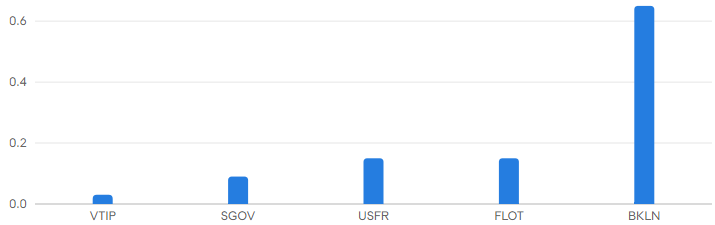
What each fund costs: expense ratios (%)
Expense ratio (%) by Motley Fool, U.S. News and Vanguard; per $10,000 that is $3, $9, $15, $15 and $65 a year
The Rate Hike Question
For most of the past three years the question was when the Fed would cut rates. In 2026 it flipped. The Fed raised its target by a quarter point in September, held at 3.75% to 4.00% on October 28 and left markets pricing nearly 75% odds of at least one more hike by year-end, with inflation at 3.7% and the 10-year Treasury near 4.93%. For anyone who owns bonds, that raises an old, uncomfortable question: what happens to my bond funds if rates keep rising?The answer depends heavily on which funds you own. Funds holding fixed-rate bonds lose value when rates rise, and the longer their bonds last, the more they lose. Funds whose income adjusts with short-term rates behave very differently. This guide looks at five of them, with the latest yields and fees I could verify, what each is built to do and where each can hurt you. I will not tell you which to buy, since your goals matter, but I can show you what the numbers say.
The Short Answer: Five ETFs
Five funds are commonly named as rising-rate tools: the iShares 0-3 Month Treasury Bond ETF (SGOV), the WisdomTree Floating Rate Treasury Fund (USFR), the iShares Floating Rate Bond ETF (FLOT), the Invesco Senior Loan ETF (BKLN) and the Vanguard Short-Term Inflation-Protected Securities ETF (VTIP). They share short effective duration, so their prices barely react to rate hikes, and in four of the five, income that rises when rates do. They differ sharply in yield and risk, from almost no credit risk in USFR to meaningful credit risk in BKLN.
Why Some Bond Funds Fall When Rates Rise
A bond’s price moves opposite to interest rates, because a fixed coupon is worth less when new bonds pay more. The sensitivity is measured by duration: a fund with a duration of 1.8 years loses roughly 1.8% for each one-point rise in yields. Floating-rate and T-bill funds have a duration near zero, so their prices barely move and their income resets higher.This year is a live example. According to ETF Beacon data as of October 27, the Vanguard Short-Term Treasury fund (VGSH) was down about 1.67% and the iShares 1-3 Year Treasury fund (SHY) down 1.65%, while an intermediate fund (SPTI) was down 4.23% and a longer fund (TLH) down 5.93%. Funds near zero duration were slightly positive. The lesson is not that bonds are bad but that the type of bond fund matters more than the label.
ETF Beacon, October 27, 2026: SHY −1.65%, VGSH −1.67%, SPTI −4.23%, TLH −5.93% year to date. Duration of about 1.8 years means roughly a 1.8% price drop for each one-point rise in yields.
ETF 1: SGOV (T-Bills)
The iShares 0-3 Month Treasury Bond ETF is the simplest choice. It holds Treasury bills maturing in zero to three months, so as old bills mature, the fund reinvests at the new, higher rates within weeks. It carried a 0.09% expense ratio and a 30-day SEC yield of 3.73% as of October 12, according to the Motley Fool, and held about $113 billion earlier in October. Zacks notes that rising short-term rates can lift a short T-bill fund’s yield quickly while its short duration limits price declines.The downside is symmetrical: if the Fed cuts, the yield falls just as fast. And at 3.73%, SGOV pays less than a one-year brokered CD at 4.60% or a 52-week T-bill at 4.46%, because it holds the shortest bills. In my illustration, $50,000 earns about $1,865 a year, and a quarter-point hike would add about $125 if the yield followed. SGOV is a flexible, liquid place for cash that wants to ride rate changes.
ETF 2: USFR (Floating-Rate Treasuries)
The WisdomTree Floating Rate Treasury Fund holds floating-rate notes issued by the US Treasury, whose coupons reset weekly based on 13-week bill auction rates. It carried a 3.93% 30-day SEC yield and a 0.15% expense ratio on October 12, higher than SGOV’s 3.73%. Investing.com data from a few months earlier showed a year-to-date return of about 2.45% and a one-year return of about 3.99%. The main appeal is almost no credit risk, since the issuer is the US government, and income that tracks short-term rates.The trade-offs are a slightly higher fee, about $15 a year per $10,000 versus $9 for SGOV, and slightly more price movement than a T-bill fund. For investors who expect hikes and want government-only credit, USFR is a natural candidate, and the iShares Treasury Floating Rate Bond ETF (TFLO) is a close alternative at about 3.8% in older data. As with SGOV, a rate cut would pull the yield down.
ETF 3: FLOT (Investment-Grade Floaters)
The iShares Floating Rate Bond ETF holds investment-grade, US dollar floating-rate notes with remaining maturities of one month to five years. It had the highest yield of the Motley Fool’s three picks, a 4.09% 30-day SEC yield on October 12, with a 0.15% fee. VanEck’s FLTR is a similar fund charging 0.14% with a 4.22% yield as of September 14 and a one-year return of 4.9%, according to ETF Trends. In my illustration, $50,000 in FLOT earns about $2,045 a year.The extra yield, about 0.16 points over USFR and 0.36 over SGOV, is payment for credit risk: if companies get into trouble, these notes can fall and spreads can widen. Investment grade means moderate risk, not zero, though far lower than in senior loans.
ETF 4: BKLN (Senior Loans)
The Invesco Senior Loan ETF holds loans made to below-investment-grade companies, with floating rates that reset every few months. It charges 0.65% and paid a 30-day SEC yield of about 6.8% in U.S. News data from September, and Zacks cited a 6.39% yield. In my illustration, $50,000 would earn about $3,400 a year, roughly $1,500 more than SGOV. Because the loans float, the fund’s price tends to hold up when rates rise, which is why it appears on rate-hike lists.But that extra income is compensation for credit risk. The 3.07-point premium over SGOV shrinks quickly if defaults rise: after a 2% loss rate the net yield would be about 4.8%, and after 3%, about 3.8%, below SGOV. U.S. News warns that the loans are below investment grade, leaving them vulnerable when credit conditions deteriorate, and the $65-per-$10,000 fee is high. BKLN is an income-and-credit investment that happens to float, not a cash substitute.
Senior loan funds can fall sharply in a credit downturn, including when the economy weakens. A higher yield is not free: it reflects the chance of loss. Size BKLN as a small slice of a bond allocation, not as a replacement for T-bills.
ETF 5: VTIP (Short-Term TIPS)
The Vanguard Short-Term Inflation-Protected Securities ETF holds Treasury Inflation-Protected Securities with remaining maturities under five years. Its principal rises with inflation, and it charges just 0.03%, or $3 per $10,000. Its 30-day SEC yield was about 2.18% as of October 21, according to a secondary source, which is the real yield before inflation adjustments. With inflation at 3.7%, the fund’s total return could be higher, but this year’s results have not kept pace: Vanguard showed a year-to-date return of 2.16% as of October 29, below inflation.That gap is a useful warning. TIPS adjust with a lag and their prices can fall when real yields rise, so VTIP is an inflation hedge, not a rate-hike hedge in the same sense as floaters; it fell about 1.14% in the month to September 25. It suits investors worried that inflation, not just rates, will rise, as a complement to the floaters.
The Five Side by Side
On $50,000, the three low-risk funds earn about $1,865 (SGOV), $1,965 (USFR) and $2,045 (FLOT) a year at the October yields. BKLN earns about $3,400 but with real credit risk, and its fee is $325 a year versus $45 for SGOV. VTIP’s real yield of about 2.18% implies about $1,090 before inflation accruals. The three low-risk funds trail the one-year brokered CD at 4.60%, about $2,300 on $50,000, but a CD locks in its rate and these funds do not.
Three Scenarios: Hike, Hold, Cut
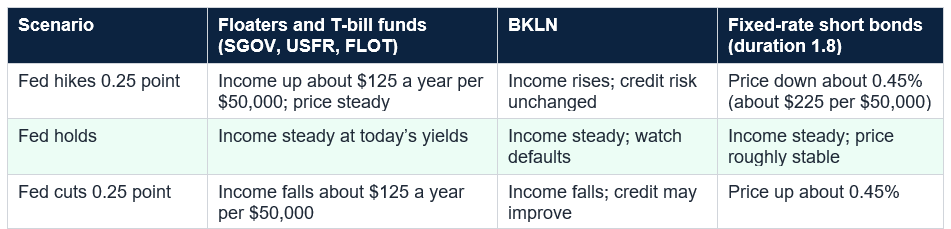
No fund works in every scenario. If the Fed hikes by a quarter point in December, SGOV, USFR and FLOT would see income rise by about $125 a year per $50,000 with minimal price moves, while a 1.8-year-duration fund would lose about 0.45%, or about $225. If the Fed holds, floaters keep paying what they pay, less than a locked CD. If it cuts, their yields fall within weeks and fixed-rate bonds gain, so a rate-hike hedge becomes a drag.
Building a Mix and Avoiding Mistakes
A sensible way to use these funds is as a mix sized to your goals. A conservative investor might hold mostly SGOV and USFR for cash and near-term needs, a balanced investor might add FLOT and a small VTIP position, and one willing to take credit risk might add a small BKLN slice. If you need the money on a fixed date, a CD or Treasury bill maturing then is simpler than any fund. This is illustration, not advice.Common mistakes include buying BKLN for the headline yield without understanding credit risk, assuming floating means safe, ignoring fees and forgetting that rate-hike hedges become drags if the Fed cuts. Keep perspective too: inflation was 3.7% in September, so even a 4% yield only just keeps pace. These funds protect your principal from rate hikes; they are not the place for long-term growth money.
Write down when you will need the money, then match the fund: a fixed date suggests a CD or T-bill; cash that might be needed anytime suggests SGOV or USFR; a little extra yield with some credit risk suggests FLOT; inflation worry suggests VTIP. Check the current yield and fee on the fund company’s page before buying.
Conclusion
If the Fed raises rates again, the best defense in a bond portfolio is short duration and income that resets. SGOV, USFR and FLOT offer that with yields of about 3.73% to 4.09% and fees of 0.09% to 0.15%, BKLN adds income of about 6.8% in exchange for real credit risk and a 0.65% fee, and VTIP adds inflation protection at 0.03%, though its 2.16% return this year has trailed inflation. Meanwhile, longer Treasury funds have lost about 4% to 6% in 2026.None of this guarantees profit. If the Fed cuts, these funds’ yields fall quickly, and none of them matches the 4.60% a one-year CD can lock in. Pick the fund that fits your time horizon and risk, keep an eye on fees and use them as the rate-protection part of a broader plan. This is general education, not personalized advice, and a qualified adviser can help you decide.
Frequently Asked Questions
Why do bond ETFs fall when interest rates rise?Because existing bonds pay a fixed coupon that becomes less attractive when new bonds pay more, so their prices drop. The longer a fund’s duration, the bigger the drop. In 2026, ETF Beacon data showed 1-to-3-year Treasury funds down about 1.65% for the year, an intermediate Treasury fund down about 4.2% and a longer fund down about 5.9%.
Which ETF benefits most from a rate hike?
Funds whose income resets with short-term rates benefit most: T-bill ETFs such as SGOV, floating-rate Treasury ETFs such as USFR and floating-rate corporate funds such as FLOT. Their yields rise within weeks or months after a Fed hike while their prices barely move. Senior loan funds such as BKLN also reset, but they carry credit risk.
Are floating-rate ETFs safe?
Floating-rate Treasury funds such as USFR carry almost no credit risk, though their prices can wobble slightly. Investment-grade floaters such as FLOT carry modest credit risk. Senior loan funds such as BKLN hold loans to below-investment-grade companies and can fall sharply in a credit downturn, so they are not a cash substitute.
What if the Fed cuts instead of hiking?
Then floating-rate and T-bill funds see their yields fall within weeks, while fixed-rate bonds locked in earlier would keep paying more and their prices would rise. These funds are a hedge against hikes, not a bet that rates will rise. Nobody knows what the Fed will do: after the October 28 hold, markets were pricing nearly 75% odds of at least one hike by year-end.
Should I put all my bond money in these ETFs?
Probably not. Long-term needs may suit longer bonds or stocks, while short-term needs suit T-bills or CDs. These funds are best used as the rate-protection part of a mix. This is general education, not personal advice.
0 Comments
Be the first to share your thoughts on this article.