

Business
7 Best Brainstorming Techniques for Entrepreneurs


Table of Contents
- Why Most Entrepreneurs Never Find Their Best Idea
- Why Brainstorming Technique Matters More Than Raw Creativity
- The 7 Techniques at a Glance: Quick Reference Guide
- The 7 Best Brainstorming Techniques for Entrepreneurs — In Depth
- Which Technique When? The Scenario-Based Decision Matrix
- How to Run an Effective Brainstorming Session: The Framework
- Conclusion
- Frequently Asked Questions (FAQ)
- External References & Further Reading
Why Most Entrepreneurs Never Find Their Best Idea
Shopify's 2026 guide on building business ideas states the stakes plainly: data shows that only about one-third of new businesses are operating after ten years, underscoring how critical it is to start with an idea that can grow, adapt, and meet real customer demand. But it adds something equally important: 'Strong ideas are not just about inspiration. They are shaped through research, observation, and iteration.' The difference between an entrepreneur who finds a great idea and one who does not is rarely intelligence or creativity. It is almost always method.Most people brainstorm by staring at a blank page and hoping something emerges. When nothing comes, they conclude either that they lack creativity or that good ideas are reserved for others. Neither conclusion is accurate. Creativity is not a fixed trait -- it is a process, and processes can be structured, repeated, and improved. ITONICS Innovation (December 2025): 'In 2026, the most important techniques combine traditional methods like brainstorming and brainwriting with modern approaches such as AI-powered tools and structured workshops. Techniques that encourage diverse perspectives, challenge assumptions, and leverage technology are key to generating innovative solutions in today's fast-paced environment.'
This guide presents the seven best brainstorming techniques for entrepreneurs in 2026 -- drawn from Asana's comprehensive February 2026 analysis of 29 brainstorming methods, Shopify's entrepreneur-focused guides, AFFiNE's 2025 creativity research, and updated coaching guidance from business coach Dave Schoenbeck. Each technique is explained with its precise mechanics, the specific entrepreneurial scenarios where it produces the best results, and a worked example that makes it immediately actionable. A quick-reference comparison table and a scenario-based decision matrix help you select the right tool for every creative challenge.
Why Brainstorming Technique Matters More Than Raw Creativity
The conventional image of entrepreneurial inspiration is wrong. It is not a lone genius having a shower revelation. It is a process. Asana (February 2026): 'Brainstorming is a creative problem-solving approach that often supports the design thinking process, where an individual or team generates ideas to improve a product, organisation, or strategy. The goal is to use divergent and convergent thinking to produce as many ideas as possible without judgment, then refine them into actionable solutions.' That two-phase process -- diverge first, converge later -- is the fundamental operating principle that separates effective brainstorming from unsuccessful staring at blank pages.Asana identifies three key steps common to every effective brainstorming technique: capture ideas freely (allow creativity to flow without restriction or judgment); discuss and refine (consider different perspectives and constructive feedback); and select the best ideas (choose the strongest concepts to develop further and put into action). The technique you choose determines how well the first phase generates truly diverse ideas, how structured the second phase is, and how disciplined the third phase becomes. Without a technique, the first phase is typically too short (self-editing kills ideas before they are captured), the second phase is too dominated by strong voices, and the third phase never happens at all.
ITONICS: 'Creative thinking drives real business results when it generates ideas that address actual challenges and open new opportunities.' Shopify adds the competitive context: 'With the right brainstorming approach, it is possible to dramatically improve your odds of building something that lasts.' The seven techniques below cover the full spectrum -- from fast individual idea generation to structured team sessions to systematic evaluation frameworks -- giving entrepreneurs a complete toolkit for every creative challenge they face.
Brainstorming for entrepreneurs -- 2026 data: Only 1 in 3 new businesses survive 10 years (Shopify 2026). Brainwriting produces 108 ideas in 30 minutes from 6 people. 2026: AI tools now combine with traditional methods. — Shopify (2026): 'Data shows that only about one-third of new businesses are operating after 10 years, underscoring how critical it is to start with an idea that can grow, adapt, and meet real customer demand. Strong ideas are shaped through research, observation, and iteration.' Asana (February 21, 2026): '29 brainstorming techniques analysed; best methods are Mind Mapping, SCAMPER, Reverse Brainstorming, and Brainwriting.' ITONICS Innovation (December 2025): 'In 2026, the most important techniques combine traditional methods with AI-powered tools and structured workshops like Lightning Decision Jam.'
The 7 Techniques at a Glance: Quick Reference Guide
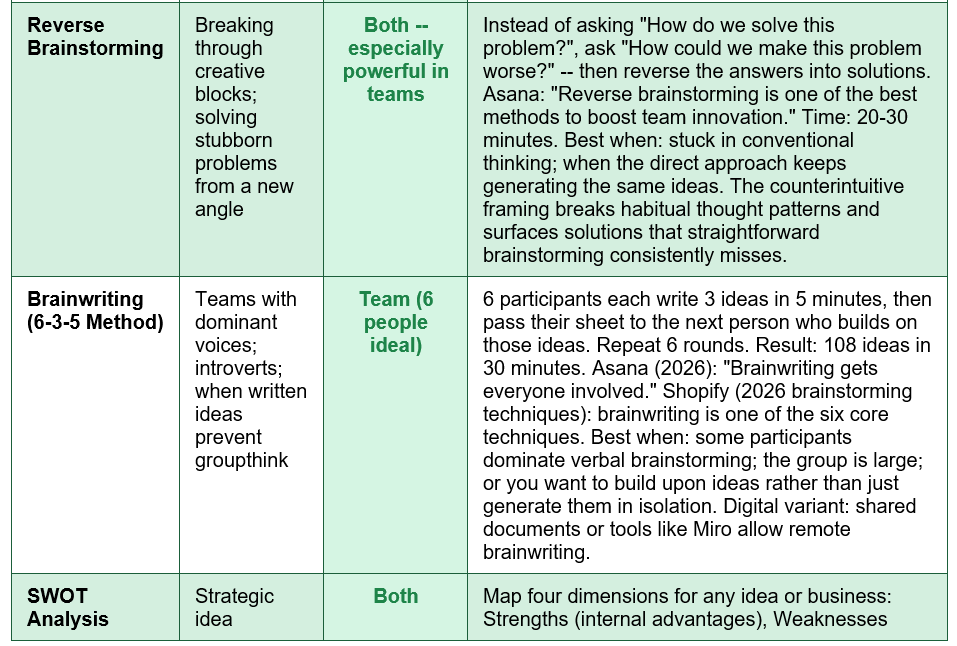
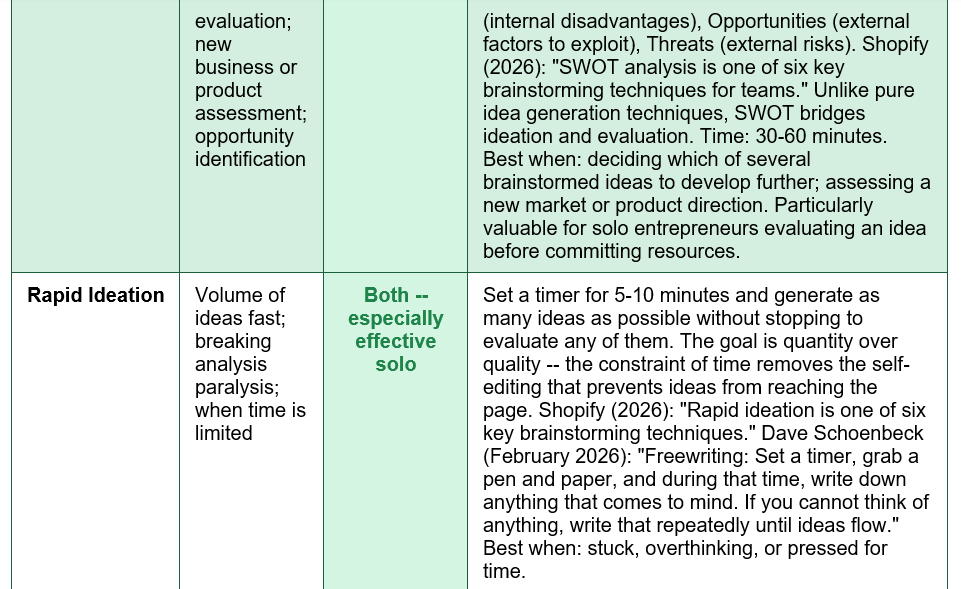
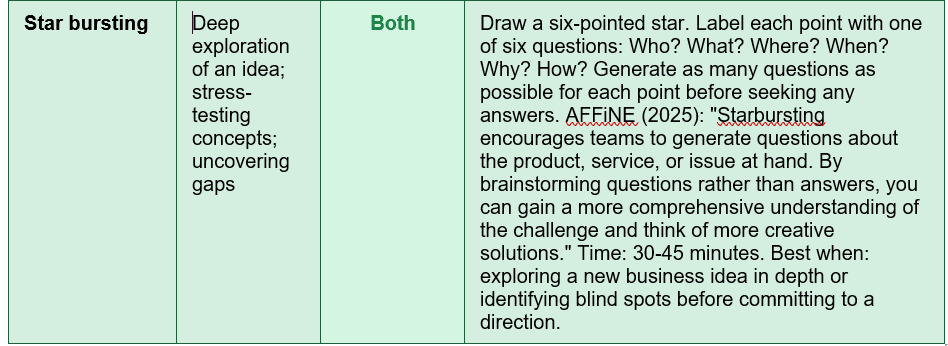
Before the full explanation of each technique, the following table gives a complete quick reference -- showing when, how, and with whom to use each method: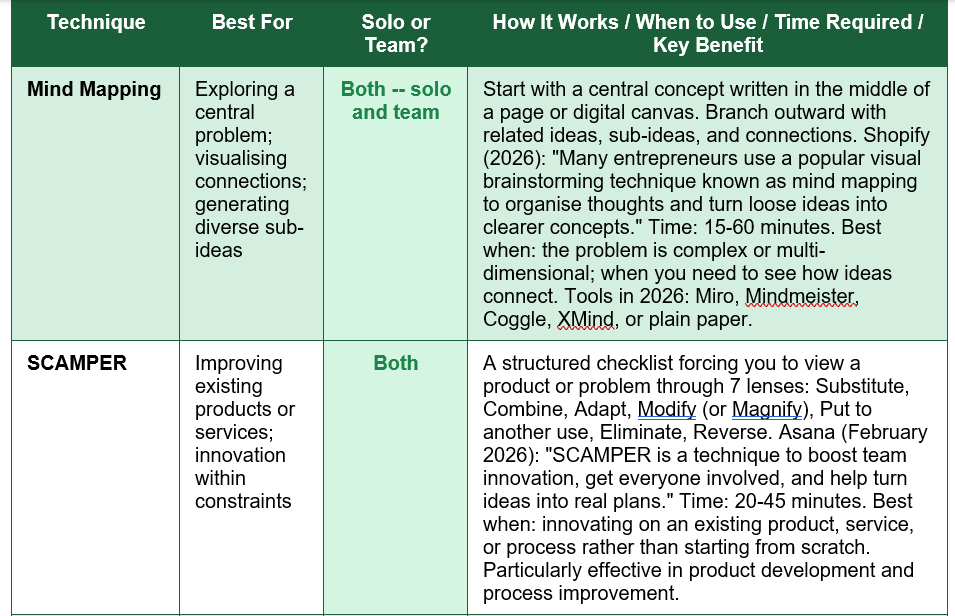
The 7 Best Brainstorming Techniques for Entrepreneurs — In Depth
TECHNIQUE 1: Mind Mapping | The Visual Thinker's Foundation
Mind mapping is one of the most widely used brainstorming techniques among entrepreneurs because it mirrors how the brain naturally organises information -- in networks and connections rather than linear lists. Shopify (2026): 'Many entrepreneurs use a popular visual brainstorming technique known as mind mapping to organise thoughts and turn loose ideas into clearer concepts.' The technique: write your central concept, question, or problem in the centre of a blank page or digital canvas. Draw branches outward -- each branch represents a related idea, theme, or question. From each branch, draw sub-branches for more specific ideas. Keep going until the canvas is full. The process of making connections -- seeing that an idea on one branch relates to a thought on a completely different branch -- is where the most original insights emerge. Mind mapping works for both solo entrepreneurs (exploring a business problem alone) and teams (where different participants add branches from their own expertise). In 2026, digital tools including Miro, Mindmeister, Coggle, and XMind allow real-time collaborative mind mapping with remote teams. The visual layout makes it easy to spot patterns, gaps, and unexpected connections that a list-based approach would miss. Entrepreneur application: use mind mapping at the start of any business challenge -- a new product, a market entry decision, a marketing strategy -- to map the full landscape of considerations before diving into specific analysis.TECHNIQUE 2: SCAMPER | The Systematic Innovation Checklist
SCAMPER is a structured checklist developed to drive innovation by forcing you to examine a product, service, or process through seven different lenses. Asana (February 2026): 'SCAMPER is one of the best methods to boost team innovation, get everyone involved, and help turn ideas into real plans.' The seven lenses: Substitute (what could you substitute or replace -- materials, people, processes, energy sources?); Combine (what could you combine with something else to produce something new?); Adapt (what could be adapted from a different context, industry, or era?); Modify/Magnify (what could be changed, magnified, minimised, or altered in some way?); Put to another use (what else could this be used for, or could this be used in a new market?); Eliminate (what could be removed, simplified, or done without?); Reverse (what could be reversed, flipped, or done in reverse order?). SCAMPER is particularly powerful for entrepreneurs who are iterating on an existing product or business model rather than starting from scratch. Working systematically through all seven lenses ensures that no obvious improvement angle is overlooked. Entrepreneur application: when your product or service is not growing as expected, run a SCAMPER session. Often the breakthrough improvement comes from a lens you would not have naturally considered -- Eliminate is frequently the most productive, as removing complexity is a consistent source of product improvement.TECHNIQUE 3: Reverse Brainstorming | The Creative Block Buster
Reverse brainstorming is the technique to deploy when conventional brainstorming has produced the same ideas repeatedly or when the team has hit a genuine creative wall. Asana (February 2026): 'Reverse brainstorming is one of the best brainstorming techniques to boost team innovation.' The technique inverts the question. Instead of asking: 'How could we increase customer retention?', ask: 'How could we make customers leave as quickly as possible?' Instead of 'How could we improve our delivery speed?', ask: 'How could we make delivery as slow and unreliable as possible?' Generate as many answers to the inverted question as possible -- without judgment. Then take each answer and reverse it into a genuine solution. A session on 'how to make customers leave' might generate: 'ignore complaints, make the website unusable, never update the product, make pricing confusing.' Reversed: 'respond to every complaint within 24 hours, invest in UX, maintain a clear product roadmap, use transparent pricing.' These are often better, more actionable solutions than straightforward brainstorming produces -- because the inversion breaks habitual thinking patterns. The counterintuitive framing makes the exercise feel playful, which itself removes the self-consciousness that blocks creativity in conventional sessions. Entrepreneur application: use reverse brainstorming specifically when stuck, when a direct session has produced nothing new, or when you want to stress-test a current approach by first identifying all the ways it could fail.TECHNIQUE 4: Brainwriting (6-3-5 Method) | The Great Equaliser
Brainwriting is the team brainstorming technique that solves one of the most consistent problems in group ideation: the dominance of the loudest voices. In conventional group brainstorming, the first idea stated frames the entire subsequent discussion; quieter participants defer to more assertive colleagues; and the final output reflects the views of two or three people, not the group. Brainwriting removes all of this by making ideation a written rather than verbal process. The 6-3-5 format: six participants each take a sheet of paper and write three ideas related to the central question within five minutes. When the timer ends, every participant passes their sheet to the person on their left. The next person reads the existing ideas and writes three more -- either building on what is already there or adding entirely new concepts. After six rounds (30 minutes), every sheet has 18 ideas on it, giving the group a total of 108 ideas. Asana (February 2026): 'Brainwriting gets everyone involved.' For entrepreneurial teams where the founder's ideas tend to dominate, brainwriting creates the structural space for co-founders, early employees, and advisers to contribute equally. The written format also slows the ideation enough to produce more considered and varied ideas than fast-talking group sessions. Entrepreneur application: use brainwriting for any team session on a significant decision -- new product features, market expansion options, pricing strategy, brand direction.TECHNIQUE 5: SWOT Analysis | The Idea Evaluator
SWOT analysis (Strengths, Weaknesses, Opportunities, Threats) is sometimes mischaracterised as an evaluation tool rather than a brainstorming technique -- but Shopify (2026) correctly identifies it as one of the core brainstorming techniques for teams precisely because of how it structures idea generation. Shopify: 'SWOT analysis is one of six key brainstorming techniques.' A SWOT session for an entrepreneur brainstorming a new business idea generates ideas in four quadrants simultaneously: Strengths (what internal advantages does this idea play to? what do I do better than anyone else? what resources do I have that others lack?); Weaknesses (where do I lack capability? what would someone criticise about this approach? what should be avoided?); Opportunities (what external trends or market gaps does this idea exploit? what competitor weaknesses exist?); Threats (what external factors could damage this idea? what are competitors doing? what could regulations, technology shifts, or economic changes do to this concept?). Importantly, every quadrant generates ideas by generating questions -- the Opportunities quadrant alone typically surfaces multiple business ideas and product directions that were not on the original agenda. MasterClass identifies the entrepreneur's three core evaluation filters after brainstorming: time, money, and resources. SWOT feeds directly into these filters: Weaknesses reveal where time and resources are insufficient; Opportunities show where resource investment would deliver the greatest return. Entrepreneur application: use SWOT as the second session after an initial idea generation session -- apply it to the three to five strongest ideas from the first session to determine which has the best realistic opportunity for this specific entrepreneur at this specific time.TECHNIQUE 6: Rapid Ideation | The Paralysis Antidote
Rapid ideation is the simplest technique in the toolkit and sometimes the most immediately effective -- because its power comes not from structure but from the deliberate removal of one thing: time. Most creative blocks are not blocks at all; they are editorial filters applied too early. The inner critic evaluates and rejects every idea before it can be captured, leaving the page blank. Rapid ideation disables the inner critic by making time itself the constraint. Dave Schoenbeck (updated February 1, 2026): 'Freewriting: Set a timer, grab a pen and paper, and during that time, write down anything that comes to mind. If you cannot think of anything, write that repeatedly until ideas flow.' Shopify (2026): 'Rapid ideation is one of six key brainstorming techniques.' The technique: set a timer for 5-10 minutes. Write -- do not stop, do not delete, do not evaluate. Every idea gets recorded regardless of how ridiculous, impractical, or derivative it seems. When the timer ends, stop. Then review what was captured and look for patterns, surprising combinations, or seeds worth developing. The volume produced under time pressure is consistently higher than in unstructured sessions because the brain knows the constraint is real. Entrepreneur application: use rapid ideation at the start of any brainstorming session as a warm-up; use it when faced with a blank page and a deadline; and use it with artificial constraints (only ideas under £5,000 to execute; only ideas involving technology you already have) to force creative thinking within real-world boundaries.TECHNIQUE 7: Starbursting | The Question Generator
Starbursting is the most distinctive technique in this guide because its output is not ideas -- it is questions. AFFiNE (2025): 'Starbursting encourages teams to generate questions about the product, service, or issue at hand. By brainstorming questions rather than answers, you can gain a more comprehensive understanding of the challenge and think of more creative solutions.' The technique: draw a six-pointed star on a whiteboard or paper. Label each point with one of the six core questions: Who? What? Where? When? Why? How? For each point, generate as many questions as possible related to the business idea or challenge -- without attempting to answer any of them. Who are the customers? Who are the competitors? Who would oppose this? What does the product do? What does it not do? What problem does it solve? Where would it be sold? Where could it expand? When would customers buy it? When would they not? Why would someone choose this over alternatives? Why might they not? How would it be delivered? How would it scale? By the time the session is complete, the entrepreneur has a comprehensive map of every question that needs to be answered -- including many that would never have been considered without the structured six-direction prompting. The questions themselves often contain the business model innovations: 'Who else could use this?' frequently surfaces adjacent markets; 'How could it be delivered at one-tenth the cost?' often reveals product simplifications. Entrepreneur application: use starbursting when you have an idea you believe in but have not fully stress-tested; before any major investment decision; and as the final technique in a multi-session brainstorming process to identify what you do not yet know.Which Technique When? The Scenario-Based Decision Matrix
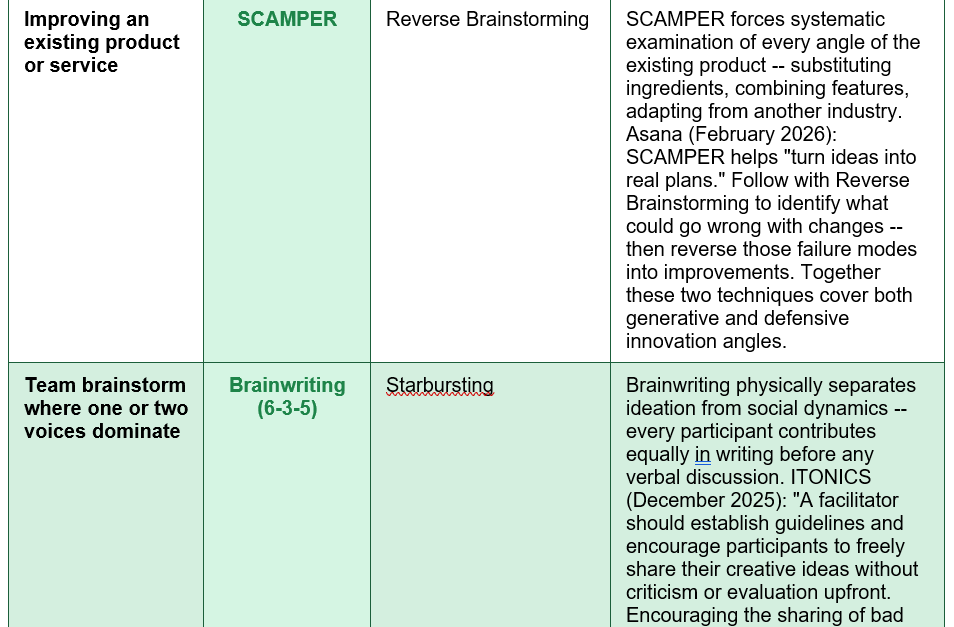
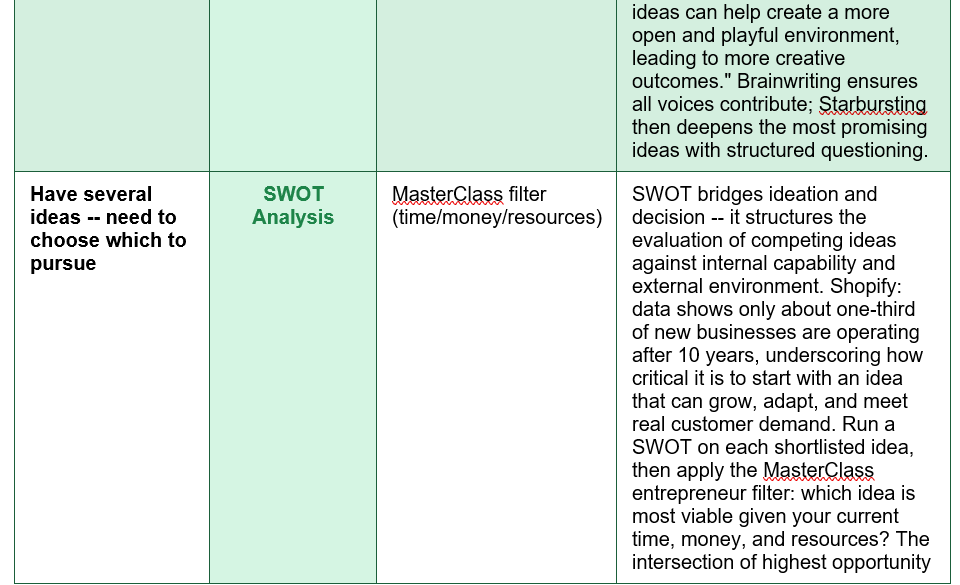
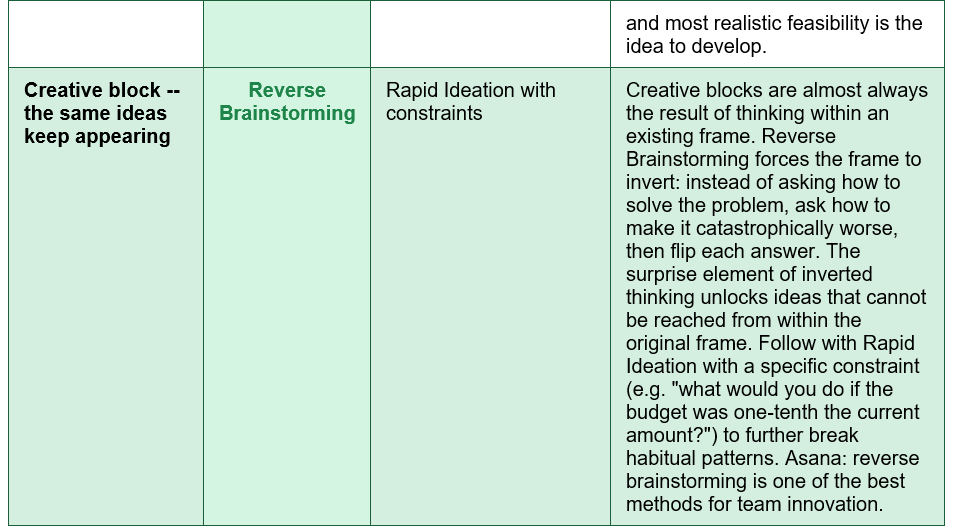
Not every technique suits every challenge. The following matrix maps the five most common entrepreneurial brainstorming scenarios to the optimal technique combination: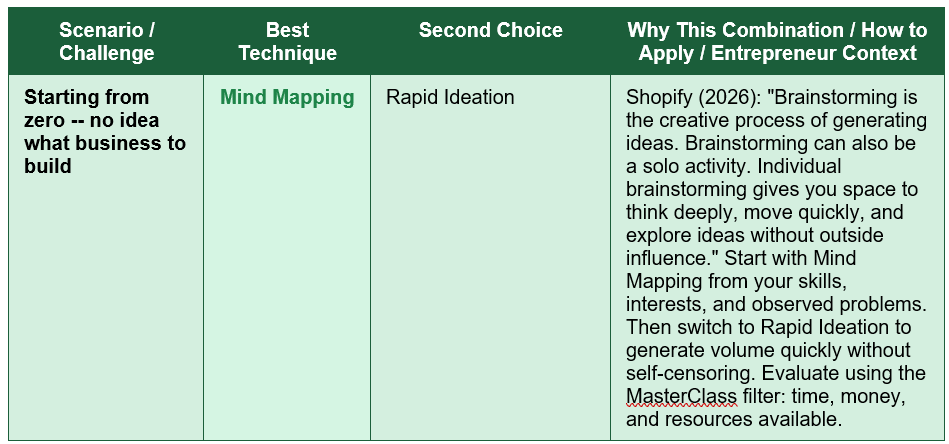
How to Run an Effective Brainstorming Session: The Framework
Choosing the right technique is necessary but not sufficient. The conditions in which the technique is used determine whether it produces genuinely useful outputs. ITONICS (December 2025): 'A brainstorm involves a diverse group coming together to generate ideas on a specific topic or problem. It begins with a clearly defined objective and the assemblage of individuals with different perspectives, backgrounds, and expertise. A facilitator should establish guidelines and encourage participants to freely share their creative ideas without criticism or evaluation upfront.'- Define the problem precisely before starting: Asana (February 2026): 'All brainstorming techniques need the same basics: people, a problem or opportunity, and some time to work on it.' A well-defined problem statement focuses the session and prevents the diffuse ideation that produces general thoughts about an industry rather than specific solutions to a real challenge. The difference between 'How could we grow our business?' and 'How could we increase repeat purchases from customers who buy once but never return?' is the difference between a vague discussion and a productive session.
- Create psychological safety for all ideas: ITONICS: 'Encouraging the sharing of bad ideas during a brainstorm can help create a more open and playful environment, leading to more creative outcomes.' The ground rule that all ideas are captured without judgment during the divergent phase is not just a nicety -- it is operationally critical. The most valuable ideas in any session often begin as ideas that sound absurd in the first statement.
- Combine techniques within a session: ITONICS: 'Techniques that encourage diverse perspectives, challenge assumptions, and leverage technology to enhance creativity and collaboration are key.' A single 60-90 minute session might open with Rapid Ideation (warm up, generate volume), shift to Mind Mapping (organise and connect the raw ideas), and close with SWOT (evaluate the strongest candidates). No rule requires using a single technique per session.
- Use AI tools as a brainstorming partner in 2026: ITONICS: 'Using ideation software or platforms helps collect, organise, and categorise concepts efficiently. Tools like ITONICS enable evaluation through voting or rating, facilitate collaborative refinement, and track ideas through stages from concept to implementation.' In 2026, AI tools (Claude, ChatGPT, Gemini) can serve as brainstorming partners for solo entrepreneurs -- providing alternative perspectives, challenging assumptions, and generating counterexamples on demand. They do not replace the creative insight of an informed entrepreneur but they can dramatically expand the range of inputs into the process.
- Move from divergent to convergent: Every brainstorming session must transition from idea generation (divergent thinking -- as many ideas as possible) to idea selection (convergent thinking -- which ideas are worth developing). Asana: 'Select the best ideas: Choose the strongest concepts to develop further and put into action.' Techniques for convergent selection: dot voting (each participant places a limited number of votes on their favourite ideas); impact vs effort mapping (plot ideas by potential impact and implementation effort); or the MasterClass entrepreneur filter (time, money, and resources -- which ideas are feasible with what you actually have?).
The solo entrepreneur advantage: while team brainstorming gets most of the research attention, solo brainstorming has distinct advantages for entrepreneurs. Shopify (2026): 'Individual brainstorming gives you space to think deeply, move quickly, and explore ideas without outside influence. Both approaches have value. Group brainstorming can spark unexpected connections and challenge your assumptions.' Solo brainstorming with a structured technique is particularly effective because the entrepreneur brings the deepest contextual knowledge of the problem, can follow unexpected threads without social pressure to move on, and can iterate at their own pace. The best entrepreneurial brainstorming practice often combines solo sessions (rapid ideation, mind mapping, starbursting) with team or advisory board sessions (brainwriting, SWOT, reverse brainstorming) -- using each environment for what it does best.
THE BRAINSTORMING TECHNIQUE SELECTION GUIDE -- 2026: WHEN STARTING FROM ZERO: Mind Mapping + Rapid Ideation. WHEN IMPROVING EXISTING PRODUCT/SERVICE: SCAMPER + Reverse Brainstorming. WHEN IN A TEAM WHERE SOME VOICES DOMINATE: Brainwriting (6-3-5). WHEN CHOOSING BETWEEN IDEAS: SWOT Analysis + MasterClass 3-filter evaluation (time, money, resources). WHEN CREATIVELY BLOCKED: Reverse Brainstorming with time pressure. WHEN STRESS-TESTING AN IDEA BEFORE COMMITTING: Starbursting (generate questions first, answers second). FOR SOLO ENTREPRENEURS: Rapid Ideation > Mind Mapping > Starbursting. FOR ENTREPRENEURIAL TEAMS: Brainwriting > Reverse Brainstorming > SCAMPER. FOR EVALUATING IDEAS: SWOT > filter by time/money/resources. IN 2026 -- ADD AI: Use Claude/ChatGPT/Gemini as a brainstorming partner for additional perspectives, counterarguments, and idea expansions after your own session.
Conclusion
The seven brainstorming techniques in this guide -- Mind Mapping, SCAMPER, Reverse Brainstorming, Brainwriting, SWOT Analysis, Rapid Ideation, and Starbursting -- are not equally suited to every situation. They are a toolkit, and the skilled entrepreneur selects the right tool for the specific challenge at hand. Asana (February 2026): 'Good brainstorming techniques help teams find creative solutions by creating a safe space for ideas, encouraging lots of suggestions, and using different ways to look at problems. These approaches boost team innovation, get everyone involved, and help turn ideas into real plans.'The consistent thread across all seven techniques is the structured separation of idea generation from idea evaluation. This is the single most important insight in all brainstorming research: judging ideas while generating them kills the creative process. Generate first, evaluate second. Volume before quality. Questions before answers. Diverge before converging. Every technique in this guide operationalises this principle in a different way suited to a different creative challenge.
Shopify's reminder stands: only one-third of new businesses survive ten years. The ideas that get businesses into that one-third are rarely the first idea that came to mind -- they are the ideas that emerged from structured exploration, iterative refinement, and honest evaluation against the entrepreneur's actual capabilities and resources. The techniques in this guide are how entrepreneurs do that exploration systematically, rather than waiting for inspiration that may never arrive.
0 Comments
Be the first to share your thoughts on this article.