

Taxes
7 Legal Ways to Cut Your CGT Bill in 2026/27: Plain UK Guide

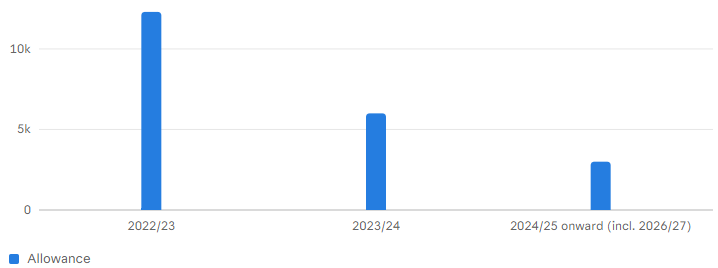
A plain-English UK guide to Capital Gains Tax in 2026/27, with worked examples. Allowance £3,000 (was £12,300 in 2022/23); rates 18% and 24%; CGT receipts £22.2bn in 2025-26 vs £16.9bn peak in 2022-23; BADR lifetime limit falls to £500,000 from 6 April 2027.
£ per person by Source: UK Tax Tools, Taxfly
The good news is that there are several legitimate ways to cut the bill. The seven I cover here are using your allowance every year, Bed and ISA, sharing assets with a spouse or civil partner, using losses, timing sales across tax years, using a pension contribution to widen your 18% band, and claiming every allowable cost.
Most of these work best when you plan before you sell, not after. This post explains each, with a worked example, and ends with a section on reporting mistakes. It is education, not advice.
Key takeaway: The rates are fixed for now, so your levers are who owns the asset, which tax year you sell in, and which wrapper holds it.
Third, the taxman is collecting more. SyndicateRoom reports that HMRC collected a record £22.2 billion of CGT in 2025-26, against a previous peak of £16.9 billion in 2022-23, though the OBR attributes some of the rise to people bringing disposals forward before the October 2024 Budget. A separate summary says HMRC recovered nearly £500 million through compliance work in 2025/26.
The Autumn Budget on 28 October 2026 brought no CGT rate rises. The annual exempt amount stays at £3,000 and the 18% and 24% rates stay for 2027/28, according to one summary of the Budget. I could only read that summary through a search excerpt, so please confirm it on GOV.UK.
There were changes for business owners, covered later. And the freeze on income tax thresholds now runs until 5 April 2031, according to one Budget guide [19]. That matters because your CGT rate depends on how much of your basic-rate band your income uses up. A note on stale numbers: Some sites still show old rates. One page I found says "10%/20% on other assets" for 2026/27, which is out of date. Always check the date.
In practice, this is sometimes called gain harvesting. You sell, take the gain tax-free, and, to keep your position, buy back in a way that complies with the 30-day rule discussed in Way 2.
Do remember what I said about timing. If the gain on a large holding is far above £3,000, trying to realise it all in one year wastes nothing, but you can still spread the sale across several years.
Why does it work? HMRC has a "bed and breakfast" rule: if you sell shares and buy the same shares back within 30 days, the sale is matched with the new purchase, which wipes out the benefit [13]. But the 30-day rule applies in the same name and wrapper, so rebuying inside an ISA is different. The mechanics are that the shares in the ISA are a different holding.
Here is a rough illustration of the long-term value (my calculation, with an assumed 7% annual growth that is not a forecast). Suppose you move £20,000 of investments into an ISA. After ten years it grows to about £39,300. If it had stayed outside, the gain of about £19,300 would, after the £3,000 allowance, be taxed at 24% for a bill of about £3,900. Inside the ISA that bill is nil. The catch: the sale in the first step is still a disposal, so a large gain uses your allowance and may cost you tax. For big gains, spread the move across tax years.
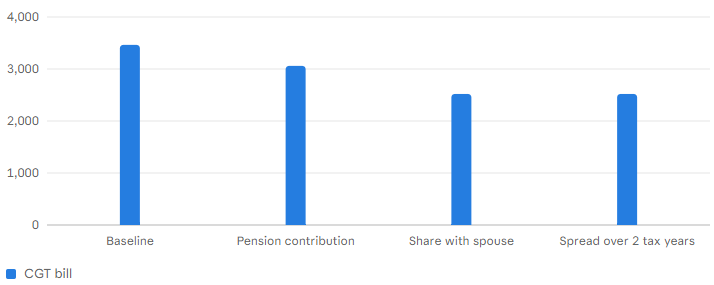
Now suppose the gain was shared evenly with a spouse who has no other income (my calculation). Each person has a £10,000 gain, less £3,000 allowance, leaving £7,000 taxable, all within the basic-rate band at 18%. That is £1,260 each, or £2,520 in total, which saves £943.80.
Two cautions. The transfer must be a real gift: the asset genuinely becomes your partner's, which is general knowledge and not something I could confirm in a source, so check the conditions with an adviser. And it only helps if your partner will actually use the lower band. Do not forget the other taxes that can matter, such as inheritance tax and your family circumstances.
Using the same £20,000 gain and £40,000 salary, suppose you sell £10,000 of gain before 5 April and £10,000 after. Each year you get a £3,000 allowance and £7,000 is taxable, all within the 18% band, so £1,260 each year and £2,520 in total (my calculation). That again saves £943.80 compared with selling everything in one year. This does assume your income is similar in both years and that the investment does not move sharply between sales. If the price falls in between, you could end up worse off, so I would not let tax drive the decision on its own.
Using the same example, £6,730 of the gain was taxed at 24%. If you made a gross pension contribution of £6,730 (that is £5,384 from your pocket after 20% basic-rate relief, my calculation), all £17,000 of taxable gain would sit at 18%, for a tax bill of £3,060 (my calculation). That is £403.80 less than £3,463.80, in addition to the pension's own tax relief.
The trade-off is that pension money is generally locked away until retirement age, and annual limits apply. For most people, the pension decision should be driven by retirement planning, with the CGT effect as a bonus.
For shares, HMRC's section 104 pool uses an average cost per share, and every purchase, sale and corporate action adjusts it. That makes records essential. Keep contract notes, dealing charges, platform statements, dates of purchase and any reinvested dividends that bought extra shares. I have not listed which costs qualify in every situation, because that depends on the asset. For property, improvements and fees are often relevant. Check HMRC guidance for your case.
A new Founders' Relief will apply a 10% rate to up to £10 million of lifetime gains for qualifying founders and significant early investors in high-growth, innovative companies from 6 April 2027. The qualifying conditions matter, and a consultation on the detail was still open at the time of the coverage I read, so treat it as an announcement not a certainty.
For homeowners, your main home is normally exempt from CGT under Private Residence Relief [16]. Second homes and rental properties are in scope, and if CGT is due on UK residential property you must report and pay within 60 days of completion.
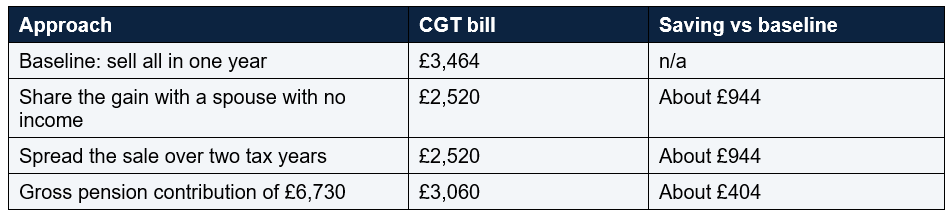
Treat the figures as an illustration: they assume particular income, a particular band and no other gains.
You may see £12,000, four times the allowance, quoted as the threshold. I saw it on several sites, but GOV.UK states £50,000 from the 2023 to 2024 tax year, so I treat the £12,000 figure as out of date. If you do not usually file a return, there is an HMRC real-time reporting service for one-off gains. And if you have never filed, you must tell HMRC by 5 October after the tax year ends, which means 5 October 2027 for 2026/27.
Residential property is different: report and pay within 60 days. ICAEW notes that 173,000 taxpayers reported disposals of 195,000 residential properties through that service for 2024/25, with total gains of £10.9 billion and CGT receipts of £2.4 billion. Common pitfalls: forgetting that gifts to anyone other than a spouse count as disposals at market value [12], ignoring the 30-day rule, missing the loss claim deadline, and failing to keep records.
The bear case: the allowance is small, CGT receipts are at a record, HMRC compliance is increasing, and political talk of aligning CGT with income tax rates has come up before. Government has not announced that, but it is a risk to remember if you are planning a very large disposal. Both are consistent with the same facts: the rules are stable for now, but your own tax position is what drives the answer.
Watch the following: the 5 April 2027 tax-year end if you want to use two allowances; any detail on Founders' Relief and the BADR change before 6 April 2027; your income level and how much basic-rate band you will have left; and the next Budget, because CGT has been in the news in each of the last few Budgets.
If you hold assets with large gains, a useful habit is to review them each February or March, well before the tax-year end.
In my worked example, simple steps could trim about £400 to £950 from a £3,460 bill, and an ISA can remove future CGT altogether on money you move in. None of this replaces advice for your situation. If the sums are large, a qualified tax adviser is well worth paying. This post is education only, not advice.
£3,000 per person. It cannot be carried forward .
What are the CGT rates for 2026/27?
18% on gains within your basic-rate band and 24% above it, for most assets including residential property. The rates for Business Asset Disposal Relief are 18%.
Did the October 2026 Budget change CGT?
No rate rises were announced. The BADR lifetime limit falls to £500,000 from 6 April 2027 and a new Founders' Relief arrives, according to several summaries.
Does Bed and ISA avoid the 30-day rule?
According to the sources I read, yes, because the 30-day rule applies in the same wrapper and name. The original sale still counts as a disposal.
Do I need to report gains under £3,000?
Not necessarily, but if you are in Self Assessment and your total sale proceeds were over £50,000, you must report even if the gain is below the allowance (GOV.UK, as quoted in sources).
Table of Contents
- The quick answer
- What changed, and why it matters
- Way 1: Use your annual allowance every year
- Way 2: Move gains into an ISA with Bed and ISA
- Way 3: Share assets with your spouse or civil partner
- Way 4: Use your losses
- Way 5: Time your sales across tax years
- Way 6: Use a pension contribution to widen your 18% band
- Way 7: Claim every allowable cost and keep records
- Bonus: business owners and your home
- Putting the ways together
- Reporting rules and pitfalls
- Bull case versus bear case
- What to watch next
- Conclusion
- FAQ
UK CGT annual exempt amount (£)
£ per person by Source: UK Tax Tools, Taxfly
What the allowance saves a higher-rate taxpayer (£ a year)
£ of tax saved by My calculation from allowance and higher rate
CGT bill on a £20,000 gain, £40,000 salary (£)
£ CGT payable by Baseline from FinanceToolz; other scenarios are my calculationThe quick answer
In 2026/27 you pay Capital Gains Tax at 18% on gains that fall within your basic-rate band and 24% on gains above it, after your £3,000 annual exempt amount. That allowance used to be £12,300, so many more people now owe tax on gains from shares, funds, crypto and second homes.The good news is that there are several legitimate ways to cut the bill. The seven I cover here are using your allowance every year, Bed and ISA, sharing assets with a spouse or civil partner, using losses, timing sales across tax years, using a pension contribution to widen your 18% band, and claiming every allowable cost.
Most of these work best when you plan before you sell, not after. This post explains each, with a worked example, and ends with a section on reporting mistakes. It is education, not advice.
Key takeaway: The rates are fixed for now, so your levers are who owns the asset, which tax year you sell in, and which wrapper holds it.
What changed, and why it matters
Three changes explain why CGT planning matters more than it used to. First, the annual exempt amount fell from £12,300 in 2022/23 to £6,000 in 2023/24 and £3,000 from 2024/25. Second, the main rates rose on 30 October 2024 to 18% and 24%, from 10% and 20%, and now apply equally to shares, funds and residential property.Third, the taxman is collecting more. SyndicateRoom reports that HMRC collected a record £22.2 billion of CGT in 2025-26, against a previous peak of £16.9 billion in 2022-23, though the OBR attributes some of the rise to people bringing disposals forward before the October 2024 Budget. A separate summary says HMRC recovered nearly £500 million through compliance work in 2025/26.
The Autumn Budget on 28 October 2026 brought no CGT rate rises. The annual exempt amount stays at £3,000 and the 18% and 24% rates stay for 2027/28, according to one summary of the Budget. I could only read that summary through a search excerpt, so please confirm it on GOV.UK.
There were changes for business owners, covered later. And the freeze on income tax thresholds now runs until 5 April 2031, according to one Budget guide [19]. That matters because your CGT rate depends on how much of your basic-rate band your income uses up. A note on stale numbers: Some sites still show old rates. One page I found says "10%/20% on other assets" for 2026/27, which is out of date. Always check the date.
Way 1: Use your annual allowance every year
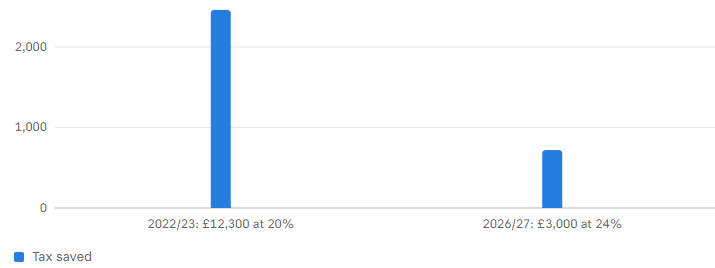
Everyone gets an annual exempt amount, £3,000 for 2026/27, and it cannot be carried forward if you do not use it. A couple can use £6,000 between them. The idea is simple: if you hold investments with large unrealised gains, realise some each year up to the allowance, and no tax is due. For a higher-rate taxpayer, £3,000 of tax-free gain is worth £720 a year at 24%, or £540 at 18% (my calculation). By contrast, the same allowance in 2022/23 was worth about £2,460 to a higher-rate taxpayer, because it was £12,300 and the rate was 20% (my calculation). So the benefit has shrunk, but it is still free money.In practice, this is sometimes called gain harvesting. You sell, take the gain tax-free, and, to keep your position, buy back in a way that complies with the 30-day rule discussed in Way 2.
Do remember what I said about timing. If the gain on a large holding is far above £3,000, trying to realise it all in one year wastes nothing, but you can still spread the sale across several years.
Way 2: Move gains into an ISA with Bed and ISA
Bed and ISA means selling investments held outside an ISA, using your allowance to absorb the gain, and immediately buying them back inside a Stocks and Shares ISA. Future growth and income are then free of CGT, and you can add up to £20,000 a year across your ISAs. The Autumn Budget helped here. It reversed the planned cut in the cash ISA limit, so the £20,000 allowance remains from 6 April 2027. That figure is the overall ISA limit; the cash ISA reduction would have applied to under-65s only.Why does it work? HMRC has a "bed and breakfast" rule: if you sell shares and buy the same shares back within 30 days, the sale is matched with the new purchase, which wipes out the benefit [13]. But the 30-day rule applies in the same name and wrapper, so rebuying inside an ISA is different. The mechanics are that the shares in the ISA are a different holding.
Here is a rough illustration of the long-term value (my calculation, with an assumed 7% annual growth that is not a forecast). Suppose you move £20,000 of investments into an ISA. After ten years it grows to about £39,300. If it had stayed outside, the gain of about £19,300 would, after the £3,000 allowance, be taxed at 24% for a bill of about £3,900. Inside the ISA that bill is nil. The catch: the sale in the first step is still a disposal, so a large gain uses your allowance and may cost you tax. For big gains, spread the move across tax years.
Way 3: Share assets with your spouse or civil partner
Transfers between spouses and civil partners are not subject to CGT. That opens up two benefits. You can double your allowances to £6,000, and you can move gains to the partner who pays the lower rate. Take the worked example from FinanceToolz: someone earning £40,000 sells shares for a £20,000 gain. After the £3,000 allowance, £17,000 is taxable. With £10,270 of the basic-rate band left, £10,270 is taxed at 18% (£1,848.60) and £6,730 at 24% (£1,615.20), a total of £3,463.80.Now suppose the gain was shared evenly with a spouse who has no other income (my calculation). Each person has a £10,000 gain, less £3,000 allowance, leaving £7,000 taxable, all within the basic-rate band at 18%. That is £1,260 each, or £2,520 in total, which saves £943.80.
Two cautions. The transfer must be a real gift: the asset genuinely becomes your partner's, which is general knowledge and not something I could confirm in a source, so check the conditions with an adviser. And it only helps if your partner will actually use the lower band. Do not forget the other taxes that can matter, such as inheritance tax and your family circumstances.
Way 4: Use your losses
If you have sold anything at a loss, those losses can reduce your gains. Take another example: a £9,000 gain on one shareholding and a £4,000 loss on another in the same year. The net gain is £5,000, and after the £3,000 allowance only £2,000 is taxable (my calculation, from the example's figures). Two rules matter. Losses must be reported: you can claim a loss up to four years after the end of the tax year of the disposal. And unused losses can be carried forward, though losses carried forward can only reduce your gains down to the annual exempt amount, so they do not waste your allowance. Practical point: some investors deliberately sell a loser to offset a winner. Be careful, though, as the same 30-day rule applies if you buy the same asset back within 30 days.Way 5: Time your sales across tax years
Because the rate depends on where your gain sits in your basic-rate band, timing matters. One guide notes that selling part of a holding now and part after 6 April uses two years' allowances and can keep gains within the 18% band. The same guide suggests timing a sale for a low-income year, such as a career break or retirement year.Using the same £20,000 gain and £40,000 salary, suppose you sell £10,000 of gain before 5 April and £10,000 after. Each year you get a £3,000 allowance and £7,000 is taxable, all within the 18% band, so £1,260 each year and £2,520 in total (my calculation). That again saves £943.80 compared with selling everything in one year. This does assume your income is similar in both years and that the investment does not move sharply between sales. If the price falls in between, you could end up worse off, so I would not let tax drive the decision on its own.
Way 6: Use a pension contribution to widen your 18% band
Pension contributions can lower your taxable income, which can push some of your gain from the 24% band into the 18% one. In general, a gross personal contribution to a relief-at-source pension extends your basic-rate band by the same amount, though I did not confirm that mechanism in a source, so check with your provider.Using the same example, £6,730 of the gain was taxed at 24%. If you made a gross pension contribution of £6,730 (that is £5,384 from your pocket after 20% basic-rate relief, my calculation), all £17,000 of taxable gain would sit at 18%, for a tax bill of £3,060 (my calculation). That is £403.80 less than £3,463.80, in addition to the pension's own tax relief.
The trade-off is that pension money is generally locked away until retirement age, and annual limits apply. For most people, the pension decision should be driven by retirement planning, with the CGT effect as a bonus.
Way 7: Claim every allowable cost and keep records
Your gain is the sale price minus the purchase price and allowable costs. FinanceToolz's property example subtracts £6,000 of buying costs such as legal fees before arriving at a £60,000 gain. MMBA also lists allowable costs among the ways to reduce a property gain.For shares, HMRC's section 104 pool uses an average cost per share, and every purchase, sale and corporate action adjusts it. That makes records essential. Keep contract notes, dealing charges, platform statements, dates of purchase and any reinvested dividends that bought extra shares. I have not listed which costs qualify in every situation, because that depends on the asset. For property, improvements and fees are often relevant. Check HMRC guidance for your case.
Bonus: business owners and your home
If you own a business, the Autumn Budget made changes worth knowing. Business Asset Disposal Relief (BADR) has a rate of 18% from April 2026, up from 14% , and from 6 April 2027 the lifetime limit halves from £1 million to £500,000 [5][6]. One analysis says the maximum lifetime saving is now £30,000 per person, because the rate is 18% against a main rate of 24%. That matches my calculation: £500,000 times six percentage points is £30,000.A new Founders' Relief will apply a 10% rate to up to £10 million of lifetime gains for qualifying founders and significant early investors in high-growth, innovative companies from 6 April 2027. The qualifying conditions matter, and a consultation on the detail was still open at the time of the coverage I read, so treat it as an announcement not a certainty.
For homeowners, your main home is normally exempt from CGT under Private Residence Relief [16]. Second homes and rental properties are in scope, and if CGT is due on UK residential property you must report and pay within 60 days of completion.
Putting the ways together
These ways stack. Imagine a couple holding £20,000 of gains outside an ISA. They might use both allowances through a spousal transfer, spread the sale across two tax years to double the allowance again, move proceeds into ISAs, and offset any losses. In many cases the CGT bill could fall to nothing. The worked examples in this post, all from the same £40,000 salary and £20,000 gain, show the possible savings (my calculation):Treat the figures as an illustration: they assume particular income, a particular band and no other gains.
Reporting rules and pitfalls
Reporting trips up many people. For shares there is no 60-day rule: you report on your Self Assessment return, due by 31 January after the end of the tax year. If you are registered for Self Assessment, GOV.UK says you must report if the total you sold assets for exceeded £50,000, even if the gain is under the allowance.You may see £12,000, four times the allowance, quoted as the threshold. I saw it on several sites, but GOV.UK states £50,000 from the 2023 to 2024 tax year, so I treat the £12,000 figure as out of date. If you do not usually file a return, there is an HMRC real-time reporting service for one-off gains. And if you have never filed, you must tell HMRC by 5 October after the tax year ends, which means 5 October 2027 for 2026/27.
Residential property is different: report and pay within 60 days. ICAEW notes that 173,000 taxpayers reported disposals of 195,000 residential properties through that service for 2024/25, with total gains of £10.9 billion and CGT receipts of £2.4 billion. Common pitfalls: forgetting that gifts to anyone other than a spouse count as disposals at market value [12], ignoring the 30-day rule, missing the loss claim deadline, and failing to keep records.
Bull case versus bear case
The bull case: the rates and allowance are fixed for 2027/28, so planning is predictable, and several tools are open to ordinary investors, including ISAs, spousal transfers and pensions.The bear case: the allowance is small, CGT receipts are at a record, HMRC compliance is increasing, and political talk of aligning CGT with income tax rates has come up before. Government has not announced that, but it is a risk to remember if you are planning a very large disposal. Both are consistent with the same facts: the rules are stable for now, but your own tax position is what drives the answer.
Watch the following: the 5 April 2027 tax-year end if you want to use two allowances; any detail on Founders' Relief and the BADR change before 6 April 2027; your income level and how much basic-rate band you will have left; and the next Budget, because CGT has been in the news in each of the last few Budgets.
If you hold assets with large gains, a useful habit is to review them each February or March, well before the tax-year end.
Conclusion
Seven ideas can cut a CGT bill legally: use the £3,000 allowance each year, move assets into an ISA, share assets with your spouse, use losses, spread sales over tax years, widen your 18% band with a pension contribution, and claim every allowable cost. With the Budget confirming stable rates and a £3,000 allowance for 2027/28 according to one summary, the planning is mostly about timing and ownership.In my worked example, simple steps could trim about £400 to £950 from a £3,460 bill, and an ISA can remove future CGT altogether on money you move in. None of this replaces advice for your situation. If the sums are large, a qualified tax adviser is well worth paying. This post is education only, not advice.
FAQ
What is the CGT allowance for 2026/27?£3,000 per person. It cannot be carried forward .
What are the CGT rates for 2026/27?
18% on gains within your basic-rate band and 24% above it, for most assets including residential property. The rates for Business Asset Disposal Relief are 18%.
Did the October 2026 Budget change CGT?
No rate rises were announced. The BADR lifetime limit falls to £500,000 from 6 April 2027 and a new Founders' Relief arrives, according to several summaries.
Does Bed and ISA avoid the 30-day rule?
According to the sources I read, yes, because the 30-day rule applies in the same wrapper and name. The original sale still counts as a disposal.
Do I need to report gains under £3,000?
Not necessarily, but if you are in Self Assessment and your total sale proceeds were over £50,000, you must report even if the gain is below the allowance (GOV.UK, as quoted in sources).
0 Comments
Be the first to share your thoughts on this article.