

Financial Literacy
7 Tiny Habits to Become Financially Literate

Key Statistics: Only 57% of US adults are financially literate (TIAA Institute/GFLEC, 2024). Only 33% of US high school students receive personal finance education (NGPF, 2025). 78% of Americans live paycheck to paycheck at some point (LendingTree, 2025). 34% of Americans have no emergency savings (Bankrate, 2026). Financially literate people are significantly more likely to have retirement accounts, emergency savings, and lower debt (TIAA Institute). People who track spending save on average 20% more than those who don’t (National Endowment for Financial Education). Reading 15 minutes per day on a subject puts you in the top 1% of knowledge in that field within 7 years (James Clear, Atomic Habits). A person who starts investing at 22 vs 32 can end up with the same wealth with just 10 years of contributions vs 30 years. 84% of Americans have new financial resolutions for 2026 (Vanguard). Habit formation takes on average 66 days — not 21 (University College London study).
The conventional response to this is to recommend a course, a book, or a qualification. The problem with this response is that it positions financial literacy as something you achieve, like a driving licence — a discrete event with a clear endpoint. Financial literacy is not an event. It is a state that is maintained through ongoing, habitual engagement with financial ideas, information, and decisions. You do not become financially literate by passing a test. You become financially literate by developing the habits that keep you informed and reflective about money over a lifetime.
This article presents seven tiny habits — each one taking between two and thirty minutes — that, practised consistently, will build genuine financial knowledge, improve financial decision-making, and compound into measurably better financial outcomes. None of them requires a finance degree. All of them can start today.
The University College London study on habit formation found that habits take an average of 66 days to become automatic — not the commonly cited 21 days. The habits that form most reliably are those tied to an existing routine (a morning coffee, a Sunday evening, a Monday commute) and those that produce an immediately visible outcome. Financial literacy habits can be designed to meet both criteria.
James Clear, Atomic Habits: You do not rise to the level of your goals. You fall to the level of your systems. Every financial goal — getting out of debt, building savings, investing for retirement — is the cumulative product of financial habits repeated so many times they become automatic.
The seven habits that follow are chosen specifically because they meet the criteria of tiny, immediately rewarding, and compounding over time. They are not the seven habits of genius investors. They are the seven habits of ordinary people who, over years, know significantly more about money than they did when they started.
The cumulative effect of this habit over a year is significant. One story per day times 365 days equals 365 pieces of financial context. By the end of a year, you will have encountered interest rates, inflation, company earnings, economic indicators, central bank decisions, market movements, consumer trends, property prices, and government policy more times than most adults encounter these topics in a decade. And because you are encountering them through the lens of actual news rather than textbook definitions, the knowledge sticks because it connects to real events you remember.
Where to find the story: the BBC Business section (free), the Financial Times front page (one free article per day without a subscription), MoneySavingExpert’s weekly newsletter, The Guardian Money section, or the Investopedia News section. Do not use social media as your primary source — financial news on social media skews toward sensationalism and misinformation.
What to do with what you read: after you read the story, ask yourself two questions. First: what is the mechanism behind this? (Why did inflation rise? What caused the company to post a loss? Why did the central bank hold rates?) Second: does this affect me directly, and if so, how? You do not need to write answers down. Simply asking the questions as you read transforms passive consumption into active financial thinking.
Tiny Action: Starting tomorrow, add one financial news site to your morning routine. Set it as a browser bookmark or add it to your phone’s home screen. Read one story before you check social media. Do this for 30 days without judging the quality of what you retain.
Most people have a vague impression of their spending. They know roughly what they spend on rent, on food, on transport. They do not know, without checking, how much they spent on takeaways last month, how many subscription services they are paying for, how many times they used their overdraft, or what their total spending on clothing was over the past three months. The bank statement review habit closes this gap.
Ten minutes every Sunday. Open your banking app or log in to your bank’s website. Look at the past week’s transactions. Ask three questions: Was there anything I did not expect? Was there anything I regret? Is there anything I have been paying for that I do not remember signing up for?
This habit builds financial literacy in two ways. First, it builds specific knowledge of your own financial behaviour — which is the foundation on which all other financial decisions rest. You cannot set a meaningful budget without knowing what you actually spend. Second, it trains you to read financial statements: a skill that transfers to reading company accounts, investment fund statements, and pension documents, all of which follow the same logic of income, expenditure, and balance.
Tiny Action: This Sunday evening, open your banking app and scroll through the past 7 days of transactions. Write down the total in three categories: needs (rent, food, transport), wants (dining, entertainment, subscriptions), and savings/debt repayment. Note the percentage each category represents. Do this for four consecutive Sundays before drawing any conclusions.
The habit: every day, learn one financial term you do not yet fully understand. Not its textbook definition alone. Its real-world application — what it describes, why it matters, and where you would encounter it in your own financial life.
You do not need to seek out obscure terminology. Start with the terms that appear most frequently in the news and documents you encounter: inflation, interest rate, credit score, return on investment, gross versus net, asset, liability, equity, dividend, index fund, amortisation, leverage. Once you have worked through the most common terms, let your news reading habit supply new ones. When a term appears in a story you read and you are not certain what it means, look it up that day.
Two minutes is enough. A good financial glossary — Investopedia is the most comprehensive and reliable free resource — provides a clear definition, a worked example, and real-world context for any term in under two minutes. The accumulation of 365 financial terms in a year is the equivalent of building a comprehensive financial vocabulary from scratch without ever sitting in a classroom.
Tiny Action: Go to investopedia.com right now and look up one term you have heard but cannot confidently explain to someone else. Set a daily phone alarm for 9am labelled ‘Money Word’ as a reminder to look up one new term per day. After 30 days, you will have learned 30 terms — more than most personal finance courses cover in their first module.
Most people have never calculated their net worth. Of those who have, most have not done it more than once. The habit of calculating it monthly — same date each month, same format — transforms it from an abstract number into a live feedback mechanism that tells you whether your financial decisions are working.
A monthly net worth calculation takes five minutes with a simple spreadsheet or a free app (Personal Capital, or its successor Empower, is widely recommended in the US; in the UK, Money Dashboard and Emma serve a similar function). List your assets (current account balance, savings, investment accounts, pension value, property equity) and your liabilities (mortgage balance, loans, credit card balances, car finance). Subtract liabilities from assets.
The specific number matters less than the direction and rate of change. A net worth that increases by £300 or $400 per month — even from a low base — is a net worth that doubles over time through the combined effect of debt reduction, savings accumulation, and investment growth. The monthly habit of measuring it keeps this long-term trajectory visible and makes the impact of specific financial decisions concrete rather than abstract.
The financial literacy dimension of this habit: calculating net worth requires you to engage with your pension statement, your mortgage balance, your investment account balance, and your debt balances every month. Monthly engagement with these documents means you will notice changes, catch errors, understand what different figures mean, and build the financial fluency that comes from regular, repeated contact with your own financial data.
Tiny Action: On the first of next month, open a blank spreadsheet and create two columns: Assets and Liabilities. List every account, investment, property, loan, and debt balance. Calculate the total for each column. Subtract liabilities from assets. Write the result at the top and date it. Repeat on the first of every subsequent month. After six months, you will have a financial trend line that is more informative than any single snapshot.
Podcasts are particularly effective for financial literacy because they are conversational, contextual, and updated in real time. Unlike a textbook written in 2019, a podcast episode from this week discusses this week’s economic conditions, current interest rates, and the financial challenges people are actually facing right now. The combination of timeliness and the podcast medium’s capacity for nuanced explanation makes it one of the most efficient financial education formats available for free.
Recommended podcasts for financial literacy in 2026:
The habit: before any financial decision — taking out a loan, choosing an investment, signing a direct debit, buying insurance, renewing a mortgage — ask yourself: do I know why this is the right choice? Not whether it feels right, or whether someone you trust recommended it. Whether you can explain, in your own words, why this specific financial product or decision is appropriate for your specific situation.
If you can answer yes confidently, make the decision. If you cannot — if you are uncertain about the terms, the alternatives, the true cost, or the long-term implications — pause, research, and answer the question before proceeding. This does not mean delaying every financial decision indefinitely. It means refusing to make significant financial decisions in a state of ignorance that could be resolved with thirty minutes of research.
The questions this habit generates are the building blocks of financial literacy:
Tiny Action: The next time you receive a financial document — a bank statement, a pension letter, an insurance renewal, a mortgage offer — identify one term or figure you do not fully understand and look it up before filing the document away. One question per document. Over a year, this habit will have answered dozens of financial questions that directly apply to your own financial life.
The habit: once a month, have a genuine conversation about money with someone you trust. Not a complaint about bills. Not a vague worry about the economy. A specific, substantive exchange: what investment approach are you using for your pension? How are you thinking about the property market? Did you know that switching energy tariff has saved me £200 a year? How are you managing the interest rate on your mortgage since it was renewed?
These conversations serve three financial literacy functions. First, they expose you to approaches and knowledge you do not already have. The person you speak with may have discovered a savings rate, tax efficiency strategy, or debt management approach that you have not encountered through your own research. Second, they normalise financial discussion, which reduces the shame and avoidance that compound financial problems for millions of people who feel they cannot talk about money struggles. Third, they require you to articulate your own financial understanding — and articulating what you know is one of the most effective ways to consolidate it.
The Breaking Money Silence movement, founded by financial therapist Kathleen Burns Kingsbury, documents how financial conversations between family members transmit financial literacy across generations. Children who hear their parents discuss money openly and honestly develop stronger financial literacy in adulthood than those raised in financially silent households. The habit of monthly money conversations builds your own literacy and, if you have children, begins building theirs.
Tiny Action: Identify one person in your life — a trusted friend, a partner, a sibling, a colleague — with whom you can have an honest money conversation this month. Choose one specific topic: pension contributions, emergency funds, mortgage renewal, or investment approach. Not a complaint session. A genuine exchange of what each of you is doing and why. Schedule it.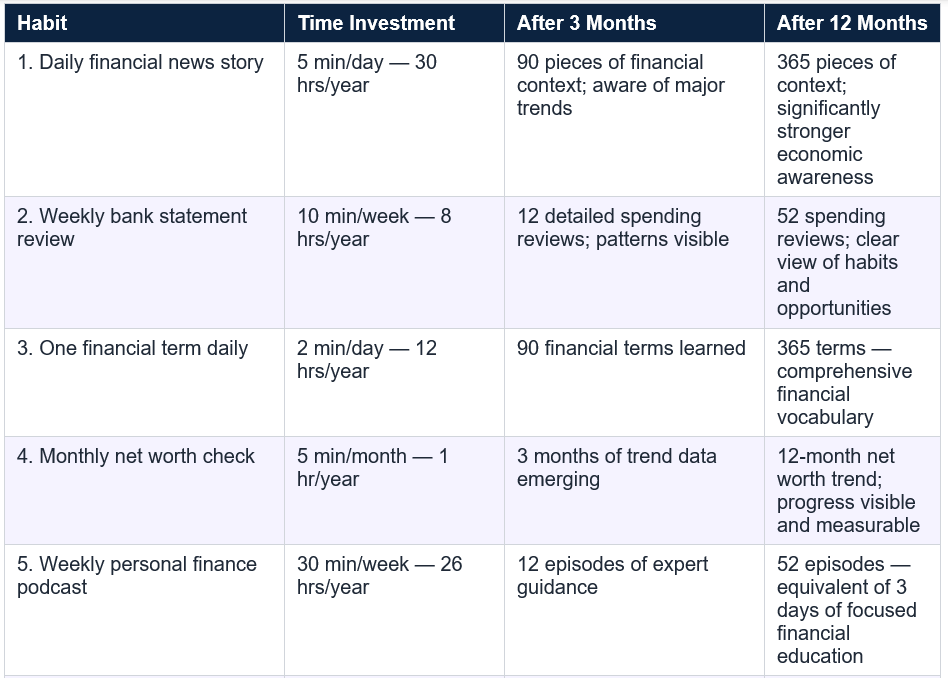
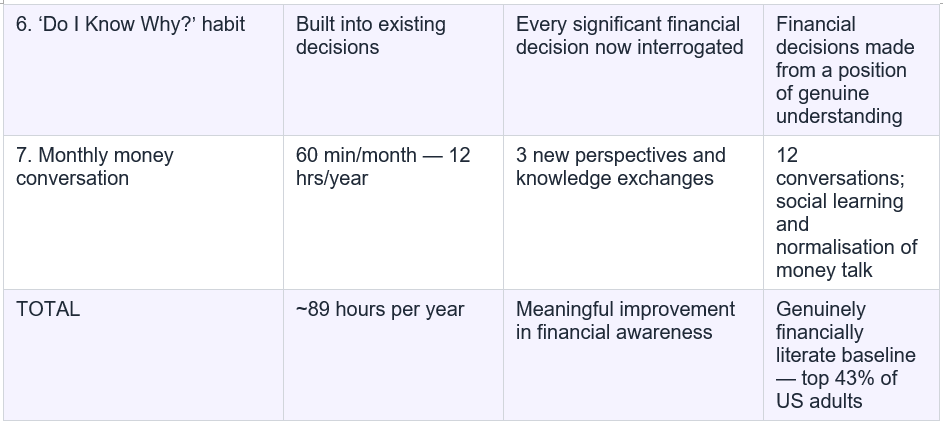
Eighty-nine hours per year of targeted financial learning — built from habits that individually require no more than 30 minutes at a time — represents more financial education than most people receive in their entire lives. And because it is applied continuously to real-world events, real spending decisions, and real financial products rather than theoretical classroom scenarios, it produces knowledge that is immediately applicable rather than abstract.
Applied to the seven financial literacy habits:
In one year of these habits, you will have read 365 financial news stories and encountered the major economic events of the year with enough context to understand them. You will have reviewed your spending 52 times and know exactly where your money goes. You will have learned 365 financial terms and have the vocabulary to read any financial document placed in front of you. You will have tracked your net worth for 12 consecutive months and know whether your overall financial position is improving. You will have listened to over 50 podcast episodes from qualified financial educators. You will have interrogated every significant financial decision you made. And you will have had 12 genuine money conversations that expanded your perspective and normalised financial discussion in your life.
The person who has done all of this for a year is meaningfully more financially literate than the person who has not — not because they are smarter, more dedicated, or more naturally gifted with money. Because they have built seven tiny habits that gave financial knowledge no choice but to accumulate. Start one habit this week. Add a second in a month. The knowledge compounds, just like interest.
Financial literacy is a continuous state rather than a fixed destination. But measurable, meaningful improvement can be achieved in as little as three to six months of consistent daily habits. The TIAA Institute research shows that financially literate people make demonstrably better decisions about savings, debt, and investment. The seven habits in this article, practised consistently for one year, produce approximately 89 hours of targeted financial learning — significantly more than most people receive in formal education.
Do I need to know maths to be financially literate?
Not advanced maths. The mathematical concepts required for personal financial literacy are addition, subtraction, percentages, and basic multiplication — all of which most adults already have. Understanding compound interest requires knowing that 7% of £1,000 is £70. Understanding a debt-to-income ratio requires knowing that £900 divided by £2,000 is 45%. The barrier to financial literacy is not mathematics. It is vocabulary, familiarity, and confidence. All three can be built through the habits in this article.
What is the single most important financial literacy habit to start with?
If you can only do one, start with Habit 2: the weekly Sunday bank statement review. Understanding exactly what you spend your money on is the foundation of every other financial decision. You cannot budget without knowing where your money goes. You cannot assess whether your income is sufficient without knowing what you spend. You cannot identify where savings are possible without knowing what you currently spend. Every other financial literacy habit becomes more powerful once you have this baseline knowledge of your own financial behaviour.
How do I know if I am financially literate enough?
A practical self-assessment: can you explain, in plain English, what compound interest is and how it affects you? Can you explain the difference between an asset and a liability? Do you know your approximate net worth? Do you know your debt-to-income ratio? Do you understand how your pension is invested and at what approximate rate? Can you read a bank statement, a pension statement, and a credit card bill and understand all the figures? If you answered no to more than two of these questions, the seven habits in this article will address each gap.
Is financial literacy different for people in the UK vs the US?
The core concepts are identical — income, expenditure, savings, investment, debt, insurance, tax efficiency. The specific products, institutions, and regulations differ: the UK has ISAs, the NHS reducing healthcare insurance needs, the state pension, stamp duty, and council tax; the US has 401(k) plans, health insurance markets, Social Security, property taxes, and Federal vs. state tax considerations. The daily news story habit and podcast habit should use sources relevant to your country. The financial term, net worth, bank review, and money conversation habits are universally applicable.
How do I get my partner or family on board with these habits?
Start with yourself. Lead by example rather than by instruction. The monthly money conversation habit is the most directly social of the seven habits and provides a natural entry point for bringing a partner into financial discussion. Share what you are learning from your news reading and podcast listening in a low-pressure, non-judgmental way. Celebrate their curiosity when they ask financial questions rather than responding with complex explanations that might discourage further engagement. Financial literacy within a household grows most effectively when it is a shared practice rather than one person’s solo endeavour.
What if I make a financial mistake while I am still learning?
Financial mistakes are not failures of financial literacy. They are experiences that generate financial knowledge. The financially literate response to a mistake is to understand exactly what went wrong and why, to assess what you would do differently, and to apply that learning to the next decision. Shame about past financial decisions is one of the most common barriers to developing financial literacy — because shame prevents the honest examination of what happened that is required to learn from it. Every financially knowledgeable person you know has made financial mistakes. The difference is that they examined them.
Table of Contents
- Why Financial Literacy Is Built in Minutes, Not Degrees
- The Science of Tiny Habits and Financial Knowledge
- Habit 1: Read One Financial News Story Every Morning (5 Minutes)
- Habit 2: Review Your Bank Statement Every Sunday (10 Minutes)
- Habit 3: Learn One Financial Term Every Day (2 Minutes)
- Habit 4: Check Your Net Worth Monthly (5 Minutes)
- Habit 5: Listen to One Personal Finance Podcast Episode Weekly (30 Minutes)
- Habit 6: Ask ‘Do I Know Why?’ Before Every Financial Decision
- Habit 7: Have One Money Conversation Every Month
- The Compound Effect: What These 7 Habits Do Over 12 Months
- Building the Habits: The Practical System
- Common Mistakes That Kill Financial Literacy Habits
- Conclusion: The Financially Literate Person You’ll Become
- Frequently Asked Questions
Why Financial Literacy Is Built in Minutes, Not Degrees
Only 57 percent of US adults are financially literate, according to the TIAA Institute and Global Financial Literacy Excellence Center’s 2024 survey. Only 33 percent of high school students in the US receive any personal finance education, according to the Next Gen Personal Finance 2025 report. The result is that most people arrive in adulthood managing credit cards, mortgages, investment accounts, and tax obligations with no formal preparation for any of it.The conventional response to this is to recommend a course, a book, or a qualification. The problem with this response is that it positions financial literacy as something you achieve, like a driving licence — a discrete event with a clear endpoint. Financial literacy is not an event. It is a state that is maintained through ongoing, habitual engagement with financial ideas, information, and decisions. You do not become financially literate by passing a test. You become financially literate by developing the habits that keep you informed and reflective about money over a lifetime.
This article presents seven tiny habits — each one taking between two and thirty minutes — that, practised consistently, will build genuine financial knowledge, improve financial decision-making, and compound into measurably better financial outcomes. None of them requires a finance degree. All of them can start today.
The Science of Tiny Habits and Financial Knowledge
The phrase tiny habits comes from BJ Fogg’s research at Stanford University into behaviour change. Fogg’s finding — validated across thousands of participants — is that the smallest possible version of a habit is the most reliably formed. James Clear’s Atomic Habits popularised the principle further: a 1 percent improvement each day compounds to 37 times better over a year. Applied to financial knowledge: reading one news story per day is trivially easy to maintain. Reading a finance textbook cover to cover is not.The University College London study on habit formation found that habits take an average of 66 days to become automatic — not the commonly cited 21 days. The habits that form most reliably are those tied to an existing routine (a morning coffee, a Sunday evening, a Monday commute) and those that produce an immediately visible outcome. Financial literacy habits can be designed to meet both criteria.
James Clear, Atomic Habits: You do not rise to the level of your goals. You fall to the level of your systems. Every financial goal — getting out of debt, building savings, investing for retirement — is the cumulative product of financial habits repeated so many times they become automatic.
The seven habits that follow are chosen specifically because they meet the criteria of tiny, immediately rewarding, and compounding over time. They are not the seven habits of genius investors. They are the seven habits of ordinary people who, over years, know significantly more about money than they did when they started.
HABIT 1: Read One Financial News Story Every Morning (5 Minutes)
The most foundational financial literacy habit is also the simplest: read one story about money, economics, or personal finance every morning. Not a curated feed of everything happening in global finance. One story. Read it to the end. Think about what it means for a minute before moving on.The cumulative effect of this habit over a year is significant. One story per day times 365 days equals 365 pieces of financial context. By the end of a year, you will have encountered interest rates, inflation, company earnings, economic indicators, central bank decisions, market movements, consumer trends, property prices, and government policy more times than most adults encounter these topics in a decade. And because you are encountering them through the lens of actual news rather than textbook definitions, the knowledge sticks because it connects to real events you remember.
Where to find the story: the BBC Business section (free), the Financial Times front page (one free article per day without a subscription), MoneySavingExpert’s weekly newsletter, The Guardian Money section, or the Investopedia News section. Do not use social media as your primary source — financial news on social media skews toward sensationalism and misinformation.
What to do with what you read: after you read the story, ask yourself two questions. First: what is the mechanism behind this? (Why did inflation rise? What caused the company to post a loss? Why did the central bank hold rates?) Second: does this affect me directly, and if so, how? You do not need to write answers down. Simply asking the questions as you read transforms passive consumption into active financial thinking.
Tiny Action: Starting tomorrow, add one financial news site to your morning routine. Set it as a browser bookmark or add it to your phone’s home screen. Read one story before you check social media. Do this for 30 days without judging the quality of what you retain.
HABIT 2: Review Your Bank Statement Every Sunday (10 Minutes)
The National Endowment for Financial Education found that people who track their spending save on average 20 percent more than those who do not. The reason is simple: you cannot make better decisions about money you do not know you are spending.Most people have a vague impression of their spending. They know roughly what they spend on rent, on food, on transport. They do not know, without checking, how much they spent on takeaways last month, how many subscription services they are paying for, how many times they used their overdraft, or what their total spending on clothing was over the past three months. The bank statement review habit closes this gap.
Ten minutes every Sunday. Open your banking app or log in to your bank’s website. Look at the past week’s transactions. Ask three questions: Was there anything I did not expect? Was there anything I regret? Is there anything I have been paying for that I do not remember signing up for?
This habit builds financial literacy in two ways. First, it builds specific knowledge of your own financial behaviour — which is the foundation on which all other financial decisions rest. You cannot set a meaningful budget without knowing what you actually spend. Second, it trains you to read financial statements: a skill that transfers to reading company accounts, investment fund statements, and pension documents, all of which follow the same logic of income, expenditure, and balance.
Tiny Action: This Sunday evening, open your banking app and scroll through the past 7 days of transactions. Write down the total in three categories: needs (rent, food, transport), wants (dining, entertainment, subscriptions), and savings/debt repayment. Note the percentage each category represents. Do this for four consecutive Sundays before drawing any conclusions.
HABIT 3: Learn One Financial Term Every Day (2 Minutes)
Financial jargon is a barrier between most people and their own money. Terms like amortisation, yield curve, equity, compound interest, DTI ratio, basis points, and AER appear constantly in financial documents, news articles, and conversations with financial professionals. When you do not know what these terms mean, you cannot fully engage with the information they describe. And when you cannot engage, you defer — to advisers, to partners, to inertia — rather than making informed decisions yourself.The habit: every day, learn one financial term you do not yet fully understand. Not its textbook definition alone. Its real-world application — what it describes, why it matters, and where you would encounter it in your own financial life.
You do not need to seek out obscure terminology. Start with the terms that appear most frequently in the news and documents you encounter: inflation, interest rate, credit score, return on investment, gross versus net, asset, liability, equity, dividend, index fund, amortisation, leverage. Once you have worked through the most common terms, let your news reading habit supply new ones. When a term appears in a story you read and you are not certain what it means, look it up that day.
Two minutes is enough. A good financial glossary — Investopedia is the most comprehensive and reliable free resource — provides a clear definition, a worked example, and real-world context for any term in under two minutes. The accumulation of 365 financial terms in a year is the equivalent of building a comprehensive financial vocabulary from scratch without ever sitting in a classroom.
Tiny Action: Go to investopedia.com right now and look up one term you have heard but cannot confidently explain to someone else. Set a daily phone alarm for 9am labelled ‘Money Word’ as a reminder to look up one new term per day. After 30 days, you will have learned 30 terms — more than most personal finance courses cover in their first module.
HABIT 4: Check Your Net Worth Monthly (5 Minutes)
Net worth is the most honest single number in personal finance. Assets minus liabilities. What you own minus what you owe. It is your financial scoreboard, and it is the number that tells you whether you are making genuine progress regardless of what your income, spending, or investment returns are doing in any given month.Most people have never calculated their net worth. Of those who have, most have not done it more than once. The habit of calculating it monthly — same date each month, same format — transforms it from an abstract number into a live feedback mechanism that tells you whether your financial decisions are working.
A monthly net worth calculation takes five minutes with a simple spreadsheet or a free app (Personal Capital, or its successor Empower, is widely recommended in the US; in the UK, Money Dashboard and Emma serve a similar function). List your assets (current account balance, savings, investment accounts, pension value, property equity) and your liabilities (mortgage balance, loans, credit card balances, car finance). Subtract liabilities from assets.
The specific number matters less than the direction and rate of change. A net worth that increases by £300 or $400 per month — even from a low base — is a net worth that doubles over time through the combined effect of debt reduction, savings accumulation, and investment growth. The monthly habit of measuring it keeps this long-term trajectory visible and makes the impact of specific financial decisions concrete rather than abstract.
The financial literacy dimension of this habit: calculating net worth requires you to engage with your pension statement, your mortgage balance, your investment account balance, and your debt balances every month. Monthly engagement with these documents means you will notice changes, catch errors, understand what different figures mean, and build the financial fluency that comes from regular, repeated contact with your own financial data.
Tiny Action: On the first of next month, open a blank spreadsheet and create two columns: Assets and Liabilities. List every account, investment, property, loan, and debt balance. Calculate the total for each column. Subtract liabilities from assets. Write the result at the top and date it. Repeat on the first of every subsequent month. After six months, you will have a financial trend line that is more informative than any single snapshot.
HABIT 5: Listen to One Personal Finance Podcast Episode Weekly (30 Minutes)
Audio learning has one specific advantage over reading for financial literacy: it can happen during time that is otherwise being wasted. A commute. A walk. A gym session. Cooking. Cleaning. Thirty minutes of personal finance podcast per week uses time that would otherwise produce nothing financially educational and converts it into approximately 26 hours of financial content per year — the equivalent of three full working days of targeted learning.Podcasts are particularly effective for financial literacy because they are conversational, contextual, and updated in real time. Unlike a textbook written in 2019, a podcast episode from this week discusses this week’s economic conditions, current interest rates, and the financial challenges people are actually facing right now. The combination of timeliness and the podcast medium’s capacity for nuanced explanation makes it one of the most efficient financial education formats available for free.
Recommended podcasts for financial literacy in 2026:
- • Money Box (BBC Radio 4, UK): short, authoritative, covering everything from interest rates to pension changes to consumer rights. Episodes are typically 25 to 30 minutes.
- • Planet Money (NPR, US): makes economics and finance genuinely engaging through storytelling. Episodes explain complex concepts in accessible terms without oversimplifying.
- • The Martin Lewis Podcast (UK): practical, consumer-focused financial guidance on the issues most relevant to ordinary UK households. Direct and actionable.
- • We Study Billionaires (The Investor’s Podcast): deep dives into investment principles and the practices of successful investors. More advanced but consistently evidence-based.
- • Afford Anything (Paula Pant, US): focused on financial independence, passive income, and intentional money management. Strong on the psychology of money as well as the mechanics.
HABIT 6: Ask ‘Do I Know Why?’ Before Every Financial Decision
This habit is invisible and free. It takes zero extra time. And it is one of the most powerful financial literacy builders available because it converts every financial decision you make into a learning moment.The habit: before any financial decision — taking out a loan, choosing an investment, signing a direct debit, buying insurance, renewing a mortgage — ask yourself: do I know why this is the right choice? Not whether it feels right, or whether someone you trust recommended it. Whether you can explain, in your own words, why this specific financial product or decision is appropriate for your specific situation.
If you can answer yes confidently, make the decision. If you cannot — if you are uncertain about the terms, the alternatives, the true cost, or the long-term implications — pause, research, and answer the question before proceeding. This does not mean delaying every financial decision indefinitely. It means refusing to make significant financial decisions in a state of ignorance that could be resolved with thirty minutes of research.
The questions this habit generates are the building blocks of financial literacy:
- • Why is the interest rate on this savings account different from the one I currently have?
- • Why does my mortgage adviser recommend a 5-year fix rather than a 2-year fix right now?
- • Why does the insurance policy I am being offered have this specific excess?
- • Why is this investment fund’s expense ratio higher than the comparable index fund?
- • Why does this pension transfer have a penalty if I move before a certain date?
Tiny Action: The next time you receive a financial document — a bank statement, a pension letter, an insurance renewal, a mortgage offer — identify one term or figure you do not fully understand and look it up before filing the document away. One question per document. Over a year, this habit will have answered dozens of financial questions that directly apply to your own financial life.
HABIT 7: Have One Money Conversation Every Month
Financial literacy is not only an individual practice. It is also a social one. The cultures and conversations we have with people around us about money shape our understanding of it as powerfully as anything we read or listen to. In most Western societies — and particularly in the UK, where surveys consistently find that money is considered more taboo to discuss than religion or politics — the habit of talking about money openly is itself a counter-cultural act.The habit: once a month, have a genuine conversation about money with someone you trust. Not a complaint about bills. Not a vague worry about the economy. A specific, substantive exchange: what investment approach are you using for your pension? How are you thinking about the property market? Did you know that switching energy tariff has saved me £200 a year? How are you managing the interest rate on your mortgage since it was renewed?
These conversations serve three financial literacy functions. First, they expose you to approaches and knowledge you do not already have. The person you speak with may have discovered a savings rate, tax efficiency strategy, or debt management approach that you have not encountered through your own research. Second, they normalise financial discussion, which reduces the shame and avoidance that compound financial problems for millions of people who feel they cannot talk about money struggles. Third, they require you to articulate your own financial understanding — and articulating what you know is one of the most effective ways to consolidate it.
The Breaking Money Silence movement, founded by financial therapist Kathleen Burns Kingsbury, documents how financial conversations between family members transmit financial literacy across generations. Children who hear their parents discuss money openly and honestly develop stronger financial literacy in adulthood than those raised in financially silent households. The habit of monthly money conversations builds your own literacy and, if you have children, begins building theirs.
Tiny Action: Identify one person in your life — a trusted friend, a partner, a sibling, a colleague — with whom you can have an honest money conversation this month. Choose one specific topic: pension contributions, emergency funds, mortgage renewal, or investment approach. Not a complaint session. A genuine exchange of what each of you is doing and why. Schedule it.
The Compound Effect: What These 7 Habits Do Over 12 Months
Eighty-nine hours per year of targeted financial learning — built from habits that individually require no more than 30 minutes at a time — represents more financial education than most people receive in their entire lives. And because it is applied continuously to real-world events, real spending decisions, and real financial products rather than theoretical classroom scenarios, it produces knowledge that is immediately applicable rather than abstract.
Building the Habits: The Practical System
BJ Fogg’s research on tiny habits identifies three components of reliable habit formation: an anchor (an existing routine the new habit attaches to), a tiny action (the smallest possible version of the habit), and a celebration (a brief moment of acknowledgement that the habit was completed).Applied to the seven financial literacy habits:
- Habit 1 (daily news story): anchor it to morning coffee or breakfast. Tiny action: read one headline and click one story. Celebration: acknowledge it is done before opening social media.
- Habit 2 (Sunday bank review): anchor it to Sunday evening after dinner. Tiny action: open the banking app and scroll through one week of transactions.
- Habit 3 (daily financial term): anchor it to the morning commute or the first bathroom break of the workday. Tiny action: look up one term on Investopedia. Twenty seconds.
- Habit 4 (monthly net worth): anchor it to the first Sunday of each month. Tiny action: update one spreadsheet. Five minutes maximum.
- Habit 5 (weekly podcast): anchor it to a commute, workout, or household task that already happens weekly. Tiny action: press play on the queued episode.
- Habit 6 (‘Do I know why?’): no scheduling required. Trigger: any financial decision or document. Action: ask the question and look up anything you cannot answer.
- Habit 7 (monthly money conversation): schedule it explicitly, as you would schedule any other monthly commitment. Add it to a calendar.
Common Mistakes That Kill Financial Literacy Habits
Most financial literacy habit attempts fail not because the person is not motivated but because the habits are designed incorrectly:- Starting too big: committing to reading a finance book every week, listening to an hour of podcast daily, and reviewing a comprehensive budget every evening is not a system of tiny habits. It is an overwhelming programme that will collapse within two weeks. Start smaller than feels meaningful.
- Seeking perfection over consistency: missing a Monday’s news story is not a reason to abandon the habit. Missing the Sunday bank review because of an unusual week is not a failure. The financial literacy habit system works on the basis of average behaviour over months, not perfect compliance on every single day.
- Treating the habit as information collection rather than understanding: reading financial news without asking what it means, or learning a financial term without connecting it to your own financial life, produces recognition without comprehension. The habits only build genuine literacy when they are practised actively, with curiosity and attention, not passively, as box-ticking exercises.
- Comparing your progress to others: financial literacy is not a competition. The goal is to understand more about money than you did six months ago, to make better decisions than you made before, and to feel more confident and capable in your own financial life. These outcomes are personal and non-comparative.
Conclusion:
Financial literacy is not a trait that some people are born with and others are not. It is a capability built through regular, repeated engagement with financial information, financial decisions, and financial conversations. The seven tiny habits in this article — a news story each morning, a bank review each Sunday, one term each day, a net worth check each month, one podcast each week, one question before every financial decision, one money conversation every month — are individually trivial. Together, over a year, they produce something genuinely substantial.In one year of these habits, you will have read 365 financial news stories and encountered the major economic events of the year with enough context to understand them. You will have reviewed your spending 52 times and know exactly where your money goes. You will have learned 365 financial terms and have the vocabulary to read any financial document placed in front of you. You will have tracked your net worth for 12 consecutive months and know whether your overall financial position is improving. You will have listened to over 50 podcast episodes from qualified financial educators. You will have interrogated every significant financial decision you made. And you will have had 12 genuine money conversations that expanded your perspective and normalised financial discussion in your life.
The person who has done all of this for a year is meaningfully more financially literate than the person who has not — not because they are smarter, more dedicated, or more naturally gifted with money. Because they have built seven tiny habits that gave financial knowledge no choice but to accumulate. Start one habit this week. Add a second in a month. The knowledge compounds, just like interest.
14. Frequently Asked Questions
How long does it actually take to become financially literate?Financial literacy is a continuous state rather than a fixed destination. But measurable, meaningful improvement can be achieved in as little as three to six months of consistent daily habits. The TIAA Institute research shows that financially literate people make demonstrably better decisions about savings, debt, and investment. The seven habits in this article, practised consistently for one year, produce approximately 89 hours of targeted financial learning — significantly more than most people receive in formal education.
Do I need to know maths to be financially literate?
Not advanced maths. The mathematical concepts required for personal financial literacy are addition, subtraction, percentages, and basic multiplication — all of which most adults already have. Understanding compound interest requires knowing that 7% of £1,000 is £70. Understanding a debt-to-income ratio requires knowing that £900 divided by £2,000 is 45%. The barrier to financial literacy is not mathematics. It is vocabulary, familiarity, and confidence. All three can be built through the habits in this article.
What is the single most important financial literacy habit to start with?
If you can only do one, start with Habit 2: the weekly Sunday bank statement review. Understanding exactly what you spend your money on is the foundation of every other financial decision. You cannot budget without knowing where your money goes. You cannot assess whether your income is sufficient without knowing what you spend. You cannot identify where savings are possible without knowing what you currently spend. Every other financial literacy habit becomes more powerful once you have this baseline knowledge of your own financial behaviour.
How do I know if I am financially literate enough?
A practical self-assessment: can you explain, in plain English, what compound interest is and how it affects you? Can you explain the difference between an asset and a liability? Do you know your approximate net worth? Do you know your debt-to-income ratio? Do you understand how your pension is invested and at what approximate rate? Can you read a bank statement, a pension statement, and a credit card bill and understand all the figures? If you answered no to more than two of these questions, the seven habits in this article will address each gap.
Is financial literacy different for people in the UK vs the US?
The core concepts are identical — income, expenditure, savings, investment, debt, insurance, tax efficiency. The specific products, institutions, and regulations differ: the UK has ISAs, the NHS reducing healthcare insurance needs, the state pension, stamp duty, and council tax; the US has 401(k) plans, health insurance markets, Social Security, property taxes, and Federal vs. state tax considerations. The daily news story habit and podcast habit should use sources relevant to your country. The financial term, net worth, bank review, and money conversation habits are universally applicable.
How do I get my partner or family on board with these habits?
Start with yourself. Lead by example rather than by instruction. The monthly money conversation habit is the most directly social of the seven habits and provides a natural entry point for bringing a partner into financial discussion. Share what you are learning from your news reading and podcast listening in a low-pressure, non-judgmental way. Celebrate their curiosity when they ask financial questions rather than responding with complex explanations that might discourage further engagement. Financial literacy within a household grows most effectively when it is a shared practice rather than one person’s solo endeavour.
What if I make a financial mistake while I am still learning?
Financial mistakes are not failures of financial literacy. They are experiences that generate financial knowledge. The financially literate response to a mistake is to understand exactly what went wrong and why, to assess what you would do differently, and to apply that learning to the next decision. Shame about past financial decisions is one of the most common barriers to developing financial literacy — because shame prevents the honest examination of what happened that is required to learn from it. Every financially knowledgeable person you know has made financial mistakes. The difference is that they examined them.
0 Comments
Be the first to share your thoughts on this article.