

Credits
7 Tips to Negotiate With Debt Collectors: UK vs US Guide


Table of Contents
- Why You Have More Power Than You Think
- UK vs US: The Key Legal Differences That Shape Your Negotiation
- What Settlement Can You Realistically Achieve? The 2026 Range Guide
- The 7 Tips to Successfully Negotiate With Debt Collectors
- Negotiation Scripts: What to Say in Every Common Situation
- After the Negotiation: Protecting Yourself Long-Term
- Conclusion
- Frequently Asked Questions (FAQ)
Why You Have More Power Than You Think
When a debt collector contacts you, the psychological dynamic is almost universally one-sided: the collector is trained, prepared, and motivated; the debtor is surprised, anxious, and uninformed. This imbalance does not reflect the legal and practical reality of the negotiation, which is considerably more equal than most people realise. Debt collectors do not hold all the cards. In many cases, they hold surprisingly few.SoloSuit's February 2026 analysis, drawing on the expertise of former debt collection attorney Yale Levy with 20 years of industry experience, states it directly: 'Most collectors settle for 70-90% of the original debt amount, while doing nothing could cost you up to 150% with added fees and interest.' Nolo (April 2026) provides the settlement range from the debtor's side: 'Debt collectors typically settle for 30-60% of the total owed, but the percentage can vary based on factors like how old the debt is, the collector policies, and your financial situation.' Debt.org (April 2026) widens this further: some agencies settle for as little as 33%.
These are not exceptional outcomes reserved for those with legal representation. They are the normal operating parameters of the debt collection industry in both the UK and the US. The collector who buys a debt for pennies on the pound (or dollar) can still profit at 40 cents back. The commissioned agency that recovers nothing earns nothing. Both have structural reasons to negotiate rather than litigate. This guide gives you the seven tips that produce the best negotiation outcomes -- in both the UK and the US -- grounded in current 2026 data, legal frameworks, and practical scripts.
UK vs US: The Key Legal Differences That Shape Your Negotiation
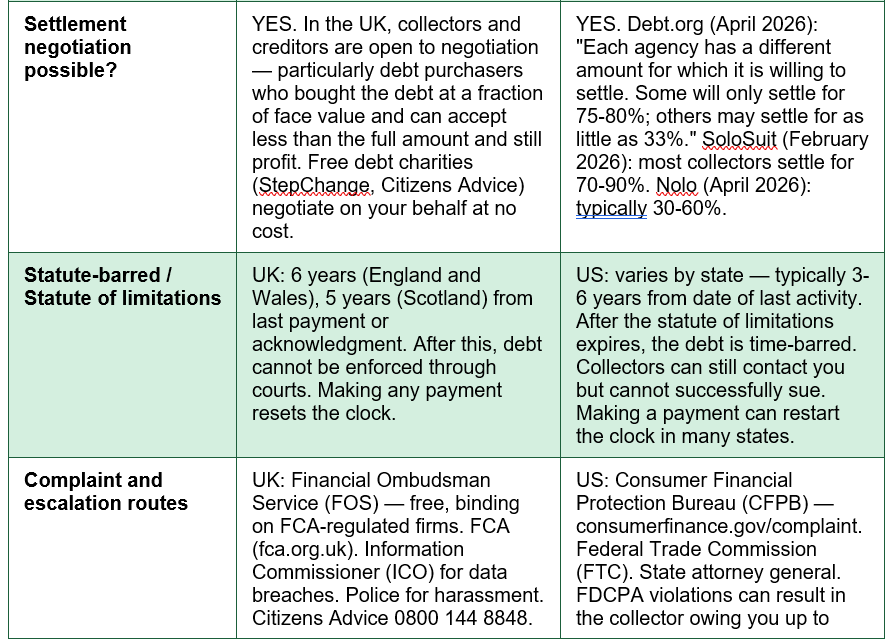
The negotiation principles in this guide apply in both the UK and the US, but the legal frameworks differ in important ways that affect your rights and tactics. Understanding which country's rules apply to you is the foundation of any informed debt negotiation: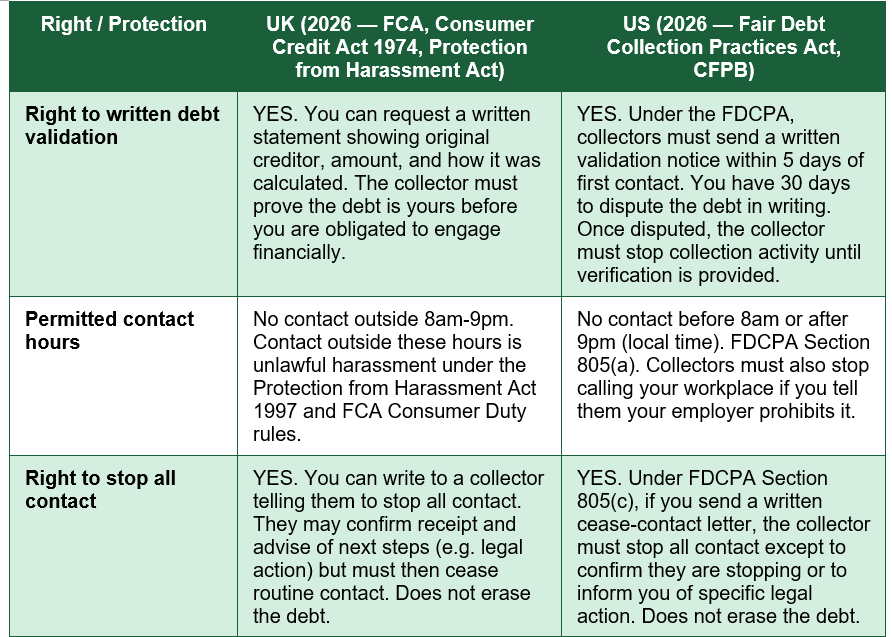

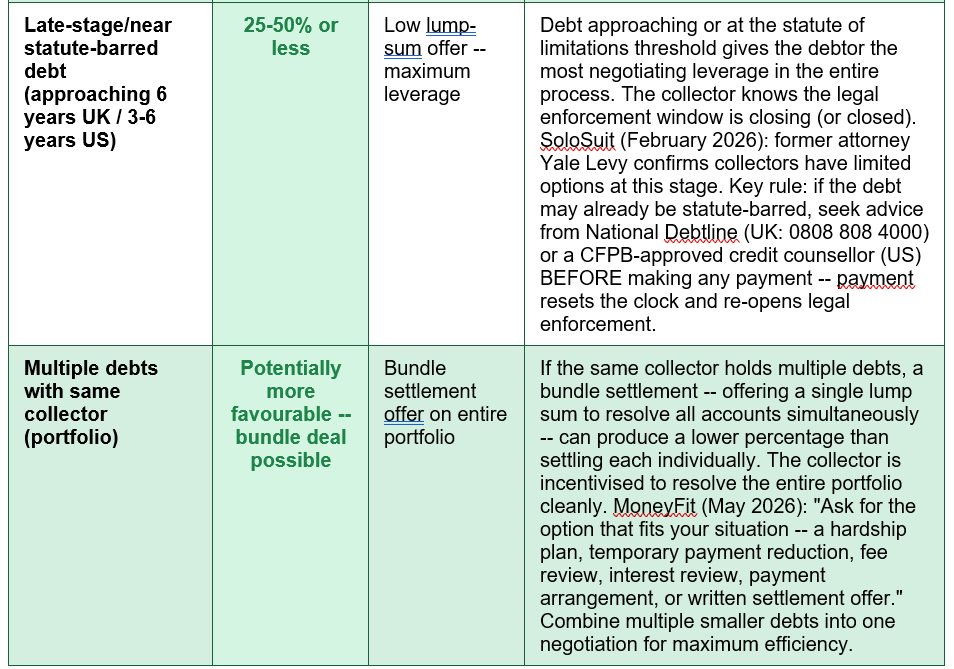
What Settlement Can You Realistically Achieve? The 2026 Range Guide
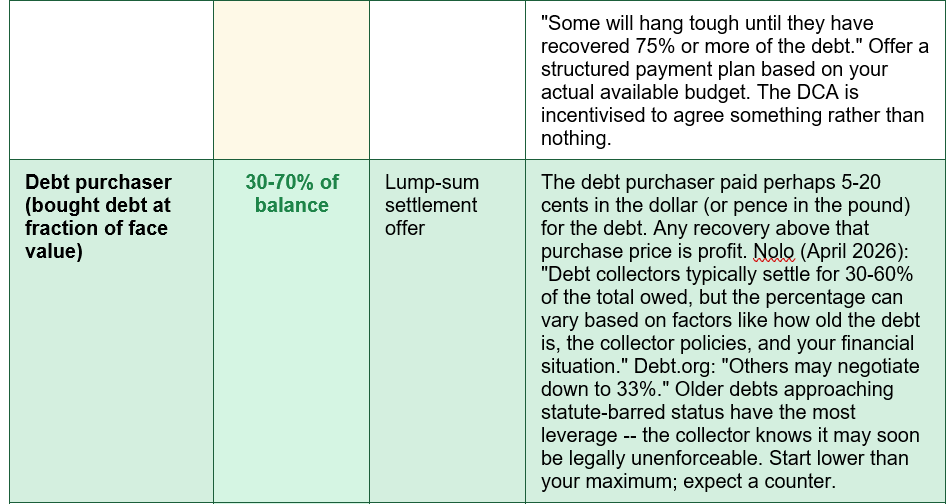
The settlement percentage you can realistically achieve depends on who is collecting the debt and how old it is. The following table maps every major scenario with the realistic settlement range and recommended approach: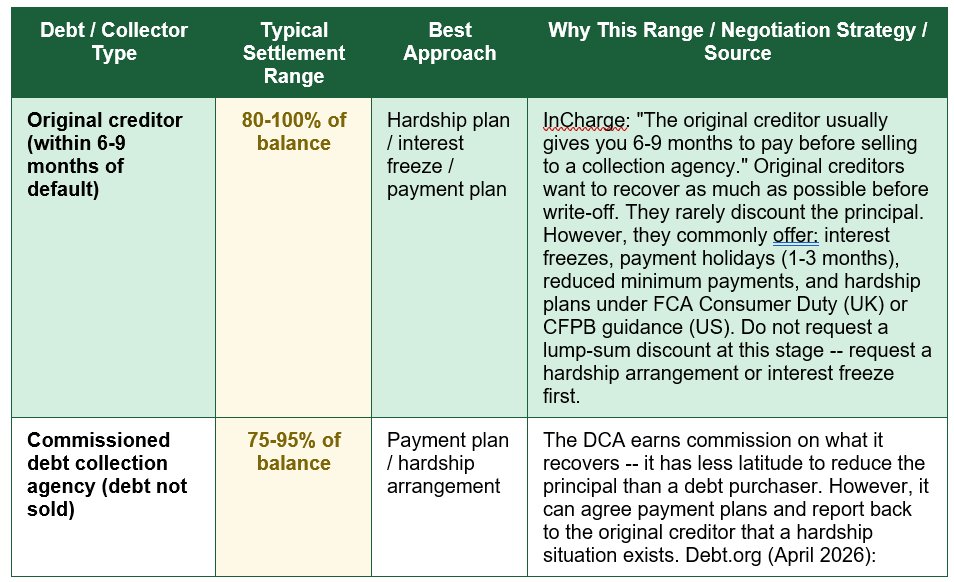
The 7 Tips to Successfully Negotiate With Debt Collectors
TIP 1 Know Exactly Who You Are Dealing With Before You Say Anything
The single most important pre-negotiation step is identifying precisely who has contacted you and what their relationship to the original debt is. MoneyFit (May 2026): 'Determine whether you are speaking with the original creditor, a debt collector, a debt buyer, or a servicing company. Write down the company name, phone number, mailing address, account number, and representative name.' This matters because each party has a different settlement latitude. Original creditors rarely reduce principal. Debt buyers who purchased the debt for 5-20 pence/cents per pound/dollar can accept far less and still profit. The type of collector you are dealing with determines your opening offer, your negotiation ceiling, and your leverage. In the UK: check the company's FCA registration at register.fca.org.uk. In the US: check CFPB complaint records at consumerfinance.gov. If they cannot confirm their company name and FCA/state registration, do not engage further -- they may not be legitimate.TIP 2 Verify the Debt Before You Acknowledge or Pay Anything
Do not make any payment and do not acknowledge any debt until you have received written verification that the debt is accurate, is yours, and has not already been paid. MoneyFit (May 2026): 'If a collector contacts you and you do not recognise the debt, ask for validation information. If you dispute the debt, follow the written dispute process and keep proof of what you sent.' In the US, under FDCPA Section 809, the collector must provide written validation within 5 days of first contact and must stop collection activity if you dispute the debt within 30 days. In the UK, you have the right to request a written statement of account at any time. Southeastclientservicesinc warns: 'Debt collectors can also make mistakes. Some of them even chase expired debts. Others report incorrect balances. Before you pay, confirm the debt is real and accurate.' Always check: Is the amount claimed correct? Is the debt statute-barred? Is the company that contacted you actually the legal owner of the debt? If the debt is not yours or has errors, dispute it in writing immediately and keep copies.TIP 3 Know Your Budget Before Every Conversation -- and Never Exceed It
One of the most consistently cited errors in debt negotiation is agreeing to a payment plan during the initial phone call without knowing what you can actually afford. MoneyFit (May 2026): 'Add up income, essentials, required payments, and irregular expenses. Decide what you can afford without missing rent, food, utilities, medicine, transportation, or childcare.' InCharge quotes financial expert James Allen: 'If the debt is yours, create a budget to determine what you can afford to pay. Not understanding what you can afford to pay is one of the main reasons people fall behind in the first place.' Your budget is your non-negotiable floor. If the collector's minimum demand exceeds what your budget can support, a higher payment plan will simply default -- and defaulting on a payment plan can trigger court action faster than the original debt. Know the maximum you can offer for a lump sum and the maximum monthly payment you can sustain before you pick up the phone or open an email thread. Never disclose your maximum during negotiation -- start lower.TIP 4 Open Low, Stay Calm, and Never Accept the First Counter
The opening offer in any debt settlement should be below your actual maximum to leave room for a counter. JG Wentworth (February 2026): 'Start by offering to pay a percentage of the total debt, such as 50% or 75%, in exchange for the debt being considered paid in full. Be prepared to negotiate with the debt collector, as they may counteroffer with a higher amount.' The gap between your opening offer and your true maximum is your negotiation space. Debt.org (April 2026): 'You may have better luck with a new person on the other end of the line if your proposal is declined -- hang up, wait a few days, and call again.' Southeastclientservicesinc identifies the tactics used against debtors: scare tactics ('we will sue you immediately'), false urgency ('one last chance before legal action'), and emotional manipulation ('they act friendly to gain your trust, others make you feel guilty'). OCJ.org provides the specific phrases for each common scenario: when you cannot afford the proposed amount: 'Right now, I can commit to [monthly payment amount based on your budget] a month. I will contact you if my financial situation changes.' When being pushed for more: 'I appreciate that you are willing to work with me, but I need to consider all of my financial obligations and bills. Right now, I can commit to [monthly payment amount].' Stay calm, polite, and firm throughout. Emotions that run high during the call produce worse outcomes than calm, structured responses.TIP 5 Always Negotiate in Writing and Get Every Agreement in Writing
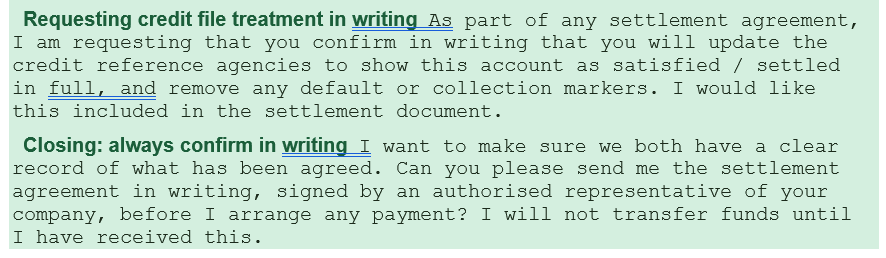
The most dangerous mistake in debt negotiation is agreeing to terms verbally on a phone call and then making a payment before those terms are confirmed in writing. Nolo (April 2026): 'The best approach when negotiating a debt settlement is to stay calm, polite, and to be prepared. Keep records of the communications sent to and from the collector during the negotiations and confirm all terms in a signed agreement before making any payment.' MoneyFit (May 2026): 'Keep notes from every conversation and get the agreement in writing before relying on it.' What must the written agreement contain? The exact amount being settled; confirmation that this amount is accepted as payment in full (UK) or settled in full (US); the payment schedule or date for a lump sum; what the collector will report to credit reference agencies (UK) / credit bureaus (US) -- request removal of negative information if possible; the collector's signature and date. Do not transfer any money until you hold a signed written settlement agreement. Once you have it, make the agreed payment by bank transfer with a clear reference line matching the agreement (creating a record). Keep the agreement and the payment confirmation permanently -- some collectors or subsequent purchasers attempt to collect on a settled debt without a written record.TIP 6 Request Credit Report Treatment as Part of the Settlement
When negotiating a settlement, credit report treatment is a separate negotiation point that many debtors fail to raise. Nolo (April 2026): 'While you negotiate settlement of the amount you owe, you can also ask the collector to agree to report your debt a certain way on your credit reports. Ask the collector to tell the bureaus to remove any negative information about the debt from your credit files. The collector might not agree, or it might have to get the creditor approval, but it does not hurt to ask.' In the UK: request that the debt is marked as 'satisfied' or 'settled' on your credit file, and that any default or collection marker is removed upon settlement. In the US: a pay-for-delete agreement (where the collector agrees to remove the account entirely from credit bureau reports in exchange for payment) is the gold standard -- collectors are not required to agree but many will for a lump-sum settlement. Including credit file treatment in the written settlement agreement means it is contractually enforceable. If they agree to report positively but then do not, you have a written basis for a complaint to the FCA/FOS (UK) or CFPB/FTC (US).TIP 7 Know When Not to Negotiate -- and Use Free Professional Help
Not every debt negotiation should be conducted by the debtor alone. SoloSuit (February 2026): 'You should negotiate with debt collectors because it could help you avoid paying the full debt plus interest, attorney fees, court costs, and post-judgment interest.' But there are specific circumstances where negotiating alone is counterproductive or dangerous: if the debt may be statute-barred (any payment or acknowledgment resets the clock); if you are considering an IVA, DRO, or bankruptcy (UK) or Chapter 7/13 (US) where individual negotiations may prejudice the formal process; if the collector has already filed a court claim; or if the debt amount is large enough that legal advice is worth the cost. In these cases, free professional help is the right first step: UK: StepChange (0800 138 1111) will negotiate with creditors on your behalf at no charge, and often achieves better outcomes than individual negotiation because creditors know DMPs are legally structured and reduce their administrative burden. Citizens Advice (0800 144 8848) and National Debtline (0808 808 4000) can advise on whether individual negotiation, a DMP, or a formal insolvency solution is most appropriate. US: NFCC-affiliated nonprofit credit counsellors (nfcc.org) can conduct debt management negotiations at low or no cost. The CFPB (consumerfinance.gov) has a find-a-counsellor tool.Negotiation Scripts: What to Say in Every Common Situation
OCJ.org and MoneyFit (May 2026) both emphasise practising specific phrases before entering any debt negotiation. The following scripts cover the most common scenarios: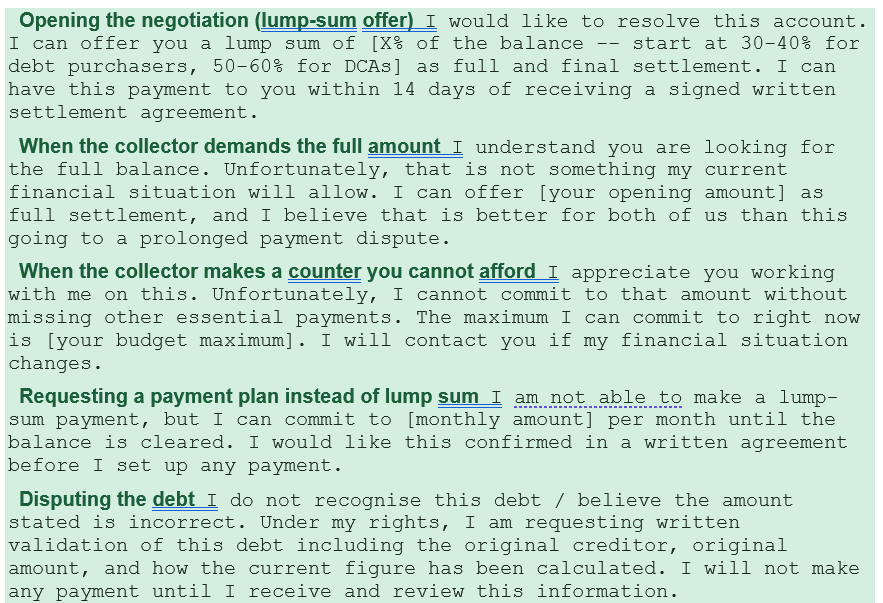
The statute of limitations check -- the most important question before any negotiation: Before engaging in any debt negotiation, always check whether the debt might be statute-barred. In the UK: 6 years from last payment or written acknowledgment (England and Wales); 5 years (Scotland). In the US: varies by state, typically 3-6 years. If the debt is statute-barred, the collector cannot obtain a court judgment. Making any payment -- even a token amount -- or sending a letter acknowledging you owe the debt can restart the limitation clock, making a legally unenforceable debt enforceable again. If you believe the debt may be near or past its limitation period, do NOT contact the collector, do NOT make any payment, and do NOT write acknowledging the debt until you have checked with: UK: National Debtline 0808 808 4000 (statute-barred checker at nationaldebtline.org). US: CFPB at consumerfinance.gov or NFCC-affiliated counsellor. This single check can mean the difference between paying nothing on a legally unenforceable old debt and inadvertently re-opening it.
After the Negotiation: Protecting Yourself Long-Term
Successful negotiation is only the beginning. The steps taken after a settlement agreement protect you from future contact and ensure the settlement delivers the credit file improvement you agreed:- File the written agreement permanently: Keep the signed settlement letter and your payment confirmation (bank transfer receipt showing the reference) in a secure location -- physical and digital copies. Some collectors or subsequent debt purchasers attempt to collect on already-settled debts. Your signed agreement is the legal proof that the obligation has been discharged.
- Check your credit file 30 days after settlement: UK: check Equifax, Experian, and TransUnion (all free). US: annualcreditreport.com (free weekly checks). If the agreed credit file update has not been made within 30-45 days, write to the collector citing the specific terms of your settlement agreement and request immediate update. If they do not comply, escalate to the FOS (UK) or CFPB/FTC (US).
- Watch for re-selling of settled debts: Some settled debts are improperly re-sold to new collectors who then attempt to collect on what is already discharged. If you receive contact about a debt you have settled, do not panic and do not make any payment. Send a letter stating the debt was settled on [date] by [collector name] under settlement agreement reference [your agreement details], and attach a copy of the agreement. If contact continues, it is harassment.
- Consider free professional advice before your next steps: If you have multiple debts, a settled debt is one step in a broader plan. StepChange (UK: 0800 138 1111), Citizens Advice (UK: 0800 144 8848), and NFCC counsellors (US: 1-800-388-2227) can advise on managing remaining debts, rebuilding credit, and creating the financial habits that prevent recurrence.
COMPLETE NEGOTIATION CHECKLIST -- BEFORE, DURING, AND AFTER: BEFORE: (1) Identify the collector type (original creditor, DCA, debt purchaser) -- this sets your opening offer. (2) Check whether the debt might be statute-barred -- before any contact or payment. (3) Pull your credit report to verify the debt details. (4) Build your budget: determine the lump sum you can offer and the maximum monthly payment you can sustain. (5) Decide your opening offer (lower than your maximum) and your walk-away point. DURING: (6) Ask for written validation before acknowledging anything. (7) Do not disclose your maximum offer first. (8) Remain calm and use the scripts above. (9) Include credit file treatment in the negotiation. (10) Never agree to terms verbally without a follow-up written agreement. AFTER: (11) Get everything signed in writing before any payment. (12) Pay by bank transfer with clear reference. (13) Check your credit file 30-45 days later. (14) File all documents permanently. (15) Contact free debt advice if you have remaining debts to resolve.
FOUR DEBT COLLECTOR TACTICS TO RECOGNISE AND COUNTER IN 2026: (1) FALSE URGENCY: 'This is your last chance to avoid a lawsuit / arrest / bailiffs.' Southeastclientservicesinc: 'False urgency -- they may say you have one last chance to pay before legal action.' Consumer debt cannot lead to arrest in the UK or US. Court action takes months to escalate. Take time; do not make rushed decisions. (2) SCARE TACTICS ABOUT IMMEDIATE LEGAL ACTION: 'We are filing with the courts tomorrow.' Nolo (April 2026): 'Debt is a civil matter, not a criminal one.' Collectors must follow Pre-Action Protocols (UK) or FDCPA procedures (US) before any court action -- this takes weeks or months, not hours. (3) VERBAL AGREEMENTS WITHOUT WRITTEN CONFIRMATION: 'Just make a payment today and we will sort out the paperwork.' Nolo: 'Confirm all terms in a signed agreement before making any payment.' Any payment made without a written settlement agreement is just a payment -- it does not establish what was agreed or stop further collection activity. (4) CLAIMING TO HAVE POWERS THEY DO NOT HAVE: 'We will be sending officers to your property.' In the UK, only certificated enforcement agents with court-authorised writs can attend for goods. In the US, collectors cannot threaten arrest or property seizure for unsecured consumer debts. Report any such claims to the FOS (UK) or CFPB (US).
Conclusion
Negotiating with a debt collector is a skill -- and like all skills, it improves dramatically with preparation. The seven tips in this guide address every stage: knowing who you are dealing with and their settlement latitude; verifying the debt before engaging; knowing your budget ceiling before the first conversation; opening below your maximum and staying calm under pressure; conducting negotiation in writing and getting every agreement signed before payment; negotiating credit file treatment as part of the settlement; and knowing when to use free professional help instead of negotiating alone.The data from 2026 confirms what experienced debt advisers and former collection attorneys consistently report: collectors settle for 30-60% of outstanding balances on average, some as low as 25-33% for old debts or debt purchasers, and the vast majority would rather negotiate a settlement than pursue months of legal action on a debt where the outcome is uncertain and the cost is real. The debtor who enters a negotiation informed, calm, and with a clear written strategy consistently achieves better outcomes than one who panics, avoids contact, or makes hasty verbal agreements under phone pressure.
Whether you are in the UK or the US, the foundational rules are the same: verify the debt, know your budget, start lower than your maximum, always get it in writing, and never pay before you have a signed agreement. If the situation is complex -- statute-barred debt, multiple creditors, formal insolvency being considered, or a court claim already filed -- free professional help from StepChange (UK: 0800 138 1111), Citizens Advice (UK: 0800 144 8848), National Debtline (UK: 0808 808 4000), or NFCC-affiliated counsellors (US: 1-800-388-2227) is always the right first call.
0 Comments
Be the first to share your thoughts on this article.