

Credits
What is Low Income Grants: The Complete Guide?


Table of Contents
- The Biggest Change of 2026: From Household Support Fund to Crisis and Resilience Fund
- Every Major UK Low Income Grant in 2026: Quick Reference
- Grants by Nation: England, Scotland, Wales, and Northern Ireland
- How to Apply for a Crisis and Resilience Fund Payment
- Who Can Apply
- What Crisis Payments Can Be Used For
- How to Find and Apply
- DWP Interest-Free Loans: Budgeting Loans and Budgeting Advances
- Budgeting Loans (Legacy Benefits)
- Budgeting Advances (Universal Credit)
- Energy Hardship Grants: Help With Fuel Costs and Bills
- Warm Home Discount
- Energy Supplier Hardship Funds
- ECO4 and Warm Homes Local Grant (Energy Efficiency)
- Charity Grants: The £200–£500 Payments Most People Never Know to Look For
- Your Action Plan: How to Find Every Grant You Are Entitled To
- Conclusion
- Frequently Asked Questions (FAQ)
- External References & Further Reading
April 2026 brought the most significant restructuring of UK crisis grant provision since the cost-of-living emergency began. The Household Support Fund — which had provided emergency help to vulnerable households through local councils since 2021 — ended on 31 March 2026 after distributing billions of pounds in support. In its place, the government launched the Crisis and Resilience Fund on 1 April 2026: a three-year scheme running to March 2029 that channels approximately £842 million per year to English local authorities, with separate parallel schemes continuing in Scotland, Wales, and Northern Ireland.
The most important change for people who need help right now: the new Crisis and Resilience Fund's Crisis Payment strand does not require you to be receiving benefits to apply. Any household on a low income experiencing a sudden financial shock — redundancy, a health emergency, an unexpected essential expense, a vehicle breakdown — can apply regardless of whether they are claiming Universal Credit, Housing Benefit, or any other benefit. This represents a wider net than some previous schemes, and it is a key fact that many eligible households will not know unless they are told.
This guide covers every major grant and financial support scheme available to low-income households in the UK in 2026 — what has changed, what is new, what requires benefits and what does not, what is repayable (not all of it is a grant), and the specific steps and resources to find what is available in your postcode. Whether you are facing an immediate crisis, struggling with energy costs, need help with housing, or are looking for longer-term support through charity grants, this is the complete 2026 reference.
The Biggest Change of 2026: From Household Support Fund to Crisis and Resilience Fund
The Household Support Fund (HSF) was introduced in October 2021 as a short-term emergency response to pandemic-era financial hardship and the rising cost of living. It was extended repeatedly — seven times in total — and in its final year (April 2025 to March 2026) distributed through local councils to cover food, energy, clothing, housing costs, and other essentials. Birmingham City Council alone had distributed over £6 million to approximately 30,000 households through its HSF programme by the time the scheme ended.The Crisis and Resilience Fund (CRF) that replaced it from 1 April 2026 is a fundamentally different design. Rather than a time-limited emergency extension, the CRF is a three-year consolidated grant to local authorities that replaces three separate previous mechanisms: the Household Support Fund, Discretionary Housing Payments (DHPs), and Local Welfare Assistance (LWA) schemes. The GOV.UK guidance for the CRF, published on 7 April 2026, confirms it is structured around three distinct strands:
- Crisis Payments: One-off emergency grants for households experiencing a sudden financial shock — redundancy, health emergency, flooding, fire, or other acute events. No benefits requirement. Available to any resident in genuine financial crisis.
- Housing Payments: Formerly called Discretionary Housing Payments — help for people who receive Housing Benefit or Universal Credit housing element but still face a shortfall in their housing costs. This strand does require you to be receiving a qualifying housing benefit.
- Resilience Services: Longer-term support to help households build financial resilience — access to debt advice, budgeting support, energy advice, income maximisation, and referrals to other services. Not a cash payment but support that helps prevent the next crisis.
The new CRF is designed to last: £842 million/year to English councils, running April 2026 to March 2029 — the three-year structure of the Crisis and Resilience Fund is specifically intended to give councils and residents more stability and predictability than the repeated short-term extensions of the Household Support Fund — Manchester City Council confirmed the scheme is 'expected to run for at least three years, with up to £1 billion per year across England, subject to future funding decisions' (Manchester City Council / GOV.UK CRF Guidance, April 2026).
Every Major UK Low Income Grant in 2026: Quick Reference
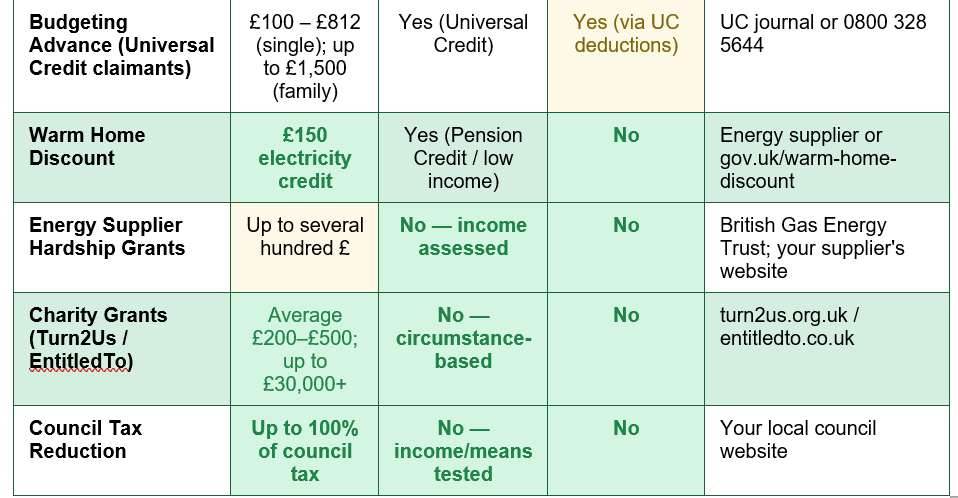
The table below provides a quick reference to every major grant and financial assistance scheme available to low-income households in the UK in 2026, including whether benefits are required, whether the money must be repaid, and where to apply: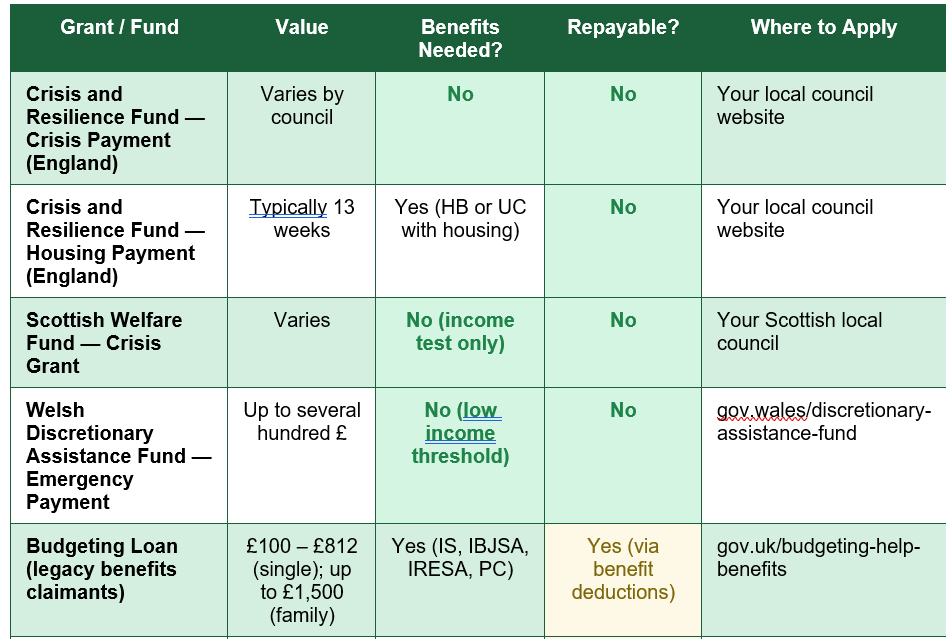
Grants by Nation: England, Scotland, Wales, and Northern Ireland
The UK's grants landscape is devolved — different schemes operate in each nation, and the 2026 changes in England do not affect Scotland, Wales, or Northern Ireland in the same way. The table below clarifies what is available in each nation and where to apply: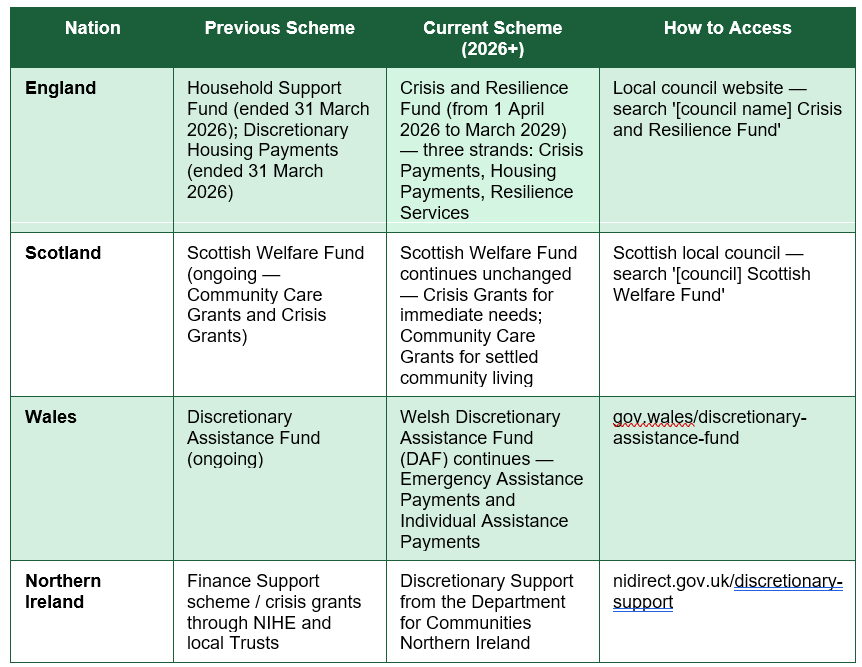
The postcode-lottery reality: Even within England, eligibility criteria, award amounts, and the availability of funds vary significantly between councils. One council may award up to £500 for an energy crisis; a neighbouring council may have exhausted their allocation for the quarter. This variation is inherent to locally-administered grant schemes. If your council's allocation is temporarily paused or exhausted, check whether your council has a Local Welfare Assistance Scheme in addition to the CRF, and use the Turn2Us grant search or Citizens Advice to identify parallel charity-funded routes while you wait.
How to Apply for a Crisis and Resilience Fund Payment
The Crisis and Resilience Fund Crisis Payment is the primary emergency grant available to English households from April 2026. Here is how the application process works in practice:Who Can Apply
You do not need to be receiving benefits to apply for a Crisis Payment under the CRF. The GOV.UK guidance (published 7 April 2026) confirms: 'You do not have to get benefits to be eligible for Crisis Payments.' The eligibility test is based on financial need — whether you are on a low income and have experienced a genuine financial crisis — rather than benefit status. You must be aged 18 or over in most councils (some schemes extend to 16-17 year olds), resident in the local authority area, and experiencing a specific financial shock rather than ongoing low income as a general condition.What Crisis Payments Can Be Used For
- Managing a sudden, unexpected expense or drop in income — redundancy, health emergency, flooding, fire, vehicle breakdown essential for work.
- Preventing crisis — not having food, shelter, heating, or essential household items.
- Essential white goods (fridge, washing machine) when they have failed and cannot be replaced from income.
- Emergency clothing for children or vulnerable adults.
- Urgent travel to medical appointments or to collect essential medication.
How to Find and Apply
- Find your local council: Use gov.uk/find-local-council, entering your postcode. This takes you to your council's website.
- Search for the Crisis and Resilience Fund or Crisis Payment: Use your council's website search bar with 'Crisis and Resilience Fund', 'Crisis Payment', or 'emergency grant'. Most councils launched their schemes from 1 April 2026 — if yours has not published information yet, call their benefits team.
- Complete the application: Most councils offer an online application form, though some use telephone or in-person applications for those without digital access. You will typically need to provide proof of address, evidence of income or benefit status, and a brief explanation of the financial crisis you have experienced.
- Payments are typically cash-first: The GOV.UK CRF guidance prioritises cash payments — direct bank transfers — over vouchers, to give recipients the dignity of choice. Some councils also offer Post Office cash-out vouchers or supermarket vouchers depending on local preference.
DWP Interest-Free Loans: Budgeting Loans and Budgeting Advances
Two DWP schemes provide interest-free loans (not grants) to benefit claimants who need help with one-off essential costs. While these must be repaid, the repayment is through small deductions from future benefit payments and carries no interest — making them considerably better value than payday loans or credit cards.Budgeting Loans (Legacy Benefits)
Budgeting Loans are available to people who have been receiving Income Support, income-based Jobseeker's Allowance, income-related Employment and Support Allowance, or Pension Credit for at least 26 weeks. The minimum loan is £100. The maximum is £812 for single people and up to £1,500 for couples or families, depending on circumstances. The loan is repaid over a maximum of 104 weeks (two years) through deductions from your benefit. You can apply online at gov.uk, by phone on 0800 169 0140, or at your Jobcentre.Budgeting Advances (Universal Credit)
Budgeting Advances serve the same function for Universal Credit claimants. You must have been on UC for at least one month (unless you are taking on new employment) and must have earned less than £2,600 in the previous six months (£3,600 for couples). The loan amounts and repayment periods are the same as Budgeting Loans. Apply through your UC online journal or by calling the UC helpline on 0800 328 5644.Both loans can be used for: furniture, clothing, or footwear; rent in advance or removal costs; maternity or funeral expenses; travel to start work or for job interviews; HP payments to stop repossession of household goods; improving, maintaining, or securing the home; or getting help for people on Universal Credit to start or advance their work.
Energy Hardship Grants: Help With Fuel Costs and Bills
Energy costs remain one of the biggest pressures on low-income households in 2026, with the price cap at £1,663/year (new TDCV basis) from July 2026. Several overlapping schemes provide targeted help:Warm Home Discount
The Warm Home Discount provides £150 off your electricity bill each winter. For those who receive the Guarantee Credit element of Pension Credit, the discount is applied automatically by HMRC. For other low-income households, eligibility is assessed via the 'broader group' criteria — contact your energy supplier between October and March each year, or check at gov.uk/the-warm-home-discount-scheme.Energy Supplier Hardship Funds
Most major UK energy suppliers operate discretionary hardship funds for customers in serious financial difficulty. British Gas, EDF, Octopus, OVO, and most others offer assistance — and the British Gas Energy Trust is specifically open to all households experiencing fuel poverty, not only British Gas customers. Swift Money's April 2026 guide to emergency grants in the UK confirms a maximum grant of several hundred pounds from energy supplier hardship schemes, with no repayment required. Contact your supplier's vulnerability or hardship team directly, or apply through the British Gas Energy Trust at britishgasenergytrust.org.uk.ECO4 and Warm Homes Local Grant (Energy Efficiency)
For longer-term energy cost reduction, the Warm Homes Local Grant (from your local council) can fund insulation, heat pump installation, and other energy efficiency measures for low-income homeowners and private renters up to £30,000. ECO4 has transitioned to a remediation-only phase closing in December 2026. These are free, non-repayable improvements — see our separate UK Housing and Energy Government Grants guide for full details.Charity Grants: The £200–£500 Payments Most People Never Know to Look For
More than 1,300 charitable funds are searchable through Turn2Us's grant search service at turn2us.org.uk — and the average grant is £200 to £500, with some specialist funds offering significantly more. Swift Money's 2026 guide confirmed grants are available up to £30,000+ from some charitable foundations for people in specific qualifying circumstances (disability, specific profession, region, religion, age group, or life event).These grants do not have to be repaid. They are not loans. They do not count as income for most benefit purposes. And they are dramatically under-claimed: the Turn2Us system exists specifically because most people in need of financial help are unaware of the charitable funds that exist for their specific circumstances — a former nurse who is now elderly and in difficulty, for example, may qualify from nursing charities they have never heard of; a person who grew up in a specific county may qualify from a local benevolent fund even if they have since moved away.
The process for claiming charity grants is simpler than most people expect. Turn2Us's grant search asks you to enter your postcode, household circumstances, age, employment status, and any specific characteristics (disability, armed forces connection, profession, etc.) and returns a list of all funds you may be eligible for. Many funds accept direct online applications; others require a letter or referral from a social worker or advice agency.
The Family Fund: For families caring for a severely disabled or seriously ill child under 18, the Family Fund (familyfund.org.uk) provides government-backed grants for essential items — washing machines, dryers, computers for education, sensory equipment, bedding, and family breaks. In 2024-25 it supported over 90,000 families across the UK. You do not need to be receiving benefits, but household income and the level of the child's needs are assessed. This is one of the highest-value, most underutilised grants for eligible families.
Your Action Plan: How to Find Every Grant You Are Entitled To
If you are on a low income or facing a financial crisis, the following approach is the most efficient way to find every source of support available in 2026:- Run a free benefits check first: Use Turn2Us (turn2us.org.uk/benefits-calculator) or entitledto (entitledto.co.uk) to check whether you are claiming every benefit you are entitled to. Many households receive less than their full entitlement — missing, for example, Pension Credit (which unlocks a cascade of other benefits), Council Tax Reduction, or Carer's Allowance.
- Apply for a Crisis Payment from your local council (England): If you are in England, search '[your council name] Crisis and Resilience Fund' and apply for a Crisis Payment. You do not need to be on benefits.
- Search the Turn2Us charity grant database: Go to turn2us.org.uk, use the grant search, and apply for every fund you qualify for. Grants can be stacked — receiving one charity grant does not prevent you from applying for others.
- Contact your energy supplier's hardship team: Call your energy supplier and ask specifically about their 'hardship fund' or 'vulnerability team.' If you are struggling with energy bills, the British Gas Energy Trust is open to everyone regardless of supplier.
- If you are on UC, request a Budgeting Advance: Apply through your UC journal for an interest-free advance of up to £1,500 for family households. This is not a grant — it is repaid — but it is zero-interest and prevents the need for high-cost credit.
- Contact Citizens Advice for a full support review: Citizens Advice (0808 223 1133, free) provides free, confidential advice on all benefits, grants, and debt options. Their advisers can identify support you may have missed and help you apply. This step is particularly valuable for complex situations.
Conclusion
The UK grants landscape changed significantly on 1 April 2026 when the Crisis and Resilience Fund replaced the Household Support Fund and Discretionary Housing Payments across England. The new fund is better designed for longevity — it runs for three years, not six months at a time — and its Crisis Payment strand removes the benefit requirement that excluded some of the lowest-income working households from previous schemes. For any household in England experiencing a genuine financial emergency, the local council's Crisis Payment is the first port of call.Beyond the CRF, the grants landscape is broader than most people know. Energy supplier hardship funds, the Warm Home Discount, Budgeting Loans and Advances, the Turn2Us charity grant search, Council Tax Reduction, and specialist funds for specific groups (disabled children, pensioners, former service personnel, specific professions) collectively represent a much larger pool of available support than any single scheme. The most consistently underused route is the charity grant search — over 1,300 charitable funds are available in the UK, most of them known only to benefit advisers and the organisations themselves, and most of them providing genuinely non-repayable grants rather than loans.
The most important action anyone in financial difficulty can take is to seek advice before their situation deteriorates. Citizens Advice is free, confidential, and available across the UK. Turn2Us and entitledto are free online tools that can identify support in minutes. And the new Crisis and Resilience Fund — available through your local council from April 2026 — is there for exactly the situations this guide describes: a sudden drop in income, an unexpected essential expense, a crisis that no one planned for. You do not need to be on benefits to apply. You just need to ask.
Frequently Asked Questions (FAQ)
What replaced the Household Support Fund in 2026?
The Household Support Fund ended on 31 March 2026. It was replaced from 1 April 2026 by the Crisis and Resilience Fund (CRF), a new three-year scheme running to March 2029. The CRF is delivered by local councils in England and has three strands: Crisis Payments (for households experiencing sudden financial shocks — no benefit requirement), Housing Payments (replacing Discretionary Housing Payments for housing cost shortfalls), and Resilience Services (support to build financial resilience and prevent future crises). The devolved schemes — Scottish Welfare Fund and Welsh Discretionary Assistance Fund — continue unchanged under their own governance.Do I need to be on benefits to get a grant from my local council?
No — for Crisis Payments under the Crisis and Resilience Fund, you do not need to be receiving benefits. The GOV.UK guidance published on 7 April 2026 explicitly confirms this. Any resident on a low income who has experienced a sudden financial crisis can apply regardless of benefit status. Housing Payments (also part of the CRF) do require you to be on Housing Benefit or Universal Credit with a housing element. Council Tax Reduction is a separate means-tested scheme. Some councils' additional Local Welfare Assistance Schemes may have their own eligibility criteria. Check your specific council's website for the exact requirements in your area.How much can I get from a Crisis Payment?
The amount varies by council. The CRF gives each council discretion to set award levels based on local needs and budget. Birmingham City Council's scheme awarded up to £200 per household. Other councils may award more or less, and some provide goods directly (white goods, clothing vouchers) rather than cash. The GOV.UK guidance encourages a 'cash-first' approach — direct bank transfers — to give recipients flexibility. You can typically only receive one Crisis Payment per year, though some councils allow additional applications if circumstances change significantly.What is the Turn2Us grant search and how do I use it?
Turn2Us is a UK charity that operates a free online grant search database at turn2us.org.uk. The search tool allows you to enter your postcode, household circumstances, income, employment status, and personal characteristics (disability, age, profession, armed forces connection, etc.) and returns a list of charitable funds you may be eligible for. Over 1,300 charitable funds are included in the database, and the average grant is £200 to £500, with some funds offering significantly more. Grants from charities do not have to be repaid, do not count as income for most benefit purposes, and do not affect existing benefit claims. Many people receive multiple charity grants simultaneously.Are there grants specifically for energy bills and fuel poverty?
Yes. The Warm Home Discount provides £150 off electricity bills for eligible low-income households each winter — automatic for Pension Credit recipients, and available to other low-income households by application to their energy supplier. Most major energy suppliers (British Gas, EDF, Octopus, OVO, and others) also operate discretionary hardship funds. The British Gas Energy Trust is open to any household struggling with energy costs, not just British Gas customers, and provides non-repayable grants. For longer-term energy cost reduction, the Warm Homes Local Grant from your council can fund free insulation and heat pump installation for eligible low-income homeowners and private renters.External References
The following authoritative sources were used in researching this article and are recommended for further reading:1. GOV.UK — Crisis and Resilience Fund: Guidance for Local Authorities (1 April 2026 to 31 March 2029)
https://www.gov.uk/government/publications/crisis-and-resilience-fund-guidance-for-local-authorities-in-england-1-april-2026-to-31-march-2029
2. GOV.UK — Find Your Local Council (to locate your CRF or Crisis Payment scheme)
https://www.gov.uk/find-local-council
3. Turn2Us — Free Benefits Calculator and Grant Search
https://www.turn2us.org.uk/
4. Independent Age — Extra Help with Essential Costs if You're on a Low Income (April 2026 factsheet)
https://www.independentage.org/sites/default/files/2026-04/Factsheet-Extra-help-with-essential-costs-2026_0.pdf
5. Scope UK — Crisis and Resilience Fund: Housing and Crisis Payments Explained
https://www.scope.org.uk/advice-and-support/discretionary-housing-payment
6. Swift Money — Emergency Grants and Crisis Support UK 2026 Guide (April 2026)
https://swiftmoney.com/guides/emergency-grants-crisis-support.php
7. Family Fund — Grants for Families with Disabled or Seriously Ill Children
https://www.familyfund.org.uk/
8. Citizens Advice — Benefits and Financial Help (free helpline: 0808 223 1133)
https://www.citizensadvice.org.uk/benefits/
0 Comments
Be the first to share your thoughts on this article.