

Hustle
Affiliate Marketing Reality: How Long Till Your First $1,000

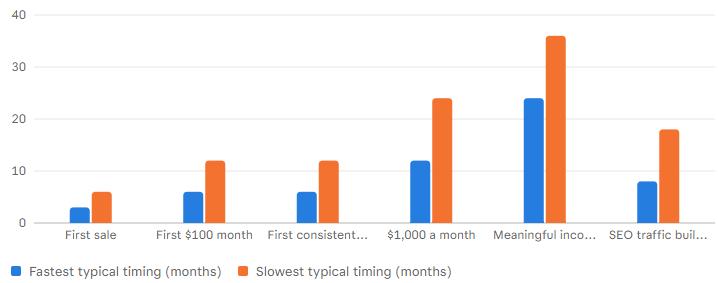
First sale usually in months 3–6; first $100 in 6–12 months; first consistent commissions in 6–12 months; $1,000 a month in 12–24 months for most (6–12 for SEO-focused sites); SEO traffic takes 8–18 months; some advise planning 2–3 years. Earnings and rates: about 41% of affiliates earn under $1,000 a month (one source says 70%–80% under $500); the $8,038 monthly average is skewed; global average commission 9.2%; Amazon pays 0%–10% by category with a 24-hour cookie and payment about 60 days after month end; average conversion 0.5%–2.1% (sources conflict). My model: at 2% link click-through and 2.5% conversion, a $30 commission earns about $0.015 per visitor and a $100 commission $0.05; a hypothetical traffic ramp reaches cumulative $1,000 in about month 16 (with $30) or month 11 (with $100) and $1,000 in a single month in about month 28 or 17; $1,000 earned over about 780 hours is about $1.28 an hour; after self-employment tax, $1,000 nets about $859.
This guide uses 2026 data and a transparent model to show how long it typically takes and what drives the timeline. The sources are mostly secondary and often conflict, so I show ranges, and where I do my own math I say so and use assumptions you can change. I will not promise a number; I will show you how to work out whether the math can work for you before you spend your evenings on it.
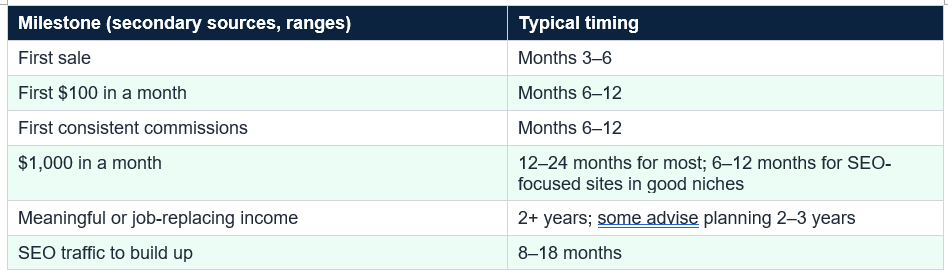
Beginners fare worse than the averages. Sources say those with up to a year of experience typically earn $0 to $1,000 a month, most make a first sale between months 3 and 6 with $50 to $200 in that month, and revenue stops feeling random somewhere between months 6 and 12. One site says SEO-focused affiliates targeting long-tail buyer keywords reach $1,000 a month in 6 to 12 months, while the same page says 12 to 24 months is typical and new affiliates should plan on two to three years, and OptinMonster says SEO traffic takes 8 to 18 months to build.
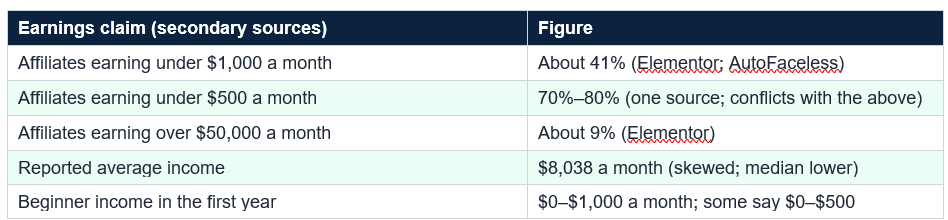
About 41% of affiliates earn under $1,000 a month (one source says 70%–80% earn under $500). Beginners usually make a first sale in months 3–6 and reach $1,000 a month in 12–24 months, faster (6–12) for SEO-focused sites in good niches. The $8,038 average is skewed by top earners.
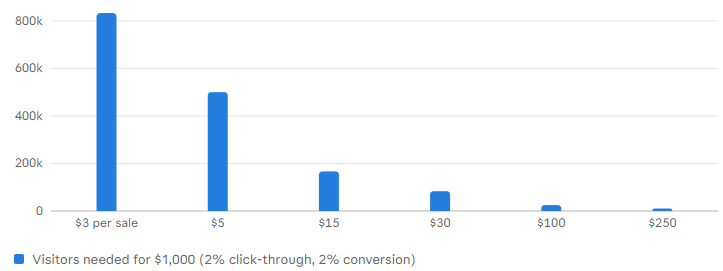
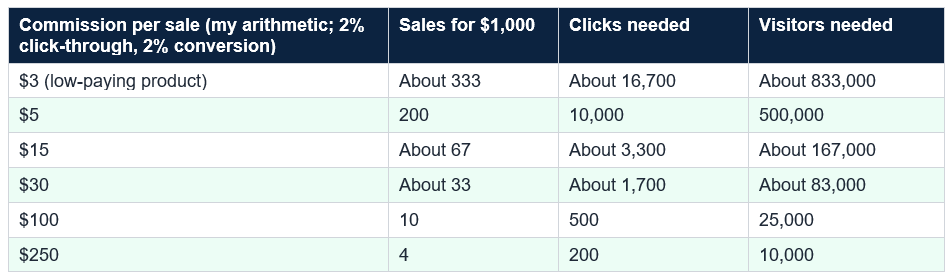
To see what that means in traffic, I assume a 2% click-through rate on affiliate links and a 2% conversion rate, within the 0.5% to 2.1% range of sources. At $5 a sale you need 200 sales, 10,000 clicks and about 500,000 visitors; at $30, about 33 sales and 83,000 visitors; at $100, 10 sales and 25,000 visitors; at $250, 4 sales and about 10,000 visitors. The higher the commission, the fewer visitors you need, which is why niche and program choice often matter more than effort.
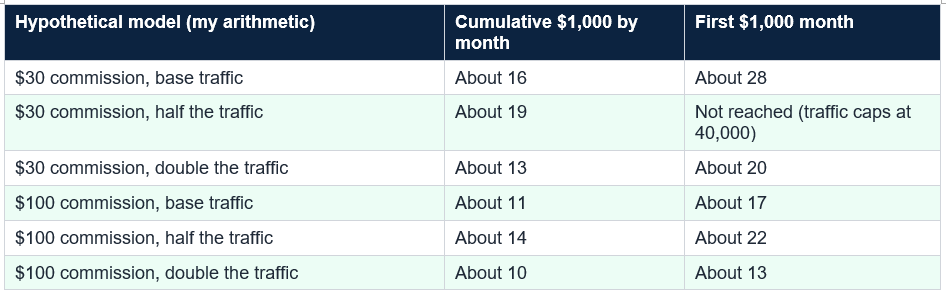
With a $100 commission, the same traffic earns about $400 in month 12 and $1,250 in month 18, reaching a cumulative $1,000 around month 11 and a $1,000 month around month 17. Halve the traffic and the $30 site reaches a cumulative $1,000 at about month 19 but never a $1,000 month, because its traffic caps at 40,000 visitors; the $100 site takes about 14 months to the cumulative figure and 22 to a $1,000 month. Double the traffic and the cumulative $1,000 arrives at month 13 or 10. The model is deliberately simple, and real sites vary enormously.
This is a model, not a forecast. It assumes steady traffic growth, a 2% click-through and a 2.5% conversion. Many sites never reach 25,000 visitors a month, and some niches convert far worse.
Amazon reportedly cut rates in some categories by as much as 50% during 2026, according to a secondary source citing eMarketer, which I could not verify. Competition is heavy: Amazon Associates alone has more than 900,000 affiliates, and many niches are crowded with sites that have years of authority. None of this makes success impossible, but it explains why most beginners earn little in year one and why many quit before the compounding begins.
Be wary of shortcuts. Paid traffic can lose money if conversion is low: at 2% click-through, 2.5% conversion and a $30 commission each visitor is worth about $0.015, so paying more than a cent or two per visitor loses money in my model. Fake reviews, undisclosed links and spammy tactics risk bans and legal trouble. The fastest honest route is a narrow niche you know, content aimed at people about to buy and patience measured in months, not weeks.
Rules matter too. In the US, the FTC expects you to disclose affiliate relationships clearly, and programs have their own terms: Amazon, for example, has a $10 payment minimum for direct deposit and policies on how links can be used. Read each program’s terms and keep records of income and expenses, since mistakes can cost you your account. A professional can help if your income grows.
That is the optimistic branch. Many sites never reach it, and income can drop if rankings change or a program cuts rates. Think of it as a long-odds, compounding project, like starting a small business, and decide how many hours and dollars you can afford to risk. Keep an emergency fund, since Bankrate found only 46% of Americans could cover three months of expenses, and do not depend on affiliate income for essentials in the first two years.
Be careful with anyone selling the dream. Income screenshots and “make $10,000 a month” claims usually reflect the best case, and the seller often earns more from the course than from affiliate marketing. Averages like $8,038 a month are misleading, promises of “passive income” overlook the work and the delay, and the statistics sites that cite averages often sell tools or courses themselves. Be skeptical of expensive coaching, guaranteed results and pressure to buy now.
Before you start, write down the commission per sale, the number of sales you need for $1,000 and how many visitors that requires at 2% click-through and 2% conversion. If the visitor number is far beyond what your niche can deliver, pick a higher-commission product or a different niche. Common mistakes include choosing a low-commission program and a crowded niche, writing for everyone instead of buyers, quitting before the second year, expecting passive income, ignoring disclosure rules, buying expensive courses before earning anything and spreading effort across too many sites. In the first year, judge progress by traffic, clicks and email subscribers, which lead income.
The deciding factors are commission per sale, traffic and conversion, and the first is the one you control most. Do the math before you start, choose a niche and program where the numbers can work, be patient with a one-to-two-year timeline and treat the income as a bonus, not essential. Disclose your links, set aside tax and keep an emergency fund. Many people earn little and some earn a lot, and the arithmetic tells you which side of the odds you are leaning toward.
It depends on whether you mean $1,000 in total or $1,000 in a month. Sources suggest most beginners make a first sale in months 3 to 6, a first $100 in 6 to 12 months and $1,000 a month in 12 to 24 months, faster (6 to 12 months) for SEO-focused sites in profitable niches. Many take longer, and about 41% of affiliates earn under $1,000 a month. These figures come from secondary sources and vary.
How much do affiliate marketers really make?
The widely quoted average of $8,038 a month is misleading because a few high earners pull it up, and the median is far lower. Reports say about 41% of affiliates earn under $1,000 a month and one source says 70% to 80% earn under $500, while about 9% earn over $50,000 a month. Beginners in their first year typically earn $0 to $1,000 a month. Treat all of these as rough.
Is Amazon Associates a good way to start?
It is easy to join and sells almost everything, but the pay is low: standard rates run from 0% to 10% by category, with 4.5% on books, kitchen and automotive, 3% on toys and furniture, 1% on grocery and health and 4% for other categories, according to a recent summary of Amazon’s schedule. Its cookie lasts 24 hours, and commissions arrive about 60 days after the end of the month. Higher-commission programs can reach $1,000 faster.
Do I need a website or audience to start?
You need some way to reach buyers: a website with search traffic, a YouTube channel, a newsletter or an existing audience. Search-based sites are slow to build, with one source putting SEO traffic at 8 to 18 months, while an existing audience can convert faster. Whatever the channel, trust and relevance matter more than volume.
Are affiliate earnings taxable?
Yes. Affiliate commissions are generally self-employment income, subject to income tax plus self-employment tax of 15.3% on 92.35% of net profit, about 14.1% effective, which is general knowledge I did not retrieve from the sources above. On $1,000 of net profit that is about $141, leaving about $859 before income tax. You must also disclose affiliate relationships to your audience. This is general education, not personal advice.
Table of Contents
- The Question Behind the Question
- The Short Answer
- What the Data Says
- The Math of $1,000
- A Traffic Model: Months to $1,000
- Why It Takes So Long
- How to Speed Up (Without Cheating)
- Costs, Taxes and Rules
- The Hourly Reality
- Red Flags to Avoid
- A Realistic 12-Month Plan
- Common Mistakes
- Conclusion
- Frequently Asked Questions
How long it typically takes: affiliate marketing milestones (months)
Months by Ranges from Elementor, PostAffiliatePro, OptinMonster and BizToolkit (secondary sources that sometimes conflict); 2+ years converted to 24-36 months
Commission per sale is the lever: visitors needed to earn $1,000
Visitors needed by my arithmetic: $1,000 / commission = sales; / 2% conversion = clicks; / 2% link click-through = visitors; assumptions within the 0.5%-2.1% range of sources
The Question Behind the Question
“How long before I earn my first $1,000?” is the right question and a slippery one. Do you mean $1,000 in total, or $1,000 in a single month, a sign the business is starting to work? The answers differ by a year or more. The honest answer to both is that affiliate marketing usually starts slowly and, for many people, never gets there.This guide uses 2026 data and a transparent model to show how long it typically takes and what drives the timeline. The sources are mostly secondary and often conflict, so I show ranges, and where I do my own math I say so and use assumptions you can change. I will not promise a number; I will show you how to work out whether the math can work for you before you spend your evenings on it.
The Short Answer
For most beginners building a website, the first sale arrives in months 3 to 6 and the first $100 in months 6 to 12. A first $1,000 in total often takes a year or more, and $1,000 in a single month commonly takes 12 to 24 months, faster in profitable niches with higher commissions. Roughly 41% of affiliates earn under $1,000 a month, and many beginners earn nothing in the first year. The timeline depends on commission per sale, traffic and conversion; change any one and the answer moves by months.
What the Data Says
One 2026 breakdown says 41% of affiliate marketers earn less than $1,000 a month, while 9% earn over $50,000 a month. The widely repeated average of $8,038 a month is, as the same source notes, misleading because high earners pull it up, and the median is much lower; another source, which conflicts, says 70% to 80% earn under $500 a month. Treat all of these as rough, since they come from self-selected surveys and promotional blogs.Beginners fare worse than the averages. Sources say those with up to a year of experience typically earn $0 to $1,000 a month, most make a first sale between months 3 and 6 with $50 to $200 in that month, and revenue stops feeling random somewhere between months 6 and 12. One site says SEO-focused affiliates targeting long-tail buyer keywords reach $1,000 a month in 6 to 12 months, while the same page says 12 to 24 months is typical and new affiliates should plan on two to three years, and OptinMonster says SEO traffic takes 8 to 18 months to build.
About 41% of affiliates earn under $1,000 a month (one source says 70%–80% earn under $500). Beginners usually make a first sale in months 3–6 and reach $1,000 a month in 12–24 months, faster (6–12) for SEO-focused sites in good niches. The $8,038 average is skewed by top earners.
The Math of $1,000
Affiliate income is commission per sale times the number of sales, so what you earn per sale is key. Amazon’s standard rates run from 0% to 10% by category, with 4.5% on books, kitchen and automotive, 3% on toys and furniture, 1% on grocery and health and 4% for most other categories, according to a summary of its October 2026 schedule. A 4% commission on a $60 item is $2.40, so $1,000 takes about 417 sales. The global average commission is 9.2%, SaaS programs can pay 20% to 70% and some finance and B2B programs pay flat amounts of $50 to $190 or more per lead.To see what that means in traffic, I assume a 2% click-through rate on affiliate links and a 2% conversion rate, within the 0.5% to 2.1% range of sources. At $5 a sale you need 200 sales, 10,000 clicks and about 500,000 visitors; at $30, about 33 sales and 83,000 visitors; at $100, 10 sales and 25,000 visitors; at $250, 4 sales and about 10,000 visitors. The higher the commission, the fewer visitors you need, which is why niche and program choice often matter more than effort.
A Traffic Model: Months to $1,000
Now add time. I assume a new site grows traffic along a hypothetical curve, not a typical one: about 200 monthly visitors by month 3, 1,000 by month 6, 3,000 by month 9, 8,000 by month 12, 15,000 by month 15, 25,000 by month 18, 50,000 by month 24 and 80,000 by month 30. With a 2% click-through and 2.5% conversion, a $30 commission earns about $0.015 per visitor and a $100 commission $0.05. The $30 site then earns about $120 in month 12 and $375 in month 18, reaches a cumulative $1,000 around month 16 and first earns $1,000 in a single month around month 28.With a $100 commission, the same traffic earns about $400 in month 12 and $1,250 in month 18, reaching a cumulative $1,000 around month 11 and a $1,000 month around month 17. Halve the traffic and the $30 site reaches a cumulative $1,000 at about month 19 but never a $1,000 month, because its traffic caps at 40,000 visitors; the $100 site takes about 14 months to the cumulative figure and 22 to a $1,000 month. Double the traffic and the cumulative $1,000 arrives at month 13 or 10. The model is deliberately simple, and real sites vary enormously.
This is a model, not a forecast. It assumes steady traffic growth, a 2% click-through and a 2.5% conversion. Many sites never reach 25,000 visitors a month, and some niches convert far worse.
Why It Takes So Long
Several forces slow the clock. Search traffic takes 8 to 18 months to build because new sites must earn trust and rankings, and readers buy from people they believe, which beginners have not yet earned. Commission terms matter too: Amazon’s cookie lasts 24 hours, with items added to the cart tracked for up to 89 days, so a reader who buys later may not count, and commissions are paid about 60 days after the end of the month in which they were earned, so a first sale in month four may not reach your bank until month six or seven.Amazon reportedly cut rates in some categories by as much as 50% during 2026, according to a secondary source citing eMarketer, which I could not verify. Competition is heavy: Amazon Associates alone has more than 900,000 affiliates, and many niches are crowded with sites that have years of authority. None of this makes success impossible, but it explains why most beginners earn little in year one and why many quit before the compounding begins.
How to Speed Up (Without Cheating)
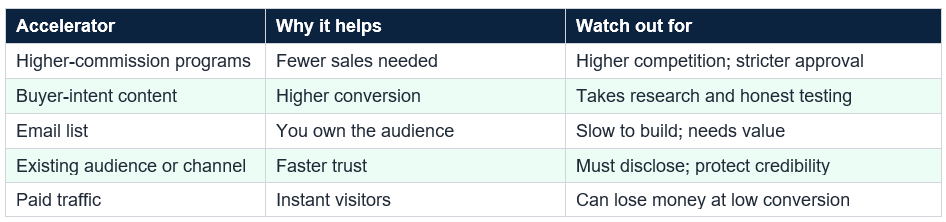
The legitimate accelerators are well known. Choose a program with a higher commission per sale, which changes the arithmetic more than anything. Write for buyers, not browsers: pages that compare products, review them honestly or answer a purchase question convert better than general articles. Build an email list so you own the audience, and use any existing audience, since a trusted recommendation to people who know you can produce a first commission in days, not months.Be wary of shortcuts. Paid traffic can lose money if conversion is low: at 2% click-through, 2.5% conversion and a $30 commission each visitor is worth about $0.015, so paying more than a cent or two per visitor loses money in my model. Fake reviews, undisclosed links and spammy tactics risk bans and legal trouble. The fastest honest route is a narrow niche you know, content aimed at people about to buy and patience measured in months, not weeks.
Costs, Taxes and Rules
Affiliate marketing is cheap to start, but not free: a domain and hosting cost roughly $100 to $300 a year in my general knowledge (not retrieved), and tools, email software and your time add up. Commissions are generally self-employment income, subject to income tax plus self-employment tax of about 14.1% effective (general knowledge, not retrieved). On $1,000 of net profit that is about $141, leaving about $859 before income tax, and you may need quarterly estimated payments.Rules matter too. In the US, the FTC expects you to disclose affiliate relationships clearly, and programs have their own terms: Amazon, for example, has a $10 payment minimum for direct deposit and policies on how links can be used. Read each program’s terms and keep records of income and expenses, since mistakes can cost you your account. A professional can help if your income grows.
The Hourly Reality
Suppose you work 10 hours a week for 18 months, about 780 hours, and earn a cumulative $1,000: about $1.28 an hour before tax and costs. People still do it because early work compounds, since pages that rank keep earning. In my model, the base $30 site earns about $750 in month 24 and $1,200 in month 30, so the hourly rate climbs sharply if the traffic arrives.That is the optimistic branch. Many sites never reach it, and income can drop if rankings change or a program cuts rates. Think of it as a long-odds, compounding project, like starting a small business, and decide how many hours and dollars you can afford to risk. Keep an emergency fund, since Bankrate found only 46% of Americans could cover three months of expenses, and do not depend on affiliate income for essentials in the first two years.
Be careful with anyone selling the dream. Income screenshots and “make $10,000 a month” claims usually reflect the best case, and the seller often earns more from the course than from affiliate marketing. Averages like $8,038 a month are misleading, promises of “passive income” overlook the work and the delay, and the statistics sites that cite averages often sell tools or courses themselves. Be skeptical of expensive coaching, guaranteed results and pressure to buy now.
A Realistic 12-Month Plan
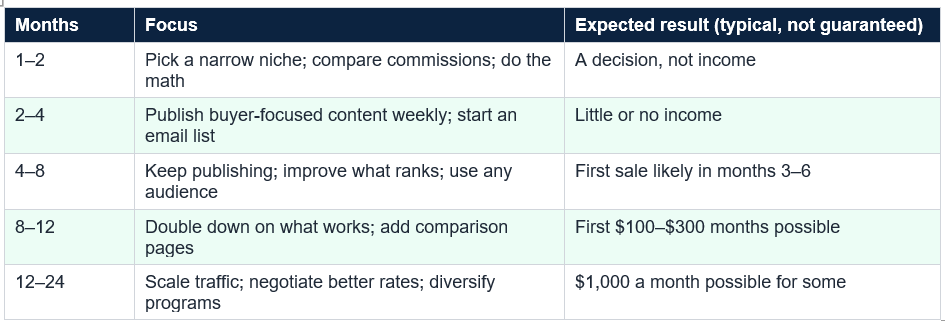
In months 1 to 2, choose a narrow niche you know, check program commission rates and estimate the sales you would need for $1,000 using the table above. In months 2 to 4, publish buyer-focused content weekly, set up an email list and apply to programs. In months 4 to 8, keep publishing and improving pages that get impressions; expect your first sale somewhere in months 3 to 6. In months 8 to 12, double down on what works, add comparison pages and a lead magnet and track clicks, conversions and earnings.Before you start, write down the commission per sale, the number of sales you need for $1,000 and how many visitors that requires at 2% click-through and 2% conversion. If the visitor number is far beyond what your niche can deliver, pick a higher-commission product or a different niche. Common mistakes include choosing a low-commission program and a crowded niche, writing for everyone instead of buyers, quitting before the second year, expecting passive income, ignoring disclosure rules, buying expensive courses before earning anything and spreading effort across too many sites. In the first year, judge progress by traffic, clicks and email subscribers, which lead income.
Conclusion
For most beginners, a first sale comes in months 3 to 6, a first $100 in 6 to 12 months and $1,000 in a single month in 12 to 24 months, faster for SEO-focused sites in profitable niches and slower for low-paying programs. About 41% of affiliates earn under $1,000 a month, and the $8,038 average is skewed by top earners. In my hypothetical model, a $30 commission reaches a cumulative $1,000 around month 16 and a $1,000 month around month 28, while a $100 commission does it by months 11 and 17.The deciding factors are commission per sale, traffic and conversion, and the first is the one you control most. Do the math before you start, choose a niche and program where the numbers can work, be patient with a one-to-two-year timeline and treat the income as a bonus, not essential. Disclose your links, set aside tax and keep an emergency fund. Many people earn little and some earn a lot, and the arithmetic tells you which side of the odds you are leaning toward.
Frequently Asked Questions
How long does it take to earn the first $1,000 in affiliate marketing?It depends on whether you mean $1,000 in total or $1,000 in a month. Sources suggest most beginners make a first sale in months 3 to 6, a first $100 in 6 to 12 months and $1,000 a month in 12 to 24 months, faster (6 to 12 months) for SEO-focused sites in profitable niches. Many take longer, and about 41% of affiliates earn under $1,000 a month. These figures come from secondary sources and vary.
How much do affiliate marketers really make?
The widely quoted average of $8,038 a month is misleading because a few high earners pull it up, and the median is far lower. Reports say about 41% of affiliates earn under $1,000 a month and one source says 70% to 80% earn under $500, while about 9% earn over $50,000 a month. Beginners in their first year typically earn $0 to $1,000 a month. Treat all of these as rough.
Is Amazon Associates a good way to start?
It is easy to join and sells almost everything, but the pay is low: standard rates run from 0% to 10% by category, with 4.5% on books, kitchen and automotive, 3% on toys and furniture, 1% on grocery and health and 4% for other categories, according to a recent summary of Amazon’s schedule. Its cookie lasts 24 hours, and commissions arrive about 60 days after the end of the month. Higher-commission programs can reach $1,000 faster.
Do I need a website or audience to start?
You need some way to reach buyers: a website with search traffic, a YouTube channel, a newsletter or an existing audience. Search-based sites are slow to build, with one source putting SEO traffic at 8 to 18 months, while an existing audience can convert faster. Whatever the channel, trust and relevance matter more than volume.
Are affiliate earnings taxable?
Yes. Affiliate commissions are generally self-employment income, subject to income tax plus self-employment tax of 15.3% on 92.35% of net profit, about 14.1% effective, which is general knowledge I did not retrieve from the sources above. On $1,000 of net profit that is about $141, leaving about $859 before income tax. You must also disclose affiliate relationships to your audience. This is general education, not personal advice.
0 Comments
Be the first to share your thoughts on this article.