

Insurance
Before You Click ‘Same as Last Year’ in 2027 Open Enrollment

Marketplace open enrollment for 2027 coverage November 1, 2026 to January 15, 2027 on HealthCare.gov (December 15 for a January 1 start); Medicare October 15 to December 7. Premiums: median proposed 2027 increase about 15% (KFF, 276 insurers) after about 20%–26% for 2026; out-of-pocket premium payments rose 58% on average in 2026 after enhanced subsidies expired January 1, 2026. Limits: 2027 Marketplace out-of-pocket maximum $12,000 individual and $24,000 family (up from $10,600 for an individual); HSA $4,500 self-only and $9,000 family; HDHP family deductible between $6,050 and $9,050 (IRS); Medicare Part D out-of-pocket cap $2,400 in 2027 (secondary source); 87% of 2026 Marketplace enrollees got subsidies. My arithmetic: a 26% increase followed by 15% is about 44.9% over two years ($500 a month becomes about $724.50); in a hypothetical comparison, a $320-a-month plan with a $5,500 deductible beats a $520-a-month plan with a $1,500 deductible only if claims stay under about $4,500; a $4,500 HSA contribution saves about $990 of federal tax at a 22% bracket.
Automatic renewal also carries quieter risks: some insurers are leaving the Marketplace, so your plan may no longer exist or may be replaced by one that does not match your doctors, and the “same” plan is rarely the same price. This guide explains what changed for 2027, shows how to compare plans on total cost with a worked example and lists the money-saving opportunities a quick click can miss.
Medicare has its own window, October 15 to December 7, with changes taking effect January 1. Employer dates vary and are often in November with short deadlines, so check your HR portal now. Outside these windows you can generally change coverage only after a qualifying life event such as losing other coverage, marriage or a birth (general knowledge), so missing your window can mean being stuck for a year.
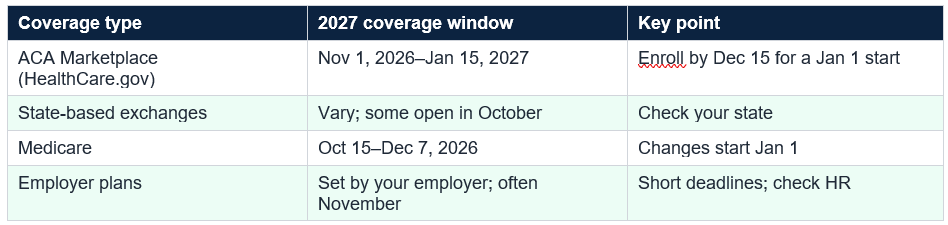
Subsidies now follow the pre-2021 rules: households between 100% and 400% of the federal poverty level may qualify, and those above 400% generally do not. About 87% of 2026 enrollees still received subsidies, and because credits are pegged to a benchmark plan they grow when premiums do, but they are less generous. Several insurers are leaving, extra income verification applies and the 2027 out-of-pocket maximum rises to $12,000 for an individual and $24,000 for a family. One site also reports bronze and catastrophic plans now count as HSA-compatible, which I could not confirm elsewhere.
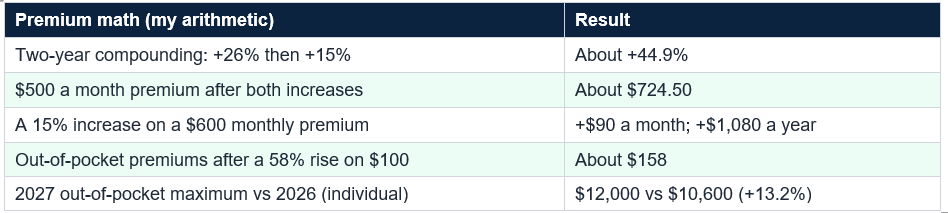
Marketplace open enrollment for 2027: Nov 1, 2026 to Jan 15, 2027 (Dec 15 for a Jan 1 start). Median proposed premium increase about 15% after about 20%–26% for 2026; enhanced subsidies expired Jan 1, 2026; out-of-pocket premiums rose 58% on average in 2026; 2027 out-of-pocket maximum $12,000 individual, $24,000 family.
Each answer matters. Income determines Marketplace subsidies, and an outdated estimate can mean overpaying now or owing money at tax time (general knowledge). Household changes affect who needs coverage and whether a family plan or separate plans cost less, and a new medication can make the drug list the deciding factor. A plan that was ideal when you were healthy and single can be wrong for a family with a chronic condition.
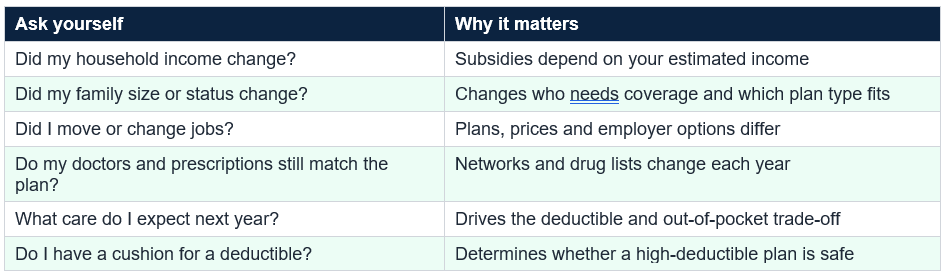
List the care you expect, such as regular prescriptions, specialist visits and planned procedures, then check each plan’s network and drug tiers and compare the deductible, coinsurance and out-of-pocket maximum, your worst-case spending beyond premiums. Consider your cushion: Bankrate found only 46% of Americans could cover three months of expenses, so a plan with a $9,000 maximum may be unaffordable in a bad year even if it looks cheaper. Plan for the bad year, not just the average one.
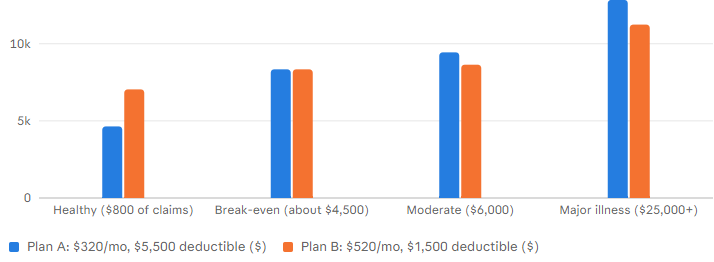
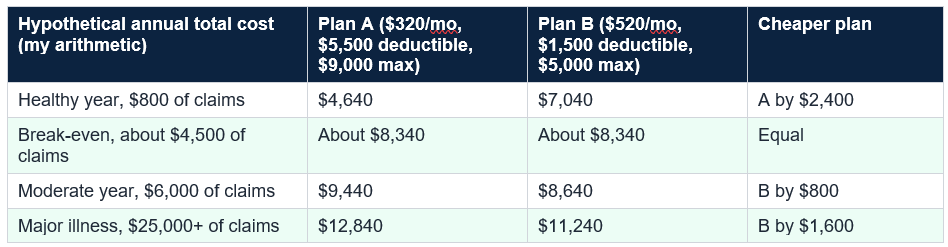
The break-even is about $4,500 of claims: below that Plan A wins, above it Plan B does. So the question is how likely you are to use more than $4,500 of care and whether you could afford the $9,000 maximum in a bad year. The prices are invented and real plans differ in copays, networks and drug coverage, but the method is real: estimate total cost across a range of usage, not one number.
The catch is eligibility and risk. You need an HSA-qualified high-deductible plan, with a family deductible of at least $6,050 under the IRS’s 2027 rules, and the plan must fit your health, since a deductible only works if you can afford it. An employer flexible spending account also offers pre-tax savings but money may be forfeited if unused (general knowledge), so estimate carefully; the 2026 health FSA limit was $3,400 and I did not retrieve the 2027 figure.
So estimate carefully: include all income, update it if your situation changed and remember that you reconcile the credit on your tax return. Pre-tax retirement and HSA contributions, one source notes, reduce the income the Marketplace uses. Also check whether employer coverage counts as affordable: for 2027 the test is an employee-only premium at or below 10.22% of household income, according to one site, and if it passes, Marketplace credits are not available even if family coverage is expensive.
Use the Medicare Plan Finder on Medicare.gov, check that your doctors and prescriptions are covered and compare total costs, not just premiums, and read any annual notice of changes your plan sent. If you are about to turn 65, your enrollment period is separate (general knowledge). The “same as last year” button may leave you in a plan that has raised costs or dropped a drug you use.
If your employer plan meets the affordability and minimum-value tests, you generally cannot get Marketplace subsidies, even if family coverage is costly, so check before assuming the Marketplace is cheaper. Mark the deadline and keep the confirmation. Many employers default you to your current plan if you do nothing, and some require you to re-elect an FSA or HSA contribution each year, so doing nothing can mean losing a tax benefit.
This week, pull up last year’s explanation-of-benefits statements, add up what you actually spent on premiums and care and use it as your baseline for comparing 2027 plans.
Common mistakes include clicking “same as last year” without comparing, choosing by premium alone, forgetting to check doctors and drug lists, using an outdated income estimate, ignoring the out-of-pocket maximum, picking a high-deductible plan without a cushion, missing the deadline and not paying the first premium. An hour of comparison can save hundreds or thousands of dollars.
So do not just click “same as last year.” Compare plans on total expected cost, as in my example where a $200-a-month cheaper plan saved $2,400 in a healthy year but lost if claims passed about $4,500. Update your income, check doctors and drugs, consider an HSA, which can save about $990 of federal tax on $4,500 at a 22% bracket, keep a cushion for the deductible and confirm your dates on HealthCare.gov, Medicare.gov or your employer’s site.
For most people buying on the Marketplace, open enrollment runs November 1, 2026 through January 15, 2027 on HealthCare.gov, with December 15 the deadline for coverage starting January 1. A proposed shorter window was blocked in court, though some sites still show December 15 as the end date, so confirm with HealthCare.gov or your state exchange. Medicare’s window runs October 15 to December 7, and employer deadlines vary, so check your HR portal.
Why shouldn’t I just choose ‘same as last year’?
Because premiums, deductibles, networks, drug lists and subsidies can all change, and so can your life. KFF-based reports say insurers proposed a median 15% premium increase for 2027, following a large increase for 2026, and the enhanced Marketplace subsidies expired on January 1, 2026. Your old plan may also have been discontinued or changed. Automatic renewal can leave you in a plan that no longer fits.
How do I compare health plans?
Compare total expected cost, not just the monthly premium: twelve months of premiums plus what you would likely pay in deductibles, copays and coinsurance, capped at the plan’s out-of-pocket maximum. Also check whether your doctors and prescriptions are covered. In my hypothetical example, a $200-a-month cheaper plan saved $2,400 for a healthy year but cost more if claims passed about $4,500.
What is the out-of-pocket maximum for 2027?
For 2027 Marketplace plans, the federal limit is $12,000 for an individual and $24,000 for a family, up from $10,600 for an individual in 2026, according to healthinsurance.org and HealthCare.gov as cited. Many plans set lower limits, so compare each plan’s own maximum along with its deductible and premium.
Should I choose a plan that works with an HSA?
Perhaps, if you are relatively healthy and have a cushion for the deductible. The 2027 HSA limits are $4,500 for self-only and $9,000 for family coverage, and in my arithmetic a $4,500 contribution saves about $990 of federal tax at a 22% bracket. But high-deductible plans can cost more if you have heavy medical needs. This is general education, not personal advice.
Table of Contents
- Why “Same as Last Year” Is Risky
- The Short Answer
- The Dates That Matter
- What Changed for 2027
- Your Life Changed Too: A Checklist
- Compare Plans on Total Cost
- A Worked Example
- HSAs, FSAs and Tax Savings
- Income, Subsidies and the Cliff
- If You Are on Medicare
- If You Have an Employer Plan
- Your Open Enrollment Plan
- Common Mistakes
- Conclusion
- Frequently Asked Questions
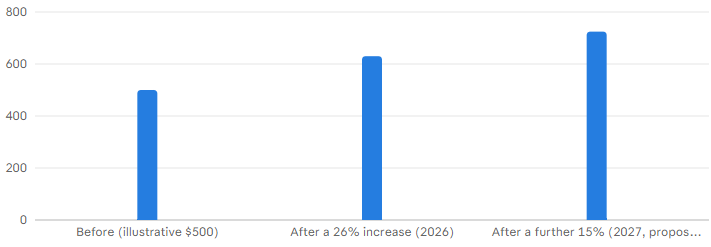
Why 'same as last year' costs more: a $500 premium after two increases ($ a month)
Monthly premium ($) by Author's compounding of reported increases (26% for 2026 per one source; median proposed 15% for 2027 per KFF via secondary sources); cumulative about +44.9%; unsubsidized premium illustration
Compare on total cost, not premium: two hypothetical plans by how much care you use ($ a year)
Total annual cost ($) by Author's hypothetical plans: premiums for 12 months plus deductible, 20% coinsurance, capped at the out-of-pocket maximum ($9,000 for A, $5,000 for B); real plans also differ in networks and drugs
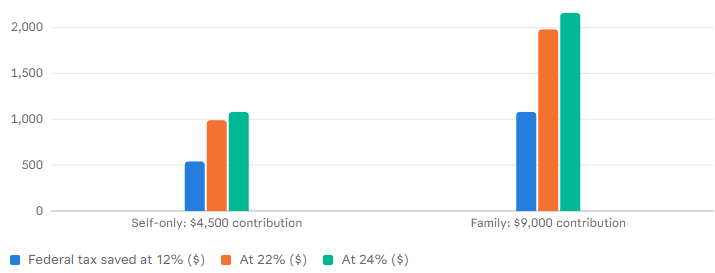
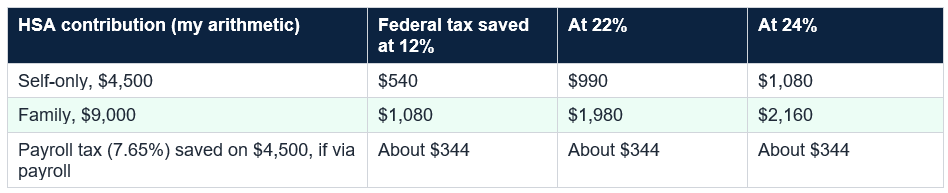
What an HSA could save: 2027 contribution limits by tax bracket ($)
Federal tax saved ($) by Author's arithmetic on the 2027 HSA limits (healthinsurance.org, BenefitChamps); excludes the 7.65% payroll tax saved on payroll contributions (about $344 on $4,500) and state tax; requires an HSA-eligible plan
Why “Same as Last Year” Is Risky
Open enrollment arrives with a tempting button: keep my current plan. It takes one click, and for years it was a sensible default. This year it is a gamble. Premiums, deductibles, networks and drug lists change every year, the subsidies that held down Marketplace costs have expired and your situation may look very different from a year ago. A new job, a raise or pay cut, a baby, a move, a new medication or a doctor who left a network can each change which plan is cheapest and best.Automatic renewal also carries quieter risks: some insurers are leaving the Marketplace, so your plan may no longer exist or may be replaced by one that does not match your doctors, and the “same” plan is rarely the same price. This guide explains what changed for 2027, shows how to compare plans on total cost with a worked example and lists the money-saving opportunities a quick click can miss.
The Short Answer
Do not auto-renew without checking. For 2027, Marketplace insurers proposed a median 15% premium increase after a large rise for 2026, the enhanced subsidies expired on January 1, 2026 and the individual out-of-pocket maximum rises to $12,000. Compare plans on total expected cost, twelve months of premiums plus likely out-of-pocket spending, check your doctors and drugs and update your income estimate. If you are healthy, an HSA-eligible plan may save money and taxes; if you expect heavy use, a higher-premium, lower-deductible plan may cost less overall.
The Dates That Matter
For most people on HealthCare.gov, open enrollment for 2027 coverage runs from November 1, 2026 through January 15, 2027, with December 15 the usual deadline for a January 1 start, and a proposed shorter window was blocked in court in June, according to several sources. One site still lists December 15 as the end date, which conflicts with most, so confirm on HealthCare.gov. State exchanges set their own dates; Connecticut, for example, opens on October 23.Medicare has its own window, October 15 to December 7, with changes taking effect January 1. Employer dates vary and are often in November with short deadlines, so check your HR portal now. Outside these windows you can generally change coverage only after a qualifying life event such as losing other coverage, marriage or a birth (general knowledge), so missing your window can mean being stuck for a year.
What Changed for 2027
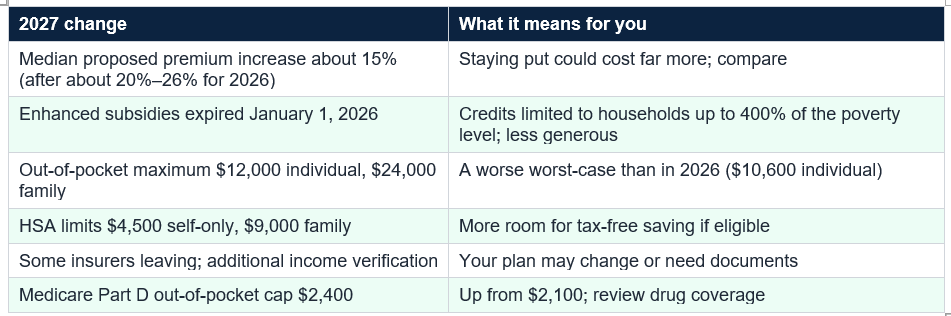
The headline is cost. KFF’s analysis of insurer filings, as reported by several sites, found a median proposed increase of about 15% for 2027 across 276 insurers, after a median finalized increase of roughly 20% in 2026 (26% in one source). In my arithmetic, 26% followed by 15% compounds to about 44.9%, so a $500 monthly premium would become about $724.50. On top of that, the enhanced premium tax credits that ran from 2021 through 2025 expired on January 1, 2026, and out-of-pocket premium payments rose 58% on average this year, per KFF figures cited by BenefitChamps.Subsidies now follow the pre-2021 rules: households between 100% and 400% of the federal poverty level may qualify, and those above 400% generally do not. About 87% of 2026 enrollees still received subsidies, and because credits are pegged to a benchmark plan they grow when premiums do, but they are less generous. Several insurers are leaving, extra income verification applies and the 2027 out-of-pocket maximum rises to $12,000 for an individual and $24,000 for a family. One site also reports bronze and catastrophic plans now count as HSA-compatible, which I could not confirm elsewhere.
Marketplace open enrollment for 2027: Nov 1, 2026 to Jan 15, 2027 (Dec 15 for a Jan 1 start). Median proposed premium increase about 15% after about 20%–26% for 2026; enhanced subsidies expired Jan 1, 2026; out-of-pocket premiums rose 58% on average in 2026; 2027 out-of-pocket maximum $12,000 individual, $24,000 family.
Your Life Changed Too: A Checklist
The market changed, and so did you. Ask what is different in your household since last year. Has your income gone up or down? Did someone get a new job, lose one or start freelancing? Did you marry, divorce, have a baby or add a dependent? Did you move to a county or state where plans and prices differ? Are you taking a new prescription, expecting a procedure or seeing a new specialist? Has a doctor you rely on left your plan’s network?Each answer matters. Income determines Marketplace subsidies, and an outdated estimate can mean overpaying now or owing money at tax time (general knowledge). Household changes affect who needs coverage and whether a family plan or separate plans cost less, and a new medication can make the drug list the deciding factor. A plan that was ideal when you were healthy and single can be wrong for a family with a chronic condition.
Compare Plans on Total Cost
The most common mistake is shopping by monthly premium. The better measure is total expected cost: twelve months of premiums plus what you would likely pay in deductibles, copays and coinsurance, capped at the plan’s out-of-pocket maximum. A cheap plan with a high deductible can cost more than a pricey plan with a low one if you use care, and the reverse if you do not; you can estimate from last year’s use.List the care you expect, such as regular prescriptions, specialist visits and planned procedures, then check each plan’s network and drug tiers and compare the deductible, coinsurance and out-of-pocket maximum, your worst-case spending beyond premiums. Consider your cushion: Bankrate found only 46% of Americans could cover three months of expenses, so a plan with a $9,000 maximum may be unaffordable in a bad year even if it looks cheaper. Plan for the bad year, not just the average one.
A Worked Example
In a hypothetical comparison for one person, Plan A costs $320 a month ($3,840 a year) with a $5,500 deductible, 20% coinsurance and a $9,000 out-of-pocket maximum, and Plan B costs $520 a month ($6,240 a year) with a $1,500 deductible, 20% coinsurance and a $5,000 maximum. In a healthy year with $800 of claims, Plan A costs $4,640 in total and Plan B $7,040, so A saves $2,400. With $6,000 of claims, A costs about $9,440 and B about $8,640, so B saves about $800, and with a major illness both hit their maximums, A at $12,840 and B at $11,240, a $1,600 advantage to B.The break-even is about $4,500 of claims: below that Plan A wins, above it Plan B does. So the question is how likely you are to use more than $4,500 of care and whether you could afford the $9,000 maximum in a bad year. The prices are invented and real plans differ in copays, networks and drug coverage, but the method is real: estimate total cost across a range of usage, not one number.
HSAs, FSAs and Tax Savings
Health savings accounts can turn a high-deductible plan into a tax-saving tool. The 2027 limits are $4,500 for self-only and $9,000 for family coverage, and contributions are tax-deductible, grow tax-free and can be spent tax-free on qualified medical costs (general knowledge). In my arithmetic, a $4,500 contribution saves about $540 of federal tax at a 12% bracket, $990 at 22% and $1,080 at 24%, and a $9,000 family contribution $1,080, $1,980 or $2,160; payroll contributions can also avoid the 7.65% payroll tax, about $344 on $4,500.The catch is eligibility and risk. You need an HSA-qualified high-deductible plan, with a family deductible of at least $6,050 under the IRS’s 2027 rules, and the plan must fit your health, since a deductible only works if you can afford it. An employer flexible spending account also offers pre-tax savings but money may be forfeited if unused (general knowledge), so estimate carefully; the 2026 health FSA limit was $3,400 and I did not retrieve the 2027 figure.
Income, Subsidies and the Cliff
For Marketplace shoppers, your income estimate is the most important number you enter. With the enhanced subsidies gone, premium tax credits are generally limited to households up to 400% of the federal poverty level, and above that the credit disappears entirely. Using the 2026 guideline for a family of four of $33,000, that line is about $132,000 (one site; I understand it applies to 2027 coverage from general knowledge), and a dollar over can cost thousands in lost credits.So estimate carefully: include all income, update it if your situation changed and remember that you reconcile the credit on your tax return. Pre-tax retirement and HSA contributions, one source notes, reduce the income the Marketplace uses. Also check whether employer coverage counts as affordable: for 2027 the test is an employee-only premium at or below 10.22% of household income, according to one site, and if it passes, Marketplace credits are not available even if family coverage is expensive.
If You Are on Medicare
Medicare’s open enrollment, October 15 to December 7, is the main chance to switch Medicare Advantage or Part D drug plans for 2027. Plans change their premiums, networks and drug lists every year, so a plan that fit last year may not fit now, and the Part D out-of-pocket cap rises to $2,400 from $2,100, according to one secondary source, a reason to review drug coverage even if your drugs are unchanged.Use the Medicare Plan Finder on Medicare.gov, check that your doctors and prescriptions are covered and compare total costs, not just premiums, and read any annual notice of changes your plan sent. If you are about to turn 65, your enrollment period is separate (general knowledge). The “same as last year” button may leave you in a plan that has raised costs or dropped a drug you use.
If You Have an Employer Plan
Employer plans have their own traps. Compare options on total cost, as in the worked example, and look at what you pay for family coverage, often far higher than employee-only. Check whether an HSA-eligible option is offered and whether the employer contributes to it, which can change the math, look for surcharges such as for covering a spouse who has other coverage (general knowledge) and confirm your doctors and drugs are covered.If your employer plan meets the affordability and minimum-value tests, you generally cannot get Marketplace subsidies, even if family coverage is costly, so check before assuming the Marketplace is cheaper. Mark the deadline and keep the confirmation. Many employers default you to your current plan if you do nothing, and some require you to re-elect an FSA or HSA contribution each year, so doing nothing can mean losing a tax benefit.
Your Open Enrollment Plan
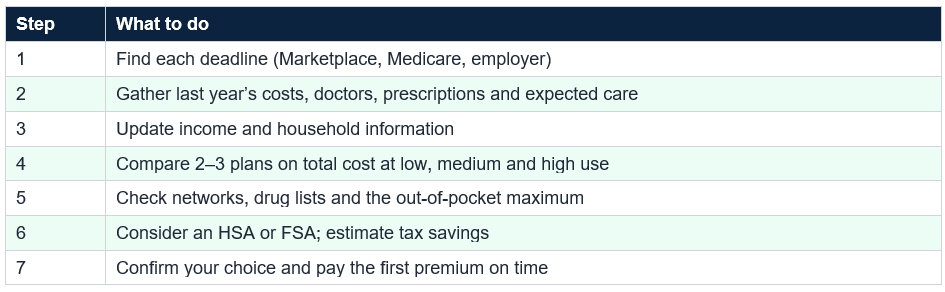
A simple plan: find your deadlines for each type of coverage; gather last year’s medical costs and your expected care, doctors and prescriptions; update your income and household information; compare two or three plans on total cost across low, medium and high use, plus network and drug coverage; consider an HSA if you qualify and can afford the deductible; and confirm your choice in writing and pay the first premium, since an unpaid first premium can leave you uninsured.This week, pull up last year’s explanation-of-benefits statements, add up what you actually spent on premiums and care and use it as your baseline for comparing 2027 plans.
Common mistakes include clicking “same as last year” without comparing, choosing by premium alone, forgetting to check doctors and drug lists, using an outdated income estimate, ignoring the out-of-pocket maximum, picking a high-deductible plan without a cushion, missing the deadline and not paying the first premium. An hour of comparison can save hundreds or thousands of dollars.
Conclusion
Open enrollment is the one time each year you can reset your health coverage, and this year the stakes are higher. Marketplace insurers proposed a median 15% increase for 2027 after a large rise for 2026, the enhanced subsidies expired and the individual out-of-pocket maximum rises to $12,000. Marketplace enrollment runs from November 1 to January 15, with December 15 the deadline for a January 1 start, Medicare’s window closes December 7 and employer deadlines are often sooner.So do not just click “same as last year.” Compare plans on total expected cost, as in my example where a $200-a-month cheaper plan saved $2,400 in a healthy year but lost if claims passed about $4,500. Update your income, check doctors and drugs, consider an HSA, which can save about $990 of federal tax on $4,500 at a 22% bracket, keep a cushion for the deductible and confirm your dates on HealthCare.gov, Medicare.gov or your employer’s site.
Frequently Asked Questions
When is open enrollment for 2027 health coverage?For most people buying on the Marketplace, open enrollment runs November 1, 2026 through January 15, 2027 on HealthCare.gov, with December 15 the deadline for coverage starting January 1. A proposed shorter window was blocked in court, though some sites still show December 15 as the end date, so confirm with HealthCare.gov or your state exchange. Medicare’s window runs October 15 to December 7, and employer deadlines vary, so check your HR portal.
Why shouldn’t I just choose ‘same as last year’?
Because premiums, deductibles, networks, drug lists and subsidies can all change, and so can your life. KFF-based reports say insurers proposed a median 15% premium increase for 2027, following a large increase for 2026, and the enhanced Marketplace subsidies expired on January 1, 2026. Your old plan may also have been discontinued or changed. Automatic renewal can leave you in a plan that no longer fits.
How do I compare health plans?
Compare total expected cost, not just the monthly premium: twelve months of premiums plus what you would likely pay in deductibles, copays and coinsurance, capped at the plan’s out-of-pocket maximum. Also check whether your doctors and prescriptions are covered. In my hypothetical example, a $200-a-month cheaper plan saved $2,400 for a healthy year but cost more if claims passed about $4,500.
What is the out-of-pocket maximum for 2027?
For 2027 Marketplace plans, the federal limit is $12,000 for an individual and $24,000 for a family, up from $10,600 for an individual in 2026, according to healthinsurance.org and HealthCare.gov as cited. Many plans set lower limits, so compare each plan’s own maximum along with its deductible and premium.
Should I choose a plan that works with an HSA?
Perhaps, if you are relatively healthy and have a cushion for the deductible. The 2027 HSA limits are $4,500 for self-only and $9,000 for family coverage, and in my arithmetic a $4,500 contribution saves about $990 of federal tax at a 22% bracket. But high-deductible plans can cost more if you have heavy medical needs. This is general education, not personal advice.
0 Comments
Be the first to share your thoughts on this article.