

Savings
Best Children's Savings Accounts: Accountants' Guide

CHILDREN'S SAVINGS | JISA limit: £9,000/year tax-free (unchanged to April 2031). Best Cash JISA: 4.5-5.25% AER. Halifax Kids' Monthly Saver: 5.5%. Nationwide: 5% easy access. Average high-street rate: 0.4-0.8%. The gap matters: over 18 years it can mean a house deposit.
NavigatorKids (2026): 'Most parents open a children's account with their own bank out of convenience -- and never revisit it. A Which? Money survey found the average high-street children's account earns 0.4-0.8% AER, while the best easy-access children's accounts in 2026 pay over 5%.' MomPlans (March 2026): 'In practice, the difference between a 3% account and a 5.5% account over 18 years can be the difference between a small gift and a house deposit.' The JISA annual limit for 2026-27 remains £9,000 -- unchanged, and confirmed to remain unchanged until April 2031. Competitive Cash JISA rates now reach 5.25% AER. Halifax's Kids' Monthly Saver pays 5.5% AER fixed for a year. Nationwide's FlexOne Saver pays 5% on easy-access balances. With the Bank of England base rate at 3.75%, these are genuinely attractive rates relative to the inflation outlook. This guide covers every type of children's savings account available in 2026, the best current rates, the tax rules, how compound growth works, and exactly how to choose the right account for each family's circumstances.
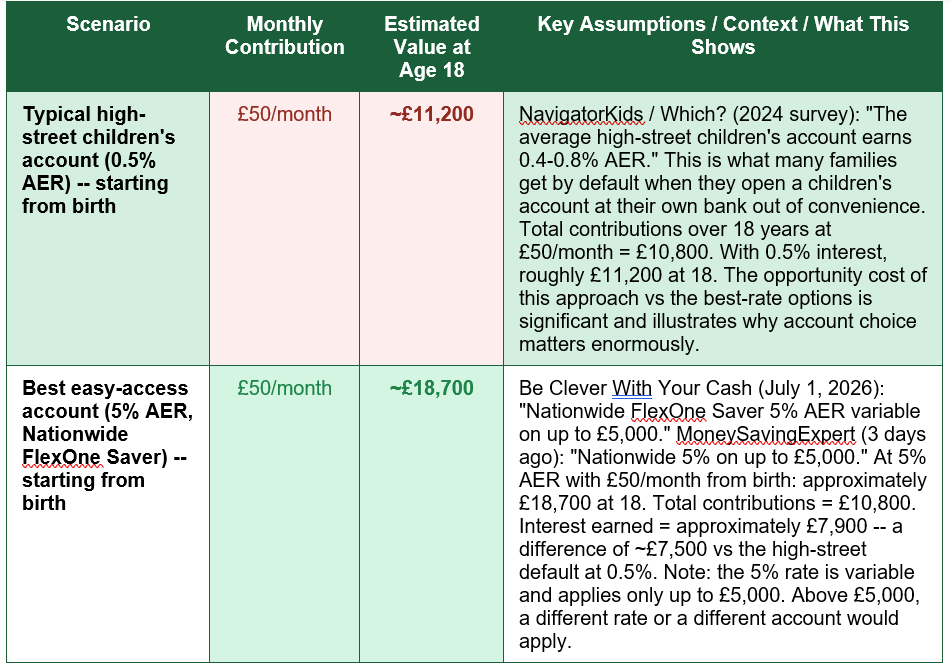
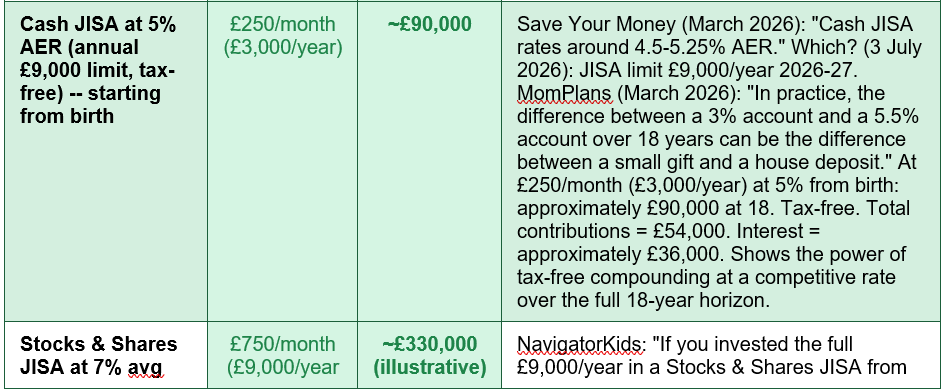
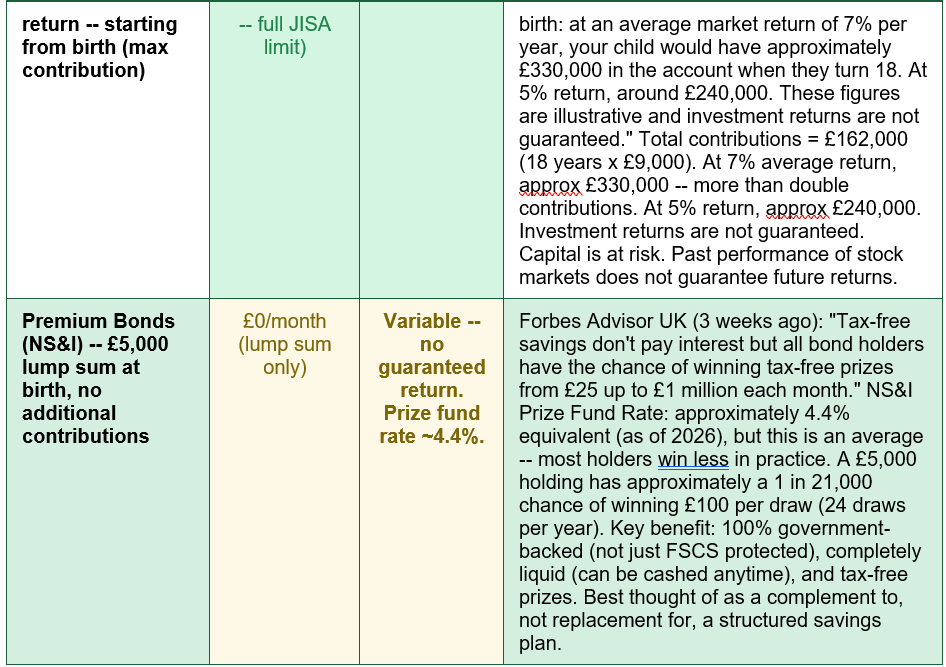
At £50/month from birth at 5% AER: a child reaches 18 with approximately £18,700, having contributed £10,800. The interest earned (£7,900) almost matches the total contributions. At the same £50/month at the average high-street rate of 0.5%: the child reaches 18 with approximately £11,200 -- over £7,500 less, for the same effort and the same discipline, simply because of account selection. NavigatorKids (2026): 'If you invested the full £9,000/year in a Stocks & Shares JISA from birth at an average market return of 7% per year, your child would have approximately £330,000 in the account when they turn 18. At 5% return, around £240,000. These figures are illustrative and investment returns are not guaranteed.'
Which? analysis (27 July 2026): '80% of accounts anyone can apply for (including junior ISAs and children's savings accounts) could beat inflation.' With UK CPI at 2.6% in June 2026, virtually every competitive children's savings account currently offers a positive real return. This contrasts sharply with the 2020-2022 period when both interest rates and the inflation environment made this very difficult. The current environment -- with base rates at 3.75% and children's savings rates of 4.5-5.5% -- is genuinely favourable for building long-term savings for children.
Children's savings in 2026 -- key numbers: Best Cash JISA: 5.25% AER. Halifax Monthly Saver: 5.5% AER. Nationwide easy access: 5%. JISA limit: £9,000/year. High-street average: 0.4-0.8% AER. Tax-free threshold: £18,570. — MoneySavingExpert (updated 3 days ago -- most current): 'Earn up to 5.5% on kids' savings. Halifax Kids' Monthly Saver 5.5% fixed. Nationwide 5% on up to £5,000.' Which? (rates checked 3 July 2026): '5% easy access and 4.15% fixed.' Save Your Money (March 2026): 'Cash JISA rates around 4.5-5.25% AER.' NavigatorKids: 'Average high-street children's account earns 0.4-0.8% AER.' Which? July 2026: JISA limit £9,000/year 2026-27 unchanged until April 2031. Be Clever With Your Cash (July 1, 2026 -- most current review): 'Children can earn a total of £18,500 from savings and other income each financial year.'
For longer horizons, the Stocks & Shares JISA case is compelling. PocketWise (March 2026): 'For long-term savings (10+ years): consider stocks & shares JISAs -- historically they outperform cash over longer periods.' The mathematics of NavigatorKids' projection illustrates this: at 7% average market return, full JISA contributions from birth produce approximately £330,000 by age 18 -- around £90,000 more than the cash alternative at 5%. However, investment returns are not guaranteed, and a market downturn near the child's 18th birthday can significantly reduce the final value. Many families address this by gradually shifting from stocks to cash in the JISA as the child approaches 16-18.
The grandparent savings advantage: why money from grandparents, aunts, and uncles is treated differently. The £100/year parental rule applies only to gifts from a natural parent or step-parent. Money placed into a child's non-ISA savings account by a grandparent, aunt, uncle, or family friend is NOT subject to the parental settlement rule -- the full interest is treated as the child's own income and is sheltered within the child's own generous tax-free threshold (up to £18,570 in 2026-27). This means grandparents who want to contribute to a grandchild's savings can place money in a non-ISA children's savings account with no parental settlement concern, while a parent wishing to make a large contribution is better placed using a JISA (where all interest is tax-free regardless of the amount or the relationship of the contributor). For families where multiple people contribute to a child's savings -- parents, grandparents, and other family members -- using a JISA as the primary vehicle is the cleanest approach, since the tax-free status applies universally regardless of who contributes.
FIVE MISTAKES TO AVOID WITH CHILDREN'S SAVINGS IN 2026: (1) OPENING AN ACCOUNT AT YOUR OWN BANK WITHOUT COMPARING RATES. NavigatorKids: 'Most parents open a children's account with their own bank out of convenience -- and never revisit it.' The average high-street rate is 0.4-0.8% AER. The best rate is 5.5% AER. Over 18 years, this difference is enormous. Always compare using MoneySavingExpert or Which? before opening. (2) NOT USING THE JISA TAX-FREE WRAPPER. All interest in a non-ISA children's savings account is subject to the parental settlement rule (taxed as parental income above £100/year). A JISA eliminates this concern entirely -- all interest is tax-free regardless of who contributes or how much is earned. If you are making significant contributions, the JISA is almost always the better vehicle. (3) CONFUSING A REGULAR SAVER WITH AN EASY-ACCESS ACCOUNT. The Halifax Kids' Monthly Saver pays 5.5% AER but requires monthly deposits and allows no withdrawals during the year. If you close early, you lose accrued interest. Read the account terms carefully -- regular savers require discipline and commitment. (4) IGNORING A CHILD TRUST FUND. If your child was born between 1 September 2002 and 2 January 2011, they may have a CTF. Many CTFs earn very low rates. You can transfer to a JISA for free -- and this can make a significant difference to the final value. Check whether your child has a CTF at gov.uk/child-trust-funds and arrange a transfer if so. (5) NOT INCREASING CONTRIBUTIONS AS INCOME RISES. The JISA limit of £9,000/year is a ceiling, not a target. Even small regular increases in monthly contributions -- going from £25 to £50, or from £50 to £100 -- have a disproportionate impact over 18 years because of compound growth. Review contributions annually and increase where possible.
COMPLETE CHILDREN'S SAVINGS ACTION PLAN FOR 2026: STEP 1 -- OPEN THE RIGHT ACCOUNT FOR YOUR SITUATION: (a) Long-term (10+ years, no early access needed): Stocks & Shares JISA via Vanguard or AJ Bell. (b) Medium-term or risk-averse: Cash JISA at 4.5-5.25% AER -- check Coventry BS, Nationwide, Yorkshire BS. (c) Need access before 18: Nationwide FlexOne Saver (5% up to £5,000) or Kent Reliance (4.18% up to £25,000). (d) Regular disciplined saving: Halifax Kids' Monthly Saver (5.5% fixed, £10-£100/month, age 15 and under). STEP 2 -- IF YOUR CHILD HAS A CTF, TRANSFER IT: Check at gov.uk/child-trust-funds. Transfer to a JISA for better rates -- the tax-free wrapper transfers with the money. STEP 3 -- UNDERSTAND THE TAX RULES: Money gifted by parents to a non-ISA account: parental settlement rule applies above £100/year interest (taxed as parental income). JISA: all interest is tax-free for everyone. Money from grandparents/other relatives in non-ISA accounts: subject to child's own tax threshold (up to £18,570 in 2026-27). STEP 4 -- USE COMPOUND GROWTH: Set up a standing order from a family account into the savings account. Even £25/month from birth at 5% builds to approximately £10,000 by age 18. Increase contributions at every life stage milestone (pay rise, reduced childcare costs, child benefit). STEP 5 -- REVIEW ANNUALLY: Variable rates change. Check whether your current rate is still competitive each tax year. If not, transfer to a better rate (JISA transfers preserve the tax-free wrapper). COMPARE AT: MoneySavingExpert.com/savings/child-savings-tax-free | Which?.co.uk | MoneyfactsCompare.co.uk/isa/junior-isas FREE GUIDANCE: MoneyHelper 0800 138 7777.
The Junior ISA is the natural centrepiece of any serious children's savings strategy: £9,000 per year of tax-free, compounding growth, locked safely until the child's 18th birthday when it converts automatically to an adult ISA. The JISA limit stays at £9,000 until April 2031 -- confirmed. Cash JISA rates of 4.5-5.25% are genuinely competitive. Stocks & Shares JISAs offer historically superior long-term returns for those with a 10-year-plus horizon and tolerance for investment risk. For families who need access before the child turns 18, Nationwide's 5% easy-access account or Kent Reliance's 4.18% up to £25,000 are the best current options. For disciplined monthly savers, Halifax's 5.5% fixed regular saver is the market's highest rate.
The most important message is simple: compare before you commit. MoneySavingExpert (updated 3 days ago) and Which? (updated 3 July 2026) publish current rate tables updated in real time. Five minutes of comparison can be worth thousands of pounds over 18 years. And for families with existing Child Trust Funds earning poor rates: transfer to a JISA today. It costs nothing, preserves the tax-free wrapper, and the rate improvement begins immediately.
The best account depends on your specific needs -- access, tax, and time horizon. For the highest fixed rate on a regular saver: the Halifax Kids' Monthly Saver at 5.50% AER fixed for one year (£10-£100/month, age 15 and under -- Forbes Advisor UK, 3 weeks ago). For the best easy-access children's account: Nationwide FlexOne Saver at 5% AER variable on up to £5,000 (requires a Nationwide FlexOne current account -- Be Clever With Your Cash, July 1, 2026). For the best easy-access without a linked current account: Kent Reliance at 4.18% on up to £25,000 (Yahoo Finance, May 2026). For the best Cash JISA: rates currently reach 4.5-5.25% AER from providers including Coventry Building Society, Nationwide, and Yorkshire Building Society -- check MoneyfactsCompare.co.uk for the current leader (Save Your Money, March 2026). For long-term growth potential: a Stocks & Shares JISA invested in a global index fund via Vanguard or AJ Bell -- historical average returns of 7% per year, though not guaranteed (NavigatorKids, 2026). MoneySavingExpert (updated 3 days ago) and Which? (updated 3 July 2026) publish current rate comparisons updated regularly. Always verify the current rate directly with the provider before opening.
How much can I save in a Junior ISA each year?
The Junior ISA (JISA) annual limit for 2026-27 is £9,000 per child per tax year. Which? (1 month ago): 'Parents, grandparents and friends can put money into a Junior ISA for a child each year, up to a limit of £9,000 in 2026-27 (the same as 2025-26). This will remain unchanged until April 2031.' The £9,000 limit is per child, per tax year (running 6 April to 5 April). Contributions can be made by anyone -- the child's parents, grandparents, other relatives, family friends, or the child themselves -- as long as the total across all JISAs for that child does not exceed £9,000 in the tax year. The limit applies to the sum of Cash JISA and Stocks & Shares JISA contributions combined -- if a child has both types, the total contributed to both must not exceed £9,000. MoneyfactsCompare: 'A Junior ISA is a tax-free savings account for children under the age of 18, introduced by the UK Government in 2011 as a replacement for the Child Trust Fund.' All interest and growth inside the JISA is completely tax-free, regardless of the amount.
Can grandparents open or contribute to a Junior ISA?
Grandparents can contribute to a Junior ISA, but they cannot open one -- only a parent or legal guardian can open a JISA for a child. MoneyfactsCompare: 'Contributions can be made by anyone, so long as the total amount paid in doesn't exceed the £9,000 annual limit.' Once a JISA is opened by a parent or guardian, any person can contribute to it -- grandparents, aunts, uncles, godparents, family friends -- as long as the annual £9,000 limit is not exceeded across all contributions to that child's JISA in the tax year. The practical arrangement: the parent or guardian opens the JISA and then shares the account details with grandparents who wish to contribute. Many JISA providers allow one-off electronic transfers into a JISA from any account, making grandparent contributions straightforward. Importantly, money contributed by grandparents to a non-ISA children's savings account (rather than a JISA) is not subject to the parental settlement rule -- grandparent-gifted money is treated as the child's own income and sheltered within the child's personal tax-free threshold of up to £18,570 in 2026-27. For large grandparent contributions, either a JISA (all interest tax-free) or a non-ISA account (grandparent gifts are not subject to the parental £100 rule) both work effectively.
What happens to a Junior ISA when the child turns 18?
When the child turns 18, the Junior ISA automatically converts to an adult ISA in the child's own name. Save Your Money (March 2026): 'Money is locked until the child turns 18, when the JISA automatically converts to an adult ISA and the child takes control.' MoneyfactsCompare: 'The child cannot access the funds until they turn 18, though they can take control of the account at 16.' The sequence: at age 16, the child gains the ability to manage the JISA themselves -- they can change the nominated provider, make contribution decisions, and communicate directly with the account provider -- but they cannot withdraw funds. At 18, the JISA automatically becomes an adult Cash ISA or Stocks & Shares ISA (depending on the type of JISA held), and the child can access the money, withdraw it, transfer it, or continue saving into it within the adult ISA rules. The transition is automatic -- no action is required from parents or the child to trigger the conversion. The child is under no obligation to withdraw the money at 18 -- many families use this as an opportunity for the young adult to continue building their ISA pot, benefiting from the adult annual ISA limit (£20,000 in 2026-27).
Is a Junior ISA or a children's savings account better?
The answer depends on whether you need access to the money before the child turns 18. If you do not need access and the savings are genuinely long-term: a Junior ISA is almost always better. All interest and growth is tax-free regardless of the source of contributions, the amount earned, or any parental settlement considerations. The £9,000 annual limit is generous. Rates are competitive with non-ISA children's savings. And the money is protected from being spent for any reason until the child's 18th birthday -- a feature that some families regard as a bug but many regard as the most important benefit. If you do need access before the child turns 18: a children's savings account (easy-access or regular saver) is the appropriate choice, since JISA withdrawals are simply not permitted. For very large lump sums where even the JISA's £9,000 annual limit is not enough: a combination of maximum JISA contributions (£9,000/year) plus a non-ISA children's savings account for the excess, or Premium Bonds for their tax-free prizes and government backing, covers the overflow. Be Clever With Your Cash (July 1, 2026): the practical summary is that for most families making regular monthly contributions, the JISA is the vehicle of choice for the tax-free advantage, while a good easy-access children's savings account at 5% is the best option for accessible savings the family might need before the child's 18th birthday.
Table of Contents
- Why Account Choice Matters More Than Most Parents Realise
- Why Starting Early Matters: The Power of Compound Growth
- Best Children's Savings Accounts 2026: Rates, Rules and Who They Suit
- Junior ISAs (JISAs) 2026: The Complete Guide
- JISA Rules for 2026-27
- Cash JISA vs Stocks & Shares JISA: Which Is Right for You?
- Tax Rules on Children's Savings 2026: What Every Parent Must Know
- The Child's Personal Tax-Free Threshold
- The £100 Parental Rule: The Exception Parents Must Know
- Compound Growth Projections: How Different Accounts Compare Over 18 Years
- How to Choose the Right Children's Savings Account
- Conclusion
- Frequently Asked Questions (FAQ)
- What is the best children's savings account in the UK in 2026?
- How much can I save in a Junior ISA each year?
- Can grandparents open or contribute to a Junior ISA?
- What happens to a Junior ISA when the child turns 18?
- Is a Junior ISA or a children's savings account better?
Why Account Choice Matters More Than Most Parents Realise
Saving for a child's future is one of the most impactful financial decisions a parent, grandparent, or family member can make. The earlier money is set aside and the better the interest rate or investment return, the more dramatically compound growth works in the child's favour over years and decades. But the difference between the best and worst available children's savings rates in 2026 is so large that the choice of account -- not the amount saved -- can determine whether a child reaches 18 with a modest gift or a meaningful financial head start.NavigatorKids (2026): 'Most parents open a children's account with their own bank out of convenience -- and never revisit it. A Which? Money survey found the average high-street children's account earns 0.4-0.8% AER, while the best easy-access children's accounts in 2026 pay over 5%.' MomPlans (March 2026): 'In practice, the difference between a 3% account and a 5.5% account over 18 years can be the difference between a small gift and a house deposit.' The JISA annual limit for 2026-27 remains £9,000 -- unchanged, and confirmed to remain unchanged until April 2031. Competitive Cash JISA rates now reach 5.25% AER. Halifax's Kids' Monthly Saver pays 5.5% AER fixed for a year. Nationwide's FlexOne Saver pays 5% on easy-access balances. With the Bank of England base rate at 3.75%, these are genuinely attractive rates relative to the inflation outlook. This guide covers every type of children's savings account available in 2026, the best current rates, the tax rules, how compound growth works, and exactly how to choose the right account for each family's circumstances.
Why Starting Early Matters: The Power of Compound Growth
The most important variable in children's savings is time. Compound interest -- earning interest on previously earned interest -- is the mechanism that turns modest regular contributions into significant sums over 18 years. The mathematics are straightforward but the results are striking.At £50/month from birth at 5% AER: a child reaches 18 with approximately £18,700, having contributed £10,800. The interest earned (£7,900) almost matches the total contributions. At the same £50/month at the average high-street rate of 0.5%: the child reaches 18 with approximately £11,200 -- over £7,500 less, for the same effort and the same discipline, simply because of account selection. NavigatorKids (2026): 'If you invested the full £9,000/year in a Stocks & Shares JISA from birth at an average market return of 7% per year, your child would have approximately £330,000 in the account when they turn 18. At 5% return, around £240,000. These figures are illustrative and investment returns are not guaranteed.'
Which? analysis (27 July 2026): '80% of accounts anyone can apply for (including junior ISAs and children's savings accounts) could beat inflation.' With UK CPI at 2.6% in June 2026, virtually every competitive children's savings account currently offers a positive real return. This contrasts sharply with the 2020-2022 period when both interest rates and the inflation environment made this very difficult. The current environment -- with base rates at 3.75% and children's savings rates of 4.5-5.5% -- is genuinely favourable for building long-term savings for children.
Children's savings in 2026 -- key numbers: Best Cash JISA: 5.25% AER. Halifax Monthly Saver: 5.5% AER. Nationwide easy access: 5%. JISA limit: £9,000/year. High-street average: 0.4-0.8% AER. Tax-free threshold: £18,570. — MoneySavingExpert (updated 3 days ago -- most current): 'Earn up to 5.5% on kids' savings. Halifax Kids' Monthly Saver 5.5% fixed. Nationwide 5% on up to £5,000.' Which? (rates checked 3 July 2026): '5% easy access and 4.15% fixed.' Save Your Money (March 2026): 'Cash JISA rates around 4.5-5.25% AER.' NavigatorKids: 'Average high-street children's account earns 0.4-0.8% AER.' Which? July 2026: JISA limit £9,000/year 2026-27 unchanged until April 2031. Be Clever With Your Cash (July 1, 2026 -- most current review): 'Children can earn a total of £18,500 from savings and other income each financial year.'
Best Children's Savings Accounts 2026: Rates, Rules and Who They Suit
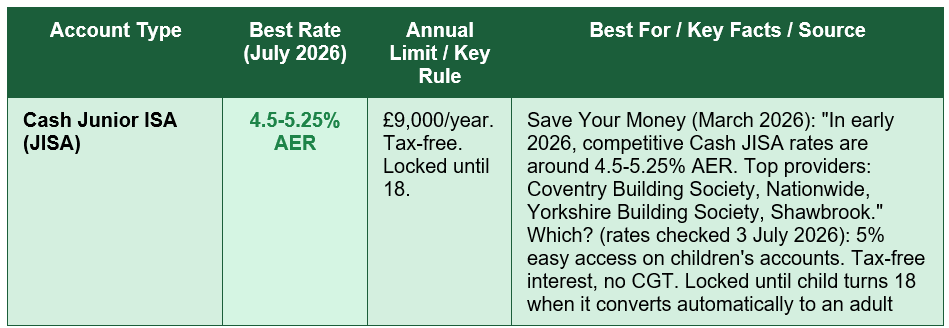
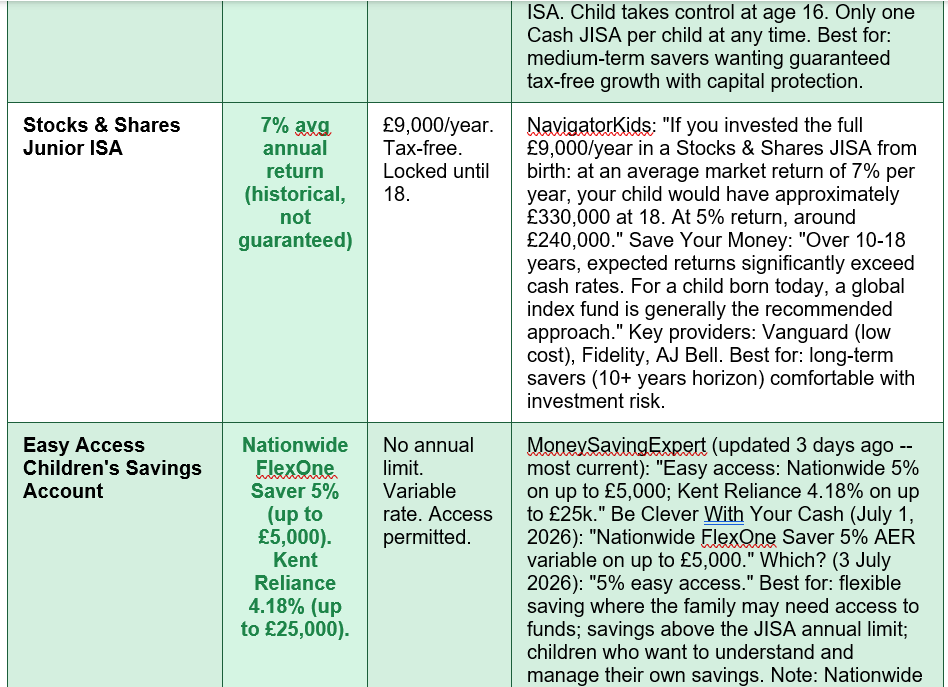
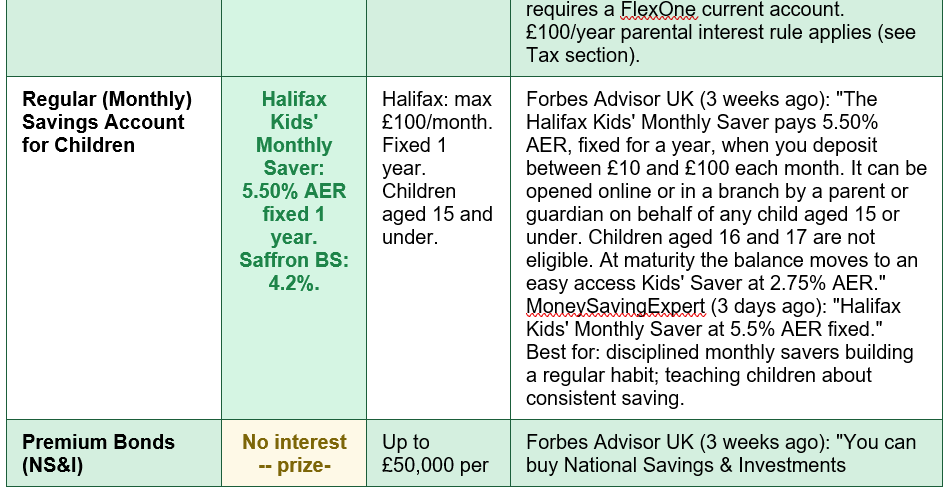
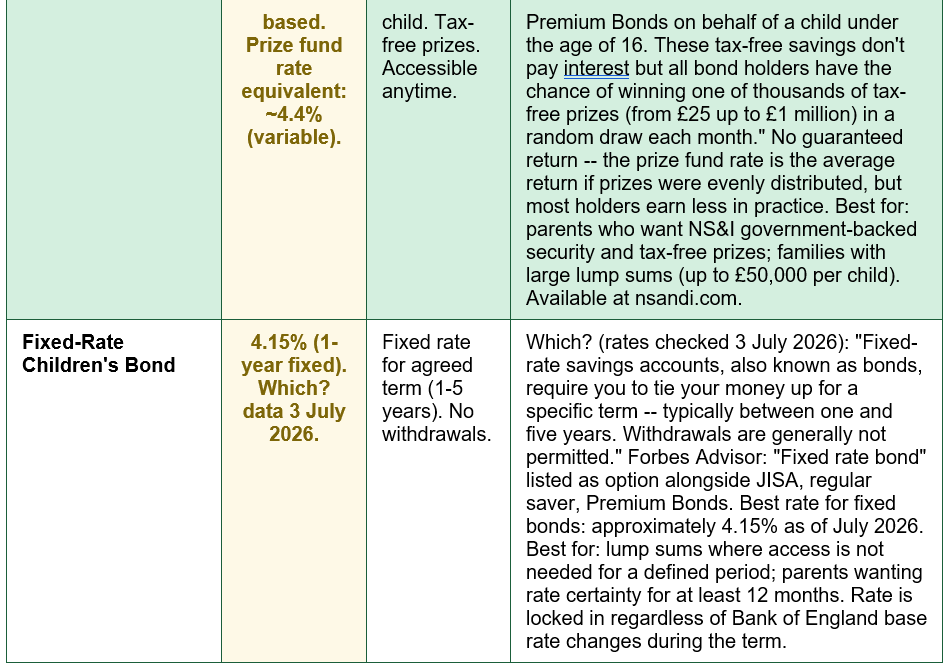
The following table maps every major children's savings account type against the best current rates, key rules, and which family circumstances each one suits best:
Junior ISAs (JISAs) 2026: The Complete Guide
The Junior ISA is the single most powerful long-term savings vehicle available for children in the UK, combining a generous annual limit, tax-free growth, and flexibility between cash and investment options. Understanding how JISAs work -- and what has changed -- is essential before opening one.JISA Rules for 2026-27
- Annual limit: £9,000 per child per tax year (2026-27). Which?: "This will remain unchanged until April 2031." The £9,000 can be contributed by anyone -- parents, grandparents, family friends, or the child themselves -- as long as the total across all JISAs for that child does not exceed £9,000 in the tax year.
- Types: Cash JISA (interest-bearing, capital protected, FSCS covered up to £85,000 per banking licence) OR Stocks & Shares JISA (invested in funds, shares, and bonds -- higher long-term return potential but capital at risk). MoneyfactsCompare: "As of the 2026/27 tax year, a child can have one cash JISA and one stocks and shares JISA." Both can be held simultaneously.
- Locking: Money is locked until the child's 18th birthday. No withdrawals permitted in any circumstances. Save Your Money: "Money is locked until the child turns 18, when the JISA automatically converts to an adult ISA and the child takes control." The child takes management control of the account at age 16 -- but cannot withdraw until 18.
- Eligibility: Any UK child under 18 who does not hold a Child Trust Fund (CTF). If your child has a CTF, you cannot also open a JISA -- but you can transfer the CTF into a JISA. PocketWise (March 2026): "Consider transferring: Many CTFs have poor rates. Transferring to a JISA could significantly improve returns."
- Tax: All interest and investment growth inside a JISA is completely tax-free -- no income tax, no capital gains tax, regardless of the amount earned. This is the primary financial advantage of the JISA over non-ISA children's savings accounts.
- Transfers: You can transfer a JISA between providers at any time without losing the tax-free wrapper. Save Your Money: "You can also transfer between providers -- something many families don't realise." This means if you find a better rate elsewhere, you can switch. The transfer must be handled between providers directly -- do not withdraw funds to transfer or you lose the ISA wrapper.
Cash JISA vs Stocks & Shares JISA: Which Is Right for You?
The choice between a Cash JISA and a Stocks & Shares JISA depends primarily on the child's age, the time horizon, and the family's attitude to risk. Save Your Money (March 2026): 'Cash JISAs offer a guaranteed interest rate with no risk to your capital. They're ideal for money needed within 5 years or as part of a diversified approach (shifting from stocks to cash as the child nears 18). In early 2026, competitive Cash JISA rates are around 4.5-5.25% AER.'For longer horizons, the Stocks & Shares JISA case is compelling. PocketWise (March 2026): 'For long-term savings (10+ years): consider stocks & shares JISAs -- historically they outperform cash over longer periods.' The mathematics of NavigatorKids' projection illustrates this: at 7% average market return, full JISA contributions from birth produce approximately £330,000 by age 18 -- around £90,000 more than the cash alternative at 5%. However, investment returns are not guaranteed, and a market downturn near the child's 18th birthday can significantly reduce the final value. Many families address this by gradually shifting from stocks to cash in the JISA as the child approaches 16-18.
Tax Rules on Children's Savings 2026: What Every Parent Must Know
Children's savings are largely tax-free in 2026 -- but there is one important exception that catches many parents out. Understanding the rules prevents unexpected tax bills.The Child's Personal Tax-Free Threshold
Be Clever With Your Cash (July 1, 2026): 'Children can earn a total of £18,500 from savings and other income each financial year.' This is made up of: the personal allowance of £12,570 (income below which no income tax is payable), plus a £5,000 starting savings allowance (for those with little or no earned income), plus the £1,000 personal savings allowance. Most children with no earned income can therefore receive up to £18,570 in savings interest completely free of income tax in 2026-27. Which? confirms the 2026-27 figure of £18,570 as the threshold. For a child earning interest on a savings account, this means only very large balances would generate enough interest to be taxable -- at 5% AER, a balance of £370,000 would be needed to generate £18,570 in interest, which vastly exceeds what most children's accounts hold.The £100 Parental Rule: The Exception Parents Must Know
PocketWise (March 2026): 'If a parent (or step-parent) gifts money to their child, and that money earns more than £100 in interest per year, ALL the interest is taxed as the parent's income.' This rule -- sometimes called the parental settlement rule -- is specifically designed to prevent parents from using their child's tax-free allowance as an additional savings shelter. It applies only to money gifted by a natural or step parent, not to money gifted by grandparents, aunts, uncles, or other relatives. It applies only when the interest exceeds £100 per year. For most families with modest savings in a children's account, the £100 threshold is not reached, and the rule does not apply. But for parents saving larger amounts, opening a JISA (where all interest is genuinely tax-free regardless of source) rather than a non-ISA savings account avoids this rule entirely.The grandparent savings advantage: why money from grandparents, aunts, and uncles is treated differently. The £100/year parental rule applies only to gifts from a natural parent or step-parent. Money placed into a child's non-ISA savings account by a grandparent, aunt, uncle, or family friend is NOT subject to the parental settlement rule -- the full interest is treated as the child's own income and is sheltered within the child's own generous tax-free threshold (up to £18,570 in 2026-27). This means grandparents who want to contribute to a grandchild's savings can place money in a non-ISA children's savings account with no parental settlement concern, while a parent wishing to make a large contribution is better placed using a JISA (where all interest is tax-free regardless of the amount or the relationship of the contributor). For families where multiple people contribute to a child's savings -- parents, grandparents, and other family members -- using a JISA as the primary vehicle is the cleanest approach, since the tax-free status applies universally regardless of who contributes.
Compound Growth Projections: How Different Accounts Compare Over 18 Years
The following table illustrates how the same savings habit produces dramatically different outcomes across account types -- making the case for why choosing the right account is as important as saving consistently:
How to Choose the Right Children's Savings Account
The right children's savings account depends on three questions: how long until the money is needed, whether access is required before the child turns 18, and how much risk the family is comfortable with. Here is a practical guide:- If the child is under 8 and savings are long-term (10+ years horizon): A Stocks & Shares JISA invested in a low-cost global index fund is the strongest long-term option for most families. Historical equity returns over 10-18 year periods have significantly outperformed cash. Save Your Money: "For a child born today, a global index fund in a Stocks & Shares JISA is generally the recommended approach. Key comparison points: platform fees, fund charges, investment choice, and ease of use." Vanguard (low cost, from 0.15% platform charge) and AJ Bell (accessible interface) are frequently cited. Capital is at risk. If this risk is uncomfortable, a Cash JISA at 5%+ is the next best option.
- If you need access to the money before the child turns 18: A JISA is not suitable -- money is locked until 18 with no exceptions. Choose an easy-access children's savings account (Nationwide FlexOne Saver at 5%, Kent Reliance at 4.18%) or Premium Bonds (fully liquid, no notice period). The trade-off is lower rates vs. a JISA and the parental settlement rule for non-ISA accounts.
- If you want the best fixed rate for 12 months: The Halifax Kids' Monthly Saver at 5.5% AER (fixed, £10-£100/month, children aged 15 and under) is the highest widely available rate in the market as of July 2026. It is a regular saver -- not a lump sum account -- and requires a monthly deposit. At the end of 12 months, the balance transfers to Halifax's Kids' Saver at 2.75% variable, so renewal or transfer is needed annually to maintain a competitive rate.
- If you already have a Child Trust Fund (CTF): Transfer it to a JISA. PocketWise (March 2026): "Many CTFs have poor rates. Transferring to a JISA could significantly improve returns." The transfer process requires contacting the CTF provider and a JISA provider to arrange a direct transfer -- the child must not withdraw the funds. The tax-free wrapper transfers with the money. This one-time action could significantly improve the rate and the flexibility of the account.
- If you want maximum government backing and tax-free prizes: Premium Bonds via NS&I (nsandi.com) are 100% government-backed (not just FSCS protected) and eligible for children under 16. The prize fund rate equivalent is approximately 4.4%, but returns are not guaranteed and depend on luck. Best used as a complement to a JISA or regular savings account rather than a replacement.
FIVE MISTAKES TO AVOID WITH CHILDREN'S SAVINGS IN 2026: (1) OPENING AN ACCOUNT AT YOUR OWN BANK WITHOUT COMPARING RATES. NavigatorKids: 'Most parents open a children's account with their own bank out of convenience -- and never revisit it.' The average high-street rate is 0.4-0.8% AER. The best rate is 5.5% AER. Over 18 years, this difference is enormous. Always compare using MoneySavingExpert or Which? before opening. (2) NOT USING THE JISA TAX-FREE WRAPPER. All interest in a non-ISA children's savings account is subject to the parental settlement rule (taxed as parental income above £100/year). A JISA eliminates this concern entirely -- all interest is tax-free regardless of who contributes or how much is earned. If you are making significant contributions, the JISA is almost always the better vehicle. (3) CONFUSING A REGULAR SAVER WITH AN EASY-ACCESS ACCOUNT. The Halifax Kids' Monthly Saver pays 5.5% AER but requires monthly deposits and allows no withdrawals during the year. If you close early, you lose accrued interest. Read the account terms carefully -- regular savers require discipline and commitment. (4) IGNORING A CHILD TRUST FUND. If your child was born between 1 September 2002 and 2 January 2011, they may have a CTF. Many CTFs earn very low rates. You can transfer to a JISA for free -- and this can make a significant difference to the final value. Check whether your child has a CTF at gov.uk/child-trust-funds and arrange a transfer if so. (5) NOT INCREASING CONTRIBUTIONS AS INCOME RISES. The JISA limit of £9,000/year is a ceiling, not a target. Even small regular increases in monthly contributions -- going from £25 to £50, or from £50 to £100 -- have a disproportionate impact over 18 years because of compound growth. Review contributions annually and increase where possible.
COMPLETE CHILDREN'S SAVINGS ACTION PLAN FOR 2026: STEP 1 -- OPEN THE RIGHT ACCOUNT FOR YOUR SITUATION: (a) Long-term (10+ years, no early access needed): Stocks & Shares JISA via Vanguard or AJ Bell. (b) Medium-term or risk-averse: Cash JISA at 4.5-5.25% AER -- check Coventry BS, Nationwide, Yorkshire BS. (c) Need access before 18: Nationwide FlexOne Saver (5% up to £5,000) or Kent Reliance (4.18% up to £25,000). (d) Regular disciplined saving: Halifax Kids' Monthly Saver (5.5% fixed, £10-£100/month, age 15 and under). STEP 2 -- IF YOUR CHILD HAS A CTF, TRANSFER IT: Check at gov.uk/child-trust-funds. Transfer to a JISA for better rates -- the tax-free wrapper transfers with the money. STEP 3 -- UNDERSTAND THE TAX RULES: Money gifted by parents to a non-ISA account: parental settlement rule applies above £100/year interest (taxed as parental income). JISA: all interest is tax-free for everyone. Money from grandparents/other relatives in non-ISA accounts: subject to child's own tax threshold (up to £18,570 in 2026-27). STEP 4 -- USE COMPOUND GROWTH: Set up a standing order from a family account into the savings account. Even £25/month from birth at 5% builds to approximately £10,000 by age 18. Increase contributions at every life stage milestone (pay rise, reduced childcare costs, child benefit). STEP 5 -- REVIEW ANNUALLY: Variable rates change. Check whether your current rate is still competitive each tax year. If not, transfer to a better rate (JISA transfers preserve the tax-free wrapper). COMPARE AT: MoneySavingExpert.com/savings/child-savings-tax-free | Which?.co.uk | MoneyfactsCompare.co.uk/isa/junior-isas FREE GUIDANCE: MoneyHelper 0800 138 7777.
Conclusion
The children's savings market in 2026 offers some of the most competitive rates available in years -- but the default choice remains the worst one. NavigatorKids captures the problem precisely: most parents open an account at their own bank out of convenience, earning 0.4-0.8% AER, when the best rates are between 5% and 5.5%. Over 18 years, that gap is the difference between a modest gift and a meaningful financial foundation.The Junior ISA is the natural centrepiece of any serious children's savings strategy: £9,000 per year of tax-free, compounding growth, locked safely until the child's 18th birthday when it converts automatically to an adult ISA. The JISA limit stays at £9,000 until April 2031 -- confirmed. Cash JISA rates of 4.5-5.25% are genuinely competitive. Stocks & Shares JISAs offer historically superior long-term returns for those with a 10-year-plus horizon and tolerance for investment risk. For families who need access before the child turns 18, Nationwide's 5% easy-access account or Kent Reliance's 4.18% up to £25,000 are the best current options. For disciplined monthly savers, Halifax's 5.5% fixed regular saver is the market's highest rate.
The most important message is simple: compare before you commit. MoneySavingExpert (updated 3 days ago) and Which? (updated 3 July 2026) publish current rate tables updated in real time. Five minutes of comparison can be worth thousands of pounds over 18 years. And for families with existing Child Trust Funds earning poor rates: transfer to a JISA today. It costs nothing, preserves the tax-free wrapper, and the rate improvement begins immediately.
Frequently Asked Questions (FAQ)
What is the best children's savings account in the UK in 2026?The best account depends on your specific needs -- access, tax, and time horizon. For the highest fixed rate on a regular saver: the Halifax Kids' Monthly Saver at 5.50% AER fixed for one year (£10-£100/month, age 15 and under -- Forbes Advisor UK, 3 weeks ago). For the best easy-access children's account: Nationwide FlexOne Saver at 5% AER variable on up to £5,000 (requires a Nationwide FlexOne current account -- Be Clever With Your Cash, July 1, 2026). For the best easy-access without a linked current account: Kent Reliance at 4.18% on up to £25,000 (Yahoo Finance, May 2026). For the best Cash JISA: rates currently reach 4.5-5.25% AER from providers including Coventry Building Society, Nationwide, and Yorkshire Building Society -- check MoneyfactsCompare.co.uk for the current leader (Save Your Money, March 2026). For long-term growth potential: a Stocks & Shares JISA invested in a global index fund via Vanguard or AJ Bell -- historical average returns of 7% per year, though not guaranteed (NavigatorKids, 2026). MoneySavingExpert (updated 3 days ago) and Which? (updated 3 July 2026) publish current rate comparisons updated regularly. Always verify the current rate directly with the provider before opening.
How much can I save in a Junior ISA each year?
The Junior ISA (JISA) annual limit for 2026-27 is £9,000 per child per tax year. Which? (1 month ago): 'Parents, grandparents and friends can put money into a Junior ISA for a child each year, up to a limit of £9,000 in 2026-27 (the same as 2025-26). This will remain unchanged until April 2031.' The £9,000 limit is per child, per tax year (running 6 April to 5 April). Contributions can be made by anyone -- the child's parents, grandparents, other relatives, family friends, or the child themselves -- as long as the total across all JISAs for that child does not exceed £9,000 in the tax year. The limit applies to the sum of Cash JISA and Stocks & Shares JISA contributions combined -- if a child has both types, the total contributed to both must not exceed £9,000. MoneyfactsCompare: 'A Junior ISA is a tax-free savings account for children under the age of 18, introduced by the UK Government in 2011 as a replacement for the Child Trust Fund.' All interest and growth inside the JISA is completely tax-free, regardless of the amount.
Can grandparents open or contribute to a Junior ISA?
Grandparents can contribute to a Junior ISA, but they cannot open one -- only a parent or legal guardian can open a JISA for a child. MoneyfactsCompare: 'Contributions can be made by anyone, so long as the total amount paid in doesn't exceed the £9,000 annual limit.' Once a JISA is opened by a parent or guardian, any person can contribute to it -- grandparents, aunts, uncles, godparents, family friends -- as long as the annual £9,000 limit is not exceeded across all contributions to that child's JISA in the tax year. The practical arrangement: the parent or guardian opens the JISA and then shares the account details with grandparents who wish to contribute. Many JISA providers allow one-off electronic transfers into a JISA from any account, making grandparent contributions straightforward. Importantly, money contributed by grandparents to a non-ISA children's savings account (rather than a JISA) is not subject to the parental settlement rule -- grandparent-gifted money is treated as the child's own income and sheltered within the child's personal tax-free threshold of up to £18,570 in 2026-27. For large grandparent contributions, either a JISA (all interest tax-free) or a non-ISA account (grandparent gifts are not subject to the parental £100 rule) both work effectively.
What happens to a Junior ISA when the child turns 18?
When the child turns 18, the Junior ISA automatically converts to an adult ISA in the child's own name. Save Your Money (March 2026): 'Money is locked until the child turns 18, when the JISA automatically converts to an adult ISA and the child takes control.' MoneyfactsCompare: 'The child cannot access the funds until they turn 18, though they can take control of the account at 16.' The sequence: at age 16, the child gains the ability to manage the JISA themselves -- they can change the nominated provider, make contribution decisions, and communicate directly with the account provider -- but they cannot withdraw funds. At 18, the JISA automatically becomes an adult Cash ISA or Stocks & Shares ISA (depending on the type of JISA held), and the child can access the money, withdraw it, transfer it, or continue saving into it within the adult ISA rules. The transition is automatic -- no action is required from parents or the child to trigger the conversion. The child is under no obligation to withdraw the money at 18 -- many families use this as an opportunity for the young adult to continue building their ISA pot, benefiting from the adult annual ISA limit (£20,000 in 2026-27).
Is a Junior ISA or a children's savings account better?
The answer depends on whether you need access to the money before the child turns 18. If you do not need access and the savings are genuinely long-term: a Junior ISA is almost always better. All interest and growth is tax-free regardless of the source of contributions, the amount earned, or any parental settlement considerations. The £9,000 annual limit is generous. Rates are competitive with non-ISA children's savings. And the money is protected from being spent for any reason until the child's 18th birthday -- a feature that some families regard as a bug but many regard as the most important benefit. If you do need access before the child turns 18: a children's savings account (easy-access or regular saver) is the appropriate choice, since JISA withdrawals are simply not permitted. For very large lump sums where even the JISA's £9,000 annual limit is not enough: a combination of maximum JISA contributions (£9,000/year) plus a non-ISA children's savings account for the excess, or Premium Bonds for their tax-free prizes and government backing, covers the overflow. Be Clever With Your Cash (July 1, 2026): the practical summary is that for most families making regular monthly contributions, the JISA is the vehicle of choice for the tax-free advantage, while a good easy-access children's savings account at 5% is the best option for accessible savings the family might need before the child's 18th birthday.
0 Comments
Be the first to share your thoughts on this article.