

Investing
Best One-Year Fixed Savings Accounts — Up to 5.05% AER
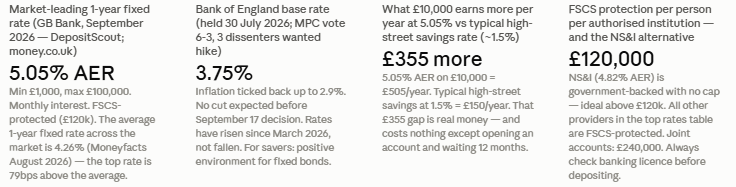
The Bank of England held rates at 3.75% in July 2026 — and with inflation ticking back up to 2.9%, a cut is not on the table before September’s meeting either. That is very good news for savers. One-year fixed bonds are now paying up to 5.05% AER, and the average one-year fixed rate has climbed from 3.79% in March to 4.26% in August. This guide covers the best accounts on the market right now, what to watch out for, and whether locking in for a year is the right call for your savings.
For fixed savings, this backdrop is supportive. When the market does not expect rate cuts in the near term, providers do not need to price in a decline and can offer competitive one-year fixed rates that genuinely reward commitment. The average one-year fixed savings rate has climbed from 3.79% at the start of March 2026 to 4.26% at the start of August 2026 — a meaningful increase of 47 basis points in five months, according to Moneyfacts data published by Moneyfactscompare.co.uk (August 27, 2026).
At the top of the market, the best one-year fixed rates now sit above 4.80% AER, with GB Bank leading the market at 5.05% AER as of September 2026 (DepositScout; money.co.uk). For a saver with £10,000 to put to work, the difference between the market-leading fixed rate (5.05%) and a typical easy-access account at or near the base rate (3.75%) is approximately £130 per year in additional interest — and the difference versus leaving money in a high-street bank’s standard savings account (often 1-2%) is substantially larger.
Moneyfactscompare noted in its August 2026 analysis that ‘the leading rate on one-year bonds has edged higher since March, which has given savers more opportunity to maximise the return on their money.’ The caveat is that rates can change quickly: Moneyfactscompare also notes that ‘providers can amend rates and products relatively quickly, savers shouldn’t delay if they see a competitive account that’s right for them.’
Bank of England base rate: 3.75% (held 30 July 2026; next decision 17 September 2026). MPC vote: 6-3 for hold (3 dissenters wanted hike). Inflation: 2.9% (September 2026). Average one-year fixed rate: 4.26% (August 2026, up from 3.79% in March 2026 -- Moneyfacts via Moneyfactscompare.co.uk). Best one-year fixed rate: 5.05% AER (GB Bank, September 2026 -- DepositScout; money.co.uk). FSCS limit: £120,000 per person per authorised institution (£240,000 joint). PSA: £1,000 (basic rate); £500 (higher rate); £0 (additional rate).
The defining feature is the guarantee: the rate you see when you open the account is the rate you get for the full term, regardless of what happens to the Bank of England base rate, inflation, or the broader savings market in the intervening 12 months. If rates fall after you lock in, you continue to earn your agreed rate. If rates rise, you are stuck at the lower rate until maturity.
The trade-off is access. Almost all one-year fixed savings accounts do not permit withdrawals before the maturity date. Once you deposit your money, it is locked away until the account matures. Some providers allow closure in exceptional circumstances (typically bereavement), but this usually involves a penalty equivalent to the lost interest. The no-access condition is what providers offer in exchange for the higher rate: they need to know the deposit will be available to them for the full term in order to deploy it effectively and price the rate competitively.
Interest can be paid in different ways depending on the account. Some pay interest monthly (which allows the income to be used or redirected), some pay annually on the anniversary, and some pay all interest at maturity. For most savers, the annual equivalent rate (AER) is the correct figure to compare between accounts regardless of interest payment frequency, as it standardises the return to an annual basis accounting for compounding.
A one-year fixed bond is most appropriate when: (a) you have a lump sum you are confident you will not need for at least 12 months; (b) you believe rates are likely to stay the same or fall during the term (making locking in attractive); (c) you have already kept three to six months of expenses in an accessible emergency fund. If any of those three conditions are not met, easy access may be a better fit. Not financial advice.
Rates change frequently. Always verify the current rate directly with the provider before opening an account. Providers listed have been given in good faith based on available data at time of writing. The inclusion of a provider in this table does not constitute a recommendation.

GB Bank is an FSCS-authorised UK bank that specialises in savings products and SME lending. It is authorised by the Prudential Regulation Authority (PRA) and regulated by the Financial Conduct Authority (FCA) and the PRA. Its deposits are protected by the FSCS up to £120,000 per person. The £100,000 maximum deposit means that most savers can deposit their full eligible savings with a single institution and remain comfortably within FSCS protection limits.
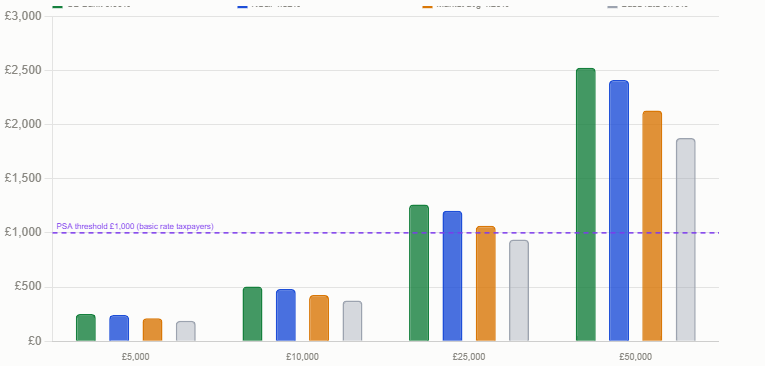
At 5.05% AER on a £10,000 deposit, the estimated interest for the year is £505 (DepositScout return calculator). On £50,000, that rises to approximately £2,525 before tax. On the maximum £100,000, the estimated interest is approximately £5,050 before tax. Basic rate taxpayers whose savings interest (from all sources) exceeds their £1,000 Personal Savings Allowance will owe income tax on the excess at 20%.
GB Bank contacts savers at least 14 calendar days before the maturity date to outline the options available — typically rollover to a new fixed term, transfer out, or a move to an easy access account. This notice period gives savers adequate time to decide whether to lock in again for another term or redirect the funds.
GB Bank 1 Year Fixed Rate Bond: 5.05% AER (September 2026 market-leading rate). Min £1,000, max £100,000. Monthly interest. FSCS-protected (£120,000). Interest on £10,000: approx £505/year before tax. Interest on £50,000: approx £2,525/year before tax. 14 days' notice before maturity. Source: DepositScout September 2026; money.co.uk. Always verify the current rate at gbbank.co.uk before applying. Not financial advice.
The defining feature of NS&I products is not their rate — there are higher rates available elsewhere — but their backing. NS&I products are backed 100% by HM Treasury. They are not FSCS-protected in the conventional sense, because they do not need to be: the government guarantee means there is no effective cap on the protection. A saver can deposit up to £1 million in NS&I Guaranteed Bonds and the entire amount is government-backed. For savers with amounts above the £120,000 FSCS limit, NS&I provides a qualitatively different level of security than any other savings provider.
Caitlyn Eastell, Personal Finance Analyst at Moneyfactscompare.co.uk, commented on the July rate increase: ‘NS&I’s decision to increase rates on its British Savings Bonds is a welcome boost for savers and makes them a far more competitive option in the current fixed rate savings market.’ The Moneyfactscompare analysis noted, however, that ‘higher returns can be found elsewhere,’ with rates above 5% available on fixed savings products from other providers.
For the Guaranteed Growth Bond, interest is added to the bond on each anniversary and is not accessible until maturity. For the Guaranteed Income Bond, interest is paid monthly to a nominated bank account — making it suitable for retirees or others who want a regular income stream from their savings without locking up the income along with the capital.
NS&I is the right choice when: (a) you have more than £120,000 to save with a single institution, making you vulnerable to exceeding FSCS limits elsewhere; (b) you specifically want income paid monthly (the Guaranteed Income Bond); or (c) your primary priority is absolute security over maximum rate. The 23 basis point rate difference between NS&I (4.82%) and GB Bank (5.05%) costs approximately £23 per year per £10,000 saved. The government guarantee may be worth that premium to many savers. Not financial advice. Always verify with nsandi.com.
OakNorth’s Personal 12 Month Fixed Term Deposit stands out for its unusually low minimum deposit of £1 — one of the lowest in the market — and a maximum deposit of £500,000, making it accessible to both small and larger savers with a single account. Money.co.uk’s editorial team awarded it an expert verdict of 4.8 out of 5 as their top editorial pick for one-year bonds in September 2026, citing the low entry point, competitive rate (4.76% AER), and FSCS protection. OakNorth Bank is authorised by the PRA and regulated by the FCA and PRA.
Vanquis Bank pays 4.78% AER on its one-year fixed rate bond with a £1,000 minimum, interest payable monthly or annually, and FSCS protection. Vanquis Bank is best known as a credit card provider for borrowers with non-standard credit histories, but its savings arm offers fully regulated, FSCS-protected deposits. The flexibility of monthly or annual interest payment is a useful feature for savers who want income flexibility within a fixed-term account.
Union Bank of India (UK) Ltd’s Union Premier Bond pays 4.76% AER with a £1,000 minimum and interest paid at maturity. Union Bank of India (UK) Ltd is the UK subsidiary of Union Bank of India (a major Indian state-owned bank) and is authorised by the PRA and regulated by the FCA and PRA. FSCS protection applies up to £120,000. Interest at maturity means the full interest is received in a single payment at the end of the year, which may be preferable for tax planning in some circumstances (allowing the interest to fall into the following tax year).
How to compare these accounts: (1) Check the minimum deposit -- OakNorth accepts from £1; Vanquis and Union Bank from £1,000; HBZ requires £5,000. (2) Consider interest timing -- monthly (Vanquis, GB Bank) vs on maturity (Union Bank, HBZ, OakNorth). (3) Confirm FSCS protection and the total amount you will deposit with each institution. (4) Use the AER to compare rates across accounts regardless of interest payment frequency. (5) Verify the current rate directly with each provider before applying -- rates in this guide reflect September 2026 market data and are subject to change. Not financial advice.
Note: figures are estimates based on the AER and assume a single deposit with no withdrawals. Interest is taxable above the Personal Savings Allowance (£1,000 for basic rate taxpayers; £500 for higher rate; £0 for additional rate). Individual tax position varies. Not financial or tax advice.
Easy-access savings accounts pay lower rates than the best fixed bonds — the best easy-access rates in September 2026 are in the 4.5–4.8% range for competitive challenger banks, lower for high-street institutions — but they allow you to withdraw your money at any time (usually with same-day or next-day availability). For money you might need in the next 12 months — for a planned purchase, emergency expenses, or general liquidity — easy access is the right choice even at a lower rate.
A fixed-rate bond is appropriate when you have a specific sum that you are genuinely confident you will not need for the full term. The classic guidance is to maintain three to six months of living expenses in an accessible account first, and then consider fixing the remainder. If your £10,000 represents your only liquid savings and an emergency could require some of it at short notice, a fixed bond is the wrong home for it regardless of the rate premium.
One practical middle path is to split your savings. Keep three to six months of expenses in an easy-access account (either at a competitive challenger bank or within a Cash ISA wrapper if you have allowance remaining), and fix the balance for 12 months. This gives you both the security of accessible funds and the benefit of a higher rate on the portion that can genuinely be committed for a year.
The only circumstance in which early access to a one-year fixed bond is typically possible is a significant life event such as death or terminal illness. Do not open a fixed-rate bond with money you may need before the term ends. Unlike an easy-access account, you will almost certainly not be able to retrieve the funds early, or will face penalties for doing so that eliminate the benefit of the higher rate. Not financial advice.
The FSCS limit applies per person per banking licence, not per account or per product. If you hold a current account, an ISA, and a fixed bond all with the same bank, your combined deposits are protected up to £120,000 in total — not £120,000 per account. This matters particularly for savers with larger balances: if you hold £150,000 across two accounts with the same institution, only £120,000 is protected. The remaining £30,000 is at risk in the unlikely event of the institution failing.
Several providers in the comparison table above share banking licences with other institutions. It is important to check which banking licence any savings account operates under before depositing, particularly if you hold accounts with multiple brands. The FSCS website (fscs.org.uk) and the ‘who owns whom’ guides published by comparison sites like DepositScout allow you to verify the licence structure of each provider.
NS&I is the exception: its products are not covered by the FSCS but are instead backed directly by HM Treasury (the UK government). This provides effectively unlimited protection for NS&I deposits, making it the only savings option with no deposit protection cap. The trade-off is that NS&I’s rates are typically slightly below the market-leading rates from FSCS-protected challenger banks.
For most savers with balances below £120,000 per institution, FSCS protection provides ample security and the choice of provider can be made primarily on rate and service quality. Savers with balances above £120,000 should either: (a) split deposits across multiple banking licences to stay within FSCS limits at each; or (b) use NS&I for the excess, accepting the lower rate in exchange for the government guarantee. Not financial advice. FSCS limit correct at time of writing (2026) -- verify at fscs.org.uk.
The PSA in 2026 remains at £1,000 per year for basic rate (20%) taxpayers and £500 per year for higher rate (40%) taxpayers. Additional rate (45%) taxpayers receive no PSA and pay tax on all savings interest. The PSA covers interest from all savings sources combined — not per account.
At 5.05% AER, a £19,802 deposit generates approximately £1,000 in interest — exactly the basic rate taxpayer’s PSA. Interest above that threshold is taxable. A basic rate taxpayer with £30,000 in a 5.05% bond generates approximately £1,515 in interest. The first £1,000 is covered by the PSA; the remaining £515 is taxable at 20%, meaning a tax bill of approximately £103.
For higher rate (40%) taxpayers, the PSA is only £500, so a much smaller deposit generates a tax liability. At 5.05%, a £10,000 deposit generates £505 in interest — £5 above the PSA. The tax on that £5 excess is £2 at 40%, which is negligible. But at £30,000 at 5.05%, interest is approximately £1,515, with £1,015 above the PSA taxable at 40% — a tax bill of approximately £406. For additional rate taxpayers, the entire £1,515 is taxable at 45%, giving a tax bill of approximately £682.
Tax on savings interest is collected via PAYE (for employees) or Self Assessment (for the self-employed). HMRC receives information about savings interest automatically from banks. You do not need to open a tax return solely because of savings interest, but the interest must be declared if it exceeds your PSA. Cash ISAs remain the primary vehicle for sheltering savings interest from tax -- the ISA allowance is £20,000 per person per tax year. If you have unused ISA allowance, consider a one-year fixed Cash ISA in preference to a fixed savings bond for the same term and a similar rate. Not financial or tax advice. Consult HMRC or a qualified tax adviser for guidance specific to your situation.
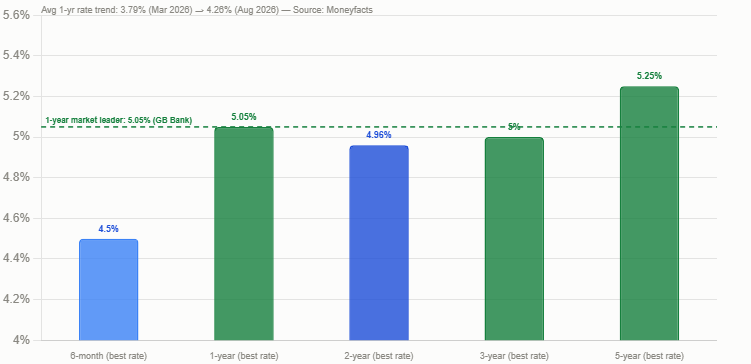
The two-year fixed market is currently paying up to 4.96% AER (Shawbrook Bank via Raisin, or direct; Investec Save at 4.95% AER) according to Which? Moneyfacts data from September 8, 2026. The three-year market reaches 5.00% AER (Investec Save Fixed Rate Saver). The five-year market reaches 5.25% AER (GB Bank five-year bond) and 5.00% AER (Atom Bank five-year fixed saver), according to DepositScout and money.co.uk September 2026.
The rate premium for longer terms over one year is currently modest: the difference between GB Bank’s one-year rate (5.05%) and its five-year rate (5.25%) is just 20 basis points. For a saver with £10,000, the annual difference is approximately £20 per year. That is a relatively small premium for committing money for four additional years. If you anticipate needing the funds before five years are up, or if you believe rates will rise further (making a shorter commitment that frees you to refix at higher rates more attractive), the one-year bond may be the more prudent choice.
If you expect rates to fall over the next two to five years (which many analysts project, though the September 2026 environment has surprised to the upside), locking in a longer-term bond at today’s rates protects you from the decline. The right decision depends on your personal rate view, which nobody can forecast with certainty.
DepositScout’s September 2026 savings guide observes that its rate history graphs — which show whether a provider tends to hold its rate or cut it soon after launch — are ‘worth thirty seconds before you commit.’ A provider that consistently launches at competitive rates and then cuts them is a different proposition from one with a stable rate history.
The supporting environment is equally positive. The Bank of England held rates at 3.75% in July, with three MPC members calling for a hike. Inflation has ticked back up to 2.9%. Nobody is seriously expecting a cut before the September 17 decision. For savers with money they can lock away for 12 months, this is the most straightforward savings environment in several years: high rates, no imminent cut threat, and a wide range of well-regulated FSCS-protected options.
The most important action is timing. Moneyfactscompare’s August 2026 analysis warns that ‘providers can amend rates and products relatively quickly, savers shouldn’t delay if they see a competitive account that’s right for them.’ Compare today’s rates, confirm your FSCS position, check the tax implications against your PSA, and open the account that matches your deposit size, interest payment preference, and term requirements.
Not financial advice — all information in this guide reflects September 2026 market data. Always verify current rates directly with providers before applying. FSCS coverage is up to £120,000 per person per authorised institution. Interest is taxable above your Personal Savings Allowance. Consult a qualified financial adviser if you need personalised guidance.
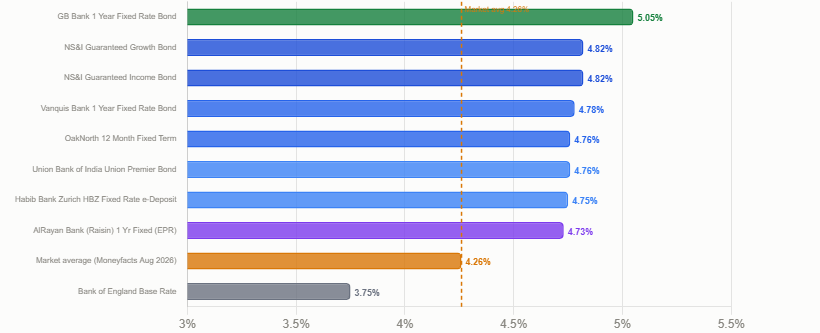
As of September 2026, the best one-year fixed savings rate in the UK is 5.05% AER, offered by GB Bank on its 1 Year Fixed Rate Bond. The minimum deposit is £1,000 and the maximum is £100,000. Interest is paid monthly and the account is FSCS-protected up to £120,000. Other leading rates include NS&I Guaranteed Growth and Income Bonds at 4.82% AER (government-backed, no FSCS cap), Vanquis Bank at 4.78% AER, OakNorth 12 Month Fixed Term Deposit at 4.76% AER, and Union Bank of India (UK) Premier Bond at 4.76% AER. The average one-year fixed rate across the market stood at 4.26% in August 2026, according to Moneyfacts data. Always verify the current rate directly with the provider before applying, as rates change frequently. Not financial advice. Sources: DepositScout September 2026; Which? Moneyfacts September 2026; Moneyfactscompare.co.uk August 2026.
Is my money safe in a fixed-rate savings bond?
Yes, for UK-authorised institutions. Deposits in fixed-rate savings bonds held with UK-authorised banks and building societies are protected by the Financial Services Compensation Scheme (FSCS) up to £120,000 per person per authorised institution (£240,000 for joint accounts). The FSCS guarantees that if a UK-authorised bank or building society fails, your eligible deposits up to £120,000 are repaid, typically within seven working days. The FSCS limit applies to combined deposits with the same institution, not per account. If you hold more than £120,000 with a single institution (across all accounts), only £120,000 is protected. For amounts above this, consider splitting deposits across different banking licences, or using NS&I whose products carry a full HM Treasury government guarantee with no cap. Always check the banking licence of a provider before depositing, particularly if you hold accounts with multiple brands that may share a licence. Verify the FSCS position for any specific account at fscs.org.uk. Not financial advice.
Can I withdraw money from a one-year fixed savings account early?
In almost all cases, no. One-year fixed savings accounts are designed specifically to hold your money for the full 12-month term, and most do not permit withdrawals before maturity. This is the core trade-off: in exchange for the higher guaranteed rate, you accept that the funds are locked away. Some providers allow closure in exceptional circumstances such as terminal illness or bereavement, but this typically involves a penalty (usually forfeiture of some or all of the interest) that eliminates much of the benefit of the higher rate. Before opening a fixed-rate bond, ensure that the funds you intend to deposit are genuinely surplus to your needs for at least 12 months. If you have any prospect of needing the money before the term ends, an easy-access savings account at a competitive challenger bank is a better fit, even at a lower rate. Not financial advice.
Do I pay tax on the interest from a fixed savings account?
Yes, interest from a fixed savings account is taxable income. However, the Personal Savings Allowance (PSA) allows UK savers to earn a certain amount of savings interest tax-free each year. In 2026, basic rate (20%) taxpayers can earn up to £1,000 in savings interest tax-free per year. Higher rate (40%) taxpayers have a PSA of £500. Additional rate (45%) taxpayers have no PSA. These limits apply to total savings interest from all sources combined. If your interest exceeds your PSA, the excess is taxable at your marginal rate. HMRC receives information about savings interest directly from banks, so it typically adjusts your PAYE tax code to collect any tax owed, or you may need to complete a Self Assessment return. Cash ISAs provide a tax-efficient alternative: interest earned in a Cash ISA does not count toward your PSA and is completely tax-free. The annual ISA allowance is £20,000. Not financial or tax advice. Verify your position with HMRC at gov.uk/tax-on-savings or consult a qualified tax adviser.
Should I fix for one year or consider a longer-term bond?
The right answer depends on three things: your need for the money, your view on interest rates, and the rate premium available for longer terms. In September 2026, two-year fixed bonds pay up to 4.96% AER (Shawbrook Bank via Raisin; Investec Save), three-year bonds pay up to 5.00% AER (Investec Save), and five-year bonds pay up to 5.25% AER (GB Bank). The premium over the best one-year rate (5.05% AER) is modest -- for two years, actually slightly less; for five years, 20 basis points more. If you believe rates will fall over the next two to five years, locking in a longer-term bond protects you from that decline. If you expect rates to rise or stay high, a one-year bond gives you the flexibility to switch to a better rate at maturity. If you might need the money within two years, the one-year bond is the safest choice. Splitting between terms -- fixing some money for one year and some for longer -- diversifies across rate scenarios. Not financial advice. Always compare current rates directly before applying.
Table of Contents
- Why September 2026 Is a Good Time to Fix Your Savings
- What Is a One-Year Fixed Savings Account?
- The Best One-Year Fixed Rate Bonds Right Now
- GB Bank — The 5.05% Market Leader
- NS&I Guaranteed Growth and Income Bonds — The Safest Option
- OakNorth, Vanquis, Union Bank of India — Strong Challengers
- What £10,000 Earns at the Top Rates
- Fixed vs Easy Access: Which Is Right for You?
- FSCS Protection: What It Covers and What It Doesn’t
- Tax on Savings Interest: What You Need to Know
- Should You Fix for One Year or Longer?
- How to Open a One-Year Fixed Savings Account
- Conclusion: Rates Are Up — Act Before They Move
- Frequently Asked Questions
Best 1-year fixed rates — September 2026
What your money earns — £5k, £10k, £25k, £50k
Rate context — market trends and term comparison
Why September 2026 Is a Good Time to Fix Your Savings
For savers who have been waiting for the right moment to lock into a fixed-rate account, September 2026 presents a compelling case to act. The Bank of England held the base rate at 3.75% at its 30 July meeting — and with inflation ticking back up to 2.9%, the Monetary Policy Committee voted 6-3, with three members calling for a hike rather than a cut. The September decision, due on 17 September 2026, is widely expected to hold or potentially tighten, not ease (DepositScout, September 2026).For fixed savings, this backdrop is supportive. When the market does not expect rate cuts in the near term, providers do not need to price in a decline and can offer competitive one-year fixed rates that genuinely reward commitment. The average one-year fixed savings rate has climbed from 3.79% at the start of March 2026 to 4.26% at the start of August 2026 — a meaningful increase of 47 basis points in five months, according to Moneyfacts data published by Moneyfactscompare.co.uk (August 27, 2026).
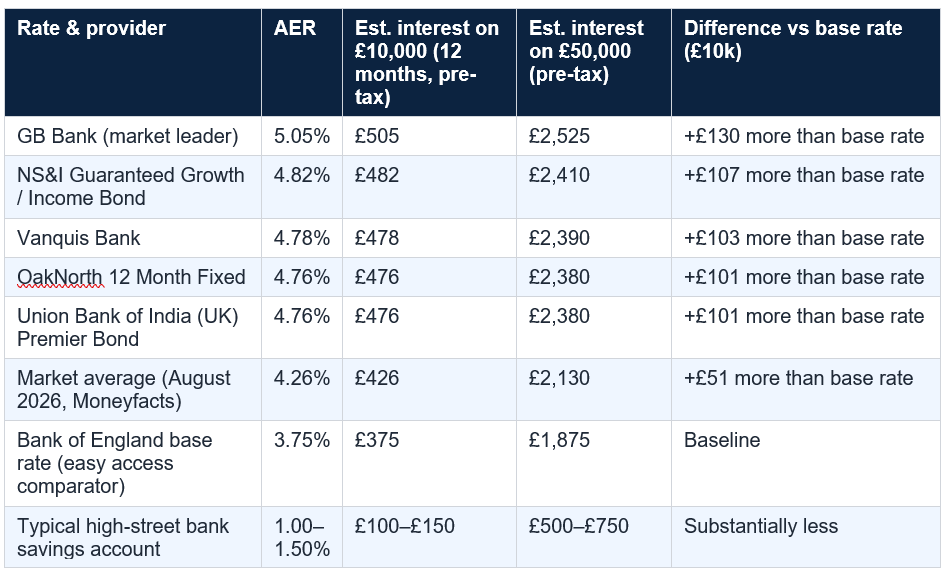
At the top of the market, the best one-year fixed rates now sit above 4.80% AER, with GB Bank leading the market at 5.05% AER as of September 2026 (DepositScout; money.co.uk). For a saver with £10,000 to put to work, the difference between the market-leading fixed rate (5.05%) and a typical easy-access account at or near the base rate (3.75%) is approximately £130 per year in additional interest — and the difference versus leaving money in a high-street bank’s standard savings account (often 1-2%) is substantially larger.
Moneyfactscompare noted in its August 2026 analysis that ‘the leading rate on one-year bonds has edged higher since March, which has given savers more opportunity to maximise the return on their money.’ The caveat is that rates can change quickly: Moneyfactscompare also notes that ‘providers can amend rates and products relatively quickly, savers shouldn’t delay if they see a competitive account that’s right for them.’
Bank of England base rate: 3.75% (held 30 July 2026; next decision 17 September 2026). MPC vote: 6-3 for hold (3 dissenters wanted hike). Inflation: 2.9% (September 2026). Average one-year fixed rate: 4.26% (August 2026, up from 3.79% in March 2026 -- Moneyfacts via Moneyfactscompare.co.uk). Best one-year fixed rate: 5.05% AER (GB Bank, September 2026 -- DepositScout; money.co.uk). FSCS limit: £120,000 per person per authorised institution (£240,000 joint). PSA: £1,000 (basic rate); £500 (higher rate); £0 (additional rate).
What Is a One-Year Fixed Savings Account?
A one-year fixed savings account — also called a one-year fixed rate bond or a one-year fixed term deposit — is a savings product that locks your money away for exactly 12 months in exchange for a guaranteed interest rate that does not change during that period. When the year is up, you receive your original deposit back plus the accumulated interest.The defining feature is the guarantee: the rate you see when you open the account is the rate you get for the full term, regardless of what happens to the Bank of England base rate, inflation, or the broader savings market in the intervening 12 months. If rates fall after you lock in, you continue to earn your agreed rate. If rates rise, you are stuck at the lower rate until maturity.
The trade-off is access. Almost all one-year fixed savings accounts do not permit withdrawals before the maturity date. Once you deposit your money, it is locked away until the account matures. Some providers allow closure in exceptional circumstances (typically bereavement), but this usually involves a penalty equivalent to the lost interest. The no-access condition is what providers offer in exchange for the higher rate: they need to know the deposit will be available to them for the full term in order to deploy it effectively and price the rate competitively.
Interest can be paid in different ways depending on the account. Some pay interest monthly (which allows the income to be used or redirected), some pay annually on the anniversary, and some pay all interest at maturity. For most savers, the annual equivalent rate (AER) is the correct figure to compare between accounts regardless of interest payment frequency, as it standardises the return to an annual basis accounting for compounding.
A one-year fixed bond is most appropriate when: (a) you have a lump sum you are confident you will not need for at least 12 months; (b) you believe rates are likely to stay the same or fall during the term (making locking in attractive); (c) you have already kept three to six months of expenses in an accessible emergency fund. If any of those three conditions are not met, easy access may be a better fit. Not financial advice.
The Best One-Year Fixed Rate Bonds Right Now
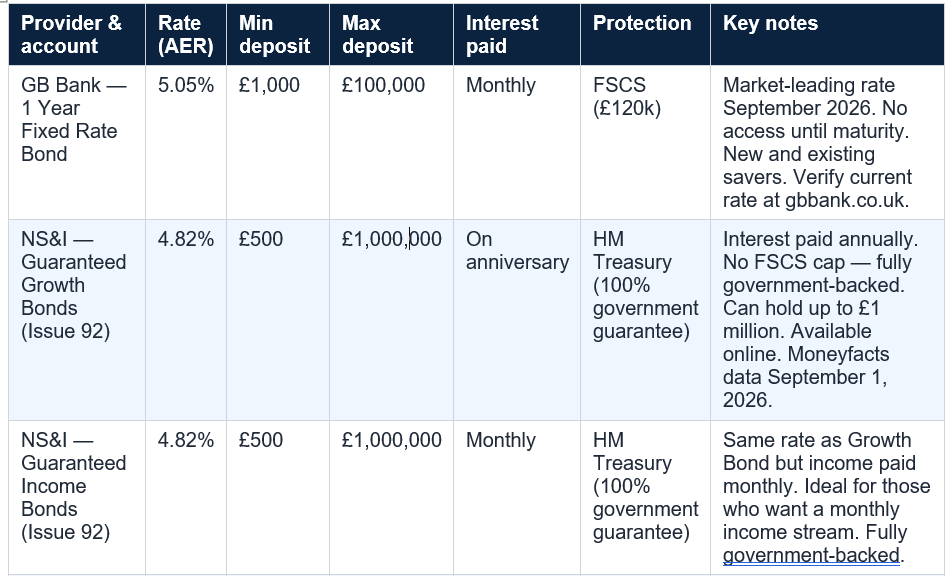
The table below shows the leading one-year fixed rate savings accounts available in the UK as of September 2026. Rates are sourced from DepositScout, Moneyfactscompare.co.uk, Which? Money (Moneyfacts data tables dated September 1 and September 8, 2026), and money.co.uk. All accounts listed are FSCS-protected up to £120,000 per person (except NS&I, which carries a full HM Treasury government guarantee).Rates change frequently. Always verify the current rate directly with the provider before opening an account. Providers listed have been given in good faith based on available data at time of writing. The inclusion of a provider in this table does not constitute a recommendation.
GB Bank — The 5.05% Market Leader
GB Bank’s one-year fixed rate bond is the headline rate in the market as of September 2026, paying 5.05% AER. DepositScout’s review of the account confirms the key terms: minimum deposit £1,000, maximum deposit £100,000, interest paid monthly, FSCS-protected up to £120,000, and no access until maturity. The account is available to new and existing savers.GB Bank is an FSCS-authorised UK bank that specialises in savings products and SME lending. It is authorised by the Prudential Regulation Authority (PRA) and regulated by the Financial Conduct Authority (FCA) and the PRA. Its deposits are protected by the FSCS up to £120,000 per person. The £100,000 maximum deposit means that most savers can deposit their full eligible savings with a single institution and remain comfortably within FSCS protection limits.
At 5.05% AER on a £10,000 deposit, the estimated interest for the year is £505 (DepositScout return calculator). On £50,000, that rises to approximately £2,525 before tax. On the maximum £100,000, the estimated interest is approximately £5,050 before tax. Basic rate taxpayers whose savings interest (from all sources) exceeds their £1,000 Personal Savings Allowance will owe income tax on the excess at 20%.
GB Bank contacts savers at least 14 calendar days before the maturity date to outline the options available — typically rollover to a new fixed term, transfer out, or a move to an easy access account. This notice period gives savers adequate time to decide whether to lock in again for another term or redirect the funds.
GB Bank 1 Year Fixed Rate Bond: 5.05% AER (September 2026 market-leading rate). Min £1,000, max £100,000. Monthly interest. FSCS-protected (£120,000). Interest on £10,000: approx £505/year before tax. Interest on £50,000: approx £2,525/year before tax. 14 days' notice before maturity. Source: DepositScout September 2026; money.co.uk. Always verify the current rate at gbbank.co.uk before applying. Not financial advice.
NS&I Guaranteed Growth and Income Bonds — The Safest Option
National Savings & Investments (NS&I) raised the rates on its British Savings Bonds on 31 July 2026, with the one-year version now offering 4.82% AER on both the Guaranteed Growth Bond (interest paid on anniversary) and the Guaranteed Income Bond (interest paid monthly). The rate applies to Issue 92 of both bonds (Which? Moneyfacts data September 1, 2026).The defining feature of NS&I products is not their rate — there are higher rates available elsewhere — but their backing. NS&I products are backed 100% by HM Treasury. They are not FSCS-protected in the conventional sense, because they do not need to be: the government guarantee means there is no effective cap on the protection. A saver can deposit up to £1 million in NS&I Guaranteed Bonds and the entire amount is government-backed. For savers with amounts above the £120,000 FSCS limit, NS&I provides a qualitatively different level of security than any other savings provider.
Caitlyn Eastell, Personal Finance Analyst at Moneyfactscompare.co.uk, commented on the July rate increase: ‘NS&I’s decision to increase rates on its British Savings Bonds is a welcome boost for savers and makes them a far more competitive option in the current fixed rate savings market.’ The Moneyfactscompare analysis noted, however, that ‘higher returns can be found elsewhere,’ with rates above 5% available on fixed savings products from other providers.
For the Guaranteed Growth Bond, interest is added to the bond on each anniversary and is not accessible until maturity. For the Guaranteed Income Bond, interest is paid monthly to a nominated bank account — making it suitable for retirees or others who want a regular income stream from their savings without locking up the income along with the capital.
NS&I is the right choice when: (a) you have more than £120,000 to save with a single institution, making you vulnerable to exceeding FSCS limits elsewhere; (b) you specifically want income paid monthly (the Guaranteed Income Bond); or (c) your primary priority is absolute security over maximum rate. The 23 basis point rate difference between NS&I (4.82%) and GB Bank (5.05%) costs approximately £23 per year per £10,000 saved. The government guarantee may be worth that premium to many savers. Not financial advice. Always verify with nsandi.com.
OakNorth, Vanquis, Union Bank of India — Strong Challengers
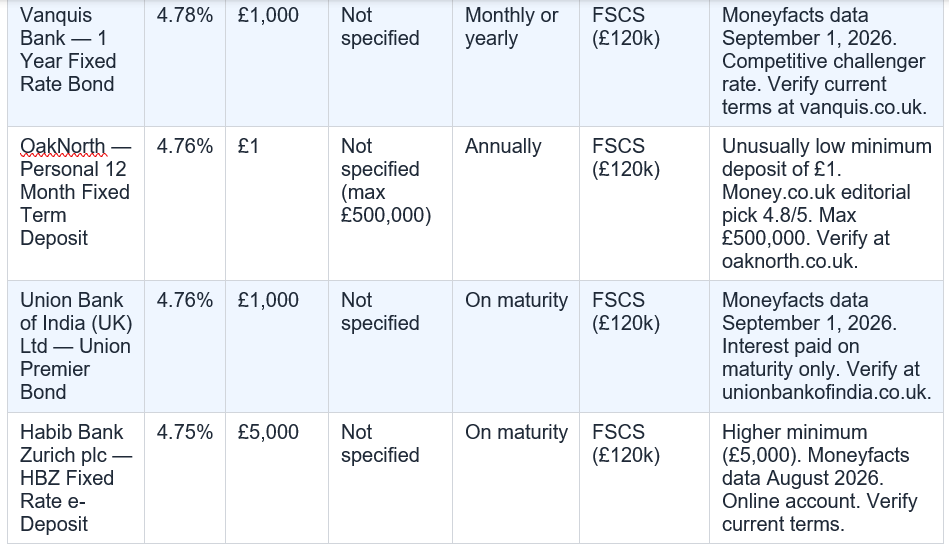
Three providers offer particularly notable one-year fixed rates in the 4.75–4.78% range, each with a distinct feature that may suit different savers.OakNorth’s Personal 12 Month Fixed Term Deposit stands out for its unusually low minimum deposit of £1 — one of the lowest in the market — and a maximum deposit of £500,000, making it accessible to both small and larger savers with a single account. Money.co.uk’s editorial team awarded it an expert verdict of 4.8 out of 5 as their top editorial pick for one-year bonds in September 2026, citing the low entry point, competitive rate (4.76% AER), and FSCS protection. OakNorth Bank is authorised by the PRA and regulated by the FCA and PRA.
Vanquis Bank pays 4.78% AER on its one-year fixed rate bond with a £1,000 minimum, interest payable monthly or annually, and FSCS protection. Vanquis Bank is best known as a credit card provider for borrowers with non-standard credit histories, but its savings arm offers fully regulated, FSCS-protected deposits. The flexibility of monthly or annual interest payment is a useful feature for savers who want income flexibility within a fixed-term account.
Union Bank of India (UK) Ltd’s Union Premier Bond pays 4.76% AER with a £1,000 minimum and interest paid at maturity. Union Bank of India (UK) Ltd is the UK subsidiary of Union Bank of India (a major Indian state-owned bank) and is authorised by the PRA and regulated by the FCA and PRA. FSCS protection applies up to £120,000. Interest at maturity means the full interest is received in a single payment at the end of the year, which may be preferable for tax planning in some circumstances (allowing the interest to fall into the following tax year).
How to compare these accounts: (1) Check the minimum deposit -- OakNorth accepts from £1; Vanquis and Union Bank from £1,000; HBZ requires £5,000. (2) Consider interest timing -- monthly (Vanquis, GB Bank) vs on maturity (Union Bank, HBZ, OakNorth). (3) Confirm FSCS protection and the total amount you will deposit with each institution. (4) Use the AER to compare rates across accounts regardless of interest payment frequency. (5) Verify the current rate directly with each provider before applying -- rates in this guide reflect September 2026 market data and are subject to change. Not financial advice.
What £10,000 Earns at the Top Rates
The table below shows estimated interest on a £10,000 deposit over 12 months at key rates available in September 2026, before tax. Tax position depends on your other savings income and your taxpayer status.Note: figures are estimates based on the AER and assume a single deposit with no withdrawals. Interest is taxable above the Personal Savings Allowance (£1,000 for basic rate taxpayers; £500 for higher rate; £0 for additional rate). Individual tax position varies. Not financial or tax advice.
Fixed vs Easy Access: Which Is Right for You?
The choice between a fixed-rate bond and an easy-access savings account is fundamentally a choice between higher guaranteed returns and flexibility. Both have their place, and neither is universally superior. The right choice depends on your personal circumstances, financial commitments, and appetite for locking money away.Easy-access savings accounts pay lower rates than the best fixed bonds — the best easy-access rates in September 2026 are in the 4.5–4.8% range for competitive challenger banks, lower for high-street institutions — but they allow you to withdraw your money at any time (usually with same-day or next-day availability). For money you might need in the next 12 months — for a planned purchase, emergency expenses, or general liquidity — easy access is the right choice even at a lower rate.
A fixed-rate bond is appropriate when you have a specific sum that you are genuinely confident you will not need for the full term. The classic guidance is to maintain three to six months of living expenses in an accessible account first, and then consider fixing the remainder. If your £10,000 represents your only liquid savings and an emergency could require some of it at short notice, a fixed bond is the wrong home for it regardless of the rate premium.
One practical middle path is to split your savings. Keep three to six months of expenses in an easy-access account (either at a competitive challenger bank or within a Cash ISA wrapper if you have allowance remaining), and fix the balance for 12 months. This gives you both the security of accessible funds and the benefit of a higher rate on the portion that can genuinely be committed for a year.
The only circumstance in which early access to a one-year fixed bond is typically possible is a significant life event such as death or terminal illness. Do not open a fixed-rate bond with money you may need before the term ends. Unlike an easy-access account, you will almost certainly not be able to retrieve the funds early, or will face penalties for doing so that eliminate the benefit of the higher rate. Not financial advice.
FSCS Protection: What It Covers and What It Doesn’t
The Financial Services Compensation Scheme (FSCS) is the UK’s deposit guarantee scheme. In 2026, it protects up to £120,000 per person per authorised institution (up to £240,000 for joint accounts). If a UK-authorised bank or building society fails, the FSCS guarantees that eligible deposits up to this limit are repaid to savers, typically within seven working days.The FSCS limit applies per person per banking licence, not per account or per product. If you hold a current account, an ISA, and a fixed bond all with the same bank, your combined deposits are protected up to £120,000 in total — not £120,000 per account. This matters particularly for savers with larger balances: if you hold £150,000 across two accounts with the same institution, only £120,000 is protected. The remaining £30,000 is at risk in the unlikely event of the institution failing.
Several providers in the comparison table above share banking licences with other institutions. It is important to check which banking licence any savings account operates under before depositing, particularly if you hold accounts with multiple brands. The FSCS website (fscs.org.uk) and the ‘who owns whom’ guides published by comparison sites like DepositScout allow you to verify the licence structure of each provider.
NS&I is the exception: its products are not covered by the FSCS but are instead backed directly by HM Treasury (the UK government). This provides effectively unlimited protection for NS&I deposits, making it the only savings option with no deposit protection cap. The trade-off is that NS&I’s rates are typically slightly below the market-leading rates from FSCS-protected challenger banks.
For most savers with balances below £120,000 per institution, FSCS protection provides ample security and the choice of provider can be made primarily on rate and service quality. Savers with balances above £120,000 should either: (a) split deposits across multiple banking licences to stay within FSCS limits at each; or (b) use NS&I for the excess, accepting the lower rate in exchange for the government guarantee. Not financial advice. FSCS limit correct at time of writing (2026) -- verify at fscs.org.uk.
Tax on Savings Interest: What You Need to Know
Savings interest earned on a fixed-rate bond is taxable income in the UK. The key framework is the Personal Savings Allowance (PSA), introduced in 2016, which allows savers to earn a certain amount of savings interest free of income tax each year.The PSA in 2026 remains at £1,000 per year for basic rate (20%) taxpayers and £500 per year for higher rate (40%) taxpayers. Additional rate (45%) taxpayers receive no PSA and pay tax on all savings interest. The PSA covers interest from all savings sources combined — not per account.
At 5.05% AER, a £19,802 deposit generates approximately £1,000 in interest — exactly the basic rate taxpayer’s PSA. Interest above that threshold is taxable. A basic rate taxpayer with £30,000 in a 5.05% bond generates approximately £1,515 in interest. The first £1,000 is covered by the PSA; the remaining £515 is taxable at 20%, meaning a tax bill of approximately £103.
For higher rate (40%) taxpayers, the PSA is only £500, so a much smaller deposit generates a tax liability. At 5.05%, a £10,000 deposit generates £505 in interest — £5 above the PSA. The tax on that £5 excess is £2 at 40%, which is negligible. But at £30,000 at 5.05%, interest is approximately £1,515, with £1,015 above the PSA taxable at 40% — a tax bill of approximately £406. For additional rate taxpayers, the entire £1,515 is taxable at 45%, giving a tax bill of approximately £682.
Tax on savings interest is collected via PAYE (for employees) or Self Assessment (for the self-employed). HMRC receives information about savings interest automatically from banks. You do not need to open a tax return solely because of savings interest, but the interest must be declared if it exceeds your PSA. Cash ISAs remain the primary vehicle for sheltering savings interest from tax -- the ISA allowance is £20,000 per person per tax year. If you have unused ISA allowance, consider a one-year fixed Cash ISA in preference to a fixed savings bond for the same term and a similar rate. Not financial or tax advice. Consult HMRC or a qualified tax adviser for guidance specific to your situation.
Should You Fix for One Year or Longer?
The comparison between one-year, two-year, and longer fixed-rate bonds depends on your view of the interest rate environment and your personal timeline. In September 2026, longer-term bonds offer meaningfully higher rates than one-year bonds in some cases, but not all.The two-year fixed market is currently paying up to 4.96% AER (Shawbrook Bank via Raisin, or direct; Investec Save at 4.95% AER) according to Which? Moneyfacts data from September 8, 2026. The three-year market reaches 5.00% AER (Investec Save Fixed Rate Saver). The five-year market reaches 5.25% AER (GB Bank five-year bond) and 5.00% AER (Atom Bank five-year fixed saver), according to DepositScout and money.co.uk September 2026.
The rate premium for longer terms over one year is currently modest: the difference between GB Bank’s one-year rate (5.05%) and its five-year rate (5.25%) is just 20 basis points. For a saver with £10,000, the annual difference is approximately £20 per year. That is a relatively small premium for committing money for four additional years. If you anticipate needing the funds before five years are up, or if you believe rates will rise further (making a shorter commitment that frees you to refix at higher rates more attractive), the one-year bond may be the more prudent choice.
If you expect rates to fall over the next two to five years (which many analysts project, though the September 2026 environment has surprised to the upside), locking in a longer-term bond at today’s rates protects you from the decline. The right decision depends on your personal rate view, which nobody can forecast with certainty.
DepositScout’s September 2026 savings guide observes that its rate history graphs — which show whether a provider tends to hold its rate or cut it soon after launch — are ‘worth thirty seconds before you commit.’ A provider that consistently launches at competitive rates and then cuts them is a different proposition from one with a stable rate history.
How to Open a One-Year Fixed Savings Account
Opening a one-year fixed savings account is typically straightforward. Most providers now offer fully online applications that can be completed in 10 to 20 minutes. Here is the standard process:- Check eligibility: most accounts require you to be aged 18 or over and a permanent UK resident. Some have maximum age requirements; some do not. Verify before applying.
- Prepare your documents: you will need a valid UK address, a UK bank account for transferring funds in and out, and identity verification (passport or driving licence, typically completed online via automated ID checks). Some providers may require a recent utility bill or bank statement as proof of address.
- Compare rates on the day you apply: the rate shown on comparison sites may not be the current rate. Always click through to the provider’s own website and confirm the rate is still as quoted before completing your application.
- Check the FSCS position before depositing: if you hold other accounts with the same institution (or its parent or sister banks), confirm that your combined balance will not exceed £120,000 with that banking licence. Use DepositScout’s rate history tool or the FSCS website to check banking licence relationships.
- Make the opening deposit within the specified window: most fixed-rate bonds have a funding window of 14 to 30 days after account opening. If the deposit is not received within this window, the account may be closed or the rate may change. Transfer the funds promptly once the account is opened.
- Note the maturity date and keep a diary reminder: if you take no action at maturity, most providers roll the balance into a lower-rate easy-access account or a new fixed bond at the prevailing rate, which may not be the best available. Set a reminder 30 days before maturity to compare rates and decide whether to switch.
Conclusion
One-year fixed savings rates are at their best levels in years, led by GB Bank at 5.05% AER and supported by a competitive market in which NS&I, Vanquis, OakNorth, Union Bank of India, and Habib Bank are all paying above 4.75% AER. The average one-year fixed rate has risen from 3.79% in March 2026 to 4.26% in August — and the leading rates are substantially above even that improved average.The supporting environment is equally positive. The Bank of England held rates at 3.75% in July, with three MPC members calling for a hike. Inflation has ticked back up to 2.9%. Nobody is seriously expecting a cut before the September 17 decision. For savers with money they can lock away for 12 months, this is the most straightforward savings environment in several years: high rates, no imminent cut threat, and a wide range of well-regulated FSCS-protected options.
The most important action is timing. Moneyfactscompare’s August 2026 analysis warns that ‘providers can amend rates and products relatively quickly, savers shouldn’t delay if they see a competitive account that’s right for them.’ Compare today’s rates, confirm your FSCS position, check the tax implications against your PSA, and open the account that matches your deposit size, interest payment preference, and term requirements.
Not financial advice — all information in this guide reflects September 2026 market data. Always verify current rates directly with providers before applying. FSCS coverage is up to £120,000 per person per authorised institution. Interest is taxable above your Personal Savings Allowance. Consult a qualified financial adviser if you need personalised guidance.
Frequently Asked Questions
What is the best one-year fixed savings rate in the UK right now?As of September 2026, the best one-year fixed savings rate in the UK is 5.05% AER, offered by GB Bank on its 1 Year Fixed Rate Bond. The minimum deposit is £1,000 and the maximum is £100,000. Interest is paid monthly and the account is FSCS-protected up to £120,000. Other leading rates include NS&I Guaranteed Growth and Income Bonds at 4.82% AER (government-backed, no FSCS cap), Vanquis Bank at 4.78% AER, OakNorth 12 Month Fixed Term Deposit at 4.76% AER, and Union Bank of India (UK) Premier Bond at 4.76% AER. The average one-year fixed rate across the market stood at 4.26% in August 2026, according to Moneyfacts data. Always verify the current rate directly with the provider before applying, as rates change frequently. Not financial advice. Sources: DepositScout September 2026; Which? Moneyfacts September 2026; Moneyfactscompare.co.uk August 2026.
Is my money safe in a fixed-rate savings bond?
Yes, for UK-authorised institutions. Deposits in fixed-rate savings bonds held with UK-authorised banks and building societies are protected by the Financial Services Compensation Scheme (FSCS) up to £120,000 per person per authorised institution (£240,000 for joint accounts). The FSCS guarantees that if a UK-authorised bank or building society fails, your eligible deposits up to £120,000 are repaid, typically within seven working days. The FSCS limit applies to combined deposits with the same institution, not per account. If you hold more than £120,000 with a single institution (across all accounts), only £120,000 is protected. For amounts above this, consider splitting deposits across different banking licences, or using NS&I whose products carry a full HM Treasury government guarantee with no cap. Always check the banking licence of a provider before depositing, particularly if you hold accounts with multiple brands that may share a licence. Verify the FSCS position for any specific account at fscs.org.uk. Not financial advice.
Can I withdraw money from a one-year fixed savings account early?
In almost all cases, no. One-year fixed savings accounts are designed specifically to hold your money for the full 12-month term, and most do not permit withdrawals before maturity. This is the core trade-off: in exchange for the higher guaranteed rate, you accept that the funds are locked away. Some providers allow closure in exceptional circumstances such as terminal illness or bereavement, but this typically involves a penalty (usually forfeiture of some or all of the interest) that eliminates much of the benefit of the higher rate. Before opening a fixed-rate bond, ensure that the funds you intend to deposit are genuinely surplus to your needs for at least 12 months. If you have any prospect of needing the money before the term ends, an easy-access savings account at a competitive challenger bank is a better fit, even at a lower rate. Not financial advice.
Do I pay tax on the interest from a fixed savings account?
Yes, interest from a fixed savings account is taxable income. However, the Personal Savings Allowance (PSA) allows UK savers to earn a certain amount of savings interest tax-free each year. In 2026, basic rate (20%) taxpayers can earn up to £1,000 in savings interest tax-free per year. Higher rate (40%) taxpayers have a PSA of £500. Additional rate (45%) taxpayers have no PSA. These limits apply to total savings interest from all sources combined. If your interest exceeds your PSA, the excess is taxable at your marginal rate. HMRC receives information about savings interest directly from banks, so it typically adjusts your PAYE tax code to collect any tax owed, or you may need to complete a Self Assessment return. Cash ISAs provide a tax-efficient alternative: interest earned in a Cash ISA does not count toward your PSA and is completely tax-free. The annual ISA allowance is £20,000. Not financial or tax advice. Verify your position with HMRC at gov.uk/tax-on-savings or consult a qualified tax adviser.
Should I fix for one year or consider a longer-term bond?
The right answer depends on three things: your need for the money, your view on interest rates, and the rate premium available for longer terms. In September 2026, two-year fixed bonds pay up to 4.96% AER (Shawbrook Bank via Raisin; Investec Save), three-year bonds pay up to 5.00% AER (Investec Save), and five-year bonds pay up to 5.25% AER (GB Bank). The premium over the best one-year rate (5.05% AER) is modest -- for two years, actually slightly less; for five years, 20 basis points more. If you believe rates will fall over the next two to five years, locking in a longer-term bond protects you from that decline. If you expect rates to rise or stay high, a one-year bond gives you the flexibility to switch to a better rate at maturity. If you might need the money within two years, the one-year bond is the safest choice. Splitting between terms -- fixing some money for one year and some for longer -- diversifies across rate scenarios. Not financial advice. Always compare current rates directly before applying.

0 Comments Comments