

Savings
Best Regular Bank Savings Accounts UK: Complete Guide

RATES CURRENT | Santander and Lloyds both pay 8% AER on regular savers. First Direct and HSBC pay 7%. Skipton BS pays 5.5% -- no current account needed. Easy access best rate: 5%. Bank of England base rate: 3.75%. MoneyfactsCompare data updated 1 hour ago.
BankingGeek (July 2026): 'Regular savings accounts pay some of the highest interest rates on the UK market right now, with top deals reaching well above 6% AER while easy access accounts sit closer to 4-5%. The trade-off is that you commit to saving a fixed amount every month, usually between £25 and £300, rather than depositing a lump sum.' Which? (rates sourced from Moneyfacts, 27 July 2026): 'Regular savings accounts can offer higher interest rates than other savings accounts, but some require you to have a current account with the same provider. Unlike fixed-rate bonds or instant-access accounts, which allow you to deposit a lump sum, you'll be much more restricted on the amount you can pay into a regular savings account. Maximum monthly deposits are typically between £200 and £300.'
The key structural point about regular savers that most people do not appreciate: because you deposit a fixed monthly amount rather than a lump sum, the interest you actually earn is significantly less than the headline rate applied to the total amount deposited. Kias Consulting (July 2026): 'The effective rate is roughly half the headline. That is still worth having.' This guide covers every top rate available right now, how much you will actually earn on each account, who qualifies, and the smart strategy for getting the best possible return on your savings in the current environment.
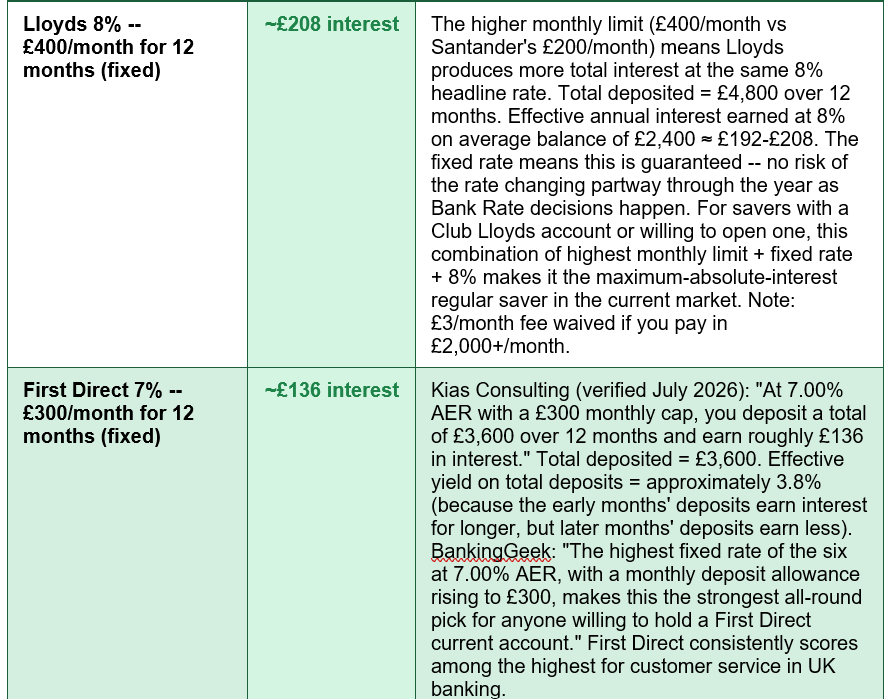
The mechanics are simple but have a nuance that most people miss. Unlike a fixed-rate bond or easy-access savings account where you deposit a lump sum and earn the full interest rate on the entire balance for the full year, a regular saver builds up balance gradually. You deposit £200 in month 1, £200 in month 2, and so on. The month 1 deposit earns 12 months of interest; the month 12 deposit earns only one month of interest. The average balance over the year is therefore roughly half the total deposited. Kias Consulting (July 2026): 'At 7.00% AER with a £300 monthly cap, you deposit a total of £3,600 over 12 months and earn roughly £136 in interest.' That £136 on £3,600 deposited looks like a 3.8% effective rate -- but it remains significantly better than the best easy-access account for money you were going to save monthly anyway.
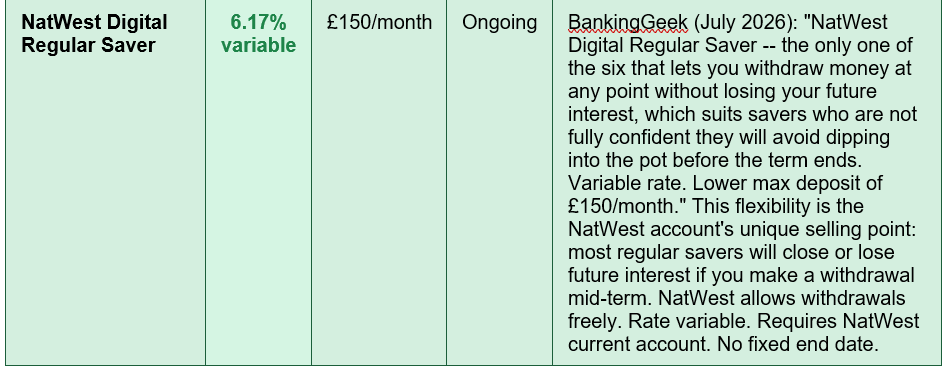
There are two additional features to understand. First, most regular savers require you to hold a linked current account with the same provider -- this is how Santander, Lloyds, First Direct, HSBC, and Nationwide offer their top rates, as they use the regular saver to reward existing or new current account holders. Second, most regular savers will close, reduce your rate, or forfeit accrued interest if you miss monthly deposits or make withdrawals mid-term. The exception is NatWest's Digital Regular Saver, which allows withdrawals without penalty -- a useful flexibility for savers who are not fully certain they can commit to monthly deposits.
Regular savings accounts -- July 2026 top rates: Best rate: 8% AER (Santander & Lloyds). Fixed: 8% Lloyds, 7% First Direct & HSBC. Variable: 8% Santander, 6.5% Nationwide. Open to all: 5.5% Skipton BS. — MoneyfactsCompare (updated 1 hour ago -- 31 July 2026 -- most current): 'Highest UK savings account rates range from 4.38% to 8.00% AER.' MSE (updated 3 days ago): 'Santander 8% variable; Lloyds Bank 8% fixed; First Direct 7% fixed; HSBC 7% fixed; Co-op Bank 7% variable; Zopa 7.1% variable for six months.' BankingGeek (July 2026): 'Top regular saver rates in the UK range from around 5% to 7% AER, with First Direct's Regular Saver at 7.00% AER.' DepositScout (July 2026): 'Santander hits 8% -- plus every top rate for July 2026.'
Kias Consulting: 'Keep your lump sum in the top-paying easy access account, earning interest on the full amount from day one. Each month, transfer the maximum allowed into your regular saver. This way, your money is earning 4.50-4.75% AER in easy access while also feeding into the 7.00% regular saver each month. Over 12 months, the blended return on the regular saver deposits is materially higher than leaving them all in easy access. Example: £10,000 pot + £300/month regular saver ≈ approximately £60 more in a year.'
The practical setup: if you have savings of, say, £5,000 sitting in an easy-access account at 5%, set up a standing order from that easy-access account to your regular saver on the day your salary or income arrives each month. The maximum allowed amount (£200 for Santander, £300 for First Direct, £400 for Lloyds) flows automatically into the regular saver, where it earns 7-8% for the remainder of the term. The £5,000 in easy access continues to earn 5% on the full balance. BankingGeek: 'Set up a standing order for the maximum allowed monthly deposit on the day your salary arrives. Regular savers only pay their advertised rate if you actually keep depositing consistently, and missing months is the single most common way savers end up earning far less than they expected.'
What happens at the end of 12 months -- and why it matters. Almost every regular saver runs for a fixed 12-month term. At the end of the term, the accumulated balance (your deposits plus earned interest) is typically transferred automatically to the provider's standard savings account -- which almost always pays a much lower rate. Halifax (now Lloyds) example from Forbes Advisor UK: at maturity, the balance 'is moved to an easy access Kids' Saver account, currently paying 2.75% AER.' This pattern is universal: the provider transfers you to a lower-rate account at maturity. To avoid this: set a calendar reminder for one month before your regular saver matures. When it matures, either renew with the same provider (if they offer a renewal of the same or a comparable rate), switch the balance to the best available easy-access or fixed-rate account, or open a new regular saver with a different provider. Doing nothing after maturity is one of the most common and costly savings mistakes -- the money sits in an account paying 1-2% instead of the 5-8% it could be earning.
FIVE REGULAR SAVER MISTAKES THAT REDUCE YOUR RETURN: (1) MISSING MONTHLY DEPOSITS. BankingGeek (July 2026): 'Missing months is the single most common way savers end up earning far less than they expected.' Most providers require a monthly deposit to maintain the account -- some will close it, others will reduce the rate, others will simply not credit interest for the missed month. Set up a standing order from your current account to your regular saver on a fixed date each month. Make it automatic so it cannot be forgotten. (2) MAKING WITHDRAWALS MID-TERM (except NatWest). With the exception of the NatWest Digital Regular Saver, withdrawing money from a regular saver mid-term will typically trigger loss of accrued interest, account closure, or rate reduction. If there is any possibility you will need access to the money during the term, NatWest is the correct choice or use an easy-access account instead. (3) NOT CHECKING ELIGIBILITY BEFORE APPLYING. Santander (Edge account required), Lloyds (Club Lloyds required), First Direct (1st Account required), HSBC (HSBC account required), and NatWest (NatWest account required) all need a linked current account. Check the requirement before applying. If you do not have the required account, factor in the time and switching process needed to open one -- and check whether a switching bonus makes the current account itself financially worthwhile. (4) FORGETTING THE ACCOUNT AT MATURITY. At the end of 12 months, your balance is moved to a low-rate account automatically if you take no action. Review the options one month before maturity and act immediately when the term ends. The 12-month review is as important as the initial account selection. (5) CHOOSING HEADLINE RATE OVER ACTUAL INTEREST EARNED. An 8% account with a £200/month cap earns less total interest than a 7% account with a £300/month cap for someone who can save £300 per month. Always calculate the actual pounds of interest you will earn -- not just the headline rate -- to choose the account that maximises your return.
REGULAR SAVINGS ACCOUNT ACTION PLAN -- JULY 2026: STEP 1 -- CHOOSE YOUR ACCOUNT BY YOUR SITUATION: (a) Already have a Club Lloyds account OR willing to open one (£3/month, waived if pay in £2,000+/month): Lloyds Monthly Saver at 8% fixed, £400/month -- maximum absolute interest for most savers. (b) Already have or willing to open a Santander Edge account: 8% variable, £200/month. (c) Want fixed rate + £300/month + good customer service: First Direct 7% fixed (check current availability of any switching offer). (d) Want no current account requirement: Skipton BS 5.5%, £250/month -- open to all, no switching needed. (e) Want flexibility to withdraw mid-term: NatWest 6.17% variable, £150/month. STEP 2 -- SET UP A STANDING ORDER: Set a standing order from your current account to your regular saver for the maximum monthly amount on the day your salary arrives. Do this before you spend the money. Make it automatic. STEP 3 -- COMBINE WITH EASY ACCESS: If you have a lump sum, keep it in the best easy-access account (Revolut 5% to Dec 4th; Tembo HomeSaver 4.55%) and feed maximum monthly into the regular saver from it. STEP 4 -- SET A MATURITY REMINDER: Mark your calendar for one month before the regular saver matures. At maturity: review available rates, open a new regular saver, or move the balance to the best available account. Do not allow it to roll to the default low-rate account. COMPARE AND VERIFY RATES AT: moneysavingexpert.com/savings/best-regular-savings-accounts | moneyfactscompare.co.uk | which.co.uk | bankinggeek.com/en/regular-savings-account. FREE GUIDANCE: MoneyHelper 0800 138 7777.
The three most important things to take from this guide: first, the effective interest earned on a regular saver is roughly half the headline rate applied to total deposits (because deposits build up gradually over 12 months). At 8% on £200/month: approximately £108. At 8% on £400/month (Lloyds): approximately £208. Second, the smart strategy is to combine a regular saver with an easy-access account -- keeping a lump sum earning 5% in easy access and feeding the maximum monthly amount into the 7-8% regular saver for a blended return that outperforms either product alone. Third, set a maturity reminder: the single most common error is allowing the balance to roll into the provider's standard low-rate account at the end of 12 months.
For savers who do not want to open or switch a current account: Skipton Building Society at 5.5% variable is the best genuinely open-to-all regular saver in the current market, available to anyone, with no linked product requirement. BankingGeek's advice is the most practical summary: 'Whichever account you choose, set up a standing order for the maximum allowed monthly deposit on the day your salary arrives.' Consistency is everything with a regular saver -- and the reward for that consistency, in the current rate environment, is genuinely significant.
As of 31 July 2026, the best regular savings accounts by headline rate are Santander Edge Regular Saver at 8% variable AER (£200/month maximum, requires Edge current account) and Lloyds Bank Club Lloyds Monthly Saver at 8% fixed AER (£400/month maximum, requires Club Lloyds current account). The Lloyds account is particularly strong because its fixed 8% rate and higher monthly limit (£400 vs Santander's £200) means it produces the most total interest in absolute terms -- approximately £208 over 12 months at maximum contributions vs approximately £108 for Santander. For savers wanting a fixed rate without going to 8%: First Direct at 7% fixed (£300/month) and HSBC at 7% fixed (£250/month) are both excellent choices with reliable providers. For anyone who does not want or cannot open a linked current account: Skipton Building Society at 5.5% variable (£250/month) is the best genuinely open-to-all regular saver. MoneyfactsCompare (updated 1 hour ago -- 31 July 2026): 'As of 31 July 2026, the highest UK savings account rates range from 4.38% AER to 8.00% AER.' Always verify current rates directly with the provider before opening, as rates -- especially variable ones -- can change at any time.
How much will I actually earn on a regular savings account?
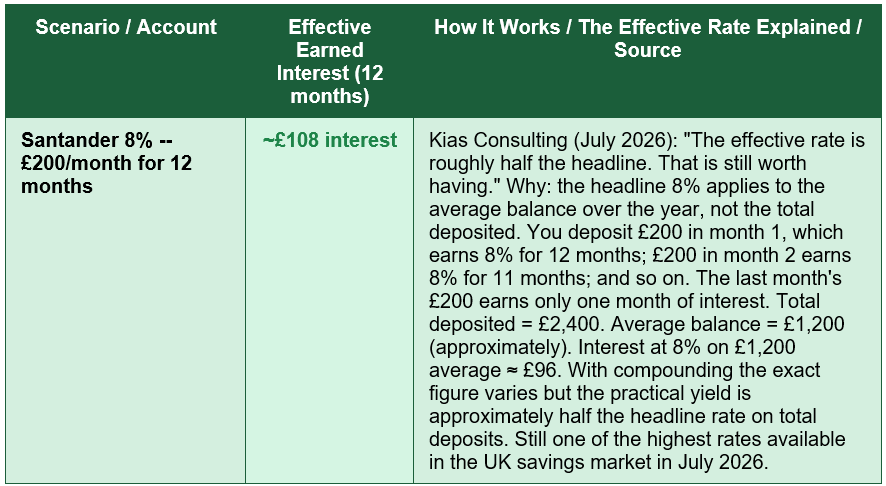
The interest you earn is significantly less than the headline rate applied to the total amount you deposit -- and understanding this is essential. Kias Consulting (July 2026): 'The effective rate is roughly half the headline. That is still worth having.' Here is why: in a regular saver, you deposit a fixed amount each month rather than a lump sum. Month 1's deposit earns the headline rate for 12 months; month 2's deposit earns it for 11 months; month 12's deposit earns it for only 1 month. The average balance over the year is roughly half the total deposited. Practical examples at the top rates: Santander/Lloyds 8% fixed, £200/month for 12 months -- total deposited £2,400, interest earned approximately £108. Lloyds 8% fixed, £400/month for 12 months -- total deposited £4,800, interest earned approximately £208. First Direct 7% fixed, £300/month for 12 months -- total deposited £3,600, interest earned approximately £136 (confirmed by Kias Consulting). Skipton 5.5% variable, £250/month for 12 months -- total deposited £3,000, interest earned approximately £91. The key comparison: the best easy-access account currently pays 5% on the full balance from day one. A regular saver at 8% effectively pays around 4% on the total deposited (half of 8%) -- but still represents a better rate on money you were going to save monthly anyway.
Do I need a current account to open a regular savings account?
Most of the highest-paying regular savers do require a linked current account with the same provider -- but not all. The accounts that require a linked current account: Santander Edge Regular Saver (requires Santander Edge current account, £3/month fee); Lloyds Club Lloyds Monthly Saver (requires Club Lloyds current account, £3/month fee waived if you pay in £2,000+/month); First Direct Regular Saver (requires First Direct 1st Account); HSBC Regular Saver (requires HSBC current account); NatWest Digital Regular Saver (requires NatWest current account); Nationwide Regular Saver (requires Nationwide FlexDirect or FlexPlus current account). The account that does NOT require a current account: Skipton Building Society Regular Saver (5.5% variable, £250/month) is open to any UK resident with no current account requirement and no switching needed. BankingGeek (July 2026) and MSE both confirm this as the best genuinely open-to-all regular saver in the current market. If you are willing to open or switch a current account, most providers offering linked regular savers also offer switching bonuses (HSBC £220, Nationwide £175, Santander £180 -- all per DepositScout July 2026) that can further offset any monthly fee.
Can I withdraw money from a regular savings account early?
In most cases, withdrawing money from a regular savings account before the end of the 12-month term will result in loss of accrued interest, closure of the account, or a significant rate reduction. Which? (27 July 2026): 'The rates sometimes only apply for a limited time, often 12 months.' BankingGeek (July 2026) notes this as one of the main trade-offs of regular savers vs easy-access accounts. The specific exception is the NatWest Digital Regular Saver (6.17% variable AER), which BankingGeek confirms 'lets you withdraw money at any point without losing your future interest -- which suits savers who are not fully confident they will avoid dipping into the pot before the term ends.' This makes NatWest the best option for anyone who wants above-easy-access rates but may need access to the money during the year. If access to your savings is important: either use NatWest (with its lower maximum of £150/month and lower rate of 6.17%), or use an easy-access account (best currently 5%) as your primary savings vehicle and only use a regular saver for money you are confident you will not need during the term.
What happens when a regular savings account matures?
At the end of a regular saver's 12-month term, the accumulated balance (all monthly deposits plus the interest earned) is typically transferred automatically to the provider's standard savings account. This is almost always a much lower rate -- sometimes as low as 1-2.75% AER. This automatic transfer to a lower rate is one of the most common and costly savings mistakes, because many savers simply forget the account has matured and leave their money earning minimal interest. The practical response: set a calendar reminder for one month before your regular saver is due to mature. When the term ends, review the options: (1) check whether the same provider is offering a renewal of the regular saver at a competitive rate for a further 12 months; (2) if not, move the accumulated balance to the best available easy-access account or fixed-rate bond; (3) or open a new regular saver with a different provider that currently offers the best rate. MoneySavingExpert (updated 3 days ago) publishes a regularly updated best-buy table for regular savers at moneysavingexpert.com/savings/best-regular-savings-accounts -- bookmark it and check it when your current account matures. Kias Consulting strategy: keep the matured balance in the best easy-access account (currently 5%) while you decide, rather than leaving it in the default low-rate account.
Table of Contents
- Best Regular Savings Accounts UK -- July 2026
- Table of Contents
- Introduction: Why Regular Savings Accounts Offer the Best Rates in the UK Right Now
- What Is a Regular Savings Account and How Does It Work?
- Best Regular Savings Accounts UK: Rates and Rules (31 July 2026)
- What You Actually Earn: Real Interest Projections for Each Account
- The Top Accounts in Detail: Who Qualifies and What to Watch
- The Smart Strategy: Combine Regular Saver + Easy Access for Maximum Return
- Conclusion
- Frequently Asked Questions (FAQ)
- What is the best regular savings account UK in July 2026?
- How much will I actually earn on a regular savings account?
- Do I need a current account to open a regular savings account?
- Can I withdraw money from a regular savings account early?
- What happens when a regular savings account matures?
Why Regular Savings Accounts Offer the Best Rates in the UK Right Now
Regular savings accounts are consistently the highest-interest savings products available to UK consumers -- and in July 2026, they are paying significantly more than any other mainstream savings vehicle. MoneyfactsCompare (updated 1 hour ago -- 31 July 2026): as of today, the highest UK savings account rates range from 4.38% AER to 8.00% AER across easy access, notice, fixed rate, and regular saver accounts. The 8.00% maximum is only available through regular savings accounts. The best easy-access account currently pays 5% (money.co.uk, 30 July 2026). The gap -- up to 3 percentage points -- is significant when measured in actual pounds of interest earned.BankingGeek (July 2026): 'Regular savings accounts pay some of the highest interest rates on the UK market right now, with top deals reaching well above 6% AER while easy access accounts sit closer to 4-5%. The trade-off is that you commit to saving a fixed amount every month, usually between £25 and £300, rather than depositing a lump sum.' Which? (rates sourced from Moneyfacts, 27 July 2026): 'Regular savings accounts can offer higher interest rates than other savings accounts, but some require you to have a current account with the same provider. Unlike fixed-rate bonds or instant-access accounts, which allow you to deposit a lump sum, you'll be much more restricted on the amount you can pay into a regular savings account. Maximum monthly deposits are typically between £200 and £300.'
The key structural point about regular savers that most people do not appreciate: because you deposit a fixed monthly amount rather than a lump sum, the interest you actually earn is significantly less than the headline rate applied to the total amount deposited. Kias Consulting (July 2026): 'The effective rate is roughly half the headline. That is still worth having.' This guide covers every top rate available right now, how much you will actually earn on each account, who qualifies, and the smart strategy for getting the best possible return on your savings in the current environment.
What Is a Regular Savings Account and How Does It Work?
A regular savings account is a savings product that requires you to deposit a fixed amount of money each month -- typically between £25 and £400 depending on the provider -- in exchange for an above-market interest rate. The rate is the reward for committing to a consistent monthly saving habit. Most regular savers run for a fixed 12-month term, after which the balance and accumulated interest is either paid out or transferred to a lower-rate account.The mechanics are simple but have a nuance that most people miss. Unlike a fixed-rate bond or easy-access savings account where you deposit a lump sum and earn the full interest rate on the entire balance for the full year, a regular saver builds up balance gradually. You deposit £200 in month 1, £200 in month 2, and so on. The month 1 deposit earns 12 months of interest; the month 12 deposit earns only one month of interest. The average balance over the year is therefore roughly half the total deposited. Kias Consulting (July 2026): 'At 7.00% AER with a £300 monthly cap, you deposit a total of £3,600 over 12 months and earn roughly £136 in interest.' That £136 on £3,600 deposited looks like a 3.8% effective rate -- but it remains significantly better than the best easy-access account for money you were going to save monthly anyway.
There are two additional features to understand. First, most regular savers require you to hold a linked current account with the same provider -- this is how Santander, Lloyds, First Direct, HSBC, and Nationwide offer their top rates, as they use the regular saver to reward existing or new current account holders. Second, most regular savers will close, reduce your rate, or forfeit accrued interest if you miss monthly deposits or make withdrawals mid-term. The exception is NatWest's Digital Regular Saver, which allows withdrawals without penalty -- a useful flexibility for savers who are not fully certain they can commit to monthly deposits.
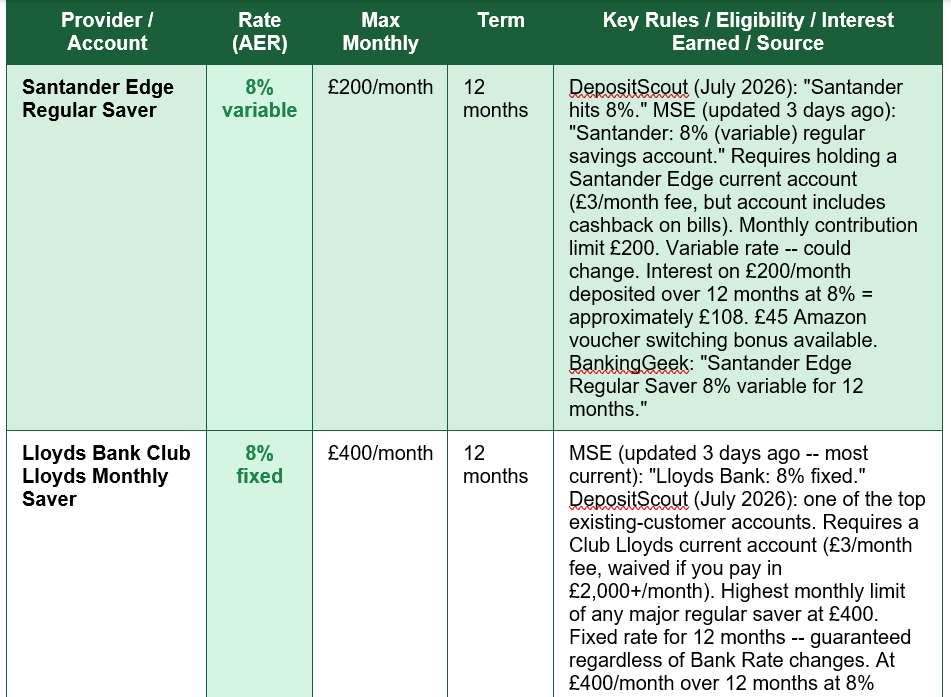
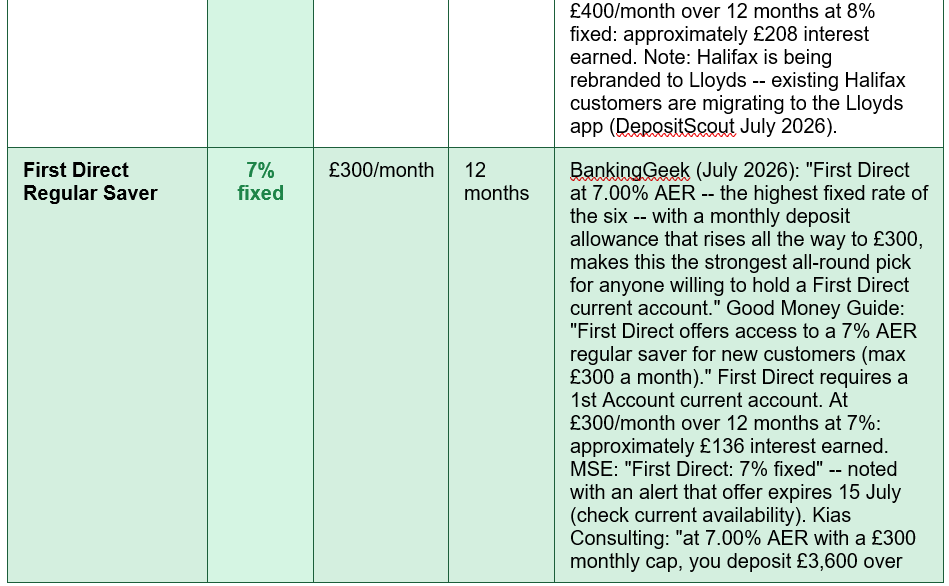
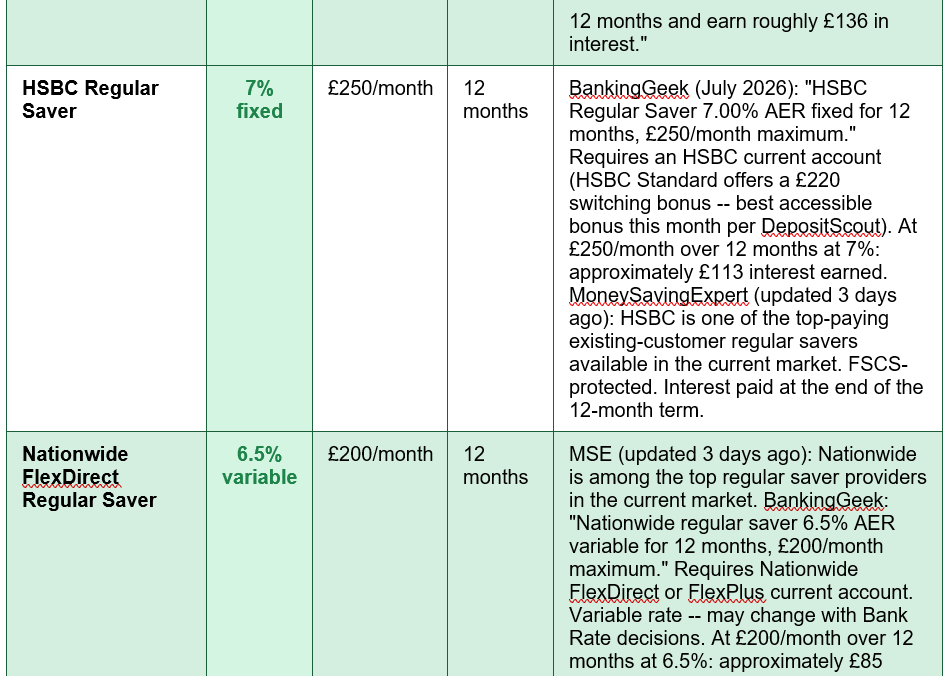
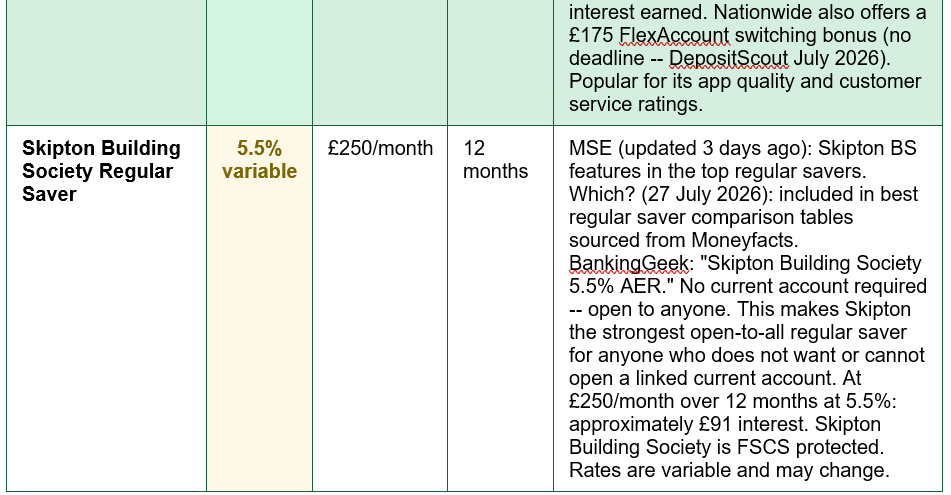
Regular savings accounts -- July 2026 top rates: Best rate: 8% AER (Santander & Lloyds). Fixed: 8% Lloyds, 7% First Direct & HSBC. Variable: 8% Santander, 6.5% Nationwide. Open to all: 5.5% Skipton BS. — MoneyfactsCompare (updated 1 hour ago -- 31 July 2026 -- most current): 'Highest UK savings account rates range from 4.38% to 8.00% AER.' MSE (updated 3 days ago): 'Santander 8% variable; Lloyds Bank 8% fixed; First Direct 7% fixed; HSBC 7% fixed; Co-op Bank 7% variable; Zopa 7.1% variable for six months.' BankingGeek (July 2026): 'Top regular saver rates in the UK range from around 5% to 7% AER, with First Direct's Regular Saver at 7.00% AER.' DepositScout (July 2026): 'Santander hits 8% -- plus every top rate for July 2026.'
Best Regular Savings Accounts UK: Rates and Rules (31 July 2026)
The following table maps the top regular savings accounts available in the UK as of 31 July 2026, with current rates, monthly limits, terms, and key eligibility requirements:
What You Actually Earn: Real Interest Projections for Each Account
Understanding the difference between the headline rate and what you will actually receive in pounds is essential before choosing a regular saver. The following table translates headline rates into real interest earned over 12 months:
The Top Accounts in Detail: Who Qualifies and What to Watch
SANTANDER EDGE REGULAR SAVER 8% variable AER | Best headline rate -- requires Edge current account
The Santander Edge Regular Saver at 8% variable is the joint-highest regular saver rate available in the UK in July 2026. MoneySavingExpert (updated 3 days ago): 'Santander: 8% (variable) regular savings account.' DepositScout (July 2026): 'Santander hits 8%.' To access this rate you must hold a Santander Edge current account, which costs £3 per month but includes cashback on your household bills. The maximum monthly contribution is £200. Because the rate is variable, it can be changed by Santander at any time -- meaning it could fall if the Bank Rate falls further, or rise if competitive pressure warrants it. DepositScout notes a £180 switching bonus available for those opening the Edge account as part of a current account switch. The practical interest earned: approximately £108 over 12 months at £200/month. What makes the Santander offering interesting in the current market is that it also includes a linked Edge Saver paying competitive easy-access rates, allowing you to hold your lump sum in the Edge Saver and feed the maximum £200/month into the regular saver each month for an optimised return.LLOYDS BANK CLUB LLOYDS MONTHLY SAVER 8% fixed AER | Highest monthly limit + fixed rate = maximum absolute interest
The Lloyds Club Lloyds Monthly Saver matches Santander's 8% headline rate but adds two significant advantages: the rate is fixed for 12 months (guaranteed regardless of Bank Rate changes) and the monthly limit is £400 -- the highest of any major regular saver in the current market. MSE (updated 3 days ago): 'Lloyds Bank: 8% fixed.' This combination produces approximately £208 in interest over 12 months at the maximum £400/month contribution -- making it the account that pays the most total interest in absolute terms. The Club Lloyds current account requirement: there is a £3/month fee, but this is waived if you pay in at least £2,000 per month. DepositScout (July 2026) notes that Halifax is being rebranded to Lloyds -- existing Halifax customers are being migrated to the Lloyds app, with account numbers and sort codes unchanged. This is administrative rather than product change. For existing Club Lloyds customers, this account is the obvious first action in the current savings environment: 8% fixed with the highest monthly limit available.FIRST DIRECT REGULAR SAVER 7% fixed AER | Best all-round pick -- fixed rate, £300/month, strong customer service
BankingGeek (July 2026): 'The highest fixed rate of the six at 7.00% AER, with a monthly deposit allowance that rises all the way to £300, makes this the strongest all-round pick for anyone willing to hold a First Direct current account.' Good Money Guide: 'First Direct offers access to a 7% AER regular saver for new customers (max £300 a month).' First Direct has a long-standing reputation for customer service quality and has historically offered among the best regular saver rates in the UK market. The account requires a First Direct 1st Account current account. First Direct currently offers a switching bonus for new customers (DepositScout: 'First Direct expires 15 July -- don't sit on it' -- verify current availability as the bonus may have an updated deadline). Interest earned at £300/month over 12 months at 7%: approximately £136. The fixed rate provides certainty: unlike Santander and Nationwide's variable offerings, First Direct's rate will not change during the 12-month term regardless of what the Bank Rate does.SKIPTON BUILDING SOCIETY REGULAR SAVER 5.5% variable AER -- NO current account required | Best open-to-all option: no linked account, no switching needed
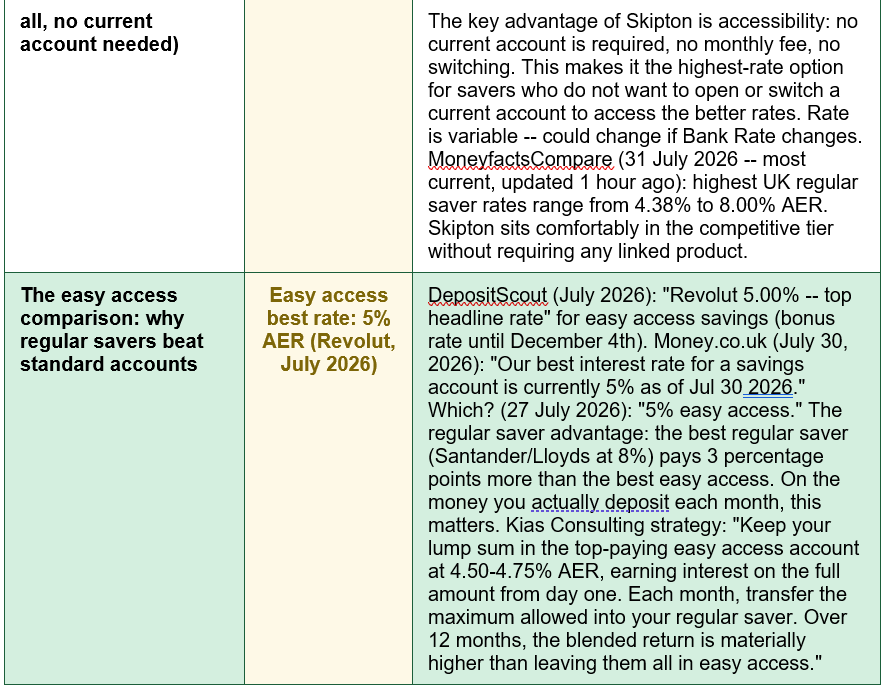
Skipton Building Society's regular saver is the standout choice for anyone who does not want to open or switch a current account to access a competitive regular saver rate. MSE (updated 3 days ago): Skipton features in the top regular savers. BankingGeek lists Skipton at 5.5% AER variable. Which? (27 July 2026): Skipton is included in the best regular saver comparison based on Moneyfacts data. No linked current account is required. No switching is needed. No monthly fee. The account is open to any UK resident. At £250/month over 12 months at 5.5%: approximately £91 interest. While 5.5% is lower than the 7-8% available through current-account-linked products, the rate is genuinely competitive -- 0.5 percentage points above the best easy-access rate (5%) -- without any product bundling requirement. For first-time regular savers, savers who have recently switched current accounts and cannot switch again, or anyone who simply wants the best rate without opening another current account, Skipton is the practical choice.NATWEST DIGITAL REGULAR SAVER 6.17% variable AER | Unique advantage: withdrawals allowed without penalty
BankingGeek (July 2026): 'NatWest's Digital Regular Saver is the only one of the six that lets you withdraw money at any point without losing your future interest, which suits savers who are not fully confident they will avoid dipping into the pot before the term ends.' This is the key differentiator of the NatWest account. Every other regular saver will either close the account, reduce the rate, or forfeit accrued interest if you make a withdrawal mid-term. NatWest allows withdrawals freely at any time, meaning the account behaves more like a high-interest easy-access account -- but one that requires a monthly deposit to maintain eligibility. The rate is variable (6.17% as of July 2026). The maximum monthly deposit is the lowest of the accounts covered (£150/month), limiting the absolute interest earned. NatWest current account required. For savers who want above-easy-access rates but are not confident they can fully commit to 12 months without access, NatWest provides the best risk-managed option.The Smart Strategy: Combine Regular Saver + Easy Access for Maximum Return
The most effective approach to regular savings accounts in 2026 is to use them as a monthly drip-feed from a separate easy-access account rather than as a standalone savings vehicle. This is the strategy recommended by Kias Consulting (verified July 2026):Kias Consulting: 'Keep your lump sum in the top-paying easy access account, earning interest on the full amount from day one. Each month, transfer the maximum allowed into your regular saver. This way, your money is earning 4.50-4.75% AER in easy access while also feeding into the 7.00% regular saver each month. Over 12 months, the blended return on the regular saver deposits is materially higher than leaving them all in easy access. Example: £10,000 pot + £300/month regular saver ≈ approximately £60 more in a year.'
The practical setup: if you have savings of, say, £5,000 sitting in an easy-access account at 5%, set up a standing order from that easy-access account to your regular saver on the day your salary or income arrives each month. The maximum allowed amount (£200 for Santander, £300 for First Direct, £400 for Lloyds) flows automatically into the regular saver, where it earns 7-8% for the remainder of the term. The £5,000 in easy access continues to earn 5% on the full balance. BankingGeek: 'Set up a standing order for the maximum allowed monthly deposit on the day your salary arrives. Regular savers only pay their advertised rate if you actually keep depositing consistently, and missing months is the single most common way savers end up earning far less than they expected.'
What happens at the end of 12 months -- and why it matters. Almost every regular saver runs for a fixed 12-month term. At the end of the term, the accumulated balance (your deposits plus earned interest) is typically transferred automatically to the provider's standard savings account -- which almost always pays a much lower rate. Halifax (now Lloyds) example from Forbes Advisor UK: at maturity, the balance 'is moved to an easy access Kids' Saver account, currently paying 2.75% AER.' This pattern is universal: the provider transfers you to a lower-rate account at maturity. To avoid this: set a calendar reminder for one month before your regular saver matures. When it matures, either renew with the same provider (if they offer a renewal of the same or a comparable rate), switch the balance to the best available easy-access or fixed-rate account, or open a new regular saver with a different provider. Doing nothing after maturity is one of the most common and costly savings mistakes -- the money sits in an account paying 1-2% instead of the 5-8% it could be earning.
FIVE REGULAR SAVER MISTAKES THAT REDUCE YOUR RETURN: (1) MISSING MONTHLY DEPOSITS. BankingGeek (July 2026): 'Missing months is the single most common way savers end up earning far less than they expected.' Most providers require a monthly deposit to maintain the account -- some will close it, others will reduce the rate, others will simply not credit interest for the missed month. Set up a standing order from your current account to your regular saver on a fixed date each month. Make it automatic so it cannot be forgotten. (2) MAKING WITHDRAWALS MID-TERM (except NatWest). With the exception of the NatWest Digital Regular Saver, withdrawing money from a regular saver mid-term will typically trigger loss of accrued interest, account closure, or rate reduction. If there is any possibility you will need access to the money during the term, NatWest is the correct choice or use an easy-access account instead. (3) NOT CHECKING ELIGIBILITY BEFORE APPLYING. Santander (Edge account required), Lloyds (Club Lloyds required), First Direct (1st Account required), HSBC (HSBC account required), and NatWest (NatWest account required) all need a linked current account. Check the requirement before applying. If you do not have the required account, factor in the time and switching process needed to open one -- and check whether a switching bonus makes the current account itself financially worthwhile. (4) FORGETTING THE ACCOUNT AT MATURITY. At the end of 12 months, your balance is moved to a low-rate account automatically if you take no action. Review the options one month before maturity and act immediately when the term ends. The 12-month review is as important as the initial account selection. (5) CHOOSING HEADLINE RATE OVER ACTUAL INTEREST EARNED. An 8% account with a £200/month cap earns less total interest than a 7% account with a £300/month cap for someone who can save £300 per month. Always calculate the actual pounds of interest you will earn -- not just the headline rate -- to choose the account that maximises your return.
REGULAR SAVINGS ACCOUNT ACTION PLAN -- JULY 2026: STEP 1 -- CHOOSE YOUR ACCOUNT BY YOUR SITUATION: (a) Already have a Club Lloyds account OR willing to open one (£3/month, waived if pay in £2,000+/month): Lloyds Monthly Saver at 8% fixed, £400/month -- maximum absolute interest for most savers. (b) Already have or willing to open a Santander Edge account: 8% variable, £200/month. (c) Want fixed rate + £300/month + good customer service: First Direct 7% fixed (check current availability of any switching offer). (d) Want no current account requirement: Skipton BS 5.5%, £250/month -- open to all, no switching needed. (e) Want flexibility to withdraw mid-term: NatWest 6.17% variable, £150/month. STEP 2 -- SET UP A STANDING ORDER: Set a standing order from your current account to your regular saver for the maximum monthly amount on the day your salary arrives. Do this before you spend the money. Make it automatic. STEP 3 -- COMBINE WITH EASY ACCESS: If you have a lump sum, keep it in the best easy-access account (Revolut 5% to Dec 4th; Tembo HomeSaver 4.55%) and feed maximum monthly into the regular saver from it. STEP 4 -- SET A MATURITY REMINDER: Mark your calendar for one month before the regular saver matures. At maturity: review available rates, open a new regular saver, or move the balance to the best available account. Do not allow it to roll to the default low-rate account. COMPARE AND VERIFY RATES AT: moneysavingexpert.com/savings/best-regular-savings-accounts | moneyfactscompare.co.uk | which.co.uk | bankinggeek.com/en/regular-savings-account. FREE GUIDANCE: MoneyHelper 0800 138 7777.
Conclusion
Regular savings accounts are the highest-paying savings products available to UK consumers in July 2026, with rates up to 8% AER from Santander and Lloyds -- significantly above the best easy-access rate of 5%. The trade-off is a monthly deposit commitment, a maximum monthly limit of between £150 and £400 depending on the provider, and in most cases a requirement to hold a linked current account. MoneyfactsCompare (updated 1 hour ago, 31 July 2026): the range from 4.38% to 8.00% across all savings account types confirms regular savers sit at the top of the market.The three most important things to take from this guide: first, the effective interest earned on a regular saver is roughly half the headline rate applied to total deposits (because deposits build up gradually over 12 months). At 8% on £200/month: approximately £108. At 8% on £400/month (Lloyds): approximately £208. Second, the smart strategy is to combine a regular saver with an easy-access account -- keeping a lump sum earning 5% in easy access and feeding the maximum monthly amount into the 7-8% regular saver for a blended return that outperforms either product alone. Third, set a maturity reminder: the single most common error is allowing the balance to roll into the provider's standard low-rate account at the end of 12 months.
For savers who do not want to open or switch a current account: Skipton Building Society at 5.5% variable is the best genuinely open-to-all regular saver in the current market, available to anyone, with no linked product requirement. BankingGeek's advice is the most practical summary: 'Whichever account you choose, set up a standing order for the maximum allowed monthly deposit on the day your salary arrives.' Consistency is everything with a regular saver -- and the reward for that consistency, in the current rate environment, is genuinely significant.
Frequently Asked Questions (FAQ)
What is the best regular savings account UK in July 2026?As of 31 July 2026, the best regular savings accounts by headline rate are Santander Edge Regular Saver at 8% variable AER (£200/month maximum, requires Edge current account) and Lloyds Bank Club Lloyds Monthly Saver at 8% fixed AER (£400/month maximum, requires Club Lloyds current account). The Lloyds account is particularly strong because its fixed 8% rate and higher monthly limit (£400 vs Santander's £200) means it produces the most total interest in absolute terms -- approximately £208 over 12 months at maximum contributions vs approximately £108 for Santander. For savers wanting a fixed rate without going to 8%: First Direct at 7% fixed (£300/month) and HSBC at 7% fixed (£250/month) are both excellent choices with reliable providers. For anyone who does not want or cannot open a linked current account: Skipton Building Society at 5.5% variable (£250/month) is the best genuinely open-to-all regular saver. MoneyfactsCompare (updated 1 hour ago -- 31 July 2026): 'As of 31 July 2026, the highest UK savings account rates range from 4.38% AER to 8.00% AER.' Always verify current rates directly with the provider before opening, as rates -- especially variable ones -- can change at any time.
How much will I actually earn on a regular savings account?
The interest you earn is significantly less than the headline rate applied to the total amount you deposit -- and understanding this is essential. Kias Consulting (July 2026): 'The effective rate is roughly half the headline. That is still worth having.' Here is why: in a regular saver, you deposit a fixed amount each month rather than a lump sum. Month 1's deposit earns the headline rate for 12 months; month 2's deposit earns it for 11 months; month 12's deposit earns it for only 1 month. The average balance over the year is roughly half the total deposited. Practical examples at the top rates: Santander/Lloyds 8% fixed, £200/month for 12 months -- total deposited £2,400, interest earned approximately £108. Lloyds 8% fixed, £400/month for 12 months -- total deposited £4,800, interest earned approximately £208. First Direct 7% fixed, £300/month for 12 months -- total deposited £3,600, interest earned approximately £136 (confirmed by Kias Consulting). Skipton 5.5% variable, £250/month for 12 months -- total deposited £3,000, interest earned approximately £91. The key comparison: the best easy-access account currently pays 5% on the full balance from day one. A regular saver at 8% effectively pays around 4% on the total deposited (half of 8%) -- but still represents a better rate on money you were going to save monthly anyway.
Do I need a current account to open a regular savings account?
Most of the highest-paying regular savers do require a linked current account with the same provider -- but not all. The accounts that require a linked current account: Santander Edge Regular Saver (requires Santander Edge current account, £3/month fee); Lloyds Club Lloyds Monthly Saver (requires Club Lloyds current account, £3/month fee waived if you pay in £2,000+/month); First Direct Regular Saver (requires First Direct 1st Account); HSBC Regular Saver (requires HSBC current account); NatWest Digital Regular Saver (requires NatWest current account); Nationwide Regular Saver (requires Nationwide FlexDirect or FlexPlus current account). The account that does NOT require a current account: Skipton Building Society Regular Saver (5.5% variable, £250/month) is open to any UK resident with no current account requirement and no switching needed. BankingGeek (July 2026) and MSE both confirm this as the best genuinely open-to-all regular saver in the current market. If you are willing to open or switch a current account, most providers offering linked regular savers also offer switching bonuses (HSBC £220, Nationwide £175, Santander £180 -- all per DepositScout July 2026) that can further offset any monthly fee.
Can I withdraw money from a regular savings account early?
In most cases, withdrawing money from a regular savings account before the end of the 12-month term will result in loss of accrued interest, closure of the account, or a significant rate reduction. Which? (27 July 2026): 'The rates sometimes only apply for a limited time, often 12 months.' BankingGeek (July 2026) notes this as one of the main trade-offs of regular savers vs easy-access accounts. The specific exception is the NatWest Digital Regular Saver (6.17% variable AER), which BankingGeek confirms 'lets you withdraw money at any point without losing your future interest -- which suits savers who are not fully confident they will avoid dipping into the pot before the term ends.' This makes NatWest the best option for anyone who wants above-easy-access rates but may need access to the money during the year. If access to your savings is important: either use NatWest (with its lower maximum of £150/month and lower rate of 6.17%), or use an easy-access account (best currently 5%) as your primary savings vehicle and only use a regular saver for money you are confident you will not need during the term.
What happens when a regular savings account matures?
At the end of a regular saver's 12-month term, the accumulated balance (all monthly deposits plus the interest earned) is typically transferred automatically to the provider's standard savings account. This is almost always a much lower rate -- sometimes as low as 1-2.75% AER. This automatic transfer to a lower rate is one of the most common and costly savings mistakes, because many savers simply forget the account has matured and leave their money earning minimal interest. The practical response: set a calendar reminder for one month before your regular saver is due to mature. When the term ends, review the options: (1) check whether the same provider is offering a renewal of the regular saver at a competitive rate for a further 12 months; (2) if not, move the accumulated balance to the best available easy-access account or fixed-rate bond; (3) or open a new regular saver with a different provider that currently offers the best rate. MoneySavingExpert (updated 3 days ago) publishes a regularly updated best-buy table for regular savers at moneysavingexpert.com/savings/best-regular-savings-accounts -- bookmark it and check it when your current account matures. Kias Consulting strategy: keep the matured balance in the best easy-access account (currently 5%) while you decide, rather than leaving it in the default low-rate account.
0 Comments
Be the first to share your thoughts on this article.