
Business
Best Uses of a Business Line of Credit

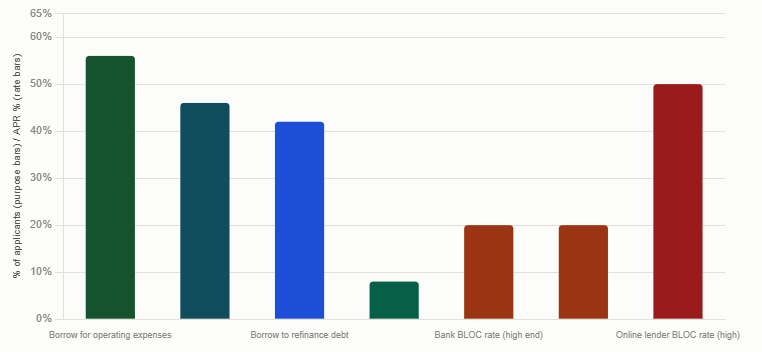
56% of small businesses borrow to manage operating expenses. 46% borrow to pursue new opportunities. A business line of credit is the most flexible financing tool available — but only when it is matched to the right use case. Here is exactly when it wins and when it does not.

A business line of credit is the most flexible financing instrument available to small businesses. Unlike a term loan, which delivers a fixed lump sum and charges interest on the full principal from day one, a line of credit gives the business a borrowing capacity it can draw against as needed, repay, and draw against again. Interest accrues only on the amount outstanding, not on the total available credit. This revolving structure makes it uniquely suited to the variable, cyclical, and timing-sensitive cash needs that characterise most small and mid-sized businesses.
The challenge is that flexible tools are also the most easily misused. A business line of credit applied to the right problem — a 60-day receivables gap, a pre-season inventory purchase, a payroll shortfall during a slow month — generates a clear, calculable return on the cost of borrowing. The same line of credit applied to chronic operating deficits, long-lived capital expenditures, or non-essential spending converts short-term flexibility into long-term debt that erodes the financial health of the business. This guide identifies the seven best uses and the clearest use-case mistakes.
The Numbers: 56% of small businesses borrow to meet operating expenses; 46% to pursue expansion or new opportunities (Federal Reserve SBCS 2025). 60% of small employer firms applied for financing in the preceding 12 months. Only 42% of applicants received the full amount they sought (Federal Reserve SBCS 2025, Fora Financial June 2026). Full approval rates have declined 21 percentage points since 2019.
The 2022–2023 rate hiking cycle pushed the Prime Rate from 3.25 percent to 8.5 percent in less than 18 months. For businesses with variable-rate lines, this meant rates rose by more than 5 percentage points. In 2026, the rate environment is more stable following Federal Reserve rate reductions in 2024 and 2025, though rate risk remains real for any variable-rate borrower, per Crestmont Capital’s May 2026 rate guide.
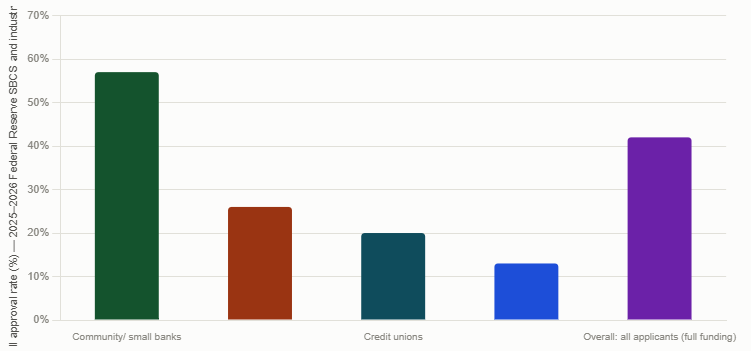
Federal Reserve 2025 Small Business Credit Survey (released March 2026): Only 42% of financing applicants received the full amount they sought. Full approval rates have declined by 21 percentage points since 2019 — from 62% in 2019 to approximately 41% in 2024. The sustained decline reflects tighter credit standards, higher interest rates, and increased concern over borrower debt loads.
A construction firm completes a project in June and submits an invoice for $180,000. Payment terms are Net 30 to Net 60. Meanwhile, payroll falls due, supplier invoices arrive, and equipment lease payments are due. The business has a $180,000 asset (the receivable) but a 30 to 60-day gap before it converts to cash. A line of credit bridges this gap precisely: the business draws what it needs, the receivable arrives, the line is repaid. Interest accrues for 30 to 60 days on the drawn amount only.
Capital Gurus (August 2026) states the principle clearly: ‘Seasonal businesses don’t have a cash-flow problem in the way lenders usually define it. They have a timing problem.’ This framing applies equally to non-seasonal businesses with longer receivables cycles. A professional services firm, a manufacturer, a wholesale distributor, a contractor — any business that invoices after delivery and waits for payment has a timing problem that a line of credit solves more efficiently than any other product.
Strategy: Calculate your average days-outstanding on receivables and your average days-payable-outstanding. If receivables routinely extend beyond payables, a line of credit sized to cover 30 to 60 days of operating costs gives the business breathing room without the cost of carrying unnecessary fixed debt.
Retailers stocking up ahead of a holiday season, agricultural suppliers purchasing inputs before the growing season, apparel brands building warm-weather inventory in February, and food distributors buying commodities ahead of known price increases all share the same timing structure. The inventory purchase represents a near-term liability (the line draw) that generates a definable revenue stream (the season’s sales) that repays the line.
Crestmont Capital’s May 2026 inventory line of credit guide notes that businesses which optimise supplier relationships through timely bulk purchasing can save 5 to 20 percent on cost of goods, citing Forbes. The interest cost of a 60 to 90-day line draw at 10 to 15 percent APR on a $50,000 inventory purchase is approximately $820 to $1,850. If the bulk purchase saves 10 percent on $50,000 in inventory, the saving is $5,000 — almost three times the borrowing cost. The economics of using a line to capture bulk discounts are compelling when the discount exceeds the borrowing cost.
Secured inventory lines of credit — where the inventory itself serves as collateral — typically offer higher limits and lower rates than unsecured lines, and may be accessible to businesses that would not qualify for a general unsecured line.
A landscaping company that generates the vast majority of its revenue from April through October still needs to retain its experienced crew through the winter. A tourist-dependent hospitality business still needs its management team in January. A holiday retailer still needs its experienced senior staff in February. Letting go of experienced employees to save payroll costs during slow months means rehiring and retraining at the start of every season — an investment of time, money, and operational disruption that often exceeds the payroll cost of retention.
Crestmont Capital’s May 2026 seasonal business guide addresses this directly: ‘Yes, payroll is a legitimate use of funds from a business line of credit. Many seasonal businesses use their line not just for pre-peak investments but also to retain key year-round staff during slow months when revenue does not fully cover fixed labor costs.’ The payroll use case passes the fundamental test of productive borrowing: the debt funds something that generates a return (an experienced team ready to execute at peak season’s start) that exceeds the cost of the debt.
Avoid This: Payroll borrowing that funds a chronically unsustainable wage bill — where slow-month revenue cannot plausibly support the headcount even in the medium term — is structural, not cyclical. A line of credit solves a timing problem. It does not solve an income statement problem. If payroll cannot be covered by peak-season revenue and reasonable off-season revenue together, the problem is overstaffing, not cash flow timing.
This type of opportunistic use requires two conditions: first, the line must be available — which means the line should be established and maintained before the opportunity arises, not applied for in response to it. Second, the economics must be calculated clearly before the draw — not assumed. The discount must genuinely exceed the borrowing cost, including any fees associated with the draw.
The pre-established line is the key point. A line of credit applied for in response to an opportunity will almost certainly take too long to approve — even from fast-approval online lenders, documentation and underwriting takes days. The businesses that successfully use lines for opportunistic purchasing have the line in place, understand its costs and terms, and can draw quickly when an opportunity emerges.
Each of these events creates an immediate cash need without an immediately available cash source. A business that has maintained a line of credit with available capacity can draw the needed funds, manage the crisis, and repay the line when operations normalise. A business without a line either burns through cash reserves (depleting the buffer that protects against the next event), delays response (often making the problem more expensive), or enters a crisis financing process at the worst possible time — when the business is already stressed and lenders are most cautious.
The Federal Reserve’s 2025 SBCS data that only 42 percent of financing applicants received full funding is particularly sobering in the context of emergency financing. A business that attempts to establish or expand a line during a crisis will face the most stringent underwriting precisely when it is least able to meet those standards. The time to establish and maintain a business line of credit is when the business does not need it.
The critical discipline for this use case: the payback period must be clearly defined and realistically shorter than the line’s draw period. A growth investment that takes 24 months to generate positive return is not appropriate for a revolving line of credit designed for short-term liquidity. It belongs on a term loan with a matched amortisation schedule.
The 46 percent of small business borrowers seeking financing to pursue expansion or new opportunities (Federal Reserve SBCS 2025) include a mix of appropriate and inappropriate line-of-credit candidates. A short-duration, revenue-generating opportunity with a clear payback is appropriate. A long-duration, capital-intensive expansion project is not — regardless of the projected return.
Bridge financing uses require the same discipline as emergency uses: the line must have available capacity, the draw must be sized to the specific bridge need, and the repayment source must be clearly identified and essentially certain. A bridge draw repaid by approved financing is structurally sound. A bridge draw repaid by hoped-for revenue is speculative and risks converting short-term bridge debt into longer-term carrying debt that erodes the line’s availability for its primary uses.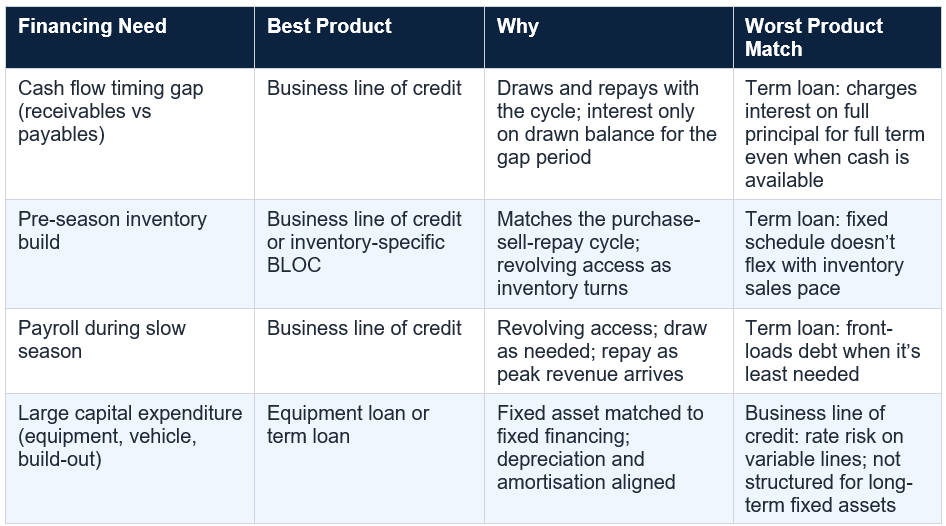
The seven best uses identified in this guide — cash flow gap management, pre-season inventory build, payroll during slow periods, opportunistic supplier discounts, emergency operational buffer, short-duration growth investments, and bridge financing — all share a common structure: a defined, short-duration need, a clear repayment source, and a financial return that exceeds the cost of borrowing. The uses to avoid — chronic operating deficits, long-lived capital expenditures, permanent maximum draws — all involve mismatching a short-term revolving instrument to a long-term structural problem.
The final principle is timing. A line of credit established when the business is strong, when financials are favourable, and when the approval process reflects the business at its best is a strategic asset. A line of credit applied for in crisis, when cash is already gone and lenders are most cautious, is far harder to obtain and far more expensive. Build the tool before you need it. Use it with discipline when you do.
The best use of a business line of credit is any short-duration financial need with a clear repayment source that makes the cost of borrowing worthwhile. The most productive use cases in 2026 are: (1) managing cash flow timing gaps between invoicing and payment collection, (2) pre-season inventory builds for businesses with predictable peak periods, (3) payroll retention of core staff during slow seasons, (4) capturing time-sensitive supplier discounts that exceed the borrowing cost, and (5) maintaining a standing emergency operational buffer. In all cases, the line should be drawn with a specific purpose and a specific repayment plan, not as a general funding source for ongoing operations.
How is a business line of credit different from a term loan?
A term loan delivers a fixed lump sum and charges interest on the full principal from the first day of the loan, regardless of how much of the money you have actually spent. Monthly payments are fixed for the duration of the loan term. A business line of credit is revolving: you draw what you need, pay interest only on the amount drawn, repay, and draw again. For variable, cyclical, or unpredictable cash needs, the line of credit is far more cost-efficient. For large, one-time investments with a defined repayment schedule (equipment purchase, building acquisition, leasehold improvement), a term loan is structurally more appropriate. The mismatch — using a line for long-term assets or a term loan for short-term cash flow needs — creates unnecessary cost in both directions.
What do I need to qualify for a business line of credit in 2026?
Typical eligibility requirements across reputable lenders: minimum 6–12 months in business (2+ years for traditional bank lenders); minimum $50,000–$250,000 in annual revenue depending on lender and line size; personal credit score of 600+ for online lenders, 680–700 for traditional banks, 700+ for competitive rates; 12 months of business bank statements showing consistent cash flow; business tax returns (1–2 years for established lenders); business banking account. The 2024 Federal Reserve SBCS found that only 41% of applicants received full funding, down from 62% in 2019. The most common denial reasons in 2024 were insufficient collateral, weak credit history, and excessive existing debt load (which has nearly doubled as a denial reason since 2021). Apply when your financial position is strongest, not when you are under pressure.
What are business line of credit rates in 2026?
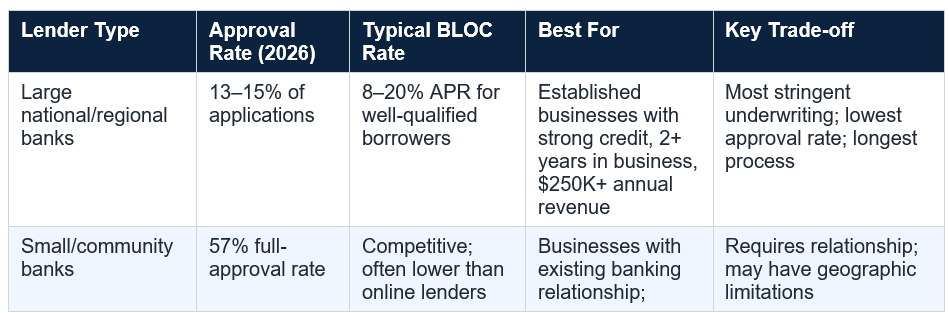
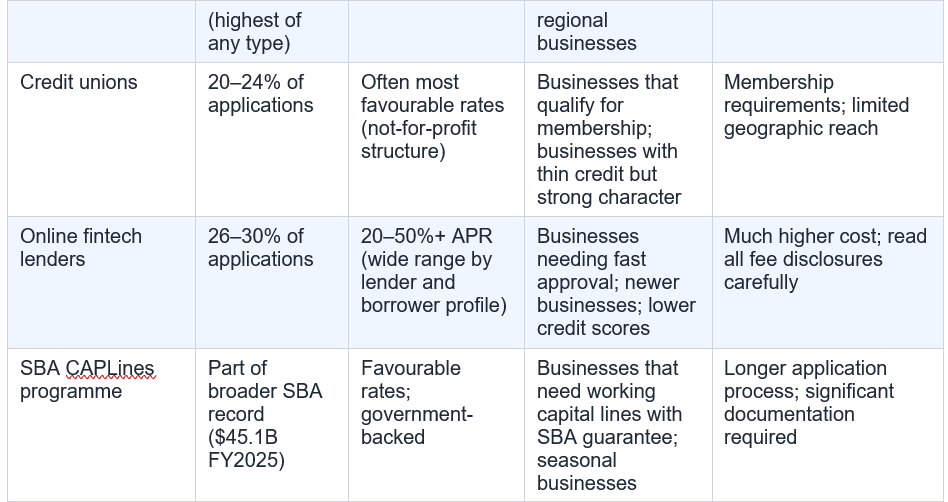
Business line of credit rates in 2026 vary significantly by lender type and borrower profile. Large national and regional banks offer the lowest rates — typically 8–20% APR — for well-qualified borrowers, but with the most stringent approval requirements. Small/community banks offer competitive rates and have the highest full-approval rate at 57% (Federal Reserve SBCS 2025). Credit unions often provide the most favourable rates. Online fintech lenders offer faster approvals but at substantially higher rates, often 20–50%+ APR. When comparing lenders, always request the full APR (which includes fees in addition to the stated interest rate), not just the stated rate. A 'rate starting at' figure in advertising is reserved for the most qualified borrowers; get a personalised quote based on your actual profile before committing to any application.
Should I use my business line of credit for payroll?
Yes, for seasonal or cyclical businesses retaining core staff during slow periods — provided the payroll is genuinely temporary and covered by peak-season revenue. Using a line of credit to cover payroll during a predictable slow season is a legitimate, productive use of revolving credit. The cost of borrowing to retain an experienced team is typically less than the cost of rehiring and retraining at the start of every busy season. However, using a line of credit to fund payroll for a headcount that the business cannot sustain even during peak seasons indicates a structural staffing cost problem, not a cash flow timing problem. A line of credit solves timing problems; it does not solve income statement problems.
When should I establish a business line of credit?
During your business's strongest financial period — not when you need money urgently. The approval process, rate offered, and credit limit all reflect the business's current financial condition. A business with strong recent bank statements, solid annual revenue, and minimal existing debt will receive a better line, at a better rate, with a higher limit than the same business applying after a difficult quarter. Establish the line when you don't need it, keep it largely undrawn as a standing buffer, and it will be available — at a rate that reflects your business at its best — when you need it. The Federal Reserve's data showing only 42% of financing applicants receive full funding in 2026 reflects a market where being a well-prepared applicant matters more than ever.
Table of Contents
- The Most Flexible Tool in Small Business Finance
- What a Business Line of Credit Actually Is
- The 2026 Small Business Lending Landscape
- Best Use #1: Managing Cash Flow Gaps Between Receivables and Payables
- Best Use #2: Pre-Season Inventory Build
- Best Use #3: Payroll Coverage During Slow Periods
- Best Use #4: Capitalising on Opportunistic Supplier Discounts
- Best Use #5: Emergency Operational Buffer
- Best Use #6: Funding Short-Duration Growth Investments
- Best Use #7: Bridge Financing for Larger Capital Needs
- Business Line of Credit vs Term Loan: The Decision Framework
- What to Avoid Using a Business Line of Credit For
- How to Qualify: What Lenders Look For in 2026
- How to Choose the Right Lender
- How to Use a Line of Credit Strategically (Not Just When You Are Desperate)
- Conclusion: The Line of Credit That Works Is the One You Use Before You Need It
Why Businesses Borrow + rates
Approval Rate By Lender Type
The Most Flexible Tool in Small Business Finance
Sixty percent of small employer firms applied for financing in the 12 months covered by the Federal Reserve’s 2025 Small Business Credit Survey. Of those, 56 percent were borrowing primarily to manage operating expenses and 46 percent to pursue new opportunities. These are the two most common, most practical, and most financially sensitive use cases in small business finance — and they happen to be exactly what a business line of credit is designed for.A business line of credit is the most flexible financing instrument available to small businesses. Unlike a term loan, which delivers a fixed lump sum and charges interest on the full principal from day one, a line of credit gives the business a borrowing capacity it can draw against as needed, repay, and draw against again. Interest accrues only on the amount outstanding, not on the total available credit. This revolving structure makes it uniquely suited to the variable, cyclical, and timing-sensitive cash needs that characterise most small and mid-sized businesses.
The challenge is that flexible tools are also the most easily misused. A business line of credit applied to the right problem — a 60-day receivables gap, a pre-season inventory purchase, a payroll shortfall during a slow month — generates a clear, calculable return on the cost of borrowing. The same line of credit applied to chronic operating deficits, long-lived capital expenditures, or non-essential spending converts short-term flexibility into long-term debt that erodes the financial health of the business. This guide identifies the seven best uses and the clearest use-case mistakes.
The Numbers: 56% of small businesses borrow to meet operating expenses; 46% to pursue expansion or new opportunities (Federal Reserve SBCS 2025). 60% of small employer firms applied for financing in the preceding 12 months. Only 42% of applicants received the full amount they sought (Federal Reserve SBCS 2025, Fora Financial June 2026). Full approval rates have declined 21 percentage points since 2019.
What a Business Line of Credit Actually Is
A business line of credit is a revolving credit facility extended by a bank, credit union, or online lender to a business borrower. The lender approves a maximum borrowing limit. The business can draw funds up to that limit, repay them, and draw again — as many times as needed during the draw period, without reapplying each time. Key structural features:- Revolving access: funds are replenishable. Unlike a term loan, the credit becomes available again as it is repaid.
- Interest on drawn balance only: you pay interest only on the amount currently outstanding, not on the total credit limit. An unused $200,000 line costs nothing in interest.
- Flexible draw amounts: draw $10,000 today, $45,000 next month, and $0 the month after. The line accommodates variable cash needs naturally.
- Secured vs unsecured: secured lines are backed by business assets (inventory, accounts receivable, equipment, real estate) and typically offer higher limits and lower rates. Unsecured lines rely on creditworthiness alone and carry higher rates and lower limits.
- Draw period and repayment terms: many lines have a 12-month draw period with monthly minimum payments, followed by a repayment period. Some are revolving indefinitely subject to annual renewal.
The 2026 Small Business Lending Landscape
Understanding the environment in which a business line of credit is sought helps calibrate realistic expectations:The 2022–2023 rate hiking cycle pushed the Prime Rate from 3.25 percent to 8.5 percent in less than 18 months. For businesses with variable-rate lines, this meant rates rose by more than 5 percentage points. In 2026, the rate environment is more stable following Federal Reserve rate reductions in 2024 and 2025, though rate risk remains real for any variable-rate borrower, per Crestmont Capital’s May 2026 rate guide.
Federal Reserve 2025 Small Business Credit Survey (released March 2026): Only 42% of financing applicants received the full amount they sought. Full approval rates have declined by 21 percentage points since 2019 — from 62% in 2019 to approximately 41% in 2024. The sustained decline reflects tighter credit standards, higher interest rates, and increased concern over borrower debt loads.
Best Use #1: Managing Cash Flow Gaps Between Receivables and Payables
Best Use #1: Bridging the Gap Between When You Invoice and When You Get Paid
The most structurally perfect use of a business line of credit is closing the timing gap between when operating costs must be paid and when revenue arrives. This is not a financial problem in the traditional sense — the business is profitable and has genuine receivables. It has a timing problem: expenses fall due before customer payments arrive.A construction firm completes a project in June and submits an invoice for $180,000. Payment terms are Net 30 to Net 60. Meanwhile, payroll falls due, supplier invoices arrive, and equipment lease payments are due. The business has a $180,000 asset (the receivable) but a 30 to 60-day gap before it converts to cash. A line of credit bridges this gap precisely: the business draws what it needs, the receivable arrives, the line is repaid. Interest accrues for 30 to 60 days on the drawn amount only.
Capital Gurus (August 2026) states the principle clearly: ‘Seasonal businesses don’t have a cash-flow problem in the way lenders usually define it. They have a timing problem.’ This framing applies equally to non-seasonal businesses with longer receivables cycles. A professional services firm, a manufacturer, a wholesale distributor, a contractor — any business that invoices after delivery and waits for payment has a timing problem that a line of credit solves more efficiently than any other product.
Strategy: Calculate your average days-outstanding on receivables and your average days-payable-outstanding. If receivables routinely extend beyond payables, a line of credit sized to cover 30 to 60 days of operating costs gives the business breathing room without the cost of carrying unnecessary fixed debt.
Best Use #2: Pre-Season Inventory Build
Best Use #2: Purchasing Inventory Before Peak Season Without Depleting Cash Reserves
Inventory financing is the second most structurally aligned use case for a business line of credit. The cash-to-inventory-to-sales-to-cash cycle creates a defined, predictable financing need: the business must pay for inventory before it sells it, and the sale proceeds repay the financing. A revolving line of credit mirrors this cycle naturally.Retailers stocking up ahead of a holiday season, agricultural suppliers purchasing inputs before the growing season, apparel brands building warm-weather inventory in February, and food distributors buying commodities ahead of known price increases all share the same timing structure. The inventory purchase represents a near-term liability (the line draw) that generates a definable revenue stream (the season’s sales) that repays the line.
Crestmont Capital’s May 2026 inventory line of credit guide notes that businesses which optimise supplier relationships through timely bulk purchasing can save 5 to 20 percent on cost of goods, citing Forbes. The interest cost of a 60 to 90-day line draw at 10 to 15 percent APR on a $50,000 inventory purchase is approximately $820 to $1,850. If the bulk purchase saves 10 percent on $50,000 in inventory, the saving is $5,000 — almost three times the borrowing cost. The economics of using a line to capture bulk discounts are compelling when the discount exceeds the borrowing cost.
Secured inventory lines of credit — where the inventory itself serves as collateral — typically offer higher limits and lower rates than unsecured lines, and may be accessible to businesses that would not qualify for a general unsecured line.
Best Use #3: Payroll Coverage During Slow Periods
Best Use #3: Retaining Core Staff During Off-Season Without Liquidating Reserves
Payroll is the most emotionally and operationally critical operating expense for most small businesses, and also one of the most logical applications of a business line of credit for seasonal or cyclical businesses. The structure of the problem is clear: revenue is concentrated in peak months, but the core team that produces that revenue needs to be paid year-round.A landscaping company that generates the vast majority of its revenue from April through October still needs to retain its experienced crew through the winter. A tourist-dependent hospitality business still needs its management team in January. A holiday retailer still needs its experienced senior staff in February. Letting go of experienced employees to save payroll costs during slow months means rehiring and retraining at the start of every season — an investment of time, money, and operational disruption that often exceeds the payroll cost of retention.
Crestmont Capital’s May 2026 seasonal business guide addresses this directly: ‘Yes, payroll is a legitimate use of funds from a business line of credit. Many seasonal businesses use their line not just for pre-peak investments but also to retain key year-round staff during slow months when revenue does not fully cover fixed labor costs.’ The payroll use case passes the fundamental test of productive borrowing: the debt funds something that generates a return (an experienced team ready to execute at peak season’s start) that exceeds the cost of the debt.
Avoid This: Payroll borrowing that funds a chronically unsustainable wage bill — where slow-month revenue cannot plausibly support the headcount even in the medium term — is structural, not cyclical. A line of credit solves a timing problem. It does not solve an income statement problem. If payroll cannot be covered by peak-season revenue and reasonable off-season revenue together, the problem is overstaffing, not cash flow timing.
Best Use #4: Capitalising on Opportunistic Supplier Discounts
Best Use #4: Capturing Time-Sensitive Discounts That Exceed the Cost of Borrowing
Some of the highest-return uses of a business line of credit are also the most unpredictable: supplier discounts, clearance purchasing opportunities, and time-limited bulk offers. A supplier offers a 15 percent discount on a $100,000 order that must be placed within 72 hours. The business has $40,000 in cash and a $100,000 line of credit with a $70,000 available balance. The line can be drawn in 24 hours. The $60,000 draw costs approximately $5,500 in interest at 10 percent APR over 90 days. The discount saves $15,000. Net benefit: $9,500. The line of credit generated a $9,500 return on a $5,500 borrowing cost.This type of opportunistic use requires two conditions: first, the line must be available — which means the line should be established and maintained before the opportunity arises, not applied for in response to it. Second, the economics must be calculated clearly before the draw — not assumed. The discount must genuinely exceed the borrowing cost, including any fees associated with the draw.
The pre-established line is the key point. A line of credit applied for in response to an opportunity will almost certainly take too long to approve — even from fast-approval online lenders, documentation and underwriting takes days. The businesses that successfully use lines for opportunistic purchasing have the line in place, understand its costs and terms, and can draw quickly when an opportunity emerges.
Best Use #5: Emergency Operational Buffer
Best Use #5: Maintaining Business Operations Through Unexpected Disruptions
The most defensively valuable use of a business line of credit is as a standing emergency operational buffer: unused in normal conditions, available immediately when something goes wrong. Equipment breaks down. A key customer delays a large payment. A regulatory issue requires immediate legal response. A natural disaster disrupts operations for several weeks. A key supplier fails to deliver.Each of these events creates an immediate cash need without an immediately available cash source. A business that has maintained a line of credit with available capacity can draw the needed funds, manage the crisis, and repay the line when operations normalise. A business without a line either burns through cash reserves (depleting the buffer that protects against the next event), delays response (often making the problem more expensive), or enters a crisis financing process at the worst possible time — when the business is already stressed and lenders are most cautious.
The Federal Reserve’s 2025 SBCS data that only 42 percent of financing applicants received full funding is particularly sobering in the context of emergency financing. A business that attempts to establish or expand a line during a crisis will face the most stringent underwriting precisely when it is least able to meet those standards. The time to establish and maintain a business line of credit is when the business does not need it.
Best Use #6: Funding Short-Duration Growth Investments
Best Use #6: Financing Revenue-Generating Growth With a Defined Payback Period
A business line of credit can fund short-duration growth investments — specifically those with a payback period that aligns with the line’s repayment structure. A marketing campaign that generates measurable sales within 60 to 90 days. A short-term contract staffing cost to deliver a large new client project. A professional certification or training that enables the team to offer a new service line. A new product launch that requires upfront production costs before sales revenue arrives.The critical discipline for this use case: the payback period must be clearly defined and realistically shorter than the line’s draw period. A growth investment that takes 24 months to generate positive return is not appropriate for a revolving line of credit designed for short-term liquidity. It belongs on a term loan with a matched amortisation schedule.
The 46 percent of small business borrowers seeking financing to pursue expansion or new opportunities (Federal Reserve SBCS 2025) include a mix of appropriate and inappropriate line-of-credit candidates. A short-duration, revenue-generating opportunity with a clear payback is appropriate. A long-duration, capital-intensive expansion project is not — regardless of the projected return.
Best Use #7: Bridge Financing for Larger Capital Needs
Best Use #7: Bridging the Gap Between Immediate Need and Approved Long-Term Financing
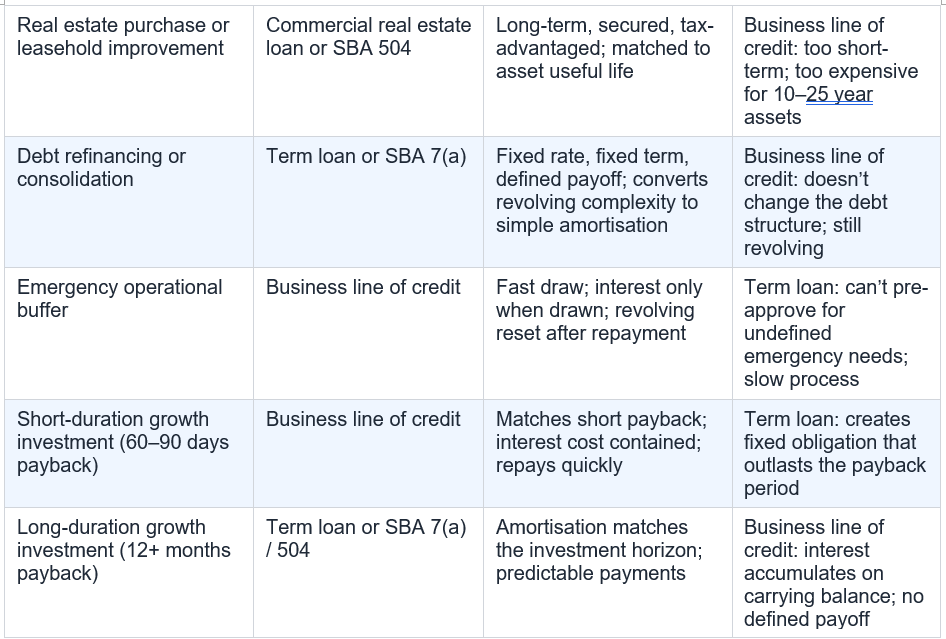
A business line of credit can serve as bridge financing: covering an immediate capital need while a larger, long-term financing solution is in process. A business has been approved for a commercial real estate purchase but the loan closing is 45 days away. Equipment needed for a major contract must be ordered immediately. A line of credit covers the interim need; the term loan or equipment financing repays the line at closing.Bridge financing uses require the same discipline as emergency uses: the line must have available capacity, the draw must be sized to the specific bridge need, and the repayment source must be clearly identified and essentially certain. A bridge draw repaid by approved financing is structurally sound. A bridge draw repaid by hoped-for revenue is speculative and risks converting short-term bridge debt into longer-term carrying debt that erodes the line’s availability for its primary uses.
Business Line of Credit vs Term Loan: The Decision Framework
What to Avoid Using a Business Line of Credit For
The misuse of a business line of credit is one of the most common ways small businesses convert a flexible asset into a chronic liability. Four specific misuse patterns:- Funding chronic operating deficits: if the business consistently spends more than it earns each month and uses the line to bridge the shortfall, the line balance will grow month by month with no organic repayment event. This converts short-term revolving credit into long-term carrying debt, erodes the available balance for legitimate uses, and signals to lenders a structural income statement problem that will affect future financing access.
- Long-lived capital expenditures: using a revolving line to purchase equipment, vehicles, or make leasehold improvements that will be in use for 5 to 10 years means paying interest on a depreciating asset for longer than intended and preventing the line from being used for its cyclical purpose. Match long-lived assets to long-term fixed financing.
- Drawing the maximum and carrying it: the line should oscillate — drawn when needed, repaid when cash is available. A line that is perpetually drawn to its maximum provides no operational flexibility, typically indicates it is covering a structural deficit, and is visible to lenders as a concerning sign at renewal.
- Using the line as a primary business account: business credit should be reserved for specific, identified needs rather than used as a default funding source for all operating costs. When every expense runs through the line, the discipline of matching the draw to the purpose is lost.
How to Qualify: What Lenders Look For in 2026
The 21-percentage-point decline in full approval rates since 2019 (Crestmont Capital, March 2026) reflects tighter underwriting across all lender categories. Understanding what lenders evaluate helps businesses prepare the strongest possible application:- Time in business: most traditional lenders require a minimum of 2 years in business. Online lenders may approve at 6 to 12 months, but at significantly higher rates. A business under 2 years old is considered higher-risk and faces a narrower, more expensive market.
- Annual revenue: minimum revenue requirements vary by lender but typically start at $50,000 to $100,000 for small lines from online lenders and $250,000 or more for traditional bank lines. The line limit is typically correlated to annual revenue.
- Personal and business credit scores: personal credit score matters significantly for small business lending, particularly for businesses without an established business credit profile. A personal score of 620 to 650 is typically the minimum for online lenders; 680 to 700 for traditional banks; 700+ for the best rates.
- Cash flow documentation: bank statements demonstrating consistent cash inflows and manageable outflows are the primary underwriting document for most small business lenders. Twelve months of bank statements showing stable or growing revenue is the standard request.
- Debt-to-income and existing debt load: the doubling of denials citing excessive debt (22 percent in 2021 to 41 percent in 2024) reflects a lending environment that scrutinises debt burden heavily. Businesses carrying significant existing debt obligations will face more challenges accessing new lines.
How to Choose the Right Lender
The lender selection decision should be driven by three factors: the cost of capital, the speed of access, and the relationship value:- Start with your existing business bank: if you have a business banking relationship with a community bank or regional bank, this is typically the most favourable starting point. Community banks have the highest full-approval rate at 57 percent (Federal Reserve SBCS 2025). The existing relationship provides the banker with context that underwriting alone cannot capture.
- Compare the APR, not just the rate: business lenders are required to disclose fees alongside rate. The APR captures origination fees, draw fees, maintenance fees, and prepayment provisions in a single comparable figure. An 8 percent rate with a 3 percent origination fee is more expensive than a 10 percent rate with no fees for most usage patterns.
- Consider the SBA CAPLines programme: for businesses with strong financial documentation, the SBA CAPLines programme provides government-guaranteed revolving credit specifically designed for working capital and seasonal financing. The SBA’s record $45.1 billion in FY2025 lending (Fora Financial June 2026) reflects growing adoption and expanding access.
- Evaluate online lenders for speed, not cost: online fintech lenders (which grew from 17 percent to 29 percent of application share between 2020 and 2025, per Fora Financial) offer approval and funding in as little as 24 hours. This speed comes at a significant cost premium. Online lender rates of 20 to 50 percent APR are appropriate for urgent bridge needs but not for routine cash flow management at that rate level.
15. How to Use a Line of Credit Strategically
The most financially disciplined approach to a business line of credit has three components:- Establish it before you need it: apply during the business’s strongest financial period. The approval process reflects the business at its current state. A business applying for a line during a slow month or after a difficult quarter will face a harder approval at a higher rate than the same business applying during peak season with strong bank statements.
- Draw with a purpose and a payback timeline: every draw should correspond to a specific use and a specific repayment event. ‘I am drawing $40,000 to build holiday inventory that will be sold and repay the line by January 31’ is a disciplined draw. ‘I am drawing $40,000 because we need cash’ is not.
- Maintain available balance: keep at least 30 to 50 percent of the line undrawn as a standing operational buffer. A $200,000 line that is always drawn to $190,000 provides almost no flexibility. The same line that is typically drawn to $80,000 to $100,000 provides $100,000 to $120,000 of immediate capacity for the unexpected.
Conclusion
A business line of credit, used correctly, is the most capital-efficient financing tool available to a small or mid-sized business. It pays interest only on what is drawn. It replenishes as it is repaid. It matches the variable, timing-sensitive cash needs that define most business operations. The Federal Reserve’s data shows that 56 percent of small businesses borrow for operating expenses and 46 percent for growth opportunities — both use cases where the revolving structure of a line of credit is structurally superior to any fixed-term alternative.The seven best uses identified in this guide — cash flow gap management, pre-season inventory build, payroll during slow periods, opportunistic supplier discounts, emergency operational buffer, short-duration growth investments, and bridge financing — all share a common structure: a defined, short-duration need, a clear repayment source, and a financial return that exceeds the cost of borrowing. The uses to avoid — chronic operating deficits, long-lived capital expenditures, permanent maximum draws — all involve mismatching a short-term revolving instrument to a long-term structural problem.
The final principle is timing. A line of credit established when the business is strong, when financials are favourable, and when the approval process reflects the business at its best is a strategic asset. A line of credit applied for in crisis, when cash is already gone and lenders are most cautious, is far harder to obtain and far more expensive. Build the tool before you need it. Use it with discipline when you do.
Frequently Asked Questions
What is the best use of a business line of credit?The best use of a business line of credit is any short-duration financial need with a clear repayment source that makes the cost of borrowing worthwhile. The most productive use cases in 2026 are: (1) managing cash flow timing gaps between invoicing and payment collection, (2) pre-season inventory builds for businesses with predictable peak periods, (3) payroll retention of core staff during slow seasons, (4) capturing time-sensitive supplier discounts that exceed the borrowing cost, and (5) maintaining a standing emergency operational buffer. In all cases, the line should be drawn with a specific purpose and a specific repayment plan, not as a general funding source for ongoing operations.
How is a business line of credit different from a term loan?
A term loan delivers a fixed lump sum and charges interest on the full principal from the first day of the loan, regardless of how much of the money you have actually spent. Monthly payments are fixed for the duration of the loan term. A business line of credit is revolving: you draw what you need, pay interest only on the amount drawn, repay, and draw again. For variable, cyclical, or unpredictable cash needs, the line of credit is far more cost-efficient. For large, one-time investments with a defined repayment schedule (equipment purchase, building acquisition, leasehold improvement), a term loan is structurally more appropriate. The mismatch — using a line for long-term assets or a term loan for short-term cash flow needs — creates unnecessary cost in both directions.
What do I need to qualify for a business line of credit in 2026?
Typical eligibility requirements across reputable lenders: minimum 6–12 months in business (2+ years for traditional bank lenders); minimum $50,000–$250,000 in annual revenue depending on lender and line size; personal credit score of 600+ for online lenders, 680–700 for traditional banks, 700+ for competitive rates; 12 months of business bank statements showing consistent cash flow; business tax returns (1–2 years for established lenders); business banking account. The 2024 Federal Reserve SBCS found that only 41% of applicants received full funding, down from 62% in 2019. The most common denial reasons in 2024 were insufficient collateral, weak credit history, and excessive existing debt load (which has nearly doubled as a denial reason since 2021). Apply when your financial position is strongest, not when you are under pressure.
What are business line of credit rates in 2026?
Business line of credit rates in 2026 vary significantly by lender type and borrower profile. Large national and regional banks offer the lowest rates — typically 8–20% APR — for well-qualified borrowers, but with the most stringent approval requirements. Small/community banks offer competitive rates and have the highest full-approval rate at 57% (Federal Reserve SBCS 2025). Credit unions often provide the most favourable rates. Online fintech lenders offer faster approvals but at substantially higher rates, often 20–50%+ APR. When comparing lenders, always request the full APR (which includes fees in addition to the stated interest rate), not just the stated rate. A 'rate starting at' figure in advertising is reserved for the most qualified borrowers; get a personalised quote based on your actual profile before committing to any application.
Should I use my business line of credit for payroll?
Yes, for seasonal or cyclical businesses retaining core staff during slow periods — provided the payroll is genuinely temporary and covered by peak-season revenue. Using a line of credit to cover payroll during a predictable slow season is a legitimate, productive use of revolving credit. The cost of borrowing to retain an experienced team is typically less than the cost of rehiring and retraining at the start of every busy season. However, using a line of credit to fund payroll for a headcount that the business cannot sustain even during peak seasons indicates a structural staffing cost problem, not a cash flow timing problem. A line of credit solves timing problems; it does not solve income statement problems.
When should I establish a business line of credit?
During your business's strongest financial period — not when you need money urgently. The approval process, rate offered, and credit limit all reflect the business's current financial condition. A business with strong recent bank statements, solid annual revenue, and minimal existing debt will receive a better line, at a better rate, with a higher limit than the same business applying after a difficult quarter. Establish the line when you don't need it, keep it largely undrawn as a standing buffer, and it will be available — at a rate that reflects your business at its best — when you need it. The Federal Reserve's data showing only 42% of financing applicants receive full funding in 2026 reflects a market where being a well-prepared applicant matters more than ever.
0 Comments
Be the first to share your thoughts on this article.