
Savings
10 Money-Saving Techniques to Boost Financial Health in 2027

Saving more rarely needs a dramatic overhaul. These ten habits are backed by current numbers and each takes less than an afternoon to start. Saving rate 3.8%; 47% can cover a $1,000 emergency; card APR 19.71%; subscriptions $219 itemized vs $86 guessed; 401(k) limit $25,500 in 2027.
If you only have a minute, here are the ten: automate your savings, build a small starter emergency fund, move idle cash to a high-yield account, tackle high-interest card debt, audit your subscriptions, cut food waste, capture any employer retirement match, use a health savings account if you qualify, review your recurring bills, and set up sinking funds for predictable costs. None of them is clever. That is the point. Most money problems are not about missing a secret trick. They are about small leaks and missing buffers that compound over a year. Fixing even a few of these in January 2027 can change how the next twelve months feel.
Key takeaway: Start with the technique that closes your biggest gap: no cushion, expensive debt, or cash earning almost nothing. One consistent change beats ten half-finished ones.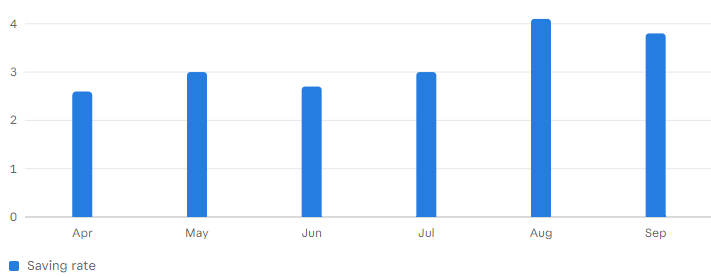
The trend over time is mixed. Bankrate's earlier surveys found 56% could not cover a $1,000 expense in 2024 and 59% in 2025. The 2026 reading is better, but still leaves roughly half of adults exposed (my reading of the surveys). Debt makes it worse. The same Bankrate research found 29% of Americans have more credit card debt than emergency savings, against 44% who have more savings than card debt. Inflation is part of the story: 54% of respondents said it is causing them to save less for emergencies. That is why the habits below focus on money you can actually find.
To see how small amounts add up, take someone with a take-home pay of $3,500 a month who automates 3%. That is $105 a month, or $1,260 a year, enough to clear the $1,000 starter target in under ten months (my calculation, ignoring interest).
Technique 2: Build a starter emergency fund. The $1,000 figure that surveys use is a sensible first target. Once you reach it, aim for one month of essential costs, then three. A third of Americans say they would go into debt to cover a $1,000 emergency, and borrowing is expensive, as the next section shows.
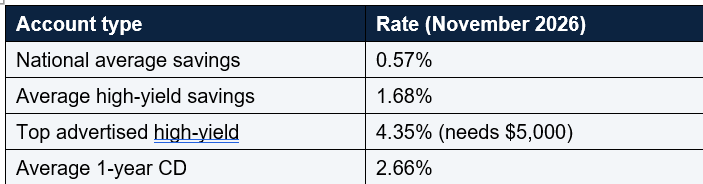
Technique 3: Move idle cash to a high-yield savings account. The national average savings rate was 0.57% in Bankrate's November data, while the top advertised high-yield rate was 4.35%, subject to a $5,000 minimum balance. Experian's Curinos data put the average high-yield account at 1.68%. Those sources disagree on what "typical" looks like, so shop around.
Rates vary by provider and date. Bankrate's own rate history table shows a lower 3.75% for the same bank on earlier dates, so check the live rate . On $10,000, 0.57% earns about $57 a year and 4.35% earns about $435, a gap of roughly $378 (my calculation, before taxes and assuming the rate holds). Make sure any account is insured by the FDIC or NCUA.
Bankrate's example shows the cost of minimum payments: on $5,000 at 20% APR, paying only the minimum takes about 23 years and roughly $7,723 in interest. Paying that debt down first can beat almost any savings account, because 19.71% is far above the 4.35% top savings rate. As a rough guide, a $5,000 balance at 19.71% costs about $985 in interest in a year (my calculation, ignoring compounding and payments). Many people split their effort: keep a small cushion, then put extra cash on the highest-rate card.
Technique 5: Audit your subscriptions. This is probably the easiest cash to find. In a C+R Research survey, Americans guessed they spent $86 a month on subscriptions, but an itemized tally came to $219. A separate survey found 89% of consumers underestimated their spending. CNET's survey put the average at $111 a month, up 23% from a year earlier. Different surveys, different definitions, but they point the same way.
Fortunly reports 59.9% of consumers have at least one unused paid subscription, and an average of $26.79 a month goes to unused ones. The fix: go through your last two bank and card statements, list every recurring charge, and cancel anything you did not use in the past month. Set a calendar reminder to repeat it every quarter.
Technique 6: Cut food waste. A consumer-focused analysis puts the value of wasted food at about $728 a year per person, roughly 11% of food spending. ReFED's 2026 survey found rising food prices are pushing many households to waste less. Practical steps: plan three to four dinners a week, shop your fridge first, freeze bread and leftovers, and keep older items at the front.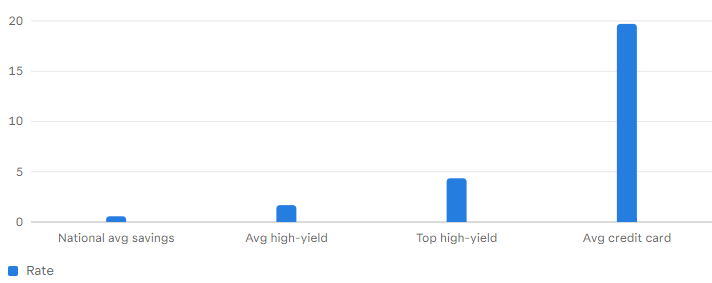
Technique 8: Use a health savings account if you are eligible. For 2027 the self-only HSA limit rises to $4,500 from $4,400, and the family limit rises by $250 to $9,000. You must be covered by a qualifying high-deductible health plan to contribute, so check with your plan before you start. HSAs can be a tax-efficient way to pay for medical costs you would pay anyway (tax rules vary, so confirm with a professional).
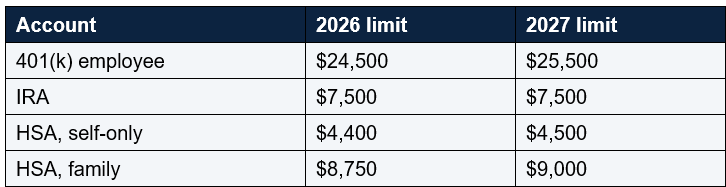
The 2026 401(k) figure is the 2027 limit minus the $1,000 increase; the family HSA 2026 figure is $9,000 minus the $250 rise. Check IRS Notice 2026-66 for details.
Technique 10: Use sinking funds. A sinking fund is a small amount set aside monthly for a known future expense, such as car repairs, holiday gifts, annual insurance or travel. Divide the yearly cost by 12 and automate that transfer. It turns surprise bills into planned ones, and it keeps your emergency fund for true emergencies. For example, if car repairs, gifts and annual insurance together come to $1,800 a year, that is $150 a month set aside, and the bills stop feeling like emergencies (my calculation). A 24-hour wait before non-essential purchases over a set amount pairs well with it (my suggestion).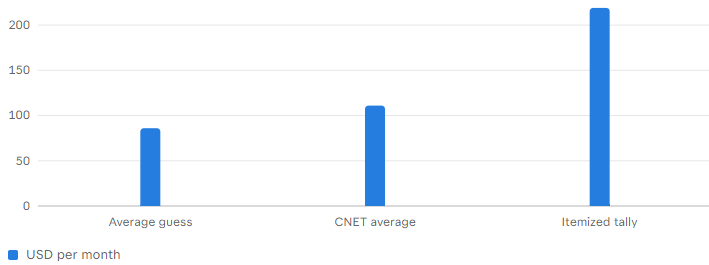
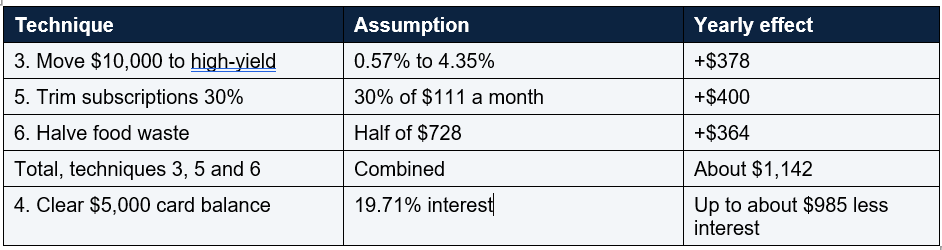
My calculations. Assumes rates hold, balances are as stated, and savings are not taxed. Results vary widely. That is roughly $1,142 a year from three small changes, before touching debt or retirement (my calculation). It is not life-changing alone, but it adds up, and it is fully within your control. Put it into an emergency fund or card payoff and the effect compounds.
If you are unsure where to begin, use this order: first the starter cushion, then high-interest debt, then the employer match, then the optimizing steps such as the savings-account switch. Someone with no debt can reverse the order of the first two, and someone with a large card balance may split their effort, as discussed above (my reasoning, not a rule). Keep the plan small. You are building routines, not chasing perfection. If you miss a week, restart where you stopped.
Chasing the top savings rate at the cost of convenience is one trap. A rate that needs a high minimum, or that drops after a promotion, may not be worth it.
Another is saving while carrying expensive card debt. At 19.71%, the interest usually outweighs what a savings account earns. A small cushion plus fast payoff is the common compromise (my reasoning). A third is cancelling something you value just to hit a number. The goal is to cut spending you do not notice, not spending that makes life better.
Another trap is forgetting about the changes in the calendar. Contribution limits reset in January, subscription free trials roll into paid plans, and insurance renewals arrive quietly. Put these dates in your calendar now so they do not catch you out (my suggestion). Finally, do not treat headline statistics as a verdict on you. Survey results differ by method, as the $1,000 emergency data show. Use them as context, then look at your own statements.
The data show why it matters. Saving rates are low, many households cannot cover a $1,000 surprise, and cards cost nearly 20%. The ten techniques are not a test you pass or fail. Treat them as a menu, pick the two that fit your situation, and review the results in three months. Pick two techniques this week and start. This is general education, not advice, and I am not a financial adviser. Check current rates and rules before acting.
There is no single answer. The US saving rate was 3.8% in September. Many planners suggest aiming higher, but start with an amount you can sustain and increase it over time (my reasoning).
How big should my emergency fund be?
A common first goal is $1,000, since surveys test whether people can cover that. Then build toward one to three months of essential costs.
Is a high-yield savings account worth it?
Often yes. The national average savings rate was 0.57% while top accounts advertised up to 4.35%, though minimums and rate changes apply.
What are the 2027 retirement contribution limits?
The 401(k) limit rises to $25,500, and the IRA limit stays at $7,500. The self-only HSA limit is $4,500.
How do I find forgotten subscriptions?
Review two months of bank and card statements. Surveys show most people underestimate subscription costs, with an itemized average of $219 versus an $86 guess.
Table of Contents
- Where Americans stand right now
- Techniques 1 to 3: build the foundation
- Techniques 4 to 6: plug the leaks
- Techniques 7 and 8: use the tax-advantaged accounts
- Techniques 9 and 10: everyday habits
- What the ten could add up to
- A simple 30-day plan
- Mistakes to avoid
- Conclusion
- FAQ
If you only have a minute, here are the ten: automate your savings, build a small starter emergency fund, move idle cash to a high-yield account, tackle high-interest card debt, audit your subscriptions, cut food waste, capture any employer retirement match, use a health savings account if you qualify, review your recurring bills, and set up sinking funds for predictable costs. None of them is clever. That is the point. Most money problems are not about missing a secret trick. They are about small leaks and missing buffers that compound over a year. Fixing even a few of these in January 2027 can change how the next twelve months feel.
Key takeaway: Start with the technique that closes your biggest gap: no cushion, expensive debt, or cash earning almost nothing. One consistent change beats ten half-finished ones.
US personal saving rate, 2026 (% of disposable income)
Where Americans stand right now
First, the backdrop. The US personal saving rate, which is the share of after-tax income people keep, was 3.8% in September 2026 and 4.1% in August. Earlier in the year it was lower: 2.6% in April, 3.0% in May, and 3.0% in July. So households are saving little, and the figure moves around a lot. Emergency cushions are thin. A Bankrate survey published in January found only 47% of Americans had sufficient liquidity or access to funds to cover a $1,000 emergency, and 33% said they would go into debt to pay for it. A U.S. News survey put the share who could not cover $1,000 from savings at 43%. The two surveys ask the question differently, so the numbers do not match, but both show the same problem.The trend over time is mixed. Bankrate's earlier surveys found 56% could not cover a $1,000 expense in 2024 and 59% in 2025. The 2026 reading is better, but still leaves roughly half of adults exposed (my reading of the surveys). Debt makes it worse. The same Bankrate research found 29% of Americans have more credit card debt than emergency savings, against 44% who have more savings than card debt. Inflation is part of the story: 54% of respondents said it is causing them to save less for emergencies. That is why the habits below focus on money you can actually find.
Techniques 1 to 3: build the foundation
Technique 1: Pay yourself first. Set an automatic transfer on payday, even a small one, before you can spend the money. The behavior matters more than the amount. Starting at 1% or 2% of pay and raising it every few months is easier than trying to find a big chunk later (my suggestion, not drawn from a source).To see how small amounts add up, take someone with a take-home pay of $3,500 a month who automates 3%. That is $105 a month, or $1,260 a year, enough to clear the $1,000 starter target in under ten months (my calculation, ignoring interest).
Technique 2: Build a starter emergency fund. The $1,000 figure that surveys use is a sensible first target. Once you reach it, aim for one month of essential costs, then three. A third of Americans say they would go into debt to cover a $1,000 emergency, and borrowing is expensive, as the next section shows.
Technique 3: Move idle cash to a high-yield savings account. The national average savings rate was 0.57% in Bankrate's November data, while the top advertised high-yield rate was 4.35%, subject to a $5,000 minimum balance. Experian's Curinos data put the average high-yield account at 1.68%. Those sources disagree on what "typical" looks like, so shop around.
Rates vary by provider and date. Bankrate's own rate history table shows a lower 3.75% for the same bank on earlier dates, so check the live rate . On $10,000, 0.57% earns about $57 a year and 4.35% earns about $435, a gap of roughly $378 (my calculation, before taxes and assuming the rate holds). Make sure any account is insured by the FDIC or NCUA.
Techniques 4 to 6: plug the leaks
Technique 4: Attack high-interest debt. The average credit card rate was 19.71% on 4 November, a little below the record 20.79% from August 2024. Rates follow the Prime Rate, and after the Fed's September hike the average rose by 0.12 points the next month. If the Fed hikes again, cards will likely get slightly more expensive (my reasoning).Bankrate's example shows the cost of minimum payments: on $5,000 at 20% APR, paying only the minimum takes about 23 years and roughly $7,723 in interest. Paying that debt down first can beat almost any savings account, because 19.71% is far above the 4.35% top savings rate. As a rough guide, a $5,000 balance at 19.71% costs about $985 in interest in a year (my calculation, ignoring compounding and payments). Many people split their effort: keep a small cushion, then put extra cash on the highest-rate card.
Technique 5: Audit your subscriptions. This is probably the easiest cash to find. In a C+R Research survey, Americans guessed they spent $86 a month on subscriptions, but an itemized tally came to $219. A separate survey found 89% of consumers underestimated their spending. CNET's survey put the average at $111 a month, up 23% from a year earlier. Different surveys, different definitions, but they point the same way.
Fortunly reports 59.9% of consumers have at least one unused paid subscription, and an average of $26.79 a month goes to unused ones. The fix: go through your last two bank and card statements, list every recurring charge, and cancel anything you did not use in the past month. Set a calendar reminder to repeat it every quarter.
Technique 6: Cut food waste. A consumer-focused analysis puts the value of wasted food at about $728 a year per person, roughly 11% of food spending. ReFED's 2026 survey found rising food prices are pushing many households to waste less. Practical steps: plan three to four dinners a week, shop your fridge first, freeze bread and leftovers, and keep older items at the front.
Interest rates: what you earn vs what you pay (%)
Techniques 7 and 8: use the tax-advantaged accounts
Technique 7: Capture your employer match and use the 2027 limits. The IRS raised the 2027 401(k) employee limit to $25,500, up $1,000 from 2026. The IRA limit stays at $7,500, and the IRA catch-up limit stays at $1,100. If your employer matches contributions, contribute at least enough to get the full match, since unclaimed match is money left on the table (my suggestion). You do not need to hit the maximum. Raise your contribution by one percentage point each time you get a raise. Small automatic steps work better than occasional big ones.Technique 8: Use a health savings account if you are eligible. For 2027 the self-only HSA limit rises to $4,500 from $4,400, and the family limit rises by $250 to $9,000. You must be covered by a qualifying high-deductible health plan to contribute, so check with your plan before you start. HSAs can be a tax-efficient way to pay for medical costs you would pay anyway (tax rules vary, so confirm with a professional).
The 2026 401(k) figure is the 2027 limit minus the $1,000 increase; the family HSA 2026 figure is $9,000 minus the $250 rise. Check IRS Notice 2026-66 for details.
Techniques 9 and 10: everyday habits
Technique 9: Review your recurring bills. Insurance, internet, phone and utilities often drift upward. Once a year, call or compare quotes, and ask what the best available rate is for existing customers. I do not have a survey figure for typical savings, so treat the benefit as case by case (my suggestion).Technique 10: Use sinking funds. A sinking fund is a small amount set aside monthly for a known future expense, such as car repairs, holiday gifts, annual insurance or travel. Divide the yearly cost by 12 and automate that transfer. It turns surprise bills into planned ones, and it keeps your emergency fund for true emergencies. For example, if car repairs, gifts and annual insurance together come to $1,800 a year, that is $150 a month set aside, and the bills stop feeling like emergencies (my calculation). A 24-hour wait before non-essential purchases over a set amount pairs well with it (my suggestion).
Monthly subscription spending: guess vs survey vs itemized (USD)
What the ten could add up to
Let's make the numbers tangible. The table below uses illustrative assumptions drawn from the sources above, not forecasts or promises.My calculations. Assumes rates hold, balances are as stated, and savings are not taxed. Results vary widely. That is roughly $1,142 a year from three small changes, before touching debt or retirement (my calculation). It is not life-changing alone, but it adds up, and it is fully within your control. Put it into an emergency fund or card payoff and the effect compounds.
A simple 30-day plan
Week one: set up an automatic transfer and open or compare high-yield accounts. Week two: list every subscription and cancel the unused ones. Week three: list your debts by interest rate, and check what your employer match is. Week four: plan a week of meals, check your insurance renewal dates, and name your sinking funds.If you are unsure where to begin, use this order: first the starter cushion, then high-interest debt, then the employer match, then the optimizing steps such as the savings-account switch. Someone with no debt can reverse the order of the first two, and someone with a large card balance may split their effort, as discussed above (my reasoning, not a rule). Keep the plan small. You are building routines, not chasing perfection. If you miss a week, restart where you stopped.
Chasing the top savings rate at the cost of convenience is one trap. A rate that needs a high minimum, or that drops after a promotion, may not be worth it.
Another is saving while carrying expensive card debt. At 19.71%, the interest usually outweighs what a savings account earns. A small cushion plus fast payoff is the common compromise (my reasoning). A third is cancelling something you value just to hit a number. The goal is to cut spending you do not notice, not spending that makes life better.
Another trap is forgetting about the changes in the calendar. Contribution limits reset in January, subscription free trials roll into paid plans, and insurance renewals arrive quietly. Put these dates in your calendar now so they do not catch you out (my suggestion). Finally, do not treat headline statistics as a verdict on you. Survey results differ by method, as the $1,000 emergency data show. Use them as context, then look at your own statements.
Conclusion
Better financial health in 2027 does not need a perfect budget. It needs a few reliable habits: automate savings, build a starter cushion, earn more on idle cash, pay down expensive debt, remove forgotten subscriptions, waste less food, use retirement and health accounts well, review your bills, and fund predictable costs in advance.The data show why it matters. Saving rates are low, many households cannot cover a $1,000 surprise, and cards cost nearly 20%. The ten techniques are not a test you pass or fail. Treat them as a menu, pick the two that fit your situation, and review the results in three months. Pick two techniques this week and start. This is general education, not advice, and I am not a financial adviser. Check current rates and rules before acting.
FAQ
How much should I save each month?There is no single answer. The US saving rate was 3.8% in September. Many planners suggest aiming higher, but start with an amount you can sustain and increase it over time (my reasoning).
How big should my emergency fund be?
A common first goal is $1,000, since surveys test whether people can cover that. Then build toward one to three months of essential costs.
Is a high-yield savings account worth it?
Often yes. The national average savings rate was 0.57% while top accounts advertised up to 4.35%, though minimums and rate changes apply.
What are the 2027 retirement contribution limits?
The 401(k) limit rises to $25,500, and the IRA limit stays at $7,500. The self-only HSA limit is $4,500.
How do I find forgotten subscriptions?
Review two months of bank and card statements. Surveys show most people underestimate subscription costs, with an itemized average of $219 versus an $86 guess.
0 Comments
Be the first to share your thoughts on this article.