
Finance
3 Changes to Treasury Direct You Need to Know

Table of Contents
Why This Fall Matters for TreasuryDirect InvestorsThe Three Changes at a Glance
Change #1: ID.me Is Now the Only Way to Log In
- What changed
- Will you lose your money if you miss the deadline?
- Why some investors are upset
- What to do this week
Change #2: Certificates of Indebtedness Are No Longer a Payment Destination
- What changed
- What hasn't changed
- Why it matters
Change #3: The Tax-Refund I Bond Option Is Gone for Good
- What changed
- Why Treasury killed it
- How to work within the new limit
Frequently Asked Questions
Why This Fall Matters for TreasuryDirect Investors
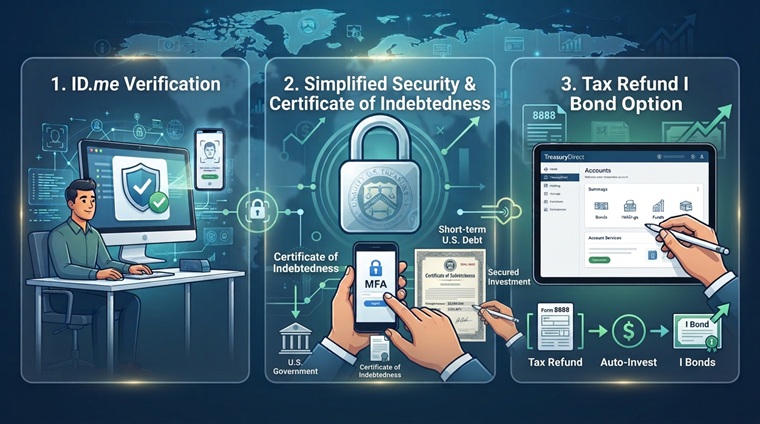
If you own I bonds, EE bonds, T-bills, or any other security inside a TreasuryDirect account, 2026 has quietly turned into the year the old system finally started to change. For two decades, TreasuryDirect felt frozen in time. It had the clunky virtual keyboard, the security image you had to remember, and a design that looked like it was built when flip phones were cool. Investors grumbled, but they also got used to it.That era is ending. Over the last year and a half, the Treasury has rolled out three changes that affect how you sign in, where your money lands when a security matures, and how much you can actually put into I bonds each year. One of them comes with a hard deadline that is now less than a week away.
I have spent a lot of time reading the official notices, the FAQs, and the reactions from long-time bond investors so you don't have to. Below, I break down each change in plain English: what happened, why it matters, and exactly what you should do about it.
The Three Changes at a Glance
Here is the short version before we dig in: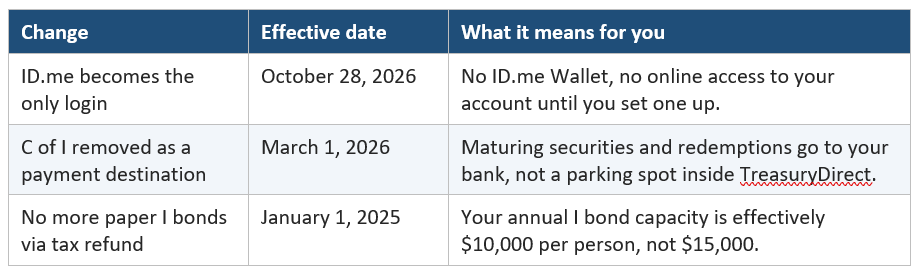
Change #1: ID.me Is Now the Only Way to Log In
What changed
This is the big one, and it is time-sensitive. In mid-August 2026, TreasuryDirect began emailing account holders to announce that it was replacing its traditional login with ID.me, a third-party digital identity service already used by the IRS, Social Security, and the VA. According to Treasury's own FAQ, ID.me went live as an option on September 13, 2026, and customers were given a 45-day window to keep using their traditional login. After October 28, 2026, ID.me becomes the required sign-in method, full stop.In practice, that means the account number, password, security image, and emailed one-time code you have been using for years will stop working. Once you link your account to ID.me, the old login and personalized security image are retired immediately, and trying to use them afterward simply returns an error.
Will you lose your money if you miss the deadline?
No, and this is worth repeating because a lot of people are panicking. Treasury has stated that if you don't connect to ID.me by October 28, only your online access is restricted. Your bonds, bills, and any cash in the account stay put and keep earning interest. You can restore access at any time by finishing the ID.me setup and linking your account.That said, being locked out is still a real problem. TreasuryDirect does not mail you 1099-INT tax forms; you download them from your account. As personal finance writer David Enna of Tipswatch pointed out, anyone who redeemed bonds in 2026 will need a working ID.me login to grab those tax documents in early 2027.
Why some investors are upset
ID.me is a private, for-profit company, and verification can involve uploading a government ID and taking a selfie. Many investors would have preferred Login.gov, the government's own sign-in service. A Change.org petition is asking Treasury to pause the mandate and add Login.gov as an alternative. Treasury's FAQ is clear, though: even if you already have Login.gov, you still need ID.me to get into TreasuryDirect. On the other side, plenty of users say the switch was painless, especially those who already had ID.me from the IRS or Social Security.What to do this week
1. Log in with your current credentials now and download any statements or tax forms you might need, while the old system still works.2. Create or confirm your ID.me Wallet. If you already use ID.me for IRS.gov or SSA, you are halfway there.
3. Go to TreasuryDirect.gov, click Secure Sign In, sign in through ID.me, and approve the data-sharing prompt to link your account.
4. Set up strong multi-factor authentication on ID.me. A security key or authenticator app is safer than text messages.
5. If you manage entity, trust, or minor-linked accounts, check the ID.me FAQ about linking multiple accounts to one Wallet before the deadline.
Block out at least an hour. Some readers report finishing in ten minutes; others needed a video call with an ID.me agent. Don't leave it for the night of October 27.
Change #2: Certificates of Indebtedness Are No Longer a Payment Destination
What changed
A Certificate of Indebtedness, or C of I, is basically a zero-interest holding pen inside your TreasuryDirect account. For years, many investors had their maturing T-bills, redemptions, and interest payments drop into a C of I so they could roll the money into new purchases quickly. Some people even used BuyDirect to push cash from their bank into a C of I, which made it a popular trick for meeting bank bonus "direct deposit" requirements.Since March 1, 2026, that door has closed. TreasuryDirect says you can no longer select C of I as a new payment destination, and you can no longer move money from your bank into a C of I through BuyDirect. Going forward, your linked bank account becomes the primary payment destination.
What hasn't changed
- If C of I was already set as your payment destination before March 1, payments continue to flow there.
- You can still use C of I money you already hold to buy interest-bearing securities.
- You can still redeem your C of I balance to your bank account at any time.
Why it matters
Treasury frames this as a simplification, and it openly encourages customers not to leave money sitting in a C of I because it earns nothing. Honestly, that's good advice. Every dollar parked at 0% is a dollar losing ground to inflation. The FAQ also hints that more C of I changes could follow, so the safest move is to treat it as something to phase out.Your action step: Log in, check whether you have a C of I balance, and either buy a security with it or redeem it to your bank. To redeem, go to ManageDirect, choose Redeem Securities, select C of I, and pick your bank. While you are there, confirm your bank details are current, since that's where future payments will now land.
Change #3: The Tax-Refund I Bond Option Is Gone for Good
What changed
For years, savvy I bond fans had a "back door." Beyond the $10,000 electronic limit per person, you could buy up to $5,000 more in paper Series I bonds by directing part of your federal tax refund through IRS Form 8888. Some households even overpaid their estimated taxes on purpose just to unlock this extra slot.Treasury ended the Tax Time Savings Bond program on January 1, 2025. IRS Form 8888 still exists, but it is now only used to split a refund between bank accounts. The 2026 filing season was the first full year where that $5,000 option simply wasn't there, and a lot of people only noticed when their tax software no longer offered it.
Why Treasury killed it
The numbers tell the story. Treasury reported that, on average, only about 35,000 tax filers a year bought paper I bonds this way, which is roughly 0.03% of all filers. Those sales made up less than 1% of all Series I purchases. Printing and mailing paper bonds for that small group was hard to justify when everything else had gone electronic years ago.How to work within the new limit
- Each person can still buy $10,000 a year in electronic I bonds, so a married couple can buy $20,000 using two accounts.
- Entity and trust accounts (with their own EIN) get their own $10,000 limit.
- The gift box lets you buy bonds now as gifts and deliver them in a future year, subject to the recipient's annual cap.
- If you still hold old paper bonds, consider converting them to electronic form in TreasuryDirect. It's safer, and fewer banks cash paper bonds these days.
By the Numbers: Where I Bond Rates Stand Right Now
Why does any of this matter? Because I bonds are attractive again. Treasury announced on May 1, 2026 that I bonds issued from May through October 2026 earn a 4.26% composite rate. That rate is built from a 0.90% fixed rate, which you keep for the bond's 30-year life, plus a 3.34% annualized inflation rate. That fixed rate is among the highest since 2007, which means you're locking in a real return above inflation for decades.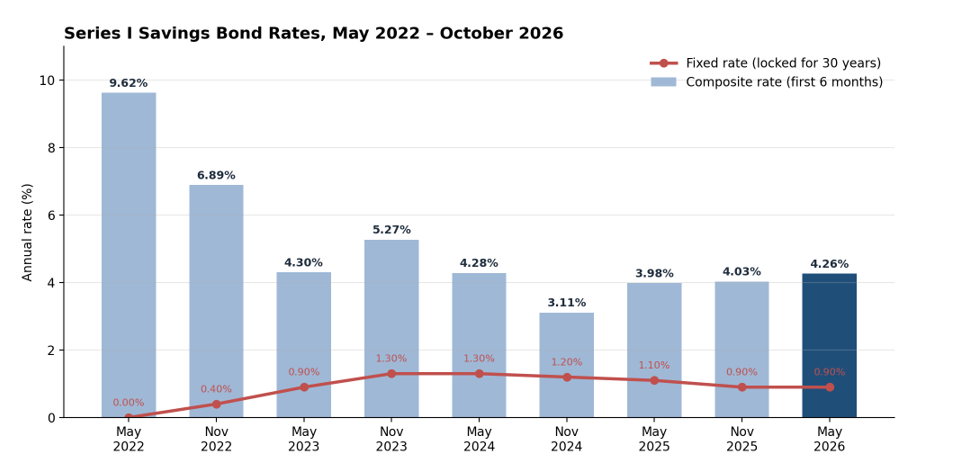
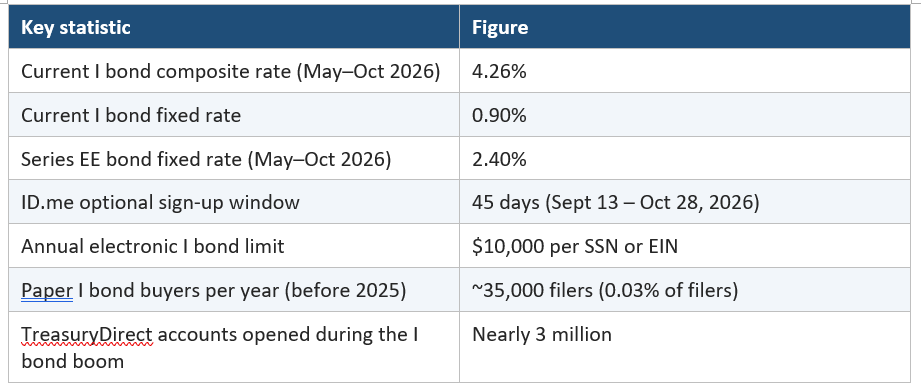
One more date to watch: Treasury resets I bond rates every May 1 and November 1. The next announcement lands on November 1, 2026, just days after the ID.me deadline. If you want to buy at the current 0.90% fixed rate, or check the new one, you'll need working access.
Your TreasuryDirect Action Checklist
- Link your account to ID.me before October 28, 2026.
- Download any 2026 statements and confirm where you'll find your 1099-INT.
- Check for an idle C of I balance and put it to work or redeem it.
- Verify your linked bank account is correct.
- Plan your 2026 and 2027 I bond purchases around the $10,000 limit.
- Add a payable-on-death beneficiary if you haven't already.
Conclusion
TreasuryDirect is finally being modernized, and like most upgrades, it's a little bumpy. The ID.me requirement is the urgent piece: take an hour this week and get it done so you aren't scrambling for tax forms next spring. The C of I change is a nudge to stop parking cash at zero percent, and the end of tax-refund paper bonds means planning your I bond buying around a clean $10,000-per-person limit.None of these changes put your money at risk. They do, however, reward people who stay a step ahead. With I bonds paying 4.26% and a fixed rate near its best level in nearly two decades, it's worth making sure you can actually get into your account when it counts.
This article is for general information only and isn't financial, tax, or legal advice. Always confirm details on TreasuryDirect.gov.
Frequently Asked Questions
What happens if I don't set up ID.me by October 28, 2026?Your securities stay safe and keep earning interest, but you won't be able to log in online until you create an ID.me Wallet and link your account. You can do that any time after the deadline.
Can I use Login.gov instead of ID.me for TreasuryDirect?
Not at this time. Treasury's FAQ says Login.gov users must still verify through ID.me to access TreasuryDirect.
Is my old C of I balance still usable?
Yes. You can use existing C of I funds to buy securities or redeem them to your bank. You just can't choose C of I as a new payment destination or fund it via BuyDirect.
Can I still buy I bonds with my tax refund?
No. The option to buy paper I bonds with a tax refund ended January 1, 2025. Electronic purchases on TreasuryDirect, up to $10,000 per person per year, are the main route now.
What is the current I bond rate?
I bonds issued May 1 through October 31, 2026 earn 4.26%, including a 0.90% fixed rate. A new rate will be announced November 1, 2026.
How do I get my 1099-INT if I'm locked out?
Tax forms are downloaded from your online account, so you'll need to complete ID.me verification first. Download anything you need now while your current login still works.
0 Comments
Be the first to share your thoughts on this article.