
General
Are Paid Dating Apps Worth It? What You'll Really Pay Yearly

Premium dating apps promise better matches and more visibility, but subscriptions and extras can add up quickly. Here is what you will pay and whether upgrading is worth it. Match Group Q3 2026: 13.8M payers (down 5%), $21.19 revenue per payer | Bumble App paying users 2.0M (down 15.1%) | Pew: 58% of paid users report positive experiences vs 50% of never-paid | Estimated $392 to $1,080 a year for one to three premium apps | Match Group FTC settlement: $14M.
Short answer: sometimes, but not by default. Paid dating apps can be worth it for a particular person at a particular moment, and a waste of money for the same person six months later. What you get depends on the app, the tier, how many people in your area use it, and honestly, how good your profile is before you pay a penny.
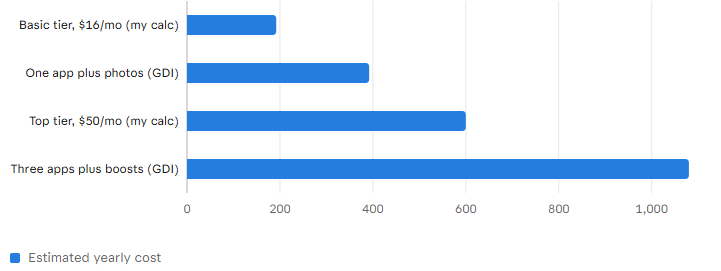
On price, one 2026 breakdown puts a basic premium tier on Tinder, Bumble or Hinge at about $16 a month, with top tiers at $40 to $50. The same source estimates about $392 a year for one premium app (including one set of professional photos) and about $1,080 a year for three premium apps with occasional boosts. Those are estimates from one publisher, not a measured average, and they leave out the cost of the dates themselves.
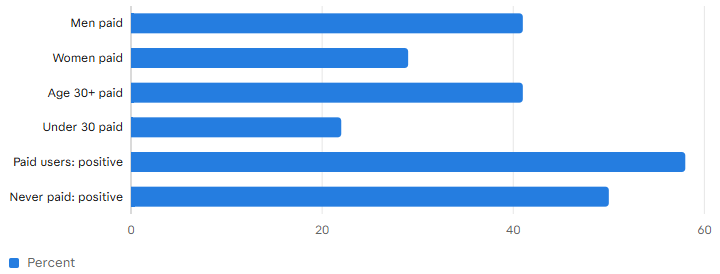
On results, the best evidence I found is a little encouraging and a little murky. In Pew Research's 2022 survey, people who had ever paid for a dating site or app were more likely to describe their experience as positive: 58%, against 50% of those who had never paid. That is a correlation. It does not prove that paying causes better outcomes, since people who pay may differ from people who do not.
Key takeaway: Treat a subscription as a short, deliberate experiment, not a habit. Fix your photos first, pay for one app at a time, and put the cancellation date in your calendar the day you sign up.
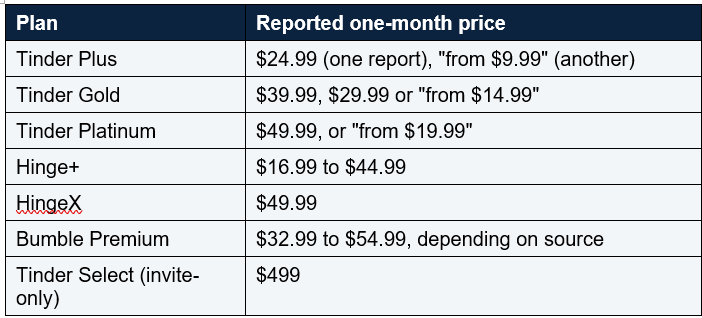
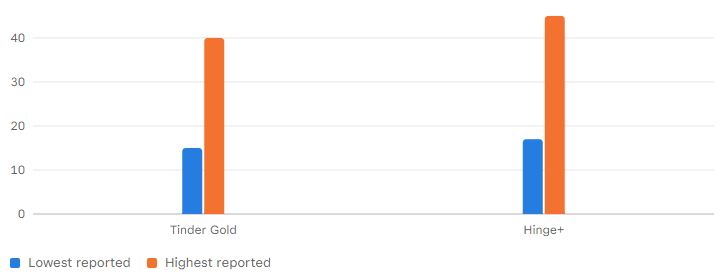
Look at Tinder Gold. One reviewer lists it at $39.99 a month for a single month. Another lists it at $29.99, and a third at "starting at $14.99". Those cannot all describe the same product on the same day. Hinge shows the same pattern: one site lists Hinge+ at $16.99 a mont while another says $29.99 for one month and a third lists $44.99.
Longer plans bring the monthly rate down. One review says HingeX costs $49.99 for a single month and as little as $24 a month on a six-month commitment. Another says Tinder Plus is $24.99 for a month or $16.66 a month on a six-month plan. If you are tempted by a six-month discount, remember what you are agreeing to: you pay for months you may not use.
At the far end of the scale sits Tinder Select, an invite-only tier reported at $499 a month. Industry reporting also noted that Bumble was considering a tier above its then-current plan of about $60 a month, and that Grindr planned more premium options. You do not need those tiers to date, and nothing I found says they work better.
One more wrinkle: not every price you see is in US dollars. A Canadian column I read quotes Hinge+ at C$32.99 for one month and C$21.66 a month on a three-month plan, and weekly plans from C$12.99 to C$17.99 for Tinder, Hinge+ and Bumble. Android Authority notes that weekly plans are less cost-effective than monthly or six-monthly ones, so avoid them unless you truly want a quick one-week test.
The practical advice from that guide is blunt: read the checkout screen, not a generic price article. I agree, and I would add one thing. Take a screenshot of the price and the renewal date before you tap pay. If the charge later differs from what you saw, you have something to show your app store or card provider.
4. What you actually get for the money
What do you actually get for the extra money? Broadly, the paid tiers sell you three things: more reach, more information, and more convenience.
More reach means more likes or more visibility. A 2026 guide says Tinder, Bumble and Hinge all sell optional upgrades such as expanded likes, undo tools, travel settings or access to a Likes queue. On Tinder, one review describes Gold as adding a Likes You view and other perks, while Platinum adds prioritised likes.
More information means seeing who has already liked you. This is the feature many people pay for first, because it saves swiping through profiles that may never be interested. The Knot describes Bumble's Premium as unlocking advanced filters and the ability to see who swiped right on you. Please check the current tier list in the app itself.
More convenience means filters and fewer limits. The Knot says Hinge's paid tier offers unlimited likes and advanced filters, while the free tier limits daily likes. LowerMySubs puts the free allowance at about 8 likes a day on Hinge. Here is where I would pause. Every one of these features is about access. None of them improves your photos, your first message, or how you come across on a first date. A paid tier can put you in front of more people, but it cannot make those people like you more. That is my inference, and it is the reason the photo advice later in this post matters so much.
From the companies themselves. Match Group, which owns Tinder and Hinge, reported 13.8 million payers in the third quarter of 2026, down 5%, with average monthly revenue per payer up 3% to $21.19. Bumble reported its Bumble App paying users fell 15.1% to 2.0 million in the third quarter, with revenue per paying user of $28.02 a month. Bumble's total paying users were about 3.08 million, down almost half a million year on year.
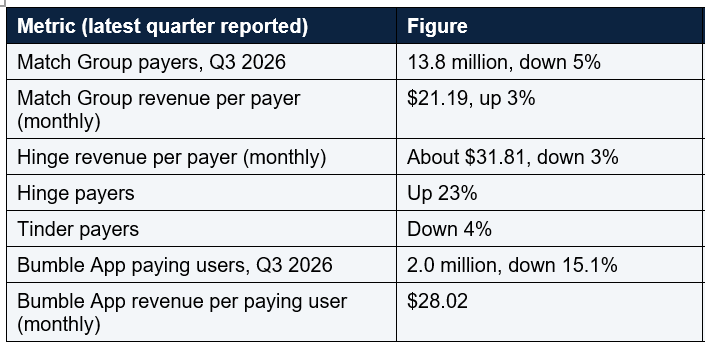
Source note: another report gives Match Group payers as 14.53 million and revenue per payer as $20.58; I could not reconcile this with the company figures above, and it may use a different period or definition. Hinge revenue per payer appears as about $30 on the earnings call, $31.81 and $32.87.
Those monthly figures are averages across everyone who pays, including people on cheap long plans and people buying extras. In my calculation, $21.19 a month works out to roughly $254 a year, and Hinge's $31.81 to roughly $382 a year. That is well below the $1,080 estimate for three premium apps. One caution: Match Group counts payers per brand, so a person paying at two of its apps counts twice, and per-person spend can therefore be higher than these averages (my inference).
Hinge is the interesting case. A quote in Fast Company calls Hinge "one of the highest-priced products we have", and the earnings call put Hinge revenue per payer at about $30, roughly double the average for Tinder. If you pay for Hinge, expect to be in the more expensive end of the market. From surveys. In the UK, Barclays research (Opinium, 2,000 UK consumers, 25 to 29 September 2026) found single daters spend an average of £7.10 a month on dating apps, up from £4.70 in 2025. Men averaged £9.20 against £4.20 for women, and millennials were the biggest spenders at £12.20. In the US, Morgan Stanley estimated in 2023 that the average dater who paid spent $18 to $19 a month.
The extremes exist. A CBS News report described one man who signed up for paid versions of several apps and found himself spending around $1,000 a month on paid features. That is an individual case, not a typical one. More typical is not knowing: a Dating News survey found about 70% of singles do not track their dating costs at all. The wider picture is gloomy. A BMO survey reported by Fortune found 47% of single Americans say dating is no longer financially worth it, with daters spending an average of $2,323 a year going out and going on about 12 dates in the past year. That figure is about dates, not apps, but it is the number to hold in mind when you add subscriptions on top.
Extras. Beyond the subscription, apps sell boosts, super likes and similar à la carte items. One article describes à la carte options such as super likes, paid filters and even the ability to keep swiping. Global Dating Insights' $1,080 estimate includes occasional boosts, and the $780 to $912 range for running multiple apps is before extra features. Auto-renewal and cancellation. This is where people lose money without noticing. In 2025 Match Group agreed to pay $14 million to settle Federal Trade Commission charges that it misrepresented a free-renewal guarantee and made cancellation difficult for Match.com and related services. The FTC named Match.com, OkCupid, PlentyOfFish and The League, among others. Those allegations concerned particular brands and past practices, and the company agreed to simplify cancellation. I am not saying Tinder or Hinge do the same. I am saying that cancellation friction is a recognised risk in this industry, so cancel through your app store settings and check your statements.
My suggestion: The day you subscribe, set a calendar reminder for two days before renewal. If you would not pay again today, cancel then. That one habit does more to protect your wallet than any discount code.
Take that with care. First, it is a self-reported satisfaction measure, not a count of dates, relationships or marriages. Second, the survey is now more than four years old, and the apps and their paywalls have changed a lot since. Third, as I said earlier, paying may be a marker of someone who is more serious or more active, not the cause of a better experience. I could not find a recent, independent study that measured whether a given paid tier produces more or better matches.
Who pays also matters. Pew found that 41% of online dating users aged 30 and over had paid, compared with 22% of those under 30, and that men were more likely than women to have paid (41% versus 29%). Another summary of the same survey puts the share of users who had paid at around 35%. In other words, the people who pay are not a random sample, which is one more reason to be careful with the 58% versus 50% comparison (my inference). The most practical piece of evidence is about photos. Global Dating Insights cites one study, which it does not name, in which better photos raised match rates from 25% to 43%, while bio improvements had minimal effect. Because I cannot see the study, I would treat the exact numbers as unverified. The direction, though, matches common sense: before you pay to reach more people, make sure your profile is worth reaching.
Here is the business picture. Match Group's payers fell 5% to 13.8 million in the third quarter even as revenue per payer rose 3%. Tinder payers fell 4% while Hinge payers grew 23%. Bumble's total paying users fell 16.4% to 3.2 million in the second quarter, and its Bumble App paying users fell 15.1% in the third. Industry coverage described apps testing higher-priced tiers in the face of falling payer numbers.
My inference from those numbers: when fewer people pay, the companies have two levers. They can try to win payers back with better products and cheaper entry tiers, or they can squeeze more from the people who stay. Match Group's Hinge saw revenue per payer fall 3% as it tested discounts, which suggests at least some cheaper options are being tried. Meanwhile, Bumble reported an all-cash merger valued at $1.3 billion agreed in October, subject to regulatory approvals. I did not retrieve who the buyer is, and a deal like that could change pricing, but I would not guess how.
The takeaway for you is that the paywall is a business model, not a verdict on you. If you are not getting matches on the free tier, that does not mean you are unlovable. It may mean the free tier is designed to show you just enough to make you curious about paying. Euro Weekly News, citing Business of Apps, reports over 350 million people use dating apps and 23 million pay for premium features. By my calculation that is under 7% paying, which means the large majority of users do not pay at all.
You are looking for something specific. If you want to filter for particular goals, distance or lifestyle, advanced filters can cut out a lot of mismatch. That is worth more to someone with clear criteria than to someone casually browsing. You have already fixed the basics. If your photos are good, your profile is thoughtful and you are still stuck, a one-month upgrade is a reasonable test. Set a clear question, such as whether you get more good conversations in 30 days, and judge by the answer.
You are on one app, not four. The spending problem tends to start when people stack subscriptions. One app, one month, one clear goal is a healthy way to test. If you do pay, consider a mid-priced tier before a premium one. One guide says Tinder's Gold tier adds the Likes You view and Platinum adds prioritised likes, so the middle tier may already give you the feature you want. Check what each tier lists today before you buy.
The price is a long commitment. A six-month or annual plan is cheaper per month but only if you will use it. If you are not sure, pay monthly and accept the higher rate. You are chasing status tiers. An invite-only plan of about $500 a month is an extreme, and nothing I found shows that such tiers produce better matches. If a price feels like a luxury purchase, treat it as one.
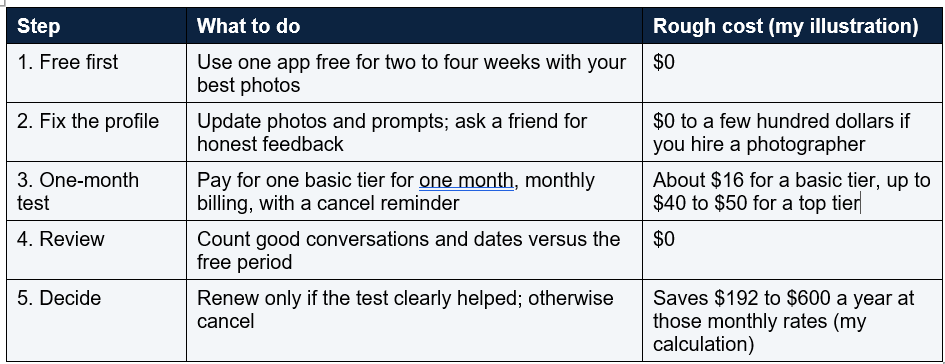
A word on that last row. The $192 to $600 range is my calculation: $16 a month times 12 is $192, and $50 a month times 12 is $600. It assumes you would otherwise have kept paying all year, which not everyone does.
A few common mistakes are worth naming. Counting only the subscription. Time, extras and the cost of dates matter too. Americans in the BMO survey report spending about $2,323 a year going out , so the app fee is often the smaller line on the bill.
The prices are real, if confusing: roughly $16 a month for a basic tier and $40 to $50 for a top one with plenty of variation by app, plan and country. The evidence that paying helps is modest: Pew found paid users somewhat more positive, 58% versus 50%, but that is a survey from 2022 and cannot show cause and effect. The hidden costs of time, extras and auto-renewal are real too, and regulators have pursued at least one major dating company over them.
My practical advice is to treat a subscription as an experiment. Start free, make your profile as good as it can be, then pay for one app for one month with a clear question in mind. Track what you spend. Cancel if the answer is no. If the answer is yes, keep going, but keep an eye on the renewal date.
And remember that no tier can buy chemistry. Whatever you decide, the goal is not a bigger inbox of likes. It is one good conversation that turns into a first date you are happy you went on. This post is general education, and I am not a relationship or financial adviser.
Sometimes. Pew found that people who had paid were somewhat more likely to report positive experiences, 58% versus 50%, but that does not prove paying causes better results. Treat a subscription as a short test with a clear goal.
How much do Tinder, Hinge and Bumble cost per month?
Reports vary. One 2026 breakdown puts basic premium at about $16 a month and top tiers at $40 to $50, but individual tiers are quoted much higher or lower elsewhere. Check the checkout screen, because prices vary by plan, account and country.
How much do people actually spend on dating apps?
Match Group reported average revenue per payer of $21.19 a month, and Bumble App reported $28.02. In the UK, Barclays found single daters spend £7.10 a month on average. One estimate for three premium apps is about $1,080 a year.
Is it better to pay for one app or several?
In my view, one at a time. Running several premium apps costs $780 to $912 a year before extras, and the apps may show you overlapping people. Test one app for a month, then decide.
How do I avoid being charged after I cancel?
Cancel through your app store subscription settings, take a screenshot of the confirmation, and check your statements. The FTC's case against Match Group involved allegations about difficult cancellation on Match.com and related services. That case concerned specific brands, but it shows why keeping records is wise.
Table of Contents
- What the apps charge: the sticker prices
- Why the prices never seem to agree
- What you actually get for the money
- What people really spend
- The hidden costs: time, extras and auto-renewal
- Does paying actually work?
- Why the free versions feel so limited
- When upgrading is worth it
- When to skip it
- A simple spending plan
- Conclusion
- FAQ
Reported one-month price range for Tinder Gold and Hinge+ (US$)
US$ per month by Sources disagree: The Knot, Android Authority, LowerMySubs, Modern Dating by Eddie
Estimated yearly cost of premium dating apps (US$)
US$ per year by GDI = Global Dating Insights estimates; 'my calc' = monthly price x 12. Excludes dates.
Pew 2022: who pays, and how positive paid users feel (%)
% of online dating users by Pew Research Center, July 2022 survey of 6,034 US adults. Correlation, not cause.Short answer: sometimes, but not by default. Paid dating apps can be worth it for a particular person at a particular moment, and a waste of money for the same person six months later. What you get depends on the app, the tier, how many people in your area use it, and honestly, how good your profile is before you pay a penny.
On price, one 2026 breakdown puts a basic premium tier on Tinder, Bumble or Hinge at about $16 a month, with top tiers at $40 to $50. The same source estimates about $392 a year for one premium app (including one set of professional photos) and about $1,080 a year for three premium apps with occasional boosts. Those are estimates from one publisher, not a measured average, and they leave out the cost of the dates themselves.
On results, the best evidence I found is a little encouraging and a little murky. In Pew Research's 2022 survey, people who had ever paid for a dating site or app were more likely to describe their experience as positive: 58%, against 50% of those who had never paid. That is a correlation. It does not prove that paying causes better outcomes, since people who pay may differ from people who do not.
Key takeaway: Treat a subscription as a short, deliberate experiment, not a habit. Fix your photos first, pay for one app at a time, and put the cancellation date in your calendar the day you sign up.
What the apps charge: the sticker prices
Let us start with the part everyone asks about first: what does it cost? The honest answer is that published prices disagree with each other, sometimes by a wide margin. That is partly because the apps change prices, and partly because the websites writing about them are looking at different countries, devices and dates. The table below shows the range I found for one-month plans.Look at Tinder Gold. One reviewer lists it at $39.99 a month for a single month. Another lists it at $29.99, and a third at "starting at $14.99". Those cannot all describe the same product on the same day. Hinge shows the same pattern: one site lists Hinge+ at $16.99 a mont while another says $29.99 for one month and a third lists $44.99.
Longer plans bring the monthly rate down. One review says HingeX costs $49.99 for a single month and as little as $24 a month on a six-month commitment. Another says Tinder Plus is $24.99 for a month or $16.66 a month on a six-month plan. If you are tempted by a six-month discount, remember what you are agreeing to: you pay for months you may not use.
At the far end of the scale sits Tinder Select, an invite-only tier reported at $499 a month. Industry reporting also noted that Bumble was considering a tier above its then-current plan of about $60 a month, and that Grindr planned more premium options. You do not need those tiers to date, and nothing I found says they work better.
One more wrinkle: not every price you see is in US dollars. A Canadian column I read quotes Hinge+ at C$32.99 for one month and C$21.66 a month on a three-month plan, and weekly plans from C$12.99 to C$17.99 for Tinder, Hinge+ and Bumble. Android Authority notes that weekly plans are less cost-effective than monthly or six-monthly ones, so avoid them unless you truly want a quick one-week test.
Why the prices never seem to agree
If you are wondering why a price looked different on your friend's phone, there are a few reasons. Android Authority notes that Tinder has been reported to use dynamic pricing, so published prices are guidelines only. A 2026 guide adds that dating apps can vary prices by tier, subscription length, package, account and purchase channel, and that Bumble explicitly describes those variables while Tinder's terms say pricing varies.The practical advice from that guide is blunt: read the checkout screen, not a generic price article. I agree, and I would add one thing. Take a screenshot of the price and the renewal date before you tap pay. If the charge later differs from what you saw, you have something to show your app store or card provider.
4. What you actually get for the money
What do you actually get for the extra money? Broadly, the paid tiers sell you three things: more reach, more information, and more convenience.
More reach means more likes or more visibility. A 2026 guide says Tinder, Bumble and Hinge all sell optional upgrades such as expanded likes, undo tools, travel settings or access to a Likes queue. On Tinder, one review describes Gold as adding a Likes You view and other perks, while Platinum adds prioritised likes.
More information means seeing who has already liked you. This is the feature many people pay for first, because it saves swiping through profiles that may never be interested. The Knot describes Bumble's Premium as unlocking advanced filters and the ability to see who swiped right on you. Please check the current tier list in the app itself.
More convenience means filters and fewer limits. The Knot says Hinge's paid tier offers unlimited likes and advanced filters, while the free tier limits daily likes. LowerMySubs puts the free allowance at about 8 likes a day on Hinge. Here is where I would pause. Every one of these features is about access. None of them improves your photos, your first message, or how you come across on a first date. A paid tier can put you in front of more people, but it cannot make those people like you more. That is my inference, and it is the reason the photo advice later in this post matters so much.
What people really spend
So what do real people spend? The numbers depend on whom you ask, and the sources use very different definitions. I have grouped them below so you can compare like with like.From the companies themselves. Match Group, which owns Tinder and Hinge, reported 13.8 million payers in the third quarter of 2026, down 5%, with average monthly revenue per payer up 3% to $21.19. Bumble reported its Bumble App paying users fell 15.1% to 2.0 million in the third quarter, with revenue per paying user of $28.02 a month. Bumble's total paying users were about 3.08 million, down almost half a million year on year.
Source note: another report gives Match Group payers as 14.53 million and revenue per payer as $20.58; I could not reconcile this with the company figures above, and it may use a different period or definition. Hinge revenue per payer appears as about $30 on the earnings call, $31.81 and $32.87.
Those monthly figures are averages across everyone who pays, including people on cheap long plans and people buying extras. In my calculation, $21.19 a month works out to roughly $254 a year, and Hinge's $31.81 to roughly $382 a year. That is well below the $1,080 estimate for three premium apps. One caution: Match Group counts payers per brand, so a person paying at two of its apps counts twice, and per-person spend can therefore be higher than these averages (my inference).
Hinge is the interesting case. A quote in Fast Company calls Hinge "one of the highest-priced products we have", and the earnings call put Hinge revenue per payer at about $30, roughly double the average for Tinder. If you pay for Hinge, expect to be in the more expensive end of the market. From surveys. In the UK, Barclays research (Opinium, 2,000 UK consumers, 25 to 29 September 2026) found single daters spend an average of £7.10 a month on dating apps, up from £4.70 in 2025. Men averaged £9.20 against £4.20 for women, and millennials were the biggest spenders at £12.20. In the US, Morgan Stanley estimated in 2023 that the average dater who paid spent $18 to $19 a month.
The extremes exist. A CBS News report described one man who signed up for paid versions of several apps and found himself spending around $1,000 a month on paid features. That is an individual case, not a typical one. More typical is not knowing: a Dating News survey found about 70% of singles do not track their dating costs at all. The wider picture is gloomy. A BMO survey reported by Fortune found 47% of single Americans say dating is no longer financially worth it, with daters spending an average of $2,323 a year going out and going on about 12 dates in the past year. That figure is about dates, not apps, but it is the number to hold in mind when you add subscriptions on top.
The hidden costs: time, extras and auto-renewal
The subscription fee is only part of the bill. Three other costs tend to get ignored. Time. Global Dating Insights, citing DatingSiteSpot research, says the average user spends about 51 minutes a day on dating apps, which adds up to roughly 310 hours a year, or nearly 13 full days. Whether that is a cost depends on whether you enjoy it. If you are swiping out of habit and not hope, those hours are part of the price.Extras. Beyond the subscription, apps sell boosts, super likes and similar à la carte items. One article describes à la carte options such as super likes, paid filters and even the ability to keep swiping. Global Dating Insights' $1,080 estimate includes occasional boosts, and the $780 to $912 range for running multiple apps is before extra features. Auto-renewal and cancellation. This is where people lose money without noticing. In 2025 Match Group agreed to pay $14 million to settle Federal Trade Commission charges that it misrepresented a free-renewal guarantee and made cancellation difficult for Match.com and related services. The FTC named Match.com, OkCupid, PlentyOfFish and The League, among others. Those allegations concerned particular brands and past practices, and the company agreed to simplify cancellation. I am not saying Tinder or Hinge do the same. I am saying that cancellation friction is a recognised risk in this industry, so cancel through your app store settings and check your statements.
My suggestion: The day you subscribe, set a calendar reminder for two days before renewal. If you would not pay again today, cancel then. That one habit does more to protect your wallet than any discount code.
Does paying actually work?
Now the big question. Does paying lead to better results? The evidence is thinner than the marketing suggests. The most useful source is Pew Research's survey of 6,034 US adults, conducted 5 to 17 July 2022. Overall, about half of people who had used a dating site or app described their experiences as positive. Among those who had ever paid, around 58% said their experiences were positive, versus half of those who had never paid.Take that with care. First, it is a self-reported satisfaction measure, not a count of dates, relationships or marriages. Second, the survey is now more than four years old, and the apps and their paywalls have changed a lot since. Third, as I said earlier, paying may be a marker of someone who is more serious or more active, not the cause of a better experience. I could not find a recent, independent study that measured whether a given paid tier produces more or better matches.
Who pays also matters. Pew found that 41% of online dating users aged 30 and over had paid, compared with 22% of those under 30, and that men were more likely than women to have paid (41% versus 29%). Another summary of the same survey puts the share of users who had paid at around 35%. In other words, the people who pay are not a random sample, which is one more reason to be careful with the 58% versus 50% comparison (my inference). The most practical piece of evidence is about photos. Global Dating Insights cites one study, which it does not name, in which better photos raised match rates from 25% to 43%, while bio improvements had minimal effect. Because I cannot see the study, I would treat the exact numbers as unverified. The direction, though, matches common sense: before you pay to reach more people, make sure your profile is worth reaching.
Why the free versions feel so limited
If the free version feels worse than it used to, you are not imagining things. A dating coach interviewed by CNBC said the days of "venture capital-subsidized swiping" are over, and that the rise of paid options has made free tiers feel "borderline unusable" to her clients. That is one coach's view, but it matches what the financial results show.Here is the business picture. Match Group's payers fell 5% to 13.8 million in the third quarter even as revenue per payer rose 3%. Tinder payers fell 4% while Hinge payers grew 23%. Bumble's total paying users fell 16.4% to 3.2 million in the second quarter, and its Bumble App paying users fell 15.1% in the third. Industry coverage described apps testing higher-priced tiers in the face of falling payer numbers.
My inference from those numbers: when fewer people pay, the companies have two levers. They can try to win payers back with better products and cheaper entry tiers, or they can squeeze more from the people who stay. Match Group's Hinge saw revenue per payer fall 3% as it tested discounts, which suggests at least some cheaper options are being tried. Meanwhile, Bumble reported an all-cash merger valued at $1.3 billion agreed in October, subject to regulatory approvals. I did not retrieve who the buyer is, and a deal like that could change pricing, but I would not guess how.
The takeaway for you is that the paywall is a business model, not a verdict on you. If you are not getting matches on the free tier, that does not mean you are unlovable. It may mean the free tier is designed to show you just enough to make you curious about paying. Euro Weekly News, citing Business of Apps, reports over 350 million people use dating apps and 23 million pay for premium features. By my calculation that is under 7% paying, which means the large majority of users do not pay at all.
When upgrading is worth it
With all of that in mind, here are the situations where I think a paid tier can make sense. These are my suggestions, drawn from the evidence above, and not guarantees. You live in a busy area and are drowning in volume. If you are getting a flood of likes, a tier that lets you see them and filter by what matters to you can save time. The value is efficiency.You are looking for something specific. If you want to filter for particular goals, distance or lifestyle, advanced filters can cut out a lot of mismatch. That is worth more to someone with clear criteria than to someone casually browsing. You have already fixed the basics. If your photos are good, your profile is thoughtful and you are still stuck, a one-month upgrade is a reasonable test. Set a clear question, such as whether you get more good conversations in 30 days, and judge by the answer.
You are on one app, not four. The spending problem tends to start when people stack subscriptions. One app, one month, one clear goal is a healthy way to test. If you do pay, consider a mid-priced tier before a premium one. One guide says Tinder's Gold tier adds the Likes You view and Platinum adds prioritised likes, so the middle tier may already give you the feature you want. Check what each tier lists today before you buy.
When to skip it
There are also clear signs you should keep your wallet closed. Your profile is the problem. If you have two blurry photos and an empty bio, a subscription will not help. Better photos are likely to do more than most premium features. You are paying out of frustration. If you are upgrading because the last three dates did not work out, you are buying hope, not a feature. Take a break first. You are paying for more than one app at the same time. As the Global Dating Insights estimate shows, running multiple apps pushes annual cost into the high hundreds before extras. The apps also draw on overlapping pools, so you may see the same people on each. A person quoted in the CNBC piece made this point.The price is a long commitment. A six-month or annual plan is cheaper per month but only if you will use it. If you are not sure, pay monthly and accept the higher rate. You are chasing status tiers. An invite-only plan of about $500 a month is an extreme, and nothing I found shows that such tiers produce better matches. If a price feels like a luxury purchase, treat it as one.
A simple spending plan
Here is a simple plan you can adapt. These numbers are my illustration, using the Global Dating Insights ranges, not a recommendation of any app.A word on that last row. The $192 to $600 range is my calculation: $16 a month times 12 is $192, and $50 a month times 12 is $600. It assumes you would otherwise have kept paying all year, which not everyone does.
A few common mistakes are worth naming. Counting only the subscription. Time, extras and the cost of dates matter too. Americans in the BMO survey report spending about $2,323 a year going out , so the app fee is often the smaller line on the bill.
Conclusion
So, are paid dating apps worth it? For some people, for a limited time, with a clear goal, yes. For most people most of the time, I would say not automatically.The prices are real, if confusing: roughly $16 a month for a basic tier and $40 to $50 for a top one with plenty of variation by app, plan and country. The evidence that paying helps is modest: Pew found paid users somewhat more positive, 58% versus 50%, but that is a survey from 2022 and cannot show cause and effect. The hidden costs of time, extras and auto-renewal are real too, and regulators have pursued at least one major dating company over them.
My practical advice is to treat a subscription as an experiment. Start free, make your profile as good as it can be, then pay for one app for one month with a clear question in mind. Track what you spend. Cancel if the answer is no. If the answer is yes, keep going, but keep an eye on the renewal date.
And remember that no tier can buy chemistry. Whatever you decide, the goal is not a bigger inbox of likes. It is one good conversation that turns into a first date you are happy you went on. This post is general education, and I am not a relationship or financial adviser.
FAQ
Are paid dating apps worth it?Sometimes. Pew found that people who had paid were somewhat more likely to report positive experiences, 58% versus 50%, but that does not prove paying causes better results. Treat a subscription as a short test with a clear goal.
How much do Tinder, Hinge and Bumble cost per month?
Reports vary. One 2026 breakdown puts basic premium at about $16 a month and top tiers at $40 to $50, but individual tiers are quoted much higher or lower elsewhere. Check the checkout screen, because prices vary by plan, account and country.
How much do people actually spend on dating apps?
Match Group reported average revenue per payer of $21.19 a month, and Bumble App reported $28.02. In the UK, Barclays found single daters spend £7.10 a month on average. One estimate for three premium apps is about $1,080 a year.
Is it better to pay for one app or several?
In my view, one at a time. Running several premium apps costs $780 to $912 a year before extras, and the apps may show you overlapping people. Test one app for a month, then decide.
How do I avoid being charged after I cancel?
Cancel through your app store subscription settings, take a screenshot of the confirmation, and check your statements. The FTC's case against Match Group involved allegations about difficult cancellation on Match.com and related services. That case concerned specific brands, but it shows why keeping records is wise.
0 Comments
Be the first to share your thoughts on this article.