

Financial Literacy
How To Manage Sudden Wealth: An Expert Guide to Pause & Plan

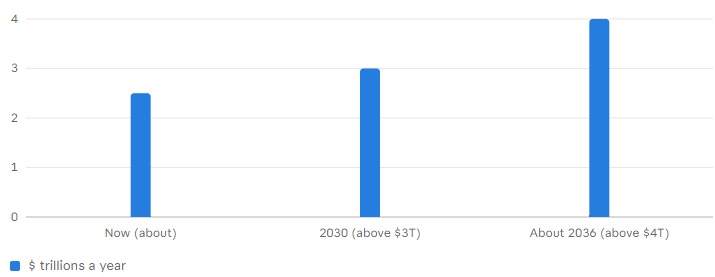
Managing sudden wealth means paying attention to heightened emotions, pausing before you act and setting boundaries before intentionally channeling the money toward your priorities. Cerulli: $124T transfer through 2048; about $2.5T inherited a year, above $4T by about 2036; 24% federal withholding on large prizes vs 37% top rate; 65% of Americans would save or invest a windfall, 52% pay off debt.
$ trillions per year by Source: Cerulli Associates via InvestmentNews. 2030 and 2036 are projections, shown at their floor values
Money that arrives fast can feel like a prize and a problem at the same time. It might be an inheritance, a business sale, a legal settlement or a lottery win. The advice from planners is remarkably consistent: slow down. Kiplinger's wealth adviser puts it as "keep calm and take the time to plan". UBS says a windfall can transform your life for the better when you pause, plan and seek professional guidance.
The summary in the headline gives the order of operations. First, notice your emotions, because they are heightened. Second, pause before you act. Third, set boundaries, with other people and with yourself. Only then, fourth, channel the money toward priorities you have chosen on purpose. Mercer Advisors describes the same idea: pause before making major decisions, assemble a fiduciary team, and pair financial planning with purpose and values work. This guide walks through six steps in that spirit, covering taxes, safe places to park cash, how to pick an adviser and what the research says about how windfalls actually play out.
Key takeaway: The money can wait. Taxes and legal deadlines cannot, so handle those first, then take your time on everything else.
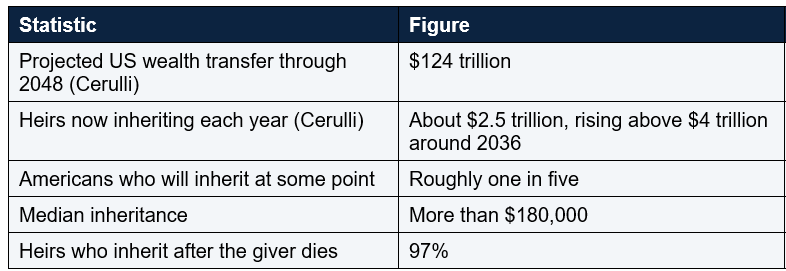
Inheritance is the big one. Vanguard says roughly one in five Americans will inherit assets at some point, with a median inheritance exceeding $180,000. For many heirs it is the biggest windfall they will ever receive. Vanguard also says 97% of heirs receive assets after the giver has died, and that inheritances typically arrive when heirs are in their early sixties .
The totals are huge, and contested. Cerulli Associates estimates that $124 trillion will be handed over through 2048. Heirs are inheriting roughly $2.5 trillion a year now, which Cerulli expects to rise above $3 trillion by 2030 and above $4 trillion around 2036. But a July 2026 Visa analysis, which excludes the top 1%, puts the boomer-to-Gen-X-and-millennial transfer at $36 trillion over 20 years. The two are not like-for-like, so treat headline totals as projections, not promises.
Stress also changes how we decide. Susan Bradley, a CFP and executive director of the Sudden Money Institute, told The Week that humans experience cognitive decline when stressed, and receiving sudden money is stressful. Robert Pagliarini, another CFP, says you need to address the emotions first, or you will make very bad financial decisions. If the money comes with a death, grief enters the picture. CommBank advises avoiding reactive decisions, especially when the money arrives alongside grief, and giving emotions time to settle. Erneroy says an inheritance tied to the death of a loved one can trigger powerful and conflicting emotions that lead to risky decisions.
Some advisers formalize this as a "no-decision zone," as the Art of Manliness describes. Windfall Advisors describes a cooling-off period that lets clients process their circumstances before making irreversible choices. None of these sources gives a single required length. In my suggestion, pick a defined period, write down the date it ends, and agree that nothing big happens before then. A defined end date keeps a pause from becoming paralysis, which Nationwide lists as a symptom. Pausing does not mean doing nothing. Erneroy recommends prioritizing the short-term decisions, like tax planning and settling an estate, and separating them from decisions that can wait, such as how to maximize the impact of your wealth. A note on ignoring the pause: The sources describe the risk in general terms. Financial Advisor Magazine says the excitement around sudden wealth often leads to impulsive investing, and that people can become victims of predatory behavior.
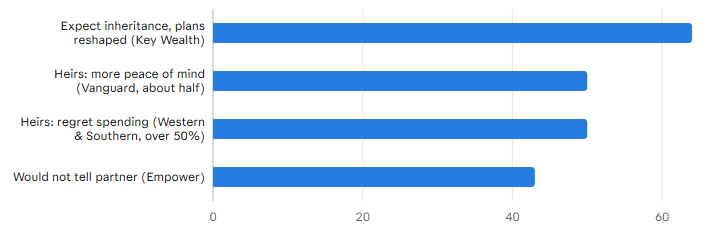
Quiet is not the same as secret from your partner. An Empower survey found 43% of Americans would not tell their spouse or partner about receiving a sudden sum. In my inference, hiding a windfall from a partner can create the very conflict and mistrust that planners warn about, so agree on shared rules early.
Gifts need rules too. LotteryUSA recounts the case of a Waffle House waitress who was tipped a lottery ticket worth $10 million, faced lawsuits from co-workers, and then spent years with the IRS asking about roughly $1 million in gift tax after she gave much of the money to family. It is one story, but it shows why you should talk to a tax professional before giving large amounts.
With yourself, set limits. My suggestions: decide a giving budget in advance, choose a single trusted person or adviser to field money requests, and agree on a "no" script such as "I'm not making financial decisions until next year." Having a rule means you are not renegotiating your boundary each time someone asks.
For inheritances, the picture is different. Kiplinger says the federal estate tax exclusion is $15 million per person, and most estates are under that. It is $30 million for married couples. The estate pays that tax, not you. But some states have their own estate or inheritance taxes. Erneroy gives Maryland and Pennsylvania as examples, and SuperMoney says five states, Kentucky, Maryland, Nebraska, New Jersey and Pennsylvania, tax inheritances directly.
Two inheritance rules matter most. First, the step-up in basis: inherited assets such as stock generally reset their cost basis to the value on the date of death, so you owe capital gains only on growth after that date, and selling soon after inheriting often means little or no gain. Second, retirement accounts do not get that step-up. Withdrawals from an inherited traditional IRA or 401(k) are taxed as ordinary income, and most non-spouse beneficiaries must empty the account within 10 years.
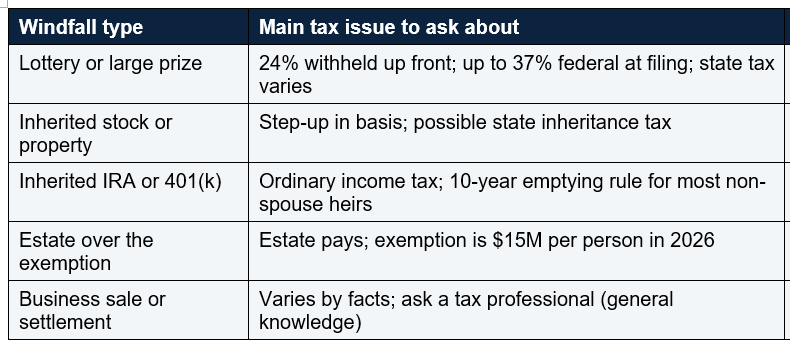
Other windfalls, such as business sales and legal settlements, have their own rules that the sources I retrieved do not cover in detail. That is a clear case for a CPA or tax attorney before you sign or cash anything.
Then build the foundation. A GOBankingRates list republished by Nasdaq includes eliminating high-interest debt, planning for taxes and assembling a team of professionals. FINRA suggests knowing your monthly expenses so you can better manage, preserve and invest wealth over the long term. Morningstar says your first step is to decide what you would like to accomplish financially, because without goals you have no direction. From general knowledge, a typical foundation also includes an emergency reserve, adequate insurance, and up-to-date wills, beneficiaries and powers of attorney. I did not retrieve a specific source for these, so treat them as questions for your adviser.
How you pick matters. Let's Make a Plan says you should ask for a written commitment that the professional will act as a fiduciary, someone who puts your interests ahead of theirs, and notes that CFP professionals commit to act as fiduciaries when giving advice. Erneroy says a person receiving an inheritance would benefit from a fee-only financial adviser. Money Crashers explains that a fee-only adviser is paid only by clients, while a fee-based adviser can also earn commissions.
Check backgrounds. AARP points to Investor.gov, run by the SEC, to check an investment adviser's credentials and disciplinary history, and to brokercheck.finra.org for brokers. And watch fees: BestMoney cites an SEC example in which a 1% fee instead of 0.25% costs about $29,000 on a $100,000 portfolio over 20 years.
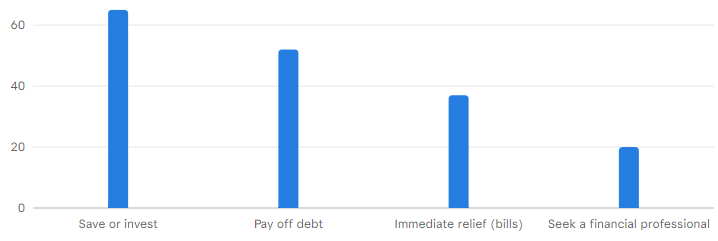
Only 20% of Americans say they would seek a financial professional's advice after receiving a windfall. In my view, that is the biggest gap between what people say they would do and what the experts recommend.
Here is a priority ladder you can adapt. It is my framework, not from a single source.
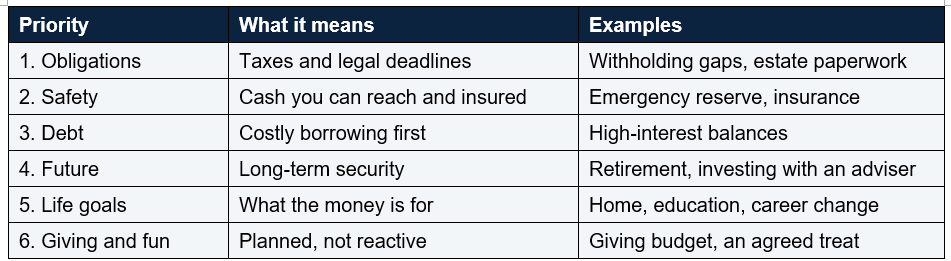
The ladder is my suggestion. Debt and obligations ideas are supported by sources and; the rest is general planning logic. One caution: do not spend money that has not arrived. Key Wealth's 2026 poll found that 64% of mass affluent Americans who expect an inheritance say it is already shaping their financial decisions, and 36% have saved or invested at least $100,000 less because of it. Most had never confirmed that an inheritance was coming.
Not every source agrees. A Jerusalem Post piece about a windfall adviser says studies consistently show most sudden wealth recipients lose their fortunes within a few years. That claim is not supported by the NEFE statement above, and the article is a promotional piece, so I treat it with caution. Inheritance data tells a more mixed story. A 2026 study in Financial Services Review using Health and Retirement Study data found inheritors were 24% more likely than other windfall recipients to spend the entire windfall before the next survey wave, after adjusting for size, and that each inherited dollar raised next-wave net worth by only $0.61. Western & Southern's survey found over 50% of Americans who received an inheritance regret how they spent it. Vanguard, however, says half of heirs reported that receiving an inheritance increased their financial peace of mind. So the evidence points to a nuanced conclusion. Windfalls are not doomed, but how you handle the first months matters, especially when the money comes from a death.
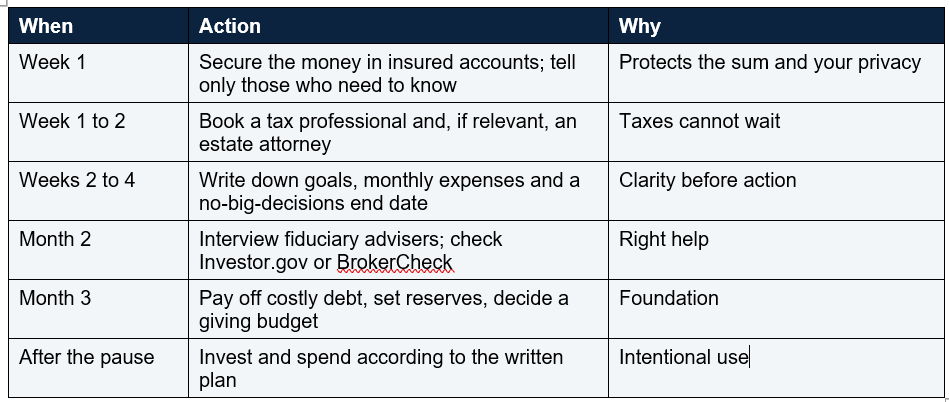
Keep the plan in writing and review it annually. In my suggestion, share the key points with your partner so everyone understands the rules.
Several mistakes come up repeatedly. The first is acting while emotions run high, which is why advisers insist on a pause. The second is quitting your job or making a major purchase before you understand the limits of your wealth. The third is ignoring taxes, especially the gap between 24% withholding and a possible 37% bill. The fourth is giving or lending without rules, which can strain relationships and, in some cases, create tax questions. The fifth is spending an inheritance before it arrives. The sixth is going it alone. Only 20% of Americans say they would seek professional advice. And the seventh is relying on myths, from the 70% bankruptcy claim to confident-sounding headline numbers. Check the source before you act on any statistic, including the ones in this post.
The research supports a hopeful but careful view. Lottery winners are not doomed by default, yet inheritances are often spent quickly and regretted. The difference is largely preparation. Treat this post as a framework, not advice. The right plan depends on the source of your money, your taxes, your family and your goals, and a qualified fiduciary adviser and tax professional can turn it into a plan that fits you.
Pause, and take care of anything with a deadline, such as taxes. Planners say the money can wait, and Kiplinger separates short-term decisions like tax planning from those that can wait. Hold off on quitting your job or large purchases.
Where should I keep the money in the meantime?
Many people use insured bank deposits. The FDIC insures up to $250,000 per depositor, per institution and per ownership category, but it does not cover stocks, bonds or mutual funds. Brokerage money market funds are not FDIC insured.
How are lottery winnings taxed?
Federal withholding is 24% on large prizes, but the final bill can reach 37% at filing. State and local taxes could add up to 15% in some places, and some states do not tax lottery winnings.
Is sudden wealth syndrome a real condition?
It is a recognized term for the stress, guilt and confusion that can follow a windfall, but it is a descriptive label and not a formal diagnosis, from my general knowledge. If distress is serious, speak to a doctor or licensed therapist.
How do I choose an adviser for a windfall?
Ask for a written fiduciary commitment, check Investor.gov or BrokerCheck, understand how they are paid and look for experience with sudden wealth.
Table of Contents
- What counts as sudden wealth, and how common it is
- Why sudden wealth feels different
- Step 1: Pause before you act
- Step 2: Set boundaries
- Step 3: Understand the tax bill
- Step 4: Park the money safely and build foundations
- Step 5: Build your team
- Step 6: Channel the money toward your priorities
- Myths and what the research says
- A simple first-90-days checklist
- Mistakes to avoid
- Conclusion
- FAQ
US inheritances per year (Cerulli estimates)
$ trillions per year by Source: Cerulli Associates via InvestmentNews. 2030 and 2036 are projections, shown at their floor values
What Americans say they would do with a windfall
% of respondents by Source: Empower survey. Respondents could pick more than one
Survey snapshots on windfalls and inheritances
% of respondents by Different surveys and samples, not directly comparable. Half and over 50% shown as 50Money that arrives fast can feel like a prize and a problem at the same time. It might be an inheritance, a business sale, a legal settlement or a lottery win. The advice from planners is remarkably consistent: slow down. Kiplinger's wealth adviser puts it as "keep calm and take the time to plan". UBS says a windfall can transform your life for the better when you pause, plan and seek professional guidance.
The summary in the headline gives the order of operations. First, notice your emotions, because they are heightened. Second, pause before you act. Third, set boundaries, with other people and with yourself. Only then, fourth, channel the money toward priorities you have chosen on purpose. Mercer Advisors describes the same idea: pause before making major decisions, assemble a fiduciary team, and pair financial planning with purpose and values work. This guide walks through six steps in that spirit, covering taxes, safe places to park cash, how to pick an adviser and what the research says about how windfalls actually play out.
Key takeaway: The money can wait. Taxes and legal deadlines cannot, so handle those first, then take your time on everything else.
What counts as sudden wealth, and how common it is
Sudden wealth does not need a winning lottery ticket. Let's Make a Plan, the Financial Planning Association's consumer site, lists a lawsuit settlement, a business sale, stock options or an inheritance. Mercer Advisors adds divorce settlements and IPOs. Kiplinger notes that lottery winners capture the headlines but are among the least common examples.Inheritance is the big one. Vanguard says roughly one in five Americans will inherit assets at some point, with a median inheritance exceeding $180,000. For many heirs it is the biggest windfall they will ever receive. Vanguard also says 97% of heirs receive assets after the giver has died, and that inheritances typically arrive when heirs are in their early sixties .
The totals are huge, and contested. Cerulli Associates estimates that $124 trillion will be handed over through 2048. Heirs are inheriting roughly $2.5 trillion a year now, which Cerulli expects to rise above $3 trillion by 2030 and above $4 trillion around 2036. But a July 2026 Visa analysis, which excludes the top 1%, puts the boomer-to-Gen-X-and-millennial transfer at $36 trillion over 20 years. The two are not like-for-like, so treat headline totals as projections, not promises.
Why sudden wealth feels different
Let's Make a Plan's adviser, who has worked with windfall recipients for over 25 years, says sudden wealth is not the same as gradual wealth. Gradual wealth is a smooth escalator ride, while sudden wealth is a rocket trip straight to the top in seconds, with no chance to adapt or grow into it. The emotions are real. UBS says you may feel excited, anxious or even guilty that you received the money instead of someone else. Nationwide describes Sudden Wealth Syndrome as a term for the mental and emotional stress that can follow, with symptoms that can include paralyzing decision-making. HuffPost says psychologist Stephen Goldbart coined the term to describe the stress, guilt, social isolation and confusion that often accompany a windfall. It is a descriptive label, not a formal diagnosis, which I note from general knowledge.Stress also changes how we decide. Susan Bradley, a CFP and executive director of the Sudden Money Institute, told The Week that humans experience cognitive decline when stressed, and receiving sudden money is stressful. Robert Pagliarini, another CFP, says you need to address the emotions first, or you will make very bad financial decisions. If the money comes with a death, grief enters the picture. CommBank advises avoiding reactive decisions, especially when the money arrives alongside grief, and giving emotions time to settle. Erneroy says an inheritance tied to the death of a loved one can trigger powerful and conflicting emotions that lead to risky decisions.
Step 1: Pause before you act
The first step is the hardest because everything in you wants to act. Don't. Advisor Perspectives puts it simply: tell windfall clients to look after themselves first, because the money is safely in an account and is not going anywhere. Time, it adds, not only soothes pain but brings clarity. Pagliarini tells clients to go on vacation for a couple of weeks before doing anything, and warns against immediately quitting their job, since a job gives people purpose and may not be wrong for them long-term. FINRA similarly says you might be tempted to quit your job or make a major purchase, but those may not be wise if you do not fully understand the limits of your new wealth.Some advisers formalize this as a "no-decision zone," as the Art of Manliness describes. Windfall Advisors describes a cooling-off period that lets clients process their circumstances before making irreversible choices. None of these sources gives a single required length. In my suggestion, pick a defined period, write down the date it ends, and agree that nothing big happens before then. A defined end date keeps a pause from becoming paralysis, which Nationwide lists as a symptom. Pausing does not mean doing nothing. Erneroy recommends prioritizing the short-term decisions, like tax planning and settling an estate, and separating them from decisions that can wait, such as how to maximize the impact of your wealth. A note on ignoring the pause: The sources describe the risk in general terms. Financial Advisor Magazine says the excitement around sudden wealth often leads to impulsive investing, and that people can become victims of predatory behavior.
Step 2: Set boundaries
Boundaries are the second step, and they have two sides: boundaries with other people, and boundaries with yourself. With other people, expect requests. U.S. Bank's Amit Poddar says people come out of the woodwork, with family, friends and acquaintances suddenly having their hand out. UBS adds that if you change how you spend money or time, friends can drift away. Money Talks News lists "be quiet" as the first tip, meaning you do not need to broadcast your news.Quiet is not the same as secret from your partner. An Empower survey found 43% of Americans would not tell their spouse or partner about receiving a sudden sum. In my inference, hiding a windfall from a partner can create the very conflict and mistrust that planners warn about, so agree on shared rules early.
Gifts need rules too. LotteryUSA recounts the case of a Waffle House waitress who was tipped a lottery ticket worth $10 million, faced lawsuits from co-workers, and then spent years with the IRS asking about roughly $1 million in gift tax after she gave much of the money to family. It is one story, but it shows why you should talk to a tax professional before giving large amounts.
With yourself, set limits. My suggestions: decide a giving budget in advance, choose a single trusted person or adviser to field money requests, and agree on a "no" script such as "I'm not making financial decisions until next year." Having a rule means you are not renegotiating your boundary each time someone asks.
Step 3: Understand the tax bill
Taxes are the part that cannot wait, and they depend entirely on where the money came from. For lottery prizes, Kiplinger says the IRS withholds 24% right away, but because lottery winnings count as ordinary income they can push you into the top federal bracket, so you could ultimately owe up to 37% when you file. NBC New York puts it plainly: plan on paying another 13% in federal taxes at filing. LotteryUSA's example shows a $1 billion advertised jackpot with a lump sum of about $620 million, falling to $471.2 million after 24% withholding, with more owed at tax time. SmartAsset says state and local taxes could take up to an additional 15%, while Kiplinger notes some states, such as California and Florida, do not tax lottery winnings.For inheritances, the picture is different. Kiplinger says the federal estate tax exclusion is $15 million per person, and most estates are under that. It is $30 million for married couples. The estate pays that tax, not you. But some states have their own estate or inheritance taxes. Erneroy gives Maryland and Pennsylvania as examples, and SuperMoney says five states, Kentucky, Maryland, Nebraska, New Jersey and Pennsylvania, tax inheritances directly.
Two inheritance rules matter most. First, the step-up in basis: inherited assets such as stock generally reset their cost basis to the value on the date of death, so you owe capital gains only on growth after that date, and selling soon after inheriting often means little or no gain. Second, retirement accounts do not get that step-up. Withdrawals from an inherited traditional IRA or 401(k) are taxed as ordinary income, and most non-spouse beneficiaries must empty the account within 10 years.
Other windfalls, such as business sales and legal settlements, have their own rules that the sources I retrieved do not cover in detail. That is a clear case for a CPA or tax attorney before you sign or cash anything.
Step 4: Park the money safely and build foundations
Once taxes are on the table, park the money somewhere safe while you think. The goal is not growth, it is protection and flexibility. Deposit insurance is worth understanding. NerdWallet says the FDIC insures up to $250,000 per depositor, per institution and per ownership category. The FDIC says it does not insure stocks, bonds, mutual funds or crypto assets, and lists Treasury bills, bonds and notes among items it does not insure. 24/7 Wall St. adds that brokerage money market mutual funds carry no FDIC protection, as only money market deposit accounts at an insured bank qualify. A large windfall can easily exceed one bank's limit, so ask each bank how coverage works for your situation. I did not retrieve current interest rates, so compare them yourself.Then build the foundation. A GOBankingRates list republished by Nasdaq includes eliminating high-interest debt, planning for taxes and assembling a team of professionals. FINRA suggests knowing your monthly expenses so you can better manage, preserve and invest wealth over the long term. Morningstar says your first step is to decide what you would like to accomplish financially, because without goals you have no direction. From general knowledge, a typical foundation also includes an emergency reserve, adequate insurance, and up-to-date wills, beneficiaries and powers of attorney. I did not retrieve a specific source for these, so treat them as questions for your adviser.
Step 5: Build your team
Nobody should be expected to deal with sudden wealth alone. U.S. Bank says that if you have never experienced it, you likely will not know how to manage it, and suggests finding both a good tax professional and a financial professional. It also recommends looking for someone with experience helping people through sudden wealth.How you pick matters. Let's Make a Plan says you should ask for a written commitment that the professional will act as a fiduciary, someone who puts your interests ahead of theirs, and notes that CFP professionals commit to act as fiduciaries when giving advice. Erneroy says a person receiving an inheritance would benefit from a fee-only financial adviser. Money Crashers explains that a fee-only adviser is paid only by clients, while a fee-based adviser can also earn commissions.
Check backgrounds. AARP points to Investor.gov, run by the SEC, to check an investment adviser's credentials and disciplinary history, and to brokercheck.finra.org for brokers. And watch fees: BestMoney cites an SEC example in which a 1% fee instead of 0.25% costs about $29,000 on a $100,000 portfolio over 20 years.
Only 20% of Americans say they would seek a financial professional's advice after receiving a windfall. In my view, that is the biggest gap between what people say they would do and what the experts recommend.
Step 6: Channel the money toward your priorities
Now comes the part the headline calls intentional: channeling the money toward priorities. Morningstar's questions are a good start: do you want to retire, can you, and who do you want to benefit, you, your family, a broker earning commissions, the tax authorities or charity? People's instincts are often sensible. In an Empower survey, 65% would save or invest a windfall, 52% would pay off debt and 37% would use it for immediate financial relief. UBS says philanthropy can help gain perspective and balance. A Nasdaq column on carrying wealth lightly suggests staying close to friends, keeping the activities you enjoy and holding off life-changing decisions until you have learned to carry the wealth.Here is a priority ladder you can adapt. It is my framework, not from a single source.
The ladder is my suggestion. Debt and obligations ideas are supported by sources and; the rest is general planning logic. One caution: do not spend money that has not arrived. Key Wealth's 2026 poll found that 64% of mass affluent Americans who expect an inheritance say it is already shaping their financial decisions, and 36% have saved or invested at least $100,000 less because of it. Most had never confirmed that an inheritance was coming.
Myths and what the research says
A few popular beliefs deserve scrutiny. The best-known is that most lottery winners end up bankrupt. NEFE, the organization often credited with the statistic, says the claim that 70% of lottery winners go bankrupt is not backed by its research and cannot be confirmed. A study of about 3,000 Swedish lottery winners who won a combined $277 million found sustained increases in life satisfaction rather than ruin, and the Motley Fool's Ascent reports that most winners are better off financially years later.Not every source agrees. A Jerusalem Post piece about a windfall adviser says studies consistently show most sudden wealth recipients lose their fortunes within a few years. That claim is not supported by the NEFE statement above, and the article is a promotional piece, so I treat it with caution. Inheritance data tells a more mixed story. A 2026 study in Financial Services Review using Health and Retirement Study data found inheritors were 24% more likely than other windfall recipients to spend the entire windfall before the next survey wave, after adjusting for size, and that each inherited dollar raised next-wave net worth by only $0.61. Western & Southern's survey found over 50% of Americans who received an inheritance regret how they spent it. Vanguard, however, says half of heirs reported that receiving an inheritance increased their financial peace of mind. So the evidence points to a nuanced conclusion. Windfalls are not doomed, but how you handle the first months matters, especially when the money comes from a death.
A simple first-90-days checklist
Here is a practical checklist for the first 90 days. It is my suggestion, built from the steps above, and you should adapt it with your advisers.Keep the plan in writing and review it annually. In my suggestion, share the key points with your partner so everyone understands the rules.
Several mistakes come up repeatedly. The first is acting while emotions run high, which is why advisers insist on a pause. The second is quitting your job or making a major purchase before you understand the limits of your wealth. The third is ignoring taxes, especially the gap between 24% withholding and a possible 37% bill. The fourth is giving or lending without rules, which can strain relationships and, in some cases, create tax questions. The fifth is spending an inheritance before it arrives. The sixth is going it alone. Only 20% of Americans say they would seek professional advice. And the seventh is relying on myths, from the 70% bankruptcy claim to confident-sounding headline numbers. Check the source before you act on any statistic, including the ones in this post.
Conclusion
Sudden wealth is a change in your finances and a change in your emotions, and both need attention. The consistent advice from planners is to pause, plan and get professional help. Notice the heightened emotions, set boundaries with others and with yourself, deal with taxes early, park the money safely, build a team and only then channel the money toward priorities you have chosen.The research supports a hopeful but careful view. Lottery winners are not doomed by default, yet inheritances are often spent quickly and regretted. The difference is largely preparation. Treat this post as a framework, not advice. The right plan depends on the source of your money, your taxes, your family and your goals, and a qualified fiduciary adviser and tax professional can turn it into a plan that fits you.
FAQ
What should I do first when I get sudden wealth?Pause, and take care of anything with a deadline, such as taxes. Planners say the money can wait, and Kiplinger separates short-term decisions like tax planning from those that can wait. Hold off on quitting your job or large purchases.
Where should I keep the money in the meantime?
Many people use insured bank deposits. The FDIC insures up to $250,000 per depositor, per institution and per ownership category, but it does not cover stocks, bonds or mutual funds. Brokerage money market funds are not FDIC insured.
How are lottery winnings taxed?
Federal withholding is 24% on large prizes, but the final bill can reach 37% at filing. State and local taxes could add up to 15% in some places, and some states do not tax lottery winnings.
Is sudden wealth syndrome a real condition?
It is a recognized term for the stress, guilt and confusion that can follow a windfall, but it is a descriptive label and not a formal diagnosis, from my general knowledge. If distress is serious, speak to a doctor or licensed therapist.
How do I choose an adviser for a windfall?
Ask for a written fiduciary commitment, check Investor.gov or BrokerCheck, understand how they are paid and look for experience with sudden wealth.
0 Comments
Be the first to share your thoughts on this article.