

Credits
Debt Repayment Strategies for the $30k–$75k Income Bracket

The average American carries $104,755 in debt. Paying it down was Americans’ #1 financial goal for 2026 (Bankrate). Five strategies that work when you’re above poverty but below median income — and every dollar has to be accounted for.
The $30,000 to $75,000 income bracket occupies a specific and often underserved position in the debt conversation. You earn too much to qualify for most hardship programmes and too little to absorb debt without it affecting every month. The average American adult carries $104,755 in total debt, according to Experian’s 2025 data. Bankrate found that paying down debt was Americans’ number one financial goal for 2026. NerdWallet’s 2026 Consumer Outlook found that 30% of Americans are looking to pay off one or more debts this year. The problem is not awareness. Most people in this bracket know they have debt and know it needs to come down. The problem is that the generic advice — ‘spend less, earn more’ — does not account for the specific maths of this income range, where the margin between income and essential expenses is real but not large, and where the choice of strategy matters as much as the intention. This article covers five specific debt repayment approaches, with the real numbers for this income bracket, the psychological and practical trade-offs of each, and the foundational budget work that makes any of them executable.
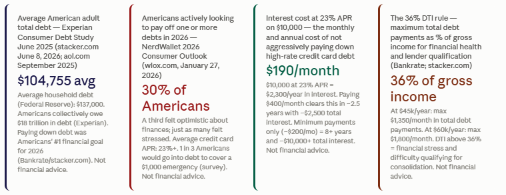
The stacker.com June 2026 data is useful context: paying down debt was Americans’ number one financial goal for 2026, according to Bankrate. NerdWallet’s 2026 Consumer Outlook found 30% of Americans are actively working to pay off at least one debt this year. The average American adult carries $104,755 in total debt (Experian June 2025). For a household earning $45,000 per year, that is more than two full years of gross income. The five strategies in this article are for people in exactly that position: carrying real debt, earning a real income, and needing an approach that fits the specific maths of this bracket.
Average American adult debt: $104,755 (Experian June 2025; stacker.com June 2026). Average household debt: $137,000 (Federal Reserve). $18 trillion total American debt (Experian; aol.com). Paying down debt was Americans' #1 financial goal for 2026 (Bankrate). 30% of Americans working to pay off debt in 2026 (NerdWallet Consumer Outlook). Not financial advice.
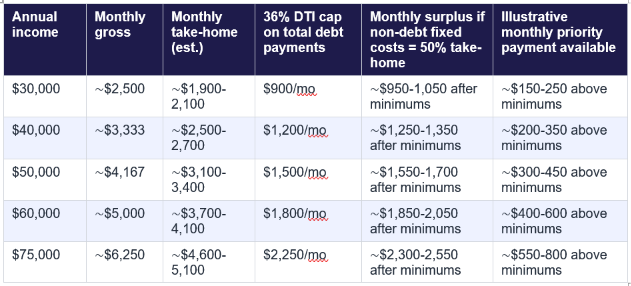
Notes: Take-home estimates assume single filer, standard federal deduction, no state income tax adjustment. Actual figures vary significantly by state, filing status, pre-tax deductions (401k, HSA), and family size. Non-debt fixed costs estimated at 50% of take-home for illustration only. Not financial advice. Use a personal budget to determine your actual numbers.
List debts smallest to largest balance. Pay minimum on all. Put every spare dollar toward the smallest debt. When it is cleared, roll that freed payment into the next smallest. Repeat until debt-free. The minimum payment you were making on the cleared debt now becomes extra payment on the next one — this is the 'snowball' effect.
People who have struggled to stay motivated with debt payoff. Multiple small debts that can be cleared quickly. Those who need visible progress to maintain momentum. Best when the emotional barrier is as large as the financial one.
Example: $30k income earner: Medical bill $1,200 (no interest), Store card $3,500 (28% APR), Personal loan $8,000 (14% APR). Snowball order: medical bill → store card → personal loan. Medical bill paid off in 2-3 months. That freed $100/month rolls into store card. Store card cleared approximately 8 months later. Both freed payments attack the personal loan. Total payoff: approximately 24-28 months at $350/month total minimum.
The snowball costs more in interest than the avalanche when high-rate debts are larger than low-rate debts. For a $30k-$75k earner with significant high-APR credit card debt (23%+), the interest cost of delaying that balance matters. Use the snowball for motivation — but if the highest-rate debt is also one of the smallest, the two methods align anyway.
List debts by highest interest rate to lowest. Pay minimum on all. Direct every spare dollar to the highest-rate debt. When cleared, roll that payment into the next highest rate. The mathematical logic: eliminating 23% APR before 14% APR before 6% APR means the money you are not spending on interest compounds in your favour faster.
People who are motivated by numbers and savings rather than quick wins. Anyone carrying significant high-APR credit card debt (where the interest savings are large enough to matter). People with a strong existing motivation to get debt-free who are less likely to drop out of the plan.
Example: $50k income earner: Credit card A $8,000 (23% APR), Credit card B $3,500 (19% APR), Auto loan $12,000 (7% APR). Avalanche order: Credit card A → Credit card B → Auto loan. Credit card A is generating approximately $153/month in interest alone. Paying an extra $300/month on it: cleared in approximately 22 months, saving approximately $2,200 in interest vs snowball order.
Motivational dropout is the primary risk. If you choose the avalanche, build in visible milestones: a balance tracker on the fridge, a milestone celebration when you clear 25% of the balance, a trusted person to share progress with. The mathematical win is only real if you stick with the plan.
Apply for a personal loan at a lower APR than your existing combined debt average. Use the loan proceeds to pay off the individual balances. Make a single payment at the lower rate. Alternatively: transfer high-APR credit card balances to a 0% balance transfer card, pay aggressively within the 0% window, pay off as much as possible before the standard rate applies.
Good credit score (670+). Multiple high-APR credit card balances. A clear commitment to not running up the paid-off cards again after consolidation. Wants simplification of multiple payments into one. Has the income headroom to qualify (DTI below lender thresholds).
Example: $60k earner: Three credit cards, $6,000 + $4,500 + $2,500 = $13,000 total at average 22% APR. Consolidation loan at 12% APR over 3 years: monthly payment approximately $432. Total interest: approximately $2,550 vs approximately $6,500+ at 22% APR with minimum payments. Interest saving: approximately $4,000. Not financial advice — actual rates depend on individual credit profile.
The most common debt consolidation failure is running up the cleared credit cards again after consolidation, creating double the debt. Cut up or freeze the paid-off cards immediately. Consolidation does not reduce debt — it restructures it. The reduced monthly payment can create a false sense of recovery if the paid-off capacity is immediately reborrowed.
Keep a 'debt snowflake' category in your budget for every unexpected money inflow. The moment any unbudgeted money arrives — tax refund, gift, overtime, sale proceeds, cash back, bonus — transfer it to your highest-priority debt before it enters your general spending account. Even small amounts matter: $50 applied to a 23% APR card saves approximately $11.50 in annual interest permanently.
Anyone on a variable income or irregular hours. People who receive an annual tax refund. Side hustle earners. Anyone who knows they will spend windfalls if they do not have a pre-committed destination for them.
Example: $40k earner: $2,800 tax refund applied to $8,000 credit card at 23% APR. Interest saving: approximately $644/year from that one action. $200 birthday gift applied to debt: saves approximately $46/year. Selling $500 of unused items on Facebook Marketplace and applying to debt: saves approximately $115/year. Combined annual snowflake: $3,500 → saves approximately $805/year in interest at 23% APR.
The risk is pre-spending windfalls mentally before they arrive. If you have already allocated the tax refund to a holiday in your head, applying it to debt feels like a loss. Pre-commitment is the solution: decide before the windfall arrives that it goes to debt.
Calculate your actual monthly take-home (not gross). List every fixed expense. List every discretionary expense honestly. Calculate the current minimum debt payments. Subtract all three from take-home. The remainder is your current debt surplus. Apply the full surplus to the priority debt (avalanche or snowball). Track this number monthly — every reduction in a bill increases it.
Everyone in this bracket — this is the foundational step before any specific method is chosen. Particularly important for anyone whose current minimum payments already consume most of the month-end budget.
Example: $52,000/year earner (≈$3,200/month take-home after tax): Housing $950, utilities $150, food $400, transport $350, subscriptions $80, other $120. Total non-debt: $2,050. Minimum debt payments: $600/month. Current surplus: $550/month. Goal: grow surplus to $800/month by cutting $250 (subscription audit: -$40, insurance review: -$80, meal planning: -$80, other: -$50). Extra $250 added to avalanche priority debt saves approximately $57.50/year per percentage point of APR.
The mistake most people make is calculating the surplus at the beginning of the month and spending it before it gets applied. Automate the priority debt payment on pay day, before discretionary spending occurs. Treat the priority debt payment like a bill, not an optional extra.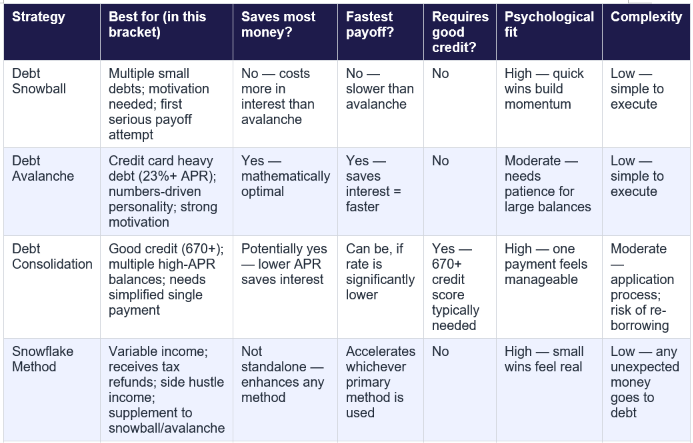

The mathematically correct answer is the avalanche — it saves the most in total interest paid. The navymutual.org guide puts it plainly: 'if high interest payments bother you, you may be more motivated by the debt avalanche.' The psychologically correct answer depends on your history with debt payoff. If you have started and abandoned debt payoff plans before, the snowball's quick wins may be more important to you than the interest savings. NerdWallet's 2026 expert Rathner recommends the snowball specifically 'for those struggling with motivation' because it creates 'a sense of progress and victory.' If your highest-rate debt is also one of your smallest balances, the two methods align anyway — you pay it off first in both approaches. Run the numbers on both methods for your specific debt stack before deciding.
How does a debt-to-income ratio affect my repayment options?
The DTI ratio is your total monthly debt payments divided by your gross monthly income. Stacker.com's June 2026 analysis identifies the benchmark: a DTI ratio above 36% signals financial stress and makes qualifying for new credit (including consolidation loans) difficult. The 28/36 rule means housing costs below 28% of gross income and all debt payments below 36%. At $50,000/year, the 36% cap is $1,500/month. If your existing minimums exceed this threshold, consolidation is less accessible without first reducing some balances. Your DTI also affects whether your balances are growing from interest faster than your minimum payments reduce them — a situation called 'negative amortisation' that requires immediate higher-payment intervention.
What is the snowflake method and does it really make a difference?
The snowflake method, described by navymutual.org, involves directing any unbudgeted money — a tax refund, birthday gift, overtime pay, yard sale proceeds, rebate — straight to debt rather than into general spending. The difference it makes is compounding and permanent: every dollar that reduces a 23% APR balance saves approximately 23 cents per year in interest, every year thereafter. The average US tax refund of approximately $3,000 directed to a 23% APR balance saves approximately $690 per year in interest — permanently. The key is pre-commitment: decide before the windfall arrives that it goes to debt, not into the account where it will be absorbed by general spending. This works as a supplement to either snowball or avalanche, and is particularly useful for people in this income bracket whose regular monthly surplus is limited but whose occasional windfalls are meaningful.
Is debt consolidation a good idea at this income level?
It depends on three factors: your credit score, the interest rate differential, and your ability to not re-borrow on the paid-off accounts. Wealthvieu.com's 2026 guide positions consolidation as a strong option for saving money on interest — replacing 22% APR credit card debt with a 12% personal loan on $13,000 saves approximately $4,000 in interest over three years in the illustrative example above. But the warning is equally important: the most common failure mode of consolidation is running up the cleared credit cards again after consolidation, effectively doubling the debt. If you consolidate, cut up or freeze the paid-off cards immediately. Consolidation does not reduce debt — it restructures it. Whether the restructured rate is available to you depends on having a credit score of approximately 670+ and a DTI ratio within lender guidelines.
What if my income changes or I have an irregular income?
The snowflake method was designed for exactly this situation. At variable income, the fixed monthly priority payment used by the snowball and avalanche can be difficult to commit to. The snowflake approach allows higher payments in high-income months and minimum payments only in lower-income months, accelerating payoff without creating a binding monthly obligation that may be missed. The wealthvieu.com 2026 guide on debt payoff also recommends applying windfalls to debt — the same principle applied to income spikes for self-employed or variable-hour earners. On the budget reset: build it from your lowest realistic monthly income, not your average, to ensure the baseline is always achievable. Then apply any excess in higher-income months as snowflakes.
The $30,000 to $75,000 income bracket occupies a specific and often underserved position in the debt conversation. You earn too much to qualify for most hardship programmes and too little to absorb debt without it affecting every month. The average American adult carries $104,755 in total debt, according to Experian’s 2025 data. Bankrate found that paying down debt was Americans’ number one financial goal for 2026. NerdWallet’s 2026 Consumer Outlook found that 30% of Americans are looking to pay off one or more debts this year. The problem is not awareness. Most people in this bracket know they have debt and know it needs to come down. The problem is that the generic advice — ‘spend less, earn more’ — does not account for the specific maths of this income range, where the margin between income and essential expenses is real but not large, and where the choice of strategy matters as much as the intention. This article covers five specific debt repayment approaches, with the real numbers for this income bracket, the psychological and practical trade-offs of each, and the foundational budget work that makes any of them executable.
Table of Contents
- Why This Income Bracket Is Different
- Your Debt Baseline: The Numbers That Matter Before You Start
- Strategy 1 The Debt Snowball
- Strategy 2 The Debt Avalanche
- Strategy 3 Debt Consolidation
- Strategy 4 The Snowflake Method
- Strategy 5 The Income-Based Budget Reset
- The Strategy Comparison Table: Which One Fits Your Situation
- UK Note: What Changes Across the Atlantic
- Conclusion: The Strategy You Use Is Less Important Than Starting
- Frequently Asked Questions
Why This Income Bracket Is Different
There are personal finance articles written for people who earn enough that the primary challenge is optimisation. Where should the 15th and 16th percent of their income go? Which tax-advantaged account should get the marginal dollar? That is not this article. There are also articles written for people in genuine financial distress, exploring debt relief, bankruptcy, and hardship programmes. That is not this article either. The $30,000-$75,000 income bracket is the space between those two extremes. Above the thresholds where debt relief programmes kick in. Below the income level where a major financial error is simply absorbed without consequence. In this bracket, debt repayment requires strategy rather than just intention, because the monthly surplus over minimums is real but limited, and the wrong choice of method or the wrong budgeting approach can mean years of paying interest without meaningfully reducing principal.The stacker.com June 2026 data is useful context: paying down debt was Americans’ number one financial goal for 2026, according to Bankrate. NerdWallet’s 2026 Consumer Outlook found 30% of Americans are actively working to pay off at least one debt this year. The average American adult carries $104,755 in total debt (Experian June 2025). For a household earning $45,000 per year, that is more than two full years of gross income. The five strategies in this article are for people in exactly that position: carrying real debt, earning a real income, and needing an approach that fits the specific maths of this bracket.
Average American adult debt: $104,755 (Experian June 2025; stacker.com June 2026). Average household debt: $137,000 (Federal Reserve). $18 trillion total American debt (Experian; aol.com). Paying down debt was Americans' #1 financial goal for 2026 (Bankrate). 30% of Americans working to pay off debt in 2026 (NerdWallet Consumer Outlook). Not financial advice.
Your Debt Baseline: The Numbers That Matter Before You Start
Before choosing a strategy, a $30k-$75k earner needs four numbers. First: total debt balance by account, including the interest rate and minimum payment on each. Second: monthly take-home income after all taxes (not gross — take-home). Third: fixed monthly expenses (housing, utilities, insurance, minimum debt payments). Fourth: the monthly surplus after all fixed costs and minimums — the actual fuel for any strategy. The debt-to-income ratio is the lender’s version of this calculation: total monthly debt payments divided by gross monthly income. The 28/36 rule provides the benchmark: all debt payments should stay below 36% of gross income. At $45,000/year, that is a maximum of $1,350/month in debt payments. At $60,000/year, $1,800/month. If existing minimums already exceed these thresholds, consolidation or negotiating with creditors becomes the priority before choosing a payoff method.Notes: Take-home estimates assume single filer, standard federal deduction, no state income tax adjustment. Actual figures vary significantly by state, filing status, pre-tax deductions (401k, HSA), and family size. Non-debt fixed costs estimated at 50% of take-home for illustration only. Not financial advice. Use a personal budget to determine your actual numbers.
Strategy 1 The Debt Snowball
The debt snowball is the method Dave Ramsey made famous, and its staying power is psychological rather than mathematical. The approach: list every debt from smallest balance to largest, regardless of interest rate. Pay the minimum on every debt except the smallest one. Put every extra dollar you have toward the smallest balance until it is gone. Then take the freed-up payment and roll it into the next smallest debt, and so on. The satisfaction of clearing a debt entirely — of watching one line item disappear from the list — produces the motivational momentum that keeps people going when the larger debts feel overwhelming. The stacker.com June 2026 analysis of debt repayment notes that the snowball ‘provides motivation to keep going’ by scoring quick psychological wins. The wlox.com January 2026 coverage of NerdWallet debt expert Rathner identifies that for those ‘struggling with motivation, the debt snowball creates a sense of progress and victory before moving to the next largest debt.’ For a $30k-$75k earner carrying multiple small and medium debts — a $1,200 medical bill, a $3,500 store card, and an $8,000 personal loan — the snowball clears the medical bill first, freeing up that payment to accelerate the store card, and then both payments to attack the personal loan. It is not the cheapest method. The avalanche saves more interest. But the research on behaviour change consistently finds that completed actions produce motivation better than theoretical future savings. For people who have tried and failed to pay down debt before, the snowball can be the approach that actually sticks.List debts smallest to largest balance. Pay minimum on all. Put every spare dollar toward the smallest debt. When it is cleared, roll that freed payment into the next smallest. Repeat until debt-free. The minimum payment you were making on the cleared debt now becomes extra payment on the next one — this is the 'snowball' effect.
People who have struggled to stay motivated with debt payoff. Multiple small debts that can be cleared quickly. Those who need visible progress to maintain momentum. Best when the emotional barrier is as large as the financial one.
Example: $30k income earner: Medical bill $1,200 (no interest), Store card $3,500 (28% APR), Personal loan $8,000 (14% APR). Snowball order: medical bill → store card → personal loan. Medical bill paid off in 2-3 months. That freed $100/month rolls into store card. Store card cleared approximately 8 months later. Both freed payments attack the personal loan. Total payoff: approximately 24-28 months at $350/month total minimum.
The snowball costs more in interest than the avalanche when high-rate debts are larger than low-rate debts. For a $30k-$75k earner with significant high-APR credit card debt (23%+), the interest cost of delaying that balance matters. Use the snowball for motivation — but if the highest-rate debt is also one of the smallest, the two methods align anyway.
Strategy 2 The Debt Avalanche
The debt avalanche is mathematically optimal. It is the approach that saves the most money in total interest paid. The logic is simple: high-interest debt costs more per month to carry. Every dollar you put toward the highest-rate balance eliminates more future interest than the same dollar applied to a lower-rate balance. The approach: list every debt from highest interest rate to lowest, regardless of balance size. Pay minimum on all except the highest-rate debt. Direct every extra dollar to the highest-rate balance. When it is cleared, roll that payment into the next highest rate. The wealthvieu.com 2026 debt payoff guide places the avalanche under ‘saves the most money’ and notes that the snowball typically costs an additional $1,000-$3,000+ in interest compared to the avalanche for the same debt stack, depending on the rate and balance mix. For a $30k-$75k earner carrying credit card debt at 23%+ APR, the avalanche’s mathematical advantage is substantial. A $10,000 credit card at 23% APR is accruing approximately $190 in interest every single month. Paying the minimum on that while clearing a $1,200 medical bill at 0% means actively choosing to pay more total interest. The avalanche removes that math. The weakness of the avalanche is motivational: if the highest-rate debt is also a large balance, you may be paying it down for a year or more without the sense of completion that the snowball’s quick wins produce. The research on debt repayment behaviour consistently finds that people drop out of debt payoff plans that do not provide visible milestones.List debts by highest interest rate to lowest. Pay minimum on all. Direct every spare dollar to the highest-rate debt. When cleared, roll that payment into the next highest rate. The mathematical logic: eliminating 23% APR before 14% APR before 6% APR means the money you are not spending on interest compounds in your favour faster.
People who are motivated by numbers and savings rather than quick wins. Anyone carrying significant high-APR credit card debt (where the interest savings are large enough to matter). People with a strong existing motivation to get debt-free who are less likely to drop out of the plan.
Example: $50k income earner: Credit card A $8,000 (23% APR), Credit card B $3,500 (19% APR), Auto loan $12,000 (7% APR). Avalanche order: Credit card A → Credit card B → Auto loan. Credit card A is generating approximately $153/month in interest alone. Paying an extra $300/month on it: cleared in approximately 22 months, saving approximately $2,200 in interest vs snowball order.
Motivational dropout is the primary risk. If you choose the avalanche, build in visible milestones: a balance tracker on the fridge, a milestone celebration when you clear 25% of the balance, a trusted person to share progress with. The mathematical win is only real if you stick with the plan.
Strategy 3 Debt Consolidation Loan
Debt consolidation replaces multiple debts with a single loan — ideally at a lower interest rate than the existing average across the combined balances. For a $30k-$75k income earner carrying several credit card balances at 20-25% APR, a consolidation loan at 10-14% (for borrowers with good credit, typically 670+) reduces the total interest cost while simplifying the payment to one monthly obligation. The wealthvieu.com 2026 guide identifies consolidation as one of the primary debt payoff approaches alongside snowball and avalanche. The stacker.com June 2026 analysis notes that a credit counsellor will ‘go through your full financial situation and help you plot a personalized debt repayment plan’ — which often includes evaluating consolidation as an option. The critical point about consolidation for this income bracket: qualification depends on credit score and debt-to-income ratio. At $45,000/year, the 36% DTI cap represents $1,350/month in total debt payments. If existing minimum payments already exceed that threshold, a consolidation loan may not be available without addressing the DTI first. Balance transfer credit cards with 0% introductory periods represent a variation of consolidation: if the balance can be substantially reduced within the 0% window (typically 12-21 months), the interest savings can be significant. The transfer fee (typically 3-5%) is typically outweighed by the interest savings on high-APR balances.Apply for a personal loan at a lower APR than your existing combined debt average. Use the loan proceeds to pay off the individual balances. Make a single payment at the lower rate. Alternatively: transfer high-APR credit card balances to a 0% balance transfer card, pay aggressively within the 0% window, pay off as much as possible before the standard rate applies.
Good credit score (670+). Multiple high-APR credit card balances. A clear commitment to not running up the paid-off cards again after consolidation. Wants simplification of multiple payments into one. Has the income headroom to qualify (DTI below lender thresholds).
Example: $60k earner: Three credit cards, $6,000 + $4,500 + $2,500 = $13,000 total at average 22% APR. Consolidation loan at 12% APR over 3 years: monthly payment approximately $432. Total interest: approximately $2,550 vs approximately $6,500+ at 22% APR with minimum payments. Interest saving: approximately $4,000. Not financial advice — actual rates depend on individual credit profile.
The most common debt consolidation failure is running up the cleared credit cards again after consolidation, creating double the debt. Cut up or freeze the paid-off cards immediately. Consolidation does not reduce debt — it restructures it. The reduced monthly payment can create a false sense of recovery if the paid-off capacity is immediately reborrowed.
Strategy 4 The Snowflake Method (Extra Payments)
The snowflake method is not a standalone strategy but an accelerator applied on top of either snowball or avalanche. It involves directing every unexpected or windfall source of money — a tax refund, a birthday gift, overtime pay, a bonus, proceeds from selling unused items, a rebate cheque, cashback from a credit card used responsibly — directly to debt rather than absorbing it into general spending. The navymutual.org debt repayment strategies guide describes it as ‘putting found money, or money that is not accounted for in a budget, toward debt payments to speed up your progress.’ For a $30k-$75k earner, windfalls are genuinely significant. The average US tax refund is approximately $3,000. Directed to a 23% APR credit card balance, a $3,000 extra payment reduces interest accrual by approximately $690 per year — permanently, for as long as that reduced balance remains. The stacker.com June 2026 advice to ‘apply windfalls to debt’ reflects the same principle: ‘reducing household bills will let you contribute more money toward debt repayment’ and ‘the most straightforward way to increase monthly income is to pick up a second job or develop a side hustle.’ The snowflake method is particularly well-suited to this income bracket because it works with variable and unpredictable income additions rather than requiring a fixed higher monthly payment.Keep a 'debt snowflake' category in your budget for every unexpected money inflow. The moment any unbudgeted money arrives — tax refund, gift, overtime, sale proceeds, cash back, bonus — transfer it to your highest-priority debt before it enters your general spending account. Even small amounts matter: $50 applied to a 23% APR card saves approximately $11.50 in annual interest permanently.
Anyone on a variable income or irregular hours. People who receive an annual tax refund. Side hustle earners. Anyone who knows they will spend windfalls if they do not have a pre-committed destination for them.
Example: $40k earner: $2,800 tax refund applied to $8,000 credit card at 23% APR. Interest saving: approximately $644/year from that one action. $200 birthday gift applied to debt: saves approximately $46/year. Selling $500 of unused items on Facebook Marketplace and applying to debt: saves approximately $115/year. Combined annual snowflake: $3,500 → saves approximately $805/year in interest at 23% APR.
The risk is pre-spending windfalls mentally before they arrive. If you have already allocated the tax refund to a holiday in your head, applying it to debt feels like a loss. Pre-commitment is the solution: decide before the windfall arrives that it goes to debt.
Strategy 5 The Income-Based Budget Reset
The most important debt repayment variable for a $30k-$75k earner is not which method they choose. It is how much extra money they can direct to debt each month above the minimums. A perfectly chosen strategy applied to $50 of extra monthly payment will take 15 years to clear $10,000 in credit card debt at 23% APR. The same debt cleared at $400/month is gone in approximately 2.5 years. The income-based budget reset is the foundational work that creates the surplus for any method to work. The 28/36 rule provides the structure: housing costs below 28% of gross income; all debt payments below 36% of gross income. For a $50,000/year earner (∼$3,600/month take-home), the 36% rule means $1,296/month maximum on all debt. If current minimums already consume $900/month, there is $396/month for accelerated payoff. The zero-based budgeting approach — assigning every dollar a purpose before the month begins — is the implementation method: income minus all essential expenses minus minimum debt payments = the available surplus that can be directed to the priority debt. Stacker.com’s June 2026 analysis recommends ‘adjusting your monthly budget or spending plan’ and ‘reducing household bills’ as foundational steps before choosing a repayment method. The most common barrier in this income bracket is not ignorance of the methods but the belief that the surplus is too small to matter. A $100/month surplus applied consistently to 23% APR debt saves more than most people estimate — and growing that surplus by $50 increments through small bill reductions produces compounding improvements over the payoff timeline.Calculate your actual monthly take-home (not gross). List every fixed expense. List every discretionary expense honestly. Calculate the current minimum debt payments. Subtract all three from take-home. The remainder is your current debt surplus. Apply the full surplus to the priority debt (avalanche or snowball). Track this number monthly — every reduction in a bill increases it.
Everyone in this bracket — this is the foundational step before any specific method is chosen. Particularly important for anyone whose current minimum payments already consume most of the month-end budget.
Example: $52,000/year earner (≈$3,200/month take-home after tax): Housing $950, utilities $150, food $400, transport $350, subscriptions $80, other $120. Total non-debt: $2,050. Minimum debt payments: $600/month. Current surplus: $550/month. Goal: grow surplus to $800/month by cutting $250 (subscription audit: -$40, insurance review: -$80, meal planning: -$80, other: -$50). Extra $250 added to avalanche priority debt saves approximately $57.50/year per percentage point of APR.
The mistake most people make is calculating the surplus at the beginning of the month and spending it before it gets applied. Automate the priority debt payment on pay day, before discretionary spending occurs. Treat the priority debt payment like a bill, not an optional extra.
The Strategy Comparison Table: Which One Fits Your Situation
UK Note: What Changes Across the Atlantic
The core strategies — snowball, avalanche, consolidation, snowflake, budget reset — apply equally in the UK. The numbers differ. UK credit card APR averages approximately 25-27% in 2026, similar to the US 23%+ average. UK average personal debt excluding mortgage is approximately £15,000-£18,000. The equivalent income bracket for this article is approximately £22,000-£55,000 per year. Key UK-specific considerations: the Debt Respite Scheme (Breathing Space) provides 60 days of legal protection from creditor action while seeking advice — available through a registered debt adviser (StepChange, Citizens Advice). StepChange and Citizens Advice offer free, regulated debt advice. The UK’s Individual Voluntary Arrangement (IVA) and Debt Management Plan (DMP) are formal options for those in severe distress, equivalent to debt management plan or Chapter 13 in the US context. The interest rate on UK personal loans for good credit in 2026 is approximately 6-15% depending on credit profile and loan size — making consolidation a mathematically strong option for those with significant credit card debt at 25%+. Not UK financial advice — consult a regulated UK financial adviser or free debt advice service.Conclusion
The navymutual.org debt repayment strategies guide makes this point cleanly: ‘the method of debt repayment that is right for you depends on the type of debt that you have and what motivates you.’ The wealthvieu.com 2026 debt payoff guide goes further: the avalanche saves the most money, the snowball provides the fastest psychological wins, and the right choice is the one you will actually sustain. For a $30k-$75k earner, the difference between the snowball and the avalanche is real but often measured in months and hundreds of dollars, not years and thousands. The difference between a $200 monthly priority payment and a $400 monthly priority payment is measured in years and thousands. The budget reset that finds an extra $150 a month is worth more than the perfect method applied to $50. The practical starting point: list every debt you have with its balance, APR, and minimum payment. Calculate your actual monthly take-home. Subtract your actual monthly fixed costs. The number that remains, above minimums, is your current debt weapon. Apply it to whichever priority debt the snowball or avalanche selects. Direct every windfall to the same target. Revisit the budget every three months to find more.Frequently Asked Questions
Should I choose the snowball or the avalanche method?The mathematically correct answer is the avalanche — it saves the most in total interest paid. The navymutual.org guide puts it plainly: 'if high interest payments bother you, you may be more motivated by the debt avalanche.' The psychologically correct answer depends on your history with debt payoff. If you have started and abandoned debt payoff plans before, the snowball's quick wins may be more important to you than the interest savings. NerdWallet's 2026 expert Rathner recommends the snowball specifically 'for those struggling with motivation' because it creates 'a sense of progress and victory.' If your highest-rate debt is also one of your smallest balances, the two methods align anyway — you pay it off first in both approaches. Run the numbers on both methods for your specific debt stack before deciding.
How does a debt-to-income ratio affect my repayment options?
The DTI ratio is your total monthly debt payments divided by your gross monthly income. Stacker.com's June 2026 analysis identifies the benchmark: a DTI ratio above 36% signals financial stress and makes qualifying for new credit (including consolidation loans) difficult. The 28/36 rule means housing costs below 28% of gross income and all debt payments below 36%. At $50,000/year, the 36% cap is $1,500/month. If your existing minimums exceed this threshold, consolidation is less accessible without first reducing some balances. Your DTI also affects whether your balances are growing from interest faster than your minimum payments reduce them — a situation called 'negative amortisation' that requires immediate higher-payment intervention.
What is the snowflake method and does it really make a difference?
The snowflake method, described by navymutual.org, involves directing any unbudgeted money — a tax refund, birthday gift, overtime pay, yard sale proceeds, rebate — straight to debt rather than into general spending. The difference it makes is compounding and permanent: every dollar that reduces a 23% APR balance saves approximately 23 cents per year in interest, every year thereafter. The average US tax refund of approximately $3,000 directed to a 23% APR balance saves approximately $690 per year in interest — permanently. The key is pre-commitment: decide before the windfall arrives that it goes to debt, not into the account where it will be absorbed by general spending. This works as a supplement to either snowball or avalanche, and is particularly useful for people in this income bracket whose regular monthly surplus is limited but whose occasional windfalls are meaningful.
Is debt consolidation a good idea at this income level?
It depends on three factors: your credit score, the interest rate differential, and your ability to not re-borrow on the paid-off accounts. Wealthvieu.com's 2026 guide positions consolidation as a strong option for saving money on interest — replacing 22% APR credit card debt with a 12% personal loan on $13,000 saves approximately $4,000 in interest over three years in the illustrative example above. But the warning is equally important: the most common failure mode of consolidation is running up the cleared credit cards again after consolidation, effectively doubling the debt. If you consolidate, cut up or freeze the paid-off cards immediately. Consolidation does not reduce debt — it restructures it. Whether the restructured rate is available to you depends on having a credit score of approximately 670+ and a DTI ratio within lender guidelines.
What if my income changes or I have an irregular income?
The snowflake method was designed for exactly this situation. At variable income, the fixed monthly priority payment used by the snowball and avalanche can be difficult to commit to. The snowflake approach allows higher payments in high-income months and minimum payments only in lower-income months, accelerating payoff without creating a binding monthly obligation that may be missed. The wealthvieu.com 2026 guide on debt payoff also recommends applying windfalls to debt — the same principle applied to income spikes for self-employed or variable-hour earners. On the budget reset: build it from your lowest realistic monthly income, not your average, to ensure the baseline is always achievable. Then apply any excess in higher-income months as snowflakes.
0 Comments
Be the first to share your thoughts on this article.