

Finance
How to Avoid the Age 18 Exit Trap on a Trump Account

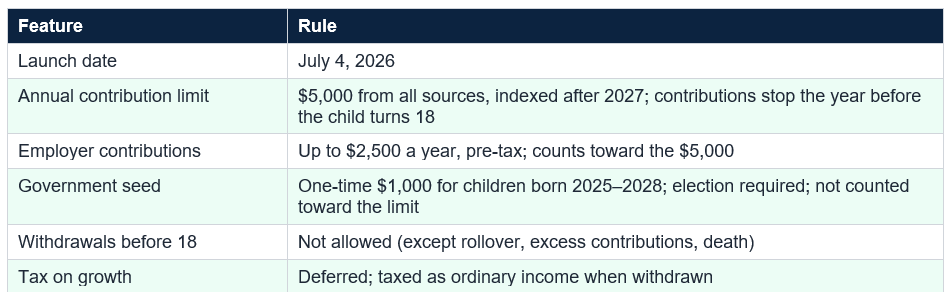
The program: launched July 4, 2026; $5,000 annual contribution limit from all sources (up to $2,500 from employers; indexed after 2027); one-time $1,000 pilot deposit for children born 2025–2028 (election required, not counted toward the cap); no withdrawals before 18; contributions end the year before the child turns 18. At 18: traditional IRA rules; withdrawals taxed as ordinary income on the taxable portion; 10% early-withdrawal penalty before 59½ with exceptions (education, first home up to $10,000); rollover or Roth conversion allowed; conversions face a 5-year clock and kiddie-tax risk. My arithmetic: $5,000 a year for 18 years plus the $1,000 seed at a constant 7% grows to about $173,400, of which $90,000 is basis; about $83,400 (48%) would be taxable; a full withdrawal at 18 would carry a penalty of about $8,300 before income tax; each $10,000 converted to a Roth would add about $4,800 of taxable income.
I call this the age 18 exit trap, though it is my phrase, not an official one. It is the cluster of surprises that catch families who assume an 18-year-old can simply take the money and pay for college or a car. This guide explains what really happens at 18, shows the math on a typical account and lays out five ways to avoid the trap, with the caveat that this is a brand-new program and some rules are still being worked out.
Children born from 2025 through 2028 can also receive a one-time $1,000 deposit from the Treasury, but only if someone elects it on Form 4547 or in the official app. That deposit does not count against the annual limit. There is no earned income requirement, which is the feature that makes the accounts novel, and before 18 the only money that can leave is rollovers, excess contributions and a distribution on death.
A critical detail is what counts as taxable. The government seed, employer contributions and qualified charitable contributions are taxable when withdrawn, along with their growth. Contributions that family members make with after-tax dollars are basis, meaning they are not taxed again, but the growth on them is taxable. And exceptions waive the penalty, not the income tax. As one explainer puts it, penalty-free still means taxed.
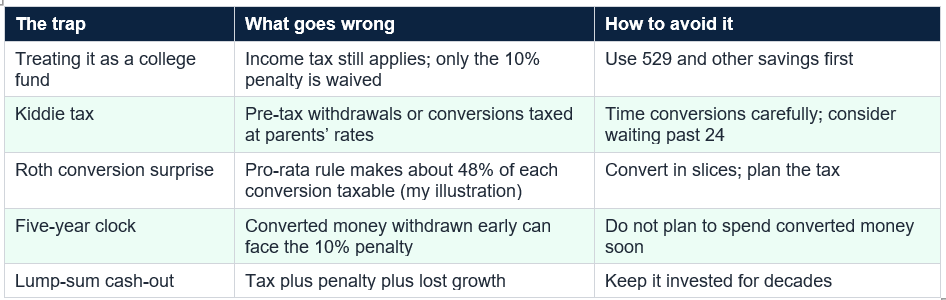
Trap three: the Roth conversion surprise. Converting to a Roth can be powerful, but it is taxable on the pre-tax portion, and under the IRA pro-rata rule you cannot convert only the tax-paid basis first. Trap four: the five-year clock. Converted amounts generally must sit for five years before they can be withdrawn without the 10% penalty, unless an exception applies. Trap five: the lump-sum cash-out, which stacks income tax, a 10% penalty and possible kiddie tax on a large amount in a single year, at the very moment a young adult has the least experience.
Now consider what an 18-year-old cashing out would face. The 10% penalty on about $83,400 of taxable money would be roughly $8,300, before ordinary income tax and possible kiddie tax. And the child would give up decades of tax-deferred growth. If instead the account were converted to a Roth in $20,000 slices, each slice would add about $9,600 of taxable income, because about 48% of every converted dollar is taxable under the pro-rata rule, and it would take about nine years to convert everything.
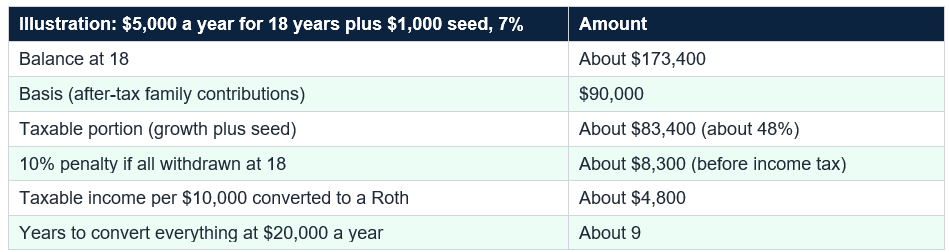
Illustration at 7%: $5,000 a year for 18 years plus the $1,000 seed grows to about $173,400, with $90,000 of basis and about $83,400 taxable (48%). A full withdrawal at 18 carries about $8,300 of penalty before income tax. Each $10,000 converted adds about $4,800 of taxable income. Assumes no other traditional IRAs and no pre-tax employer money.
Third, plan Roth conversions in slices and in low-income years. Sources disagree on timing: one adviser suggests that ages 18 to 20 can be optimal for conversions, when the child’s income is lowest, while CNBC’s tax adviser warns the kiddie tax makes it safest to wait until the child is over 24. The right answer depends on the child’s income, student status and the parents’ tax bracket, so run the numbers first. Fourth, use the exceptions wisely. The first-home exception allows up to $10,000 penalty-free (lifetime), and education expenses waive the penalty, but both remain taxable.
Fifth, get the details right: keep records of basis, watch other traditional IRA balances because the pro-rata rule aggregates them, remember that contributions end the year before 18 and ask a tax professional about the interaction with financial aid. Retirement account balances are generally not counted as assets on the FAFSA, but taxable conversion income can show up as income in later aid calculations. That point is general knowledge, not from my sources, so verify it.
At 17, schedule a conversation with a tax professional. Bring the account’s basis, the child’s income and student status, and your own tax bracket, and decide before January 1 of the year they turn 18 whether to leave, convert in slices or wait.
The practical advice is to read the IRS guidance, including Notice 2025-68 and the Form 4547 instructions, and to treat every explainer, including this one, as a starting point. If you are making a decision worth tens of thousands of dollars, a one-hour consultation with a tax professional is cheap insurance.
To avoid the trap, leave the money invested, pay for college with a 529 and other savings, convert in slices with the kiddie tax in mind, use exceptions with care and talk to a tax professional before the 18th birthday. The best outcome is the least dramatic one: a young adult who inherits decades of compounding and a plan. This is general education, not personalized advice.
The account is governed by traditional IRA rules and the child takes control. They can leave it invested, roll it into a traditional IRA or convert to a Roth IRA, or withdraw, but withdrawals are taxed as ordinary income on the taxable portion and generally carry a 10% early withdrawal penalty before age 59½ unless an exception applies. It is not a cash payout.
Can a Trump Account be used for college?
Yes, but it is not an efficient college fund. Education expenses can avoid the 10% penalty, but the income tax still applies, unlike a 529 plan, where qualified education withdrawals are tax-free. Sources generally suggest spending 529 money first and treating the Trump Account as retirement savings.
What is the kiddie tax and how does it affect a Trump Account?
The kiddie tax taxes certain unearned income of young people at their parents’ higher rates. A withdrawal or Roth conversion from a pre-tax Trump Account counts as unearned income, so doing it at 18 to 23 could be costly. A tax adviser quoted by CNBC said the safest way to stay out of it is to wait until the child is over 24. Confirm the current rules with a tax professional.
Should my child convert a Trump Account to a Roth IRA?
It can be a strong long-term move because Roth growth and qualified withdrawals are tax-free, but the conversion is taxable on the pre-tax portion, and the pro-rata rule means you cannot convert only the tax-paid contributions first. In my illustration, about 48% of each dollar converted would be taxable. Timing, other income and the kiddie tax all matter.
Is the $1,000 government deposit taxable?
It is taxable when withdrawn, along with its growth, and so are employer and qualified charitable contributions, according to published guidance. Contributions that family members make with after-tax dollars (up to $5,000 a year) are basis and are not taxed again, but their growth is. This is general education, not personal tax advice.
Table of Contents
- The Day the Account Unlocks
- The Short Answer
- Trump Account Basics
- What Actually Happens at 18
- The Five Traps at 18
- The Math: What Is Taxable?
- Five Ways to Avoid the Trap
- How a Trump Account Compares
- A Timeline From Birth to 24
- What Is Still Unsettled
- Conclusion
- Frequently Asked Questions
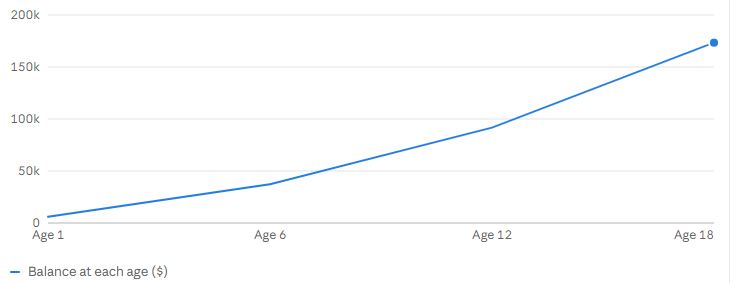
A Trump Account grows to about $173,400 by 18: $5,000 a year plus the $1,000 seed ($)
Account balance ($) by Author's illustration at a constant 7%, no fees, full $5,000 contributed each year; calculator sources show about $173,000
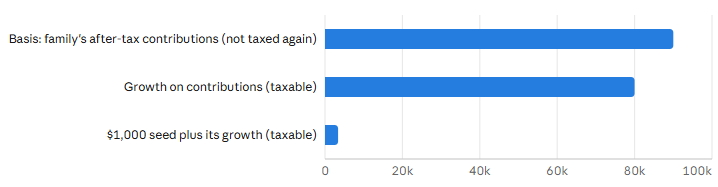
What is taxable at 18? Basis vs. growth vs. the seed ($, of about $173,400)
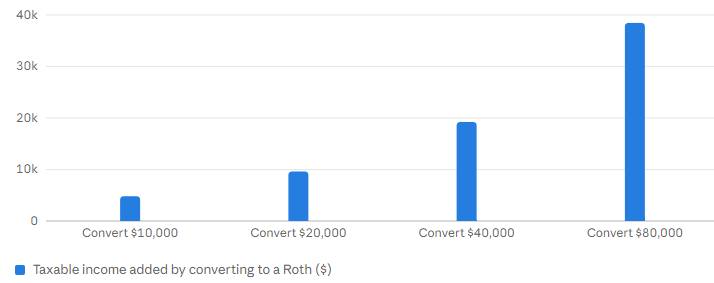
The pro-rata effect: taxable income added by each Roth conversion slice ($)
Taxable income added ($) by Author's arithmetic: about 48.1% of each converted dollar is taxable; assumes no other traditional IRA balances
The Day the Account Unlocks
For years a Trump Account is like a locked piggy bank. Family, employers and charities can add money, the investments grow and nobody, not even the child, can take it out. Then comes the child’s 18th birthday, and the lock opens. It feels like a milestone, a graduation present from the past. It is also the moment when a handful of rules, taxes and penalties wake up at once.I call this the age 18 exit trap, though it is my phrase, not an official one. It is the cluster of surprises that catch families who assume an 18-year-old can simply take the money and pay for college or a car. This guide explains what really happens at 18, shows the math on a typical account and lays out five ways to avoid the trap, with the caveat that this is a brand-new program and some rules are still being worked out.
The Short Answer
At 18, a Trump Account is governed by traditional IRA rules. Your child can leave it invested, roll it over or convert it to a Roth IRA, or withdraw, but withdrawals are taxed as ordinary income on the taxable portion and generally carry a 10% penalty before age 59½. The trap is treating the account as a cash-out fund or a college fund. The way out is to treat it as a long-term retirement account, spend 529 money on college first, plan any Roth conversion in slices and watch the kiddie tax.Trump Account Basics
Trump Accounts, formally section 530A accounts, were created by the One Big Beautiful Bill Act and opened on July 4, 2026. They are custodial-style traditional IRAs for children under 18 who have a Social Security number. Anyone can contribute up to a combined $5,000 a year in after-tax dollars until the year before the child turns 18, and employers can add up to $2,500 of that, pre-tax. The limit will be indexed for inflation after 2027.Children born from 2025 through 2028 can also receive a one-time $1,000 deposit from the Treasury, but only if someone elects it on Form 4547 or in the official app. That deposit does not count against the annual limit. There is no earned income requirement, which is the feature that makes the accounts novel, and before 18 the only money that can leave is rollovers, excess contributions and a distribution on death.
What Actually Happens at 18
According to Ameriprise and other sources, the child takes full ownership at 18. From January 1 of the year they turn 18, withdrawals are allowed, but the account follows traditional IRA rules, so there are three main options: keep it as is, roll it into a traditional IRA or convert it to a Roth IRA. A withdrawal is taxed as ordinary income and generally carries a 10% additional tax before 59½, though standard IRA exceptions apply, including qualified education expenses and up to $10,000 toward a first home.A critical detail is what counts as taxable. The government seed, employer contributions and qualified charitable contributions are taxable when withdrawn, along with their growth. Contributions that family members make with after-tax dollars are basis, meaning they are not taxed again, but the growth on them is taxable. And exceptions waive the penalty, not the income tax. As one explainer puts it, penalty-free still means taxed.
The Five Traps at 18
Trap one: treating it as a college fund. Education expenses can avoid the 10% penalty, but the withdrawal is still taxed, unlike a 529 plan, where qualified education withdrawals are tax-free. Trap two: the kiddie tax. Sources warn that a pre-tax withdrawal or Roth conversion counts as unearned income, which can be taxed at the parents’ higher rate. A tax adviser quoted by CNBC called it the largest technical risk and said the safest approach is to wait until the child is over 24.Trap three: the Roth conversion surprise. Converting to a Roth can be powerful, but it is taxable on the pre-tax portion, and under the IRA pro-rata rule you cannot convert only the tax-paid basis first. Trap four: the five-year clock. Converted amounts generally must sit for five years before they can be withdrawn without the 10% penalty, unless an exception applies. Trap five: the lump-sum cash-out, which stacks income tax, a 10% penalty and possible kiddie tax on a large amount in a single year, at the very moment a young adult has the least experience.
The Math: What Is Taxable?
Here is an illustration of my own. Suppose a family contributes the full $5,000 every year for 18 years, receives the $1,000 seed and earns a constant 7%. The account grows to about $173,400. Of that, $90,000 is basis, the after-tax contributions, and about $83,400 is taxable, since it consists of growth plus the seed and its growth. That is about 48% of the balance. An online calculator reaches a similar figure of roughly $173,000 under the same assumptions.Now consider what an 18-year-old cashing out would face. The 10% penalty on about $83,400 of taxable money would be roughly $8,300, before ordinary income tax and possible kiddie tax. And the child would give up decades of tax-deferred growth. If instead the account were converted to a Roth in $20,000 slices, each slice would add about $9,600 of taxable income, because about 48% of every converted dollar is taxable under the pro-rata rule, and it would take about nine years to convert everything.
Illustration at 7%: $5,000 a year for 18 years plus the $1,000 seed grows to about $173,400, with $90,000 of basis and about $83,400 taxable (48%). A full withdrawal at 18 carries about $8,300 of penalty before income tax. Each $10,000 converted adds about $4,800 of taxable income. Assumes no other traditional IRAs and no pre-tax employer money.
Five Ways to Avoid the Trap
First, do not withdraw at 18. The simplest way out of the trap is to leave the money invested, treating it as long-term retirement savings. Time is the biggest asset: the same $173,400 left to grow for 40 more years at 7% would become roughly $2.6 million in constant-return terms, my illustration, with the tax bill deferred. Second, fund college elsewhere. 529 withdrawals for qualified education are tax-free, and a 529 can even move up to $35,000 to a Roth IRA over a lifetime under SECURE 2.0, according to one guide.Third, plan Roth conversions in slices and in low-income years. Sources disagree on timing: one adviser suggests that ages 18 to 20 can be optimal for conversions, when the child’s income is lowest, while CNBC’s tax adviser warns the kiddie tax makes it safest to wait until the child is over 24. The right answer depends on the child’s income, student status and the parents’ tax bracket, so run the numbers first. Fourth, use the exceptions wisely. The first-home exception allows up to $10,000 penalty-free (lifetime), and education expenses waive the penalty, but both remain taxable.
Fifth, get the details right: keep records of basis, watch other traditional IRA balances because the pro-rata rule aggregates them, remember that contributions end the year before 18 and ask a tax professional about the interaction with financial aid. Retirement account balances are generally not counted as assets on the FAFSA, but taxable conversion income can show up as income in later aid calculations. That point is general knowledge, not from my sources, so verify it.
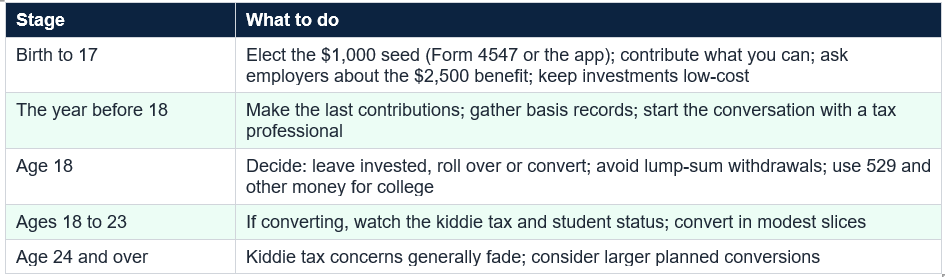
At 17, schedule a conversation with a tax professional. Bring the account’s basis, the child’s income and student status, and your own tax bracket, and decide before January 1 of the year they turn 18 whether to leave, convert in slices or wait.
How a Trump Account Compares
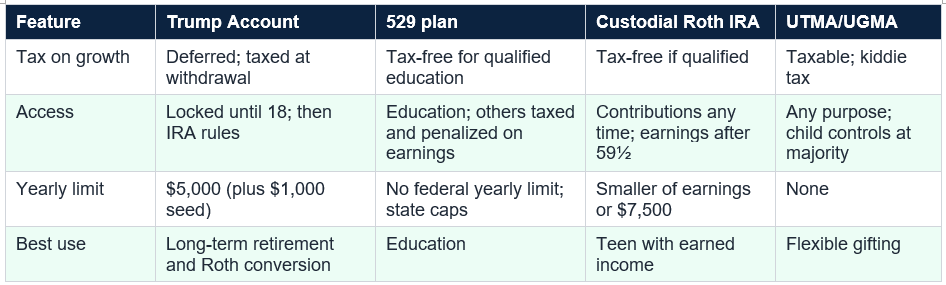
It helps to see how this account sits next to the alternatives. A 529 plan offers tax-free growth for qualified education. A custodial Roth IRA offers tax-free growth but requires the child to have earned income, with a limit of the smaller of earnings or $7,500 in 2026. A custodial UTMA account is flexible but taxable each year. The Trump Account’s distinctive advantages are the free money, the $1,000 seed and employer contributions, the lack of an earned income requirement and a possible path to Roth status. Its weakness is the tax on growth at withdrawal.
A Timeline From Birth to 24
What Is Still Unsettled
This is a young program, and honesty requires listing what I could not pin down. The kiddie tax thresholds and age rules for 2026 should be checked on the IRS site; as a general rule, the tax can apply to children under 19 and to some full-time students under 24, which is why the “over 24” advice appears. Experts disagree about the best age for conversions. Some sources I used are secondary or promotional. Rules on investments, fees and rollovers between providers may change as the Treasury and trustees refine the program.The practical advice is to read the IRS guidance, including Notice 2025-68 and the Form 4547 instructions, and to treat every explainer, including this one, as a starting point. If you are making a decision worth tens of thousands of dollars, a one-hour consultation with a tax professional is cheap insurance.
Conclusion
A Trump Account can be a generous gift: a $1,000 seed, up to $5,000 a year of tax-deferred growth and a possible path to Roth savings. But at 18 it becomes a traditional IRA, and the exit trap is treating it as a cash-out fund. Withdrawals are taxed as ordinary income, a 10% penalty generally applies before 59½, the kiddie tax can raise the bill and the pro-rata rule makes about 48% of each Roth conversion taxable in my illustration.To avoid the trap, leave the money invested, pay for college with a 529 and other savings, convert in slices with the kiddie tax in mind, use exceptions with care and talk to a tax professional before the 18th birthday. The best outcome is the least dramatic one: a young adult who inherits decades of compounding and a plan. This is general education, not personalized advice.
Frequently Asked Questions
What happens to a Trump Account when my child turns 18?The account is governed by traditional IRA rules and the child takes control. They can leave it invested, roll it into a traditional IRA or convert to a Roth IRA, or withdraw, but withdrawals are taxed as ordinary income on the taxable portion and generally carry a 10% early withdrawal penalty before age 59½ unless an exception applies. It is not a cash payout.
Can a Trump Account be used for college?
Yes, but it is not an efficient college fund. Education expenses can avoid the 10% penalty, but the income tax still applies, unlike a 529 plan, where qualified education withdrawals are tax-free. Sources generally suggest spending 529 money first and treating the Trump Account as retirement savings.
What is the kiddie tax and how does it affect a Trump Account?
The kiddie tax taxes certain unearned income of young people at their parents’ higher rates. A withdrawal or Roth conversion from a pre-tax Trump Account counts as unearned income, so doing it at 18 to 23 could be costly. A tax adviser quoted by CNBC said the safest way to stay out of it is to wait until the child is over 24. Confirm the current rules with a tax professional.
Should my child convert a Trump Account to a Roth IRA?
It can be a strong long-term move because Roth growth and qualified withdrawals are tax-free, but the conversion is taxable on the pre-tax portion, and the pro-rata rule means you cannot convert only the tax-paid contributions first. In my illustration, about 48% of each dollar converted would be taxable. Timing, other income and the kiddie tax all matter.
Is the $1,000 government deposit taxable?
It is taxable when withdrawn, along with its growth, and so are employer and qualified charitable contributions, according to published guidance. Contributions that family members make with after-tax dollars (up to $5,000 a year) are basis and are not taxed again, but their growth is. This is general education, not personal tax advice.
0 Comments
Be the first to share your thoughts on this article.