

Finance
Could Greater Bank Involvement Reshape US Stablecoin Market?

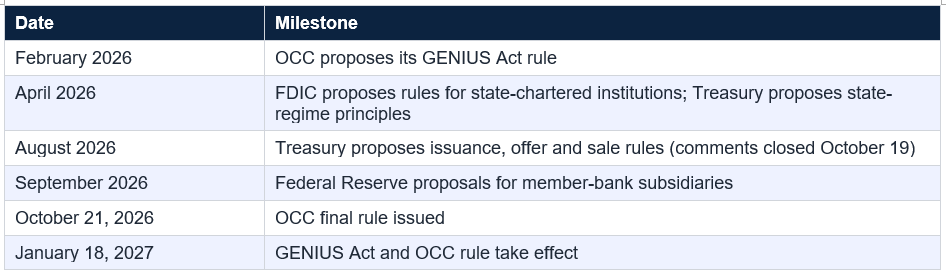
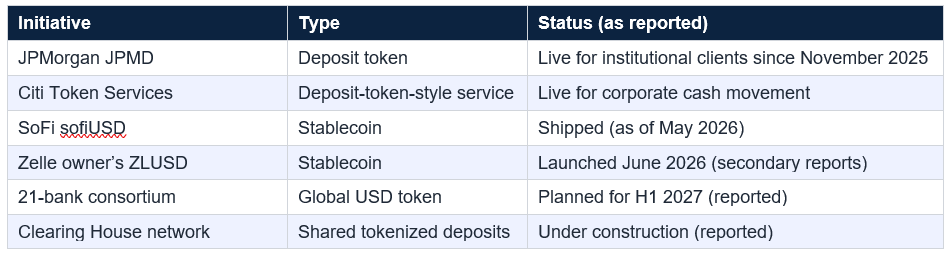
OCC final GENIUS Act rule issued October 21, 2026, effective January 18, 2027; reserves limited to approved assets; 5% daily liquidity floor; $5 million capital floor for new issuers; direct issuer yield banned, third-party rewards reviewed case by case. Market: about $302 billion of stablecoins (October 19–21, 2026), down about 6% from a roughly $322 billion peak in May; USDT about $183.5 billion (60.7%), USDC about $72.3 billion (23.9%), others about $46.5 billion (15.4%). Deposit risk: $6.6 trillion of transactional deposits flagged as exposed (Treasury advisory council); estimated displacement of about $182–$908 billion by 2030 (Citi) and about $500 billion by 2028 (Standard Chartered). Banks: JPMorgan JPMD deposit token (live since November 2025); Citi Token Services; SoFi sofiUSD; ZLUSD from Zelle’s owner (June 2026, per secondary reports); a reported 21-bank consortium targeting an H1 2027 USD token.
That raises a question with real consequences for how Americans and businesses move money: could greater bank involvement reshape the US stablecoin payment market? This guide looks at the market as it stands, what the new rules change, what banks are actually building and three plausible futures. I will be clear about what is confirmed, what is reported and what is my own analysis.
One caution about usage. Much of stablecoin volume has historically come from crypto trading and transfers rather than everyday consumer purchases. One report says USDC carries about 70% of adjusted transaction volume and USDT about 25%, a reminder that market cap and payments usage are different measures. JPMorgan Global Research has projected the market could reach $500 billion to $750 billion, according to one summary, which implies room for several issuers.
About $302 billion in stablecoins (October 2026), down about 6% from a roughly $322 billion peak in May. USDT about $183.5B (60.7%); USDC about $72.3B (23.9%); others about $46.5B (15.4%). Market-size figures are from secondary and industry sources.
Several details matter for banks. Reserves must be limited to approved assets such as Treasury securities and demand deposits, with a minimum daily liquidity requirement that the OCC cut to 5% from its proposal, and a $5 million capital floor for new issuers, according to Forbes and other summaries. The rule bans issuers from paying yield directly to holders. But the OCC declined to keep a presumption against affiliate and third-party rewards, saying it will review them case by case, which angered bank groups. The ICBA said it is focused on ensuring the policies protect community bank lending and the prohibition on yield. Anti-money-laundering rules are still pending.
There is also collective activity. A Genfinity report says 21 institutions, including Bank of America, Citi, Goldman Sachs, Wells Fargo and UBS, confirmed on September 1 that they plan to form a company in the second half of 2026 and launch a dollar token in the first half of 2027. Separately, JPMorgan, Bank of America and Citi are reported to be building shared tokenized-deposit infrastructure through The Clearing House. JPMorgan has said it has no current plan to issue its own stablecoin, according to a report on the Wall Street Journal’s coverage. Treat the consortium details as reported, not confirmed.
The second driver is economics. Stablecoin issuers keep the interest on reserves. As my own illustration, if reserves earned a 4.46% Treasury bill yield, a $302 billion market would generate roughly $13.5 billion a year in reserve income, with about $8.2 billion for USDT and $3.2 billion for USDC. That is a real revenue pool, and it is why banks do not want to cede it. The third driver is relationships: if customers hold and spend a non-bank token, banks risk losing the payment relationship, data and fees that come with it.
Illustrative reserve income at a 4.46% yield: about $13.5B a year on $302B of stablecoins (about $8.2B on USDT and $3.2B on USDC). Deposit displacement estimates: $182B–$908B by 2030 (Citi); about $500B by 2028 (Standard Chartered); $6.6T of transactional deposits flagged as exposed.
They also have weaknesses. Banks move slowly, bank tokens risk fragmenting into incompatible networks and public stablecoins already have deep liquidity and wide acceptance on crypto platforms. Tokenized deposits can pay interest, which is an advantage, but the volumes remain small next to the banks’ overall payment flows, according to one analysis. And the yield ban limits what stablecoin issuers can offer, which may blunt one of banks’ fears. The OCC’s case-by-case approach to third-party rewards keeps that fight alive.
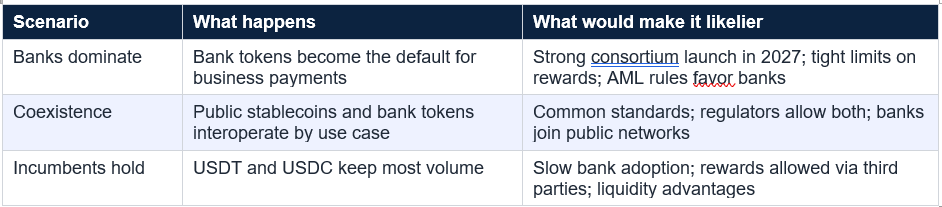
I think coexistence is the most likely path, with banks winning the most in business payments and settlement, where trust and compliance matter, and public stablecoins keeping an edge where liquidity and global reach matter. That is a judgment, not a forecast, and it could be wrong.
There are also risk questions. Stablecoins are not FDIC-insured, and reserve rules reduce but do not eliminate the possibility of a run. A bank token failing would raise different questions. And policy can change: a different administration or Congress could revisit rewards or charters. Anyone relying on a stablecoin for payments should understand who issues it, how it is backed and what protections apply. A handful of milestones will tell us which scenario is unfolding: the January 18, 2027 effective date and the first approved issuers; how the OCC rules on specific rewards programs; the finalization of Treasury, FDIC and Federal Reserve rules and the AML framework; the launch of the reported 21-bank consortium token in the first half of 2027; USDT and USDC market share over the next few quarters; and whether bank tokens reach consumers or stay institutional.
The decisive battles are over rewards, interoperability and who owns the customer relationship. My read is that coexistence is the most likely outcome, with banks strongest in business payments and public stablecoins in global and crypto flows. But this is a young market, and the rules, the technology and the politics are still moving. This is general education, not advice.
A payment stablecoin is a token issued under the GENIUS Act and backed one-to-one by reserves such as cash and Treasury bills; it cannot pay interest directly to holders. A tokenized deposit, or deposit token, is a digital version of a claim on a bank deposit, so it can sit inside deposit-insurance and capital frameworks and can pay interest. JPMorgan’s JPMD is the best-known live example of a deposit token.
When do the new US stablecoin rules take effect?
The OCC issued its final rule on October 21, 2026, and both the rule and the GENIUS Act take effect January 18, 2027. The OCC rule covers reserves, redemption, custody, licensing and capital. Anti-money-laundering rules are still to come, and Treasury, the FDIC and the Federal Reserve have proposals in progress.
Why do banks care about stablecoins?
Two reasons stand out. Deposits: a Treasury advisory council flagged $6.6 trillion of US transactional deposits as exposed to stablecoin substitution, and estimates of displacement range from about $182 billion to $908 billion by 2030 (Citi) and roughly $500 billion by 2028 (Standard Chartered). Payments: banks want to keep settlement and customer relationships rather than cede them to non-bank issuers.
Can stablecoins pay interest under the new rules?
Not directly from the issuer. The OCC final rule keeps the ban on issuers paying yield for simply holding a stablecoin, but it declined to presume that third-party or affiliate reward programs are illegal and will review them case by case. Bank trade groups such as the ICBA and the ABA are pushing back, because rewards could pull deposits from banks.
Is this investment advice about a stablecoin or a bank stock?
No. This is general education about market structure. Stablecoins are not FDIC-insured, bank deposit tokens work differently and prices, rules and plans can change quickly. Do your own research and consider a qualified adviser before making any financial decision.
Table of Contents
- A Week That Changed the Rulebook
- The Short Answer
- Where the Stablecoin Market Stands
- The New Rules
- What the Banks Are Building
- Why Banks Are Moving Now
- What Banks Bring and What They Lack
- Three Scenarios
- Who Wins and Who Loses
- Risks and Open Questions
- What to Watch Next
- Conclusion
- Frequently Asked Questions
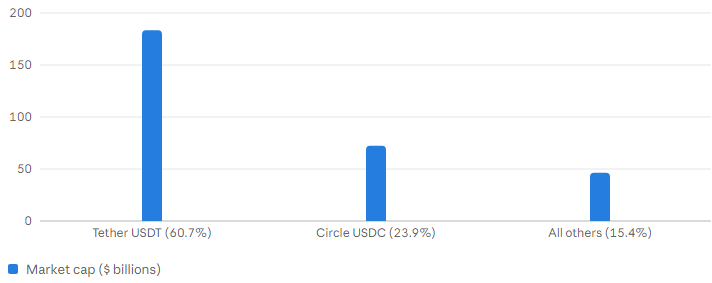
Who holds the $302 billion US-dollar stablecoin market, October 2026 ($B)
Market capitalization ($ billions) by Industry data (secondary sources) for Oct 19-21, 2026; 'others' is my subtraction
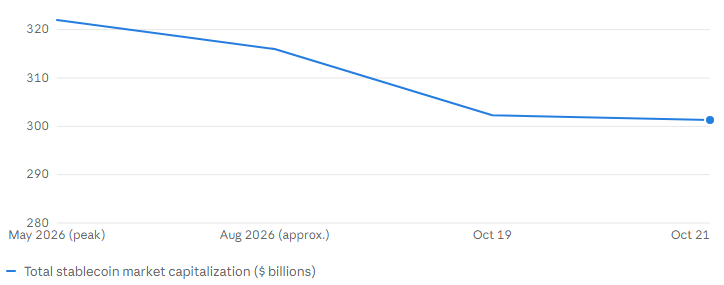
Stablecoin market capitalization: May peak to October 2026 ($B)
Market capitalization ($ billions) by Industry sources of uneven quality; roughly a 6% decline from the May peak
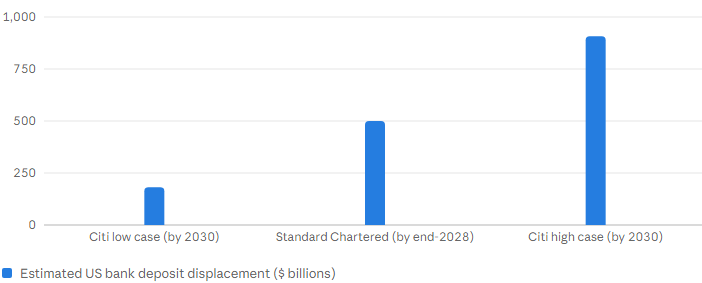
Why banks care: estimated deposit displacement from stablecoins ($B)
Deposits that could leave US banks ($ billions) by Estimates as reported by Genfinity; against $6.6 trillion of transactional deposits flagged as exposed (Treasury advisory council)
A Week That Changed the Rulebook
On October 21, 2026, the Office of the Comptroller of the Currency finalized its rule implementing the GENIUS Act, the first final federal framework for payment stablecoins. Treasury Secretary Scott Bessent called it a watershed moment in American finance. For years, stablecoins grew in a regulatory gray zone while banks watched from the sidelines. Now there is a rulebook, an effective date of January 18, 2027 and a clear invitation for banks to participate.That raises a question with real consequences for how Americans and businesses move money: could greater bank involvement reshape the US stablecoin payment market? This guide looks at the market as it stands, what the new rules change, what banks are actually building and three plausible futures. I will be clear about what is confirmed, what is reported and what is my own analysis.
The Short Answer
Yes, it likely will, but not in the simple way headlines suggest. Banks are unlikely to replace today’s dominant stablecoins quickly. The more likely change is convergence: bank-issued tokens and deposit tokens running on the same networks as public stablecoins, competing on trust, distribution and price. The biggest fights are over interest, because stablecoins that pay rewards can pull deposits from banks, and over who controls settlement. The final shape depends on how regulators handle rewards, how fast bank tokens reach consumers and whether the rails can talk to one another.Where the Stablecoin Market Stands
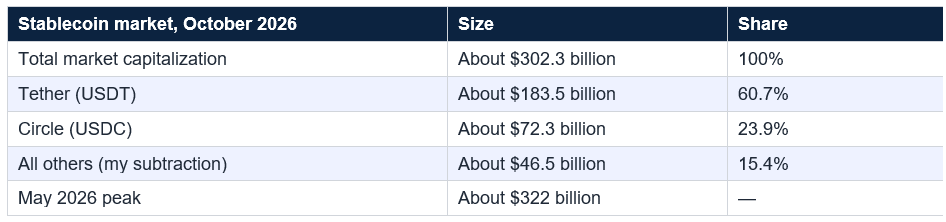
The market is large but concentrated. Total stablecoin capitalization was about $302 billion in the week of October 19 to 21, 2026, according to a market-data analysis, a secondary source I use only for the headline figure. It peaked near $322 billion in May, so it has slipped about 6%. Tether’s USDT accounts for about $183.5 billion, or 60.7%, and Circle’s USDC about $72.3 billion, or 23.9%, together roughly 85% of the market. Everything else adds up to about $46.5 billion.One caution about usage. Much of stablecoin volume has historically come from crypto trading and transfers rather than everyday consumer purchases. One report says USDC carries about 70% of adjusted transaction volume and USDT about 25%, a reminder that market cap and payments usage are different measures. JPMorgan Global Research has projected the market could reach $500 billion to $750 billion, according to one summary, which implies room for several issuers.
About $302 billion in stablecoins (October 2026), down about 6% from a roughly $322 billion peak in May. USDT about $183.5B (60.7%); USDC about $72.3B (23.9%); others about $46.5B (15.4%). Market-size figures are from secondary and industry sources.
The New Rules
The GENIUS Act created a federal framework for payment stablecoins, and regulators have been writing the details. The OCC proposed its rule in February, the FDIC proposed rules for state-chartered institutions in April, Treasury followed with proposals in April and August and the Federal Reserve issued proposals in September for subsidiaries of member banks. The OCC’s final rule, issued October 21 and effective January 18, 2027, sets requirements for reserves, redemption, custody, licensing and capital, and will be supervised like a bank’s activities, with annual examinations and weekly reporting.Several details matter for banks. Reserves must be limited to approved assets such as Treasury securities and demand deposits, with a minimum daily liquidity requirement that the OCC cut to 5% from its proposal, and a $5 million capital floor for new issuers, according to Forbes and other summaries. The rule bans issuers from paying yield directly to holders. But the OCC declined to keep a presumption against affiliate and third-party rewards, saying it will review them case by case, which angered bank groups. The ICBA said it is focused on ensuring the policies protect community bank lending and the prohibition on yield. Anti-money-laundering rules are still pending.
What the Banks Are Building
Banks are not waiting. They are taking two different routes. The first is the deposit token, a digital representation of money in a bank account. JPMorgan’s JPMD was rolled out to institutional clients on the Base network on November 12, 2025, and Citi runs Citi Token Services for corporate cash movement. Because deposit tokens are bank deposits, they can pay interest and sit within existing insurance and capital frameworks. The second route is the stablecoin itself. SoFi has shipped sofiUSD, and secondary reports say Early Warning Services, the operator of Zelle owned by seven large banks, launched a stablecoin called ZLUSD in June 2026.There is also collective activity. A Genfinity report says 21 institutions, including Bank of America, Citi, Goldman Sachs, Wells Fargo and UBS, confirmed on September 1 that they plan to form a company in the second half of 2026 and launch a dollar token in the first half of 2027. Separately, JPMorgan, Bank of America and Citi are reported to be building shared tokenized-deposit infrastructure through The Clearing House. JPMorgan has said it has no current plan to issue its own stablecoin, according to a report on the Wall Street Journal’s coverage. Treat the consortium details as reported, not confirmed.
Why Banks Are Moving Now
The main driver is deposits. A Treasury advisory council has flagged $6.6 trillion of US transactional deposits as exposed to stablecoin substitution. Estimates of how much could actually move vary widely: Citi research projects displacement of $182 billion to $908 billion by 2030, and Standard Chartered has estimated roughly $500 billion could leave US banks by the end of 2028. Even the high end is 14% of that $6.6 trillion pool, and the low end under 3%, but deposits are the raw material for lending, so community banks in particular worry.The second driver is economics. Stablecoin issuers keep the interest on reserves. As my own illustration, if reserves earned a 4.46% Treasury bill yield, a $302 billion market would generate roughly $13.5 billion a year in reserve income, with about $8.2 billion for USDT and $3.2 billion for USDC. That is a real revenue pool, and it is why banks do not want to cede it. The third driver is relationships: if customers hold and spend a non-bank token, banks risk losing the payment relationship, data and fees that come with it.
Illustrative reserve income at a 4.46% yield: about $13.5B a year on $302B of stablecoins (about $8.2B on USDT and $3.2B on USDC). Deposit displacement estimates: $182B–$908B by 2030 (Citi); about $500B by 2028 (Standard Chartered); $6.6T of transactional deposits flagged as exposed.
What Banks Bring and What They Lack
Banks bring formidable advantages. They hold the customer relationships and the compliance machinery. Zelle alone connects about 2,200 financial institutions, according to one report. Their products can sit inside deposit insurance and existing supervision, and the new rules treat bank-supervised issuers in a familiar way. Businesses that already move money through banks may prefer a token that looks like a deposit.They also have weaknesses. Banks move slowly, bank tokens risk fragmenting into incompatible networks and public stablecoins already have deep liquidity and wide acceptance on crypto platforms. Tokenized deposits can pay interest, which is an advantage, but the volumes remain small next to the banks’ overall payment flows, according to one analysis. And the yield ban limits what stablecoin issuers can offer, which may blunt one of banks’ fears. The OCC’s case-by-case approach to third-party rewards keeps that fight alive.
Three Scenarios
Nobody knows how this plays out, so here are three scenarios of my own. In the first, banks dominate: bank tokens and deposit tokens become the default for business payments and settlement, and USDT and USDC shrink to crypto-trading niches. In the second, coexistence: public stablecoins keep their lead in crypto and cross-border flows while banks capture domestic business payments, and tokens interoperate. In the third, incumbents hold: Tether and Circle keep their shares, bank tokens struggle with adoption and rewards programs draw deposits away.I think coexistence is the most likely path, with banks winning the most in business payments and settlement, where trust and compliance matter, and public stablecoins keeping an edge where liquidity and global reach matter. That is a judgment, not a forecast, and it could be wrong.
Who Wins and Who Loses
Businesses could win from faster, cheaper settlement if bank tokens work around the clock, and consumers could benefit from competition, though most people will not notice the plumbing. Large banks could defend deposits and add fee revenue. Community banks face the biggest risk if rewards-bearing stablecoins pull deposits, which is why their trade groups are lobbying. Non-bank issuers such as Tether and Circle face tougher supervision and bank competition, while platforms that share rewards with users depend on how the OCC treats them. Payment networks and fintechs may benefit as intermediaries.Risks and Open Questions
Several questions are open. Anti-money-laundering and sanctions rules have not been finalized, and the OCC rule does not address them. Foreign issuers face a gap: as of October 19, according to one report, no foreign jurisdiction had received a Treasury comparability determination, which matters for Tether, which is incorporated in El Salvador. Interoperability between bank tokens and public chains is unresolved, and a fragmented market could be less useful than the current one.There are also risk questions. Stablecoins are not FDIC-insured, and reserve rules reduce but do not eliminate the possibility of a run. A bank token failing would raise different questions. And policy can change: a different administration or Congress could revisit rewards or charters. Anyone relying on a stablecoin for payments should understand who issues it, how it is backed and what protections apply. A handful of milestones will tell us which scenario is unfolding: the January 18, 2027 effective date and the first approved issuers; how the OCC rules on specific rewards programs; the finalization of Treasury, FDIC and Federal Reserve rules and the AML framework; the launch of the reported 21-bank consortium token in the first half of 2027; USDT and USDC market share over the next few quarters; and whether bank tokens reach consumers or stay institutional.
Conclusion
Greater bank involvement could reshape the US stablecoin payment market, but more by convergence than conquest. The OCC’s October 21 final rule, effective January 18, 2027, gives banks a clear path. About $302 billion of stablecoins now circulate, with USDT and USDC holding roughly 85%, and banks are responding with deposit tokens, stablecoins and consortia while worrying about deposit estimates ranging from $182 billion to $908 billion by 2030.The decisive battles are over rewards, interoperability and who owns the customer relationship. My read is that coexistence is the most likely outcome, with banks strongest in business payments and public stablecoins in global and crypto flows. But this is a young market, and the rules, the technology and the politics are still moving. This is general education, not advice.
Frequently Asked Questions
What is the difference between a stablecoin and a tokenized deposit?A payment stablecoin is a token issued under the GENIUS Act and backed one-to-one by reserves such as cash and Treasury bills; it cannot pay interest directly to holders. A tokenized deposit, or deposit token, is a digital version of a claim on a bank deposit, so it can sit inside deposit-insurance and capital frameworks and can pay interest. JPMorgan’s JPMD is the best-known live example of a deposit token.
When do the new US stablecoin rules take effect?
The OCC issued its final rule on October 21, 2026, and both the rule and the GENIUS Act take effect January 18, 2027. The OCC rule covers reserves, redemption, custody, licensing and capital. Anti-money-laundering rules are still to come, and Treasury, the FDIC and the Federal Reserve have proposals in progress.
Why do banks care about stablecoins?
Two reasons stand out. Deposits: a Treasury advisory council flagged $6.6 trillion of US transactional deposits as exposed to stablecoin substitution, and estimates of displacement range from about $182 billion to $908 billion by 2030 (Citi) and roughly $500 billion by 2028 (Standard Chartered). Payments: banks want to keep settlement and customer relationships rather than cede them to non-bank issuers.
Can stablecoins pay interest under the new rules?
Not directly from the issuer. The OCC final rule keeps the ban on issuers paying yield for simply holding a stablecoin, but it declined to presume that third-party or affiliate reward programs are illegal and will review them case by case. Bank trade groups such as the ICBA and the ABA are pushing back, because rewards could pull deposits from banks.
Is this investment advice about a stablecoin or a bank stock?
No. This is general education about market structure. Stablecoins are not FDIC-insured, bank deposit tokens work differently and prices, rules and plans can change quickly. Do your own research and consider a qualified adviser before making any financial decision.
0 Comments
Be the first to share your thoughts on this article.