

Retirement
How to Stop Your 401(k) Becoming a Tax Burden in Retirement!

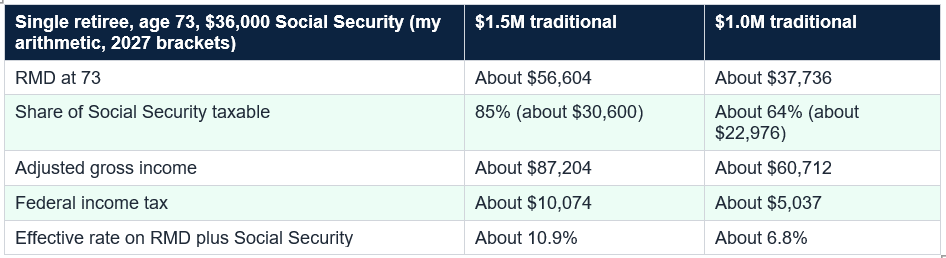
Age 73 if born 1951–1959, age 75 if born 1960 or later; factor 26.5 at age 73; penalty 25% (10% if corrected within two years); Roth 401(k) lifetime RMDs eliminated from 2024; QCDs from an IRA at 70½, about $111,000 in 2026; up to 85% of Social Security can be taxable; 2027 standard deduction $16,600 single; 401(k) limit $24,500 in 2026. My arithmetic (single retiree, age 73, $36,000 of Social Security, 2027 brackets): a $1.5 million traditional balance gives a $56,604 RMD, 85% of Social Security taxable and about $10,074 of federal tax; a $1.0 million balance gives a $37,736 RMD, 64% taxable and about $5,037. Withdrawal mix: taking $60,000 all from a traditional account costs about $10,822 of federal tax with $36,000 of Social Security, while $30,000 traditional plus $30,000 Roth costs about $3,320, a saving of about $7,500; converting $480,000 at 22% costs about $105,600 of tax up front; a missed $37,736 RMD costs $9,434 at 25% or $3,774 at 10%.
This is not a reason to stop saving: a 401(k) is still one of the best tools available, and a large balance is a good problem. But it is a reason to plan. This guide explains how a 401(k) can become a tax burden, shows with simple examples how much it can matter and covers the tools that help: Roth conversions, tax diversification, a smart withdrawal mix, charitable distributions and avoiding penalties. The sooner you start, the more choices you have.
The second is the knock-on effect. RMDs raise your adjusted gross income, and Social Security taxation uses provisional income, AGI plus half your benefits plus tax-exempt interest; as it crosses thresholds, a rising share of your benefit becomes taxable, up to 85%. Medicare premiums can also rise through income-related surcharges (IRMAA), which in my earlier research began at $109,000 for single filers and $218,000 for joint filers in 2026, using income from two years earlier. One RMD can touch your bracket, your Social Security and your Medicare costs at once.

RMDs start at 73 (born 1951–1959) or 75 (born 1960 or later); the factor is 26.5 at 73, so $1,000,000 means about $37,736. Missing one costs 25% (10% if fixed within two years). Up to 85% of Social Security can be taxable, and Roth 401(k) lifetime RMDs ended in 2024.
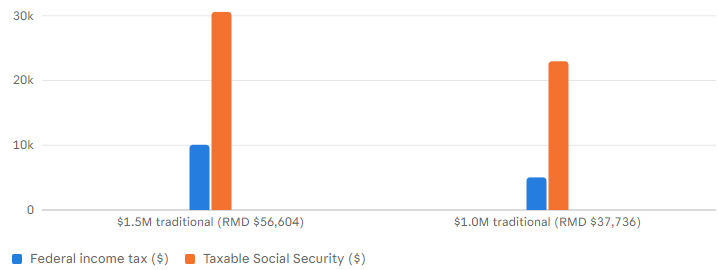
The second has $1.0 million and an RMD of about $37,736. His provisional income is about $55,736, so about 64% of his benefit, roughly $22,976, is taxable; his AGI is about $60,712, taxable income about $44,112 and federal tax about $5,037, or 6.8% of his income. A third more savings roughly doubles the tax bill, and the biggest piece is Social Security. It is a simplified case, but it shows why large pre-tax balances can carry a steep tax cost.
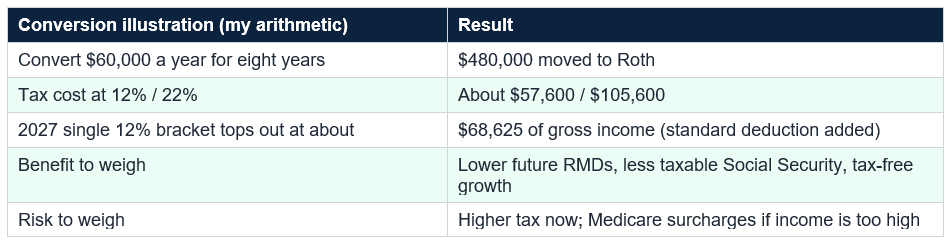
Conversions are not free, and not always wise. You pay tax on the amount converted, ideally from outside the account: converting $480,000 over eight years at 22% would cost about $105,600 up front, or about $57,600 at 12%. The benefit comes later, in lower RMDs, less taxable Social Security and tax-free growth, and depends on your future rates, how long you live and whether conversion income pushes you over Medicare surcharge thresholds. In 2027 the 12% bracket for a single filer reaches about $68,625 of gross income with the standard deduction, a useful target.
Which to choose depends on your tax rate today against your expected rate in retirement: a likely higher bracket later, or a wish for flexibility, can favor Roth, while a high current bracket can favor pre-tax, and many people split. A taxable brokerage account adds a third source with lower tax on long-term gains. The goal is not to guess the future but to have choices: with three buckets you can manage your taxable income each year instead of being forced by one large pre-tax balance.

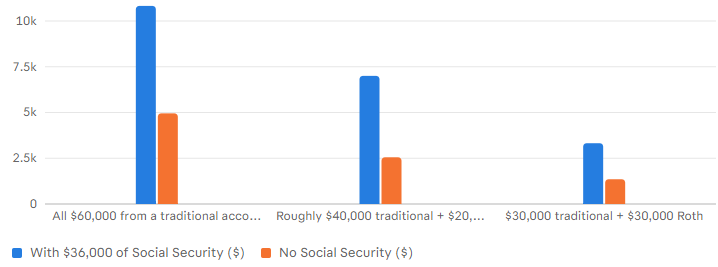
If instead $30,000 came from a traditional account and $30,000 from a Roth, the tax would be about $3,320, a saving of about $7,502 for the same spending, mostly because so little Social Security becomes taxable; without Social Security the figures would be about $4,952 versus $1,352. A Roth or taxable bucket lets you “fill” low brackets deliberately, which is impossible if everything you have is pre-tax.

Two caveats. A QCD must come from an IRA, not directly from a 401(k) or other employer plan, so you would need to roll the 401(k) into an IRA first, and it only helps if you would give anyway. In my example, a $10,000 QCD instead of taking that amount as income saves about $1,200 of federal tax at a 12% bracket and $2,200 at 22%, before effects on Social Security and Medicare.
Also keep track of every account. In my general knowledge, RMDs are calculated separately for each 401(k), so old workplace plans are easy to forget and consolidating them into one IRA can simplify things, and some plans allow a delay while you still work for the employer. Roth 401(k) accounts no longer require lifetime RMDs, a reason to hold some money there. A calendar reminder can save thousands of dollars.

From 73 or 75, take RMDs on time, use the withdrawal mix to manage your bracket and review each year as rules change; the 2027 brackets, announced this month, raise thresholds about 3.2%. Plan for heirs too: inherited traditional accounts are taxable to beneficiaries, and most non-spouse heirs must empty them within 10 years, whereas a Roth balance can leave heirs tax-free income, though withdrawal rules still apply.
This year, list your balances by bucket (pre-tax, Roth, taxable) and estimate your RMD at 73 or 75. If more than about 80% of your savings is pre-tax, start modeling Roth conversions and Roth contributions. Common mistakes include saving only in pre-tax accounts, ignoring the effect of RMDs on Social Security and Medicare, waiting until 73 to think about taxes, converting too much in one year, paying conversion tax from the account itself, missing an RMD or forgetting an old 401(k), expecting a QCD from a 401(k) and treating tax rates as permanent.
The tools are available: Roth conversions in the gap years, Roth and taxable buckets built early, a deliberate withdrawal mix, QCDs from an IRA and never missing an RMD. None is right for everyone, and conversions cost real tax today, so model your own numbers with a tax professional. Start by knowing your buckets, estimating your RMD and using the 2027 brackets as a guide; the earlier you plan, the more room you have.
Because traditional 401(k) money has never been taxed. Every dollar you withdraw is ordinary income, and from age 73 (or 75 if you were born in 1960 or later) you must withdraw a minimum amount whether you need it or not. Those withdrawals can push you into a higher bracket, make more of your Social Security taxable and raise Medicare premiums.
When do required minimum distributions start?
At age 73 if you were born between 1951 and 1959, and at 75 if you were born in 1960 or later, under SECURE 2.0. The amount is the prior year-end balance divided by an IRS life-expectancy factor, 26.5 at age 73, so a $1,000,000 balance means about $37,736. Your first deadline is April 1 of the year after you reach the age, then December 31 each year.
What is the penalty for missing an RMD?
25% of the amount you should have withdrawn, reduced to 10% if you correct the mistake within a two-year window, according to several sources. On a $37,736 RMD, that is about $9,434 at 25% or $3,774 at 10%. Roth 401(k) accounts no longer require lifetime RMDs as of 2024, so converting or contributing to a Roth can remove the issue.
Is a Roth conversion worth it?
It can be, if you convert when your tax rate is low and pay the tax from outside the account, but it is not always the right move. Converting $480,000 at 22% costs about $105,600 up front in my illustration. The benefit depends on your future tax rates, whether it keeps you below Medicare surcharge thresholds and how long you will live. This is general education, not personal tax advice.
Can I use a qualified charitable distribution from my 401(k)?
Not directly. A QCD must come from an IRA, not a 401(k), and you must be 70½ or older. You could roll the 401(k) to an IRA first. The 2026 limit is about $111,000 per person, according to several sources, though older articles list lower figures. A QCD counts toward your RMD and is excluded from taxable income.
Table of Contents
- The Tax Bill You Have Not Paid Yet
- The Short Answer
- How a 401(k) Becomes a Tax Burden
- What It Looks Like: Two Retirees
- Tool 1: Roth Conversions in the Gap Years
- Tool 2: Build Roth and Taxable Buckets Now
- Tool 3: Mix Your Withdrawals
- Tool 4: Qualified Charitable Distributions
- Tool 5: Avoid Penalties and Mistakes
- A Timeline by Age
- Common Mistakes
- Conclusion
- Frequently Asked Questions
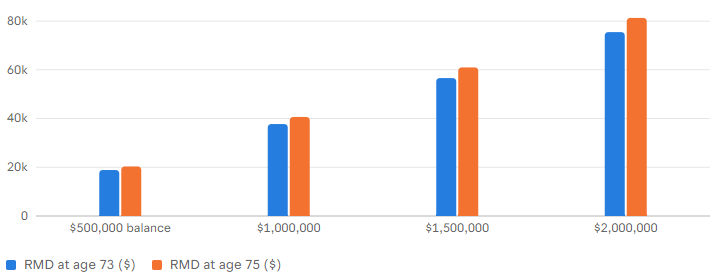
How big the forced withdrawal gets: required minimum distribution by balance ($)
RMD ($) by Author's arithmetic with IRS Uniform Lifetime Table factors reported by secondary sources (26.5 at age 73; 24.6 at age 75); start age is 73 if born 1951-1959 and 75 if born 1960 or later
The tax squeeze: single retiree at 73 with $36,000 of Social Security, $1.5M vs. $1.0M pre-tax ($)
Dollars by Author's simplified arithmetic: 2027 brackets, $16,600 standard deduction, provisional-income formula, no state tax or extra senior deduction; not an estimate of your tax
Withdrawal mix matters: federal tax on $60,000 of retirement spending ($)
Federal income tax ($) by Author's arithmetic, single filer, 2027 brackets; *the middle bar's no-Social-Security value ($2,552) is computed; its with-Social-Security value is an interpolation shown for shape only, not computed
The Tax Bill You Have Not Paid Yet
Most people think of their 401(k) balance as their money. A traditional 401(k) is actually a partnership: you get the tax deduction now, and the government gets a share of every dollar later, a share that depends on how much you withdraw, when and what else is taxed that year. Handled carelessly, a big pre-tax balance can bring required withdrawals you cannot avoid, taxed as ordinary income, stacked on top of Social Security and Medicare premiums that rise with income.This is not a reason to stop saving: a 401(k) is still one of the best tools available, and a large balance is a good problem. But it is a reason to plan. This guide explains how a 401(k) can become a tax burden, shows with simple examples how much it can matter and covers the tools that help: Roth conversions, tax diversification, a smart withdrawal mix, charitable distributions and avoiding penalties. The sooner you start, the more choices you have.
The Short Answer
A 401(k) becomes a tax burden when large, forced, fully taxable withdrawals pile up in one bracket. To prevent it, spread the tax across more years and account types: convert some pre-tax money to Roth at modest rates in the years between retirement and age 73 or 75, build Roth and taxable buckets so you can choose what to withdraw, mix withdrawals to stay in a low bracket, give to charity from an IRA with a QCD and never miss an RMD. In my example, a single retiree with $1.5 million pre-tax pays about double the federal tax of one with $1.0 million, mostly because more Social Security becomes taxable.
How a 401(k) Becomes a Tax Burden
The first mechanism is the required minimum distribution. Under SECURE 2.0, RMDs begin at age 73 for people born between 1951 and 1959 and at 75 for those born in 1960 or later. The amount is your prior year-end balance divided by an IRS life-expectancy factor, 26.5 at age 73 and 24.6 at 75, so $1,000,000 means about $37,736 at 73. The first deadline is April 1 of the year after you reach the age, then December 31 each year, and the money is taxed as ordinary income.The second is the knock-on effect. RMDs raise your adjusted gross income, and Social Security taxation uses provisional income, AGI plus half your benefits plus tax-exempt interest; as it crosses thresholds, a rising share of your benefit becomes taxable, up to 85%. Medicare premiums can also rise through income-related surcharges (IRMAA), which in my earlier research began at $109,000 for single filers and $218,000 for joint filers in 2026, using income from two years earlier. One RMD can touch your bracket, your Social Security and your Medicare costs at once.
RMDs start at 73 (born 1951–1959) or 75 (born 1960 or later); the factor is 26.5 at 73, so $1,000,000 means about $37,736. Missing one costs 25% (10% if fixed within two years). Up to 85% of Social Security can be taxable, and Roth 401(k) lifetime RMDs ended in 2024.
What It Looks Like: Two Retirees
Consider two single retirees, both 73 with $36,000 of Social Security and no other income, using the 2027 brackets and the $16,600 standard deduction. The first has $1.5 million in a traditional account and an RMD of about $56,604. Her provisional income is about $74,604, so 85% of her Social Security, about $30,600, is taxable; her AGI is about $87,204, her taxable income about $70,604 and her federal tax about $10,074, an effective 10.9% on $92,604 of income.The second has $1.0 million and an RMD of about $37,736. His provisional income is about $55,736, so about 64% of his benefit, roughly $22,976, is taxable; his AGI is about $60,712, taxable income about $44,112 and federal tax about $5,037, or 6.8% of his income. A third more savings roughly doubles the tax bill, and the biggest piece is Social Security. It is a simplified case, but it shows why large pre-tax balances can carry a steep tax cost.
Tool 1: Roth Conversions in the Gap Years
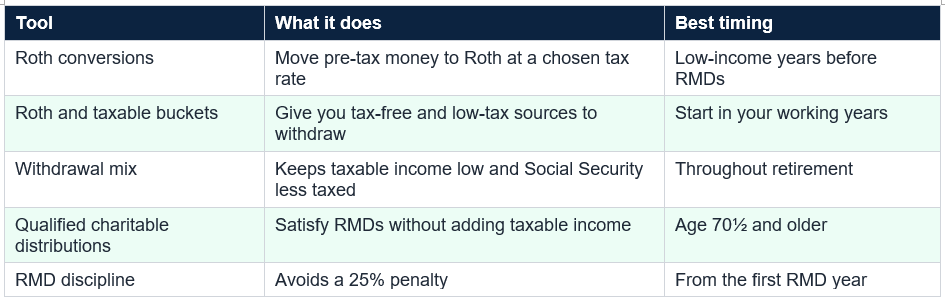
The most powerful lever is usually the Roth conversion. Between retirement and the start of RMDs, many people have unusually low taxable income, a natural time to convert pre-tax money to Roth and pay tax at a low rate. Roth balances grow tax-free, have no lifetime RMDs for the original owner and withdrawals do not raise your provisional income, and converting shrinks the traditional balance, lowering future RMDs. Several sources name Roth conversions in your 60s before RMDs as the highest-leverage move.Conversions are not free, and not always wise. You pay tax on the amount converted, ideally from outside the account: converting $480,000 over eight years at 22% would cost about $105,600 up front, or about $57,600 at 12%. The benefit comes later, in lower RMDs, less taxable Social Security and tax-free growth, and depends on your future rates, how long you live and whether conversion income pushes you over Medicare surcharge thresholds. In 2027 the 12% bracket for a single filer reaches about $68,625 of gross income with the standard deduction, a useful target.
Tool 2: Build Roth and Taxable Buckets Now
You do not have to wait for retirement. Tax diversification means holding money in different buckets: pre-tax (traditional 401(k) and IRA), Roth and taxable. If your employer offers a Roth 401(k), contributing part of your savings there builds a bucket with no lifetime RMDs, since SECURE 2.0 eliminated them from 2024. The 2026 401(k) limit is $24,500, and in my general knowledge (not retrieved) new rules from 2026 require higher earners to make catch-up contributions as Roth.Which to choose depends on your tax rate today against your expected rate in retirement: a likely higher bracket later, or a wish for flexibility, can favor Roth, while a high current bracket can favor pre-tax, and many people split. A taxable brokerage account adds a third source with lower tax on long-term gains. The goal is not to guess the future but to have choices: with three buckets you can manage your taxable income each year instead of being forced by one large pre-tax balance.
Tool 3: Mix Your Withdrawals
Once you are retired, which account you draw from can matter as much as how much. Traditional withdrawals are taxable income, Roth withdrawals are not and from a taxable account only the gains are taxed, so mixing them lets you keep taxable income in a low bracket, hold down the share of Social Security taxed and stay under Medicare surcharge thresholds. In my illustration, a single retiree with $36,000 of Social Security who needs $60,000 would pay about $10,822 of federal tax if it all came from a traditional account.If instead $30,000 came from a traditional account and $30,000 from a Roth, the tax would be about $3,320, a saving of about $7,502 for the same spending, mostly because so little Social Security becomes taxable; without Social Security the figures would be about $4,952 versus $1,352. A Roth or taxable bucket lets you “fill” low brackets deliberately, which is impossible if everything you have is pre-tax.
Tool 4: Qualified Charitable Distributions
If you give to charity, a qualified charitable distribution is one of the cleanest tools. From age 70½, you can send money directly from an IRA to a qualified charity; it counts toward your RMD and is excluded from taxable income, up to an indexed limit of about $111,000 per person in 2026, according to several sources (older articles list $100,000 to $108,000). Because it never appears in your income, it can lower your tax, protect Social Security from extra taxation and help you stay under Medicare surcharge thresholds.Two caveats. A QCD must come from an IRA, not directly from a 401(k) or other employer plan, so you would need to roll the 401(k) into an IRA first, and it only helps if you would give anyway. In my example, a $10,000 QCD instead of taking that amount as income saves about $1,200 of federal tax at a 12% bracket and $2,200 at 22%, before effects on Social Security and Medicare.
Tool 5: Avoid Penalties and Mistakes
The simplest way to avoid a tax problem is to avoid a penalty. Missing an RMD triggers a 25% penalty on the amount you should have withdrawn, reduced to 10% if you correct it within two years and file Form 5329; on a $37,736 RMD that is $9,434 or $3,774, on top of the regular income tax. The first RMD is due by April 1 of the year after you reach RMD age, but delaying it means taking two in one year, which can push you into a higher bracket.Also keep track of every account. In my general knowledge, RMDs are calculated separately for each 401(k), so old workplace plans are easy to forget and consolidating them into one IRA can simplify things, and some plans allow a delay while you still work for the employer. Roth 401(k) accounts no longer require lifetime RMDs, a reason to hold some money there. A calendar reminder can save thousands of dollars.
A Timeline by Age
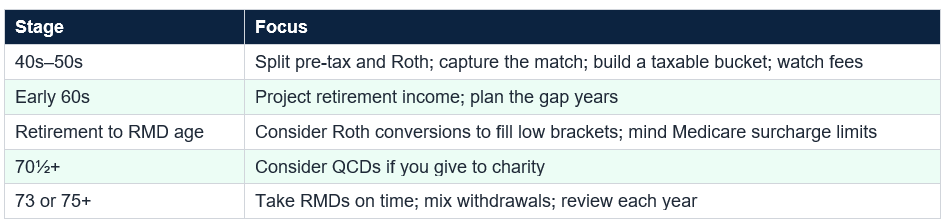
Think in stages. In your 40s and 50s, split contributions between pre-tax and Roth if you can, capture any match, build a taxable account and keep fees low. In your early 60s, once you know your retirement date, model your taxable income and shape the gap-year strategy. Between retirement and RMD age, consider conversions to fill low brackets using the 2027 thresholds, watching Medicare surcharge limits, and around 70½ consider QCDs if you give to charity.From 73 or 75, take RMDs on time, use the withdrawal mix to manage your bracket and review each year as rules change; the 2027 brackets, announced this month, raise thresholds about 3.2%. Plan for heirs too: inherited traditional accounts are taxable to beneficiaries, and most non-spouse heirs must empty them within 10 years, whereas a Roth balance can leave heirs tax-free income, though withdrawal rules still apply.
This year, list your balances by bucket (pre-tax, Roth, taxable) and estimate your RMD at 73 or 75. If more than about 80% of your savings is pre-tax, start modeling Roth conversions and Roth contributions. Common mistakes include saving only in pre-tax accounts, ignoring the effect of RMDs on Social Security and Medicare, waiting until 73 to think about taxes, converting too much in one year, paying conversion tax from the account itself, missing an RMD or forgetting an old 401(k), expecting a QCD from a 401(k) and treating tax rates as permanent.
Conclusion
A traditional 401(k) is a deferred tax bill, and it can become a burden when large, forced, fully taxable withdrawals meet Social Security and Medicare income thresholds. RMDs begin at 73 or 75, at a factor of 26.5 at 73, and a $1.5 million balance means a $56,604 RMD. In my simplified example, that single retiree pays about $10,074 of federal tax with 85% of Social Security taxable, double the $5,037 for a retiree with $1.0 million, and mixing Roth into withdrawals cut the tax on $60,000 of spending from about $10,822 to about $3,320.The tools are available: Roth conversions in the gap years, Roth and taxable buckets built early, a deliberate withdrawal mix, QCDs from an IRA and never missing an RMD. None is right for everyone, and conversions cost real tax today, so model your own numbers with a tax professional. Start by knowing your buckets, estimating your RMD and using the 2027 brackets as a guide; the earlier you plan, the more room you have.
Frequently Asked Questions
Why can a 401(k) become a tax burden in retirement?Because traditional 401(k) money has never been taxed. Every dollar you withdraw is ordinary income, and from age 73 (or 75 if you were born in 1960 or later) you must withdraw a minimum amount whether you need it or not. Those withdrawals can push you into a higher bracket, make more of your Social Security taxable and raise Medicare premiums.
When do required minimum distributions start?
At age 73 if you were born between 1951 and 1959, and at 75 if you were born in 1960 or later, under SECURE 2.0. The amount is the prior year-end balance divided by an IRS life-expectancy factor, 26.5 at age 73, so a $1,000,000 balance means about $37,736. Your first deadline is April 1 of the year after you reach the age, then December 31 each year.
What is the penalty for missing an RMD?
25% of the amount you should have withdrawn, reduced to 10% if you correct the mistake within a two-year window, according to several sources. On a $37,736 RMD, that is about $9,434 at 25% or $3,774 at 10%. Roth 401(k) accounts no longer require lifetime RMDs as of 2024, so converting or contributing to a Roth can remove the issue.
Is a Roth conversion worth it?
It can be, if you convert when your tax rate is low and pay the tax from outside the account, but it is not always the right move. Converting $480,000 at 22% costs about $105,600 up front in my illustration. The benefit depends on your future tax rates, whether it keeps you below Medicare surcharge thresholds and how long you will live. This is general education, not personal tax advice.
Can I use a qualified charitable distribution from my 401(k)?
Not directly. A QCD must come from an IRA, not a 401(k), and you must be 70½ or older. You could roll the 401(k) to an IRA first. The 2026 limit is about $111,000 per person, according to several sources, though older articles list lower figures. A QCD counts toward your RMD and is excluded from taxable income.
0 Comments
Be the first to share your thoughts on this article.