

Retirement
Is a Roth Conversion Worth It? Why Timing Is Everything Now!

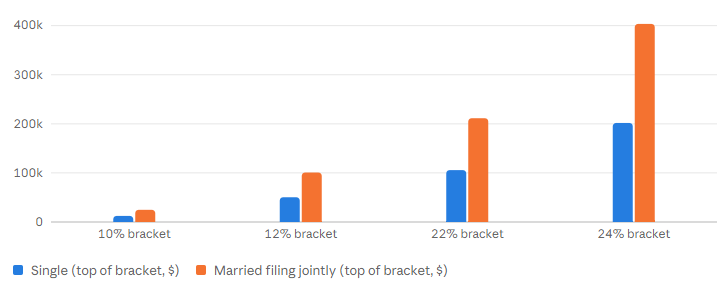
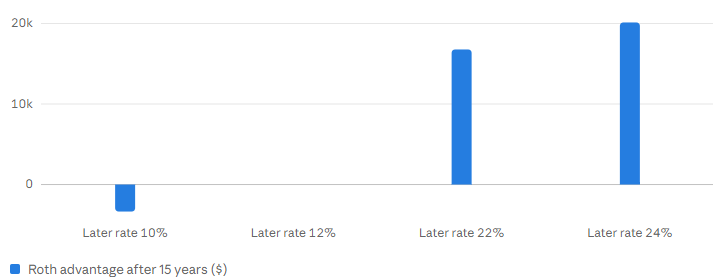
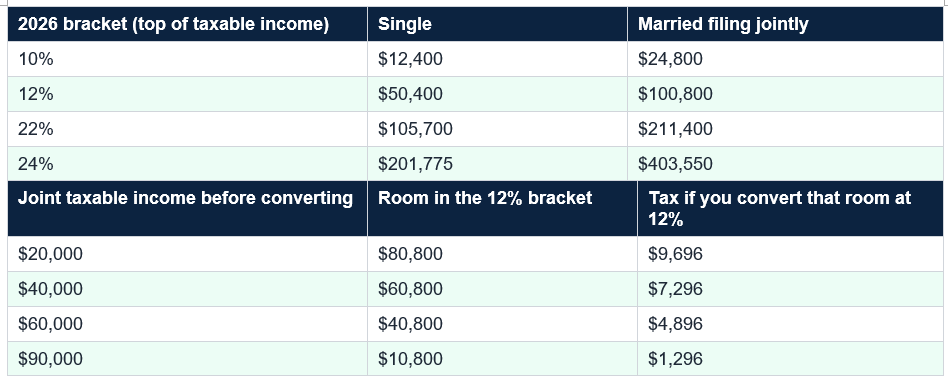
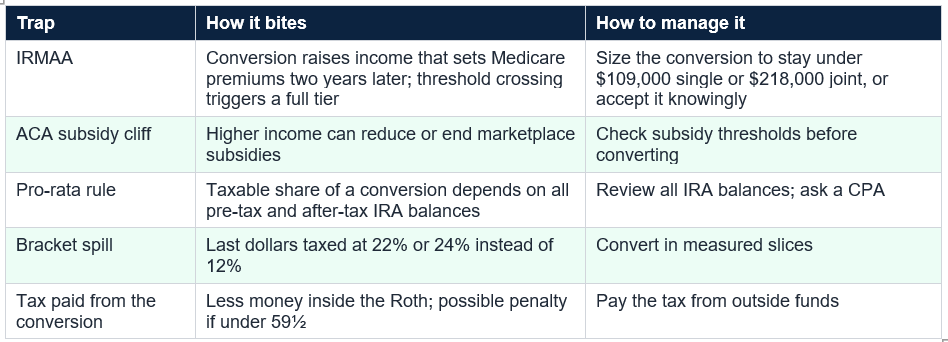
Single 10% to $12,400, 12% to $50,400, 22% to $105,700, 24% to $201,775; joint 10% to $24,800, 12% to $100,800, 22% to $211,400, 24% to $403,550; joint standard deduction $32,200. Traps: IRMAA starts at $109,000 (single) and $218,000 (joint) of modified adjusted gross income from two years earlier, so a 2026 conversion affects 2028 premiums; the first tier adds about $81.20 a month in Part B per person (about $974 a year); RMDs begin at 73 (75 by 2033). My arithmetic: converting $60,800 at 12% costs $7,296; after 15 years at 7% it is worth about $167,700; the Roth advantage is about −$3,400 if your later tax rate is 10%, $0 at 12%, about $16,800 at 22% and about $20,100 at 24%. Converting $150,000 on top of $90,000 of joint taxable income costs about $32,492, an average of 21.7%.
Timing runs through all three. The same $50,000 conversion can cost 12 cents on the dollar in one year and 24 cents in another, depending on your other income. This guide explains the math, the 2026 brackets, the best windows, the traps that can erase the benefit and a deadline two months away: conversions generally have to be completed by December 31 to count for 2026.
In my illustration, a married couple with $40,000 of taxable income has $60,800 of room in the 2026 12% bracket and converts exactly that, paying $7,296 of tax from savings. At a constant 7% for 15 years the converted money is worth about $167,700. If their later tax rate is 22%, leaving it in a traditional account would have meant about $36,900 of tax, against the $7,296 paid up front, which would have grown to about $20,100 if kept invested. The Roth path comes out about $16,800 ahead; at 24%, about $20,100 ahead; at 12%, a tie; at 10%, about $3,400 behind.
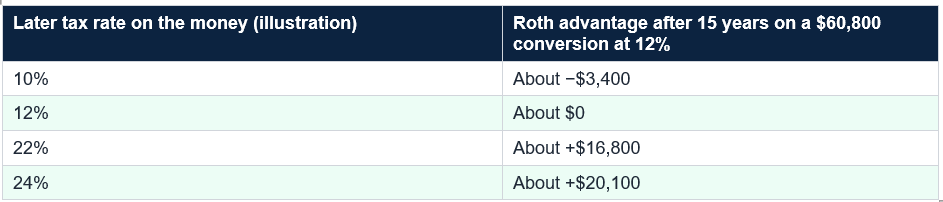
Convert $60,800 at 12% = $7,296 tax. At 7% for 15 years the converted money is worth about $167,700. Roth advantage: about −$3,400 if the later rate is 10%; $0 at 12%; about $16,800 at 22%; about $20,100 at 24%. Assumes tax paid from outside funds that also grow at 7%.
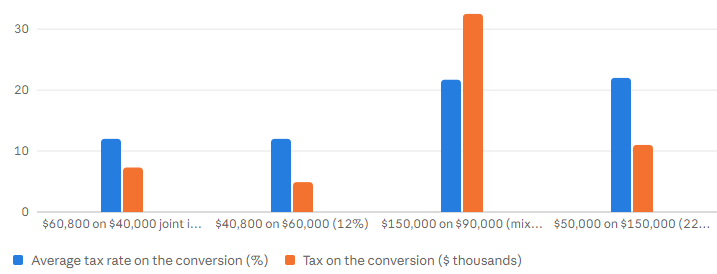
The room depends on your other income. A joint couple with $60,000 of taxable income has $40,800 of room in the 12% bracket, so converting that much costs about $4,896; a couple with $90,000 has only $10,800. Spill over and the cost jumps: converting $150,000 on top of $90,000 costs about $32,492, an average of 21.7%, with the last dollars taxed at 24%. In a Mercer Advisors example, a joint couple with $150,000 of income converting $50,000 pays about $11,000, at 22%.
The window closes because Social Security and RMDs raise taxable income later. A large traditional IRA can mean big forced withdrawals at 73, which may push a retiree into the 22% or 24% bracket, with Medicare surcharges on top, and converting during the trough lowers the balance and therefore future RMDs. A related point is the widow’s penalty: when one spouse dies, the survivor files single, with narrower brackets (the single 12% bracket ends at $50,400, versus $100,800 joint) and a lower IRMAA threshold, so converting while both spouses are alive can reduce later taxes.
Two more traps. People who buy insurance through the ACA marketplace can lose premium subsidies if a conversion raises income above a cliff, which advisors warn about. And if you have pre-tax IRA money and also make nondeductible contributions, the pro-rata rule treats all your traditional IRAs as one pot, so you cannot convert only the after-tax portion tax-free. That is why experts suggest running the numbers, or hiring a CPA, before converting more than a small amount.
Market conditions can matter too. Converting after a price drop moves more shares into the Roth for the same tax bill, and any rebound is tax-free; converting after a big rally means paying tax on a higher value. That is a general principle, not a forecast, and with the S&P 500 up about 11.4% through October 23, gains are already in many accounts. The conversion is taxed on the value on the day you convert, whatever happens next.
The tax is due on the value at conversion, and as far as I know a conversion can no longer be undone. Do not convert more than you can comfortably pay tax on from outside funds.
Be honest about your time horizon too. A conversion pays off over a decade or more, as tax-free growth compounds and RMDs shrink; someone in their 70s with a short horizon and a high bracket may do better leaving the money alone or using qualified charitable distributions. And tax law can change, which is a reason to diversify tax treatment, not to guess.
Convert only up to the top of a bracket you are comfortable with, and ask a CPA to model it if you are near a threshold. Software cannot know your retirement date, state of residence or family needs, and most of the benefit comes from staying disciplined for several years, not from perfect timing in any single year.
Pull your 2026 tax return or a recent pay stub, estimate your taxable income and look up how much room you have left in your bracket. If it is meaningful, and you will not cross an IRMAA or subsidy threshold, ask a CPA what an amount of that size would do before the end of December.
Treat the decision as a series of measured steps, not a single bet: know your bracket room, watch the $109,000 and $218,000 IRMAA thresholds two years ahead, keep the tax payment outside the account and ask a CPA to model anything large. Timing does not make a bad conversion good, but it can make a good one much better.
It is moving money from a traditional IRA or 401(k) into a Roth IRA. You pay ordinary income tax on the amount converted in the year you do it, and in exchange future growth and qualified withdrawals are tax-free. There is no income limit on conversions, unlike direct Roth IRA contributions, which phase out starting at $153,000 for single filers and $242,000 for joint filers in 2026.
When is the best time to do a Roth conversion?
Usually in a low-income year, when you can convert at a low tax rate. For many people that is the gap between retirement and the start of required minimum distributions at age 73 (75 for people born in 1960 or later), especially before Social Security begins. Job gaps, sabbaticals and big-deduction years can also qualify. The right answer depends on your income now and what you expect later.
What is the deadline for a 2026 Roth conversion?
A conversion counts for the tax year in which it is completed, and the usual deadline is December 31, so a 2026 conversion generally has to be completed by the end of this year. Unlike regular IRA contributions, you cannot make a 2026 conversion after the new year. Allow time for your custodian to process it, and confirm the details with a tax professional.
How does a Roth conversion affect Medicare premiums?
Medicare uses your modified adjusted gross income from two years earlier to set premiums, so a 2026 conversion can raise your 2028 Part B and Part D premiums if it pushes you above the first IRMAA threshold, which in 2026 is $109,000 for single filers and $218,000 for joint filers. Crossing a threshold by even $1,000 can trigger the full surcharge for that tier.
Can a Roth conversion be a mistake?
Yes. It can cost more than it saves if your future tax rate turns out lower than today’s, if you must pay the tax from the converted money itself, if the conversion triggers Medicare surcharges or lost subsidies or if you need the money within a few years. In my illustration, converting at 12% when your later rate is 10% loses about $3,400 on a $60,800 conversion. This is general education, not tax advice.
Table of Contents
- The Question Behind the Question
- The Short Answer
- The Math: Tax Rate Now vs. Tax Rate Later
- The 2026 Tax Brackets and “Filling the Bracket”
- Timing Window 1: Low-Income Years
- Timing Window 2: Between Retirement and RMDs
- The Traps: IRMAA, Subsidies and the Pro-Rata Rule
- Timing Inside the Year: The December 31 Deadline
- When a Conversion Is a Mistake
- A Five-Step Decision Process
- Conclusion
- Frequently Asked Questions
The 2026 brackets to fill: top of each bracket's taxable income ($)
Taxable income at top of bracket ($) by 2026 federal brackets via Boldin and UStax.tools (secondary sources); joint standard deduction $32,200
Timing is a bet on your future tax rate: Roth advantage by later rate ($)
Roth advantage ($) by Author's illustration: $60,800 converted at 12% ($7,296 tax paid from outside funds), 7% growth for 15 years; not a forecast
What spilling into higher brackets costs: four conversion examples
Rate (%) or tax ($ thousands) by Author's arithmetic and SocialSecurityAge ($32,492) and Mercer ($11,000) examples; 2026 joint brackets; federal tax only
The Question Behind the Question
“Is a Roth conversion worth it?” is really three questions in a trench coat. What will I pay in tax on the conversion this year? What would I have paid on that money if I had left it alone? And what else will this conversion change, in Medicare premiums, subsidies or other taxes? The first is easy to compute, the second depends on a future you cannot see and the third is where people get surprised.Timing runs through all three. The same $50,000 conversion can cost 12 cents on the dollar in one year and 24 cents in another, depending on your other income. This guide explains the math, the 2026 brackets, the best windows, the traps that can erase the benefit and a deadline two months away: conversions generally have to be completed by December 31 to count for 2026.
The Short Answer
A Roth conversion is worth it when you pay a lower tax rate now than you would on that money later, can pay the tax from outside the converted funds and do not trigger costly side effects. The best windows are low-income years, especially the stretch between retirement and required minimum distributions at 73 or 75. It is a mistake when your future rate will be lower, when it pushes you across a Medicare or subsidy threshold or when you need the money soon. The right size is usually a measured slice each year, not an all-at-once leap.The Math: Tax Rate Now vs. Tax Rate Later
The core logic is simple. When you convert, you pay tax at today’s marginal rate; when you withdraw from a traditional account, you pay tax at your future rate. If the future rate is higher, converting wins; if lower, it loses; if equal and you pay the tax from outside funds, it is a wash, though a Roth still brings other benefits such as no required minimum distributions.In my illustration, a married couple with $40,000 of taxable income has $60,800 of room in the 2026 12% bracket and converts exactly that, paying $7,296 of tax from savings. At a constant 7% for 15 years the converted money is worth about $167,700. If their later tax rate is 22%, leaving it in a traditional account would have meant about $36,900 of tax, against the $7,296 paid up front, which would have grown to about $20,100 if kept invested. The Roth path comes out about $16,800 ahead; at 24%, about $20,100 ahead; at 12%, a tie; at 10%, about $3,400 behind.
Convert $60,800 at 12% = $7,296 tax. At 7% for 15 years the converted money is worth about $167,700. Roth advantage: about −$3,400 if the later rate is 10%; $0 at 12%; about $16,800 at 22%; about $20,100 at 24%. Assumes tax paid from outside funds that also grow at 7%.
The 2026 Tax Brackets and “Filling the Bracket”
The standard strategy is to fill the bracket: convert just enough each year to use up the lower brackets without spilling into the next. For 2026, according to calculator and advisory sites, a single filer’s taxable income is taxed at 10% up to $12,400, 12% up to $50,400, 22% up to $105,700 and 24% up to $201,775; for joint filers the limits are $24,800, $100,800, $211,400 and $403,550. The joint standard deduction is $32,200.The room depends on your other income. A joint couple with $60,000 of taxable income has $40,800 of room in the 12% bracket, so converting that much costs about $4,896; a couple with $90,000 has only $10,800. Spill over and the cost jumps: converting $150,000 on top of $90,000 costs about $32,492, an average of 21.7%, with the last dollars taxed at 24%. In a Mercer Advisors example, a joint couple with $150,000 of income converting $50,000 pays about $11,000, at 22%.
Timing Window 1: Low-Income Years
The best conversion years are the years your income dips: a sabbatical, a layoff, a business loss, a stretch between jobs or early retirement all shrink taxable income and leave low brackets unused. Because unused low-bracket space disappears at year-end, a low-income year is a use-it-or-lose-it chance to fill the 10% and 12% brackets with conversions that might otherwise be taxed at 22% or 24% later. A large deduction can open the same window, as can a young earner expecting higher income later converting small amounts at a low rate now.Timing Window 2: Between Retirement and RMDs
The most commonly cited window is the stretch between stopping work and the start of required minimum distributions, which begin at 73, rising to 75 by 2033. Before then, many retirees have no paycheck and have not yet claimed Social Security, which can leave taxable income low. Advisors call these trough years, and several sources describe converting a set amount each year to fill the 12% or 22% bracket during them.The window closes because Social Security and RMDs raise taxable income later. A large traditional IRA can mean big forced withdrawals at 73, which may push a retiree into the 22% or 24% bracket, with Medicare surcharges on top, and converting during the trough lowers the balance and therefore future RMDs. A related point is the widow’s penalty: when one spouse dies, the survivor files single, with narrower brackets (the single 12% bracket ends at $50,400, versus $100,800 joint) and a lower IRMAA threshold, so converting while both spouses are alive can reduce later taxes.
The Traps: IRMAA, Subsidies and the Pro-Rata Rule
The conversion’s cost is not only income tax. The biggest hidden cost for retirees is IRMAA, the income-related surcharge on Medicare Part B and Part D premiums. Medicare looks at your modified adjusted gross income from two years earlier, so a 2026 conversion can raise your 2028 premiums. For 2026 premiums, based on 2024 income, surcharges begin above $109,000 for single filers and $218,000 for joint filers; one source puts the first tier at about $81.20 a month more for Part B per person, about $974 a year, plus a Part D surcharge. Crossing a threshold by even $1,000 can trigger the entire tier.Two more traps. People who buy insurance through the ACA marketplace can lose premium subsidies if a conversion raises income above a cliff, which advisors warn about. And if you have pre-tax IRA money and also make nondeductible contributions, the pro-rata rule treats all your traditional IRAs as one pot, so you cannot convert only the after-tax portion tax-free. That is why experts suggest running the numbers, or hiring a CPA, before converting more than a small amount.
Timing Inside the Year: The December 31 Deadline
Timing also works inside a single year. A conversion counts for the tax year in which it is completed, so the usual deadline is December 31, about two months from today, with time needed for your custodian to process it. Many advisors wait until late in the year to see full-year income, deductions and capital gains before deciding how much bracket room is left; others convert in installments to spread the risk.Market conditions can matter too. Converting after a price drop moves more shares into the Roth for the same tax bill, and any rebound is tax-free; converting after a big rally means paying tax on a higher value. That is a general principle, not a forecast, and with the S&P 500 up about 11.4% through October 23, gains are already in many accounts. The conversion is taxed on the value on the day you convert, whatever happens next.
The tax is due on the value at conversion, and as far as I know a conversion can no longer be undone. Do not convert more than you can comfortably pay tax on from outside funds.
When a Conversion Is a Mistake
A conversion tends to be a mistake when you expect a lower bracket in retirement than today; when you must take the tax out of the converted money, shrinking the Roth and, if you are under 59½, possibly owing a 10% penalty on the amount withheld; when it pushes you over an IRMAA tier or subsidy cliff; or when you will need the money within about five years, since converted amounts have their own five-year holding rule for penalty-free withdrawals before 59½.Be honest about your time horizon too. A conversion pays off over a decade or more, as tax-free growth compounds and RMDs shrink; someone in their 70s with a short horizon and a high bracket may do better leaving the money alone or using qualified charitable distributions. And tax law can change, which is a reason to diversify tax treatment, not to guess.
A Five-Step Decision Process
Step one: estimate your 2026 taxable income and see how much room remains in your bracket, using the tables above. Step two: estimate your tax rate in retirement, including Social Security, pensions and RMDs, honestly. Step three: check the thresholds, IRMAA two years ahead and any subsidies. Step four: confirm you can pay the tax from outside funds. Step five: convert a measured amount before December 31 and repeat each year as your income changes.Convert only up to the top of a bracket you are comfortable with, and ask a CPA to model it if you are near a threshold. Software cannot know your retirement date, state of residence or family needs, and most of the benefit comes from staying disciplined for several years, not from perfect timing in any single year.
Pull your 2026 tax return or a recent pay stub, estimate your taxable income and look up how much room you have left in your bracket. If it is meaningful, and you will not cross an IRMAA or subsidy threshold, ask a CPA what an amount of that size would do before the end of December.
Conclusion
So, is a Roth conversion worth it? It is when the tax you pay now is lower than the tax you would pay later, the tax can be paid from outside funds and the conversion does not trigger Medicare surcharges or lost subsidies. In my illustration, converting $60,800 at 12% beats waiting by about $16,800 if your later rate is 22%, ties at 12% and loses about $3,400 at 10%. The best windows are low-income years and the trough between retirement and RMDs at 73 or 75, and the clock is real: for 2026, the deadline is generally December 31.Treat the decision as a series of measured steps, not a single bet: know your bracket room, watch the $109,000 and $218,000 IRMAA thresholds two years ahead, keep the tax payment outside the account and ask a CPA to model anything large. Timing does not make a bad conversion good, but it can make a good one much better.
Frequently Asked Questions
What is a Roth conversion?It is moving money from a traditional IRA or 401(k) into a Roth IRA. You pay ordinary income tax on the amount converted in the year you do it, and in exchange future growth and qualified withdrawals are tax-free. There is no income limit on conversions, unlike direct Roth IRA contributions, which phase out starting at $153,000 for single filers and $242,000 for joint filers in 2026.
When is the best time to do a Roth conversion?
Usually in a low-income year, when you can convert at a low tax rate. For many people that is the gap between retirement and the start of required minimum distributions at age 73 (75 for people born in 1960 or later), especially before Social Security begins. Job gaps, sabbaticals and big-deduction years can also qualify. The right answer depends on your income now and what you expect later.
What is the deadline for a 2026 Roth conversion?
A conversion counts for the tax year in which it is completed, and the usual deadline is December 31, so a 2026 conversion generally has to be completed by the end of this year. Unlike regular IRA contributions, you cannot make a 2026 conversion after the new year. Allow time for your custodian to process it, and confirm the details with a tax professional.
How does a Roth conversion affect Medicare premiums?
Medicare uses your modified adjusted gross income from two years earlier to set premiums, so a 2026 conversion can raise your 2028 Part B and Part D premiums if it pushes you above the first IRMAA threshold, which in 2026 is $109,000 for single filers and $218,000 for joint filers. Crossing a threshold by even $1,000 can trigger the full surcharge for that tier.
Can a Roth conversion be a mistake?
Yes. It can cost more than it saves if your future tax rate turns out lower than today’s, if you must pay the tax from the converted money itself, if the conversion triggers Medicare surcharges or lost subsidies or if you need the money within a few years. In my illustration, converting at 12% when your later rate is 10% loses about $3,400 on a $60,800 conversion. This is general education, not tax advice.
0 Comments
Be the first to share your thoughts on this article.