

Vehicles & Cars
Should You Refinance Your Auto Loan In 2027? Check 5 Numbers

A lower rate is not the only thing that matters. These five numbers tell you whether refinancing will really save you money. Average new-car APR about 7.0% (Edmunds Q3 2026); used about 10.6%; 29.6% of trade-ins underwater (Q2 2026); 36.5% of new loans run 73+ months; typical refi fees $0-$300.
Refinancing a car loan sounds simple: swap your current loan for a cheaper one. In practice, whether it pays off depends on five numbers. They are your current interest rate compared with today's market, how your credit score has changed, how much equity you have in the car, how much time and balance you have left, and your break-even point after fees.
I will walk through each one, then show a worked example. A common mistake is focusing only on the monthly payment. A lower payment can come from a longer term, which may leave you paying more interest overall. So the question is not "can I pay less each month?" but "will I pay less in total, and for how long?"
In short: refinancing tends to make sense when your rate is clearly higher than what you can now get, your credit has improved, the car is worth more than you owe, and the fees are small. If those conditions are missing, waiting may be wiser. Key takeaway: Check your rate gap, your credit score change, your equity, your remaining term and your break-even. If most of the five are favourable, refinancing is worth pricing. If not, it probably is not.
The auto market agrees. Edmunds reported that the average APR for new-vehicle purchases held at 7.0% in the third quarter of 2026, the same as the second quarter and a year earlier. So if your loan was taken in the last couple of years, the market rate may be about where it was when you borrowed. That is why the other four numbers matter. If market rates are flat, your gain has to come from a better credit profile, a better lender (one rate summary puts credit unions about 1.7 points lower, or a shorter term, not from waiting for the Fed. The best time to run the numbers is when something about your own situation has changed.
Credit tier makes the biggest difference. Experian's second-quarter data show the average new-car rate at 4.41% for super-prime borrowers and 16.11% for deep subprime, with used-car rates from 6.29% to 21.62%. If you are at the high end of that range, even a modest improvement in your profile could cut your rate sharply. Credit unions often show the lowest posted rates. Navy Federal lists new-auto refinance rates "as low as" 3.89% for 12 to 36 months up to 7.39% for 85 to 96 months, and used rates from 4.79% to 6.98%. These are best-case rates for members with strong credit, so treat them as a floor. Bankrate notes that refinance rates tend to match used-vehicle rates, which Experian puts at an average of 11.26%. A practical rule of thumb from one lender guide is that refinancing reliably pays for itself when market rates have dropped by 1 percentage point or more since you took the loan. Treat that as a starting point, not a law.
For context on why lenders care, delinquencies in the auto market are elevated. The New York Fed data cited by Financer show 5.6% of auto loan balances were 90 or more days delinquent in the first quarter of 2026, and Fitch reported a record 6.9% 60-day subprime delinquency rate in January. Lenders are cautious about riskier borrowers, so a clean recent payment history is valuable.
One guide lists typical lender limits as a loan-to-value of 100% to 125%, mileage under roughly 100,000 to 150,000, and a minimum loan of $4,000 to $10,000. Limits vary, so check each lender, but the pattern is clear: older, high-mileage cars with small balances are harder to refinance. Negative equity is common. Edmunds found 29.6% of trade-ins toward new vehicles were underwater in the second quarter of 2026, with average negative equity of $6,884. By the third quarter, SuperMoney cites 29.1% and a record average of $7,107. To estimate your own LTV, divide your payoff balance by the car's current market value, using a pricing guide such as Kelley Blue Book or Edmunds.
Your balance counts too. The average balance per borrower is around $24,909, according to Experian figures cited by SuperMoney, which I use in my example below. With a small balance, there is less to save, so fees can eat up the gain. With a bigger balance, a one- or two-point drop adds up to real money.
What fees should you expect? Sources disagree. FinanceWonk says most auto refinances carry zero lender fees, with a small state title-transfer fee of $5 to $75. Formula Forge lists origination fees of $0 to $500 and title or registration transfer of $50 to $200. WealthVieu gives $10 to $50 for title transfer. The range is wide, so ask each lender for a full fee list.
Also check your current loan for a prepayment penalty. Experian says it can be up to 2% of the loan balance, though it is not common among major car lenders. Bankrate warns you to weigh your interest savings against any penalty and to watch for fees from both the old and new lender. Myzing notes many refinance offers have no prepayment penalty, but you should confirm.
Option B: refinance to 7.0% but stretch to 60 months. The payment falls to about $495, which is $133 a month lower and feels great, but the remaining interest is about $4,702. Your real saving is only about $446, and you carry the loan a year longer. That is the trap I discuss next.

These are illustrative figures, calculated with a standard loan formula and rounded. Your lender's numbers will differ slightly, particularly if it adds fees to the loan or uses different day-count conventions.
If you need payment relief, and sometimes you do, a longer term can be the right call. A tight budget is a legitimate reason. Just do it knowingly, and consider making extra payments later to bring the loan back on schedule. Check that the new loan has no prepayment penalty so you can do that. A better approach for most people with room in the budget is to keep the same remaining term, or shorten it, while taking the lower rate. That locks in the interest savings and leaves you debt-free on the original timeline or sooner.
Finally, remember that if your problem is affordability, refinancing may only be a patch. With record payments, the average new-car buyer finances $44,664 and pays about $787 a month, according to Edmunds data cited by SuperMoney. If your budget is stretched, talk to your lender about options or seek help from a nonprofit credit counsellor before you miss payments.
One more item you may see mentioned: a federal deduction for interest on certain new-vehicle loans. One site says the deduction runs through 2028 and that refinancing a qualifying loan generally preserves eligibility. I could not confirm this from an official source, and the site is not an authoritative tax reference, so please check IRS guidance or ask a tax professional before relying on it. The point for this post is simple: do not let a possible tax benefit drive your decision. Run the five numbers first, and treat any tax effect as a bonus to verify.
Typically when your credit has improved, rates are lower than your current APR, and you have equity in the car. KBB suggests looking into it if your score has risen by 100 points or more.
Can I refinance if I owe more than the car is worth?
Sometimes, but it is harder. PNC says negative equity may make refinancing harder, and Bankrate says you should check that it actually saves money [8].
What fees should I expect?
Sources range from about $5 to $75 for title transfer with no lender fee up to $0 to $500 origination plus $50 to $200 title costs. Ask for a full list.
Is there a penalty for paying off my current loan early?
Possibly. Experian says a prepayment penalty can be up to 2% of the balance, though it is uncommon at major lenders. Check your loan agreement.
Will rates fall in 2027?
No one knows. The Fed's median projection for 2027 shows no cuts, and Edmunds shows the average new-car APR holding at 7.0%.
Table of Contents
- Why 2027 is different for refinancers
- Number 1: your current APR versus the market
- Number 2: your credit score then and now
- Number 3: your equity (loan-to-value)
- Number 4: your remaining term and balance
- Number 5: your break-even point
- A worked example with real arithmetic
- The term-stretch trap
- When to wait or skip it
- How to shop without wasting time
- A note on the auto loan interest deduction
- Conclusion
- FAQ
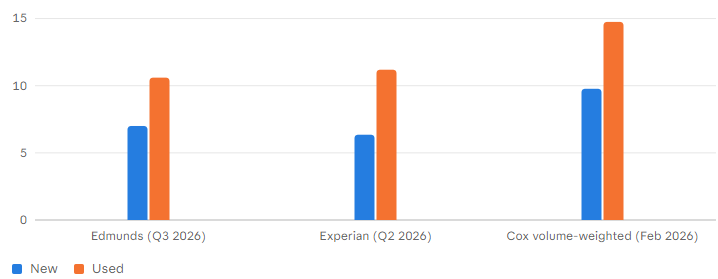
Average auto loan APR by source: new vs used (%)
% APR by Sources: Edmunds, SuperMoney/Experian, NerdWallet/Cox. Methods differ
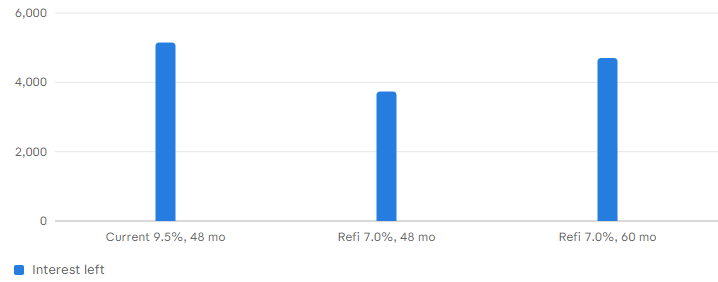
Interest left on a $25,000 loan: refinance scenarios ($)
US dollars by My calculation, illustrative; excludes fees
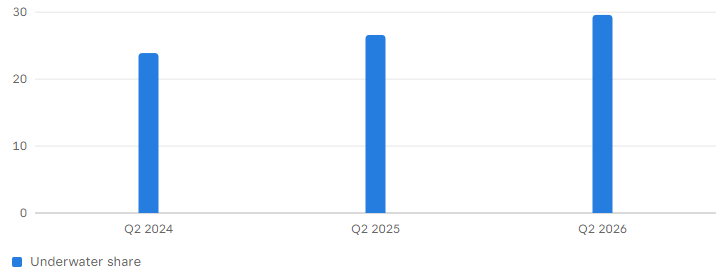
Share of new-car trade-ins that are underwater (%)
% of trade-ins by Source: Edmunds Q2 2026 reportRefinancing a car loan sounds simple: swap your current loan for a cheaper one. In practice, whether it pays off depends on five numbers. They are your current interest rate compared with today's market, how your credit score has changed, how much equity you have in the car, how much time and balance you have left, and your break-even point after fees.
I will walk through each one, then show a worked example. A common mistake is focusing only on the monthly payment. A lower payment can come from a longer term, which may leave you paying more interest overall. So the question is not "can I pay less each month?" but "will I pay less in total, and for how long?"
In short: refinancing tends to make sense when your rate is clearly higher than what you can now get, your credit has improved, the car is worth more than you owe, and the fees are small. If those conditions are missing, waiting may be wiser. Key takeaway: Check your rate gap, your credit score change, your equity, your remaining term and your break-even. If most of the five are favourable, refinancing is worth pricing. If not, it probably is not.
Why 2027 is different for refinancers
It is tempting to wait for rates to fall before refinancing. For 2027, that may be a long wait. The Federal Reserve raised its target range to 3.75%-4% on 16 September, and the median official expects rates to finish 2026 at 4.1% with the same median for 2027, meaning no cuts next year. Auto lenders do not move one-for-one with the Fed, but it is not a backdrop that points to a sudden drop in borrowing costs.The auto market agrees. Edmunds reported that the average APR for new-vehicle purchases held at 7.0% in the third quarter of 2026, the same as the second quarter and a year earlier. So if your loan was taken in the last couple of years, the market rate may be about where it was when you borrowed. That is why the other four numbers matter. If market rates are flat, your gain has to come from a better credit profile, a better lender (one rate summary puts credit unions about 1.7 points lower, or a shorter term, not from waiting for the Fed. The best time to run the numbers is when something about your own situation has changed.
Number 1: your current APR versus the market
Start with the gap between your APR and what you could get today. Averages are a rough guide. Edmunds put the new-vehicle average at 7.0% in the third quarter and the used-vehicle average at 10.6%. Experian's second-quarter figures, cited by SuperMoney, show 6.35% for new and 11.19% for used. Different data sources give different pictures. NerdWallet notes that Cox Automotive's volume-weighted average for February was 9.77% for new cars and 14.75% for used, compared with Edmunds' 7% and 10.9% for the same month. That is a wide gap, and it is why I would not trust any single average. Your own quote is the only number that counts.Credit tier makes the biggest difference. Experian's second-quarter data show the average new-car rate at 4.41% for super-prime borrowers and 16.11% for deep subprime, with used-car rates from 6.29% to 21.62%. If you are at the high end of that range, even a modest improvement in your profile could cut your rate sharply. Credit unions often show the lowest posted rates. Navy Federal lists new-auto refinance rates "as low as" 3.89% for 12 to 36 months up to 7.39% for 85 to 96 months, and used rates from 4.79% to 6.98%. These are best-case rates for members with strong credit, so treat them as a floor. Bankrate notes that refinance rates tend to match used-vehicle rates, which Experian puts at an average of 11.26%. A practical rule of thumb from one lender guide is that refinancing reliably pays for itself when market rates have dropped by 1 percentage point or more since you took the loan. Treat that as a starting point, not a law.
Number 2: your credit score then and now
Your credit score is often the strongest lever. Kelley Blue Book says that if your score has improved by 100 points or more since your loan began, investigating a refinance makes sense. Bankrate adds that even when market rates have not moved, refinancing with a better credit score can lead to savings. Think about what has happened since you signed. Did you take the loan in a hurry at the dealership with a thin credit file? Have you paid down cards, cleared late payments or built a longer history? If so, you may qualify for a rate your dealer's lender would not have offered. Before applying, pull your credit reports and check for errors, because a mistake can quietly raise your rate. And remember the flip side: if your score has dropped, a refinance may offer no help at all.For context on why lenders care, delinquencies in the auto market are elevated. The New York Fed data cited by Financer show 5.6% of auto loan balances were 90 or more days delinquent in the first quarter of 2026, and Fitch reported a record 6.9% 60-day subprime delinquency rate in January. Lenders are cautious about riskier borrowers, so a clean recent payment history is valuable.
Number 3: your equity (loan-to-value)
Equity means the car is worth more than you owe. Experian gives a clear example: a car worth $18,000 with a $12,000 balance has a loan-to-value ratio (LTV) of about 66% and about a third equity. Lenders like low LTVs because the car is the collateral for the loan. Negative equity, being upside down, makes refinancing harder. PNC says that when the balance is higher than the car's value, refinancing may be harder, and that a car's age, mileage and value can affect eligibility. Bankrate says you may still be able to refinance, but you should check that it actually saves money, because if you only break even it may not be worth it.One guide lists typical lender limits as a loan-to-value of 100% to 125%, mileage under roughly 100,000 to 150,000, and a minimum loan of $4,000 to $10,000. Limits vary, so check each lender, but the pattern is clear: older, high-mileage cars with small balances are harder to refinance. Negative equity is common. Edmunds found 29.6% of trade-ins toward new vehicles were underwater in the second quarter of 2026, with average negative equity of $6,884. By the third quarter, SuperMoney cites 29.1% and a record average of $7,107. To estimate your own LTV, divide your payoff balance by the car's current market value, using a pricing guide such as Kelley Blue Book or Edmunds.
Number 4: your remaining term and balance
How much time and money is left on the loan matters more than most people think. Early in a loan, payments are weighted toward interest, so a lower rate can save a lot. Late in a loan, you have mostly paid the interest already, and a refinance may not be worth the hassle. The other side is term. Long loans have become common. Edmunds reported that 36.5% of financed new vehicles in the second quarter of 2026 carried terms of 73 months or longer, and 23.9% stretched to 84 months or more. If you are in one of those loans, shortening the term while lowering the rate is the sweet spot for savings.Your balance counts too. The average balance per borrower is around $24,909, according to Experian figures cited by SuperMoney, which I use in my example below. With a small balance, there is less to save, so fees can eat up the gain. With a bigger balance, a one- or two-point drop adds up to real money.
Number 5: your break-even point
The break-even point is the final check. The formula is simple: divide your total refinancing costs by your monthly savings, and you get the number of months before you come out ahead. Formula Forge gives an example: $300 in fees and $25 a month in savings means a 12-month break-even. If you plan to keep the car for longer than that, it pays.What fees should you expect? Sources disagree. FinanceWonk says most auto refinances carry zero lender fees, with a small state title-transfer fee of $5 to $75. Formula Forge lists origination fees of $0 to $500 and title or registration transfer of $50 to $200. WealthVieu gives $10 to $50 for title transfer. The range is wide, so ask each lender for a full fee list.
Also check your current loan for a prepayment penalty. Experian says it can be up to 2% of the loan balance, though it is not common among major car lenders. Bankrate warns you to weigh your interest savings against any penalty and to watch for fees from both the old and new lender. Myzing notes many refinance offers have no prepayment penalty, but you should confirm.
A worked example with real arithmetic
Let me show how these numbers work together. Say you owe $25,000, close to the average balance mentioned above. You have 48 months left at 9.5%. My calculation gives a payment of about $628 a month, with about $5,148 of interest still to pay. Option A: refinance to 7.0% over the same 48 months. The payment becomes about $599, saving about $29 a month, and the remaining interest drops to about $3,735. That is a saving of roughly $1,413 over the loan. With a $75 title fee, the break-even is about 2.5 months. With a $300 fee, it is about 10 months.Option B: refinance to 7.0% but stretch to 60 months. The payment falls to about $495, which is $133 a month lower and feels great, but the remaining interest is about $4,702. Your real saving is only about $446, and you carry the loan a year longer. That is the trap I discuss next.
These are illustrative figures, calculated with a standard loan formula and rounded. Your lender's numbers will differ slightly, particularly if it adds fees to the loan or uses different day-count conventions.
The term-stretch trap
The term-stretch trap catches many people. A lender offers a lower payment, and you take it, without noticing that the loan now runs longer. The payment looks better each month, yet the total cost may be much higher. One lender guide warns that a refinance that only looks attractive because of a stretched-out term deserves a second look before you sign.If you need payment relief, and sometimes you do, a longer term can be the right call. A tight budget is a legitimate reason. Just do it knowingly, and consider making extra payments later to bring the loan back on schedule. Check that the new loan has no prepayment penalty so you can do that. A better approach for most people with room in the budget is to keep the same remaining term, or shorten it, while taking the lower rate. That locks in the interest savings and leaves you debt-free on the original timeline or sooner.
When to wait or skip it
There are times when you should wait or skip. If you are upside down and the lender will not approve you without a large cash payment, refinancing may not be possible. Autoinsurance.com suggests waiting if you are upside down, near payoff or facing a prepayment penalty. If your credit has fallen since you took the loan, or you have missed payments, a new application may come back with a worse rate. In that case, the better move is to rebuild your payment history for a few months and try again. And if the car is old, with high mileage, many lenders will not touch it.Finally, remember that if your problem is affordability, refinancing may only be a patch. With record payments, the average new-car buyer finances $44,664 and pays about $787 a month, according to Edmunds data cited by SuperMoney. If your budget is stretched, talk to your lender about options or seek help from a nonprofit credit counsellor before you miss payments.
How to shop without wasting time
Shopping is quick if you stay organised. Gather your loan statement, payoff amount, vehicle details and proof of income. Get quotes from your own bank or credit union, an online lender and one more option. Compare APR, term, fees and any prepayment rules, not just the monthly payment. Try to do the applications within a short period so that the credit inquiries are treated as a single shopping event, which is the general approach of the major scoring models. Lenders also differ on whether they use a soft check first, so ask before you apply. One guide says the process typically takes 7 to 14 days from application to new lender payments , so avoid cancelling your old loan's autopay until the payoff is confirmed.One more item you may see mentioned: a federal deduction for interest on certain new-vehicle loans. One site says the deduction runs through 2028 and that refinancing a qualifying loan generally preserves eligibility. I could not confirm this from an official source, and the site is not an authoritative tax reference, so please check IRS guidance or ask a tax professional before relying on it. The point for this post is simple: do not let a possible tax benefit drive your decision. Run the five numbers first, and treat any tax effect as a bonus to verify.
Your pre-refinance checklist
Before you apply, run through this checklist. Write down your current APR, remaining months, payoff amount and monthly payment. Check your credit score and compare with when you took the loan. Look up the car's value and calculate your LTV. Find out whether your loan has a prepayment penalty. Next, collect at least three quotes for the same or shorter term. Ask for a full list of fees. Calculate the break-even using the formula. Decide whether you want to save money overall or lower your payment, and be honest about which one it is. Then choose, and set up the new autopay only once the old loan is confirmed paid.Conclusion
Should you refinance your auto loan in 2027? If your rate is clearly above what you can now qualify for, your credit has improved, you have equity and the fees are small, quite possibly yes. If you are upside down, your loan is nearly paid off or the new loan simply stretches the term, probably not. The key is to measure rather than guess. Five numbers, an hour of quotes and a bit of arithmetic can save a four-figure sum, as my example shows. And with the Fed unlikely to cut rates next year [18], the savings are more likely to come from your own improved profile than from waiting for the market to do it for you.15. FAQ
When does it make sense to refinance a car loan?Typically when your credit has improved, rates are lower than your current APR, and you have equity in the car. KBB suggests looking into it if your score has risen by 100 points or more.
Can I refinance if I owe more than the car is worth?
Sometimes, but it is harder. PNC says negative equity may make refinancing harder, and Bankrate says you should check that it actually saves money [8].
What fees should I expect?
Sources range from about $5 to $75 for title transfer with no lender fee up to $0 to $500 origination plus $50 to $200 title costs. Ask for a full list.
Is there a penalty for paying off my current loan early?
Possibly. Experian says a prepayment penalty can be up to 2% of the balance, though it is uncommon at major lenders. Check your loan agreement.
Will rates fall in 2027?
No one knows. The Fed's median projection for 2027 shows no cuts, and Edmunds shows the average new-car APR holding at 7.0%.
0 Comments
Be the first to share your thoughts on this article.