

Retirement
What You Will Pay for Medicare in 2027: Premiums, Deductible

Official 2027 Medicare premiums and deductibles are out. See how much Part A, Part B and Part D costs will rise next year. Part B premium $209.40 (+$6.50, +3.2%); Part B deductible $292; Part A deductible $1,776 (+$40); Part D cap $2,400 (from $2,100); Part D deductible $700; IRMAA starts above $112,000 single or $224,000 joint income; Social Security COLA 3.6%.
$ per month by 2025 income, single filers. Source: United Medicare Advisors citing CMS
Medicare costs are going up again for 2027, but this year the increase is far gentler than the last. The standard Part B premium will be $209.40 a month, up $6.50 or 3.2% . The Part B deductible rises $9 to $292. The Part A hospital deductible rises $40 to $1,776. And the cap on out-of-pocket Part D drug costs climbs to $2,400 from $2,100. For context, the 2027 premium rise is much smaller than the nearly 10% jump enrollees faced this year [6], which another source puts at 9.7% . If you were bracing for a repeat, that is a relief.
Still, the biggest percentage increases are not in the premium at all. The Part D cap and deductible are each up by roughly 14% (my calculation, covered below), and higher earners face surcharges that can more than triple their Part B premium. This post walks through every part, with old and new numbers, examples, and ways to keep your bill down.
Key takeaway: Part B and Part A rise modestly, Part D out-of-pocket limits rise sharply, and the real money is in your income bracket. Use open enrollment to check your plan, and check your surcharge.
A word of caution on timing. Some sites still carry estimates from before the announcement. One page published six days earlier says the premium was "still an estimate" at $209.50, with a Part A deductible of about $1,788 [19]. Those are superseded by the official $209.40 and $1,776. I use the official figures throughout.
The window is also tight. Open enrollment runs from 15 October to 7 December. From today, 18 November, that leaves 19 days (my calculation).
If you do not have enough work credits, you can buy Part A. A broker site reports the full voluntary premium at $597 a month for people with fewer than 30 quarters (from $565), and $328 for those with 30 to 39 quarters (from $311). That is a secondary source, so confirm on Medicare.gov. By my calculation these premiums rose about 5.7% and 5.5%, faster than the deductible.
Most people pay the standard amount, but not everyone. Roughly 9% of Part B enrollees will pay more than the standard premium [6], because of the income-related surcharge I cover next. Do not overlook the coinsurance. The 20% is uncapped under original Medicare unless you have supplemental cover (general knowledge, worth confirming with your plan). A serious illness can cost far more than the premium.
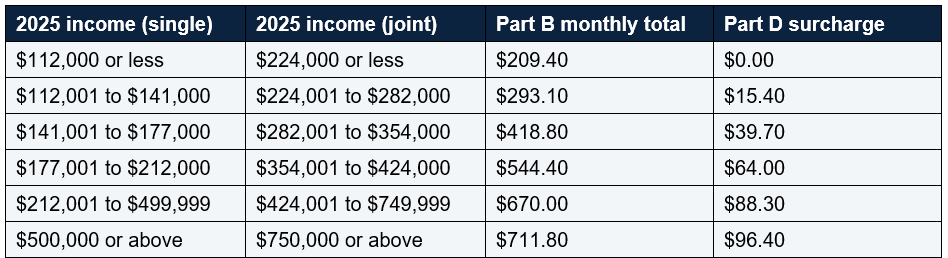
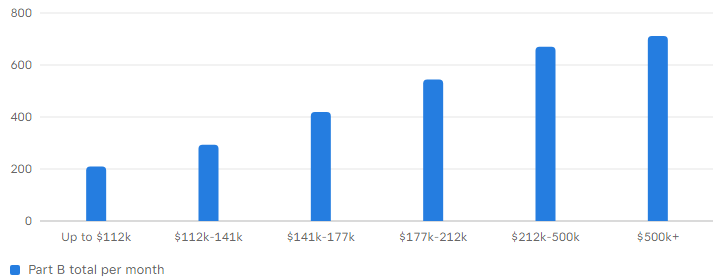
Part B premium plus both surcharges comes to $3,702 a year for an individual at the lowest surcharge ($7,404 for a couple), and $9,698.40 for an individual at the highest ($19,396.80 for a couple). My check: $711.80 times 12 is $8,541.60 for Part B, plus $96.40 times 12, which is $1,156.80, giving $9,698.40. It adds up. The cliff effect is worth knowing. Moving $1 over a threshold moves you into the next tier for the whole year. I did not retrieve the 2026 IRMAA amounts, so I cannot say how much the brackets rose.
Here is a worked example (my calculation, assuming the standard benefit design). If you pay the $700 deductible and then 25% of the rest, you reach $2,400 when you have paid $1,700 in coinsurance, which means $6,800 of drug costs after the deductible. Total drug spending is about $7,500. Real plans vary, and many have lower deductibles.
Premiums are plan-specific. The national base beneficiary premium is $41.33, up about 6% from $38.99. That figure is a starting point used to calculate plan premiums, not what everyone pays.
Two other changes matter. A temporary federal programme that stabilised stand-alone Part D premiums is ending, though Kiplinger reports that Medicare expects stand-alone premiums to rise by less than $1. And negotiated prices for 15 more high-cost drugs take effect. CMS estimates $685 million in combined out-of-pocket savings in 2027. Choice is wide. The average beneficiary can choose from 28 Medicare Advantage drug plans and 9 stand-alone plans, so shopping around can matter.
Premium is only part of the story. Advantage plans have a cap on what you can spend: $9,850 in-network, and $14,800 for in- and out-of-network combined. That is far above the Part D cap and is a real exposure for someone with serious illness. For Medigap, the out-of-pocket limits are $8,360 for Plan K and $4,180 for Plan L, and the high-deductible plans F, G and J have a $3,050 deductible, up $100. Advantage is not automatically better or worse. It depends on your doctors, your drugs and your health. A low premium can hide high costs when you need care.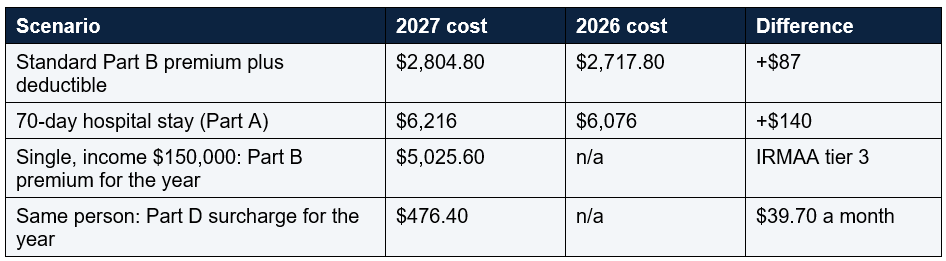
How I worked these out (my calculation): premium $2,512.80 plus deductible $292 gives $2,804.80, against $2,434.80 plus $283 for $2,717.80, so $87 more, which matches. For the hospital stay, the deductible of $1,776 plus 10 days at $444 for days 81 to 90 is $6,216, against $1,736 plus 10 at $434 giving $6,076. For the high earner, $418.80 times 12 is $5,025.60 and $39.70 times 12 is $476.40. The point of the hospital example is that a long stay is dominated by the daily coinsurance. It gets expensive quickly after day 60.
Check your doctors and hospitals. If you have an Advantage plan, confirm that your providers are in network for 2027. Check your income. If your income dropped because you retired or stopped working, you may be able to ask for a lower surcharge (general knowledge: the Social Security Administration handles this through a form for life-changing events, so check the details).
Common mistakes: assuming your plan stays the same, so you never review it; confusing the base beneficiary premium of $41.33 with what you will pay; forgetting that the Part D deductible counts toward the cap, not on top of it; ignoring the IRMAA cliff; and relying on older web pages that still show 2026 or estimated numbers . Another is choosing an Advantage plan only for the low premium without checking the out-of-pocket maximum of up to $9,850 in network.
Some caveats. The official CMS pages were not among the sources I retrieved. The Part A and Part B figures come from multiple news and benefits sites that agree with each other, and the Part D figures from Kiplinger, Newsweek and others. Please confirm on Medicare.gov. I use $85. An older page gives estimates of $209.50 and about $1,788, which are superseded. One calculator site said CMS had not yet published Part D IRMAA on 24 October, but a broker site now lists amounts, citing CMS figures. The Part A premiums for people with fewer than 40 quarters come only from a broker site. I did not retrieve the 2026 IRMAA amounts, the hold-harmless rules, or CMS's own fact sheet.
What matters is your own situation. Higher earners can pay up to $711.80 a month for Part B, drug costs bear a bigger out-of-pocket limit, and Advantage plans can look cheap but carry a high cap. Use open enrollment before 7 December, check your drugs and doctors, and see whether you qualify for help. This post is education only, not advice.
The standard monthly premium is $209.40, up $6.50 from $202.90, and the annual deductible is $292.
What is the Part A deductible for 2027?
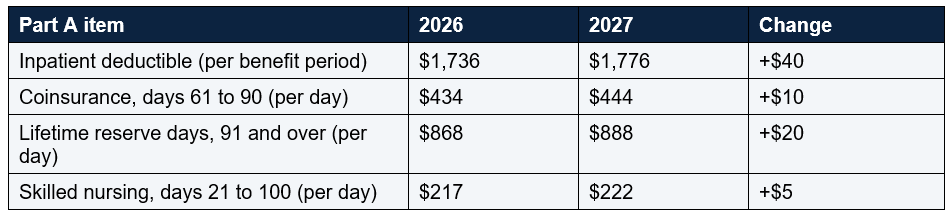
$1,776 per benefit period, up $40 from $1,736 .
What is the Part D out-of-pocket cap in 2027?
$2,400, up from $2,100, with a maximum standard deductible of $700 that counts toward the cap.
Who pays more because of IRMAA?
People with 2025 income above $112,000 (single) or $224,000 (joint). The Part B surcharge runs from $83.70 to $502.40 a month.
When is Medicare open enrollment?
15 October to 7 December.
Table of Contents
- What was announced, and when
- Part A: hospital costs
- Part B: the premium and deductible
- Income-related surcharges (IRMAA)
- Part D: prescription drug coverage
- Medicare Advantage and Medigap
- What happens to your Social Security check
- Worked examples in dollars
- Why costs keep rising
- What to do during open enrollment
- Ways to lower your bill
- Conclusion
- FAQ
2027 Part B monthly premium by income tier ($)
$ per month by 2025 income, single filers. Source: United Medicare Advisors citing CMS
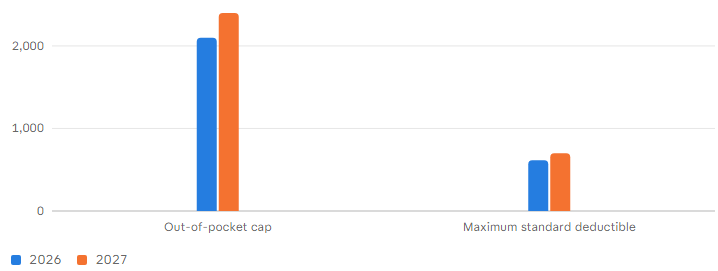
Part D limits, 2026 vs 2027 ($)
$ per year by Source: Kiplinger, Newsweek, FedRateCalc (reporting CMS)
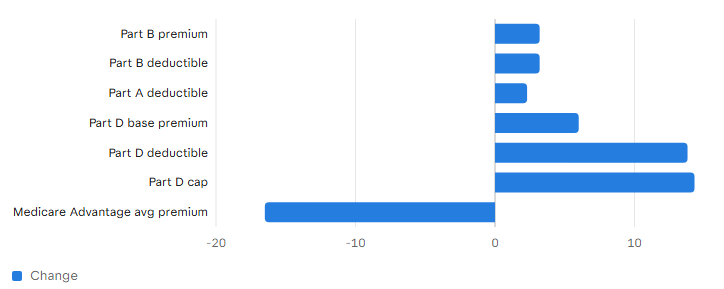
Change from 2026 to 2027 (%)
% change by My calculation from reported CMS figures; Advantage premium is projectedMedicare costs are going up again for 2027, but this year the increase is far gentler than the last. The standard Part B premium will be $209.40 a month, up $6.50 or 3.2% . The Part B deductible rises $9 to $292. The Part A hospital deductible rises $40 to $1,776. And the cap on out-of-pocket Part D drug costs climbs to $2,400 from $2,100. For context, the 2027 premium rise is much smaller than the nearly 10% jump enrollees faced this year [6], which another source puts at 9.7% . If you were bracing for a repeat, that is a relief.
Still, the biggest percentage increases are not in the premium at all. The Part D cap and deductible are each up by roughly 14% (my calculation, covered below), and higher earners face surcharges that can more than triple their Part B premium. This post walks through every part, with old and new numbers, examples, and ways to keep your bill down.
Key takeaway: Part B and Part A rise modestly, Part D out-of-pocket limits rise sharply, and the real money is in your income bracket. Use open enrollment to check your plan, and check your surcharge.
What was announced, and when
The Centers for Medicare and Medicaid Services, or CMS, released the 2027 Medicare Part A and Part B figures on 17 November 2026 . CMS said the higher premium and deductible are mainly due to "projected increases in healthcare spending". The final premium came in slightly below the $209.50 estimated in the Medicare Trustees Report earlier this year, and the deductible matched the $292 projection. The trustees had projected a 3.25% rise, so the final 3.2% is in line.A word of caution on timing. Some sites still carry estimates from before the announcement. One page published six days earlier says the premium was "still an estimate" at $209.50, with a Part A deductible of about $1,788 [19]. Those are superseded by the official $209.40 and $1,776. I use the official figures throughout.
The window is also tight. Open enrollment runs from 15 October to 7 December. From today, 18 November, that leaves 19 days (my calculation).
Part A: hospital costs
Part A covers inpatient hospital stays and some skilled nursing care. Most people pay no Part A premium if they have 40 quarters, or ten years, of Medicare-taxed work. The costs that matter are the deductible and daily coinsurance. The inpatient hospital deductible rises to $1,776 per benefit period from $1,736, an increase of $40. Telos Actuarial notes that Part A deductibles and coinsurance rise 2.3% for 2027, after a 3.6% rise in 2026.If you do not have enough work credits, you can buy Part A. A broker site reports the full voluntary premium at $597 a month for people with fewer than 30 quarters (from $565), and $328 for those with 30 to 39 quarters (from $311). That is a secondary source, so confirm on Medicare.gov. By my calculation these premiums rose about 5.7% and 5.5%, faster than the deductible.
Part B: the premium and deductible
Part B covers doctor visits, outpatient care and preventive services. The standard monthly premium is $209.40 for 2027, against $202.90 in 2026. Over a year that is $2,512.80, compared with $2,434.80, an extra $78 a year. The deductible rises from $283 to $292, add the two together and a standard-premium enrollee pays $87 more a year. After you meet the deductible, you typically pay 20% of the Medicare-approved amount for most covered services.Most people pay the standard amount, but not everyone. Roughly 9% of Part B enrollees will pay more than the standard premium [6], because of the income-related surcharge I cover next. Do not overlook the coinsurance. The 20% is uncapped under original Medicare unless you have supplemental cover (general knowledge, worth confirming with your plan). A serious illness can cost far more than the premium.
Income-related surcharges (IRMAA)
The income-related monthly adjustment amount, or IRMAA, is an extra charge for higher earners. It applies to people with income above $112,000 as a single filer or $224,000 as a married couple filing jointly, based on 2025 income. Premiums for higher earners are 35%, 50%, 65%, 80% or 85% of the total cost, depending on the tier.Part B premium plus both surcharges comes to $3,702 a year for an individual at the lowest surcharge ($7,404 for a couple), and $9,698.40 for an individual at the highest ($19,396.80 for a couple). My check: $711.80 times 12 is $8,541.60 for Part B, plus $96.40 times 12, which is $1,156.80, giving $9,698.40. It adds up. The cliff effect is worth knowing. Moving $1 over a threshold moves you into the next tier for the whole year. I did not retrieve the 2026 IRMAA amounts, so I cannot say how much the brackets rose.
Part D: prescription drug coverage
Part D, the prescription drug benefit, has the largest percentage changes. The annual out-of-pocket cap rises to $2,400 from $2,100, an increase of $300. By my calculation that is 14.3% (300 divided by 2,100). Once you reach the cap, you pay nothing for covered drugs for the rest of the year. The maximum standard deductible rises to $700 from $615. That is an $85 increase, or 13.8% (my calculation). The deductible counts toward the cap; it is not an extra $700 stacked on top of $2,400. After the deductible, a flat 25% coinsurance applies until your spending reaches the cap.Here is a worked example (my calculation, assuming the standard benefit design). If you pay the $700 deductible and then 25% of the rest, you reach $2,400 when you have paid $1,700 in coinsurance, which means $6,800 of drug costs after the deductible. Total drug spending is about $7,500. Real plans vary, and many have lower deductibles.
Premiums are plan-specific. The national base beneficiary premium is $41.33, up about 6% from $38.99. That figure is a starting point used to calculate plan premiums, not what everyone pays.
Two other changes matter. A temporary federal programme that stabilised stand-alone Part D premiums is ending, though Kiplinger reports that Medicare expects stand-alone premiums to rise by less than $1. And negotiated prices for 15 more high-cost drugs take effect. CMS estimates $685 million in combined out-of-pocket savings in 2027. Choice is wide. The average beneficiary can choose from 28 Medicare Advantage drug plans and 9 stand-alone plans, so shopping around can matter.
Medicare Advantage and Medigap
Medicare Advantage plans, which replace original Medicare with a private plan, look cheaper on premiums. The projected average monthly premium is $12.00 for 2027, down from $14.37. By my calculation that is a 16.5% fall, which matches AJMC's headline of a 16.5% drop. For plans that include drug coverage, the average Part D component is projected to fall 38%, from $11.32 to $7.00.Premium is only part of the story. Advantage plans have a cap on what you can spend: $9,850 in-network, and $14,800 for in- and out-of-network combined. That is far above the Part D cap and is a real exposure for someone with serious illness. For Medigap, the out-of-pocket limits are $8,360 for Plan K and $4,180 for Plan L, and the high-deductible plans F, G and J have a $3,050 deductible, up $100. Advantage is not automatically better or worse. It depends on your doctors, your drugs and your health. A low premium can hide high costs when you need care.
What happens to your Social Security check
Most retirees hope the Social Security cost-of-living adjustment covers the rise. The 2027 COLA is 3.6%. A Part B increase of $6.50 is small beside that. Take a retiree who receives $2,000 a month. A 3.6% raise adds $72. The Part B premium rises $6.50, so the net gain is $65.50 a month (my calculation). That assumes Part B is deducted from the benefit and ignores any hold-harmless protection, which I did not retrieve. But the Part D changes eat into the gain for people with high drug costs. One adviser quoted by Newsweek says the 14% increases in the Part D cap and deductible "will wipe away some of the purchasing power seniors receive" from the COLA.Worked examples in dollars
How I worked these out (my calculation): premium $2,512.80 plus deductible $292 gives $2,804.80, against $2,434.80 plus $283 for $2,717.80, so $87 more, which matches. For the hospital stay, the deductible of $1,776 plus 10 days at $444 for days 81 to 90 is $6,216, against $1,736 plus 10 at $434 giving $6,076. For the high earner, $418.80 times 12 is $5,025.60 and $39.70 times 12 is $476.40. The point of the hospital example is that a long stay is dominated by the daily coinsurance. It gets expensive quickly after day 60.
Why costs keep rising
Why do the costs keep rising? CMS points to projected growth in healthcare spending. Part B pays for services such as doctor visits and outpatient care, so when prices and use rise, so does the premium. Part D has its own drivers. The redesigned benefit includes an annual out-of-pocket cap, and both the cap and the maximum deductible have moved up for 2027, from $2,100 and $615 to $2,400 and $700. At the same time, temporary subsidies are phasing out. The 2026 jump of nearly 10% [6] was exceptional. The 2027 rise of 3.2% looks more like a return to a steadier pattern, though one year does not make a trend.What to do during open enrollment
Open enrollment is your chance to review your plan. It runs until 7 December. Use the plan finder on Medicare.gov to compare 2027 plan details now (check that the premiums shown are final). Check your drugs. Use the CMS plan finder, which can filter by deductible, premium or premium plus drug costs. A plan that was cheap last year may no longer be.Check your doctors and hospitals. If you have an Advantage plan, confirm that your providers are in network for 2027. Check your income. If your income dropped because you retired or stopped working, you may be able to ask for a lower surcharge (general knowledge: the Social Security Administration handles this through a form for life-changing events, so check the details).
Ways to lower your bill
Some people qualify for help and never apply. If your income is under about $23,940 as an individual or $32,460 as a couple, with limited savings, a federal programme can wipe out your premium and deductible and cap your copays at a few dollars. Other ideas, offered as general education: compare Part D plans every year; ask your pharmacist about lower-cost generics; consider whether a Medigap or Advantage plan fits your expected use of care; and keep an eye on timing if you can control income, because surcharge brackets work like cliffs.Common mistakes: assuming your plan stays the same, so you never review it; confusing the base beneficiary premium of $41.33 with what you will pay; forgetting that the Part D deductible counts toward the cap, not on top of it; ignoring the IRMAA cliff; and relying on older web pages that still show 2026 or estimated numbers . Another is choosing an Advantage plan only for the low premium without checking the out-of-pocket maximum of up to $9,850 in network.
Some caveats. The official CMS pages were not among the sources I retrieved. The Part A and Part B figures come from multiple news and benefits sites that agree with each other, and the Part D figures from Kiplinger, Newsweek and others. Please confirm on Medicare.gov. I use $85. An older page gives estimates of $209.50 and about $1,788, which are superseded. One calculator site said CMS had not yet published Part D IRMAA on 24 October, but a broker site now lists amounts, citing CMS figures. The Part A premiums for people with fewer than 40 quarters come only from a broker site. I did not retrieve the 2026 IRMAA amounts, the hold-harmless rules, or CMS's own fact sheet.
Conclusion
The numbers for 2027 are clear. Part B is $209.40 a month and $292 a year in deductible, the Part A hospital deductible is $1,776, and the Part D cap is $2,400. The Part B increase is 3.2%, much gentler than last year.What matters is your own situation. Higher earners can pay up to $711.80 a month for Part B, drug costs bear a bigger out-of-pocket limit, and Advantage plans can look cheap but carry a high cap. Use open enrollment before 7 December, check your drugs and doctors, and see whether you qualify for help. This post is education only, not advice.
FAQ
How much is Medicare Part B in 2027?The standard monthly premium is $209.40, up $6.50 from $202.90, and the annual deductible is $292.
What is the Part A deductible for 2027?
$1,776 per benefit period, up $40 from $1,736 .
What is the Part D out-of-pocket cap in 2027?
$2,400, up from $2,100, with a maximum standard deductible of $700 that counts toward the cap.
Who pays more because of IRMAA?
People with 2025 income above $112,000 (single) or $224,000 (joint). The Part B surcharge runs from $83.70 to $502.40 a month.
When is Medicare open enrollment?
15 October to 7 December.
0 Comments
Be the first to share your thoughts on this article.