

Retirement
What You Need to Know About Putting an IRA in a Trust

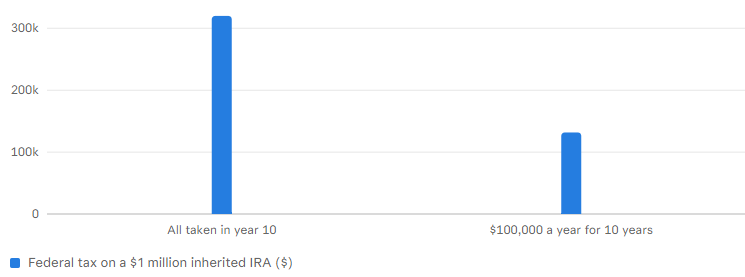
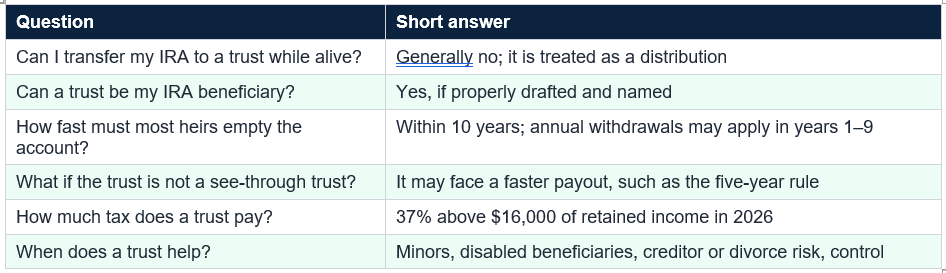
The rules: an IRA cannot be retitled to a trust during life; a trust can be named beneficiary; a see-through trust must meet four requirements (valid under state law, irrevocable at death, identifiable beneficiaries, documents to the custodian by October 31 of the year after death); most non-spouse heirs face the 10-year rule; for owners who died on or after the required beginning date, annual distributions apply in years 1–9 (2024 final regulations). The tax trap: in 2026 a trust reaches the 37% bracket at $16,000 of retained income ($15,650 in 2025), while a single individual reaches it at about $640,600, roughly 40 times higher; a non-qualifying trust may face the five-year rule if the owner died before the required beginning date. My arithmetic (single beneficiary, 2026 brackets, no other income): a $1 million lump sum in year 10 costs about $320,000 of federal tax (32%) against about $131,700 for $100,000 a year over 10 years, a $188,300 difference; retaining $100,000 in a trust costs at least about $31,080, against about $13,170 for an individual, at least $17,910 more.
What you can do is name a trust as the IRA’s beneficiary, so the trust receives the money when you die. That changes the plan: the trust must meet specific rules to get favorable treatment, the SECURE Act’s 10-year payout rule squeezes the timing and trust income is taxed at compressed rates. This guide explains how it works, shows the tax effect with numbers and covers when a trust helps and when naming people directly is better.
The beneficiary form on file with the IRA custodian controls where the money goes, not your will or trust document. If it names your estate, an old spouse or nobody, the result may not match your plans, so the first step is to complete the custodian’s form correctly, naming the trust exactly as titled, and keep it updated.
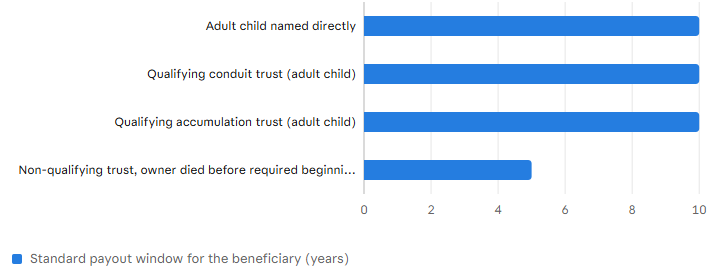
A few beneficiaries can still use longer payouts: eligible designated beneficiaries include a surviving spouse, the owner’s minor child, a disabled or chronically ill person and someone not more than 10 years younger than the owner, according to the sources. A properly drafted see-through accumulation trust for a disabled beneficiary can use the life-expectancy stretch while keeping trustee control, one of the strongest cases for a trust. For a non-disabled adult child, the 10-year rule applies whether the money goes to the child or through a conduit trust.
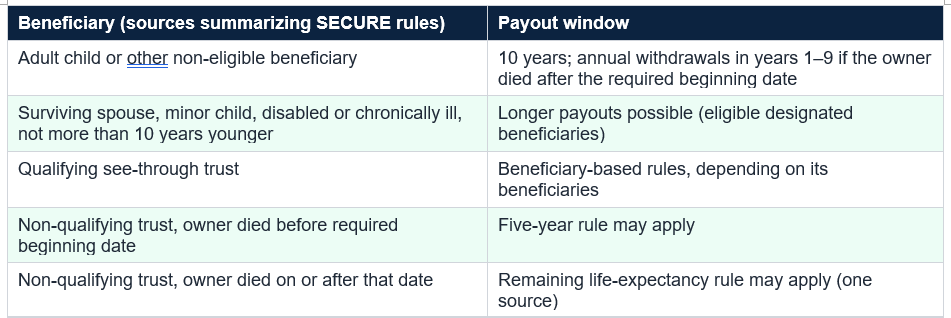
Failing a requirement can be costly. A trust that does not qualify may be treated as having no designated beneficiary, which can lead to the five-year rule if the owner died before the required beginning date (one source calls it potentially the worst outcome) and a life-expectancy-based rule if after. Many older trusts were drafted before the SECURE Act and may no longer work as intended, according to law-firm articles, so review them with an attorney who handles retirement-account trusts.
The trade-off between control and tax is the heart of IRA trust planning. Some modern trusts include toggle provisions so the trustee can choose between conduit and accumulation behavior later. There is also a timing risk: if a conduit trust does not require annual distributions in years one through nine, the trustee could wait until year 10 and pass the whole balance to the beneficiary in a single tax year, potentially a very high bracket.
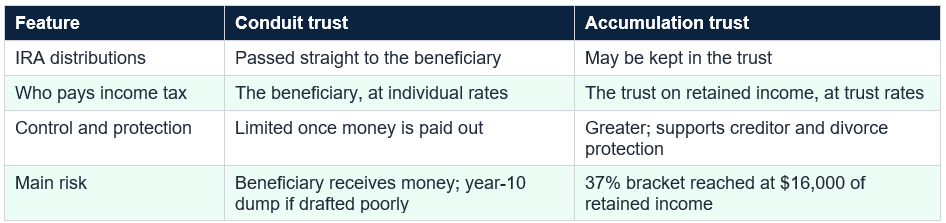
In my arithmetic, retaining a $100,000 IRA distribution in a trust costs at least about $31,080 in federal tax (37% of the $84,000 above $16,000, ignoring tax on the first $16,000) and up to $37,000. The same $100,000 paid to a single beneficiary with no other income would cost about $13,170 using 2026 brackets and the standard deduction, so the trust costs at least $17,910 more; if the beneficiary has other income, the gap shrinks. Distribute income to beneficiaries when tax matters more than control.
The numbers: 2026: trusts reach the 37% federal bracket above $16,000 of taxable income ($15,650 in 2025); a single individual reaches it near $640,600. 10-year rule for most non-spouse heirs; annual withdrawals in years 1–9 if the owner died on or after the required beginning date. See-through trusts need four requirements, including documents to the custodian by October 31 of the year after death.
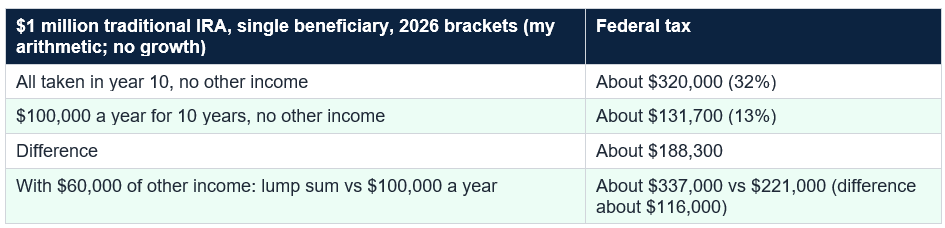
With $60,000 of other income the point remains: about $337,000 of tax on the lump sum against about $221,000 spread evenly, a difference of about $116,000. That is why trust design matters: a conduit trust that forces annual payouts spreads the income, one that allows a year-10 dump does not and an accumulation trust could pay trust-rate tax on retained amounts. Growth, state tax and real brackets would change the figures. Roth IRAs differ: distributions are generally tax-free, so brackets matter much less.
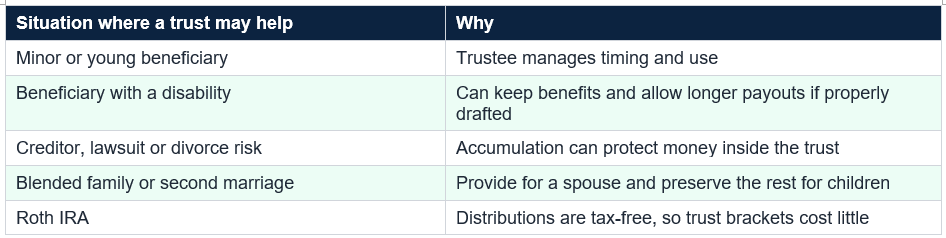
For a Roth IRA, compressed trust brackets matter far less because qualified distributions are tax-free, so the control benefits of an accumulation trust may come at little tax cost. In every case you pay for control with complexity, legal fees and sometimes higher tax, and whether the trade is worth it depends on how much you value protection.
Consider what you are trying to solve. If the worry is money management, some people use a trust for only part of the IRA and name individuals for the rest; if it is tax, spreading withdrawals through individuals is often more efficient; if it is creditor protection, check whether state law already protects inherited IRAs, a point I did not research. Review the plan when laws, balances or relationships change.
Also check the practicalities: does the trustee understand IRA rules and have a tax professional, and does your estate attorney regularly handle retirement-account trusts? Review everything after major life events and law changes. A one-hour review with a specialist can prevent an expensive mistake.
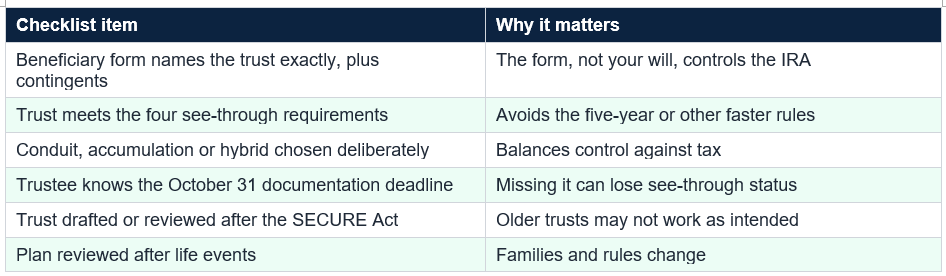
Mistakes with IRA trusts can be permanent and costly. Work with an estate attorney experienced in retirement-account trusts and a tax professional, and review the plan whenever your family or the law changes.
Common mistakes include trying to retitle an IRA into a trust, forgetting to name the trust on the custodian’s form, relying on a pre-2020 trust, ignoring compressed trust tax rates, drafting a conduit trust that allows a year-10 dump, missing the October 31 documentation deadline and leaving beneficiary forms outdated after divorce or death. A trust adds control, but also cost, complexity and sometimes tax.
In my examples, retaining $100,000 in a trust costs at least about $17,910 more than paying it to a single beneficiary with no other income, and taking a $1 million IRA in one year costs about $188,300 more in tax than spreading it over 10 years. A trust can still be the right tool for minors, disabled beneficiaries, creditor or divorce risk and complex families, especially with a Roth IRA. Review your beneficiary forms and any existing trust with an estate attorney now.
Not while you are alive. An IRA must be owned by an individual, so retitling it in a trust’s name is generally treated as a distribution, which can trigger income tax on the whole balance, according to several guides. What you can do is name a trust as the IRA’s beneficiary, so the trust receives the account after your death. That is what people usually mean by putting an IRA in a trust.
What is a see-through trust?
A trust that the IRS “looks through” to treat the people behind it as the beneficiaries for distribution purposes. Sources list four requirements: the trust is valid under state law, becomes irrevocable at the owner’s death, has identifiable beneficiaries and the trustee gives the IRA custodian the trust documents by October 31 of the year after death. If it fails, the trust may face a faster payout, such as the five-year rule.
What is the difference between a conduit and an accumulation trust?
A conduit trust must pass every IRA distribution straight to the beneficiary, who pays tax at their own rates. An accumulation trust can keep distributions inside the trust, which preserves control and protection but taxes retained income at trust rates, which reach 37% at just $16,000 in 2026. Each has trade-offs, and some trusts let the trustee choose.
Does the 10-year rule apply to a trust?
Often yes. For most non-spouse beneficiaries, the account must be emptied by the end of the tenth year after death. Under 2024 final regulations, if the owner died on or after their required beginning date, annual distributions are also required in years one through nine, according to several summaries. Certain eligible beneficiaries, such as a disabled or chronically ill person, can have longer payouts.
Should I name a trust or my children directly?
It depends on your family. A trust can make sense for minors, beneficiaries with disabilities or financial difficulties, or when you want creditor and divorce protection or control over timing. For responsible adult children and modest balances, naming them directly is simpler and often cheaper in tax terms. A trust adds complexity and compressed tax rates. Talk to an estate attorney. This is general education, not legal or tax advice.
Table of Contents
- What People Mean by “Putting an IRA in a Trust”
- The Short Answer
- Why You Cannot Retitle an IRA
- The 10-Year Rule and Who Gets Longer
- See-Through Trusts: The Four Requirements
- Conduit vs. Accumulation Trusts
- The $16,000 Tax Trap
- A $1 Million Example
- When a Trust Makes Sense
- When Naming Individuals Is Better
- Pitfalls to Check Now
- Common Mistakes
- Conclusion
- Frequently Asked Questions
How long the money can stay: payout window by beneficiary setup (years, simplified)
Years to empty the account by Law-firm and planning articles summarizing the SECURE Act and 2024 final regulations; simplified: eligible designated beneficiaries (spouse, minor child, disabled or chronically ill) can have longer payouts; annual withdrawals apply in years 1-9 if the owner died on or after the required beginning date
Timing matters: federal tax on a $1 million inherited traditional IRA, single beneficiary ($)
Federal tax ($) by Author's simplified arithmetic: 2026 single brackets and standard deduction; no other income, no investment growth, no state tax; with $60,000 of other income the figures are about $337,000 vs $221,000; not an estimate of your tax
What People Mean by “Putting an IRA in a Trust”
People want to put an IRA in a trust for good reasons: a child too young to handle a large sum, a beneficiary with special needs, a spendthrift relative, a second marriage with children from the first or a future divorce or lawsuit. A trust can add control and protection that a simple beneficiary form cannot. But the phrase hides a trap, because you cannot actually put an IRA into a trust while you are alive.What you can do is name a trust as the IRA’s beneficiary, so the trust receives the money when you die. That changes the plan: the trust must meet specific rules to get favorable treatment, the SECURE Act’s 10-year payout rule squeezes the timing and trust income is taxed at compressed rates. This guide explains how it works, shows the tax effect with numbers and covers when a trust helps and when naming people directly is better.
The Short Answer
You cannot retitle an IRA into a trust during life, because the owner must be an individual and a transfer is generally treated as a taxable distribution. You can name a trust as beneficiary, and to get beneficiary-based distribution rules it must be a see-through trust meeting four requirements. Most non-spouse beneficiaries must empty the account within 10 years, and in 2026 a trust reaches the top 37% federal rate at just $16,000 of retained income, so accumulating IRA money inside a trust can be costly: in my example, retaining $100,000 costs at least about $17,910 more in federal tax than paying it to an individual with no other income.
Why You Cannot Retitle an IRA
An IRA is owned by an individual. If you change the account’s title to a trust, guides explain, the IRS treats it as a distribution of the entire balance, making the whole amount taxable income that year and possibly triggering penalties if you are young. So, as several sources put it, the proper approach is to name the trust as beneficiary rather than transfer the IRA; even a revocable living trust used to avoid probate does not hold the IRA in life.The beneficiary form on file with the IRA custodian controls where the money goes, not your will or trust document. If it names your estate, an old spouse or nobody, the result may not match your plans, so the first step is to complete the custodian’s form correctly, naming the trust exactly as titled, and keep it updated.
The 10-Year Rule and Who Gets Longer
Before 2020, many non-spouse beneficiaries could stretch inherited IRA withdrawals over their life expectancy. The SECURE Act, enacted in December 2019, replaced that for most non-spouse heirs with a 10-year rule: the account must be empty by the end of the tenth year after the owner’s death. Under the 2024 final regulations, as summarized by several sources, if the owner died on or after their required beginning date (April 1 after turning 73 for those born 1951 to 1959 and 75 for those born in 1960 or later), annual distributions are also required in years one through nine; if before, none are required but the account must be empty by December 31 of year ten.A few beneficiaries can still use longer payouts: eligible designated beneficiaries include a surviving spouse, the owner’s minor child, a disabled or chronically ill person and someone not more than 10 years younger than the owner, according to the sources. A properly drafted see-through accumulation trust for a disabled beneficiary can use the life-expectancy stretch while keeping trustee control, one of the strongest cases for a trust. For a non-disabled adult child, the 10-year rule applies whether the money goes to the child or through a conduit trust.
See-Through Trusts: The Four Requirements
For the IRS to “look through” a trust to its human beneficiaries, it must satisfy four requirements under Treasury Regulation 1.401(a)(9)-4, according to several guides: it must be valid under state law, be or become irrevocable at the owner’s death, have beneficiaries identifiable from the document and the trustee must give the IRA custodian the trust documentation by October 31 of the year after death. A trust meeting all four is called a see-through trust.Failing a requirement can be costly. A trust that does not qualify may be treated as having no designated beneficiary, which can lead to the five-year rule if the owner died before the required beginning date (one source calls it potentially the worst outcome) and a life-expectancy-based rule if after. Many older trusts were drafted before the SECURE Act and may no longer work as intended, according to law-firm articles, so review them with an attorney who handles retirement-account trusts.
Conduit vs. Accumulation Trusts
There are two main designs. A conduit trust requires the trustee to pass every IRA distribution straight to the beneficiary, who pays tax at their own rates; it offers less control, since the money ends up in the beneficiary’s hands, and under the 10-year rule gives no extra deferral compared with naming the person directly, according to one source. An accumulation trust lets the trustee keep distributions inside the trust, preserving control and protection against creditors, divorce and poor spending, but retained income is taxed at compressed trust rates.The trade-off between control and tax is the heart of IRA trust planning. Some modern trusts include toggle provisions so the trustee can choose between conduit and accumulation behavior later. There is also a timing risk: if a conduit trust does not require annual distributions in years one through nine, the trustee could wait until year 10 and pass the whole balance to the beneficiary in a single tax year, potentially a very high bracket.
The $16,000 Tax Trap
The biggest surprise for many families is how quickly trusts reach the top tax rate. In 2026, estates and trusts enter the 37% federal bracket once taxable income exceeds $16,000, according to law-firm articles and Fidelity analysis cited by TheStreet ($15,650 in 2025), while a single individual does not reach 37% until about $640,600, roughly 40 times higher. These are marginal rates, so not all of the first $16,000 is taxed at 37%, but traditional IRA distributions are fully taxable, so an accumulation trust can face the top rate on most of what it keeps.In my arithmetic, retaining a $100,000 IRA distribution in a trust costs at least about $31,080 in federal tax (37% of the $84,000 above $16,000, ignoring tax on the first $16,000) and up to $37,000. The same $100,000 paid to a single beneficiary with no other income would cost about $13,170 using 2026 brackets and the standard deduction, so the trust costs at least $17,910 more; if the beneficiary has other income, the gap shrinks. Distribute income to beneficiaries when tax matters more than control.
The numbers: 2026: trusts reach the 37% federal bracket above $16,000 of taxable income ($15,650 in 2025); a single individual reaches it near $640,600. 10-year rule for most non-spouse heirs; annual withdrawals in years 1–9 if the owner died on or after the required beginning date. See-through trusts need four requirements, including documents to the custodian by October 31 of the year after death.
A $1 Million Example
Suppose an adult child inherits a $1 million traditional IRA, directly or through a conduit trust, with no other income and no investment growth. Taking the whole balance in year 10 costs about $320,000 of federal tax at 2026 single brackets with the standard deduction, an effective 32%, while taking $100,000 a year for 10 years costs about $13,170 a year, $131,700 in total, an effective 13%. Spreading withdrawals saves about $188,300 in this simplified case.With $60,000 of other income the point remains: about $337,000 of tax on the lump sum against about $221,000 spread evenly, a difference of about $116,000. That is why trust design matters: a conduit trust that forces annual payouts spreads the income, one that allows a year-10 dump does not and an accumulation trust could pay trust-rate tax on retained amounts. Growth, state tax and real brackets would change the figures. Roth IRAs differ: distributions are generally tax-free, so brackets matter much less.
When a Trust Makes Sense
Despite the complexity, there are good reasons to name a trust. A minor or young adult may not be ready to manage a large sum, and a trustee can control timing. A beneficiary with a disability may need to keep government benefits, and a see-through accumulation trust can use a longer payout while the trustee coordinates support, which sources call the most compelling scenario. A trust can also protect money from a beneficiary’s creditors, a lawsuit or a divorce and manage blended families, for example providing for a spouse while preserving the rest for children from a first marriage.For a Roth IRA, compressed trust brackets matter far less because qualified distributions are tax-free, so the control benefits of an accumulation trust may come at little tax cost. In every case you pay for control with complexity, legal fees and sometimes higher tax, and whether the trade is worth it depends on how much you value protection.
When Naming Individuals Is Better
A trust is not always the answer. If your beneficiaries are responsible adults and the IRA is modest, naming them directly is simpler, cheaper and often better for taxes, since individuals have far wider brackets than trusts. A conduit trust that passes everything out anyway can add cost without extra deferral. For a spouse, naming the spouse usually gives the most flexibility, including treating the IRA as their own (general knowledge). A poorly drafted trust can do more harm than none.Consider what you are trying to solve. If the worry is money management, some people use a trust for only part of the IRA and name individuals for the rest; if it is tax, spreading withdrawals through individuals is often more efficient; if it is creditor protection, check whether state law already protects inherited IRAs, a point I did not research. Review the plan when laws, balances or relationships change.
Pitfalls to Check Now
If you already have an IRA trust, review it: many were drafted before 2020, when the stretch was available. Make sure the beneficiary form names the trust exactly and lists contingent beneficiaries, that the trust is a see-through trust with identifiable beneficiaries and that your trustee knows the October 31 deadline to deliver documents to the custodian. Check how it handles annual distributions in years one through nine and whether it is a conduit, an accumulation trust or a hybrid.Also check the practicalities: does the trustee understand IRA rules and have a tax professional, and does your estate attorney regularly handle retirement-account trusts? Review everything after major life events and law changes. A one-hour review with a specialist can prevent an expensive mistake.
Mistakes with IRA trusts can be permanent and costly. Work with an estate attorney experienced in retirement-account trusts and a tax professional, and review the plan whenever your family or the law changes.
Common mistakes include trying to retitle an IRA into a trust, forgetting to name the trust on the custodian’s form, relying on a pre-2020 trust, ignoring compressed trust tax rates, drafting a conduit trust that allows a year-10 dump, missing the October 31 documentation deadline and leaving beneficiary forms outdated after divorce or death. A trust adds control, but also cost, complexity and sometimes tax.
Conclusion
You cannot put an IRA in a trust while you are alive, but you can name a trust as the beneficiary, and the details matter. A see-through trust meeting four requirements lets the IRS look through to the people behind it. Most heirs face the 10-year rule, with annual withdrawals in years one through nine if the owner died after the required beginning date. And in 2026 a trust hits the 37% bracket at just $16,000 of retained income, while an individual does not reach it until about $640,600.In my examples, retaining $100,000 in a trust costs at least about $17,910 more than paying it to a single beneficiary with no other income, and taking a $1 million IRA in one year costs about $188,300 more in tax than spreading it over 10 years. A trust can still be the right tool for minors, disabled beneficiaries, creditor or divorce risk and complex families, especially with a Roth IRA. Review your beneficiary forms and any existing trust with an estate attorney now.
Frequently Asked Questions
Can I put my IRA in a trust?Not while you are alive. An IRA must be owned by an individual, so retitling it in a trust’s name is generally treated as a distribution, which can trigger income tax on the whole balance, according to several guides. What you can do is name a trust as the IRA’s beneficiary, so the trust receives the account after your death. That is what people usually mean by putting an IRA in a trust.
What is a see-through trust?
A trust that the IRS “looks through” to treat the people behind it as the beneficiaries for distribution purposes. Sources list four requirements: the trust is valid under state law, becomes irrevocable at the owner’s death, has identifiable beneficiaries and the trustee gives the IRA custodian the trust documents by October 31 of the year after death. If it fails, the trust may face a faster payout, such as the five-year rule.
What is the difference between a conduit and an accumulation trust?
A conduit trust must pass every IRA distribution straight to the beneficiary, who pays tax at their own rates. An accumulation trust can keep distributions inside the trust, which preserves control and protection but taxes retained income at trust rates, which reach 37% at just $16,000 in 2026. Each has trade-offs, and some trusts let the trustee choose.
Does the 10-year rule apply to a trust?
Often yes. For most non-spouse beneficiaries, the account must be emptied by the end of the tenth year after death. Under 2024 final regulations, if the owner died on or after their required beginning date, annual distributions are also required in years one through nine, according to several summaries. Certain eligible beneficiaries, such as a disabled or chronically ill person, can have longer payouts.
Should I name a trust or my children directly?
It depends on your family. A trust can make sense for minors, beneficiaries with disabilities or financial difficulties, or when you want creditor and divorce protection or control over timing. For responsible adult children and modest balances, naming them directly is simpler and often cheaper in tax terms. A trust adds complexity and compressed tax rates. Talk to an estate attorney. This is general education, not legal or tax advice.
0 Comments
Be the first to share your thoughts on this article.