
Investing
Coca-Cola at $95 or PepsiCo at $140: Which Could Grow $1,000

Two of the most dependable dividend payers, two very different setups. Here is the evidence, the math and the risks. KO: 64 years of dividend raises, about 2.2% yield at $95, Q3 organic revenue +7%, PEP: 54 years, about 4.2% yield at $140, Q3 core EPS +2%, Forward P/E about 26x vs 17x (July), the model: $1,000 becomes $1,771 (KO) vs $2,341 (PEP).
Coca-Cola (KO) and PepsiCo (PEP) are two of the steadiest dividend payers you can own, and both are Dividend Kings. But the setups are not alike. Coca-Cola is growing faster and trades at a premium. PepsiCo is growing slowly, especially in North America, but pays a bigger yield and costs fewer dollars per dollar of earnings.
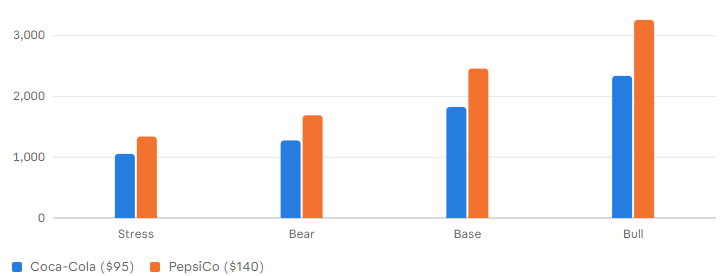
With KO near $95 and PEP near $140, I built a simple ten-year model using the assumptions in a Motley Fool projection. In my base case $1,000 grows to roughly $1,830 in Coca-Cola and $2,460 in PepsiCo, with dividends reinvested (my calculation). PepsiCo's edge comes almost entirely from a lower starting valuation and a higher yield, not from a better business.
That is the honest tension. Coca-Cola looks like the better business right now, and PepsiCo may be the cheaper way to own a consumer staples dividend. Whether the cheaper one wins depends on whether PepsiCo's North American problem is fixable. The Fool's author, who compared both with a third stock, concluded that neither may be the best buy today.
Key takeaway: Quality and price pull in opposite directions here. The model favors the cheaper stock in every scenario I ran, but the gap narrows a lot if PepsiCo's earnings stall.
The streaks tell you about resilience through recessions, inflation and changing tastes. They do not tell you what the stock will do next. A dividend can grow every year while the share price goes sideways for a decade, which is why price and valuation matter as much as the streak.
Earlier in the year, Coca-Cola's first-quarter organic revenue grew 10% and comparable EPS rose 18% to $0.86, though six extra calendar days flattered that quarter. Adjusting for that, the underlying pace looks closer to the 4% to 5% organic growth the company was guiding to at the time. Why does the market pay up for this? The Fool's author notes Coke is the "better business right now," with faster growth, stronger execution and clear momentum. The catch is that a premium valuation leaves less room for disappointment.
North America is where the pressure sits. In PepsiCo Foods North America, revenue was flat, effective net pricing fell 1% and core operating profit dropped 12%. In PepsiCo Beverages North America, net revenue rose 5% mainly from acquisitions, while organic revenue was roughly flat and organic volume fell 3%.
The CFO said North America's core operating margin will remain under pressure in the fourth quarter. International is the bright spot: revenue rose 8% in the International Beverages Franchise and Europe, Middle East and Africa, 14% in Latin America Foods and 10% in Asia Pacific Foods. The company plans more spending on innovation and additional structural cost reduction in North America.
Value the Markets notes that shoppers have grown more selective about grocery spending in North America, which limits pricing power. So PepsiCo is a turnaround story as much as a dividend story. The market has priced in some of that doubt. Whether it has priced in enough is the whole question.
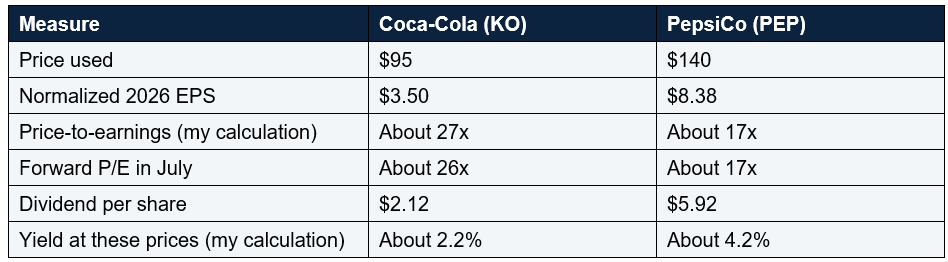
Prices are the ones in the question. The Fool page showed KO at $96.75 and PEP at $141.44 on 24 November. Price conflicts are worth flagging. The Fool's projection started from $96.91 and $143.61, while TIKR's 4.6% PepsiCo yield reflects an earlier, lower price near $129. Always recompute the yield from today's price.
Growth is closer than people think. Over five years, dividends grew 4.5% a year at Coca-Cola and 6.9% a year at PepsiCo. A Fool article noted PepsiCo's dividend rose 89% over the past decade versus 51% for Coca-Cola. Because PepsiCo starts higher and has grown faster, TIKR projects its ten-year income on $10,000 at about $839 at 6.9% growth, or $655 at 4%, against about $372 for Coca-Cola at 4.5%.
Safety is the counterweight. TIKR puts the trailing cash dividend payout ratio at 77% for Coca-Cola and 84% for PepsiCo, with net debt to EBITDA of 1.60 times versus 2.07 times. A March 24/7 Wall St. analysis was harsher on PepsiCo: it put the free-cash-flow payout near 98%, with $7.67 billion of free cash flow barely covering $7.64 billion of dividends, versus a 72% forward payout for Coca-Cola. The two sources use different measures, so I would not pick one number, but the direction is the same. For 2026, PepsiCo plans $7.9 billion of dividends and $1.0 billion of buybacks, $8.9 billion in total. That is a lot of cash going out while earnings growth is only 1% to 2%. I am not predicting a cut. A 54-year streak is a powerful incentive. But a thin cushion means slower raises are more likely than fast ones.
I reran it from $95 and $140. I assumed prices drift smoothly to the 2036 level and that dividends are reinvested each year at that year's price. I also built a stress case and a bull case. Here is the result for $1,000.
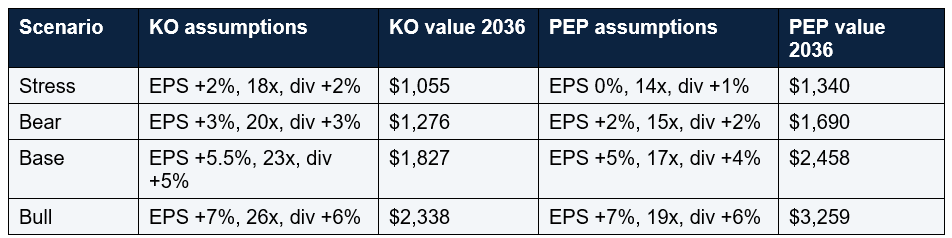
My calculation. Starting prices $95 and $140, 2026 EPS $3.50 and $8.38, dividends $2.12 and $5.92. Before taxes and fees. A model, not a forecast. The pattern is easy to see. PepsiCo ends ahead in each scenario because it begins at about 17 times earnings against about 27 times, and because it pays about twice the yield. In the base case that means roughly 9.4% a year for PepsiCo against 6.2% for Coca-Cola (my calculation).
Now the caveat that matters. The base case gives PepsiCo 5% EPS growth. Management currently guides to 1% to 2% core constant-currency growth for 202. If growth stays near 2% and the multiple compresses to 15 times, my bear case gives about $1,690, and in the stress case with no growth it is $1,340. Coca-Cola's cushion is thinner: the stress case leaves about $1,055. The reason the cheaper stock wins in the model is that a high starting multiple is a headwind. If Coca-Cola's multiple drifts from 27 times down to 23 times, that shaves about 1.6% a year off its price return (my calculation). The business has to outgrow its own valuation just to keep pace.
Mistake one is treating a Dividend King streak as a guarantee. A streak is a record, not a promise, and PepsiCo's tight cash coverage is the reason to keep watching. Mistake two is buying on yield alone. A 4.2% yield only helps if the share price holds. Mistake three is ignoring taxes: qualified dividends in a taxable account are taxed, so the account you hold them in matters. Mistake four is trusting any ten-year projection, including mine, as a prediction. The Fool's author even argued a third stock might be a better home for the $1,000 than either of these. Read the filings, check live prices and consider talking to a qualified adviser.
It depends on your goal. PepsiCo pays about 4.2% at $140 versus about 2.2% for Coca-Cola at $95 (my calculation), but Coca-Cola has the stronger earnings growth.
How many years have Coca-Cola and PepsiCo raised their dividends?
Coca-Cola has raised its dividend for 64 consecutive years and PepsiCo for 54.
Is PepsiCo's dividend safe?
There is no sign of a cut, but coverage is tighter. TIKR shows an 84% cash payout ratio versus 77% for Coca-Cola, and 24/7 Wall St. put PepsiCo's free-cash-flow payout near 98%.
What could $1,000 be worth in 2036?
In my base-case model, about $1,830 in Coca-Cola and $2,460 in PepsiCo with dividends reinvested, ranging from about $1,050 to $3,260 across scenarios (my calculation). The Fool's version gave $1,771 and $2,341.
Why is Coca-Cola more expensive than PepsiCo?
The market pays up for faster growth and consistency. Coca-Cola traded near 26 times forward earnings in July against about 17 times for PepsiCo.
Table of Contents
- Why both are Dividend Kings
- Coca-Cola: the business with momentum
- PepsiCo: the North America problem
- Valuation: what you pay for each dollar of earnings
- Dividends: yield, growth and safety
- The $1,000 math to 2036
- Risks that could break the model
- Which investor each stock may suit
- Conclusion
- FAQ
Coca-Cola (KO) and PepsiCo (PEP) are two of the steadiest dividend payers you can own, and both are Dividend Kings. But the setups are not alike. Coca-Cola is growing faster and trades at a premium. PepsiCo is growing slowly, especially in North America, but pays a bigger yield and costs fewer dollars per dollar of earnings.
With KO near $95 and PEP near $140, I built a simple ten-year model using the assumptions in a Motley Fool projection. In my base case $1,000 grows to roughly $1,830 in Coca-Cola and $2,460 in PepsiCo, with dividends reinvested (my calculation). PepsiCo's edge comes almost entirely from a lower starting valuation and a higher yield, not from a better business.
That is the honest tension. Coca-Cola looks like the better business right now, and PepsiCo may be the cheaper way to own a consumer staples dividend. Whether the cheaper one wins depends on whether PepsiCo's North American problem is fixable. The Fool's author, who compared both with a third stock, concluded that neither may be the best buy today.
Key takeaway: Quality and price pull in opposite directions here. The model favors the cheaper stock in every scenario I ran, but the gap narrows a lot if PepsiCo's earnings stall.
Why both are Dividend Kings
Dividend Kings are rare. One Motley Fool piece counted 55 companies that had raised their dividend for at least 50 years out of almost 54,000 listed stocks worldwide, barely one in a thousand. Coca-Cola raised its quarterly dividend from $0.51 to $0.53 in February 2026, its 64th consecutive annual increase. PepsiCo lifted its annualized dividend from $5.69 to $5.92, its 54th straight raise. Both raises were about 4%, and PepsiCo's was its smallest since at least 2020.The streaks tell you about resilience through recessions, inflation and changing tastes. They do not tell you what the stock will do next. A dividend can grow every year while the share price goes sideways for a decade, which is why price and valuation matter as much as the streak.
Coca-Cola: the business with momentum
Coca-Cola's third quarter was strong. Net revenue grew 7% to $13.4 billion, organic revenue grew 7%, unit case volume rose 5% and comparable EPS grew 11% to $0.91. The comparable operating margin widened to 32.9% from 31.9%. Currency added about two points to EPS, so part of the headline growth is not operational. Management raised its full-year outlook. It now expects at least 11% comparable EPS growth, up from 9% to 10%, though ROIC.ai notes the organic revenue guide was left at about 5%. Benzinga describes the organic guide as at least 5% compared with about 5% before. The wording differs between sources, but the direction is clear: earnings expectations went up.Earlier in the year, Coca-Cola's first-quarter organic revenue grew 10% and comparable EPS rose 18% to $0.86, though six extra calendar days flattered that quarter. Adjusting for that, the underlying pace looks closer to the 4% to 5% organic growth the company was guiding to at the time. Why does the market pay up for this? The Fool's author notes Coke is the "better business right now," with faster growth, stronger execution and clear momentum. The catch is that a premium valuation leaves less room for disappointment.
$1,000 in 2036 by scenario, dividends reinvested ($)
Value of $1,000 in 2036 ($) by My calculation from stated assumptions, not a forecast
PepsiCo: the North America problem
PepsiCo's third quarter looks fine on the surface. Net revenue rose 5.6% to $25.27 billion, organic revenue grew 3.1% and core EPS rose 2% to $2.34. Look closer and the story is weaker. Core constant-currency EPS rose only 1.5%, and core operating margin slipped 35 basis points to 16.9% even as core gross margin rose 50 basis points. The company also lowered its fiscal 2026 guidance. It now expects core constant-currency EPS growth of 1% to 2%, down from the low end of its prior 4% to 6% range, with organic revenue growth of about 3%.North America is where the pressure sits. In PepsiCo Foods North America, revenue was flat, effective net pricing fell 1% and core operating profit dropped 12%. In PepsiCo Beverages North America, net revenue rose 5% mainly from acquisitions, while organic revenue was roughly flat and organic volume fell 3%.
The CFO said North America's core operating margin will remain under pressure in the fourth quarter. International is the bright spot: revenue rose 8% in the International Beverages Franchise and Europe, Middle East and Africa, 14% in Latin America Foods and 10% in Asia Pacific Foods. The company plans more spending on innovation and additional structural cost reduction in North America.
Value the Markets notes that shoppers have grown more selective about grocery spending in North America, which limits pricing power. So PepsiCo is a turnaround story as much as a dividend story. The market has priced in some of that doubt. Whether it has priced in enough is the whole question.
Valuation: what you pay for each dollar of earnings
The Fool's July comparison put Coca-Cola at about 26 times forward earnings and PepsiCo at about 17 times, a discount of roughly nine turns. Another Fool piece cited about 29 times trailing earnings for Coca-Cola. Using the Fool's normalized 2026 EPS estimates of $3.50 for Coca-Cola and $8.38 for PepsiCo, today's prices give me about 27 times for KO at $95 and about 17 times for PEP at $140 (my calculation). So the valuation gap has not changed much since July.Prices are the ones in the question. The Fool page showed KO at $96.75 and PEP at $141.44 on 24 November. Price conflicts are worth flagging. The Fool's projection started from $96.91 and $143.61, while TIKR's 4.6% PepsiCo yield reflects an earlier, lower price near $129. Always recompute the yield from today's price.
Dividends: yield, growth and safety
Yield is where PepsiCo shines. TIKR's figures at an earlier price show a forward yield of 2.5% for Coca-Cola and 4.6% for PepsiCo. At the prices in this post it is about 2.2% and 4.2% (my calculation), while 24/7 Wall St. put PepsiCo near 4.0% when shares traded around $140 in September. On $10,000, TIKR illustrates about $250 a year of starting income from Coca-Cola and about $460 from PepsiCo.Growth is closer than people think. Over five years, dividends grew 4.5% a year at Coca-Cola and 6.9% a year at PepsiCo. A Fool article noted PepsiCo's dividend rose 89% over the past decade versus 51% for Coca-Cola. Because PepsiCo starts higher and has grown faster, TIKR projects its ten-year income on $10,000 at about $839 at 6.9% growth, or $655 at 4%, against about $372 for Coca-Cola at 4.5%.
Safety is the counterweight. TIKR puts the trailing cash dividend payout ratio at 77% for Coca-Cola and 84% for PepsiCo, with net debt to EBITDA of 1.60 times versus 2.07 times. A March 24/7 Wall St. analysis was harsher on PepsiCo: it put the free-cash-flow payout near 98%, with $7.67 billion of free cash flow barely covering $7.64 billion of dividends, versus a 72% forward payout for Coca-Cola. The two sources use different measures, so I would not pick one number, but the direction is the same. For 2026, PepsiCo plans $7.9 billion of dividends and $1.0 billion of buybacks, $8.9 billion in total. That is a lot of cash going out while earnings growth is only 1% to 2%. I am not predicting a cut. A 54-year streak is a powerful incentive. But a thin cushion means slower raises are more likely than fast ones.
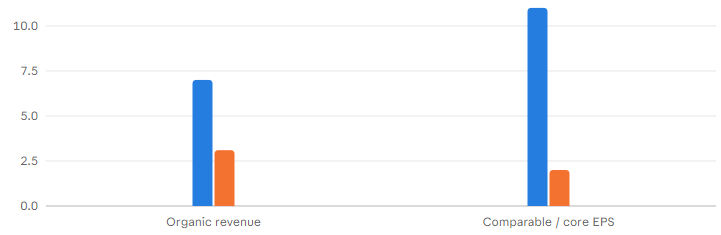
Q3 2026 growth: Coca-Cola vs PepsiCo (%)
% year on year by Source: company Q3 2026 results (KO release, PEP 8-K)
The $1,000 math to 2036
Now the part you asked for. I used the Fool's assumptions as the base case: Coca-Cola EPS growth of 5.5% a year, a 23 times exit multiple and 5% dividend growth, and PepsiCo EPS growth of 5%, a 17 times exit multiple and 4% dividend growth. The Fool's own result, starting from $96.91 and $143.61, was $1,771 for Coca-Cola and $2,341 for PepsiCo with dividends reinvested.I reran it from $95 and $140. I assumed prices drift smoothly to the 2036 level and that dividends are reinvested each year at that year's price. I also built a stress case and a bull case. Here is the result for $1,000.
My calculation. Starting prices $95 and $140, 2026 EPS $3.50 and $8.38, dividends $2.12 and $5.92. Before taxes and fees. A model, not a forecast. The pattern is easy to see. PepsiCo ends ahead in each scenario because it begins at about 17 times earnings against about 27 times, and because it pays about twice the yield. In the base case that means roughly 9.4% a year for PepsiCo against 6.2% for Coca-Cola (my calculation).
Now the caveat that matters. The base case gives PepsiCo 5% EPS growth. Management currently guides to 1% to 2% core constant-currency growth for 202. If growth stays near 2% and the multiple compresses to 15 times, my bear case gives about $1,690, and in the stress case with no growth it is $1,340. Coca-Cola's cushion is thinner: the stress case leaves about $1,055. The reason the cheaper stock wins in the model is that a high starting multiple is a headwind. If Coca-Cola's multiple drifts from 27 times down to 23 times, that shaves about 1.6% a year off its price return (my calculation). The business has to outgrow its own valuation just to keep pace.
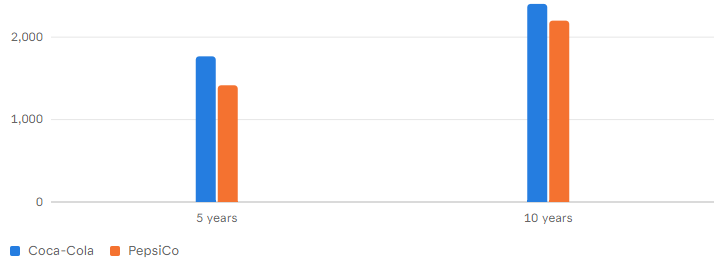
History is a useful reminder that the better business has not always been the worse stock. According to a March 2026 24/7 Wall St. comparison, $1,000 in Coca-Cola ten years earlier was worth $2,403 versus $2,200 for PepsiCo, and over five years $1,767 versus $1,416, using adjusted prices.
Risks that could break the model
Here is what could break each case. For Coca-Cola, the risk is valuation. About 26 to 29 times earnings is a lot for a company guiding to mid-single-digit organic growth. Currency tailwinds can reverse. The company also noted modest inventory reductions in its updated guidance. For PepsiCo, the risks are execution and cash. North America volume is soft, pricing is under pressure and margins are still falling. The guidance cut suggests the turnaround is slower than hoped (my reading). With a high payout relative to free cash flow, a prolonged weak patch could slow dividend growth. For both, the model assumes an exit multiple I picked for 2036. Nobody knows that number, and it moves the answer a lot.Value of $1,000 invested 5 and 10 years ago (to 5 March 2026, $)
Value ($) by Source: 24/7 Wall St., adjusted price data
Which investor each stock may suit
This is where I will not pick a winner for you, because it depends on what you want. If you want more income now, PepsiCo pays roughly twice the starting yield, which matters if you plan to spend the dividends rather than reinvest them. If you want a steadier business and can accept a smaller yield, Coca-Cola has the stronger recent execution and a lower payout ratio. If you are reinvesting for ten years, the starting price matters more than the yield alone. The model rewards PepsiCo's cheapness, but only if it stops losing ground. If you cannot stomach a turnaround that takes years, Coca-Cola's premium may feel like a fair price for fewer surprises. Some investors split the difference and hold both. That is a legitimate approach for diversification, though they are correlated, since both are consumer staples (my observation).Mistake one is treating a Dividend King streak as a guarantee. A streak is a record, not a promise, and PepsiCo's tight cash coverage is the reason to keep watching. Mistake two is buying on yield alone. A 4.2% yield only helps if the share price holds. Mistake three is ignoring taxes: qualified dividends in a taxable account are taxed, so the account you hold them in matters. Mistake four is trusting any ten-year projection, including mine, as a prediction. The Fool's author even argued a third stock might be a better home for the $1,000 than either of these. Read the filings, check live prices and consider talking to a qualified adviser.
Conclusion
Coca-Cola is the stronger business right now: faster growth, wider margins and raised guidance. PepsiCo is the cheaper stock with the bigger yield, but it is wrestling with a North American slump and lower profit guidance. In my base-case model, $1,000 grows to roughly $1,830 in Coca-Cola and $2,460 in PepsiCo by 2036 with dividends reinvested, and PepsiCo leads in every scenario I ran. The caution is that the gap shrinks sharply if PepsiCo's earnings stay flat, and a lower starting multiple does not protect you from a business that stops growing. So which could turn $1,000 into more money? On the arithmetic, the cheaper stock has the head start. On the business, the premium stock has the better momentum. That is general education, not advice, and I am not a financial adviser. Check live prices and the companies' filings before deciding.FAQ
Is Coca-Cola or PepsiCo the better dividend stock?It depends on your goal. PepsiCo pays about 4.2% at $140 versus about 2.2% for Coca-Cola at $95 (my calculation), but Coca-Cola has the stronger earnings growth.
How many years have Coca-Cola and PepsiCo raised their dividends?
Coca-Cola has raised its dividend for 64 consecutive years and PepsiCo for 54.
Is PepsiCo's dividend safe?
There is no sign of a cut, but coverage is tighter. TIKR shows an 84% cash payout ratio versus 77% for Coca-Cola, and 24/7 Wall St. put PepsiCo's free-cash-flow payout near 98%.
What could $1,000 be worth in 2036?
In my base-case model, about $1,830 in Coca-Cola and $2,460 in PepsiCo with dividends reinvested, ranging from about $1,050 to $3,260 across scenarios (my calculation). The Fool's version gave $1,771 and $2,341.
Why is Coca-Cola more expensive than PepsiCo?
The market pays up for faster growth and consistency. Coca-Cola traded near 26 times forward earnings in July against about 17 times for PepsiCo.
0 Comments
Be the first to share your thoughts on this article.