

Investing
Dividend Snowball: The Minimum You Need to Start
Dividends have accounted for 31% of S&P 500 total returns since 1926. Waiting just five years to start a dividend snowball cuts the 30-year outcome by roughly 40%. With fractional shares now available at most major brokers for as little as $1, the minimum amount you need is almost nothing. The question isn’t the starting amount. It’s whether you start reinvesting at all — and whether you understand what happens when you do.

The honest answer, however, is that the minimum amount is less important than two other variables: starting earlier rather than later, and reinvesting 100% of every dividend rather than taking the cash. DividendPro.io’s June 2026 snowball strategy guide establishes the core finding that will run through this entire piece: ‘Waiting 5 years to start cuts the 30-year result by roughly 40%.’ That is the cost of delay. Not the cost of starting with $100 instead of $1,000. The date.
This guide explains exactly how the dividend snowball works, the mechanics of DRIP that automate it, the maths at several starting amounts ($100, $500, $1,000), why yield on cost is the metric that shows whether the strategy is working, and the three specific mistakes that stop the snowball rolling. All examples are illustrative and use publicly available data from dividend investing research published in 2025–2026. This is education, not advice.
Dividends contributed ~31% of S&P 500 total returns from 1926 to Feb 2025 (S&P Dow Jones Indices). Dividend reinvestment accounts for ~40% of total stock market returns historically. Waiting 5 years to start cuts the 30-year snowball outcome by ~40% (DividendPro.io, Jun 2026). Average Dividend Aristocrat yield: 2.46% (DividendVision.com, Aug 2026). Median payout ratio: 48% — leaving room to keep raising (DividendVision.com). A 3% yield growing at 7%/yr becomes 6%+ yield on cost within a decade.
DividendPro.io’s June 2026 comprehensive snowball strategy guide identifies the three forces that drive it. Understanding all three — and how they interact — is the foundation of the strategy:
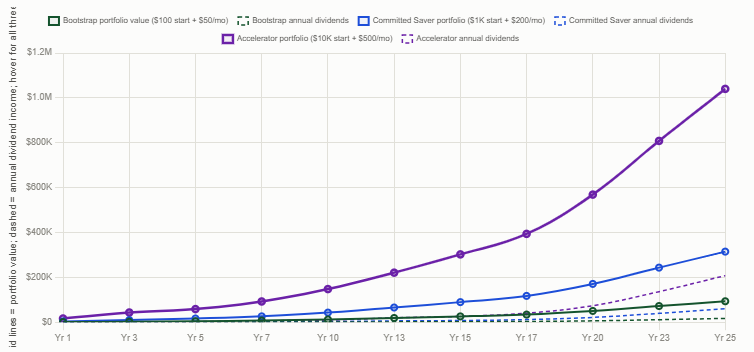
The dividend snowball feels slow to start because Force 1 (contributions) dominates and Forces 2 and 3 are small. It feels fast near the end because Forces 2 and 3 have been compounding for decades and now dwarf Force 1. Most people quit during the slow phase, just before the acceleration. The DividendPro.io June 2026 guide captures this precisely: 'It looks slow for the first few years — then it accelerates so quickly that most investors who quit are the ones who quit just before the curve bends.'
DivTrkr.com’s May 2026 guide to the dividend snowball explains the fractional share dimension that makes modern DRIP so powerful: ‘Without fractional reinvestment, a $40 dividend on a $300 stock would leave you holding $40 in cash, waiting. With fractional reinvestment, that $40 immediately becomes 0.133 of a share that starts earning for you next quarter. Nothing waits.’
The behavioural advantage of DRIP is equally significant. As DivTrkr.com notes: ‘DRIP removes the quarterly decision — and a decision you never have to make is a decision you can’t get wrong. You won’t be tempted to “just hold the cash this once.” The snowball keeps rolling whether or not you’re paying attention.’
DRIP is available at virtually all major US and UK brokerages as a cost-free setting. At Fidelity, Charles Schwab, Vanguard, and most other platforms, DRIP is enabled per holding through a simple account settings menu. Fractional share DRIP means no dividend sits as idle cash. The full value of each dividend is put back to work on the day it arrives.
Go to your brokerage account settings today. Find the DRIP or 'dividend reinvestment' toggle. Enable it for every holding you plan to own for more than three years. This single action, costing no money and taking approximately five minutes, is the most impactful structural change most dividend investors can make to their long-term outcome.
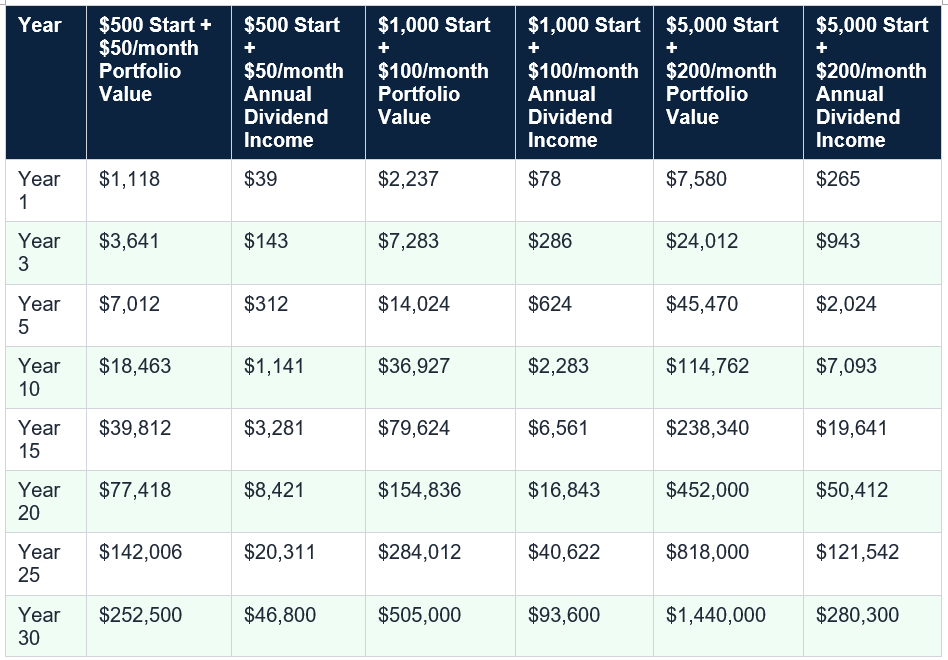
All figures are illustrative projections using approximately 3.5% yield, 7% dividend growth, 5% price growth, DRIP reinvestment. These are not predictions or guarantees. Dividend payments and share prices can fall. Source methodology: DividendPro.io (June 2026); DRIPCalc.com; consistent with Snowball Analytics assumptions.
The trajectory that the table reveals is the visual essence of the dividend snowball. In the first three years, the numbers look modest — a $1,000 start with $100/month adds up to just $7,283 after 36 months. By year 10, the portfolio has grown to $36,927 with $2,283 in annual dividend income. By year 20, $154,836 in portfolio value generating $16,843 per year. And by year 30, $505,000 generating $93,600 per year — approximately $7,800 per month in passive income from $100/month invested over 30 years.
The critical observation from the table: the annual dividend income at year 25 ($40,622 for the $1,000/month scenario) substantially exceeds the total cash invested ($100 × 300 months = $30,000 + $1,000 starting = $31,000). The snowball generates more in annual income than you put in total. This is the mathematical demonstration of why reinvesting 100% of dividends, for as long as possible, is the single most important decision in the strategy.
The practical minimum that produces a visible snowball within a human-scale time horizon depends on what ‘visible’ means to you. Three thresholds are worth considering:
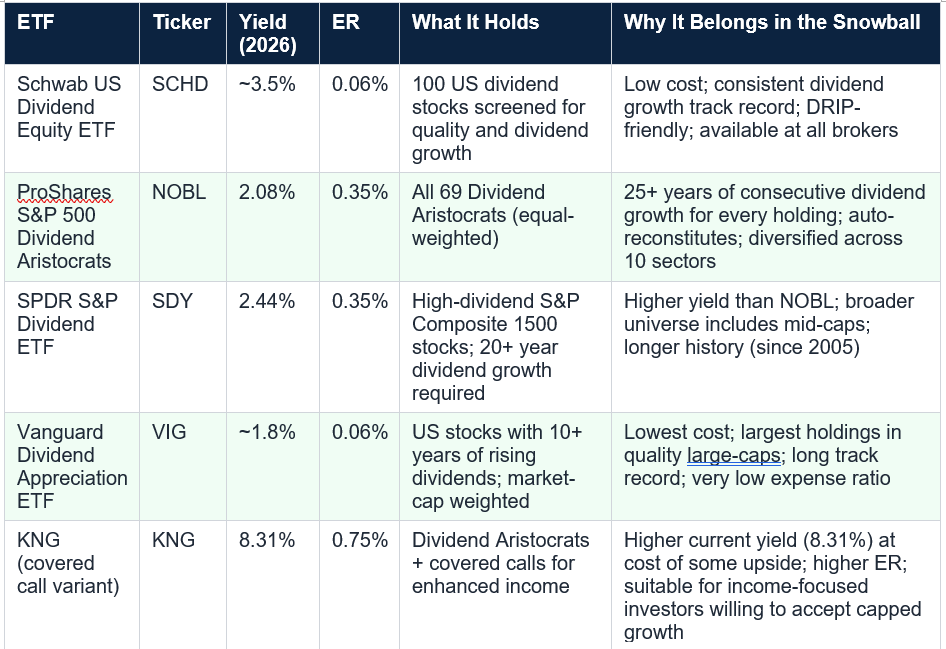
The simplest effective starting portfolio for a dividend snowball: 60–70% SCHD + 30–40% NOBL, with DRIP enabled on both. This combination provides: quality dividend growth across 160+ unique underlying companies; a combined yield of approximately 2.5–3.0%; very low average expense ratio (approximately 0.15–0.20% combined); and automatic dividend reinvestment through fractional shares. It requires one purchase decision per month (split between the two ETFs) and a DRIP toggle. Nothing else.
Open your brokerage account. Enable fractional shares (Fidelity, Schwab, and most major platforms offer them). Enable DRIP. Start with whatever you can comfortably commit monthly — even $50. Set up an automatic monthly transfer from your bank on payday. Add SCHD and/or NOBL. Reinvest 100% of dividends. Review annually. This is, in the opinion of the dividend investing community, sufficient to start a dividend snowball that will be meaningful within a decade.
DividendPro.io’s June 2026 analysis states the finding directly: ‘Doubling contributions doubles outcomes — but waiting 5 years to start cuts the 30-year result by roughly 40%.’ This asymmetry is the defining insight of the strategy. Doubling your monthly contribution from $100 to $200 doubles the outcome linearly. But a five-year delay reduces the 30-year outcome by 40% — a loss that cannot be recovered by doubling contributions later.
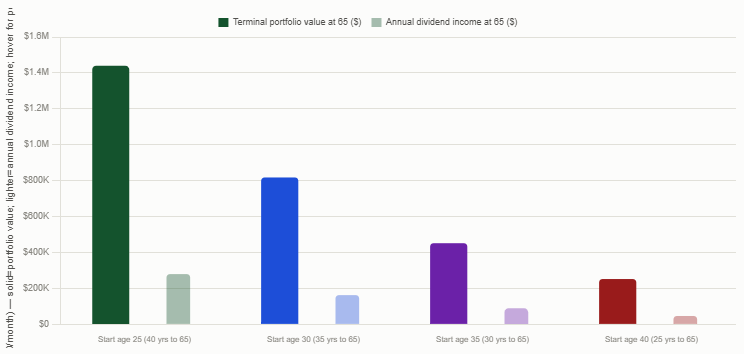
Example: Illustration of starting-date impact (3.5% yield, 7% dividend growth, $200/month, DRIP on, illustrative): Investor A starts at age 25, invests for 40 years to age 65. Investor B starts at age 30, invests for 35 years to age 65. Investor C starts at age 35, invests for 30 years to age 65. At 65: Investor A (40 years): approximately $1,440,000 portfolio, $280,000/yr dividend income. Investor B (35 years): approximately $818,000 portfolio, $163,000/yr dividend income. Investor C (30 years): approximately $452,000 portfolio, $90,000/yr dividend income. The five-year difference between A and B: Investor B has approximately 43% less than Investor A, despite only starting 5 years later and using identical monthly contributions. The 10-year difference between A and C: Investor C has approximately 69% less than Investor A. All figures are illustrative, using consistent compound growth assumptions.
The starting-date penalty: 5-year delay = ~40% less at 30-year mark (DividendPro.io Jun 2026). Investor A (25, 40 years): ~$1.44M. Investor B (30, 35 years): ~$818K. Investor C (35, 30 years): ~$452K. Same $200/month contributions. The date, not the amount, is the most powerful variable. All illustrative; not a guarantee.
Example: From fairvalueprice.com and DivTrkr.com (May 2026): Imagine buying a stock at $100 with a 3% yield ($3 annual dividend). Ten years later, the stock price has risen to $200 and the dividend has doubled to $6. The current yield is still 3% ($6/$200). But the Yield on Cost is now 6% ($6/$100) — double the original income on the same capital invested. A stock with a 3% dividend yield today that grows its dividend at 7% per year will effectively yield over 6% on your original investment within a decade (MerryDiv.com, 2026). At 7% annual dividend growth for 20 years: a 3% starting yield becomes 3% × (1.07)^20 ≈ 11.6% yield on cost — meaning the stock that yielded 3% when you bought it is paying you 11.6% of your original investment price every year. This is the mathematical foundation of the 'grow the dividend, keep the shares' strategy.
Yield on Cost is why dividend growth investors often care less about the starting yield (3% vs 5%) and more about the dividend growth rate. A 2.5% yield growing at 10% per year reaches 6% YoC in 9 years. A 5% yield with no dividend growth stays at 5% YoC forever. For investors with a 15+ year horizon, the dividend growth rate often matters more than the starting yield.
Track your Yield on Cost annually, not your current yield. If your YoC is rising year over year, the snowball is working. If it is flat or falling, dividend growth has stalled or you have been selling shares. The YoC trend is the health metric of the dividend snowball — it shows whether your income on original investment is compounding as intended.
The key 2026 statistics from DividendVision.com (updated August 2026):
The SureDividend.com June 2026 snowball effect analysis of the 10 highest expected total return Aristocrats — including FactSet Research (FDS), First Farmers Financial (FFMR), and Becton Dickinson (BDX) — identifies a common thread: ‘Snowball stocks have durable competitive edges. Evidence of their competitive advantages is seen by their long operating history and consistent dividend increases.’
In a tax-advantaged account — a Roth IRA in the US, or an ISA in the UK — dividend income is sheltered from tax, meaning 100% of every dividend is reinvested rather than a reduced amount after tax. This difference, compounded over 20 to 30 years, produces significantly higher terminal portfolio values and significantly higher annual dividend income.
Example: Illustrative tax impact (3.5% yield, 7% dividend growth, $200/month, 25% dividend tax rate in taxable account vs 0% in Roth IRA, DRIP on, 30-year horizon): Taxable account: approximately $460,000 terminal value; approximately $82,000 annual dividend income. Roth IRA: approximately $505,000 terminal value; approximately $93,600 annual dividend income. The Roth IRA produces approximately $11,500 more per year in passive income from the same contributions and investment decisions — purely from tax sheltering the dividend income during compounding. Note: all figures are illustrative only. Tax rules vary; qualified dividends may be taxed at 0% for some lower-income investors. Consult a tax adviser.
The priority for dividend snowball investors in the US: maximise Roth IRA contributions ($7,500/year under 50 in 2026; $8,600 for those 50+) before adding dividend investments to taxable accounts. In the UK, use the ISA allowance (£20,000/year in 2026/27) to shelter dividend income. Snowball Analytics confirms: ‘Set the tax rate to 0% to model a tax-advantaged account (Roth IRA, ISA, TFSA).’
All figures are illustrative projections using the methodology described. Dividend payments and share prices can fall and are not guaranteed. Tax treatment will affect the outcome in taxable accounts. Source assumptions consistent with DividendPro.io (June 2026), DRIPCalc.com, and Snowball Analytics DRIP modelling tools.
The variables that actually determine the outcome are not the starting amount. They are the starting date and the reinvestment discipline. A five-year delay costs approximately 40% of the 30-year outcome. Reinvesting only 80% of dividends instead of 100% approximately halves the eventual passive income (DividendPro.io). These are the controllable decisions that compound into life-changing differences in wealth.
The dividend snowball is simple enough to start with one ETF, a DRIP toggle, and a monthly bank transfer. It is powerful enough that, compounded consistently over 25 to 30 years, a $200/month commitment becomes a six-figure annual passive income. The question is not how much you need. It is whether you will start today.
The dividend snowball works by combining three compounding forces: new monthly contributions, dividend income from existing shares, and annual dividend growth (higher dividends per share each year). When dividend income is reinvested through DRIP (Dividend Reinvestment Plan) to buy additional shares, those new shares generate their own dividends, which buy more shares, in an accelerating loop. The early years are dominated by new contributions; the later years are dominated by the compounding of dividend income and growth. Over 20–30 years, the combination produces outcomes significantly larger than the sum of contributions alone. All projections in this article are illustrative; dividends are not guaranteed and stock prices can fall.
What is the absolute minimum I need to start a dividend snowball?
In 2026, the practical minimum is $1 to $5, as most major US and UK brokerages offer fractional share investing that allows you to own a partial share of any dividend-paying stock or ETF for very small amounts. A $1 investment earns a proportional fraction of each dividend, which DRIP automatically reinvests into more fractional shares. The mathematical minimum is therefore negligible. The practical minimum for a psychologically and financially meaningful snowball — one that generates visible, motivating progress within 3–5 years — is closer to $50–$100 per month in contributions, with DRIP enabled. The date you start matters far more than the amount you start with.
What is DRIP and how do I set it up?
DRIP stands for Dividend Reinvestment Plan. It is a setting available at virtually all major brokerages (Fidelity, Charles Schwab, Vanguard, TD Ameritrade/Schwab, Interactive Brokers, Robinhood, M1 Finance, and many UK platforms) that automatically uses your dividend payments to purchase additional shares instead of depositing cash. To set it up: log into your brokerage account; find the DRIP or 'dividend reinvestment' option (usually in account settings or under each individual holding); enable it for each stock or ETF you hold. Most platforms offer fractional DRIP, meaning the full dividend amount is reinvested regardless of whether it equals a full share price. There is typically no additional cost for DRIP.
Should I invest in individual dividend stocks or dividend ETFs?
For most investors starting a dividend snowball, ETFs are the simpler, safer, and more efficient starting point. Dividend ETFs like SCHD (0.06% expense ratio, ~3.5% yield), NOBL (0.35% ER, 2.08% yield), VIG (0.06% ER, ~1.8% yield), or SDY (0.35% ER, 2.44% yield) provide instant diversification across dozens to hundreds of dividend-paying companies, automatic reconstitution when companies no longer qualify, and the DRIP mechanism that drives the snowball. Individual stock picking requires analysis of each company's payout ratio, dividend growth history, competitive position, and balance sheet health. This is meaningful additional work and concentration risk. Individual stocks are appropriate for investors who want to tilt toward specific sectors or companies — but for starting the snowball, a single dividend ETF is sufficient and often optimal.
What is yield on cost and why does it matter?
Yield on cost (YoC) is the ratio of annual dividend income to the original price paid for shares, not the current market price. For example: a stock bought at $100 with a 3% yield ($3 annual dividend) that later trades at $200 with a $6 annual dividend has a current yield of 3% but a yield on cost of 6%. A 3% yield growing at 7% per year reaches 6% YoC in 10 years and approximately 11.6% YoC in 20 years — meaning the stock pays 11.6% of its original purchase price in dividends every year. Yield on cost is the metric that shows whether the dividend snowball's growth force (Force 3) is working. Rising YoC over time is the visible proof that the strategy is compounding as intended. If YoC is flat, the dividend is not growing; if it is falling, the dividend may have been cut.
Is dividend snowball investing better inside a Roth IRA or taxable account?
For most US investors, starting the dividend snowball inside a Roth IRA is significantly more effective because dividend income is sheltered from tax. In a taxable account, qualified US dividends are typically taxed at 0–20% in the year received, reducing the amount available for DRIP reinvestment. Over 30 years, this tax drag can reduce the terminal portfolio value by $30,000–$50,000+ (illustrative, depending on dividend tax rate and portfolio size). The Roth IRA contribution limit in 2026 is $7,500 (under 50) or $8,600 (50+). Maximise Roth IRA contributions for dividend investments first. For UK investors, the equivalent is the ISA (Individual Savings Account) at £20,000 per year, where dividend income is also tax-free. Any dividend investing beyond the tax-advantaged limit can continue in a taxable account, where the YoC-focused strategy of holding for many years minimises the realised gains from selling.
Table of Contents
- The Real Answer to the Minimum Question
- What Is the Dividend Snowball? The Three Forces
- What Is DRIP? The Automation That Makes the Snowball Roll
- The Maths: How Small Amounts Compound Into Large Ones
- The Starting Amount: $1, $100, $500, or $1,000?
- The ‘20% of the Effort, 80% of the Result’ Starting Portfolio
- Why the Date You Start Matters More Than the Amount You Start With
- Yield on Cost: The Hidden Metric That Shows Whether the Snowball Is Working
- Dividend Aristocrats in 2026: The Quality Filter
- The Three Snowball-Killing Mistakes
- Tax Location: The Most Powerful Snowball Accelerator
- A Realistic 25-Year Roadmap From Three Different Starting Points
- Conclusion: The Lowest Amount You Need Is What You Have Today
- Frequently Asked Questions
The Snowball: Portfolio Value & Annual Dividend Income Over 25 Years
Starting - Date Penalty: Why When You Start Matters More Than How Much
The Real Answer to the Minimum Question
The question ‘what is the lowest amount you need to let the dividend snowball work?’ has a more interesting answer than most people expect. The mathematical answer, in 2026, is approximately $1. Fractional shares are available at most major US and UK brokerages, meaning you can own a portion of a $300 stock for a single dollar, and that fractional share will pay you a proportional fraction of every dividend, which will then buy you more fractional shares automatically through DRIP. The compounding begins immediately.The honest answer, however, is that the minimum amount is less important than two other variables: starting earlier rather than later, and reinvesting 100% of every dividend rather than taking the cash. DividendPro.io’s June 2026 snowball strategy guide establishes the core finding that will run through this entire piece: ‘Waiting 5 years to start cuts the 30-year result by roughly 40%.’ That is the cost of delay. Not the cost of starting with $100 instead of $1,000. The date.
This guide explains exactly how the dividend snowball works, the mechanics of DRIP that automate it, the maths at several starting amounts ($100, $500, $1,000), why yield on cost is the metric that shows whether the strategy is working, and the three specific mistakes that stop the snowball rolling. All examples are illustrative and use publicly available data from dividend investing research published in 2025–2026. This is education, not advice.
Dividends contributed ~31% of S&P 500 total returns from 1926 to Feb 2025 (S&P Dow Jones Indices). Dividend reinvestment accounts for ~40% of total stock market returns historically. Waiting 5 years to start cuts the 30-year snowball outcome by ~40% (DividendPro.io, Jun 2026). Average Dividend Aristocrat yield: 2.46% (DividendVision.com, Aug 2026). Median payout ratio: 48% — leaving room to keep raising (DividendVision.com). A 3% yield growing at 7%/yr becomes 6%+ yield on cost within a decade.
What Is the Dividend Snowball? The Three Forces
The dividend snowball is the name for the compounding effect that occurs when an investor consistently reinvests dividend income to buy additional shares, which then pay additional dividends, which buy additional shares, in an accelerating loop. It is called a snowball because the growth is initially slow, then accelerates so sharply in later years that it dwarfs the early phases.DividendPro.io’s June 2026 comprehensive snowball strategy guide identifies the three forces that drive it. Understanding all three — and how they interact — is the foundation of the strategy:
- Force 1 — New contributions: money added from income each month or quarter. This is the initial push that gives the snowball its starting size and keeps it growing in the early years when dividend income is small. New contributions dominate the first five to seven years of a dividend snowball.
- Force 2 — Dividend income itself: the cash generated by the shares you own, which is reinvested to buy more shares. In the early years, this is a small number. In later years, after a decade of compounding, it becomes the dominant engine.
- Force 3 — Dividend growth: the annual increase in the dividend per share paid by the companies you own. A stock yielding 3% today that grows its dividend at 7% per year will yield over 6% on the original cost within a decade — without the investor doing anything (MerryDiv.com, 2026). This growth is what turns a modest starting yield into a powerful future income stream.
The dividend snowball feels slow to start because Force 1 (contributions) dominates and Forces 2 and 3 are small. It feels fast near the end because Forces 2 and 3 have been compounding for decades and now dwarf Force 1. Most people quit during the slow phase, just before the acceleration. The DividendPro.io June 2026 guide captures this precisely: 'It looks slow for the first few years — then it accelerates so quickly that most investors who quit are the ones who quit just before the curve bends.'
What Is DRIP? The Automation That Makes the Snowball Roll
DRIP stands for Dividend Reinvestment Plan. It is, in its modern brokerage implementation, simply a setting you toggle: instead of receiving dividend payments as cash deposited into your account, the dividends are automatically used to purchase additional shares of the same stock or ETF that paid them.DivTrkr.com’s May 2026 guide to the dividend snowball explains the fractional share dimension that makes modern DRIP so powerful: ‘Without fractional reinvestment, a $40 dividend on a $300 stock would leave you holding $40 in cash, waiting. With fractional reinvestment, that $40 immediately becomes 0.133 of a share that starts earning for you next quarter. Nothing waits.’
The behavioural advantage of DRIP is equally significant. As DivTrkr.com notes: ‘DRIP removes the quarterly decision — and a decision you never have to make is a decision you can’t get wrong. You won’t be tempted to “just hold the cash this once.” The snowball keeps rolling whether or not you’re paying attention.’
DRIP is available at virtually all major US and UK brokerages as a cost-free setting. At Fidelity, Charles Schwab, Vanguard, and most other platforms, DRIP is enabled per holding through a simple account settings menu. Fractional share DRIP means no dividend sits as idle cash. The full value of each dividend is put back to work on the day it arrives.
Go to your brokerage account settings today. Find the DRIP or 'dividend reinvestment' toggle. Enable it for every holding you plan to own for more than three years. This single action, costing no money and taking approximately five minutes, is the most impactful structural change most dividend investors can make to their long-term outcome.
The Maths: How Small Amounts Compound Into Large Ones
The compounding mathematics of dividend reinvestment produce outcomes that are counterintuitive until you see the year-by-year progression. The following projections use assumptions consistent with the dividend growth literature (DividendPro.io June 2026; DRIPCalc.com; Snowball Analytics): 3.5% starting yield, 7% annual dividend growth, 5% annual share price growth, DRIP on. All figures are illustrative; actual results will differ.All figures are illustrative projections using approximately 3.5% yield, 7% dividend growth, 5% price growth, DRIP reinvestment. These are not predictions or guarantees. Dividend payments and share prices can fall. Source methodology: DividendPro.io (June 2026); DRIPCalc.com; consistent with Snowball Analytics assumptions.
The trajectory that the table reveals is the visual essence of the dividend snowball. In the first three years, the numbers look modest — a $1,000 start with $100/month adds up to just $7,283 after 36 months. By year 10, the portfolio has grown to $36,927 with $2,283 in annual dividend income. By year 20, $154,836 in portfolio value generating $16,843 per year. And by year 30, $505,000 generating $93,600 per year — approximately $7,800 per month in passive income from $100/month invested over 30 years.
The critical observation from the table: the annual dividend income at year 25 ($40,622 for the $1,000/month scenario) substantially exceeds the total cash invested ($100 × 300 months = $30,000 + $1,000 starting = $31,000). The snowball generates more in annual income than you put in total. This is the mathematical demonstration of why reinvesting 100% of dividends, for as long as possible, is the single most important decision in the strategy.
The Starting Amount: $1, $100, $500, or $1,000?
The direct answer to the question in this article’s title: there is no minimum that prevents the dividend snowball from working. The snowball works at $1 because fractional shares allow a $1 investment to own a slice of a dividend-paying stock, which earns a proportional dividend, which is reinvested to buy more fractional shares. The compounding begins on day one.The practical minimum that produces a visible snowball within a human-scale time horizon depends on what ‘visible’ means to you. Three thresholds are worth considering:
- $1–$50 per month: the snowball works, but it is very slow in the early years. At 3.5% yield on $50/month, the first year’s dividend income is approximately $10–15. DRIP will buy fractional shares, but the income is not yet psychologically visible. The mathematical compounding is real; the felt experience of it is not yet motivating. Best for: building the habit when cash is tight; demonstrating the mechanics to yourself before scaling up.
- $100–$500 per month: the sweet spot for most investors starting their dividend journey. Annual dividend income in the first year is $42–$210 at 3.5% yield on monthly contributions. By year five, the portfolio is generating enough quarterly dividends that the DRIP purchases are clearly visible in the account. The psychological feedback loop — seeing dividend income grow each quarter — is one of the most reported reasons dividend investors stay the course. Best for: most working adults who can commit a regular monthly amount.
- $500+ per month or a lump-sum starting investment of $5,000+: the snowball enters its exponential phase noticeably earlier. The year-10 outcome at $200/month starting with $5,000 is approximately $114,762, generating over $7,000 per year in dividends — nearly $600 per month from a portfolio that was started with $5,000 and $200/month. Best for: investors with higher savings capacity, those converting a lump sum from another investment, or those in the second or third decade of an established dividend portfolio.
The ‘20% of the Effort, 80% of the Result’ Starting Portfolio
For an investor asking ‘where do I actually put the money?’, the simplest and most evidence-backed starting point is a two-ETF portfolio that captures the core of the dividend snowball strategy with minimal effort and cost:The simplest effective starting portfolio for a dividend snowball: 60–70% SCHD + 30–40% NOBL, with DRIP enabled on both. This combination provides: quality dividend growth across 160+ unique underlying companies; a combined yield of approximately 2.5–3.0%; very low average expense ratio (approximately 0.15–0.20% combined); and automatic dividend reinvestment through fractional shares. It requires one purchase decision per month (split between the two ETFs) and a DRIP toggle. Nothing else.
Open your brokerage account. Enable fractional shares (Fidelity, Schwab, and most major platforms offer them). Enable DRIP. Start with whatever you can comfortably commit monthly — even $50. Set up an automatic monthly transfer from your bank on payday. Add SCHD and/or NOBL. Reinvest 100% of dividends. Review annually. This is, in the opinion of the dividend investing community, sufficient to start a dividend snowball that will be meaningful within a decade.
Why the Date You Start Matters More Than the Amount You Start With
Of all the variables in the dividend snowball — starting amount, monthly contribution, yield, dividend growth rate — the starting date produces the largest differential outcome. This is the mathematical consequence of compound interest operating over time: earlier starting dates allow more compounding cycles, and the compounding multiplier grows exponentially with time.DividendPro.io’s June 2026 analysis states the finding directly: ‘Doubling contributions doubles outcomes — but waiting 5 years to start cuts the 30-year result by roughly 40%.’ This asymmetry is the defining insight of the strategy. Doubling your monthly contribution from $100 to $200 doubles the outcome linearly. But a five-year delay reduces the 30-year outcome by 40% — a loss that cannot be recovered by doubling contributions later.
Example: Illustration of starting-date impact (3.5% yield, 7% dividend growth, $200/month, DRIP on, illustrative): Investor A starts at age 25, invests for 40 years to age 65. Investor B starts at age 30, invests for 35 years to age 65. Investor C starts at age 35, invests for 30 years to age 65. At 65: Investor A (40 years): approximately $1,440,000 portfolio, $280,000/yr dividend income. Investor B (35 years): approximately $818,000 portfolio, $163,000/yr dividend income. Investor C (30 years): approximately $452,000 portfolio, $90,000/yr dividend income. The five-year difference between A and B: Investor B has approximately 43% less than Investor A, despite only starting 5 years later and using identical monthly contributions. The 10-year difference between A and C: Investor C has approximately 69% less than Investor A. All figures are illustrative, using consistent compound growth assumptions.
The starting-date penalty: 5-year delay = ~40% less at 30-year mark (DividendPro.io Jun 2026). Investor A (25, 40 years): ~$1.44M. Investor B (30, 35 years): ~$818K. Investor C (35, 30 years): ~$452K. Same $200/month contributions. The date, not the amount, is the most powerful variable. All illustrative; not a guarantee.
Yield on Cost: The Hidden Metric That Shows Whether the Snowball Is Working
Yield on cost (YoC) is the metric that makes dividend snowball progress visible over time. It measures dividend income relative to the original price paid for shares — not the current market price. As dividends grow over years, the yield on cost rises even if the current yield of the stock appears unchanged.Example: From fairvalueprice.com and DivTrkr.com (May 2026): Imagine buying a stock at $100 with a 3% yield ($3 annual dividend). Ten years later, the stock price has risen to $200 and the dividend has doubled to $6. The current yield is still 3% ($6/$200). But the Yield on Cost is now 6% ($6/$100) — double the original income on the same capital invested. A stock with a 3% dividend yield today that grows its dividend at 7% per year will effectively yield over 6% on your original investment within a decade (MerryDiv.com, 2026). At 7% annual dividend growth for 20 years: a 3% starting yield becomes 3% × (1.07)^20 ≈ 11.6% yield on cost — meaning the stock that yielded 3% when you bought it is paying you 11.6% of your original investment price every year. This is the mathematical foundation of the 'grow the dividend, keep the shares' strategy.
Yield on Cost is why dividend growth investors often care less about the starting yield (3% vs 5%) and more about the dividend growth rate. A 2.5% yield growing at 10% per year reaches 6% YoC in 9 years. A 5% yield with no dividend growth stays at 5% YoC forever. For investors with a 15+ year horizon, the dividend growth rate often matters more than the starting yield.
Track your Yield on Cost annually, not your current yield. If your YoC is rising year over year, the snowball is working. If it is flat or falling, dividend growth has stalled or you have been selling shares. The YoC trend is the health metric of the dividend snowball — it shows whether your income on original investment is compounding as intended.
Dividend Aristocrats in 2026: The Quality Filter
Dividend Aristocrats — S&P 500 companies with at least 25 consecutive years of dividend increases — are the most commonly cited quality filter for dividend snowball investing. In 2026, there are 69 Aristocrats, spanning 10 sectors (SimplySafeDividends.com, July 2026; SureDividend.com, September 2026).The key 2026 statistics from DividendVision.com (updated August 2026):
- Average yield across the 68–69 Aristocrats: 2.46%.
- Median payout ratio: 48% — meaning the average Aristocrat pays out less than half its earnings as dividends, leaving substantial capacity to continue raising the dividend even in difficult economic conditions.
- 52 of 68 Aristocrats have lower volatility than the broad market — the Aristocrat list disproportionately includes ‘boring’, essential-demand businesses in Consumer Staples, Industrials, and Financials.
- Yield range: 0.50% (growth-focused) to nearly 7.00% (mature, high-distribution businesses).
- The Dividend Aristocrats Index has, since its launch in 2005, delivered competitive total returns with notably lower drawdowns during market downturns including 2008–2009 and 2022 (MerryDiv.com, 2026).
The SureDividend.com June 2026 snowball effect analysis of the 10 highest expected total return Aristocrats — including FactSet Research (FDS), First Farmers Financial (FFMR), and Becton Dickinson (BDX) — identifies a common thread: ‘Snowball stocks have durable competitive edges. Evidence of their competitive advantages is seen by their long operating history and consistent dividend increases.’
The Three Snowball-Killing Mistakes
Most dividend snowball strategies that fail do not fail because of bad stock selection. They fail because of three specific behavioural errors that stop the compounding mechanism. DividendPro.io’s June 2026 guide identifies all three:- Mistake 1 — Taking dividend cash instead of reinvesting: ‘Skimming dividends for cash flow before retirement halves your endgame income.’ This is the most common and most damaging error. Every dividend taken as cash instead of reinvested removes one set of shares from the compounding base. Over 10 to 20 years, the accumulated loss of compounding on withdrawn dividends can exceed the original portfolio value. Unless you need the income to live on, reinvest 100% of every dividend until the day you need to live on it.
- Mistake 2 — Starting, stopping, and restarting: ‘Lump-sum waiting is the most expensive habit in dividend investing.’ Pausing contributions during market downturns, volatility, or personal financial stress breaks the contribution discipline and typically results in missing the quarters when dividend yields are highest (because share prices are depressed). Dollar-cost averaging through consistent monthly contributions — including during downturns — buys more shares at lower prices, which accelerates the snowball through market recoveries.
- Mistake 3 — Chasing high yield over dividend growth: a 7% current yield with a flat or declining dividend is not a snowball investment — it is an income investment. The snowball requires dividend growth. A company paying 7% today but cutting its dividend next year ends the compounding. A company paying 2.5% today but growing its dividend at 8% per year for 15 years is the engine of compounding wealth. Sustainable payout ratios (under 60–70% for most sectors, per fairvalueprice.com) are the most important screen for dividend sustainability.
Tax Location: The Most Powerful Snowball Accelerator
The tax treatment of dividend income has a significant effect on the long-term snowball outcome. Qualified US dividends are typically taxed at 0–20% depending on the investor’s income bracket. In a taxable brokerage account, each dividend payment is taxable in the year it is received, which reduces the amount available for reinvestment.In a tax-advantaged account — a Roth IRA in the US, or an ISA in the UK — dividend income is sheltered from tax, meaning 100% of every dividend is reinvested rather than a reduced amount after tax. This difference, compounded over 20 to 30 years, produces significantly higher terminal portfolio values and significantly higher annual dividend income.
Example: Illustrative tax impact (3.5% yield, 7% dividend growth, $200/month, 25% dividend tax rate in taxable account vs 0% in Roth IRA, DRIP on, 30-year horizon): Taxable account: approximately $460,000 terminal value; approximately $82,000 annual dividend income. Roth IRA: approximately $505,000 terminal value; approximately $93,600 annual dividend income. The Roth IRA produces approximately $11,500 more per year in passive income from the same contributions and investment decisions — purely from tax sheltering the dividend income during compounding. Note: all figures are illustrative only. Tax rules vary; qualified dividends may be taxed at 0% for some lower-income investors. Consult a tax adviser.
The priority for dividend snowball investors in the US: maximise Roth IRA contributions ($7,500/year under 50 in 2026; $8,600 for those 50+) before adding dividend investments to taxable accounts. In the UK, use the ISA allowance (£20,000/year in 2026/27) to shelter dividend income. Snowball Analytics confirms: ‘Set the tax rate to 0% to model a tax-advantaged account (Roth IRA, ISA, TFSA).’
A Realistic 25-Year Roadmap From Three Different Starting Points
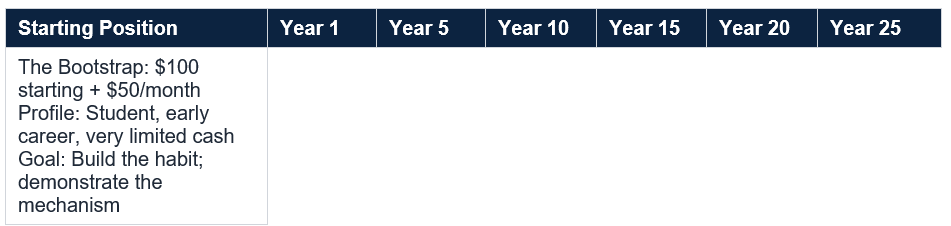
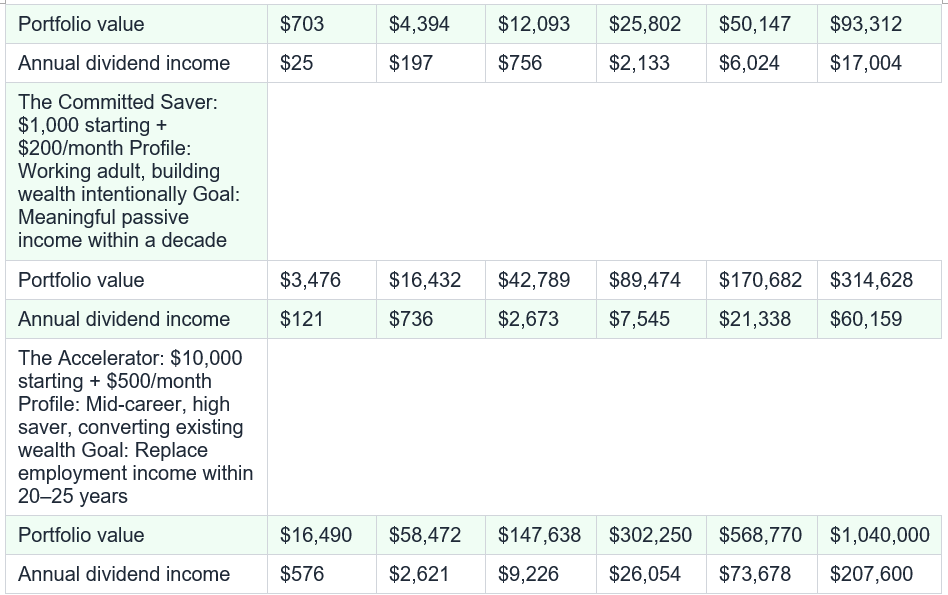
The following roadmap illustrates the dividend snowball journey from three different financial starting positions, using consistent illustrative assumptions: 3.5% starting yield, 7% annual dividend growth, 5% annual share price growth, DRIP on, $0 taxes (modelling a Roth IRA or ISA), and the monthly contribution shown. Not a prediction; not a guarantee.All figures are illustrative projections using the methodology described. Dividend payments and share prices can fall and are not guaranteed. Tax treatment will affect the outcome in taxable accounts. Source assumptions consistent with DividendPro.io (June 2026), DRIPCalc.com, and Snowball Analytics DRIP modelling tools.
Conclusion
The direct answer to the question this article started with: the lowest amount you need for the dividend snowball to work is whatever you can invest today and reinvest consistently. Fractional shares have eliminated the share-price barrier. DRIP automation has eliminated the behavioural barrier. The 2026 dividend landscape — 69 Dividend Aristocrats averaging 2.46% yield, quality ETFs available for as low as 0.06% in annual costs, dividend income contributing 31% of S&P 500 total returns since 1926 — provides the raw material for as long a compounding period as you give it.The variables that actually determine the outcome are not the starting amount. They are the starting date and the reinvestment discipline. A five-year delay costs approximately 40% of the 30-year outcome. Reinvesting only 80% of dividends instead of 100% approximately halves the eventual passive income (DividendPro.io). These are the controllable decisions that compound into life-changing differences in wealth.
The dividend snowball is simple enough to start with one ETF, a DRIP toggle, and a monthly bank transfer. It is powerful enough that, compounded consistently over 25 to 30 years, a $200/month commitment becomes a six-figure annual passive income. The question is not how much you need. It is whether you will start today.
Frequently Asked Questions
How does the dividend snowball actually work?The dividend snowball works by combining three compounding forces: new monthly contributions, dividend income from existing shares, and annual dividend growth (higher dividends per share each year). When dividend income is reinvested through DRIP (Dividend Reinvestment Plan) to buy additional shares, those new shares generate their own dividends, which buy more shares, in an accelerating loop. The early years are dominated by new contributions; the later years are dominated by the compounding of dividend income and growth. Over 20–30 years, the combination produces outcomes significantly larger than the sum of contributions alone. All projections in this article are illustrative; dividends are not guaranteed and stock prices can fall.
What is the absolute minimum I need to start a dividend snowball?
In 2026, the practical minimum is $1 to $5, as most major US and UK brokerages offer fractional share investing that allows you to own a partial share of any dividend-paying stock or ETF for very small amounts. A $1 investment earns a proportional fraction of each dividend, which DRIP automatically reinvests into more fractional shares. The mathematical minimum is therefore negligible. The practical minimum for a psychologically and financially meaningful snowball — one that generates visible, motivating progress within 3–5 years — is closer to $50–$100 per month in contributions, with DRIP enabled. The date you start matters far more than the amount you start with.
What is DRIP and how do I set it up?
DRIP stands for Dividend Reinvestment Plan. It is a setting available at virtually all major brokerages (Fidelity, Charles Schwab, Vanguard, TD Ameritrade/Schwab, Interactive Brokers, Robinhood, M1 Finance, and many UK platforms) that automatically uses your dividend payments to purchase additional shares instead of depositing cash. To set it up: log into your brokerage account; find the DRIP or 'dividend reinvestment' option (usually in account settings or under each individual holding); enable it for each stock or ETF you hold. Most platforms offer fractional DRIP, meaning the full dividend amount is reinvested regardless of whether it equals a full share price. There is typically no additional cost for DRIP.
Should I invest in individual dividend stocks or dividend ETFs?
For most investors starting a dividend snowball, ETFs are the simpler, safer, and more efficient starting point. Dividend ETFs like SCHD (0.06% expense ratio, ~3.5% yield), NOBL (0.35% ER, 2.08% yield), VIG (0.06% ER, ~1.8% yield), or SDY (0.35% ER, 2.44% yield) provide instant diversification across dozens to hundreds of dividend-paying companies, automatic reconstitution when companies no longer qualify, and the DRIP mechanism that drives the snowball. Individual stock picking requires analysis of each company's payout ratio, dividend growth history, competitive position, and balance sheet health. This is meaningful additional work and concentration risk. Individual stocks are appropriate for investors who want to tilt toward specific sectors or companies — but for starting the snowball, a single dividend ETF is sufficient and often optimal.
What is yield on cost and why does it matter?
Yield on cost (YoC) is the ratio of annual dividend income to the original price paid for shares, not the current market price. For example: a stock bought at $100 with a 3% yield ($3 annual dividend) that later trades at $200 with a $6 annual dividend has a current yield of 3% but a yield on cost of 6%. A 3% yield growing at 7% per year reaches 6% YoC in 10 years and approximately 11.6% YoC in 20 years — meaning the stock pays 11.6% of its original purchase price in dividends every year. Yield on cost is the metric that shows whether the dividend snowball's growth force (Force 3) is working. Rising YoC over time is the visible proof that the strategy is compounding as intended. If YoC is flat, the dividend is not growing; if it is falling, the dividend may have been cut.
Is dividend snowball investing better inside a Roth IRA or taxable account?
For most US investors, starting the dividend snowball inside a Roth IRA is significantly more effective because dividend income is sheltered from tax. In a taxable account, qualified US dividends are typically taxed at 0–20% in the year received, reducing the amount available for DRIP reinvestment. Over 30 years, this tax drag can reduce the terminal portfolio value by $30,000–$50,000+ (illustrative, depending on dividend tax rate and portfolio size). The Roth IRA contribution limit in 2026 is $7,500 (under 50) or $8,600 (50+). Maximise Roth IRA contributions for dividend investments first. For UK investors, the equivalent is the ISA (Individual Savings Account) at £20,000 per year, where dividend income is also tax-free. Any dividend investing beyond the tax-advantaged limit can continue in a taxable account, where the YoC-focused strategy of holding for many years minimises the realised gains from selling.

0 Comments Comments