
Investing
General Motors Finally Embraces Hybrids: Fixing Its Weakness

GM was slow to the hybrid boom, but it now says hybrids are coming in 2027. Here is what is confirmed, what is not, and what it could mean for the stock. Hybrids 16.3% of US sales in Q2 2026 vs EVs 5.8%, GM sells one US hybrid, the Corvette, Q3 EBIT-adjusted $4.1B, +21.6%, 2026 EPS guide $12.75 to $13.75, EV charges $3.59B year to date, $20B buyback authorized.
For years, General Motors told investors a very electric story. Then electric vehicles sold more slowly than expected in the US, GM took billions in charges, and drivers quietly walked into showrooms asking for hybrids. GM did not have one to sell. Today it still sells exactly one hybrid in the United States, the Chevrolet Corvette.
That is changing. On its third-quarter call, CEO Mary Barra said GM expects to introduce hybrids during calendar year 2027, in multiple segments. She also said GM would not need additional capital spending or engineering resources to do it.
Is that enough to fix the weakness? Not by itself. GM has not named a single model or even confirmed the hybrid type. But the plan arrives while the business is earning more, the EV drag is shrinking and the stock trades at a low multiple. In this post I walk through the facts, the competition and a simple valuation scenario, and flag what I could not verify.
Key takeaway: The hybrid pivot is real but early. It closes a product gap in 2027 and beyond, while the investment case today rests more on trucks, cash flow and buybacks.
The irony is that GM once led here. The Chevy Volt, its last North American plug-in hybrid, was retired after the 2019 model year. GM still sells plug-in hybrids in China, including the Chevrolet Equinox Plus, which debuted its next-generation plug-in powertrain. The reversal started earlier than most people remember. In 2024 Barra said GM would bring plug-in hybrids back to North America, with 2027 as the target [6]. Now the company is saying hybrids more broadly. The Fool's author, meanwhile, notes that GM took billions in charges and write-downs when EV demand slowed. Q3 added $238 million of EV realignment charges, bringing the year-to-date total to $3.59 billion.
Fuel prices explain much of the push. Gasoline has been above $4 a gallon for much of 2026 because of the Iran war, and it averaged $3.87 in mid-November . Interestingly, the same reporting says the gas price spike has not translated into more EV sales. One figure conflicts. A CarScoops report cited a rise from 16% in February to 19% in August, while Cox and the energy agency show about 16% through the second quarter. Different measures and dates likely explain it, but the direction is the same.
The capital point matters. Barra said GM wouldn't need additional capital expenditure or engineering resources to introduce hybrids. That suggests GM is leaning on technology it already has, since it has sold hybrids in China, and on spending it had already planned (my reading). GM is also already investing in the plants. It is spending $750 million at its Lansing Delta Township plant, as part of more than $2 billion of Lansing-region investment over several years.
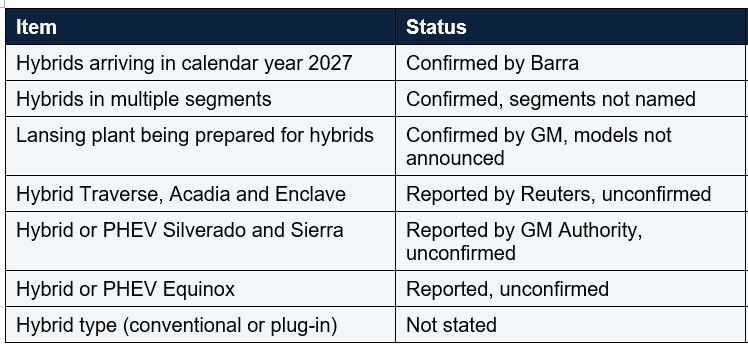
GM had named no models at the time of writing. GreenCars expects the three-row SUVs to get electrified power around 2028, alongside a mid-cycle update, though that is the author's expectation, not GM's statement. And GM plans to add Equinox production at Fairfax Assembly in Kansas starting mid-2027, but has not said it will build a hybrid there. One practical point: Barra said the gas-powered Equinox is already at maximum production in Mexico. More Equinox capacity gives GM room to add powertrain variants, but that is speculation until GM says otherwise.
Ford is a closer comparison for GM's truck-heavy business. It has a broad hybrid lineup with strong sales from the F-150 and Maverick hybrids, replaced the electric F-150 Lightning with a hybrid model, and plans hybrid versions across its gasoline range by 2030. The takeaway: GM will not win by being first. It needs to be good enough, in the segments where it already sells, which are SUVs and pickups. The GM Authority article notes that much current hybrid activity is in compact cars, midsize cars and minivans, which GM does not serve. That may be a quiet advantage or a gap.
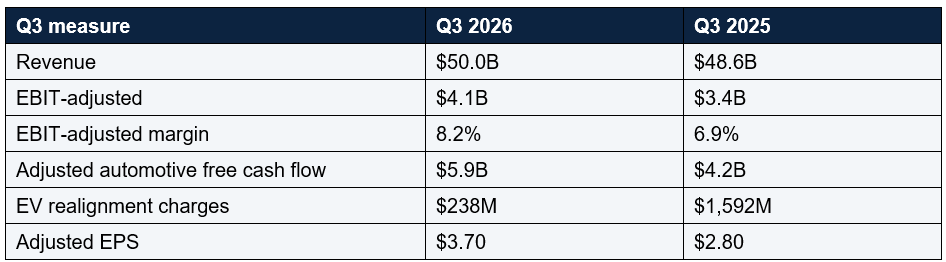
GM Q3 2026 release [8], The EV Report, Electrive. Adjusted automotive free cash flow of $5.9 billion was a four-year high, driven by higher EBIT and tariff timing. That caveat matters: tariff timing flatters the quarter, so the cash flow is not entirely a clean run rate. Guidance was narrowed. GM now expects 2026 EBIT-adjusted of $14.5 billion to $15.5 billion and adjusted EPS of $12.75 to $13.75, and raised its adjusted automotive free cash flow guide to $11.5 billion to $12.5 billion. Shares still fell on the news, because the EPS midpoint was below the $13.41 analysts expected. TIKR noted GM also flagged about $2 billion of commodity and logistics headwinds. So the hybrid plan is not coming from a position of weakness, but it is not coming without pressure either.
The buyback is the other half. The board approved a new $20 billion authorization, GM bought back $2.5 billion in Q3 retiring 29 million shares, and another $1 billion in October. TIKR said GM's share count fell to 849 million by 30 September. It also noted Barra called the stock undervalued, and that GM moved its listing to Nasdaq on 17 November, which makes it eligible for the Nasdaq-100. Note that a low multiple is not automatically cheap. Auto stocks trade low because earnings swing with the cycle, tariffs and incentives. The hybrid plan helps reduce one specific risk: losing buyers to rivals when gas prices rise (my reasoning).
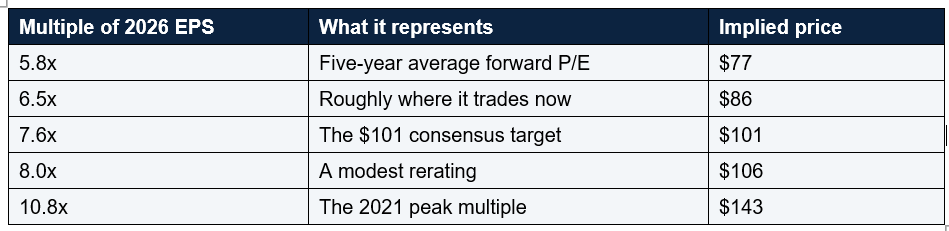
My calculation. Uses the $13.25 midpoint of the 2026 adjusted EPS guide. 2027 earnings may differ. Not a forecast. The table shows how much weight the multiple carries. If hybrids make GM's earnings steadier, investors might pay more per dollar of profit, even if earnings stay flat. If hybrids prove costly or sluggish, the multiple could shrink back to the five-year average, around $77 on the same earnings (my calculation). I would not read the $143 line as likely. It simply shows the ceiling of the past five years. The more realistic debate is between roughly $77 and $106, and the hybrid rollout is one of several things that nudges it.
Cannibalization is third. Hybrids could take sales from higher-margin gasoline trucks and from GM's own EVs. How much that happens depends on pricing and mix, which GM has not disclosed (my reasoning). Finally, there is the broader cost backdrop: tariffs, commodity costs and the roughly $2 billion of headwinds noted above. And analyst John Murphy argued that avoiding hybrids was "not as clear a major mistake as I think some people believe". In other words, even the harm of the gap is debated.
Yes, GM says it will introduce hybrids in multiple segments during calendar year 2027, but it has not named the models or the hybrid type.
How many hybrids does GM sell in the US today?
One. GM currently sells the Corvette as its only US hybrid.
Which GM vehicles might get hybrids?
Reports point to the Traverse, Acadia and Enclave, the Silverado and Sierra, and the Equinox, but none is confirmed.
How big is the US hybrid market?
Hybrids were a record 16.3% of US new-vehicle sales in Q2 2026, versus 5.8% for EVs.
How did GM do in the third quarter?
Revenue was $50.0 billion, EBIT-adjusted was $4.1 billion, up 21.6%, and adjusted EPS was $3.70.
Table of Contents
- How GM ended up with one hybrid
- The hybrid boom GM missed
- What GM has actually said
- What is confirmed and what is rumor
- The competition GM must catch
- Can GM afford the pivot? The Q3 numbers
- Valuation and the buyback
- What the market could pay: a simple scenario
- Risks that could spoil the plan
- What to watch next
- Conclusion
- FAQ
For years, General Motors told investors a very electric story. Then electric vehicles sold more slowly than expected in the US, GM took billions in charges, and drivers quietly walked into showrooms asking for hybrids. GM did not have one to sell. Today it still sells exactly one hybrid in the United States, the Chevrolet Corvette.
That is changing. On its third-quarter call, CEO Mary Barra said GM expects to introduce hybrids during calendar year 2027, in multiple segments. She also said GM would not need additional capital spending or engineering resources to do it.
Is that enough to fix the weakness? Not by itself. GM has not named a single model or even confirmed the hybrid type. But the plan arrives while the business is earning more, the EV drag is shrinking and the stock trades at a low multiple. In this post I walk through the facts, the competition and a simple valuation scenario, and flag what I could not verify.
Key takeaway: The hybrid pivot is real but early. It closes a product gap in 2027 and beyond, while the investment case today rests more on trucks, cash flow and buybacks.
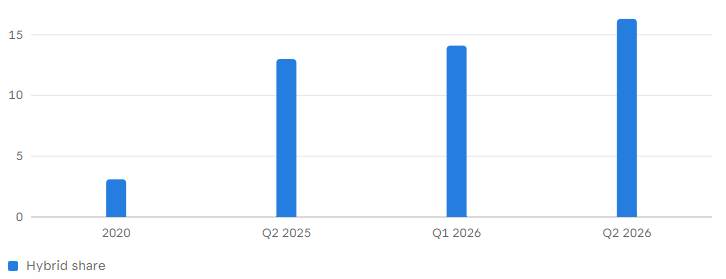
US hybrid share of new light-vehicle sales (%)
% of sales by Sources: Transportation Energy Institute, Cox Automotive via GCN, Philadelphia Inquirer
How GM ended up with one hybrid
GM did not ignore hybrids by accident. It bet on electrification and treated hybrids as an unnecessary half-measure. The Autopian summed it up as GM deciding to go all-in on the Chevy Bolt and electric vehicles, leaving it the least hybrid-oriented of the Big Three while Ford and Stellantis offered numerous hybrids and plug-in models.The irony is that GM once led here. The Chevy Volt, its last North American plug-in hybrid, was retired after the 2019 model year. GM still sells plug-in hybrids in China, including the Chevrolet Equinox Plus, which debuted its next-generation plug-in powertrain. The reversal started earlier than most people remember. In 2024 Barra said GM would bring plug-in hybrids back to North America, with 2027 as the target [6]. Now the company is saying hybrids more broadly. The Fool's author, meanwhile, notes that GM took billions in charges and write-downs when EV demand slowed. Q3 added $238 million of EV realignment charges, bringing the year-to-date total to $3.59 billion.
The hybrid boom GM missed
Here is what GM missed. Hybrids reached a record 16.3% of US new-vehicle sales in the second quarter of 2026, up from 13.0% a year earlier, according to Cox Automotive data. Over the same period, EVs fell to about 5.8% of sales, well below the 10.6% record of the third quarter of 2025, when buyers rushed ahead of expiring incentives. The trend is long running. The Transportation Energy Institute found hybrids made up 15% of light-duty sales through May 2026, versus 3.1% in 2020. The Inquirer reported hybrids reached 14.1% in the first quarter, nearly three times the EV share.Fuel prices explain much of the push. Gasoline has been above $4 a gallon for much of 2026 because of the Iran war, and it averaged $3.87 in mid-November . Interestingly, the same reporting says the gas price spike has not translated into more EV sales. One figure conflicts. A CarScoops report cited a rise from 16% in February to 19% in August, while Cox and the energy agency show about 16% through the second quarter. Different measures and dates likely explain it, but the direction is the same.
What GM has actually said
Let's separate what GM actually said from the chatter. On the third-quarter call, Barra said, in her words, "we will have hybrids in our portfolio in multiple segments, the key segments that we participate". Timing: calendar year 2027. CarPro quotes her as adding "We'll talk more about them as we get closer to the launch". GM's propulsion chief, Mike Anderson, said earlier in October that GM is not "tone deaf" to what customers want.The capital point matters. Barra said GM wouldn't need additional capital expenditure or engineering resources to introduce hybrids. That suggests GM is leaning on technology it already has, since it has sold hybrids in China, and on spending it had already planned (my reading). GM is also already investing in the plants. It is spending $750 million at its Lansing Delta Township plant, as part of more than $2 billion of Lansing-region investment over several years.
What is confirmed and what is rumor
Here is what is confirmed and what is not, because it is easy to blur the two.GM had named no models at the time of writing. GreenCars expects the three-row SUVs to get electrified power around 2028, alongside a mid-cycle update, though that is the author's expectation, not GM's statement. And GM plans to add Equinox production at Fairfax Assembly in Kansas starting mid-2027, but has not said it will build a hybrid there. One practical point: Barra said the gas-powered Equinox is already at maximum production in Mexico. More Equinox capacity gives GM room to add powertrain variants, but that is speculation until GM says otherwise.
The competition GM must catch
The market GM is entering is crowded and lopsided. Toyota accounted for 49% of US hybrid sales in the first quarter, according to Cox, and about 44% in the second quarter. Toyota, Honda and Hyundai together hold 86% of the US hybrid market, per Baum & Associates cited by the FT. Toyota has also made hybrids the default. The RAV4 is now hybrid-only, the Camry is hybrid-only, and Nissan is bringing its e-POWER hybrid system to the 2027 Rogue. Compact SUVs, led by the RAV4 and Honda CR-V, account for about 30% of US hybrid salesFord is a closer comparison for GM's truck-heavy business. It has a broad hybrid lineup with strong sales from the F-150 and Maverick hybrids, replaced the electric F-150 Lightning with a hybrid model, and plans hybrid versions across its gasoline range by 2030. The takeaway: GM will not win by being first. It needs to be good enough, in the segments where it already sells, which are SUVs and pickups. The GM Authority article notes that much current hybrid activity is in compact cars, midsize cars and minivans, which GM does not serve. That may be a quiet advantage or a gap.
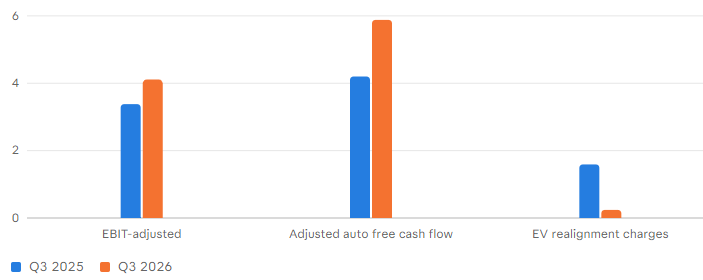
GM Q3 2025 vs Q3 2026 ($ billions)
$ billions by Source: GM Q3 2026 results, The EV Report, Electrive
Can GM afford the pivot? The Q3 numbers
Can GM afford to do this? Based on the latest quarter, yes. In the third quarter of 2026, revenue rose 2.9% to $50.0 billion, EBIT-adjusted rose 21.6% to $4.1 billion for an 8.2% margin, and adjusted EPS rose 32.2% to $3.70.GM Q3 2026 release [8], The EV Report, Electrive. Adjusted automotive free cash flow of $5.9 billion was a four-year high, driven by higher EBIT and tariff timing. That caveat matters: tariff timing flatters the quarter, so the cash flow is not entirely a clean run rate. Guidance was narrowed. GM now expects 2026 EBIT-adjusted of $14.5 billion to $15.5 billion and adjusted EPS of $12.75 to $13.75, and raised its adjusted automotive free cash flow guide to $11.5 billion to $12.5 billion. Shares still fell on the news, because the EPS midpoint was below the $13.41 analysts expected. TIKR noted GM also flagged about $2 billion of commodity and logistics headwinds. So the hybrid plan is not coming from a position of weakness, but it is not coming without pressure either.
Valuation and the buyback
The stock reflects both the strength and the doubt. GM hit a 52-week high of $92.43 on 4 November, then closed at $86.00 on 13 November. That is about 7% below the high (my calculation). On valuation, TIKR put GM at 6.4 times forward earnings on 2 November, slightly above its five-year average of 5.8 times and well below the 10.8 times peak in 2021. The consensus price target it cites is $101. Another source showed a 5.6 times forward multiple at an $87.40 price on 30 October.The buyback is the other half. The board approved a new $20 billion authorization, GM bought back $2.5 billion in Q3 retiring 29 million shares, and another $1 billion in October. TIKR said GM's share count fell to 849 million by 30 September. It also noted Barra called the stock undervalued, and that GM moved its listing to Nasdaq on 17 November, which makes it eligible for the Nasdaq-100. Note that a low multiple is not automatically cheap. Auto stocks trade low because earnings swing with the cycle, tariffs and incentives. The hybrid plan helps reduce one specific risk: losing buyers to rivals when gas prices rise (my reasoning).
What the market could pay: a simple scenario
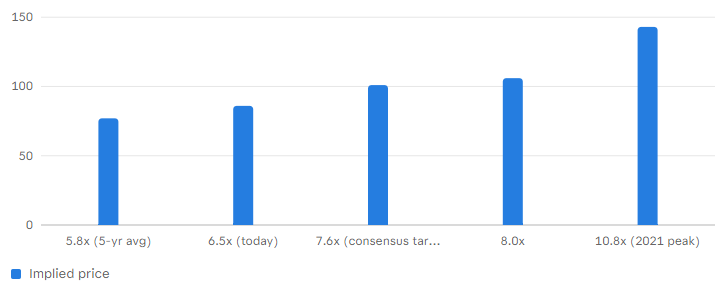
Let's make the valuation tangible. I took the midpoint of GM's 2026 adjusted EPS guidance, $13.25, and applied different multiples to see what the market would be paying.My calculation. Uses the $13.25 midpoint of the 2026 adjusted EPS guide. 2027 earnings may differ. Not a forecast. The table shows how much weight the multiple carries. If hybrids make GM's earnings steadier, investors might pay more per dollar of profit, even if earnings stay flat. If hybrids prove costly or sluggish, the multiple could shrink back to the five-year average, around $77 on the same earnings (my calculation). I would not read the $143 line as likely. It simply shows the ceiling of the past five years. The more realistic debate is between roughly $77 and $106, and the hybrid rollout is one of several things that nudges it.
GM implied price at different multiples of 2026 EPS ($)
$ per share by My calculation on the $13.25 EPS guidance midpoint. Not a forecast
Risks that could spoil the plan
Here is what could go wrong. Execution is first. GM has been out of the hybrid business, so product quality, pricing and supply matter, and rivals have a long head start. A hybrid that is late or underwhelming would be a missed opportunity, not a fix. Timing is second. If hybrids only arrive in volume around 2028, as one outlet expects for the three-row SUVs, GM could miss part of the current demand surge. Gas prices have also eased to $3.87, so the urgency may fade.Cannibalization is third. Hybrids could take sales from higher-margin gasoline trucks and from GM's own EVs. How much that happens depends on pricing and mix, which GM has not disclosed (my reasoning). Finally, there is the broader cost backdrop: tariffs, commodity costs and the roughly $2 billion of headwinds noted above. And analyst John Murphy argued that avoiding hybrids was "not as clear a major mistake as I think some people believe". In other words, even the harm of the gap is debated.
What to watch next
I would watch four things. One, whether GM names the first hybrid models and the hybrid type. Two, the pace of Lansing and Fairfax production changes. Three, the fourth-quarter and 2027 guidance in January, which TIKR flags as the next big test. Four, gasoline prices and the pace of hybrid share gains, currently around 16% of the US market [16]. Also watch the buyback. A $20 billion program at a multiple near 6 times earnings retires a meaningful share of the company over time, which can support earnings per share regardless of the hybrid story (my reasoning).Conclusion
GM is finally acknowledging what customers have been saying for two years: they want fuel-efficient options that do not require a charger. The company has committed to hybrids in 2027, in multiple segments, and says it can do it without extra capital spending . That fixes a real weakness, but only in the future. Today GM still sells one hybrid, rivals hold 86% of the market, and GM has named no models. The investment case right now leans on strong trucks, rising free cash flow, shrinking EV charges and a large buyback. The takeaway is balanced. The pivot lowers a risk and could support a higher multiple, but it does not guarantee one. This is general education, not advice, and I am not a financial adviser. Check live prices and GM's filings before making any decision.FAQ
Is General Motors making hybrids?Yes, GM says it will introduce hybrids in multiple segments during calendar year 2027, but it has not named the models or the hybrid type.
How many hybrids does GM sell in the US today?
One. GM currently sells the Corvette as its only US hybrid.
Which GM vehicles might get hybrids?
Reports point to the Traverse, Acadia and Enclave, the Silverado and Sierra, and the Equinox, but none is confirmed.
How big is the US hybrid market?
Hybrids were a record 16.3% of US new-vehicle sales in Q2 2026, versus 5.8% for EVs.
How did GM do in the third quarter?
Revenue was $50.0 billion, EBIT-adjusted was $4.1 billion, up 21.6%, and adjusted EPS was $3.70.
0 Comments
Be the first to share your thoughts on this article.